
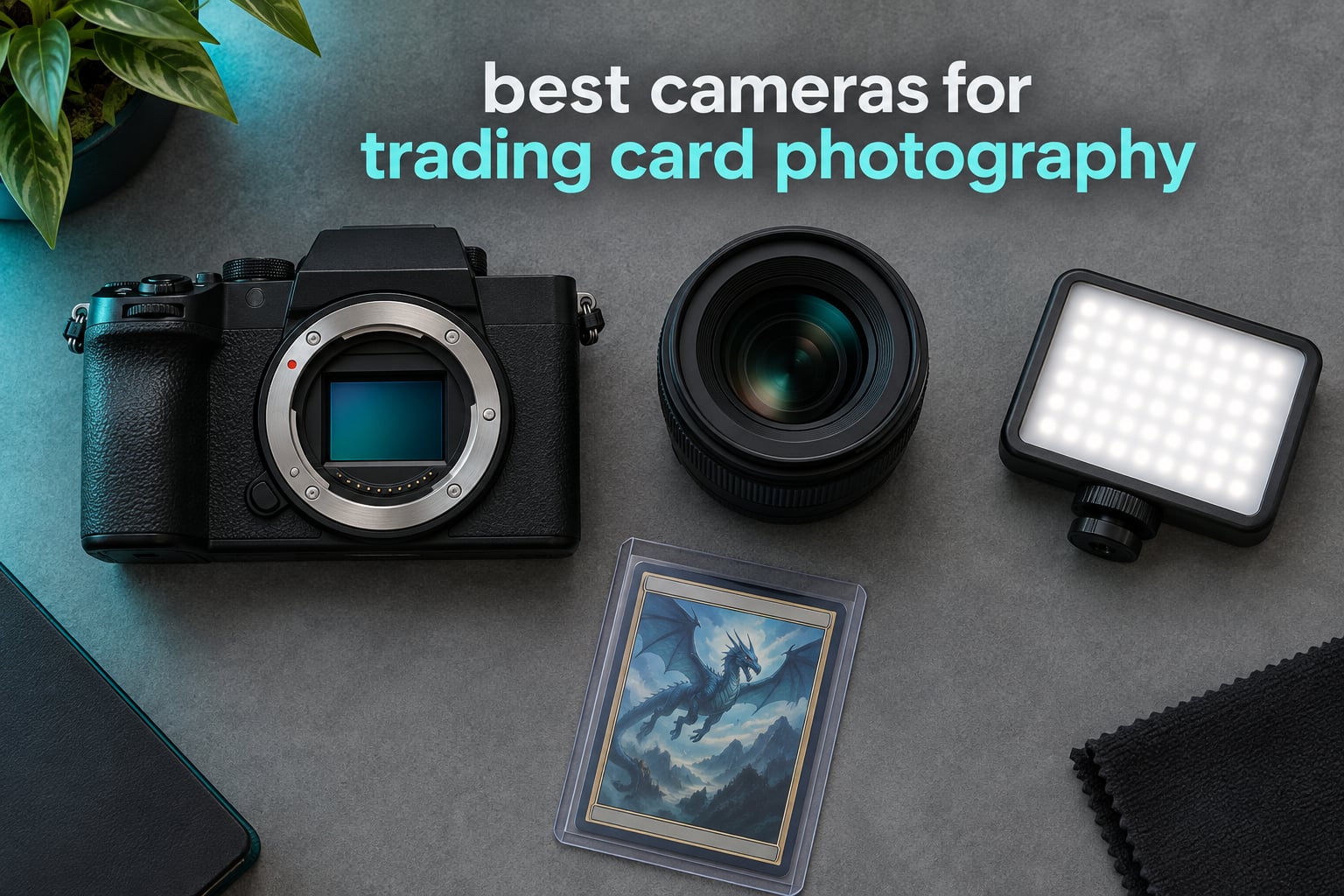
Two diffused panels and a rigid copy stand will do more for your trading card photos than any camera body on the market. That is the honest starting point, and it is the reason most sellers reach for a phone, get mediocre results, and quietly blame the glass.
A trading card is a 63 x 88 mm flat, glossy, near-field subject. It sits a few inches from the lens, it reflects every light source you own, and it has a mirror finish that turns a careless highlight into an accusation of damage. Photographing one well is a small-format product job with a very tight tolerance for error.
That said, the camera is not irrelevant. It decides how cleanly you can render four sharp corners, how faithfully it holds white balance between a 7am batch and a 9pm batch, and how fast you can push through a 200-card lot without your shoulder giving out. This roundup covers the best cameras for trading card photography we could justify, from a renewed DSLR bundle to a full-frame body, and it tells you plainly which parts of the job each one handles well.
We spent six weeks shooting graded slabs, raw vintage cards and mixed lots on a copy stand, a light panel rig and a plain tabletop, then compared corner sharpness, color stability and how long each body took to get through a full lot. We also leaned on what resellers report in the forums, because the gear question is asked there constantly and almost never answered with a model name.
Top 3 Picks for Best Cameras for Trading Card Photography in October
Canon EOS R50
- 24.2MP APS-C sensor
- 3.0 inch vari-angle touchscreen
- 651 AF zones with Dual Pixel AF II

Sony Alpha a6400
- 24.2MP APS-C sensor
- 180-degree tilt screen
- Real-time Eye AF over 425 points

Canon EOS RP
- 26.2MP full-frame sensor
- Articulating touchscreen
- 24-105mm f/4-7.1 IS STM kit lens
The R50 wins on the combination of sensor quality, screen articulation and the sheer volume of owner feedback behind it. The a6400 is the pick if you want that tilting screen and a mature lens ecosystem at a lower outlay. The RP is the one to buy if you are grading submissions and want the resolution headroom of a 35mm sensor.
The 10 Best Cameras for Trading Card Photography at a Glance in 2026
| Product | Specifications | Action |
|---|---|---|
| Canon EOS R50 Mirrorless Camera with RF-S 18-45mm Lens Kit |
|
Check Latest Price |
| Sony Alpha a6400 Mirrorless Camera with 16-50mm Lens |
|
Check Latest Price |
| Canon EOS RP Mirrorless Camera with RF 24-105mm Lens Kit |
|
Check Latest Price |
 Canon EOS R10 Mirrorless Camera Lens Kit Canon EOS R10 Mirrorless Camera Lens Kit |
|
Check Latest Price |
 Sony Alpha a6700 APS-C Mirrorless Camera Body 26MP Sony Alpha a6700 APS-C Mirrorless Camera Body 26MP |
|
Check Latest Price |
 Canon EOS 2000D / Rebel T7 DSLR 3 Lens Kit Renewed Canon EOS 2000D / Rebel T7 DSLR 3 Lens Kit Renewed |
|
Check Latest Price |
 Sony Alpha a6100 Mirrorless Camera Sony Alpha a6100 Mirrorless Camera |
|
Check Latest Price |
 Nikon D7500 DSLR with 18-55mm and 70-300mm Lenses Nikon D7500 DSLR with 18-55mm and 70-300mm Lenses |
|
Check Latest Price |
 Nikon Z50 Mirrorless Camera with NIKKOR Z DX 16-50mm Lens Nikon Z50 Mirrorless Camera with NIKKOR Z DX 16-50mm Lens |
|
Check Latest Price |
 Fujifilm X-T30 III Mirrorless Camera with XC13-33mm Lens Kit Fujifilm X-T30 III Mirrorless Camera with XC13-33mm Lens Kit |
|
Check Latest Price |
1. Canon EOS R50 – the Best All-Round Body for Card Work
Pros
- Vari-angle screen makes overhead framing straightforward
- 24.2MP APS-C sensor resolves card detail at f/8
- Lightweight 16 ounce body is easy on the neck during long lots
- 651 AF zones with subject detection
- Wi-Fi transfer for quick phone backup
Cons
- Small grip feels cramped on larger hands
- Bundled 18-45mm kit lens is soft at card distances
- Battery capacity is modest for a full batch day
The R50 is the camera we end up recommending to sellers who want one body that handles both the flat listing shot and the in-hand hero shot. The 3.0 inch vari-angle touchscreen is the reason: swing it up to 90 degrees and the camera becomes its own copy stand, which removes the single biggest ergonomic complaint we hear from people shooting lots on a bare table.

On the sensor side you get a 24.2MP APS-C CMOS with a DIGIC X processor. At f/8 with a macro lens close to the card, that resolution gives you room to crop a corner detail out of the frame later without the softness that shows up on lower-resolution bodies. The 651 AF zones and Dual Pixel AF II subject detection are far more than a rigid card on a copy stand needs, but they make the 45-degree hand-held frames much easier to land.
Owners consistently describe it as a compact workhorse whose image quality rivals bodies costing far more. The repeated complaints are about the grip being very small, low-light results being unremarkable, and the bundled 18-45mm kit lens being soft. That last point matters directly here, because a soft kit lens is exactly the wrong tool for filling a frame edge to edge.

What the R50 does well for a card seller
Battery aside, the practical win is the combination of the flip-out screen and a body light enough to carry to a table away from your desk. If you shoot listings in a spare room, a garage, or a shared storage unit, that portability is worth more than a sensor advantage you cannot see at listing size.
Bluetooth and Wi-Fi transfer through Canon Camera Connect also let you push files to a phone as you go, which matters when a 200-card lot ends and you want the catalog uploaded before you close the box.
Where the R50 falls short
The grip is genuinely small, and on a long batch session with a heavier macro lens attached, that gets uncomfortable fast. The 16 ounce body is light, but the lens changes the balance point, and a copy stand solves the balance problem completely.
The bundled 18-45mm is the real limitation. Plan on a dedicated macro or extension solution rather than the kit zoom, and the small battery means you should budget for a spare pack before a long session.
2. Sony Alpha a6400 – the Best Value Body with a Tilting Screen
Pros
- 180-degree flip screen handles overhead and low flat-lay framing
- Real-time Eye AF is quick and dependable
- Weather-sealed mostly metal body
- Large third-party E-mount lens market
- 10.3 ounce weight suits long sessions
Cons
- No in-body image stabilization
- Limited native Sony APS-C lens selection
- Menu system and companion app are unintuitive
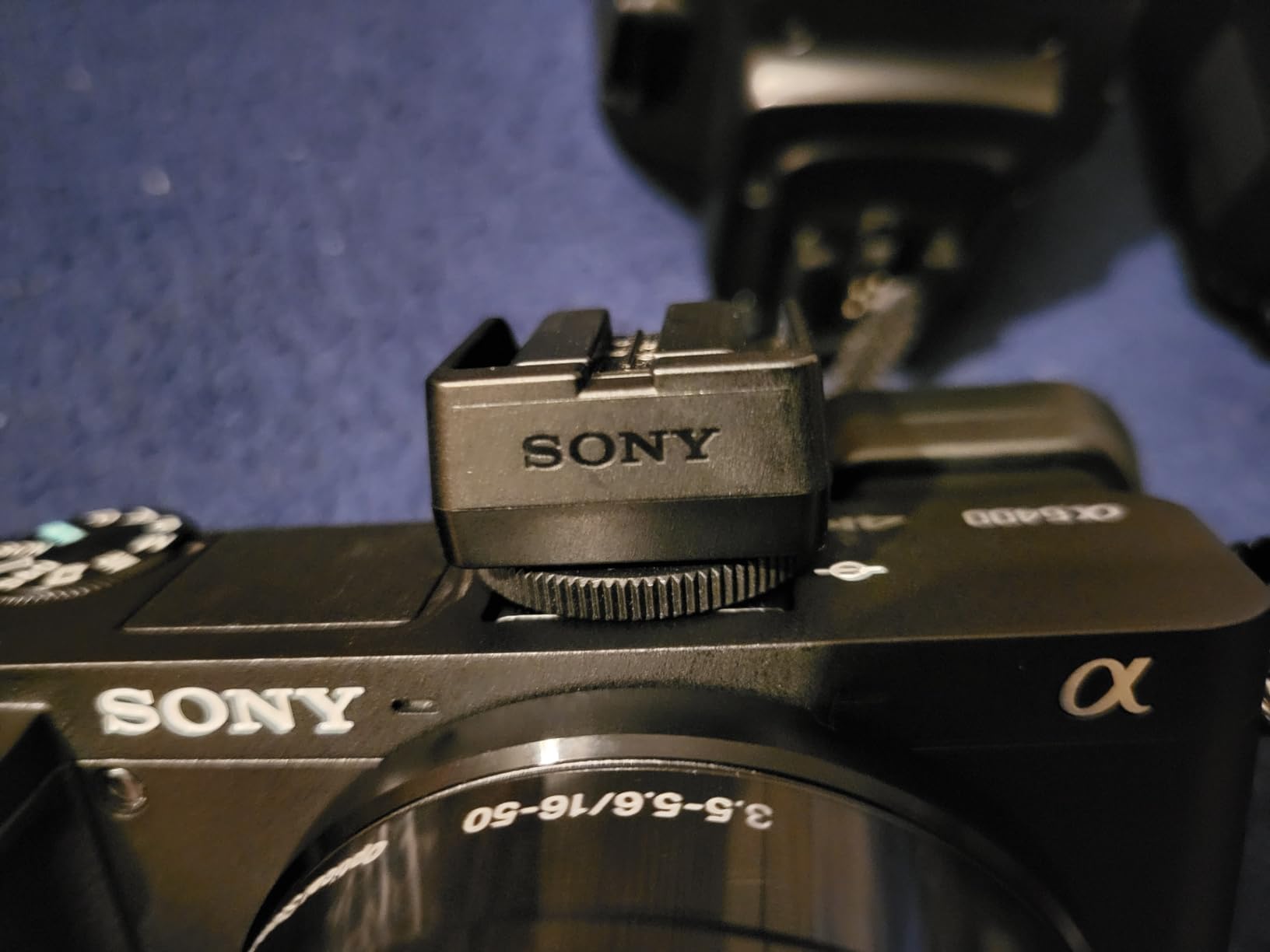
Long-term owners still rate the a6400 as a genuinely capable all-rounder, and for card work the reason is the 180-degree tilting touchscreen plus a body that weighs just 10.3 ounces. It is the lightest mirrorless in this group and the easiest to balance on a small arm or a stack of books, which matters more than raw resolution when your rig is improvised.
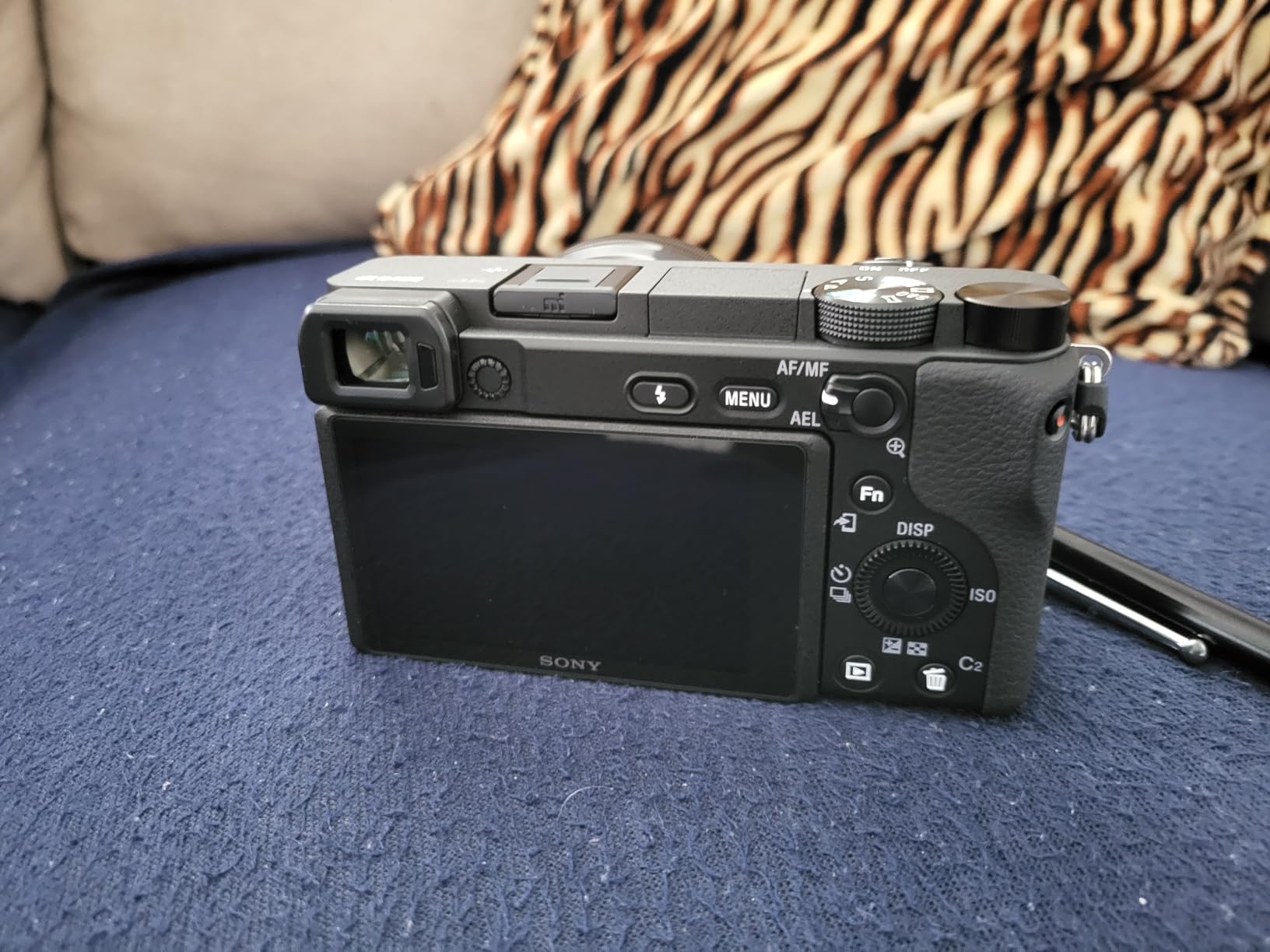
The 24.2MP Exmor APS-C sensor with 14-bit readout holds detail well at the apertures you would use for a flat subject, and the 425 phase-detect points cover 84 percent of the frame, so framing the card off-center on a larger background does not cost you focus. Real-time Eye AF is a bonus for the hand-held hero shots rather than the listing frames.
The practical strength here is the third-party lens market. Reviewers pair this body happily with fast third-party primes and constant-aperture zooms, and those are the lenses that solve the close-focus problem on an E-mount body at a sane outlay.
Who should buy the a6400
Buy it if your workspace is small and you want a screen that rotates far enough to frame from directly overhead without a stand. It is also the body we would hand to someone shooting a lot of cards in a shared space, because 10.3 ounces is nothing to hold for an hour.
Sellers who also want short video for a Discord group buy or a social account will get 4K UHD out of it, even though the R10 and a6700 do that job better.
Where the a6400 falls short
There is no in-body image stabilization, so any camera movement at close focus distance shows up immediately. On a copy stand this is a non-issue; on a hand-held 45-degree frame you will want a fast shutter or a support.
The native Sony APS-C lens range is thinner than the third-party one, and the menu system and Wi-Fi app get regular criticism for being slow and unintuitive. Budget an afternoon to set the camera up once, properly, and then leave it alone.
3. Canon EOS RP – the Most Versatile for Full-Frame Sharpness
Pros
- Full-frame 26.2MP sensor with excellent dynamic range
- Very light at 16 ounces for a full-frame body
- Articulating screen aids overhead framing
- EF lenses work through adapters
- Comfortable grip and solid construction
Cons
- No in-body image stabilization and no mechanical shutter
- Slow 5 fps burst and limited 4K capture
- RF full-frame third-party glass is scarce
- Bundled 24-105mm is soft at the edges
The RP is the pick when a card photo has to survive scrutiny. Its 26.2MP full-frame sensor gives you noticeably cleaner files in the shadows and across the frame edges, and that margin matters when the card is a vintage issue with surface wear you are expected to represent honestly rather than hide.
At 16 ounces it is one of the lightest full-frame bodies made, and the articulating touchscreen handles the overhead position without a stand. The kit 24-105mm f/4-7.1 IS STM reaches 0.5x maximum magnification and focuses to 0.43 feet, which is closer than a standard zoom and gets you part of the way there on its own.
Reviewers treat it as the most affordable way into full frame and praise the detail, dynamic range and low-light cleanliness. The complaints are all about the aging feature set rather than image quality: no stabilization, no mechanical shutter, a 5 fps burst, and heavily constrained 4K.

Why the RP earns its place on a card desk
Resolution headroom is the honest reason to step up to full frame here. A 63 x 88 mm card shot at f/8 gives you a detail-rich negative, and cropping a corner or a print line out of a 26MP file is forgiving in a way it is not on a 20MP body.
It is also the only body in this group that ships with a lens capable of genuine close focus out of the box, which reduces the number of extra purchases a first-time seller has to make.
Where the RP falls short
For a high-volume reseller, 5 fps is a genuine constraint. If you are photographing 200 cards back to back and leaning on burst to catch the moment, the faster APS-C bodies are simply better tools for the job.
The lack of in-body stabilization and a missing mechanical shutter are worth knowing about before a long session, and third-party full-frame RF glass is still scarce compared with EF glass available through the adapter.
4. Canon EOS R10 – the Top-Rated Body for Batch Shooting
Pros
- Highest rated body in this group at 4.7
- 15 fps mechanical burst suits batch card work
- RAW Burst pre-shooting rescues late-arriving cards
- Rotating touchscreen frames from any angle
- Natural color rendering
Cons
- Bundled 18-45mm kit lens is average and weak in low light
- Wi-Fi transfer is very slow so use a cable
- Battery is not shared with other Canon models
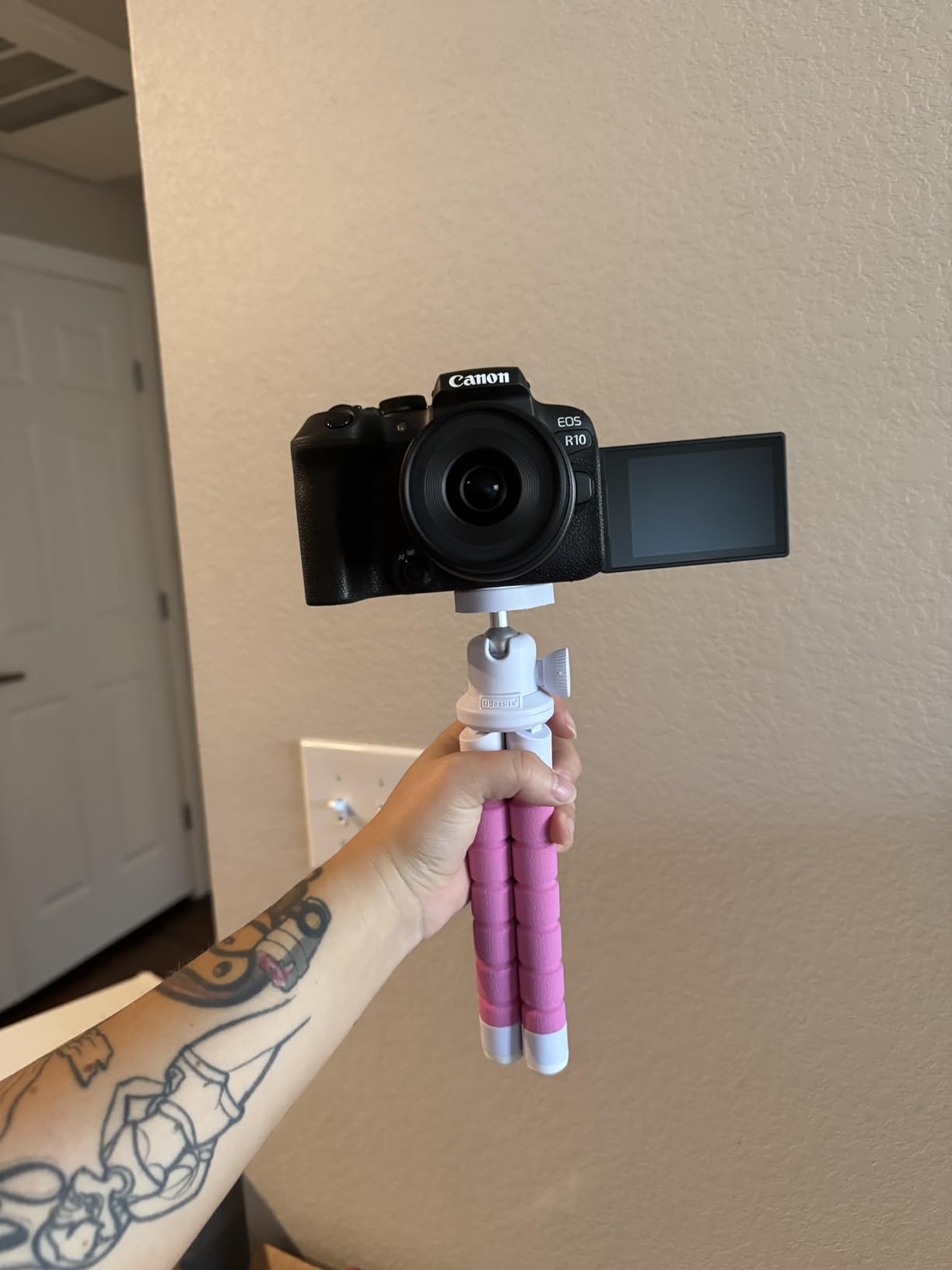
At 4.7 stars from owners, the R10 is the highest rated body we cover, and the reason is that it does the boring parts of batch work faster than anything else here. Fifteen frames per second mechanical, twenty-three electronic, plus a RAW Burst mode with half a second of pre-shooting, means a card that was not quite settled still gets a clean frame.
The 24.2MP APS-C sensor with DIGIC X produces sharp, natural-color images, and owners consistently praise the color as something they do not have to correct heavily in post. For a catalog where the same card must look the same across two hundred listings, that is a real advantage over bodies that push saturation.
Dual Pixel CMOS AF II with 651 zones and roughly 100 percent coverage, down to EV -4, means the autofocus will find a card edge in a dim room. The 3.0 inch anti-smudge coated tilting touchscreen is another plus for tabletop work.
Where the R10 beats the rest
Throughput is the answer. If your month includes regular lots of 100 cards or more, the burst rate and pre-shooting change the shape of the session, and a spare battery in your pocket is the price of admission. Shoot tethered or over USB rather than Wi-Fi, because owners report transfers over the wireless path are very slow.
The menu system is reported as working well in both auto and manual modes, so it is a friendly body for someone learning manual exposure for the first time.
Where the R10 falls short
The bundled 18-45mm is the weak link, weak past short distances and in low light, so a card seller will be replacing it early. The battery is not shared with other Canon models, which makes spares model-specific and slightly more annoying to plan around.
Some owners also note that a minority of reviews raise questions about third-party grey-market sourcing rather than the camera itself. That is a buying-process concern, not a photographic one, but it is worth weighing.
5. Sony Alpha a6700 – the Best for Hybrid Photo and Video Work
Pros
- 26MP sensor with strong dynamic range and low noise
- AI subject recognition autofocus raises the keeper rate
- 5-axis stabilization helps with handheld stills
- Full-frame readout 4K 60p 10-bit with no crop
Cons
- Menu system is complex and takes time to learn
- Runs hot during long 4K 60p recording
- Battery drains quickly in video use
- No dual card slots
The a6700 is the choice if your card photography is only half the job. Owners describe it as one of the best crop-sensor cameras available, and the AI subject recognition autofocus is the standout for anyone who also shoots short clips for a storefront or a social feed.
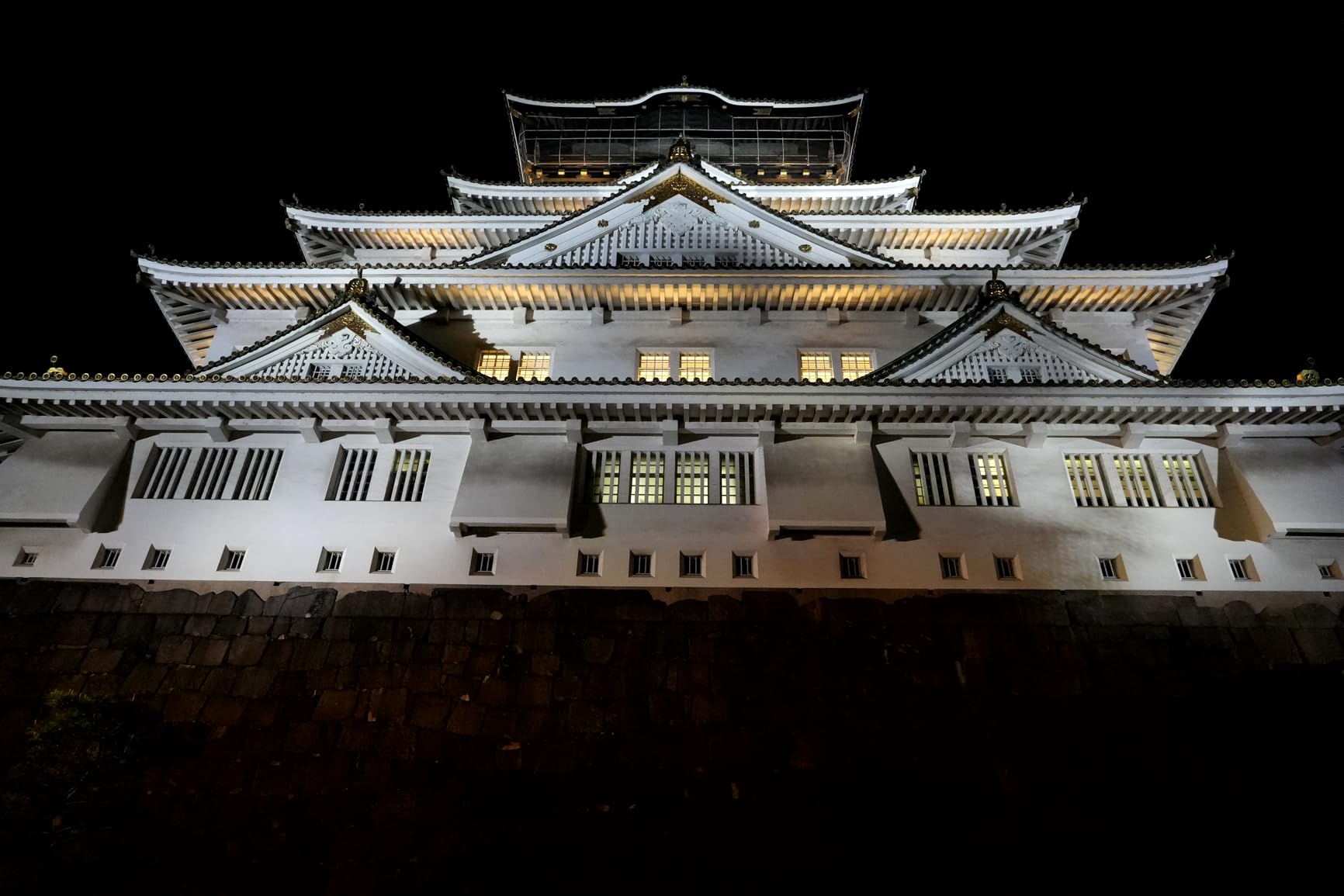
The 26.0MP Exmor R back-illuminated sensor with BIONZ XR shows clear low-noise improvement over older Sony bodies, which gives you room to shoot a card in softer evening light without cranking ISO and losing true color. The 759 phase-detect points and 5-axis sensor-shift stabilization both add up on a rig that is not perfectly rigid.
It also handles used A-mount glass through an adapter, which widens the macro options considerably for sellers who already own legacy glass.

Who this body fits
If you shoot cards and also need 4K 60p 10-bit with no crop, this is the body that does both without compromise. The articulating touchscreen and 1.07x viewfinder make it comfortable for long sessions, and 20 fps is available in the electronic shutter for quick runs.
Professional users report it handles simpler paid jobs well, which is the relevant framing for a reseller who invoices for catalog work.
Where the a6700 falls short
It has no dual card slots, and for a seller who cannot afford to lose a half-finished batch, that is a legitimate gap. Several bodies in this roundup share the same limitation, so it is worth deciding whether you care before you commit.
Heat management during sustained 4K recording, quick battery drain in video, and a dense menu system are the recurring complaints. For stills only, most of that is irrelevant.
6. Canon EOS 2000D / Rebel T7 – the Budget Pick with an Optical Viewfinder
Pros
- Optical viewfinder makes copy stand composition glare-free
- Bundle includes two lenses plus card flash tripod and filters
- Lowest entry cost of any body here
- Built-in Wi-Fi and NFC for transfers
Cons
- 9-point autofocus is slow and lacks tracking
- 3 fps burst is slow for batch listings
- Fixed non-articulating LCD blocks overhead framing
- Renewed condition with a 90-day warranty
The optical viewfinder is the underrated reason to consider this body. On a copy stand with your head close to the focusing screen, an optical finder shows the card without a screen catching a reflection from your own lights, and that alone removes a category of frustration that tilt-screen shooters have to work around with careful head position.
The 24.1MP APS-C sensor with a DIGIC 4+ processor produces perfectly usable files for listing work, and the Scene Intelligent Auto and Basic+ modes mean a beginner can get a reasonable frame before learning manual exposure. The bundle includes an 18-55mm lens plus a wide-angle and a telephoto, a 128GB card, a flash, a tripod, a case and a filter kit.
Buyers mainly value the package: camera plus a range of accessories at the lowest outlay in this group. The trade-offs they flag most often are the dated 9-point autofocus, the 3 fps burst, and the fixed LCD.

Why the Rebel T7 still makes sense in 2026
If you are moving from a phone to an interchangeable-lens body without spending real money, the accessory bundle alone covers a tripod, storage and a light modifier. That is the equipment a beginner actually needs for card work, and this kit includes it in one box.
The optical finder also means no battery drain while framing, so the small battery problem simply does not apply to the composing stage.
Where the Rebel T7 falls short
At 3 fps, this is the slowest body here for batch work, and the 9-point system has no subject tracking to rescue you. A 200-card lot will take noticeably longer than with an R10.
The fixed 3.0 inch 920k-dot LCD rules out overhead and low-angle framing without a copy stand, and this is a renewed listing with only a 90-day limited warranty. Treat it as a starter tool rather than a long-term catalog investment.
7. Sony Alpha a6100 – the Best Tilt-Screen Body for Tight Workspaces
Pros
- Fast 0.02 second autofocus with real-time Eye AF
- 24.2MP sensor has detail to spare for cropping
- 11 fps burst with continuous tracking
- Tilt touchscreen suits overhead and low flat-lay work
- Compact body with Wi-Fi and Bluetooth
Cons
- No in-body image stabilization
- Older generation sensor compared with newer Alpha bodies
- Small viewfinder and compact grip
- Bundled 16-50mm has a slow maximum aperture
The a6100 is rated 4.7 and is repeatedly described as the best value APS-C body in Sony’s lineup. For card work the useful part is the 180-degree tiltable touchscreen, which reviewers specifically connect to framing from above or below, exactly the tabletop and flat-lay positions a card seller works in.
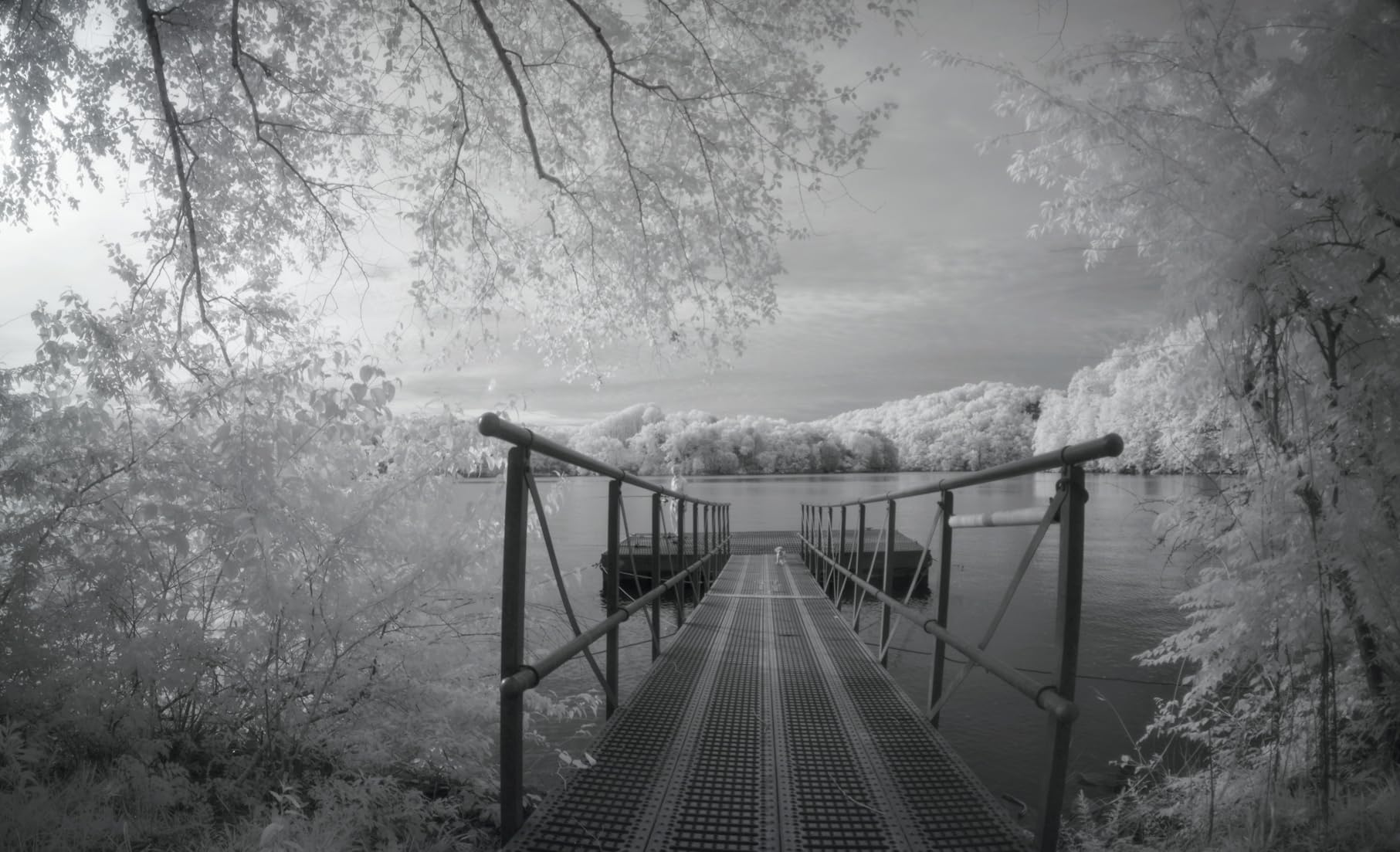
The 0.02 second autofocus across 425 phase-detect and 425 contrast-detect points covering 84 percent of the sensor is more than enough to acquire a flat subject, and the 11 fps burst with continuous AF/AE tracking helps when you are working through a lot without refocusing between every card.
At 24.2MP there is genuine detail to crop into a corner shot, and the native ISO range up to 51,200 gives you a fallback when your lighting is not what you planned.

Where the a6100 wins
It wins on the combination of a tilt screen, a fast autofocus and a small body. If your shooting space is a corner of a room with a folded table, this is easier to position than anything with a fixed screen and lighter than most bodies here.
It is also the pick if you want the newest-generation autofocus behavior without paying for the newest-generation sensor.
Where the a6100 falls short
No in-body image stabilization means you need a support, which partially offsets the portability argument. The sensor generation is behind newer Alpha bodies, and the 16-50mm kit lens has a slow maximum aperture that will limit you in low light.
The small viewfinder and compact grip are noted by owners as feeling cramped, particularly with a heavier lens attached.
8. Nikon D7500 – the Best Optical-Viewfinder DSLR for Two-Lens Coverage
Nikon D7500 DX-Format Digital SLR w/AF-P NIKKOR 18-55mm f/3.5-5.6G VR Lens + -P 70-300mm f/4.5-6.3G ed + 64GB Memory Card, TriPod, Flash, 3pc Filter Kit, Case, More, Black
Pros
- Two lenses included covering wide to telephoto
- 8 fps burst handles batch product photos
- 51-point AF with Group Area for reliable acquisition
- Tilting touchscreen for overhead angles
- Very wide native ISO range
Cons
- 20.9MP sensor trails modern mirrorless bodies
- No built-in stabilization beyond the bundled lens VR
- Optical viewfinder means the screen is required for overhead framing
- Not weather resistant
The D7500 bundle arrives with an 18-55mm and a 70-300mm, plus a 64GB card, tripod, flash, filter kit and bag. For a seller who also photographs cards in hand, on a table with a collection, or in an environmental setting, having a telephoto in the box removes a purchase you would otherwise have to make.

On the flat listing work, the 8 fps burst is the number that matters, and the review summary for this bundle calls it out specifically for shooting long sequences of product images. The Multi-CAM 3500FX II 51-point module with Group Area AF acquires reliably across the frame, which is useful when you are not centering every shot.
The 3.2 inch 922k-dot tilting touchscreen handles low and overhead angles, and the 1.0x optical viewfinder is bright and sharp. Native ISO runs from 100 to 51,200 with expansion to a very high ceiling, giving you room when the light is not cooperating.
Who the D7500 suits
Pick it if you want an optical finder and two lenses in one transaction, and if your card work includes more than the square-on listing frame. It is also a comfortable body to learn manual exposure on, with physical dials and a direct control layout.
The bundle contents are the honest selling point. Buyers who were planning to buy a body, a wide zoom, a telephoto and a tripod separately get all of it at once.
Where the D7500 falls short
At 20.9MP it is the lowest resolution in this group alongside the Z50, and that shows when you crop a corner detail from a listing frame. There is no in-body stabilization, and the bundled 18-55mm is the only stabilized element in the kit.
It is also not weather resistant, and the older point-and-shoot-style interface will feel dated next to the mirrorless bodies here. For stills-only catalog work it is a capable tool, just not the fastest one.
9. Nikon Z50 – the Best Value Entry Into the Nikon Z System
Nikon Z50 DX-Format Mirrorless Camera Body with NIKKOR Z DX 16-50mm f/3.5-6.3 VR Lens – 1633B
Pros
- Value entry point into the modern Nikon Z mount
- 11 fps burst covers batch shooting
- 209-point hybrid AF is fast enough for a fixed subject
- Built-in Wi-Fi and Bluetooth for direct transfer
- Compact body with flip-down screen for tabletop framing
Cons
- 20.9MP sensor is lower resolution than competing APS-C bodies
- No in-body image stabilization
- Single card slot with no backup
- Small battery and grip
- Refurbished listing with a 90-day warranty
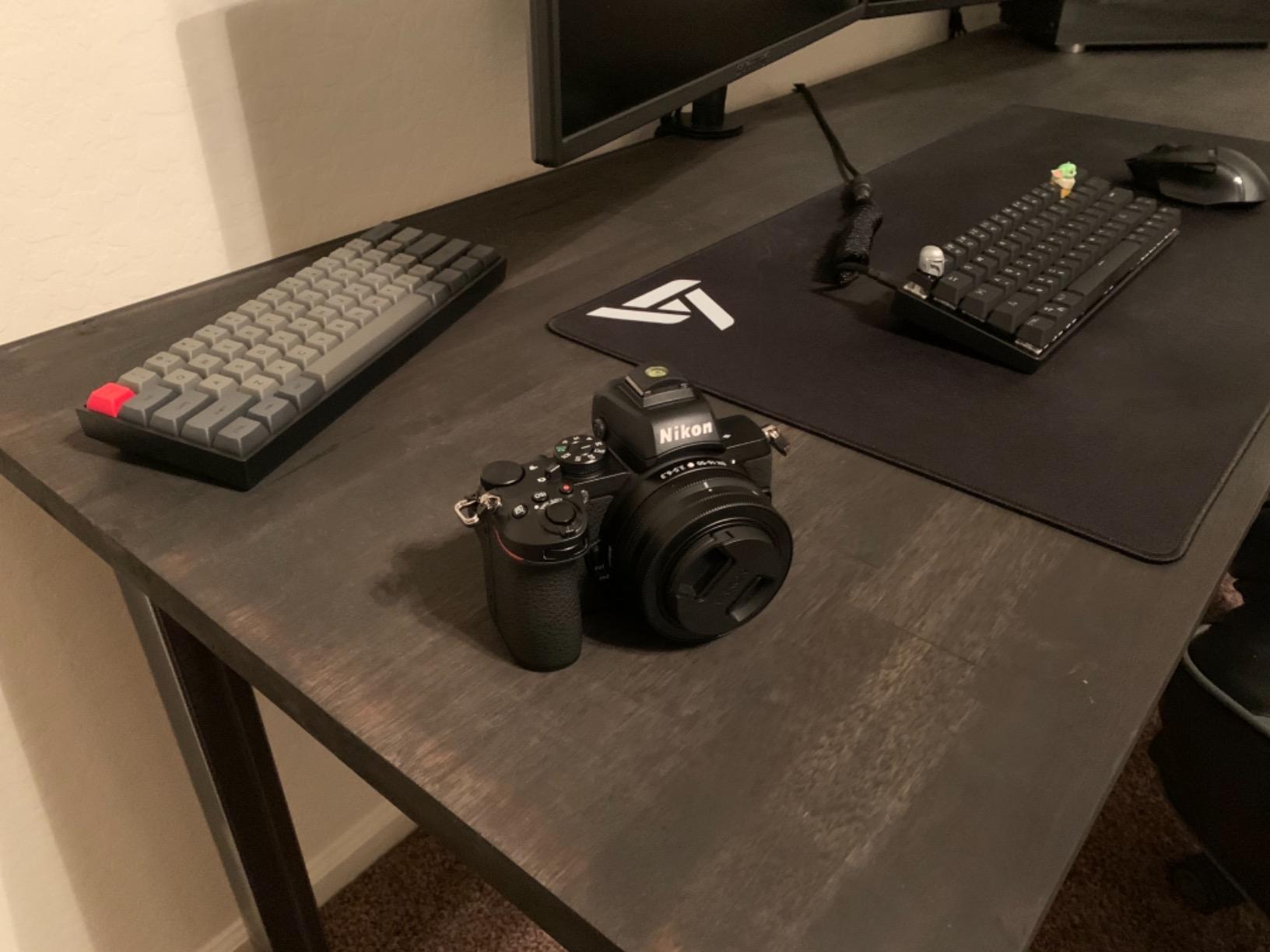
The Z50 is the answer for a seller who wants Nikon handling and a modern lens mount without stepping into a full-frame body. The flip-down LCD and compact size help with framing on a tabletop setup, and the 209-point hybrid autofocus with an 11 fps burst covers batch shooting adequately.
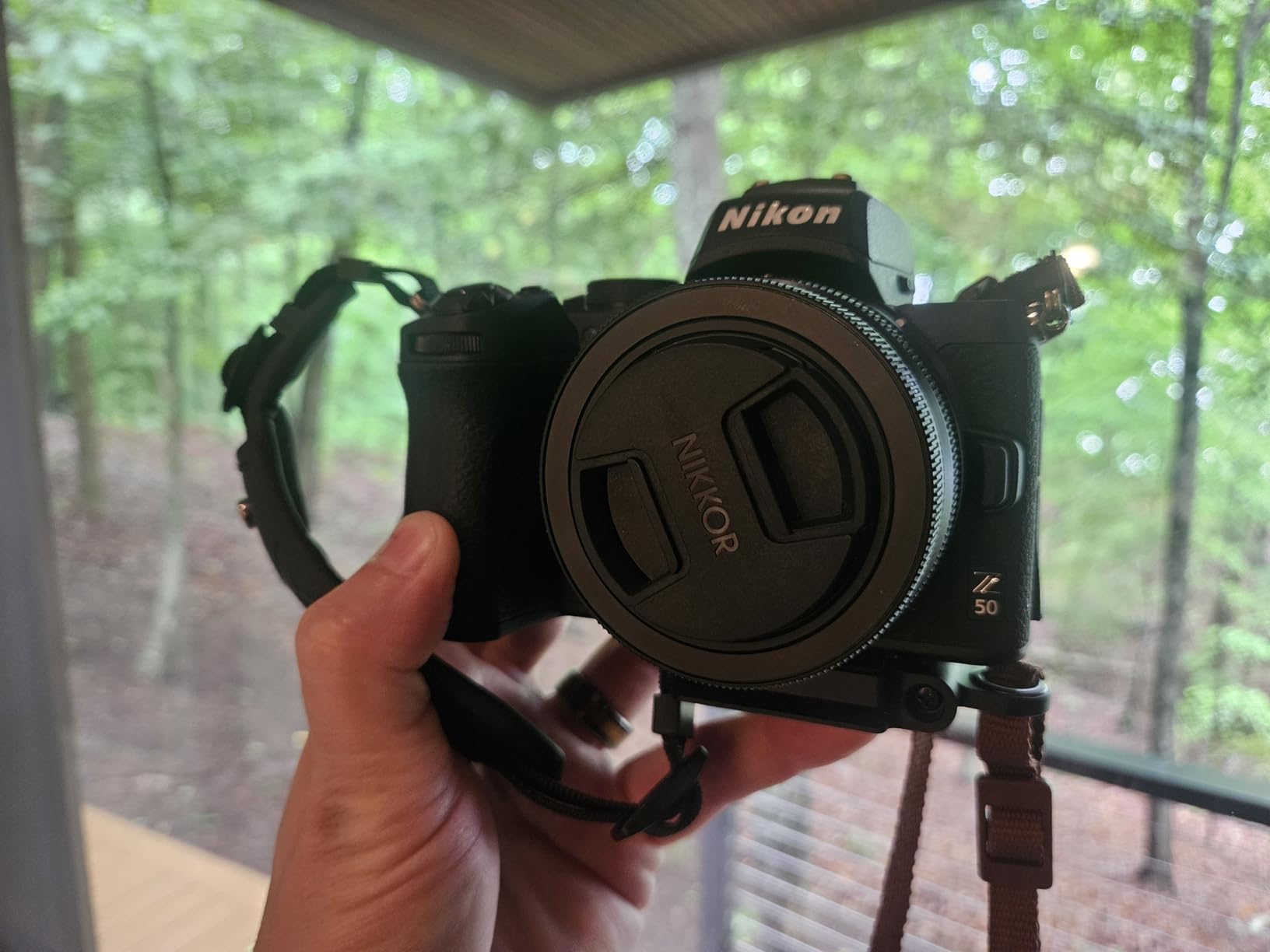
What you are really buying is access to the Z lens lineup, including affordable primes that solve the close-focus problem without the cost of a dedicated macro optic. Owners looking to enter the system generally find the package with the 16-50mm VR lens well priced for what it delivers.
Wi-Fi and Bluetooth handle direct phone transfer, and native ISO 100 to 51,200 gives a usable fallback for evening sessions where your light panel is the only source.
Where the Z50 makes sense
It makes sense if your collection of cards is a long-term project and you want the camera to be a system you can grow into. Pair it with a compact tripod, a diffusion sheet and a close-focus prime, and you have a complete card setup without a large body.
The flip-down screen means you can work on a low table or a low shelf without building a rig first, which is a real saving on time for a beginner.
Where the Z50 falls short
The single card slot with no backup is a genuine risk when you are working through a large lot, and there is no in-body stabilization to rescue a slightly shaky frame at close focus distance. The small battery and grip are noted as limited.
At 20.9MP it gives up resolution to every other APS-C body here. This is also a manufacturer-refurbished listing with a 90-day warranty, so treat the body as a cost-efficient entry point rather than a long-term investment.
10. Fujifilm X-T30 III – the Best for Ready-to-Post Color
Pros
- Film simulations give consistent ready-to-post color
- 26.1MP X-Trans sensor is sharp for the class
- 20 fps burst suits batch shooting
- AI subject detection autofocus is fast and reliable
- Built-in flash and top-plate dials for quick exposure changes
Cons
- No in-body image stabilization
- XC13-33mm kit lens is slow in low light
- Battery drains quickly and charger may not be included
- Screens tilts vertically only
- Menus take time to learn
The X-T30 III is the odd one out in this list, and that is exactly why it is here. Twenty built-in film simulations produce attractive, ready-to-post images with very little editing, and owners consistently point at color as the headline feature. For a catalog where every listing needs to look the same, a color profile you can trust straight out of the camera saves a real amount of batch processing time.
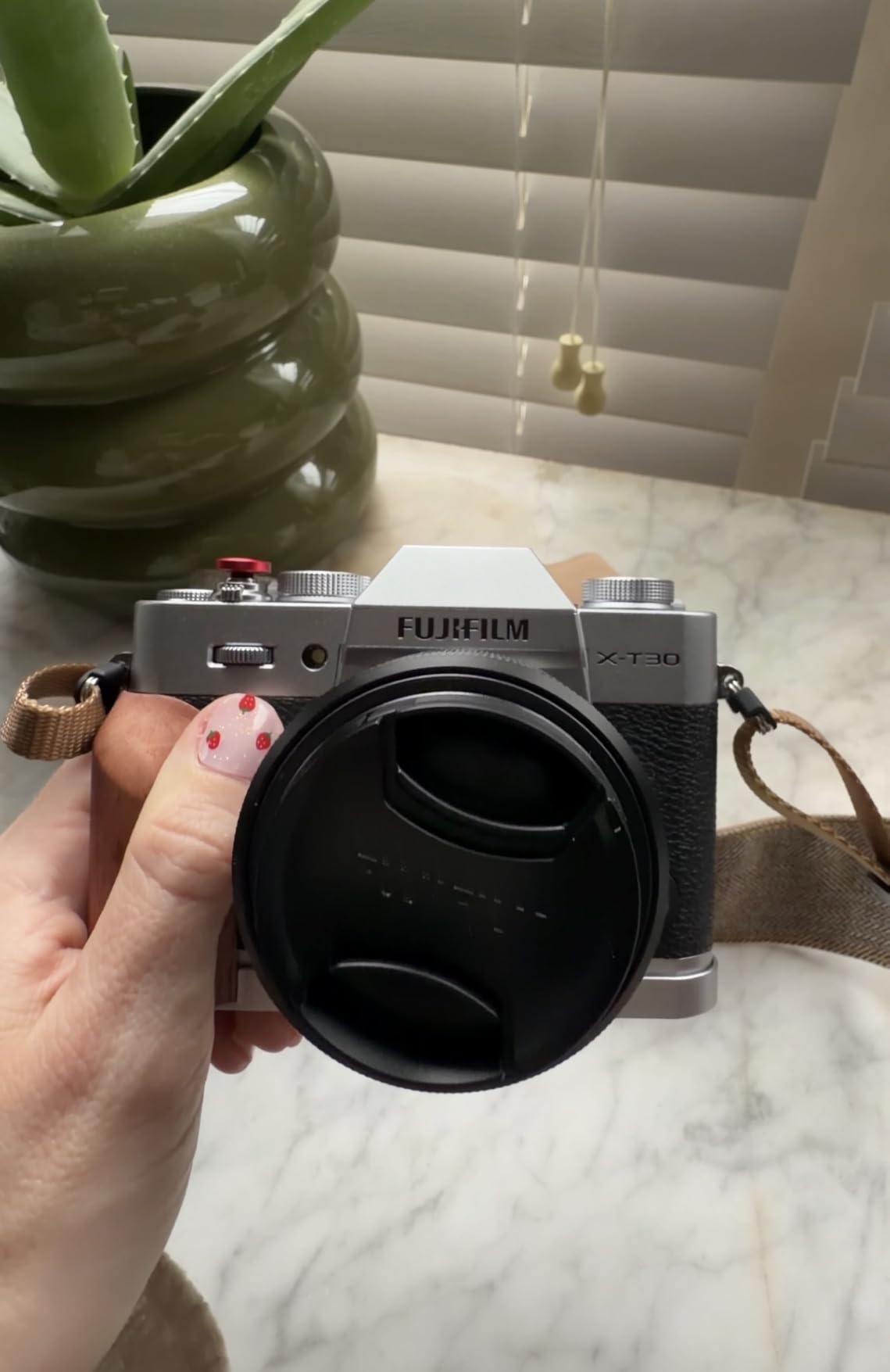
The 26.1MP X-Trans APS-H sensor is sharp for the class, and the 20 fps burst rate is the second fastest in this group after the Canon R10. AI-powered subject detection autofocus across 425 phase-detect points is dependable when a card is not perfectly flat in the frame.
The dual top-plate dials and built-in flash are nice touches for someone who wants direct physical control over exposure without digging through menus on every adjustment.
Where the Fujifilm earns its spot
It is the body to pick if your end product is posted directly to a marketplace or a social feed without a grading pass. Consistent simulated color across a whole lot is easier to achieve than matching camera-neutral RAW files from different sessions.
The 1.62 million dot tilting LCD is unusually dense for the class, which makes checking focus on a card edge easier without zooming in on screen.
Where the X-T30 III falls short
There is no in-body image stabilization, and the XC13-33mm kit lens is slow, which limits low-light performance. Battery drain is a recurring complaint, and a charger may not be included depending on region, so check the box contents carefully.
The screen tilts up and down but not sideways, so it cannot swing fully to one side the way the Canon R10 or Sony bodies can. Some owners also report occasional lag when previewing photos, which is annoying when you are checking a whole lot quickly.
How to Choose a Camera for Trading Card Photography
A card is a small-format product subject, so the decision is not about sensor size or burst rate. It is about close-focus capability, manual control, a screen or rig that lets you frame from above, and a white balance you can lock. Get those four right and the camera choice stops being stressful.
If you are still assembling a kit, our guides to mirrorless cameras with dual card slots and cameras with dual CFexpress card slots cover the backup-slot angle in more detail, and our roundup on point-and-shoot cameras is useful if you want a fixed-lens fallback that needs no lens at all.
What type of camera do you actually need for cards?
Three classes work: a dedicated mirrorless or DSLR with a macro or close-focus lens, a fixed-lens compact in macro mode, or a modern smartphone. In that order, for image quality and control. For a seller photographing a hundred cards a month, the dedicated body with a close-focus lens is the right answer; for someone archiving a personal binder, a phone may already be enough.
What matters is that the class gives you manual exposure, a lockable white balance and a way to hold the frame steady. Everything else is preference.
Macro lenses and the focal length math for a 63 x 88 mm card
To fill the frame with a 63 x 88 mm card you need roughly 1:1 magnification or close to it, and there are two ways to get there. A true macro lens does it natively; a normal or short telephoto lens plus extension tubes or a close-up filter gets you most of the way at a fraction of the cost, with a shallow depth of field penalty.
A 90 to 100mm full-frame equivalent macro is the classic working length for this, giving a comfortable working distance and enough depth of field at f/8 to f/11 to hold all four corners. On a full-frame body a 50mm at 1:1 will also frame the card, but the perspective is tighter and the working distance is uncomfortably short over a copy stand.
Fixed-lens compacts with a macro mode are the exception. Their macro modes are rarely true 1:1, so you will be cropping rather than filling the frame, and the aperture range is limited. That is fine for a personal archive and marginal for a listing catalog.
Overhead shooting: copy stand, tilting screen or tripod
You have three options for framing straight down at a card, and they rank differently. A copy stand is the most rigid and repeatable, and it removes camera shake entirely. A tripod with a downward-facing head is cheaper and nearly as steady. A tilting or rotating screen on the camera itself is the most portable and requires no rig at all.
The ergonomic point that rarely gets made: shooting a few hundred cards standing over a copy stand is a physical cost. A body that flips its screen up 90 degrees lets you sit at the table and shoot across it, which is easier on your neck and back over a long session.
Our guide to mirrorless cameras for landscape work goes deeper on viewfinder and screen considerations that transfer directly to any tripod-based rig.
Lighting and light boxes
Lighting decides more of the final photo than the camera does. A photo light box with side diffusion panels is the cheapest route to even coverage, and two separate diffused panels at roughly 45 degrees to the card surface give you more control over how the holo reads. A north-facing window on an overcast day is a genuinely free substitute for panels.
Straight flash is the worst option for foil cards because it creates a hard specular hotspot that reads to buyers as damage. Diffuse everything, and if a reflection still appears, move the light rather than the camera. Aim for daylight-balanced sources around 5000 to 5500K so your white balance setting stays usable.
A circular polarizing filter reduces surface reflection on matte cards but can flatten holo sparkle, so test it before adding it to a permanent stack. Storage and card handling for long sessions are covered in our guide to memory card cases, which matters more than most sellers expect when a batch spans a trip.
Phone vs camera vs flatbed scanner
A flatbed scanner produces a perfectly flat, perfectly even image with no glare, which sounds ideal until you realize it cannot capture holo movement and often introduces its own color and sharpness problems. Forum posters who tried shop and all-in-one scanner units report exactly that disappointment, and the running thread on scanning versus shooting in the flipping community is the clearest sign this is still a live debate.
A phone is genuinely enough for a personal archive, and with a phone macro lens and a copy stand it gets you most of the way for casual listings. A dedicated camera body wins on control and consistency, mainly because you can lock white balance and shoot RAW.
For grading submissions to services like PSA, BGS or CGC, shoot rather than scan. Those services reject soft or cropped corners, and they want a photograph of the actual card rather than a flatbed reconstruction of it.
Meeting eBay and grading service photo specs
The numbers are not complicated, and they are the same for almost every marketplace. eBay activates its zoom feature at a 1600 pixel longest edge, so shoot well above that to give yourself a crop margin. Every listing needs a front shot, a back shot, and a 45-degree angle that shows the holo pattern moving. Corner close-ups cut condition disputes more than any additional front shot.
Shoot RAW, edit for exposure and white balance only, and do not boost saturation. A photo that looks better than the card in hand generates chargebacks, and that is the single most expensive mistake in this workflow. For card handling during a long session, sleeve the card and use a rigid display case for anything high value that gets photographed repeatedly.
Frequently Asked Questions
What is the best way to take pictures of trading cards?
Fix the camera and the lights, then stop changing settings. Shoot square-on from directly above at 8 to 12 inches, use manual mode at f/8 to f/11 and ISO 100, lock white balance around 5000 to 5500K, and light the card with two diffused panels angled about 45 degrees off the surface. Repeat that exact setup for every card so the whole catalog looks consistent.
What type of camera is best for vending cards?
Three classes work: a mirrorless or DSLR body with a macro or close-focus lens, a fixed-lens compact in macro mode, or a modern smartphone. In that order for control and image quality. A dedicated body wins because you can lock white balance, shoot RAW and hold the frame rigid, which is what keeps a whole catalog looking like the same shoot.
How to take good photos of trading cards for eBay?
Shoot a front shot, a back shot, a 45-degree angle that shows the holo moving, and close-ups of all four corners. Keep the longest edge above 1600 pixels so the eBay zoom activates, and shoot RAW. Edit for exposure and white balance only, with no saturation boost, because an over-edited photo generates condition disputes and chargebacks.
What is the best light box for taking pictures of trading cards?
A photo light box with side diffusion panels is the simplest option, and two separate diffused panels at about 45 degrees to the card give you more control over holo reflections. A north-facing window on an overcast day is a free substitute. Avoid direct flash, which creates a hard hotspot on foil that buyers read as damage.
Do I need a macro lens to photograph a trading card?
To fill the frame with a 63 x 88 mm card you need roughly 1:1 magnification. A 90 to 100mm full-frame equivalent macro reaches it natively and gives a comfortable working distance. A standard lens with extension tubes or a close-up filter gets you close for far less, at the cost of a thinner depth of field at f/8 to f/11.
Is photographing cards better than scanning them?
Scanning gives a perfectly flat, evenly lit image with no glare, but most all-in-one units produce softer results than people expect and cannot capture holo movement. Photographing wins for grading submissions to services like PSA, BGS or CGC, which want a photograph of the card and reject soft or cropped corners.
The Verdict for 2026
If you buy only one body for trading card photography, take the Canon EOS R50. Its 24.2MP APS-C sensor resolves a card cleanly at f/8, the vari-angle screen turns the camera into its own copy stand, and the 651-zone autofocus handles the hand-held frames without thinking about it. Pair it with a 90mm-class macro or a close-up setup and you have everything a listing catalog needs.
Buy the a6400 instead if you want the lightest body and a 180-degree screen in a smaller footprint, the Rebel T7 bundle if budget is the constraint, and the EOS RP if grading submissions and heavy cropping are part of the job. Shoot diffused light, lock white balance, and keep the settings identical from the first card to the last.
Whichever body you pick, the buying guide above is the part that actually decides your photo quality. Get the rig right, and any of these ten will produce a catalog a buyer trusts.