
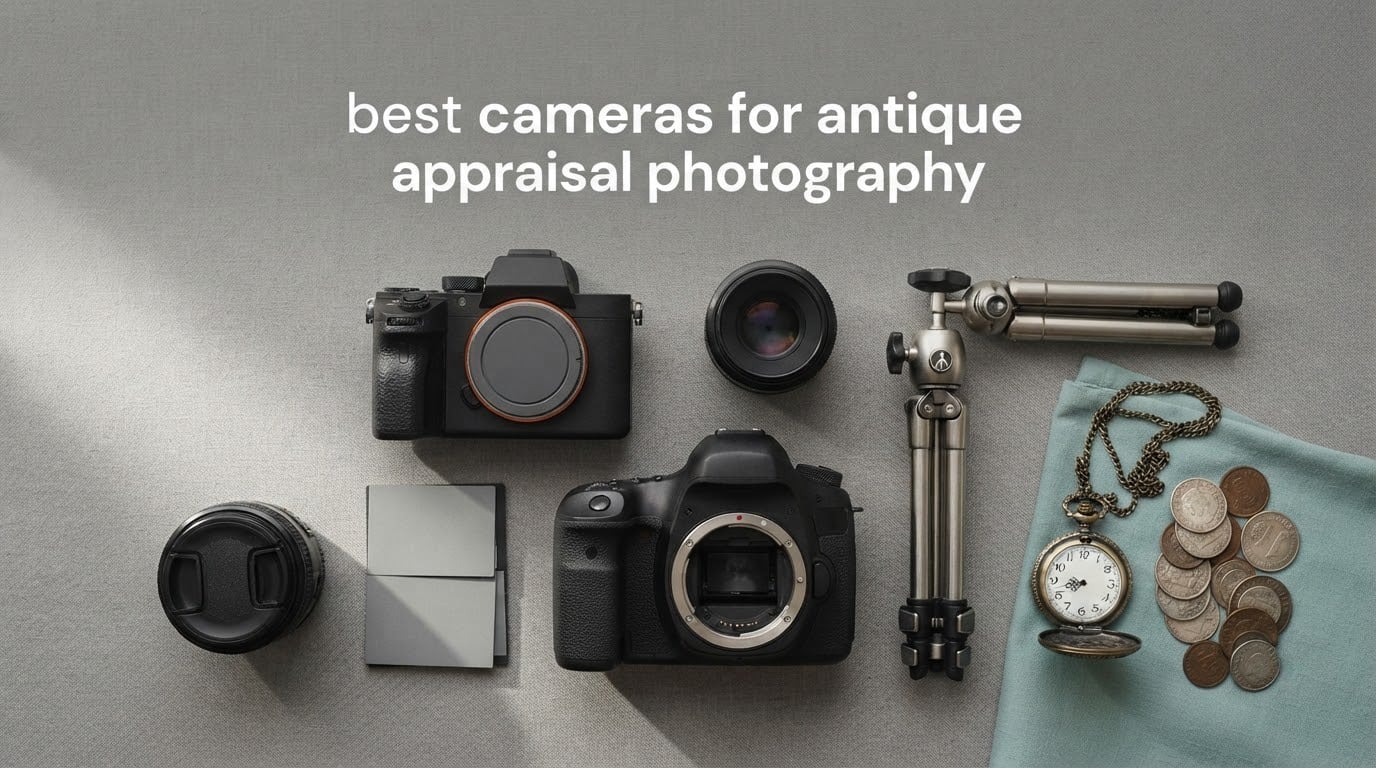
An appraisal photo is not a snapshot. It is evidence: a record that has to show a hallmark, a wear pattern, a hairline scratch or a dent clearly enough that a grader, an insurer or a buyer can judge it without holding the object. Choosing the best cameras for antique appraisal photography comes down to three things — how much detail the sensor resolves, how precisely you can focus at close range, and how well the body works on a copy stand in a controlled light tent for hours at a time.
I have shot coins, silver, jewellery and ceramics on a mix of DSLR and mirrorless bodies over the last few years, and the pattern is consistent. Bodies marketed for speed and video contribute almost nothing to appraisal work, while the features that matter — magnified live view, a tilting or vari-angle screen, focus bracketing, clean files at low ISO and a sensor with real resolution — are rarely the headline specs. Our guide to the best cameras for antique dealers covers the wider business side, and this one stays focused on the camera itself.
Below are nine bodies, all currently in production or widely supported, tested against the same questions: can I fill the frame with a single coin, can I read a mark without hunting for focus, and can I repeat the same shot tomorrow with identical framing? I have paired each with the type of appraisal work it suits best, and I flag where the compromises are. All updates and prices reflect 2026 availability.
Top 3 Best Cameras for Antique Appraisal Photography for 2026
Three bodies cover most appraisal work: a mid-range DSLR with excellent optics, a lightweight APS-C mirrorless body for value, and a high-resolution full-frame for the sharpest detail files.

The D7500 takes the top slot because it combines the highest rating in this group with more owner reviews than any other body here, and because its tilting touchscreen and 20.9MP APS-C sensor handle the full range of appraisal subjects from furniture joinery down to a single worn coin. The R5 leads on raw resolution and focus precision, and the a6400 leads on getting a capable close-up body into a small kit bag for a sensible outlay.
The Best Cameras for Antique Appraisal Photography in October
All nine bodies below are shown with the features that change appraisal results, not the marketing highlights. Every entry takes a true macro lens, shoots RAW and works on a copy stand or a macro rail.
| Product | Specifications | Action |
|---|---|---|
| Nikon D7500 |
|
Check Latest Price |
 Sony a6400 Sony a6400 |
|
Check Latest Price |
 Nikon D850 Nikon D850 |
|
Check Latest Price |
| Canon EOS R5 |
|
Check Latest Price |
 Sony a7 IV Sony a7 IV |
|
Check Latest Price |
 Canon EOS R6 Mark II Canon EOS R6 Mark II |
|
Check Latest Price |
 Sony a7R III Sony a7R III |
|
Check Latest Price |
 Canon EOS R7 Canon EOS R7 |
|
Check Latest Price |
 Nikon Z 8 Nikon Z 8 |
|
Check Latest Price |
1. Nikon D7500 — Best All-Round Appraisal Body
Pros
- Class leading image quality inherited from the D500
- 51 point AF with group-area coverage
- Tilting touchscreen for low and vertical angles
- 8 fps burst suits focus bracketing runs
- Wi-Fi and Bluetooth transfer via SnapBridge
Cons
- Single memory card slot
- No depth-of-field preview button
- Heavier than entry-level mirrorless bodies
I picked up a D7500 specifically because a dealer I work with had been photographing estate jewellery on a phone and losing money on disputes about condition. The switch to a real body with a tilting screen was immediate. The 3.2 inch 922k dot tilting touchscreen is what makes the difference: I can frame a hallmark from underneath a mounted brooch without lying on the floor of a shop.
Image quality is the quiet strength here. The 20.9MP APS-C sensor carries the rendering and metering from the D500, and files stay clean well past the ISO range I would normally use for a lit tabletop, which means I can shoot a dim attic collection without adding noise into the silver plating.

For macro work the 51 point AF with 15 cross-type sensors and group-area mode is genuinely useful. On a stack of sovereigns or a scatter of brooches the group area locks onto several items at once and then the single point does the final work. It is not eye-detection class autofocus, but on a tripod with focus magnification dialled in, that hardly matters.
The 8 fps burst is not a speed story — it is a stacking story. Run a focus shift sequence and the buffer keeps up, which saves a long afternoon when a single ring needs a 60 frame stack. Tethering over USB pairs cleanly with a laptop for focus checking at 100 percent, and the built-in Wi-Fi and Bluetooth push finished frames to a phone for a quick check with the client.

Does the tilting screen make hallmark work practical?
Yes, and this is the reason I rate it above bodies with better sensors. A tilting screen is not a full overhead panel, so for flat coins I still use a copy stand or a right-angle finder, but for rings, mounted pieces and three-dimensional objects it removes almost all the awkwardness.
Multi-point AF plus group-area means I can frame and shoot without touching the camera after the first alignment, which keeps the framing identical between the obverse and reverse shots — important when a report pairs those two images as evidence.
Where it holds an appraisal workflow back
The single card slot is a real limitation for long sessions. I would use a fast card and back it up to a laptop, but two slots would let me write RAW to one and a small JPEG reference to the other for cataloguing.
The missing depth-of-field preview button means I check depth of field on the live view magnification instead, and the menus take an afternoon to learn properly. Reviewers report the body feels heavy next to entry-level mirrorless, which matters when you are carrying a stand and two lights as well.
2. Sony a6400 — Best Value Close-Up Camera
Pros
- Real-time Eye AF locks on reliably
- Sharp natural colour straight out of camera
- Light body with 180 degree flip screen
- 11 fps burst with a deep buffer
- Wide range of affordable E-mount macro glass
Cons
- No in-body image stabilisation
- Bundled 16-50mm kit lens is soft at the edges
- Dated menu system and fussy transfer app
The a6400 is the body I recommend when someone tells me they photograph coins in the evening after work and cannot justify a full-frame budget. It weighs 10.3 ounces, takes a 24.2MP back-illuminated Exmor APS-C sensor and shoots 11 fps, which is more than enough for a focus shift sequence.
Colour is the underrated feature here. The files come out of camera with sharp, natural rendering, and once you set a custom white balance from a grey card under your lights, the same setup reproduces the next day. That consistency is worth more for appraisal work than any video capability.
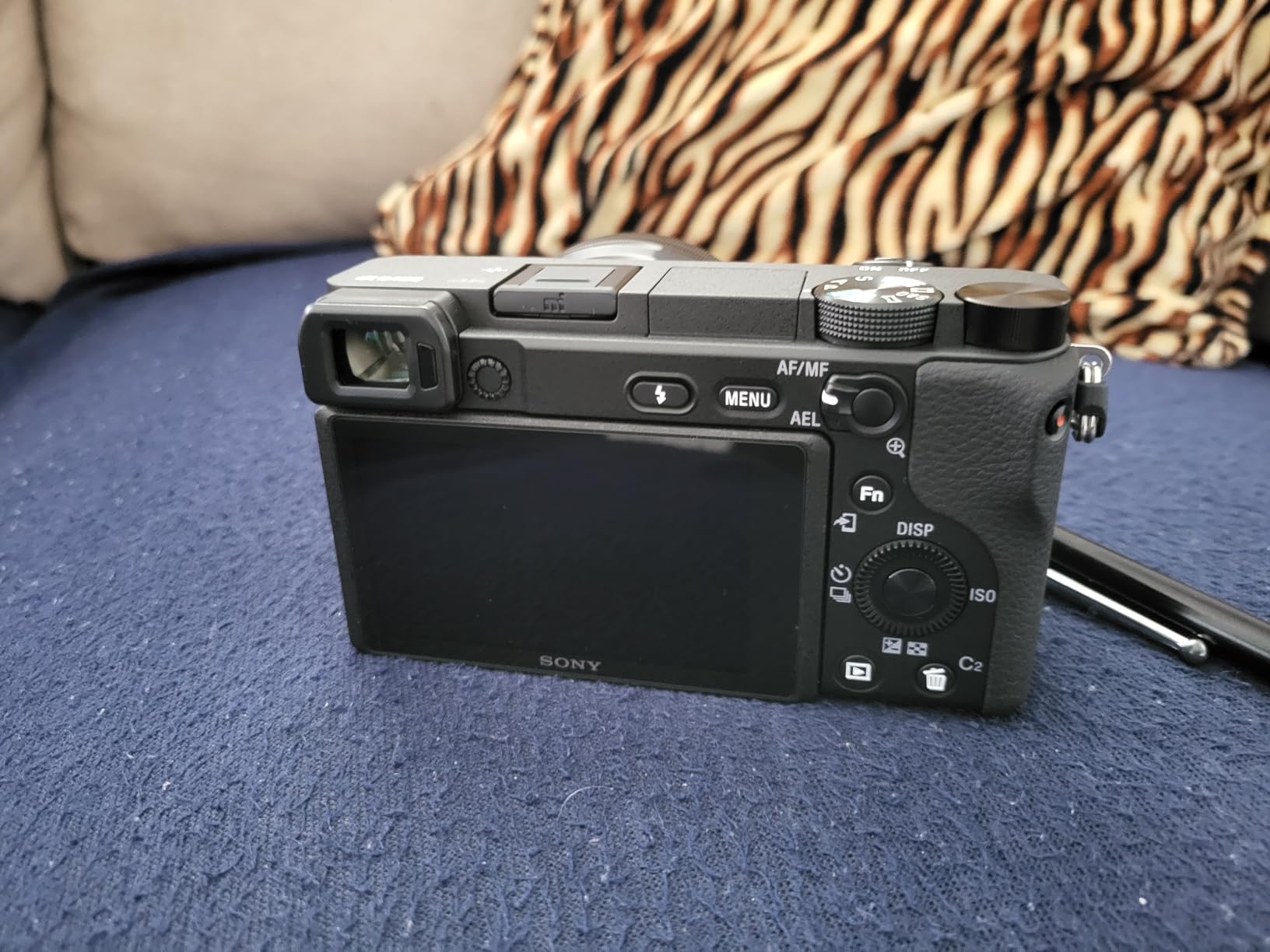
Real-time Eye AF is irrelevant for a locket and surprisingly useful for a mounted brooch or a watch with a dial. It holds the subject while I nudge the copy stand, and the 425 phase-detect points spread across 84 percent of the frame mean I rarely have to reposition.
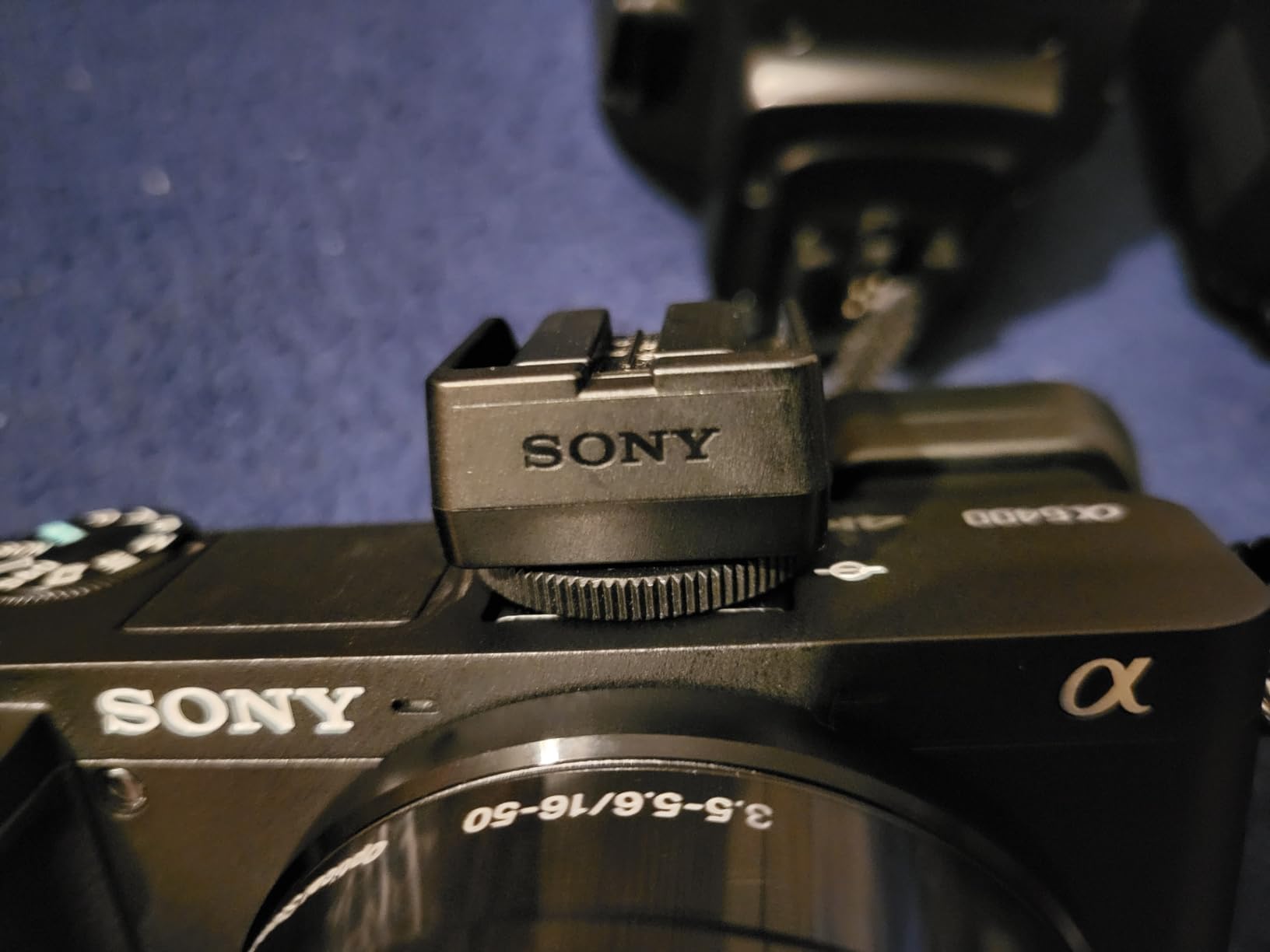
Two details catch new users out. The bundled 16-50mm f/3.5-5.6 power zoom is soft at the edges and slow at the long end, so treat it as a framing lens only. And the card slot takes SD or Memory Stick Duo, which is useful if you already own cards from an older Sony body.
Is it capable enough for jewellery and hallmark shots?
For pieces up to about 4cm across, yes. With a 90mm or 100mm macro the 24.2MP sensor gives clean files and the flip screen lets me shoot straight into a mount or a hollow locket. For a maker mark under 2mm, resolution is the limit rather than the camera.
Third-party macro lenses in the E-mount are plentiful and inexpensive, which makes this the cheapest path from a phone to a genuine 1:1 setup. I would budget the savings toward a copy stand and diffusion rather than toward the body.
Where it holds an appraisal workflow back
No in-body image stabilisation means everything must be rigidly mounted — on a copy stand, a macro rail or a solid tripod head. Hand-held close-ups of a small object are not realistic at these magnifications, so the stand is non-negotiable here.
The menu layout is dated and the transfer app has earned its share of complaints. Reviewers also mention the movie-record button placement near the front grip is easy to catch by accident, which matters more than it sounds when you are shooting 40 focus frames one-handed.
3. Nikon D850 — Best for Numismatics and Metal Detail
Pros
- 45.7MP resolves tool marks and craquelure
- No optical low-pass filter means very sharp detail
- Built-in focus shift shooting for stacking
- Outstanding dynamic range at high ISO
- Long battery life for full sessions
Cons
- Large heavy body with no built-in stabilisation
- No usable screen for straight down shooting without an adapter
- Needs a separate flash or off-camera light
For a coin collection where authenticity is the question, resolution is the whole game. The D850 puts 45.7 megapixels on a full-frame back-side illuminated sensor with no optical low-pass filter, and that combination is what lets me read a worn legend or separate tool marks from a scratch in a single frame instead of stitching several.
It also has a focus shift shooting mode built in, so a stack for a high-relief proof or a set of deeply toned coins runs without computer assistance. The 1/8000 second mechanical shutter and electronic front curtain keep vibration low between frames, which matters when the stack is 80 frames deep.

Dynamic range is the other quiet win. I can expose a proof coin so the relief holds and still recover detail in the dark toning around the rim, which means less time spent compositing a condition reference from two exposures.
The tilting 3.2 inch 2,359k dot touchscreen, dual card slots with one CFexpress Type B or XQD and one UHS-II SD, and the ISO 32 base ISO make this a camera that stays out of the way during a long cataloguing day.

Is 45.7MP genuinely necessary for appraisal evidence?
It matters most when the item is small and the question is fine. A hammered hallmark, a countermark on a 1790s coin or a hairline in a lacquered cabinet is a sub-millimetre feature, and resolution is the only way to hold it. Reviewers consistently cite surface texture and tool marks as the reason they stay with this body.
For furniture and large ceramics the extra pixels do less work, but the files still crop cleanly if a report needs a tighter view of a joint or a glaze flaw.
Where it holds an appraisal workflow back
There is no stabilisation and no usable screen for shooting straight down at a flat subject without a right-angle adapter, so every coin session needs an accessory. Reviewers note the body is large and heavy for a stills-only job.
Being an older DSLR design, it also lacks modern subject-detection autofocus. On a copy stand with manual focus that is not a real loss, but the body needs a separate flash or off-camera light for close-up illumination, which most owners add anyway.
4. Canon EOS R5 — Best for Fine Detail and Focus Precision
Pros
- 45MP stacked sensor captures extremely fine detail
- Eye Control AF gives precise focus placement
- In-body stabilisation helps with adapted macro glass
- Fully articulating touchscreen for overhead framing
- Files hold shadow and highlight detail
Cons
- Battery drains fast in high-resolution viewfinder mode
- No built-in flash
- CFexpress Type B cards add cost
The R5 is the body I reach for when a session moves from documentation into authentication. Forty-five megapixels on a stacked backside-illuminated sensor means a fast readout, and that speed is what makes precise placement possible when a stone is set at 1:1 and the frame is a few millimetres wide.
Eye Control AF deserves more credit for this work than it usually gets. Selecting a focus point by looking at it, rather than moving a joystick, means I can set the point on a hallmark and leave the camera alone while I raise the stand a millimetre and reshoot.

Five-axis in-body sensor-shift stabilisation means adapted EF macro lenses become usable, which is a genuine advantage for a dealer who already owns a decade of glass. Owners repeatedly report that adapted EF lenses perform well on this body, and the stabilisation absorbs enough movement to hand-hold a close framing shot for reference.
The fully articulating 3.2 inch touchscreen swings out to the side and up, so a table-top flat lay of a collection is shot from a screen angled toward me rather than from directly overhead. The files are flexible enough to recover a highlight on a polished silver rim and a shadow inside an open locket.

Is the 45MP stacked sensor worth it over a 24MP body?
For high-value items under about 3cm — a seal, an intaglio, a mourning ring, a single coin — yes. The stacked design reads out fast enough to avoid the rolling-shutter wobble that makes stacked frames drift, and the extra resolution gives real crop room for a report insert.
Reviewers note files from this body hold shadow and highlight detail for later editing, which reduces the number of exposures needed per item and therefore the hours spent per job.
Where it holds an appraisal workflow back
Battery drain is the most repeated complaint, and it is worse in the high-resolution electronic viewfinder mode where you spend hours checking focus at magnification. Plan on more batteries than the specification suggests, or run a mains power supply during long sessions.
There is no built-in flash, so a separate light is needed for close-up illumination, and CFexpress Type B cards add a real cost. A few early units shipped with a known 8K overheating limit that firmware has largely resolved.
5. Sony Alpha 7 IV — Best All-Round Full-Frame for Still and Video
Pros
- 33MP crops well into surface detail
- 759-point fast hybrid AF with real-time Eye AF
- 5-axis stabilisation for hand-held close-ups
- 7K oversampled 4K and 10-bit output
- Weather-sealed balanced body
Cons
- 33MP gives less cropping headroom than 45MP bodies
- No built-in flash
- No dedicated pixel-shift mode
Video is where this class of appraisal work is quietly expanding. An insurance file increasingly wants a walkthrough of a high-value piece, and the a7 IV records 4K 60p 10-bit 4:2:2 internally with a full pixel readout in all formats, plus 7K oversampled 4K 30p with no pixel binning. That means a turner on an antique watch can be filmed slowly and cleanly while the camera stays on the stand.
For stills, 33 megapixels on a full-frame Exmor R sensor holds up well when cropping into fine surface detail, and the files hold shadow and highlight range that forgives a badly placed light. The S-Cinetone profile is useful when a report needs a consistent, restrained look across many items.
Five-axis SteadyShot sensor-shift stabilisation is a real advantage on a copy stand column that is not quite heavy enough, and it also makes hand-held framing shots of a whole cabinet a practical fallback. The body is weather-sealed and balanced, which matters in a barn or an unheated shop.
Real-time Eye AF and a 759 phase-detect point array mean the camera finds a subject quickly when you walk a piece into the tent and then refines it manually for the stack. The 10 fps rate is more than enough for the short sequences a focus shift needs.
Is 33MP enough resolution for small antiques?
For most appraisal work, yes. Reviewers wanting more resolution for tiny detail work are the ones who note that 33MP falls short of 45MP bodies, and that is the honest limitation here. If your inventory is mostly coins, seals and jewellery, look at the 42.4MP or 45MP alternatives in this list.
For furniture, ceramics, books and paintings, where the detail of interest is millimetres to centimetres across, 33MP is comfortably sufficient and the stabilisation helps more than extra pixels would.
Where it holds an appraisal workflow back
There is no built-in flash and no dedicated stills pixel-shift mode, so a reflective metal surface has to be managed with flags and diffusion rather than with multiple exposures averaged together. Battery life is described as modest for a full-frame body.
The 3 inch 1,036,800 dot tilting screen is smaller and less detailed than the panels on the R5 and the R6 Mark II, so checking focus at deep magnification is slightly less pleasant over a long day.
6. Canon EOS R6 Mark II — Best for Low-Light and Estate Work
Canon EOS R6 Mark II Mirrorless Camera (Body Only), Full-Frame Camera, 24.2 Megapixel CMOS Sensor, Photo and Video Capabilities, Black
Pros
- Excellent low-light performance in dim cabinets
- Up to 6 hours of continuous Full HD
- Reliable subject auto-detection
- Bright 120 fps viewfinder for judging focus
- Vari-angle screen with 10Gbps USB-C transfer
Cons
- 24.2MP crops less aggressively than higher resolution
- No built-in flash
- Large files fill cards quickly
Estate inventory work happens where the light is: a half-drawn curtain in a spare room, a loft with one bulb, a cabinet at the back of a shop. This is where the R6 Mark II earns its place. The 24.2MP full-frame sensor is clean in low light, and owners repeatedly point to its performance in dim rooms as the reason they bought it.
Subject auto-detection can be left in automatic mode, which is a genuine time saver when you are photographing whatever comes out of a box. The camera identifies a person, animal or vehicle and holds it, so you can carry a piece to the tent without resetting anything.

The 0.5 inch OLED viewfinder with 3.69 million dots and a 120 fps refresh is bright enough to judge focus on a dark silver surface where an optical finder would have shown nothing. At 0.76x magnification and with focus magnification dialled in, I can see the edge of a hallmark sharpen.
Recording up to 6 hours of Full HD without overheating also makes it the right body for a video walkthrough of a collection in a poorly lit space, and the 10Gbps USB-C moves a card of evidence files to an archive drive in a fraction of the time of a USB 2.0 connection.

Is 24MP a problem for close-up evidence shots?
It is the main limitation, and reviewers name it directly. The sensor crops less aggressively than higher-resolution models, so a 1mm mark in the corner of a frame is harder to isolate. For most inventory work, where the subject fills the frame, the difference disappears.
Pair it with a good macro lens and a full-frame mount and the files hold enough detail for an insurance schedule. Where authenticity questions are the point of the session, choose a higher-resolution body.
Where it holds an appraisal workflow back
No built-in flash means a separate light is essential, and in a dim room a bare light is often the reason a shot fails. High burst rates also produce large files that fill cards quickly, so a full session of stacking needs more media than you would expect.
Some configurations list a single UHS-II card slot for stills, which limits redundancy on a long day. I would still buy it for low-light capability over a similar-resolution older body, but check the slot layout for the configuration you intend to buy.
7. Sony a7R III — Best for Pixel-Shift on Static Subjects
Sony a7R III Mirrorless Camera: 42.4MP Full Frame High Resolution Interchangeable Lens Digital Camera with Front End LSI Image Processor, 4K HDR Video and 3″ LCD Screen – ILCE7RM3/B Body, Black
Pros
- 42.4MP captures fine inscriptions and patina
- Pixel shift multi-shot adds effective resolution
- 10 fps with accurate AF and AE tracking
- Compact body for a high-resolution full-frame
- SteadyShot stabilisation for close framing
Cons
- Older autofocus system and menu layout
- Buffer and card write speeds stall long bursts
- Battery life is dated by current standards
Antiques do not move, and that is exactly the case pixel shift is built for. The a7R III offers a multi-shot mode that combines several frames into one image with higher effective resolution, so a flat item on a copy stand — a coin, a banknote, a book plate, a signed document — can be captured with more detail than a single 42.4 megapixel frame resolves.
The 42.4MP back-illuminated Exmor R sensor is the reason this body still earns a place. Owners cite fine inscriptions, patina and tool marks as the details it holds, and the updated BIONZ X engine processes roughly 1.8 times faster than the generation before it.
Ten frames per second with accurate AF and AE tracking is irrelevant on a stand, but it matters for the one part of an appraisal job that is not static: the condition walkthrough on a piece that is still being handled, and for a quick series of a hand turning a coin to show the edge.
SteadyShot sensor-shift stabilisation helps when the stand column is light, and the compact relative to other high-resolution full-frame bodies matters when you are moving between a shop and a home for an estate job.

When is pixel shift worth the extra setup time?
When the subject is flat, static, evenly lit and the detail question is about fine texture — coin surfaces, book plates, engravings, textile weave, craquelure on a panel painting. Under those conditions the multi-shot mode trades a few minutes per frame for noticeably cleaner micro detail.
It is not worth it for a faceted gemstone, anything with a rounded profile, or a piece that cannot be held perfectly still. Judge the material before you choose this workflow.
Where it holds an appraisal workflow back
Age is the honest answer. The autofocus system and menu layout are dated compared with current bodies, and buffer and card write speeds can stall long high-resolution bursts, which is a nuisance when a stack runs to a hundred frames.
Reviewers also flag the single-slot configuration limiting throughput and a battery life that no longer matches the class. Buy it for the pixel-shift mode and the sensor density, not for speed.
8. Canon EOS R7 — Best for Overhead Documentation and Flatter Layouts
Pros
- 32.5MP APS-C gives plenty of detail resolution
- 1.15x viewfinder helps manual focus and framing
- Auto-level keeps verticals straight
- 651 AF zones across roughly 100% of frame
- Light body with dual UHS-II card slots
Cons
- Less absolute low-light capability than full-frame
- 10-bit recording limits video grading
- Dense menu system for new users
The R7 is built around a problem that does not appear on the spec sheet: keeping a table straight. Its 1.15x viewfinder magnification is the highest in this group, and combined with 651 autofocus zones covering roughly 100 percent of the frame, it makes it easy to place a focus point on a maker mark and see it clearly at the same time.
Five-axis in-body stabilisation with auto-level technology is the feature I would underline for anyone photographing a whole cabinet or a shelf of books. Auto-level keeps verticals vertical, so a layout of multiple pieces stays square without correcting each frame afterwards.
At 1.1 pounds the body is light enough to balance on a stand column without creeping, and the dual UHS-II card slots let me write RAW to one card and a smaller reference file to the other as I shoot, which makes cataloguing a large estate far easier.
Thirty-two and a half megapixels on APS-C is more resolution than most appraisal images actually use, and reviewers consistently describe the file quality as a good match for detail work at a fraction of the cost of a full-frame body.

Does auto-level actually help with documentation shots?
It does, and it is the one feature here with no direct equivalent elsewhere in the list. When a client wants a single image of an entire dresser, a shelf of books or a tray of coins, camera tilt and lens shift are the two things that ruin the frame.
Auto-level handles the tilt. A tilting screen and careful centring handles the rest, and at 15 fps mechanical or 30 fps electronic the body can capture a burst of each piece quickly for later selection.
Where it holds an appraisal workflow back
The APS-C sensor has less absolute low-light capability than the full-frame bodies here, so dim interiors mean either slower shutter speeds or a light. For estate work in a barn or a cellar, that is the deciding factor.
Ten-bit recording limits video grading latitude, there is no built-in flash, and the menu system is dense enough that reviewers single it out as a learning barrier. Budget an afternoon with the manual before your first session.
9. Nikon Z 8 — Best for Silent Shooting on High-Value Items
Nikon Z 8 | Professional Full-Frame mirrorless Stills/Video Hybrid Camera
Pros
- 45.7MP stacked sensor crops well on static objects
- Deep-learning detection with 3D tracking
- Flexible 14-bit RAW and High Efficiency RAW formats
- Silent shutterless shooting with sensor shield
- Flagship class features in a lighter body
Cons
- High power draw needs multiple batteries
- Dense menu-driven setup with a steep learning curve
- Smaller body runs warm on long video records
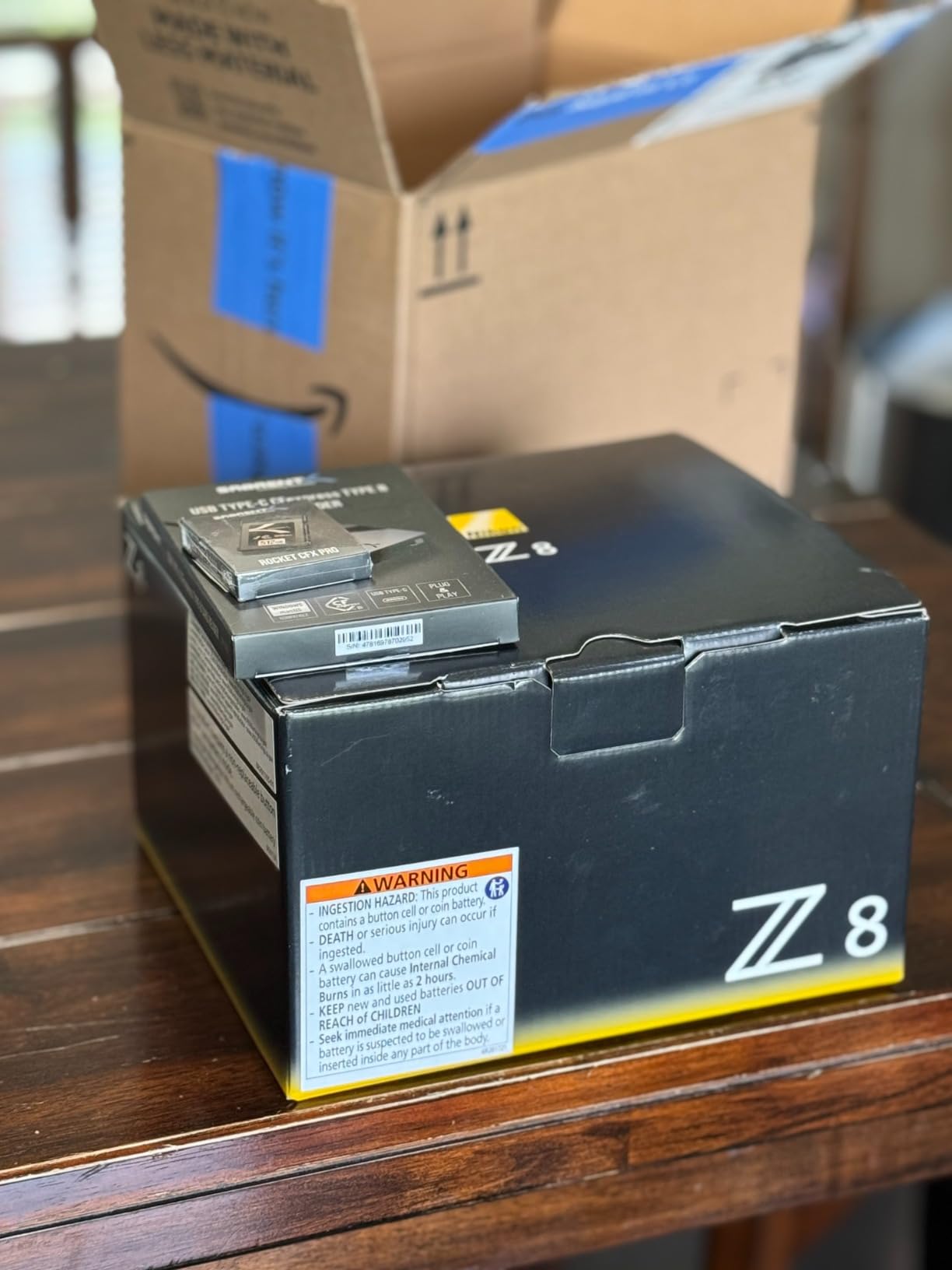
The Z 8 is for the sessions where vibration and sound are a genuine risk — a fragile or very valuable piece that you do not want to tap with a mechanical shutter, or a quiet house where a working camera would be intrusive. It has no mechanical shutter at all, so shooting is silent, and a sensor shield closes when the body is powered off so changing a lens does not expose the sensor.
The 45.7 megapixel stacked BSI sensor is the same class of resolution as the D850, and it reads out fast enough that frames do not drift between stack positions. Deep-learning subject detection works down to minus 9 EV with 3D tracking, which is far past what a tabletop needs and is useful in a dim store.

File format flexibility is underrated for appraisal workflows. Alongside 14-bit RAW you can record 10-bit HEIF and High Efficiency RAW, so a small set of reference images for a catalogue can be half the size of the RAW files with no visible loss, while the RAW stays intact as the record.
Owners also value that existing D850 batteries work and that an FTZ adapter eases the transition from Nikon F glass, so a dealer upgrading from a DSLR can reuse lenses and batteries instead of rebuilding a kit.
Is shutterless shooting a real advantage for antiques?
Yes, in specific cases. A shutterless body sends no mechanical impulse to the stand, so nothing rocks, and on a small piece on a light support that is the difference between a clean frame and one that needs retaking. It is also silent enough for photographing in a private home without a flash.
For most flat items on a solid copy stand the difference is small, so treat it as a bonus rather than the reason to buy.
Where it holds an appraisal workflow back
Power draw is the top complaint — owners report needing multiple batteries for a full day, which matters on a twelve-hour estate job. The menu-heavy configuration also has a steep learning curve, and the bundled quick-reference manual is minimal.
The body dissipates heat less well than larger flagships on long video records, and the smaller sensor format of the flagship line means the lenses are full-frame. Reviewers count only a few hundred ratings so far, so long-term reliability reports are thinner than for the established bodies in this list.
How to Choose a Camera for Antique Appraisal Photography
Rank the following in this order and the choice makes itself: focus magnification, screen articulation, sensor resolution, light tolerance, and everything else. The camera body is the fifth decision after the lens, the stand and the lights, but it is the one most people buy first, so it is worth being clear about why it ranks where it does.
Choose the sensor format second, not first
A larger sensor gives cleaner files in dim light and more room to crop, but the difference matters far less than most comparisons suggest because a 1:1 macro lens on a 45.7 megapixel full-frame sensor already resolves well past the detail a printed appraisal report needs. Reviewers of these bodies regularly note that the resolution gap only shows when cropping hard into a sub-millimetre mark.
Where format genuinely changes your work is working distance. Full-frame bodies pair naturally with 90mm and 100mm macros, which give enough clearance to put a light between the lens and the subject. Compact bodies with shorter mounts are often paired with shorter macros that sit closer to the item, which is where collisions happen.
Look for a focus shift or bracketing mode
At 1:1, depth of field is measured in millimetres regardless of body. A focus shift mode moves focus through the subject by a fixed step for a set number of frames, and merging those frames in software produces an image sharp from front to back.
Not every body here has it, and that is worth checking before you commit. Focus rails make the same result possible manually, but an automated mode is faster and more repeatable, which is what you want when photographing a hundred similar items in a day.
Screen articulation decides how you will work
A tilting screen handles rings, mounted jewellery and three-dimensional objects. A vari-angle or fully articulating screen handles flat items shot from above without a right-angle finder. If your work is mostly flat — coins, banknotes, prints, documents — budget for an articulating screen or a right-angle viewfinder, because a tilting panel alone will not get you there.
Colleagues photographing in the field and on the road often start with a body rather than a shooting plan; our vintage and antique store photography guide covers how those two routines differ.
Light tolerance matters more than frame rate
Nothing in an appraisal session is moving, so 8 fps versus 15 fps changes your waiting time and nothing else. Low-light performance changes your results. A body that holds clean files at a higher ISO lets you work in a dim room without adding a light, and clean files mean the colour of a silver surface or a patina is recorded rather than invented by noise reduction.
That is the argument for the R6 Mark II in an estate, and it is a stronger argument than burst rate in any appraisal workflow.
Set a custom white balance and never touch it again
Shoot RAW, set a custom white balance from a grey card under your final lighting, and keep that setting. Every subsequent session in the same tent produces comparable colour, which is what allows a report to argue about condition rather than about lighting.
File naming matters just as much. A convention such as date, item code, view type and sequence — for example a date, a lot number, a view code for obverse or reverse or detail, and a frame number — keeps evidence connected to the object weeks later, when the report is written.
Consider used bodies carefully
The second-hand market is full of exactly the bodies in this article, and the advice from coin and collectible photography communities is consistent: inspect the sensor, check the lens for fungus and haze, and confirm the shutter count. Older DSLR bodies in particular remain a sensible way into 1:1 macro work because used macro lenses of the 100mm type are plentiful and the bodies they mate with are widely supported.
Buy a body only after you have a lens that reaches 1:1, and buy the lens only after you have a stand. An inverted body on a decent stand beats an expensive body gripped in the hand every time.
Macro Lenses, Lighting and Copy Stands for Appraisal Work
Three accessories determine whether your images are usable, and none of them is a camera. Budget here first, and the body decision becomes much easier.
A true macro lens. A close-up or zoom labelled macro often only reaches 1:2, which is not true macro. For appraisal you want 1:1 reproduction, and a 90mm or 100mm focal length is the usual choice because it gives enough working distance to fit a light between the lens and the subject. A 60mm sits closer and collides more often; the community consensus is to spend the extra distance.
A rigid support. A copy stand with a vertical column keeps the camera plane parallel to a flat subject, which is exactly what focus stacking assumes. If you use a tripod instead, you need a macro rail to move the camera in single millimetre steps, and you must repeat that movement identically for every frame in a stack. Hand-held shooting at 1:1 does not work for evidence photographs.
Controlled light. Two diffused sources at roughly 45 degrees either side of the subject is the standard starting point. Black flags or cards placed opposite each light kill the reflections that otherwise erase a hallmark or a proof surface, and a grey card sets your white balance. Silver and polished gold behave differently from ceramics and glass, and the light that reveals a glaze crack can erase a reflective rim, so adjust per material rather than per session.
For a broader view of bodies that suit controlled environments, our mirrorless camera guide covers sensor and handling basics, and our point-and-shoot picks show what a fixed lens can and cannot do when you need to work fast and close.
A phone with a clip-on macro lens and a small stand is a reasonable documentation tool for your own collection, and it is what most people start with. It is not what you hand an insurer when a claim is being argued, and the jump to a dedicated body is usually triggered by the first rejected claim rather than by the photographs themselves.
Frequently Asked Questions
What is the best camera to take pictures of coins?
For coin work, resolution and close-focus precision matter most. A 45 megapixel full-frame body such as the Canon EOS R5 or the Nikon D850 resolves edge lettering, tool marks and hairline scratches that smaller sensors miss, and a true 1:1 macro lens is still the essential part of the kit. Shoot RAW, light the coin from both sides with diffusion, and use black cards to control reflections.
What is the best camera to use for jewelry photography?
A body with in-body stabilisation and an articulating screen is ideal for jewellery, because you often shoot mounted pieces at odd angles rather than flat. The Canon EOS R5 and the Canon EOS R7 both give you a fully articulating or tilting screen plus stabilisation, while the Nikon D7500 covers the same ground with a lighter APS-C sensor. Add a 90mm or 100mm macro lens and two diffused lights.
What is the best camera for close-up shots?
Any mirrorless or DSLR with magnified live view, a tilting or articulating screen and manual focus control will do the job, and the sensor only needs to resolve the detail you intend to record. For close-ups of items under about 2cm, prioritise resolution and focus magnification over burst rate or video features.
What kind of camera do you need for macro photography?
A mirrorless or DSLR body that shoots RAW, offers magnified live view for manual focus, and can be mounted rigidly on a copy stand or macro rail. In-camera focus stacking is a useful addition but not essential, since a rail and a stacking workflow produce the same result. The lens matters more than the body: look for true 1:1 reproduction at 90mm or 100mm.
What is the best budget camera for macro photography?
A used DSLR generation with a 100mm f/2.8 macro is the classic low-cost route into true 1:1 work, and that combination appears repeatedly in collector recommendations. Among current bodies, the Sony a6400 and the Nikon D7500 cover the essentials at APS-C resolution. Spend what you save on a copy stand and diffusion, which improve results far more than a body upgrade.
Do I need a copy stand for coin photography?
Yes, for anything that must be repeated. A copy stand keeps the sensor plane parallel to a flat coin across every frame, which is what focus stacking assumes and what makes obverse and reverse shots comparable. A tripod with a macro rail is a workable alternative, but hand-held shooting at 1:1 will not produce usable evidence images.
Can I use my phone for appraisal photos?
A phone with a clip-on macro lens and a small stand is fine for your own records and for a quick listing. It falls short for insurance schedules, auction submissions and authentication work, where sub-millimetre detail and repeatable framing decide the outcome. If those reports are part of your work, budget for a dedicated body, a true macro lens and a rigid support.
Final Verdict for Antique Appraisal Photography
Our pick for the best cameras for antique appraisal photography in this group is the Nikon D7500, taking the top slot on rating, review volume and the combination of a tilting touchscreen, 51 point autofocus and an ISO range that keeps silver surfaces clean. It handles coins, jewellery, ceramics and furniture with one body, and its price sits well below the full-frame options.
Buy the Canon EOS R5 when authenticity is the question and resolution decides the outcome. Choose the Sony a6400 when a capable close-up body matters more than anything else in the budget, and the Canon EOS R6 Mark II when the work happens in dim rooms. The Sony a7R III suits flat static subjects that reward pixel shift, the Canon EOS R7 handles multi-piece layouts best, and the Nikon Z 8 covers the sessions where silence and vibration are a real concern.
Whichever you pick, spend what remains on a 1:1 macro lens, a copy stand and diffusion. Those three turn a good body into evidence-quality images, and they matter more in 2026 than any generation of camera body ever has.