
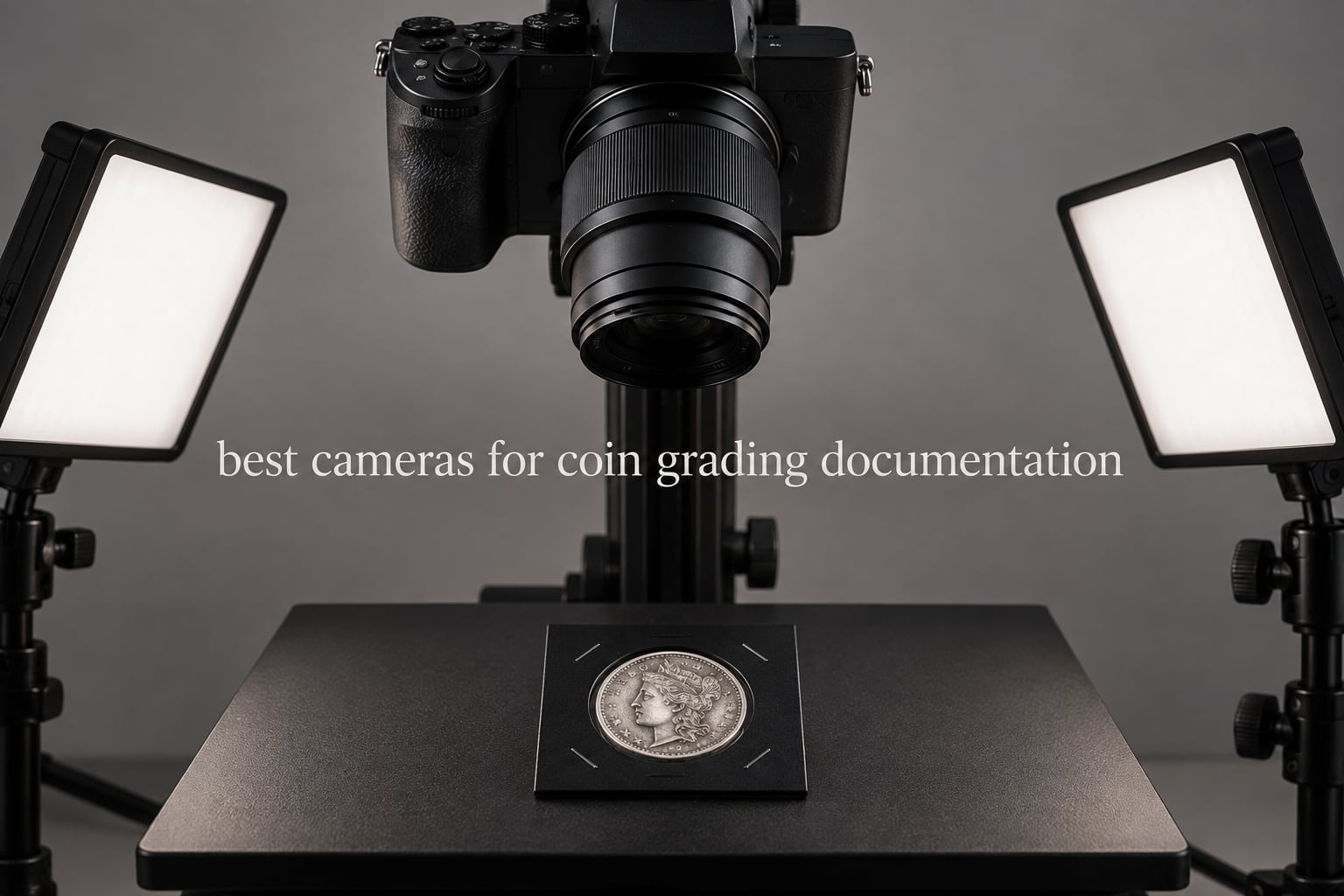
Most camera roundups about coins are written for sellers listing coins online. This one is written for the harder job: photographing a coin so a grading service, a dealer, an insurer or an estate lawyer can read the coin from the images alone. That is the whole brief behind the best cameras for coin grading documentation, and it is a narrower and more demanding one than general coin photography.
The criteria are not frame rate or video specs. They are true 1:1 macro magnification, enough resolution to separate a coin that earns MS-68 from one that earns MS-69, colour accuracy honest enough to judge natural toning, and a body that can sit on a copy stand for hours while you shoot an obverse, reverse and edge set that shares identical lighting, exposure and white balance. My selection logic here is the same one I use for our guide to cameras for evidence documentation, because both jobs share one demand: the image has to be defensible.
Let me be honest about phones first. A modern phone makes perfectly presentable listing photos, and collectors report being unable to rule out the micro-hairlines that separate MS-68 from MS-69 from a phone image at arm’s length. That is fine for a marketplace listing and not fine for grading documentation. Everything below is a body you can put on a rail or a stand with a dedicated macro lens and daylight-balanced lighting.
Top 3 Picks for Best Cameras for Coin Grading Documentation in October
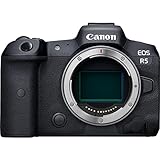
Canon EOS R5
- 45MP stacked full-frame sensor
- 1053 AF points with near full coverage
- CFexpress Type B plus SD UHS-II dual slots
- 5-axis sensor-shift IBIS

Sony Alpha 7 IV
- 33MP Exmor R full-frame sensor
- 5-axis SteadyShot stabilization
- 14-bit RAW capture
- tilting rear screen for overhead work

Canon EOS R6 Mark II
- 24.2MP full-frame CMOS sensor
- 40 fps electronic at 20MP
- Dual SD UHS-II slots
- 1.62 million dot vari-angle screen
The R5 leads because it holds a 4.7-star rating across the deepest review history of any body here, and because its card slots and screen both suit long documentation runs. The Alpha 7 IV is the version of that idea with less resolution and less weight, which many collectors prefer for hours of steady work. The R6 Mark II is the pick if your budget goes further into a macro lens than into a body, because the lens decides more than the sensor does.
Best Cameras for Coin Grading Documentation in 2026
| Product | Specifications | Action |
|---|---|---|
| Canon EOS R5 |
|
Check Latest Price |
| Sony Alpha 7 IV |
|
Check Latest Price |
| Canon EOS R6 Mark II |
|
Check Latest Price |
 Canon EOS R7 Canon EOS R7 |
|
Check Latest Price |
 Nikon Z 7II Nikon Z 7II |
|
Check Latest Price |
 Nikon Z 8 Nikon Z 8 |
|
Check Latest Price |
 Sony Alpha 7R V Sony Alpha 7R V |
|
Check Latest Price |
 Nikon Z6 III Nikon Z6 III |
|
Check Latest Price |
 Sony Alpha 7R IV A Sony Alpha 7R IV A |
|
Check Latest Price |
 Panasonic LUMIX S5 Panasonic LUMIX S5 |
|
Check Latest Price |
What a Grading Service Actually Needs to See
A hairline is the fine scratch in a coin’s field or across the device that most often separates MS-69 from MS-70 on the 1 to 70 Sheldon scale. A bag mark is a contact scuff from the soft bag the coin travelled in. A mint mark that looks like a blob instead of a character means the strike was weak, and weak strike can pull a grade on its own.
Luster is the rotating bands of light you see when you turn a coin under a fixed light source, and numismatists call that the cartwheel effect. It comes from radial flow lines in the metal surface left by the die at the mint. A hairline catches raking light and casts a shadow; luster only appears when the light arrives close to the camera axis, which is why one frame of a coin rarely settles the question.
Three other terms matter before you compare bodies. One-to-one magnification means the coin renders at life size on the sensor, which is the working standard for anything beyond casual listing work. Axial lighting arrives from the same direction as the lens and reveals surface detail without harsh reflections. Raking light sits nearly parallel to the coin and throws shadows across surface texture, which is how you find hairlines that a frontal panel light hides completely.
Focus stacking is combining frames at different focus distances into one image, and it is how a high-relief coin or a deeply struck one gets front-to-back sharpness at f/8 to f/11. Once you know that luster needs axial light, hairlines need raking light, and both need a fixed setup so the obverse and reverse frames match, camera choice gets much simpler to reason about. That is the lens of judgement I applied to the ten bodies below.
1. Canon EOS R5 – Best Balanced Body for High-Value Documentation
Pros
- 45MP stacked sensor holds micro-hairline detail at 1:1
- 1053 AF points cover almost the whole frame for fast re-framing
- 5-axis IBIS steadies handheld stack work
- dual high-speed slots protect a documentation run
- fully articulating screen for overhead copy-stand framing
Cons
- Battery drains quickly with the viewfinder at high refresh
- Body runs warm during long 8K recordings
- No dedicated control for the rear screen
This is the body I recommend first when the deciding factor is whether a hairline shows up. Its 45MP stacked backside-illuminated full-frame sensor sits in the upper tier of resolution here, and stacked construction means the sensor reads out fast enough that stacking frames is not a waiting game. Paired with the Canon RF 100mm f/2.8 L Macro IS USM it renders a large cent at life size with the field texture still holding detail.
The 1053-point Dual Pixel CMOS AF system covers almost the entire frame with Eye Control AF and subject detection, which matters more than it sounds: a coin sits in one plane and is completely static, so a single press-and-hold focus is often faster than fighting contrast detect at extreme close focus. The 3.2-inch tilting capacitive LCD at 2,100,000 dots is the screen you want when the body is bolted to a rail and the coin is under it.

Card slots are a documentation decision more than a video one. The R5 writes CFexpress Type B alongside UHS-II SD, so a graded set of several hundred coins can be split across two card types rather than risking one card across a whole estate. ISO runs 100 to 51200 with expansion to 102400, and at ISO 100 the files are clean enough to grade shadows and specular highlights on polished fields.
The practical drawback is battery life. Owners repeatedly report that the electronic viewfinder at high refresh is what drains the pack, so a full estate-day cataloguing run means spare batteries in the bag. The body also runs warm during long 8K recordings, which is irrelevant to a stills workflow and easy to forget you care about.

Where the R5 earns its place
It is the pick when you photograph high-value coins where one grade point carries real money, and when you want a 14-bit-class RAW with room to recover a blown specular highlight on a proof field. The 5-axis IBIS also makes handheld macro plausible when you are not on a stand at all, such as at a coin show table or an estate kitchen table.
At 1.6 pounds it is portable enough for field work without being a compact body, and the RF mount has a genuine 100mm f/2.8 macro and a 90mm option, so lens availability is not the reason to look elsewhere.
Where it disappoints
If your work is a long evening of stacking and printing, the battery drain becomes the bottleneck rather than the sensor. Canon’s menu structure also has a learning curve for anyone arriving from a long period with a DSLR, and reviewers mention the missing rear-screen power control more often than the spec sheet suggests they should.
Choose the R6 Mark II instead if you plan to spend your surplus budget on a macro lens and a copy stand rather than on resolution you will not crop into.
2. Sony Alpha 7 IV – Best All-Rounding Body for a Copy Stand
Pros
- 33MP full-frame files with strong dynamic range and colour
- 14-bit RAW leaves latitude for toning correction
- 5-axis stabilization supports steady close-up work
- tilting screen aids overhead framing
- dependable eye autofocus for re-framing
Cons
- Resolution sits below the 45MP and 61MP bodies here
- Modest buffer depth for long sequences
- CFexpress Type A media adds running cost
The Alpha 7 IV is the body I suggest when someone wants one camera to cover grading documentation, auction lots and general shooting without thinking about it. The 33MP Exmor R back-illuminated full-frame sensor gives 14-bit RAW files, and reviewers consistently single out its colour rendition and dynamic range as the reason it is the default recommendation for close-up work at this level.
Five-axis SteadyShot sensor-shift stabilization supports steady handheld macro, which is what you use when a coin has to be photographed in a holder on a kitchen table rather than on a stand. The 3-inch tilting LCD at 1,036,800 dots flips for overhead work, and the 759-point Fast Hybrid AF with Real-time Eye AF handles quick re-framing between the hero shot and the detail crops.
Colour accuracy is where this body quietly helps. Natural toning on a silver piece or an attractive patina on a bronze is a valuation signal, and a RAW file with a good base white balance set from a grey card under fixed daylight-balanced light gives you something defensible to correct against rather than a guess.
The 0.78x electronic viewfinder and 10 fps shooting are unremarkable for coins, which is the point. What you are buying here is a sensor, a screen that moves, and a lens mount with an excellent 90mm f/2.8 Macro G available.
What to check before choosing it
If you plan to print or crop heavily, 33MP is below the resolution of the R5, the Z 7II and the 61MP bodies, and that is the whole argument for spending more. The burst buffer is also modest, which is irrelevant on a stand and mildly annoying at a show floor where you want a short run of alternative angles.
CFexpress Type A cards are the running cost people forget. Budget for media alongside the body and the macro lens.
When to look elsewhere
Skip it if your coins are high-value and small, where resolving a mint mark is the whole job and you will want every pixel. In that case the R5 or the Z 7II is the honest answer, and the Alpha 7R V if you already have a Sony body and a fast macro lens.
3. Canon EOS R6 Mark II – Best Dual-Slot Workhorse
Pros
- Dependable subject detection and eye AF for re-framing
- 5-axis stabilization for steady close-up work
- Dual SD UHS-II slots for long cataloguing runs
- Light balanced body for long sessions
- 14-bit files with clean shadows
Cons
- 24.2MP resolution is the lowest here for heavy cropping
- Dual SD only with no CFexpress option
- Autofocus can hunt at very close focus
This is the value pick in the truest sense, because in a coin setup the macro lens and the copy stand routinely cost more than the body does. Putting the surplus into a 100mm f/2.8 macro and a decent light panel instead of into extra megapixels is the better trade for most documentation work.
The 24.2MP full-frame CMOS sensor with Dual Pixel CMOS AF II handles head, face, eye and whole-body detection, which is more useful than it sounds because a coin on a flip is a static, symmetrical subject that autofocus can lock onto from a fixed position. The 0.5-inch 3.69 million dot OLED viewfinder refreshes at 120 fps, and the 3.0-inch 1.62 million dot vari-angle touchscreen swings out for overhead copy-stand framing.

Two UHS-II SD slots is exactly the arrangement a cataloguing session needs. Shoot a matched obverse and reverse set to both cards, and a card failure at the end of a 400-coin day costs you one angle rather than the run. The 5-axis in-body sensor-shift IS is rated for steady handheld close-up work where no stand is available.
ISO 100 to 128000 with expansion to 50 keeps the base ISO clean for coin surfaces, where fine metal texture and low-contrast toning are the first things noise ruins.

What this body does well
It is the one I suggest to a dealer photographing inventory all week. The body is light and balanced, the screen is large and fully articulating, and nothing in the specification fights a static subject on a stand. Battery grip and accessories are separate, so budget for a second battery if you shoot long batches.
Continuous shooting at 40 fps electronic at 20MP is wasted on coins but harmless, and it does help if you are photographing a tray of coins quickly for inventory.
Where it falls short
24.2MP is the limiting factor. If you want to frame a whole slab of 2×2 holders and crop into a die variety at 1:1 afterwards, you are asking a lot of an already small file. A few users also report the autofocus hunting at very close focus distances, which is another reason to work manual with a focus rail.
There is no CFexpress slot, so a high-bitrate RAW workflow is not available. For stills that is not a problem.
4. Canon EOS R7 – Best Lightweight Body for Show-Floor and Estate Work
Pros
- Compact and light for field documentation
- 32.5MP detail with extra crop reach
- 5-axis stabilization for handheld stacks
- Dual UHS-II SD slots for matched sets
Cons
- APS-C gives less light and shallower depth than full frame
- 10-bit RAW is less flexible than 14-bit
- Body-only purchase means no lens included
Documentation work does not stop at the bench. Estate inventories, insurance photographs and coin show tables all need a body that is actually portable, and the R7 is 1.1 pounds with a 32.5MP APS-C sensor and 5-axis in-body IS with auto-level. Auto-level matters more than it sounds: on a show table the coin is rarely square to the sensor, and a tilted horizon in an insurance set looks careless.
Autofocus is Dual Pixel CMOS AF II across 651 zones with detection down to EV -5.0, and 15 fps mechanical or 30 fps electronic shooting means you can grab a short run of slightly different angles for luster comparison without thinking about buffer depth.
Canon’s RF-S mount gives you the option of an RF 100mm f/2.8 macro at 1:1, and because APS-C crops, that lens on this body behaves like a longer macro with extra working distance. For a high-relief coin that is a genuine advantage, not a compromise.
The 3-inch 1.62 million dot tilting touchscreen and the 0.76x to 1.15x magnification electronic viewfinder are both more than adequate for judging a hairline at 1:1 on screen.

Where it works well
Insurance and estate documentation is the use case this body fits best. You are walking rooms with a camera, not sitting at a bench, and a stabilized 32.5MP file at ISO 100 in a small body means you can photograph a coin in whatever holder it has been sitting in for forty years.
It is also a strong second body if your main system is already full-frame and you want a cheap dedicated field body.
Where it costs you
APS-C collects less light, so at f/11 on a deep coin you will need longer exposures and a patient tripod, and shallow depth of field is harder to hold across a high-relief design. The 10-bit RAW is also less forgiving than the 14-bit files elsewhere, which limits how far you can pull back a slightly underexposed toning field.
If your work is a dedicated bench and every shot is stacked, buy the full-frame body and put the money saved into a macro lens.
5. Nikon Z 7II – Best for Long Cataloguing Sessions on USB Power
Nikon Z 7II | Ultra-high Resolution Full-Frame mirrorless Stills/Video Camera | Nikon USA Model
Pros
- 45.7MP files hold detail after heavy cropping
- Good colour straight out of camera and low noise
- Dual card slots across two formats
- USB-C constant power suits long sessions
- Large buffer for long shooting runs
Cons
- Subject tracking lags newer Nikon bodies
- Older-generation menu structure
- 4K60 is cropped compared with newer models
The Z 7II is the body that makes sense when the photography is the job rather than a hobby. Forty-five point seven megapixels of full-frame detail at ISO 64 to 32000 expandable, dual EXPEED 6 processing, and 14-bit RAW files give you enough room to crop a single die variety out of a group shot and still judge its wear.
What separates it for cataloguing is USB-C constant power and charging. Photographing a 2,000-coin estate in batches, you can run the body from a power bank between shifts and stop counting batteries. It also supports F-mount NIKKOR glass through the FTZ adapter, so an existing 105mm macro carries over.

Nikon’s colour rendition is regularly praised by owners, which matters when a coin’s natural toning is the difference between two valuations and you are setting a custom white balance from a grey card under fixed light. The 3.2-inch tilting touchscreen at around 2,100,000 dots is a 90-degree panel, which is what a rail-mounted overhead workflow actually needs.
Card slots take CFexpress or XQD in one and UHS-II SD in the other, so you can mirror an estate documentation set to two media formats simultaneously.

What to verify before buying
Nikon’s 493-point phase-detect AF is competent but the subject tracking and low-contrast behaviour trail newer bodies. On a static coin on a rail you will be in manual focus anyway, so this matters less than the spec sheet implies. It matters more if you also shoot live auction lots.
There is no HEVC compression, so video files are large, and the 4K60 mode is cropped. Both are irrelevant to a stills documentation workflow.
When to pick the newer Z 8
If you want the same resolution with a stacked sensor, far faster readout, and a shutterless design that removes vibration entirely during stacking, the Z 8 is the step up. If your sessions are long and tethered, the Z 7II’s constant power support is the reason to stay.
6. Nikon Z 8 – Best for Vibration-Free Focus Stacking
Nikon Z 8 | Professional Full-Frame mirrorless Stills/Video Hybrid Camera
Pros
- Shutterless design removes shake during stacking and bracketing
- Sensor shield protects the sensor during lens changes
- 45.7MP stacked sensor reads out fast
- Deep-learning AF detects down to -9 EV
- Multiple RAW formats including High Efficiency RAW
Cons
- High battery consumption needs multiple spares
- Steep learning curve in the menu system
- Single CFexpress Type B slot rather than dual high-speed slots
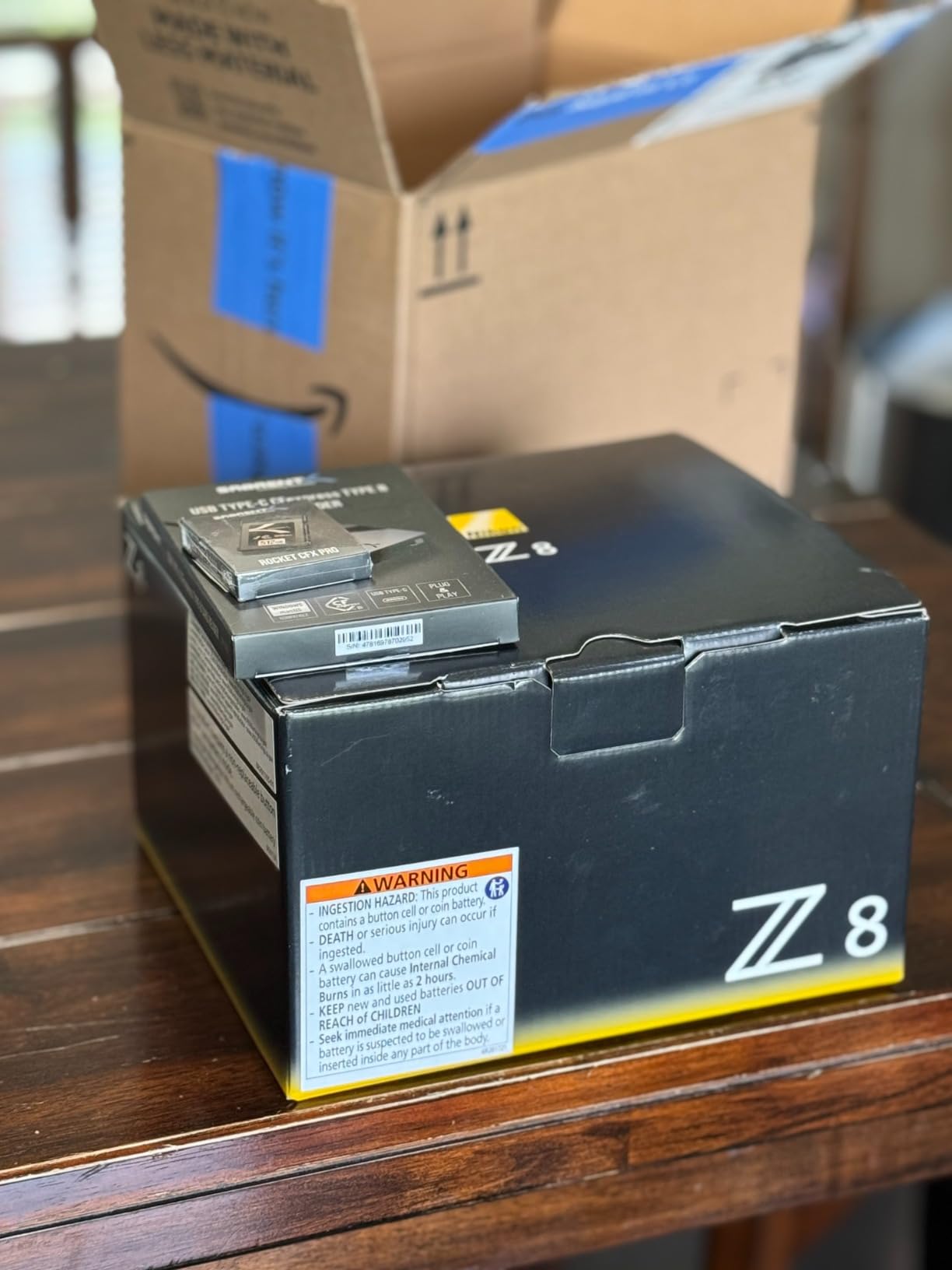
There is a specific vibration problem in coin stacking that most buyers never think about. On a copy stand, the mechanical shutter moves when you fire it, and at f/11 with a live coin on a flip the micro-blur that causes is enough to soften the very hairline you paid for the setup to resolve. The Z 8’s shutterless design removes that source of shake entirely.
The 45.7MP stacked full-frame CMOS sensor with EXPEED 7 reads out quickly, so a 20 to 30 frame stack of a high-relief coin completes in seconds rather than minutes. RAW is available in 14-bit, High Efficiency RAW and 10-bit HEIF, so you can trade file size for capacity on long cataloguing days.

The sensor shield closes when the body powers down, which addresses the dust-and-static problem practitioners complain about most. Static cling on a coin attracts lint, and the same static pulls dust onto an exposed sensor, so two problems share one cause and the shield halves the risk.
AF detection down to -9 EV with 3D tracking is engineered for people, animals, vehicles and aircraft, none of which appear on your stand. Read it as a sign of how much processing headroom the body has rather than a coin feature.
What this body fixes
Stacking consistency is the reason to choose it. When obverse and reverse frames are captured with no shutter movement, you can align and merge them into a matched documentation set and the micro-contrast stays consistent between the two halves of the submission.
Max shutter speed of 1/32000 also lets you stop a fan or a busy hand from moving the coin mid-exposure at low ISO.
What you accept for it
Battery consumption is high and reviewers recommend carrying multiple spares. The menu system is deep enough that a new owner should budget an evening of setup, and the printed quick-start manual is minimal.
There is a single CFexpress Type B slot rather than two high-speed slots, so a documentation run cannot be mirrored to two fast cards at once. Mirror to the SD slot and understand the speed difference.
7. Sony Alpha 7R V – Best for Die-Level Detail and Vari-Angle Framing
Pros
- 61MP resolves the finest surface texture and die detail
- Pixel-shift multi-frame modes add effective resolution
- Multi-angle flip screen suits overhead copy-stand work
- BIONZ XR with a dedicated AI unit
- Strong dynamic range for reflective metal
Cons
- Larger and heavier than earlier R-series bodies
- Higher battery consumption
- CFexpress Type A media is expensive
At sixty-one megapixels this is the highest-resolution body in the group, and resolution is what resolves a doubled-die obverse or a fine die crack on a late-strike issue. The back-illuminated Exmor R sensor plus BIONZ XR and a dedicated AI processing unit give 14-bit files with the headroom to crop into a full-frame group shot and still read a mint mark.
For a bench workflow the multi-angle flip-out touchscreen is the feature to notice. It swings further than a simple tilting panel, so you can frame from the side of a copy stand or from directly above without crouching, and the 0.9x 9.44 million dot OLED viewfinder makes checking a hairline on screen far more comfortable than on a small panel.

Pixel-shift multi-shot and multi-frame modes combine several frames into a higher effective resolution file. That is the direct route to die-level documentation of varieties and doubled dies, and it is the closest a conventional body gets to what a digital microscope does.
ISO 50 to 102400 with strong dynamic range means a proof coin’s mirror field can be exposed to keep the reflection without clipping the device, which is the hardest exposure problem in the whole subject.

Where the extra pixels pay
Die-level and variety identification, and any coin where a single mark decides a grade. The 60MP, 26MP and 15MP image size options also let you drop to a smaller file when you are cataloguing hundreds of coins that do not each need maximum detail.
Already on Sony E mount, the 90mm f/2.8 Macro G gives a genuine 1:1 pairing with enough working distance for a two-stack.
Where it does not
This is a large, heavy body at 16 ounces of listed weight plus lens, and it is not a portable documentation camera. Ten fps is slow by general standards and irrelevant on a stand. Reviewers also note higher battery consumption and premium CFexpress Type A media as running costs.
If you are photographing a room, not a coin, use something smaller. If you already own a 33MP body and are not chasing varieties, the marginal resolution may not repay the jump.
8. Nikon Z6 III – Best for Judging Toning in a Bright Room
Nikon Z6 III, Black | Full-Frame Mirrorless Stills/Video Camera with 6K/60p Internal RAW Recording | USA Model
Pros
- 4000 nit viewfinder stays readable in bright rooms
- DCI-P3 viewfinder gamut for colour-critical judgement
- Pixel-shift composite mode adds resolution
- Weather sealing suits show and field work
- Custom Picture Controls uploadable from NX Studio
Cons
- 24.5MP offers little cropping headroom for fine detail
- Deep complex menus take a long time to learn
- Small body for average-sized hands with a single battery slot
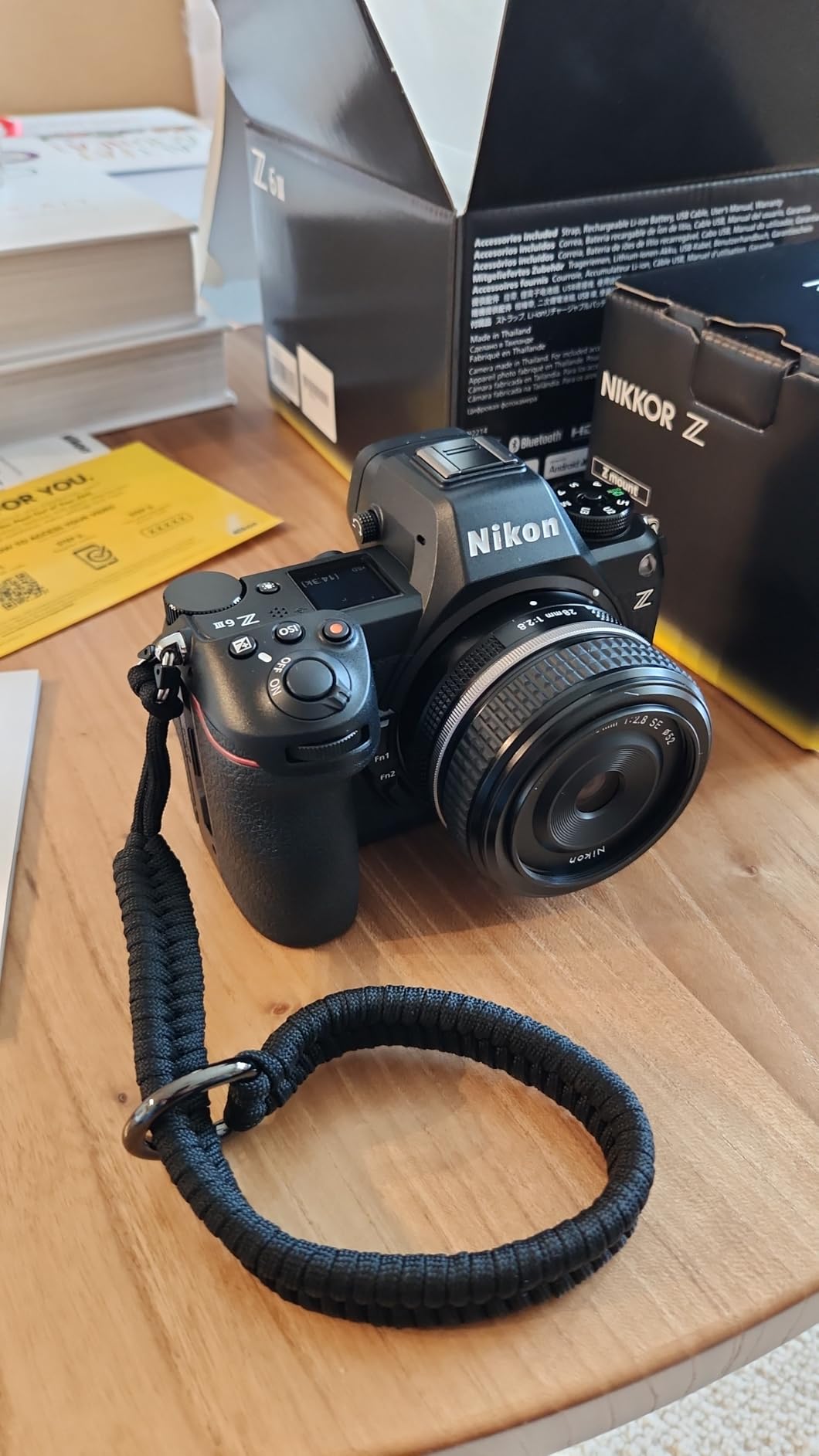
Judging toning is a viewing task before it is a photographing task, and this body is built for the viewing side. Its 4000 nit maximum brightness electronic viewfinder at 5760k dots with a 120 fps refresh and DCI-P3 gamut stays clear and colour-accurate in a bright room, which is exactly the situation when a dealer hands you a toned coin across a desk.
The 3.2-inch articulating screen is the other half of that argument. It flips out far enough to check a slab from an angle rather than squinting at a flat panel, and Custom Picture Controls can be uploaded from NX Studio so a calibrated look travels with the body.

A partially stacked 24.5MP full-frame sensor records 6K/60p N-RAW internally, which is video capability you will not use, but the readout speed also feeds the pixel-shift composite mode for added effective resolution when a single die detail matters.
Weather sealing makes this the body I would choose for a show floor or an outdoor estate where a light drizzle is possible and you cannot protect a bag of gear.
What makes it a documentation pick
Colour-critical work on attractively toned modern issues, where natural toning adds real premium value and a misjudged white balance destroys the evidence. Reviewers describe a bright viewfinder and accurate colour as the reason it feels expensive on the bench.
AF detection down to -10 EV and multi-subject recognition are fast, even if the deep, complex menu and dial layout is the part reviewers complain about most.
When to skip it
Twenty-four and a half megapixels is the lowest resolution of the full-frame bodies here, and that is a real limit when your method is crop-into-the-file. There is no high-bitrate RAW workflow, so it suits stills documentation rather than video-first production.
Some owners also cite a small body for average hands, a single battery slot, and occasional autofocus hesitation in very low light. If you photograph by loupe under a lamp, that is enough to point you at the Z 8 instead.
9. Sony Alpha 7R IV A – Best for Highlight Retention
Pros
- 15 stops of dynamic range protect mirror-field highlights
- 61MP resolves fine surface texture
- 14-bit uncompressed RAW gives maximum latitude
- Pixel Shift Multi Shooting for composite detail
- Real-time Tracking and Eye AF for quick reframing
Cons
- 10 fps drive rate is slow by current standards
- Weather sealing and grip are dated
- Battery endurance trails newer Sony models
The a7R IV A is the pick when your problem is a proof coin. Fifteen stops of dynamic range from a 61MP back-illuminated Exmor R sensor means you can expose a mirror field so it holds highlight detail instead of clipping to white, and still recover shadow detail in the rims and lettering where bag marks hide.
14-bit uncompressed RAW is the quiet headline. On toned silver where the toning gradient across a field is the evidence, a 14-bit file gives you far more room to neutralise the cast before you judge it than an 8-bit JPEG ever will.

Pixel Shift Multi Shooting combines frames for a composite high-resolution capture, which is the cheapest route to die-level detail if you already own the body. The 5.76 million dot 0.78x OLED viewfinder is fine for checking a hairline, and 5-axis SteadyShot INSIDE covers handheld macro.
Dual UHS-II SD slots let you mirror an obverse, reverse and edge set to two cards without needing fast media.

What to weigh up
It delivers the same 61MP class of detail as the a7R V with less processing behind it, and that is genuinely enough for grading documentation because a coin is a static subject on a stand. 10 fps is slow and battery endurance is average, neither of which matters on a copy stand.
Dual SD rather than CFexpress keeps media costs down, which is a quiet advantage for someone shooting several hundred coins a week.
When to choose the newer body
The a7R V is the natural upgrade with a much brighter, larger viewfinder, a much more flexible multi-angle screen and faster processing. If you are buying new and intend to keep the body for years on documentation work, the newer body is the better long-term buy; if you already own one and the 61MP is doing its job, replace it for the sensor and not the menus.
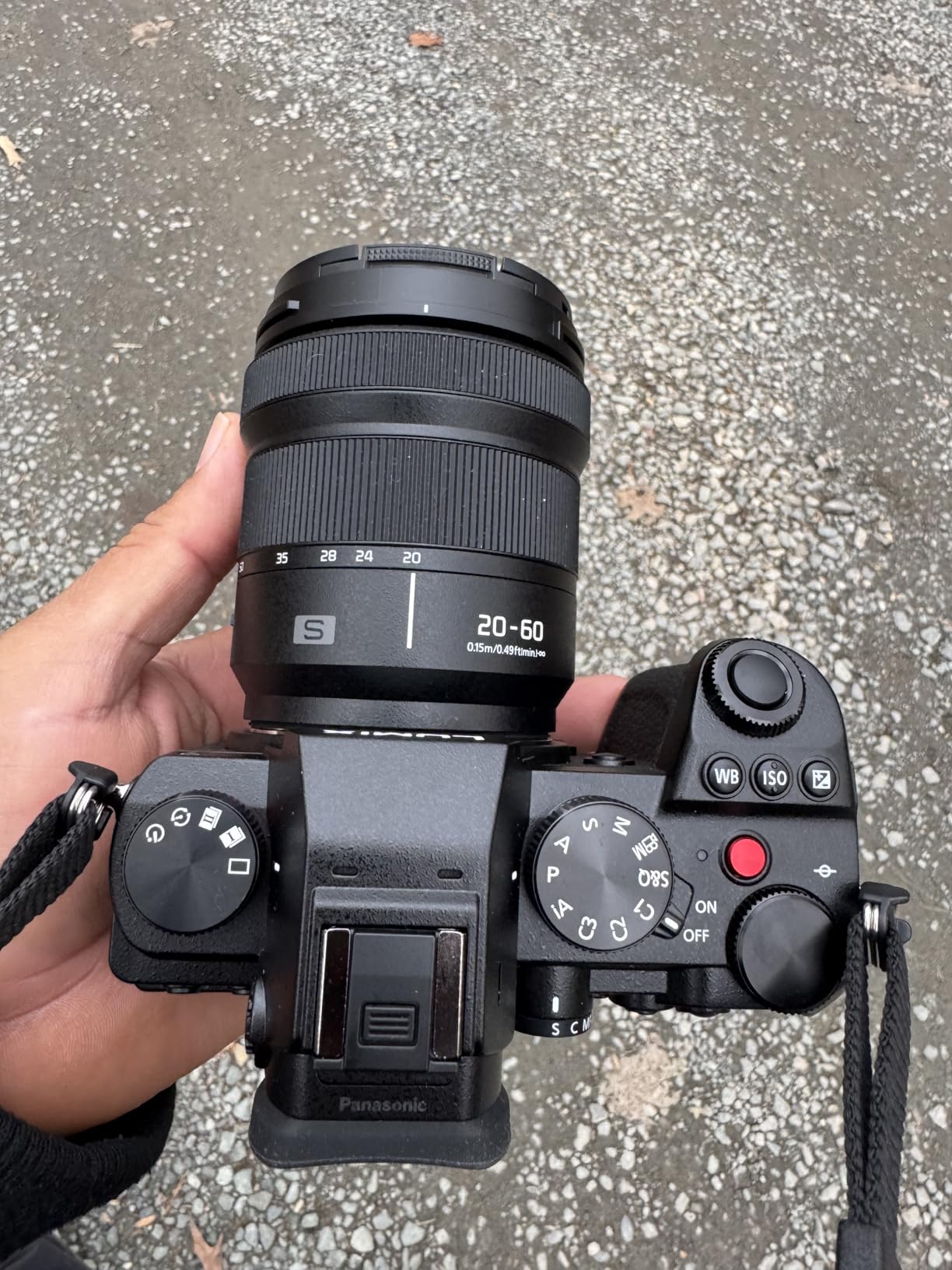
10. Panasonic LUMIX S5 – Best Built-in Focus Stacking
Panasonic LUMIX S5 Full Frame Mirrorless Camera, 4K 60P Video Recording with Flip Screen & WiFi, L-Mount, 5-Axis Dual I.S., DC-S5BODY (Black)
Pros
- Live View Composite handles stacking inside the camera
- 96MP High Resolution mode adds fine detail
- 6.5 stops of stabilization steady close-up work
- Focus peaking and deep manual-focus aids
- Full articulating screen for overhead framing
Cons
- Contrast-detect autofocus is weak in low light
- 24.2MP base resolution is modest for cropping
- Limited buffer depth
- Body and grip are large and heavy
The LUMIX S5 is the one here that stacks without a computer. Live View Composite captures a sequence at set intervals and merges them in-camera, and the 96MP High Resolution mode shifts the sensor between frames to build a composite file with more fine detail than the 24.2MP sensor records natively. For a high-relief coin or a deeply struck issue, that removes the single most tedious step in the workflow.
Manual focus aids are unusually deep for a stills body, which is what a focus rail workflow actually needs: focus peaking, and a magnified view for confirming a hairline is sharp rather than merely in focus.
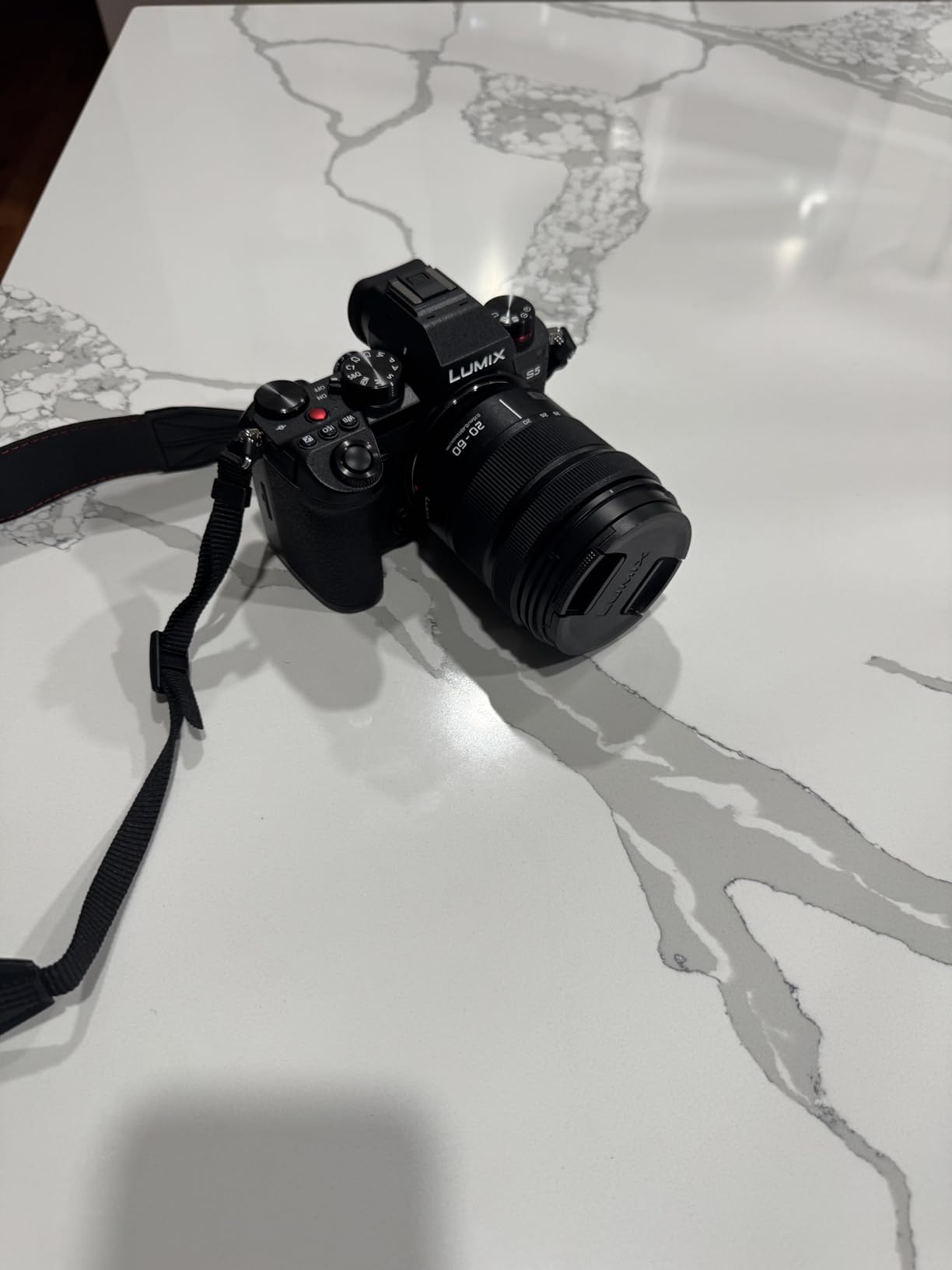
Stabilization is rated at 6.5 stops with the 5-axis Dual I.S. 2 system, the only stabilization figure explicitly rated among these bodies, which makes handheld macro and quick field captures more practical. The 3-inch articulating touchscreen at 1,840,000 dots tilts for overhead copy-stand framing.
Files are 14-bit, and V-Log/V-Gamut with 14+ stops of dynamic range is a stills asset too: it preserves the tonal separation in a proof field better than a standard profile.
Why it earns a place
Documenting a full collection is a volume problem, and in-camera stacking means a weekend of cataloguing does not become a weekend of merging. The 96MP mode also makes it the cheapest route here to die-level detail if you already own the body.
Dual SD slots cover one in UHS-II and one in UHS-I, so mirroring works with different media.
What you give up
Contrast-detect autofocus is the acknowledged weakness, flagged by nearly every reviewer. On a static coin at close focus with a rail, manual is the correct mode anyway, but it does rule this body out if you also photograph live subjects.
Twenty-four point two megapixels is modest for cropping, the buffer is shallow, and the body and grip are large for a full-frame camera. Reviewers also note exposure drift with auto ISO on static scenes, which matters when you are shooting a fixed lighting setup and want identical settings across a set.
Buying Guide: Building a Grading-Documentation Setup
Magnification and working distance decide the lens
One-to-one magnification is the working standard, and beyond that the number that matters is working distance: how much room there is between the front element and the coin. A 90mm to 105mm macro gives you enough space to put a filter, a glass stage or a light panel in the frame without fighting for it. Pairing matters more than brand, so check the mount before the brand.
For a fixed set, the macro lens will consistently cost more than the body. The standing advice from experienced collectors is worth repeating: adding light is cheaper than an f/2.8 lens.
Lighting decides more than the body does
Reflective metal is one of the most frustrating subjects to light, and the recurring complaint in every practitioner thread is glare and false reflections, not resolution. The three arrangements that work are an axial light aimed down the lens axis, two panels at roughly 45 degrees either side to reveal relief, and a raking light almost parallel to the coin to throw shadows across hairlines.
A ring light is the easy answer and the weakest one, because it puts an even, reflection-free wash across the coin that flattens luster completely. If you buy one accessory beyond the macro lens, buy diffused panels or a light tent rather than a faster lens.
The obverse, reverse and edge set has to match
Grading documentation is a set, not a photograph. You need the obverse, the reverse and the edge, and the giveaway of a careless set is lighting that moved between sides. The rule is simple: fix the camera, the lights, the white balance and the exposure, then rotate only the coin. That is why a copy stand and a rail beat a tripod in a documented workflow.
Set a custom white balance from a grey or white balance card in the same light you will shoot in, and never touch it again during the set. Name files so the set stays together, for example coin type, date, mint mark, then obverse or reverse.
Colour accuracy for toned and proof coins
Natural toning is a valuation signal, not a cosmetic detail, and a misjudged white balance either hides an attractive natural gradient or invents one. Shoot RAW at ISO 100, keep the histogram off the clipping points, and judge the result on a colour-critical display if the work will support a transaction.
That step is not exclusive to this article. Our guides to lab documentation cameras and construction documentation cameras run the same colour-management logic, because a record that gets misread later is worse than no record.
Dust, static and the risk of resting a coin on glass
Static is the quiet enemy here. It attracts lint onto the coin and dust onto the sensor at the same time, which is why a blown sensor in a coin workflow is often traceable to a humid room rather than to lens changes. A sensor shield, a blower, and a coin flip rather than a bare glass stage all reduce it.
Never rest a valuable coin directly on a hard surface. Use a proper coin flip or a holder, and support the edge rather than the face. For field work where a collection has to be photographed wherever it is stored, our sculpture documentation and construction progress documentation guides cover the same handling discipline.
Total cost of ownership beyond the body
Comparing body prices alone misleads badly, because a macro lens plus a copy stand plus lighting routinely costs more than the body. A realistic setup is body, a 90mm to 105mm macro, a copy stand or rail, two diffused light panels or a light tent, a grey or white balance card, and a colour-critical display for the editing side. Spare batteries and card capacity belong on that list too.
Buy in that order: lighting first, then the macro lens, then the body. The body is the component that matters least to the final image, and it is the one most roundups lead with.
Post-processing: enhance, never manipulate
Acceptable adjustments are exposure, contrast and curve corrections that reveal what the lens recorded, dust spot removal, and geometric straightening of a coin that was not perfectly square. Manipulation is cloning out a hairline, altering toning colour, removing a bag mark, sharpening aggressively, or applying HDR or tone mapping to make a worn coin look better.
The distinction matters more in grading documentation than in any other photographic field, because a manipulated image is a misrepresentation rather than a style. Enhance what is there, and if a defect is not visible in the image, the fix is a better lens and a raking light, not a brush tool.
Frequently Asked Questions
Do I need a macro lens to photograph coins for grading?
Yes. A dedicated 90mm to 105mm macro capable of 1:1 life-size magnification is the working standard for grading documentation. Extension tubes can get you close on a kit lens, but they reduce corner sharpness and make working distance too tight for a copy stand. Collectors report that without true macro capability it is impossible to rule out the micro-hairlines that separate MS-68 from MS-69.
Can I photograph coins with my phone for grading submission?
Not credibly. A phone is fine for listing photos and for identifying a variety at a glance, but collectors report being unable to rule out micro-hairlines from a phone image, and there is no fixed lighting, 1:1 magnification or white-balance lock. A phone can support a submission; it should not be the documentation of record.
What magnification is best for looking at coins?
A hand lens or loupe is what you use to inspect a coin, not a camera magnification figure. For photography, 1:1 life-size on a full-frame sensor is the standard, and a 90mm to 105mm macro gives enough working distance to light the coin without shadowing it. Above 1:1 you need a bellows or a microscope setup.
What lighting setup is best for coin photography?
Two diffused panels at roughly 45 degrees either side reveal relief and colour evenly, and an axial light added down the lens axis captures luster without glare. A raking light almost parallel to the coin makes hairlines cast shadows so they become visible. A bare ring light is the weakest option because it flattens luster and surface texture.
Do PCGS and NGC accept photos for grading instead of in-person submission?
Both services centre their opinion on the coin in hand, so photos do not replace a physical submission for a certified grade. What images are used for is pre-submission estimates, dealer and auction listings, and AI grading estimates. Where photo standards differ, PCGS is generally read as stricter on strike and luster while NGC is more forgiving on eye appeal, particularly for attractively toned modern issues.
Is a mirrorless camera better than a DSLR for coin photography?
For documentation work, yes in practice, though the gap has narrowed. Mirrorless bodies give you electronic viewfinder magnification, live view exposure preview, a fully articulating screen for overhead copy-stand framing, and in several cases a shutterless design that removes vibration during focus stacking. A DSLR with a flip screen can still produce excellent grading documentation if the lens and lighting are right.
Conclusion: The Body Is a Third of the Setup
If you want the best cameras for coin grading documentation, the Canon EOS R5 is where I start: 45MP stacked detail, dual high-speed card slots and an articulating screen, backed by the deepest review record in this group. The Sony Alpha 7 IV is the lighter all-rounder, the Canon EOS R6 Mark II is the value pick when the money goes further into a macro lens, and the Sony Alpha 7R V is the resolution answer for die-level work.
Whichever you choose, remember the order of spending: lighting, then the macro lens, then the body. Buy the 2026 setup you will still be using in five years, shoot the set properly, and enhance the images without touching what the coin actually is.