
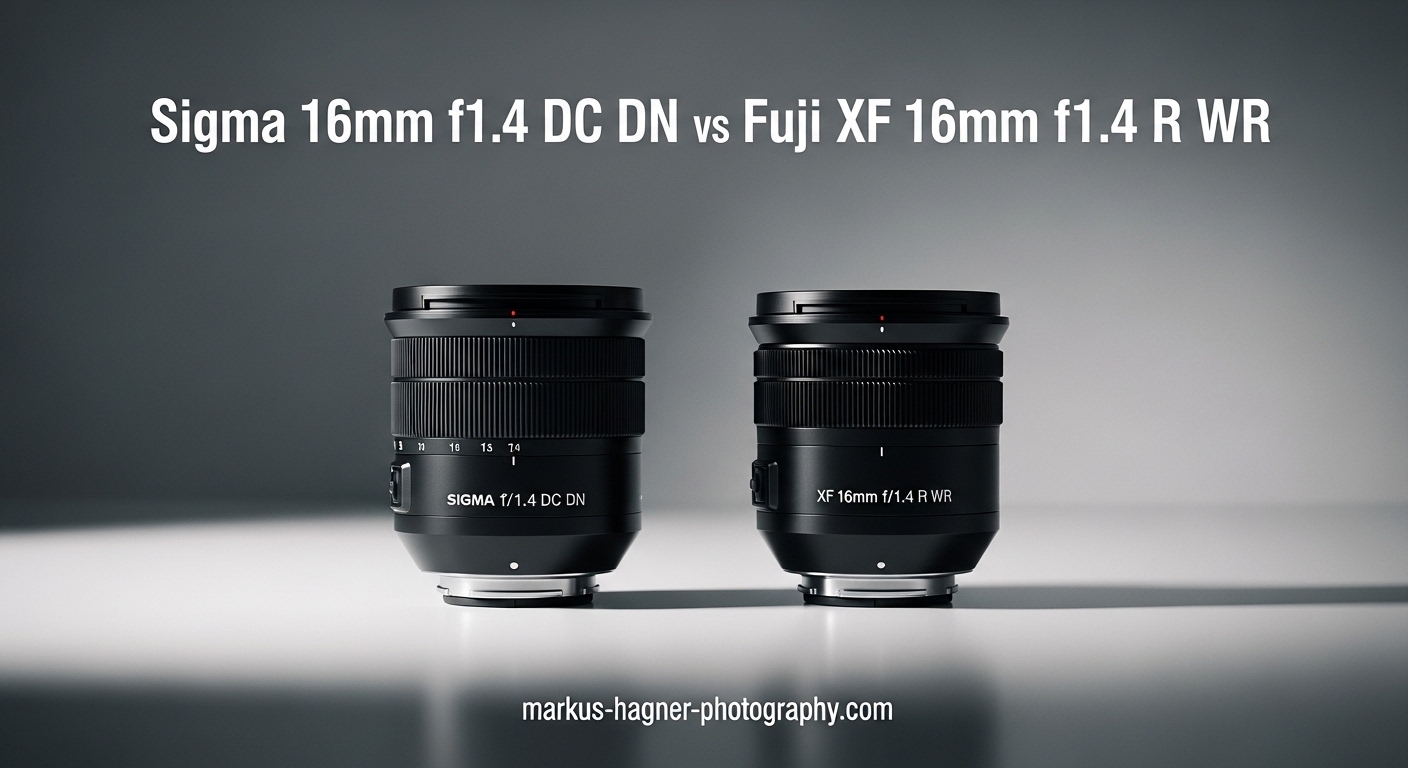
If you’re a Fujifilm X-mount shooter looking for a fast wide-angle prime, you’ve probably wrestled with this question: Should you save money with the Sigma 16mm f1.4 DC DN or invest in the native Fujinon XF 16mm f1.4 R WR? Both lenses share identical specifications on paper (16mm focal length, f1.4 maximum aperture), but the nearly three-fold price difference tells you there’s more to the story.
I’ve spent considerable time analyzing both lenses, poring over forum discussions, customer reviews, and technical comparisons to help you make the right choice. The Sigma 16mm f1.4 DC DN vs Fuji XF 16mm f1.4 R WR decision ultimately comes down to what features matter most to your photography style and budget.
Here’s the quick verdict: The Sigma offers roughly 90% of the optical performance for about 37% of the price. But the Fuji gives you premium build quality, weather sealing, an aperture ring, and that beloved manual focus clutch. Let’s dive into the details so you can decide which trade-offs work for you.
Sigma 16mm f1.4 DC DN vs Fuji XF 16mm f1.4 R WR: Quick Comparison
The 16mm focal length on Fujifilm’s APS-C sensor equals 24mm in full-frame terms, making both lenses versatile wide-angle options for street photography, landscapes, environmental portraits, and travel. At a glance, here’s how they stack up:
| Product | Specifications | Action |
|---|---|---|
 Sigma 16mm F1.4 DC DN Contemporary Sigma 16mm F1.4 DC DN Contemporary |
|
Check Latest Price |
 Fujinon XF 16mm F1.4 R WR Fujinon XF 16mm F1.4 R WR |
|
Check Latest Price |
Sigma 16mm F1.4 DC DN Contemporary Lens Review
Pros
- Super sharp optical quality
- Excellent value vs native lenses
- STM motor quiet for video
- Fast accurate autofocus
- Weather-resistant construction
Cons
- No aperture ring
- Larger than native Fuji primes
- Requires software distortion correction
When Sigma released the 16mm f1.4 DC DN for Fujifilm X-mount in 2022, it gave Fuji shooters a genuinely compelling alternative to the native glass. At roughly one-third the price of the Fujinon equivalent, many photographers wondered what corners were cut. The answer surprised most of us: not many.
The Sigma uses a sophisticated optical design with 16 elements arranged in 13 groups, including FLD (F Low Dispersion) and SLD (Special Low Dispersion) glass elements that minimize chromatic aberration. In real-world shooting, the lens delivers excellent sharpness even wide open at f1.4, with good contrast and color rendition that pairs well with Fujifilm’s JPEG engine.
One thing I appreciate about this lens is the STM (stepper) motor. It’s nearly silent during operation, making it ideal for video work where microphone placement might pick up focus motor noise. The autofocus is also fast and accurate in most lighting conditions, though it can hunt slightly in very dim situations.
The build quality uses Sigma’s Thermally Stable Composite (TSC) polycarbonate material, which feels solid without the cold heft of metal. The lens features dust and water-resistant construction, though not to the same level as Fuji’s WR rating. You get a 67mm filter thread, which is reasonably sized and won’t break the bank when buying filters.

Where the Sigma shows its budget roots is in the features department. There’s no aperture ring, which means controlling aperture through the camera body. For photographers coming from other systems, this won’t feel unusual. But for Fuji users accustomed to the tactile experience of clicking through f-stops on the lens barrel, it’s a noticeable omission.
The lens also requires software distortion correction. Raw files show noticeable barrel distortion that needs to be corrected in post-processing or through in-camera JPEG processing. This isn’t unique to the Sigma, but it’s worth noting if you shoot raw and want minimal post-processing workflow.
Fujinon XF 16mm F1.4 R WR Lens Review
Pros
- Exceptional sharpness and image quality
- Physical aperture ring for tactile control
- Manual focus clutch mechanism
- Comprehensive weather sealing
- Premium metal build quality
Cons
- Significantly higher price
- DC motor audible in video
- Can exhibit vignetting wide open
The Fujinon XF 16mm f1.4 R WR has been a staple in many Fuji kits since its release in 2015, and for good reason. This lens represents Fujifilm’s philosophy of creating premium optics with distinctive handling characteristics that set their system apart from the competition.
Optically, the Fuji uses 13 elements in 11 groups, including aspherical elements and ED (Extra-low Dispersion) glass. The Nano-GI coating alters the refractive index between glass and air to reduce ghosting and flare. In practice, this translates to exceptional sharpness across the frame, beautiful color rendition, and excellent contrast even in challenging lighting.

What really sets the Fuji apart is the handling experience. The physical aperture ring lets you click through f-stops with satisfying tactile feedback. Many street photographers and documentary shooters swear by this control method, preferring it to command dial adjustments. The ring includes an A position for automatic aperture control when you want the camera to handle exposure settings.
The manual focus clutch mechanism is another Fuji signature feature. Pull the focus ring back, and you’re in manual focus mode with a mechanical feel and distance scale visible. Push it forward, and you’re back to autofocus. For street photography where you might want to zone focus, this clutch system is incredibly useful and fast to operate.

Weather sealing on the Fuji is comprehensive, with 9 sealing points across 8 areas protecting against dust and moisture. Combined with a weather-sealed Fuji body like the X-T5 or X-Pro3, you can shoot in rain and dusty conditions with confidence. The weather resistance (WR) designation isn’t just marketing here; users have reported shooting in genuinely challenging conditions without issues.
The minimum focus distance of less than 6 inches (approximately 15cm) gives you a maximum magnification of 0.21x, which opens up creative close-up possibilities. The angle of view is 83.2 degrees, giving you that classic wide-angle perspective without extreme distortion.
Sigma 16mm f1.4 vs Fuji 16mm f1.4: Head-to-Head Comparison
Build Quality and Design
The Fuji clearly wins on build quality with its metal exterior and premium feel. The Sigma uses TSC polycarbonate, which is durable but doesn’t have the same luxurious heft. That said, both lenses are built to professional standards and should withstand years of regular use.
Where they differ most is in the feature set. The Fuji has that aperture ring and focus clutch I mentioned earlier. The Sigma has neither. For some photographers, these omissions are deal-breakers. Others won’t miss them at all.
Size and Weight
Surprisingly, the Sigma is larger and heavier than the Fuji despite costing much less. The Sigma measures 92mm in length and weighs 405g (14.3 ounces). The Fuji is more compact at 73mm length and lighter at 375g (13.2 ounces).
That 19mm length difference is noticeable when the lenses are mounted on a camera body. Forum users consistently mention the Sigma’s size as a drawback for extended shooting sessions. One user put it bluntly: “The size and weight is really not that fun for all-day carry.”
Image Quality and Sharpness
Both lenses are sharp, but the Fuji has a slight edge in pure optical quality. Side-by-side comparisons show the Fuji maintains better edge-to-edge sharpness, especially wide open. The Sigma is no slouch though; it produces excellent results that satisfy most photographers.
Distortion handling differs between the two. The Fuji has approximately -0.9% barrel distortion, while the Sigma shows around -4% before correction. In practice, both need software correction for critical work, but the Sigma requires more aggressive processing.
Bokeh Quality
This is where opinions diverge. Many photographers actually prefer the Sigma’s bokeh, finding it smoother and more pleasing for portraits and subject isolation. The Fuji’s bokeh is beautiful but can appear “busy” in certain situations with complex backgrounds.
For environmental portraits where you want smooth background separation while showing context, both lenses perform admirably. The f1.4 aperture on both gives you excellent control over depth of field.
Autofocus Performance
The Sigma uses an STM (stepper) motor that’s nearly silent during operation. The Fuji uses a DC motor that’s fast and accurate but produces audible noise that can be picked up by on-camera microphones during video recording.
For still photography, both lenses focus quickly and accurately in most conditions. For video work, the Sigma’s quiet STM motor gives it a clear advantage. As one forum user noted: “Between the two, the Sigma is a lot bigger and the Fuji has louder AF for video. I’d get the Sigma between the two for video work.”
Weather Sealing
Both lenses feature weather-resistant construction, but the Fuji’s implementation is more comprehensive. With 9 sealing points in 8 areas, the XF 16mm f1.4 R WR offers serious protection against the elements. The Sigma has dust and water-resistant construction but doesn’t match Fuji’s level of sealing.
If you regularly shoot in rain, snow, or dusty environments, the Fuji’s superior weather sealing provides genuine peace of mind. For fair-weather photography or controlled studio work, either lens will serve you well.
Minimum Focus Distance
The Fuji wins here with a minimum focus distance of approximately 15cm (6 inches) compared to the Sigma’s 25cm. This closer focusing capability gives you more creative flexibility for close-up work and environmental portraits where you want to emphasize a foreground subject.
The Fuji’s 0.21x maximum magnification also edges out the Sigma, making it slightly better for pseudo-macro work. Neither lens is a true macro, but the Fuji gets you closer to your subject.
Value Proposition
This is the most significant differentiator. The Sigma typically sells for around $439 while the Fuji commands approximately $1,199. That’s roughly a 2.7x price difference. The question becomes: Is the Fuji worth nearly three times the price?
The honest answer depends on your needs. The Fuji offers premium build, aperture ring, focus clutch, better weather sealing, and slightly superior optics. The Sigma gives you excellent image quality, quiet autofocus for video, and weather resistance at a fraction of the cost.
Many users estimate the Sigma delivers about 90% of the Fuji’s performance for roughly 37% of the price. If you’re budget-conscious or just starting with Fujifilm, the Sigma is an incredibly sensible choice.
Who Should Buy the Sigma 16mm f1.4 DC DN?
The Sigma 16mm f1.4 DC DN is ideal for photographers who prioritize value without sacrificing optical quality. You should choose the Sigma if:
You’re budget-conscious and want the most bang for your buck. The Sigma delivers professional-quality images at a price that leaves room in your budget for other gear.
You shoot video and need silent autofocus. The STM motor is nearly silent, making this lens excellent for vlogging, documentary work, or any video application where on-camera audio matters.
You don’t care about aperture rings or focus clutches. If you’re comfortable controlling aperture through the camera body and don’t need the manual focus clutch for zone focusing, you won’t miss these features.
You want a backup or travel lens. At this price point, the Sigma makes an excellent second lens or travel companion where you might not want to risk more expensive glass.
Who Should Buy the Fuji XF 16mm f1.4 R WR?
The Fujinon XF 16mm f1.4 R WR is worth the investment for photographers who value premium handling and professional-grade features. You should choose the Fuji if:
The aperture ring is important to you. Many Fuji photographers consider the physical aperture ring essential to their shooting style and wouldn’t want to give it up.
You shoot in challenging weather conditions. The comprehensive weather sealing gives you confidence to shoot in rain, snow, and dust without worrying about your gear.
You’re a street photographer who uses zone focusing. The manual focus clutch with distance scale makes quick zone focus adjustments fast and intuitive.
You want the absolute best optical quality. While the Sigma is excellent, the Fuji has a slight edge in sharpness and optical correction that matters for critical work.
You prefer native lenses and plan to keep your Fujifilm system long-term. The Fuji will likely hold its value better and maintains compatibility with future camera bodies.
Frequently Asked Questions
What is the 16mm Fuji equivalent to?
The 16mm focal length on Fujifilm X-mount cameras (APS-C sensor) is equivalent to 24mm in full-frame terms, making it a versatile wide-angle lens suitable for street photography, landscapes, and environmental portraits.
What is Sigma 16mm F1.4 good for?
The Sigma 16mm f1.4 is excellent for street photography, landscape photography, environmental portraits, travel photography, and low-light situations. Its wide aperture makes it ideal for astrophotography and interior photography where you need to capture more light.
Is the Sigma 16mm lens heavy?
The Sigma 16mm f1.4 weighs 405g (14.3 ounces), which is considered relatively heavy for a prime lens of this focal length. It is 30g heavier than the Fuji XF 16mm f1.4 (375g) and significantly longer at 92mm compared to Fuji’s 73mm length.
Does the Sigma 16mm have an aperture ring?
No, the Sigma 16mm f1.4 DC DN does not have an aperture ring. Aperture must be controlled via the camera body, which is a key difference from the Fujifilm XF 16mm f1.4 R WR that includes a physical aperture ring for tactile control.
Which lens is better for video – Sigma or Fuji 16mm?
The Sigma 16mm f1.4 is generally better for video due to its quiet STM (stepper) motor. The Fuji 16mm f1.4 uses a DC motor that can be audible during video recording, which may be picked up by the camera’s microphone.
Is the Sigma 16mm weather sealed?
Yes, the Sigma 16mm f1.4 DC DN features water and dust resistant construction. However, the Fujifilm XF 16mm f1.4 R WR has more comprehensive weather sealing with 9 sealing points in 8 areas, making it better suited for challenging weather conditions.
Final Verdict: Sigma 16mm f1.4 DC DN vs Fuji XF 16mm f1.4 R WR
Choosing between the Sigma 16mm f1.4 DC DN vs Fuji XF 16mm f1.4 R WR comes down to prioritizing features versus budget. Both lenses deliver excellent optical performance for street photography, landscapes, environmental portraits, and travel.
For most photographers, especially those building their first Fuji kit or shooting on a budget, the Sigma represents exceptional value. You get professional-grade image quality, quiet autofocus, and weather resistance at a price that’s hard to beat. The missing aperture ring and larger size are reasonable trade-offs for the cost savings.
For professionals, dedicated street photographers, or anyone who values the tactile Fuji shooting experience, the native XF 16mm f1.4 R WR is worth the premium. The aperture ring, focus clutch, superior weather sealing, and slightly better optics justify the higher price for users who will leverage these features.
My recommendation? If you’re new to Fujifilm or unsure how much you’ll use this focal length, start with the Sigma. You can always upgrade to the Fuji later if you find yourself reaching for this lens constantly and wanting those premium features. If you’re an experienced Fuji shooter who knows you’ll use this lens extensively, the native glass is worth the investment.