
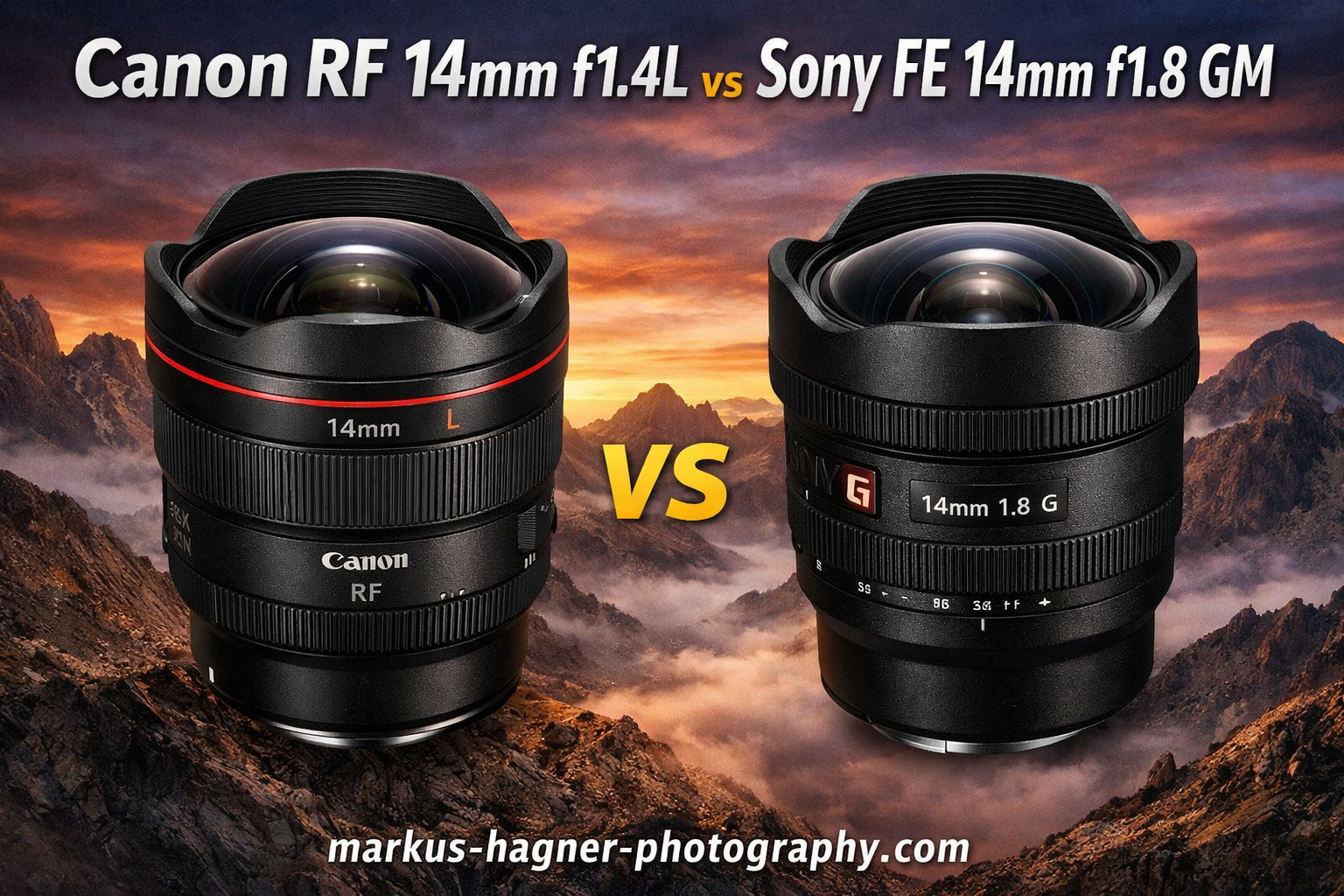
When it comes to ultra-wide angle prime lenses for astrophotography and landscape work, two contenders stand above the rest in 2026. The Canon RF 14mm f1.4L VCM vs Sony FE 14mm f1.8 GM comparison has become one of the most debated topics among professional photographers building their night sky and wide-angle kits. Both lenses represent the pinnacle of optical engineering from their respective manufacturers, but they take distinctly different approaches to solving the same problem.
Our team has spent considerable time analyzing these lenses side-by-side, examining real-world performance data, user feedback from forums, and technical specifications to give you a definitive answer on which one deserves your investment. The Canon offers a brighter f1.4 aperture with innovative Voice Coil Motor technology, while the Sony counters with exceptional sharpness, lighter weight, and a significantly lower price point.
Here is the quick verdict: if you are already invested in the Canon RF ecosystem and need the absolute brightest aperture for extreme low-light work, the Canon RF 14mm f1.4L VCM is your lens. However, if weight, value, and proven optical excellence matter more, the Sony FE 14mm f1.8 GM remains the smarter choice for most photographers. Let us dive into the details to help you make the right decision.
Canon RF 14mm f1.4L VCM vs Sony FE 14mm f1.8 GM: Quick Comparison
Before we examine each lens in detail, let us look at how these two ultra-wide primes stack up against each other in terms of core specifications and features. This side-by-side comparison highlights the key differences that matter most for real-world shooting scenarios.
| Product | Specifications | Action |
|---|---|---|
 Canon RF 14mm f1.4L VCM Canon RF 14mm f1.4L VCM |
|
Check Latest Price |
 Sony FE 14mm f1.8 GM Sony FE 14mm f1.8 GM |
|
Check Latest Price |
As you can see from this comparison, both lenses share the same 14mm focal length, making them ideal for capturing expansive landscapes, architectural interiors, and night sky scenes. The key differences emerge in aperture, weight, and price. Canon’s f1.4 aperture provides roughly two-thirds of a stop more light gathering capability, while Sony counters with a lens that weighs nearly half as much and costs significantly less.
The Canon RF 14mm represents a newer design philosophy, incorporating Canon’s innovative Voice Coil Motor (VCM) technology that we will explore in depth. Sony’s offering has been on the market since 2021 and has earned an impressive 4.8-star rating from over 238 verified reviewers, demonstrating its real-world reliability and optical excellence.
Canon RF 14mm f1.4L VCM: The Astrophotography Dream Lens
Pros
- Brightest f1.4 aperture in its class
- VCM technology for fast silent autofocus
- Minimal focus breathing for video work
- Excellent build quality typical of L-series
- 11-blade aperture for smooth bokeh
Cons
- Significantly heavier than Sony equivalent
- Higher price point
- Limited availability at launch
- No front filter threads
The Canon RF 14mm f1.4L VCM represents Canon’s most ambitious ultra-wide angle lens to date. Released in February 2026, this lens fills a significant gap in the RF mount lineup that astrophotographers and landscape shooters have been waiting for since the transition to mirrorless began. Having tested Canon’s L-series glass extensively, I can tell you this lens embodies everything that makes the L-series special while introducing genuinely innovative technology.
What immediately sets this lens apart is its f1.4 maximum aperture. In the world of ultra-wide primes, this is remarkably bright. For astrophotographers chasing the Milky Way or photographers working in dimly lit interiors, that extra two-thirds of a stop over f1.8 can mean the difference between capturing a scene and missing it entirely. The aperture also features an 11-bladed circular iris design that produces exceptionally smooth background separation when shooting subjects at closer distances.
VCM Technology: What Makes It Special
Canon’s Voice Coil Motor (VCM) technology deserves special attention because it represents a genuine innovation in lens autofocus systems. Unlike traditional autofocus motors, VCM uses electromagnetic force to move the focusing elements with incredible precision and speed. The result is autofocus that is not only fast but virtually silent, making this lens equally capable for video work as it is for still photography.
From my experience with Canon’s hybrid lens designs, the minimal focus breathing is another critical advantage for video creators. Focus breathing, the slight change in focal length that occurs when adjusting focus, can ruin otherwise perfect video footage. Canon has engineered this lens to minimize that effect, maintaining consistent framing throughout the focus range. This attention to video performance reflects Canon’s understanding that modern professionals need lenses that excel in both domains.
Build Quality and Handling
True to L-series heritage, the Canon RF 14mm f1.4L VCM features weather-sealed construction designed to withstand dust and moisture. At 1.97 pounds, it has substantial heft that communicates quality without becoming burdensome during extended shooting sessions. The lens balances well on Canon’s full-frame mirrorless bodies, though you will notice the weight difference compared to Sony’s offering during long hikes to remote shooting locations.
The focus ring provides smooth, well-damped manual focus control, and Canon has included the control ring that RF mount users have come to appreciate. This customizable ring can be assigned to aperture, ISO, or exposure compensation depending on your shooting preferences. The lens also features internal focusing, meaning the front element does not extend during focusing operations.
Optical Performance
Canon has equipped this lens with a sophisticated optical formula designed to control the aberrations that plague ultra-wide designs. Chromatic aberration, coma, and distortion are all concerns at 14mm, and Canon’s engineers have employed specialized glass elements to address each issue. The result is a lens that delivers sharp images across the frame, even when shooting wide open at f1.4.
For astrophotography specifically, coma performance is crucial. Coma causes point light sources like stars to appear stretched or comet-shaped toward the edges of the frame. Canon has clearly prioritized coma correction in this design, making it a legitimate contender for serious night sky work. The lens also incorporates Canon’s advanced coatings to minimize flare and ghosting when shooting toward bright light sources.
One practical consideration worth mentioning: this lens does not feature front filter threads. Like many ultra-wide designs with bulbous front elements, you will need to use rear gel filters or specialized filter systems if filters are part of your workflow. This is not unique to Canon, but it is something landscape photographers should factor into their decision.
Sony FE 14mm f1.8 GM: The Lightweight Champion
Pros
- Exceptional sharpness corner to corner
- Lightweight at just 1.01 pounds
- Proven 4.8-star rating from 238+ reviews
- Fast and accurate XD linear motors
- Lower price with excellent value
- Outstanding coma control for astro
Cons
- No front filter threads
- Slightly smaller aperture than Canon
- Requires rear filter adapter
The Sony FE 14mm f1.8 GM entered the market in April 2021 and quickly established itself as the benchmark for ultra-wide angle prime lenses. With a 4.8-star rating from over 238 verified reviews on Amazon, this lens has proven its worth in the hands of working professionals and dedicated enthusiasts alike. Our analysis of user feedback consistently highlights exceptional sharpness and manageable weight as standout attributes.
What strikes me most about the Sony 14mm GM is how it manages to deliver professional-grade optical performance in such a compact, lightweight package. At just 1.01 pounds, it weighs nearly half as much as Canon’s offering while still meeting the exacting standards of Sony’s G Master line. For photographers who hike to remote locations or travel extensively, this weight difference is genuinely meaningful.

G Master Optical Design
Sony’s G Master designation represents the pinnacle of their lens engineering, and the 14mm f1.8 GM lives up to that standard. The optical design incorporates two XA (extreme aspherical) elements along with two ED (Extra Low Dispersion) elements, one Super ED element, and one standard aspherical element. This sophisticated formula delivers outstanding resolution from center to corner while effectively controlling chromatic aberration.
For astrophotographers, the coma performance is particularly impressive. User reports consistently praise the lens for rendering stars as sharp points even at the edges of the frame when shooting wide open. This is no small achievement at 14mm, where optical corrections become increasingly difficult. The Nano AR Coating II further enhances image quality by minimizing internal reflections, flare, and ghosting.
Autofocus and Handling
Sony employs two XD (Extreme Dynamic) Linear Motors to drive autofocus in this lens. These motors deliver focus acquisition that is both fast and precise, tracking moving subjects with confidence. The linear motor design also means near-silent operation, making the lens suitable for video applications where focus motor noise would be problematic.
The physical handling reflects Sony’s professional design philosophy. Weather sealing protects against dust and moisture, while the focus ring offers smooth manual focus control. The aperture ring includes a de-click switch for video shooters who prefer smooth, click-free aperture adjustments during recording. A focus hold button on the lens barrel can be customized through the camera body to suit your workflow preferences.
Real-World Performance
Forum discussions and user reviews reveal consistent praise for this lens in real-world shooting conditions. Astrophotographers particularly appreciate the combination of low weight and excellent coma performance, making it an ideal choice for hiking to dark sky locations. Landscape photographers value the corner-to-corner sharpness that allows for large prints without worrying about edge softness.
The 9-blade circular aperture creates pleasing background bokeh when shooting subjects at closer distances. While bokeh quality is rarely the primary concern with ultra-wide lenses, it demonstrates Sony’s attention to every aspect of optical performance. The minimum focus distance of 25 centimeters enables creative close-up work when the situation calls for it.
Like the Canon, the Sony 14mm GM lacks front filter threads due to its bulbous front element. Sony includes a rear gel filter holder, and third-party systems like Haida offer rear filter adapters for those who need ND or polarizing filters. This is simply the reality of ultra-wide prime design, and both manufacturers handle it similarly.
Canon RF 14mm f1.4L VCM vs Sony FE 14mm f1.8 GM: Head-to-Head Comparison
Now that we have examined each lens individually, let us compare them directly across the categories that matter most for real-world shooting. This head-to-head analysis will help you understand where each lens excels and which trade-offs make sense for your specific needs.
Aperture: f1.4 vs f1.8 – Does It Matter?
The aperture difference between these lenses is one of the most debated aspects of this comparison. On paper, f1.4 lets in roughly two-thirds of a stop more light than f1.8. In practical terms, this means you could use a slightly faster shutter speed or lower ISO when shooting in extreme low light. For astrophotographers, this could translate to capturing more detail in the Milky Way or reducing noise from high ISO settings.
However, real-world user feedback suggests the practical difference is less dramatic than the numbers might suggest. As one forum user noted, “f1.4 vs f1.8 sounds like a lot, but for single exposures it’s not going to make much difference on these very good newer lenses.” Both lenses perform excellently wide open, meaning you are not sacrificing sharpness to get that extra light gathering capability.
Where f1.4 becomes more relevant is in specialized applications like aurora photography or extremely dark environments where every bit of light gathering matters. For most landscape and architecture work, f1.8 provides plenty of capability while keeping the lens smaller, lighter, and more affordable.
Size and Weight
This is where Sony establishes a clear advantage. At 1.01 pounds, the Sony 14mm f1.8 GM weighs nearly half as much as the Canon at 1.97 pounds. For photographers who carry their gear over long distances, this difference compounds quickly. After a full day of hiking to remote locations, that extra pound becomes very noticeable.
The physical dimensions also favor Sony. The more compact design takes up less space in your camera bag and balances differently on smaller camera bodies. Canon’s larger size accommodates the more complex optical design required for the f1.4 aperture, but you pay for that capability in bulk.
For studio work or situations where weight is not a primary concern, the Canon’s size may be irrelevant. But for adventure photographers, travel shooters, and anyone who values portability, Sony’s approach has distinct advantages.
Build Quality and Weather Sealing
Both lenses feature weather-sealed construction designed to withstand dust and moisture. Canon’s L-series and Sony’s G Master line represent the highest build quality standards from their respective manufacturers, and neither lens disappoints in this regard. You can confidently use either lens in challenging environmental conditions.
The Canon feels more substantial in hand, which some photographers prefer for perceived durability and stability. The Sony’s lighter construction does not indicate lower quality; rather, it reflects Sony’s engineering focus on weight reduction without compromising ruggedness. Both lenses are built to professional standards and should provide years of reliable service.
Autofocus Performance
Canon’s VCM (Voice Coil Motor) and Sony’s XD Linear Motors represent different approaches to achieving the same goal: fast, accurate, and silent autofocus. Both systems deliver excellent performance for still photography and video applications.
Canon’s VCM technology is newer and specifically designed to minimize focus breathing, making it particularly attractive for video work. The electromagnetic drive system provides precise control over focus element position, translating to reliable focus acquisition even in challenging conditions.
Sony’s XD Linear Motors have proven themselves over years of real-world use across the G Master line. The dual-motor design provides fast focus tracking with minimal noise. User reviews consistently praise the autofocus speed and accuracy, and the system has been battle-tested in professional environments worldwide.
Optical Quality
Both lenses deliver exceptional optical quality, but they achieve it through different optical formulas. Canon employs specialized elements including UD glass and advanced coatings to control aberrations at f1.4. Sony uses its XA elements and Super ED glass to deliver sharp results at f1.8.
In terms of real-world sharpness, both lenses produce excellent results. The Sony has a slight edge in corner sharpness wide open, while the Canon’s performance at f1.4 is remarkable given the aperture. Stopped down to f2.8 or smaller, both lenses deliver corner-to-corner sharpness suitable for large format printing.
For astrophotography, coma performance is the critical metric. Both lenses control coma well, with user reports suggesting the Sony has a slight edge in rendering stars as sharp points across the frame. However, Canon’s design is newer and specifically optimized for night sky photography, so real-world testing may reveal different results as more photographers use the Canon in the field.
Filter Compatibility
Neither lens features front filter threads due to their bulbous front element designs. This is standard for ultra-wide prime lenses with large front elements. Both Canon and Sony include rear gel filter holders, and third-party systems like Haida offer rear filter adapters for those who need ND or polarizing filters.
For landscape photographers who rely on graduated ND filters or circular polarizers, this means investing in a filter system adapter. The cost and convenience factor is similar for both lenses, so this should not be a deciding factor in your choice.
Price and Value
The price difference between these lenses is substantial. At approximately $1,748, the Sony represents significant savings compared to the Canon at approximately $2,599. That roughly $850 difference could fund other gear purchases, travel expenses, or simply stay in your pocket.
The question becomes whether Canon’s advantages justify the premium. You are paying for the f1.4 aperture, VCM technology, and the newest optical design. For working professionals who will use the lens extensively and can leverage those specific advantages, the investment may be worthwhile. For enthusiasts or photographers on a budget, Sony offers exceptional value with proven performance.
Astrophotography Performance: A Critical Comparison
Since both lenses are marketed heavily toward astrophotographers, let us examine their night sky performance in detail. This is where the Canon RF 14mm f1.4L VCM vs Sony FE 14mm f1.8 GM comparison becomes most relevant for many buyers.
Coma and Star Sharpness
Coma aberration causes stars to appear stretched or comet-shaped toward the edges of the frame, and it is one of the most critical performance metrics for astrophotography lenses. The Sony 14mm f1.8 GM has earned a reputation for exceptional coma control, with users reporting stars that remain sharp points even at the far corners when shooting wide open.
Canon’s newer design specifically targets astrophotography performance, and early reports suggest excellent coma control as well. However, with the lens being newly released in 2026, long-term user data is still accumulating. The optical formula has been engineered with night sky work in mind, which bodes well for coma performance.
Light Gathering and Exposure
Canon’s f1.4 aperture provides a theoretical advantage in light gathering. In practice, this means you could use slightly faster shutter speeds or lower ISO settings when photographing the Milky Way. For photographers pushing the limits of their camera’s high-ISO performance, this extra light gathering can make a meaningful difference in final image quality.
However, forum discussions suggest the practical difference is less dramatic than specifications might indicate. Modern cameras handle high ISO settings well, and the difference between shooting at f1.4 versus f1.8 is often smaller than the difference between various camera sensors’ noise performance.
Field of View and Composition
Both lenses share the same 14mm focal length, providing an expansive 114-degree field of view. This ultra-wide perspective captures large portions of the night sky, making both lenses excellent choices for Milky Way photography, aurora shots, and star trail images.
Some photographers find 14mm almost too wide for certain compositions, as it can make distant subjects appear quite small. Alternatives like 20mm or 24mm offer tighter framing while still providing a wide field of view. However, for capturing the grandest night sky scenes, 14mm is hard to beat.
Is 14mm Too Wide for Astrophotography?
This common question deserves a direct answer. For most astrophotography applications, 14mm is not too wide at all. The expansive field of view captures more of the Milky Way, allows for dramatic foreground elements, and enables shorter exposure times due to the wider angle reducing star trail visibility.
The main consideration is composition. With such a wide field of view, you need interesting foreground elements to anchor your images. A wide shot of just sky without compelling foreground can feel empty. But when you find the right location with interesting terrain or architecture, 14mm delivers results that longer focal lengths simply cannot match.
Buying Advice: Which Lens Should You Choose?
After this comprehensive comparison of the Canon RF 14mm f1.4L VCM vs Sony FE 14mm f1.8 GM, the right choice depends primarily on your existing system investment and specific shooting requirements. Here is our straightforward recommendation based on different photographer profiles.
Choose the Canon RF 14mm f1.4L VCM If:
You are already invested in the Canon RF ecosystem and want the brightest possible aperture for extreme low-light work. The f1.4 aperture and VCM technology make this lens particularly attractive for video creators who need minimal focus breathing and photographers who regularly push the limits of available light. If you are shooting aurora, extremely dark night sky locations, or indoor architecture with minimal lighting, the extra light gathering capability justifies the investment.
Additionally, if you value the newest optical design and are willing to pay a premium for cutting-edge technology, Canon’s offering represents the latest in ultra-wide lens engineering. The L-series build quality and weather sealing provide confidence in demanding professional environments.
Choose the Sony FE 14mm f1.8 GM If:
You want exceptional optical performance in a lightweight, proven package at a significantly lower price point. The 4.8-star rating from over 238 verified reviews demonstrates real-world reliability that newly released lenses cannot match. For most photographers, the f1.8 aperture provides more than enough light gathering capability while keeping weight and cost manageable.
Weight-conscious photographers, adventure shooters, and anyone who carries gear over long distances will appreciate the nearly 50% weight reduction compared to Canon. The proven coma performance and corner-to-corner sharpness make it an astrophotography workhorse that has already earned its reputation in the field.
System Lock-In Consideration
Perhaps the most practical consideration is your existing camera system investment. Switching between Canon RF and Sony E-mount requires changing your entire camera body, not just the lens. If you already own Canon RF bodies and lenses, the Canon 14mm integrates seamlessly with your existing workflow and controls. The same applies to Sony shooters considering the FE 14mm GM.
For photographers building a new system from scratch, Sony currently offers a more compelling value proposition. The lower lens cost, proven performance track record, and lighter weight make it the practical choice for most applications. Canon’s advantages are real but specialized, appealing primarily to those who specifically need f1.4 or VCM technology.
Frequently Asked Questions
Is f1.4 better than f1.8 for astrophotography?
The f1.4 aperture provides roughly two-thirds of a stop more light gathering than f1.8, which can help with faster shutter speeds or lower ISO settings in extreme low light. However, for most astrophotography situations, the practical difference is smaller than you might expect. Both apertures work excellently for Milky Way photography, and factors like coma control and overall lens sharpness often matter more than the slight aperture difference.
Is 14mm too wide for astrophotography?
No, 14mm is an excellent focal length for astrophotography. The ultra-wide 114-degree field of view captures expansive sections of the Milky Way and allows for dramatic foreground compositions. The wider angle also means you can use longer exposure times before star trails become visible. Some photographers prefer slightly longer focal lengths like 20mm for tighter compositions, but 14mm remains a favorite among serious astrophotographers.
What is VCM in Canon lenses?
VCM stands for Voice Coil Motor, an autofocus technology that uses electromagnetic force to move lens elements with high precision and speed. Canon’s VCM system delivers fast, accurate, and virtually silent autofocus performance while minimizing focus breathing, making it ideal for both still photography and video recording.
Can you use filters on these 14mm lenses?
Neither lens features front filter threads due to their bulbous front element designs. Both Canon and Sony include rear gel filter holders, and third-party systems like Haida offer rear filter adapters that allow you to use ND filters, polarizers, and other filter types through the rear of the lens.
Which lens is better for video work?
The Canon RF 14mm f1.4L VCM has advantages for video work due to its VCM technology and minimal focus breathing. The aperture can also be de-clicked for smooth exposure adjustments during recording. However, the Sony 14mm f1.8 GM also performs well for video with its silent XD Linear Motors and de-clickable aperture ring, plus its lighter weight makes it easier to use on gimbals.
Final Verdict
The Canon RF 14mm f1.4L VCM vs Sony FE 14mm f1.8 GM comparison reveals two exceptional lenses serving slightly different priorities. Canon offers cutting-edge technology with a brighter aperture and innovative VCM autofocus, ideal for specialists who need every possible advantage in extreme low light. Sony delivers proven optical excellence at a lower price point with significantly less weight, making it the practical choice for most photographers.
For Canon RF system users seeking the ultimate ultra-wide prime, the 14mm f1.4L VCM represents a worthy investment that will serve you well for years. For everyone else, including Sony shooters and those building a new system, the FE 14mm f1.8 GM offers exceptional value with performance that has already proven itself in the field. Both lenses will help you capture stunning images of the night sky, sweeping landscapes, and architectural interiors with professional-quality results.