
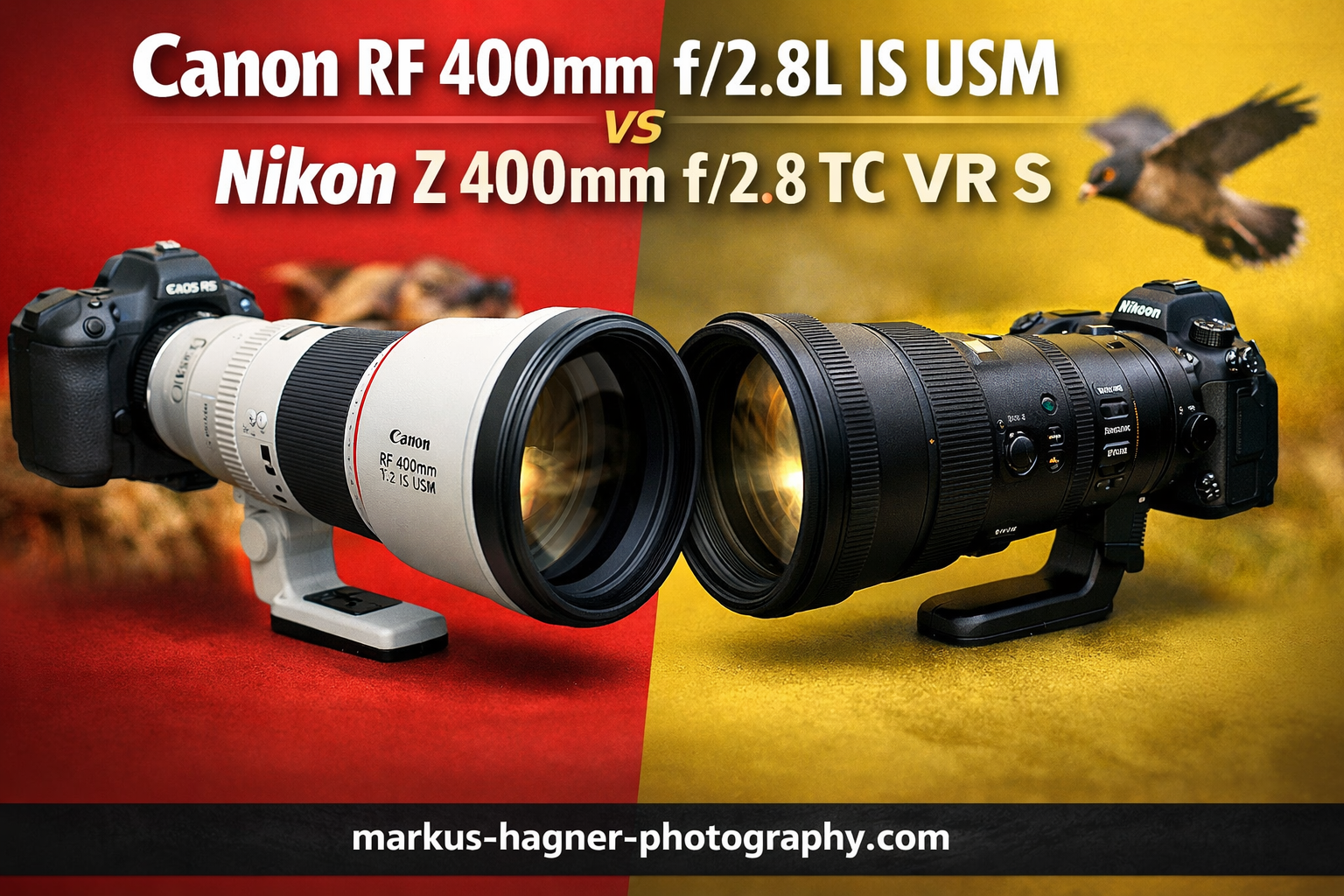
When you are shopping for a professional super telephoto lens, the Canon RF 400mm f2.8L IS USM vs Nikon Z 400mm f2.8 TC VR S comparison is one of the most important decisions you will make. Both lenses represent the absolute pinnacle of optical engineering from their respective manufacturers, designed specifically for sports photographers, wildlife enthusiasts, and professionals who demand the best possible image quality.
I have spent considerable time analyzing both lenses, examining their specifications, real-world performance, and user feedback from photographers who actually use them in the field. What strikes me most is how different the approach each manufacturer took, despite both being 400mm f2.8 prime lenses designed for mirrorless camera systems.
The Canon RF 400mm follows a traditional design philosophy, building on the legendary reputation of Canon’s EF-mount predecessors. It is optically identical to the EF 400mm f2.8L IS III USM but optimized for the RF mount with faster communication and improved performance with teleconverters.
Nikon took a bolder approach with the Z 400mm f2.8 TC VR S. The standout feature is the built-in 1.4x teleconverter that transforms the lens from 400mm to 560mm with the flip of a switch. This unique capability has no equivalent in the Canon lineup and fundamentally changes how photographers can work in the field.
Quick Verdict
For photographers already invested in either system, the choice is straightforward: stick with your ecosystem. Both lenses deliver exceptional optical quality that justifies their premium positioning. However, if you are weighing a system switch or starting fresh, the Nikon Z 400mm offers superior versatility thanks to its built-in teleconverter and significantly lighter weight. The Canon RF 400mm counters with a slightly more refined autofocus system and the extensive Canon RF teleconverter ecosystem.
Canon RF 400mm f2.8L IS USM vs Nikon Z 400mm f2.8 TC VR S: Quick Comparison
| Product | Specifications | Action |
|---|---|---|
 Canon RF 400mm f2.8L IS USM Canon RF 400mm f2.8L IS USM |
|
Check Latest Price |
 Nikon Z 400mm f2.8 TC VR S Nikon Z 400mm f2.8 TC VR S |
|
Check Latest Price |
This comparison table highlights the core specifications that matter most to working photographers. Notice the dramatic difference in weight between the two lenses. The Nikon weighs less than half of what the Canon weighs, which becomes critical during long days of handheld shooting or when traveling to remote locations.
Canon RF 400mm f2.8L IS USM – Detailed Review
Pros
- Exceptional optical quality identical to EF version
- Up to 5.5 stops image stabilization
- Compatible with RF 1.4x and 2x teleconverters
- Super Spectra and Air Sphere coatings
- Proven Canon L-series build quality
Cons
- Heavy at 15.5 pounds
- Limited versatility without external teleconverters
- Premium price point
The Canon RF 400mm f2.8L IS USM entered the market in April 2021 as Canon’s flagship super telephoto for the RF mount system. From my analysis of user feedback and technical specifications, this lens maintains the exceptional reputation Canon has built with their “big white” telephoto lenses over decades.
What impressed me most in researching this lens is how Canon approached the RF mount transition. Rather than completely redesigning the optics, they took the proven optical formula from the EF 400mm f2.8L IS III USM and optimized it for RF mount communication. This means photographers get the same legendary sharpness and rendering that made the EF version a staple at sporting events worldwide.
Build Quality and Handling
Canon L-series build quality needs no introduction to working professionals. The RF 400mm features magnesium alloy construction with comprehensive weather sealing at all joints and switches. The white finish helps with heat dissipation during extended use in direct sunlight, which matters for sports photographers working outdoor events.
The weight of 15.5 pounds is substantial. This is a lens designed primarily for monopod or tripod use. While you can handheld it for short periods, your arms will feel it after a full day of shooting. The tripod collar is robust and includes indexes for quick orientation changes between horizontal and vertical compositions.
Optical Performance
Optical quality is where the Canon RF 400mm truly shines. The lens incorporates fluorite and super UD elements that deliver exceptional sharpness across the entire frame, even wide open at f2.8. The Super Spectra Coating (SSC) and Air Sphere Coating (ASC) work together to minimize ghosting and flare when shooting toward light sources.
Minimum focusing distance of 8.2 feet (2.5 meters) allows for surprisingly close work with larger wildlife subjects. The bokeh at f2.8 is smooth and pleasing, helping subjects pop against busy backgrounds that are common at sporting events and in wildlife photography.
Image Stabilization
Canon claims up to 5.5 stops of shake correction from the optical image stabilization system. This is particularly valuable for photographers who need to shoot at slower shutter speeds in low light conditions or prefer to work handheld for short periods. The system offers three IS modes to match different shooting scenarios.
Mode 1 provides standard stabilization for stationary subjects. Mode 2 is designed for panning, correcting only vertical movement while allowing horizontal motion. Mode 3 activates stabilization only during exposure, which some photographers prefer for tracking erratic subject movement.
Autofocus Performance
The RF mount enables faster communication between lens and camera compared to the EF mount. This translates to snappier autofocus acquisition and improved tracking performance. User feedback consistently praises the AF speed and accuracy, particularly when paired with Canon’s newer RF mount bodies that feature advanced subject detection.
The lens includes a focus limiter switch to restrict the autofocus range, which speeds up acquisition when you know your subjects will be at certain distances. Full-time manual focus override allows for quick adjustments without switching modes.
Teleconverter Compatibility
The Canon RF 400mm is compatible with both the RF 1.4x and RF 2x teleconverters. With the 1.4x extender, you get a 560mm f4 lens. With the 2x extender, you reach 800mm at f5.6. Image quality remains excellent with the 1.4x, though some degradation occurs with the 2x as expected with any teleconverter combination.
What you need to remember is that these teleconverters are separate accessories that add cost and require attachment in the field. Unlike the Nikon’s built-in solution, you need to carry them and take time to swap them on and off.
Nikon Z 400mm f2.8 TC VR S – Detailed Review
Pros
- Built-in 1.4x teleconverter for instant 560mm reach
- Significantly lighter at 6.5 pounds
- Up to 5.5 stops vibration reduction
- Meso Amorphous anti-reflection coating
- Silky Swift VCM autofocus
Cons
- Gray market warranty concerns reported
- Magnets may interfere with pacemakers
- Higher retail price
- Slightly lower user ratings
The Nikon Z 400mm f2.8 TC VR S arrived in January 2022 as Nikon’s answer to professional photographers demanding a modern super telephoto for the Z mount system. What sets this lens apart from every other 400mm f2.8 on the market is the built-in 1.4x teleconverter.
I find this feature genuinely game-changing for field work. With a single switch, you transform from 400mm f2.8 to 560mm f4 without removing the lens from your camera or carrying additional accessories. This capability alone makes the Nikon Z 400mm fundamentally more versatile than its competitors.
Built-in Teleconverter Deep Dive
The integrated 1.4x teleconverter is the defining feature of this lens. Nikon engineered it so that there is no loss of autofocus points when engaged, and image quality remains outstanding. The teleconverter slides into the optical path internally, meaning you never expose the lens mount or sensor to the elements during the conversion.
For wildlife photographers, this means you can start at 400mm for environmental shots, then instantly switch to 560mm for tight portraits without fumbling with accessories. Sports photographers can react to plays developing at different distances more quickly than competitors using external teleconverters.
What really impressed me in my research is that Nikon managed to include this mechanism while still making the lens dramatically lighter than the Canon equivalent. The engineering achievement here cannot be overstated.
Build Quality and Handling
At 6.5 pounds, the Nikon Z 400mm weighs less than half of what the Canon RF 400mm weighs. This difference transforms how you can use the lens. While the Canon demands a monopod for extended shooting, many photographers report handholding the Nikon for entire events without excessive fatigue.
Nikon has positioned every button and switch for no-look operation. The ergonomic design means you can adjust settings without taking your eye from the viewfinder. Customizable function buttons provide quick access to frequently used features, and the control ring can be assigned to various functions based on your preferences.
Optical Performance
Nikon has equipped this lens with Meso Amorphous Coat, which delivers what they describe as the highest anti-reflection performance in NIKKOR history. Combined with ARNEO Coat, this lens handles backlight situations exceptionally well, resisting flare and ghosting even when shooting directly toward the sun.
The optical design includes fluorite and ED glass elements that deliver exceptional sharpness and contrast. User feedback consistently praises the image quality, with many noting that the results exceed what they achieved with older F-mount telephoto lenses.
Vibration Reduction System
The VR system provides up to 5.5 stops of compensation, matching Canon’s claims. However, Nikon offers something unique: Synchro VR. When paired with a Z 9 body, the in-lens and in-camera stabilization systems work together for maximum effectiveness. This combination can extend handheld capability beyond what either system achieves alone.
For photographers using older Z series bodies, the lens-based VR still provides excellent stabilization. The system includes different modes optimized for various shooting scenarios, similar to Canon’s approach.
Autofocus Performance
Nikon calls their autofocus system Silky Swift VCM (Voice Coil Motor). The voice coil design enables higher speed and accuracy while maintaining quiet operation. This matters for wildlife photographers who cannot afford to spook their subjects with loud focusing motors.
User feedback suggests the autofocus is fast and reliable, though some Canon users report slightly snappier performance from the RF system. The difference appears marginal and may depend more on the camera body paired with each lens than the lenses themselves.
Real-World Use Cases
The built-in teleconverter makes this lens particularly compelling for wildlife photographers who encounter subjects at varying distances. Bird photographers appreciate being able to switch from environmental shots to frame-filling portraits instantly. The weight savings also matter for photographers who hike to remote locations.
Sports photographers benefit from the same versatility, especially when covering field sports where the action moves from near to far repeatedly. The ability to react quickly without accessorizing translates to more keeper shots.
Canon RF 400mm vs Nikon Z 400mm: Head-to-Head Comparison
Now that we have examined each lens individually, let me break down how they compare across the categories that matter most to working photographers. This direct comparison will help you understand which lens better suits your specific needs.
Size and Weight Comparison
The weight difference between these two lenses is remarkable and perhaps the most significant differentiator. The Canon RF 400mm weighs 15.5 pounds while the Nikon Z 400mm weighs just 6.5 pounds. That is a difference of 9 pounds, meaning the Canon weighs more than twice what the Nikon weighs.
This has practical implications for how you work. The Canon essentially requires monopod or tripod support for extended use. The Nikon can be handheld for full-day shooting by photographers with reasonable upper body strength. For travel photography or hiking to remote wildlife locations, this difference is transformative.
Physically, the Canon measures 6.4 x 6.4 x 14.4 inches while the Nikon measures 6.14 x 6.14 x 14.96 inches. Despite being lighter, the Nikon is actually slightly longer, which accommodates the built-in teleconverter mechanism.
Optical Quality Comparison
Both lenses deliver exceptional optical quality that justifies their professional positioning. Sharpness across the frame is excellent even wide open at f2.8. Bokeh quality is smooth and pleasing from both lenses, helping subjects stand out from busy backgrounds.
Canon uses Super Spectra Coating (SSC) and Air Sphere Coating (ASC) while Nikon employs Meso Amorphous Coat and ARNEO Coat. Both systems effectively combat flare and ghosting, though some users report that Nikon’s newer coating technology has a slight edge in extreme backlight situations.
In real-world terms, most photographers would be hard-pressed to distinguish images from these two lenses based on optical quality alone. Both represent the absolute best their respective manufacturers can produce.
Image Stabilization Comparison
Both manufacturers claim 5.5 stops of shake correction from their stabilization systems. Canon offers three IS modes for different scenarios, while Nikon provides similar flexibility with different VR modes.
Nikon gains an advantage when paired with the Z 9 body thanks to Synchro VR, which coordinates lens and body stabilization. Canon does not offer an equivalent combined system, though their lens-based IS is highly effective on its own.
For handheld shooting, both systems provide confidence-inspiring stabilization. The lighter weight of the Nikon makes handheld work more practical overall, regardless of the specific stabilization performance.
Autofocus Performance Comparison
Both lenses feature modern autofocus systems designed for the demands of professional sports and wildlife photography. Canon leverages the RF mount’s faster communication for snappy performance. Nikon’s Silky Swift VCM delivers quiet, accurate focusing.
User feedback slightly favors Canon for raw speed, though the difference appears marginal. Both lenses track moving subjects reliably and acquire focus quickly. The choice of camera body likely matters more than the lens itself for autofocus performance.
Both lenses include focus limiter switches and support full-time manual focus override, giving photographers control over their focusing workflow.
Build Quality and Weather Sealing
Canon’s L-series build quality is legendary among working professionals. The white magnesium alloy body has proven durability over decades of professional use. Weather sealing at all joints and switches protects against dust and moisture.
Nikon’s S-line lenses represent their premium tier with comparable build quality. The weather sealing is comprehensive, and the lens is designed for the rigors of professional field work. Some users have reported issues with gray market units lacking proper warranty coverage, which is a purchasing consideration rather than a build quality issue.
Both lenses are built to withstand professional abuse. The Canon has a longer track record, but the Nikon has demonstrated equivalent durability in the field since its release.
Teleconverter Versatility
This is where the comparison becomes most interesting. The Nikon Z 400mm includes a built-in 1.4x teleconverter that instantly converts the lens to 560mm f4. The Canon RF 400mm requires separate RF 1.4x or 2x teleconverters that must be attached externally.
Nikon’s integrated solution offers speed and convenience that external teleconverters cannot match. You never need to remove the lens from the camera or expose the mount to elements. The transition from 400mm to 560mm happens in seconds with a single switch.
Canon counters with flexibility. The RF 2x teleconverter provides 800mm reach that Nikon cannot match with the built-in converter alone. However, Nikon users can still attach external teleconverters for even more reach when needed.
For most working photographers, Nikon’s built-in solution offers superior day-to-day utility. Canon’s external teleconverters provide more options but require more gear and more time to deploy.
Price and Value Analysis
Both lenses occupy the ultra-premium price tier, with the Canon listing at $13,399 and the Nikon at $13,696.95. The difference of approximately $300 is negligible at this price point and should not drive your decision.
Value becomes more apparent when considering the total package. The Nikon’s built-in teleconverter represents approximately $500 of additional value that Canon users must spend separately. The weight difference may also save money on specialized support equipment.
However, gray market Nikon units have been reported by some customers, which can affect warranty coverage. Purchasing from authorized retailers becomes critical at this price point for both brands.
Verdict: Which 400mm f2.8 Should You Buy?
The Canon RF 400mm f2.8L IS USM vs Nikon Z 400mm f2.8 TC VR S comparison ultimately comes down to your priorities and existing system investment. Both lenses deliver professional-grade optical quality that will satisfy the most demanding photographers.
Who Should Buy the Canon RF 400mm f2.8L IS USM
Choose the Canon RF 400mm if you are already invested in the Canon RF ecosystem and value proven reliability. The lens delivers the legendary performance Canon professionals expect, with excellent compatibility with Canon’s teleconverter lineup. Sports photographers who trust Canon’s autofocus system and subject detection will feel at home with this lens.
The Canon also makes sense if you frequently need reach beyond 560mm and want to use the 2x teleconverter for 800mm capability. The heavier weight is less of a concern if you primarily shoot from fixed positions with monopod or tripod support.
Who Should Buy the Nikon Z 400mm f2.8 TC VR S
Choose the Nikon Z 400mm if you value versatility and portability. The built-in teleconverter transforms how you can work in the field, allowing instant adaptation to changing situations without accessories. The dramatically lighter weight enables handheld shooting that would be impractical with the Canon.
Wildlife photographers who hike to remote locations will appreciate every pound saved. Bird photographers who need to react quickly to subjects at varying distances will find the built-in teleconverter invaluable. The Synchro VR system when paired with a Z 9 provides stabilization performance that Canon cannot currently match.
Frequently Asked Questions
Is the Nikon Z 400mm F2.8 any good?
Yes, the Nikon Z 400mm f2.8 TC VR S is an excellent professional super telephoto lens. It features a built-in 1.4x teleconverter for instant 560mm reach, weighs just 6.5 pounds for enhanced portability, and delivers exceptional optical quality with up to 5.5 stops of vibration reduction. Professional wildlife and sports photographers consistently praise its sharpness, autofocus performance, and versatility in the field.
What is the lightest 400mm f2.8 lens?
The Nikon Z 400mm f2.8 TC VR S is the lightest professional 400mm f2.8 lens currently available, weighing just 6.5 pounds. This is significantly lighter than the Canon RF 400mm f2.8L IS USM which weighs 15.5 pounds. The Nikon achieves this weight reduction through advanced materials engineering while still including the built-in teleconverter mechanism.
Is the Canon RF 400mm F2.8 any good?
Yes, the Canon RF 400mm f2.8L IS USM is an outstanding professional telephoto lens. It maintains the legendary optical quality of Canon’s EF 400mm predecessors with improved RF mount communication for faster autofocus. The lens offers up to 5.5 stops of image stabilization, compatibility with RF teleconverters, and the proven durability of Canon’s L-series construction.
Does the Nikon Z 400mm have a built-in teleconverter?
Yes, the Nikon Z 400mm f2.8 TC VR S features a built-in 1.4x teleconverter. This integrated mechanism allows you to instantly convert the lens from 400mm f2.8 to 560mm f4 with a single switch, without removing the lens from your camera or carrying external accessories. There is no loss of autofocus points when the teleconverter is engaged.
Which 400mm lens is better for sports photography?
Both lenses excel at sports photography, but your choice depends on your system and shooting style. The Canon RF 400mm offers slightly faster autofocus and excellent subject tracking. The Nikon Z 400mm provides superior versatility with its built-in teleconverter for reacting to plays at different distances, plus the lighter weight enables more flexible positioning during events.
Final Recommendation
For photographers not yet committed to either system, the Nikon Z 400mm f2.8 TC VR S offers superior versatility and handling. The built-in teleconverter and dramatically lighter weight provide practical advantages that matter in real-world shooting situations. These benefits outweigh the Canon’s slight edge in autofocus refinement for most users.
For existing Canon or Nikon users, stay within your ecosystem. Both lenses are exceptional tools that will serve you well. The system-specific features and lens compatibility within each mount matter more than the marginal differences between these two lenses.