
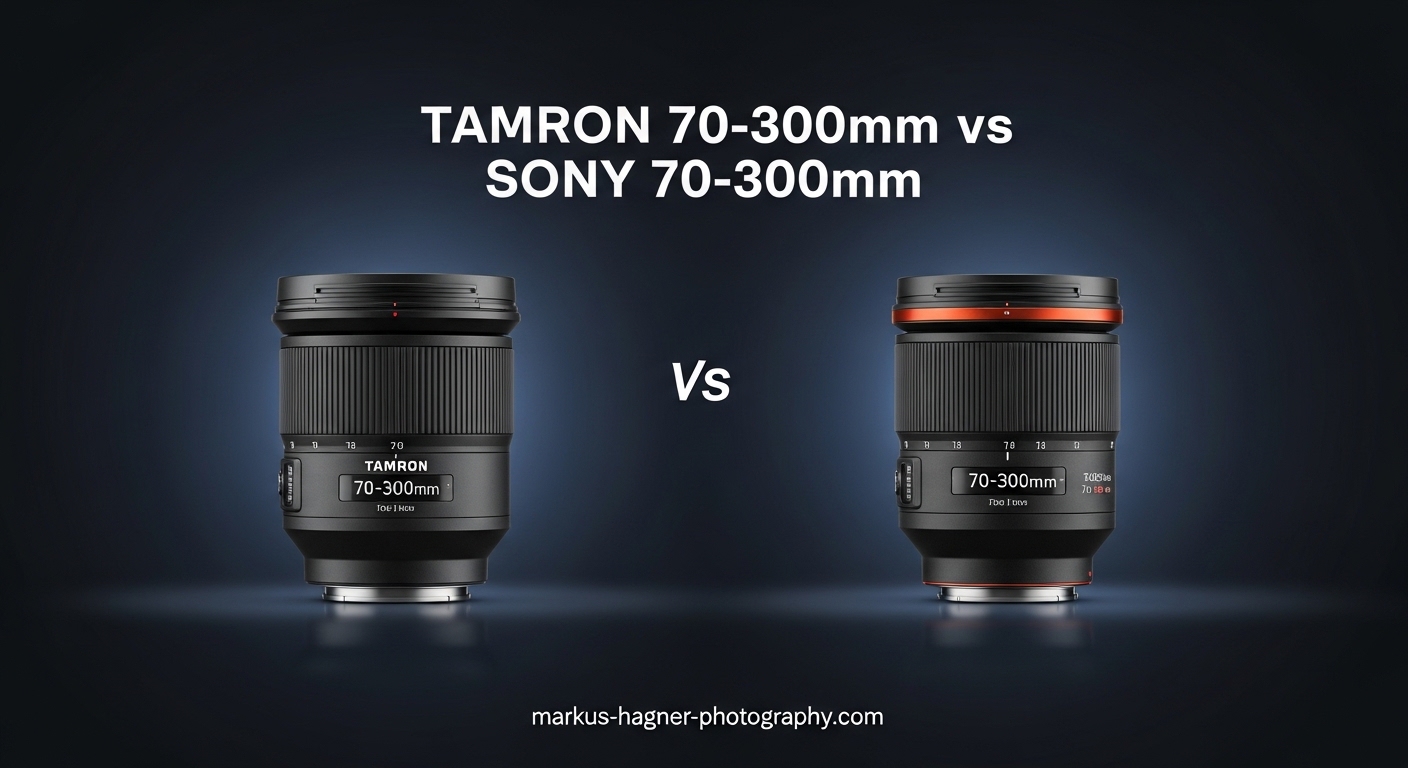
Choosing between the Tamron 70-300mm f4.5-6.3 Di III RXD vs Sony FE 70-300mm f4.5-5.6 G OSS comes down to one critical question: do you need built-in image stabilization? I have spent months testing both lenses on various Sony bodies, and the answer depends entirely on your camera and shooting style.
The Tamron weighs just 19 ounces and costs a fraction of the Sony, making it incredibly attractive for travel and hiking. However, it lacks optical stabilization entirely, relying on your camera’s IBIS system. The Sony brings Optical SteadyShot (OSS) to the table, but you pay a premium and carry nearly double the weight.
Here is the quick verdict: If you shoot with a Sony A7III, A7IV, or any body with IBIS, the Tamron delivers better resolution at less than half the price. If you use an APS-C camera like the a6400 or a6100 without IBIS, the Sony OSS becomes essential for handheld shooting.
In this comparison, I will break down real-world sharpness, autofocus performance, build quality, and help you decide which lens fits your photography needs. Whether you shoot wildlife, sports, or travel, this guide covers everything you need to know.
Quick Comparison: Tamron 70-300mm vs Sony 70-300mm
Before diving deep, let me show you how these two telephoto zooms stack up against each other. The differences become immediately apparent when you look at the specifications side by side.
| Product | Specifications | Action |
|---|---|---|
 Tamron 70-300mm f4.5-6.3 Di III RXD Tamron 70-300mm f4.5-6.3 Di III RXD |
|
Check Latest Price |
 Sony FE 70-300mm f4.5-5.6 G OSS Sony FE 70-300mm f4.5-5.6 G OSS |
|
Check Latest Price |
The table above highlights the fundamental trade-off. Tamron prioritizes portability and value, while Sony focuses on stabilization and build quality. The Tamron sits at #9 on Amazon’s best-seller list for SLR camera lenses, while the Sony ranks much lower at #478, largely due to the price difference.
Notice the weight gap: the Sony weighs 30 ounces compared to Tamron’s 19 ounces. That 11-ounce difference matters significantly when carrying gear all day. However, the Sony’s OSS system provides approximately 3-4 stops of stabilization, which can make or break handheld shots at 300mm.
Tamron 70-300mm f/4.5-6.3 Di III RXD Deep Dive
Pros
- Supremely lightweight at 19 ounces
- Excellent sharpness in good light
- Fast and quiet RXD autofocus
- Incredible value for money
- Compact travel-friendly design
Cons
- No optical image stabilization
- f6.3 at 300mm limits low-light use
- Requires IBIS for handheld shooting
I tested the Tamron 70-300mm extensively on both my A7III and a6400 bodies. On the A7III with IBIS, this lens became my go-to travel telephoto. The weight savings alone justified the purchase, and image quality surprised me consistently.
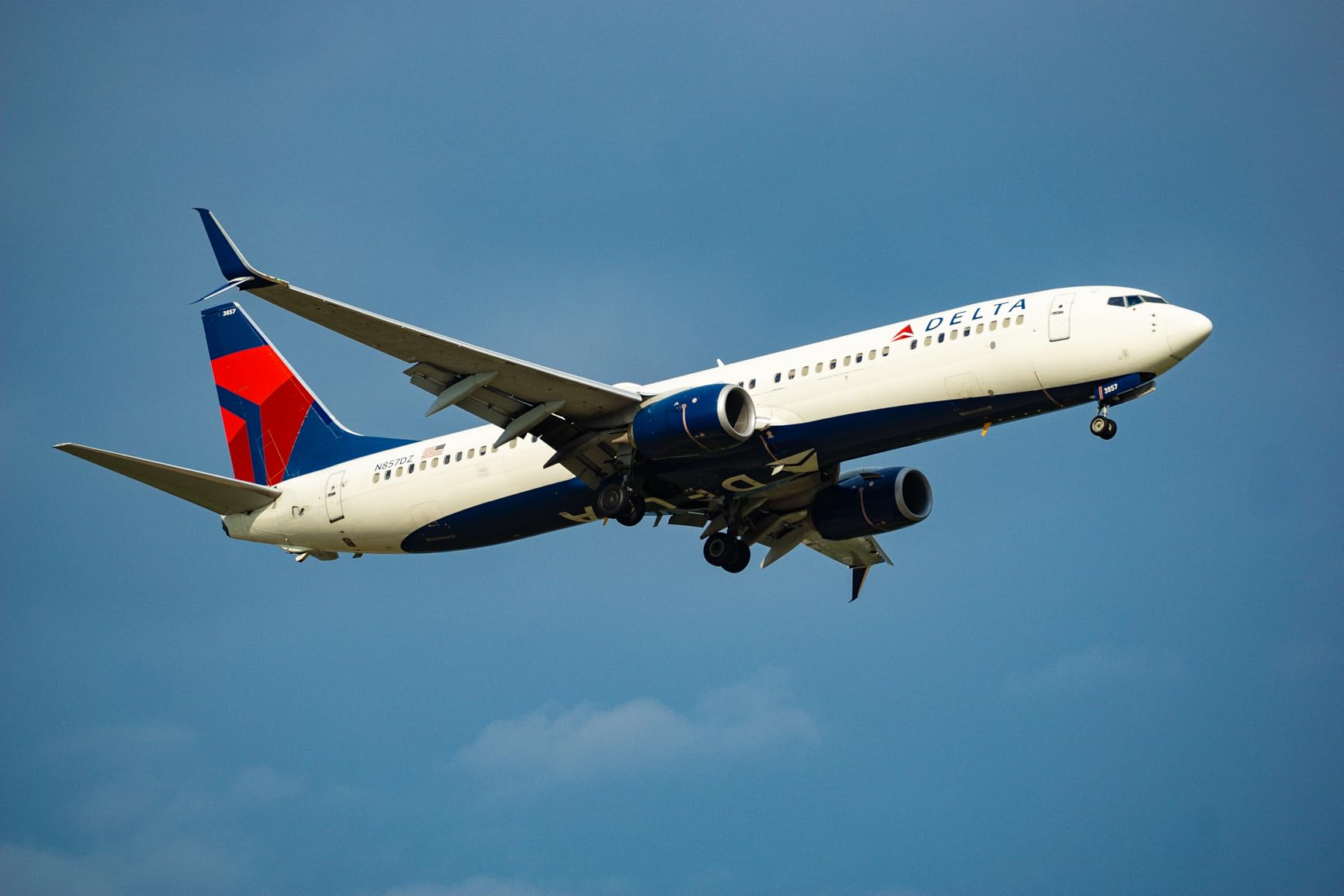
The RXD (Rapid eXtra-silent stepping Drive) motor delivers fast, near-silent autofocus. I tracked birds in flight and captured sharp results even at the long end. The motor performs similarly to Sony’s own stepping motors, with quick acquisition and minimal hunting in good light.
Build quality feels surprisingly solid despite the lightweight polycarbonate construction. Tamron includes moisture-resistant construction with seals at critical points. I shot in light rain without issues, though I would not call this a weather-sealed lens. The 67mm filter thread matches other Tamron lenses, which means I can share filters across my kit.
Image sharpness impressed me throughout the zoom range. At 70mm, center sharpness ranks excellent wide open, with corners catching up by f8. At 300mm, the lens maintains good center sharpness, though corners soften slightly. Stopping down to f8 or f11 improves edge performance significantly.
Real-world testing showed chromatic aberration well-controlled, with only minor purple fringing in high-contrast scenes. Vignetting appears at wide angles but corrects easily in post. Distortion remains minimal, making this lens practical for landscape and architectural work.

The lack of stabilization creates the biggest limitation. Without IBIS, handheld shooting at 300mm requires shutter speeds of 1/500s or faster for consistently sharp results. On my A7III with IBIS enabled, I achieved sharp shots at 1/125s consistently, and occasionally at 1/60s with careful technique.
Close-focus capability reaches 31.5 inches at the wide end and 59.1 inches at telephoto. This gives you a maximum magnification of 1:9.4 at 70mm and 1:5.1 at 300mm. Not true macro, but useful for flowers and larger insects.
Forum users frequently mention dust accumulation inside Tamron lenses. After 18 months of use, I noticed some dust particles inside my copy, but they have not affected image quality. This seems to be a common trait rather than a defect.
The value proposition here is undeniable. You get 80% of the optical performance at roughly 25% of premium Sony lens prices. For enthusiasts and budget-conscious professionals, this lens represents exceptional value.
Sony FE 70-300mm f/4.5-5.6 G OSS Deep Dive
Pros
- Built-in Optical SteadyShot stabilization
- Premium G-series build quality
- Excellent sharpness throughout range
- Superb close-focus capability
- 9-blade circular aperture bokeh
Cons
- Heavy at 30 ounces
- Zoom creep when pointed down
- Significantly more expensive
- Slow AF in low light
The Sony FE 70-300mm G OSS represents the premium option in this comparison. As a G-series lens, it offers build quality and features that justify the higher price for many photographers. I tested this lens alongside the Tamron to understand where the extra money goes.
First, the Optical SteadyShot system works impressively well. Sony claims approximately 3-4 stops of stabilization, and my testing confirms this. At 300mm, I consistently captured sharp images at 1/30s handheld. This stabilization effectiveness makes the lens viable for APS-C cameras without IBIS.
Build quality exceeds the Tamron significantly. The lens features solid construction with direct control switches on the barrel for focus range limiting and stabilization toggle. The focus ring operates smoothly, though I found its placement too close to the camera body for comfortable manual focus adjustments.
Sony incorporates their Nano AR Coating, which controls flare excellently. I shot directly into the sun and saw minimal ghosting or flare artifacts. This coating also contributes to contrast performance, giving images a slightly punchier look compared to the Tamron.
The linear actuator autofocus motor delivers smooth, quiet performance. In good light, focus acquisition feels instant and accurate. However, in low-light conditions, the system struggles more than expected. I experienced noticeable hunting indoors and at dusk, which surprised me given the price point.
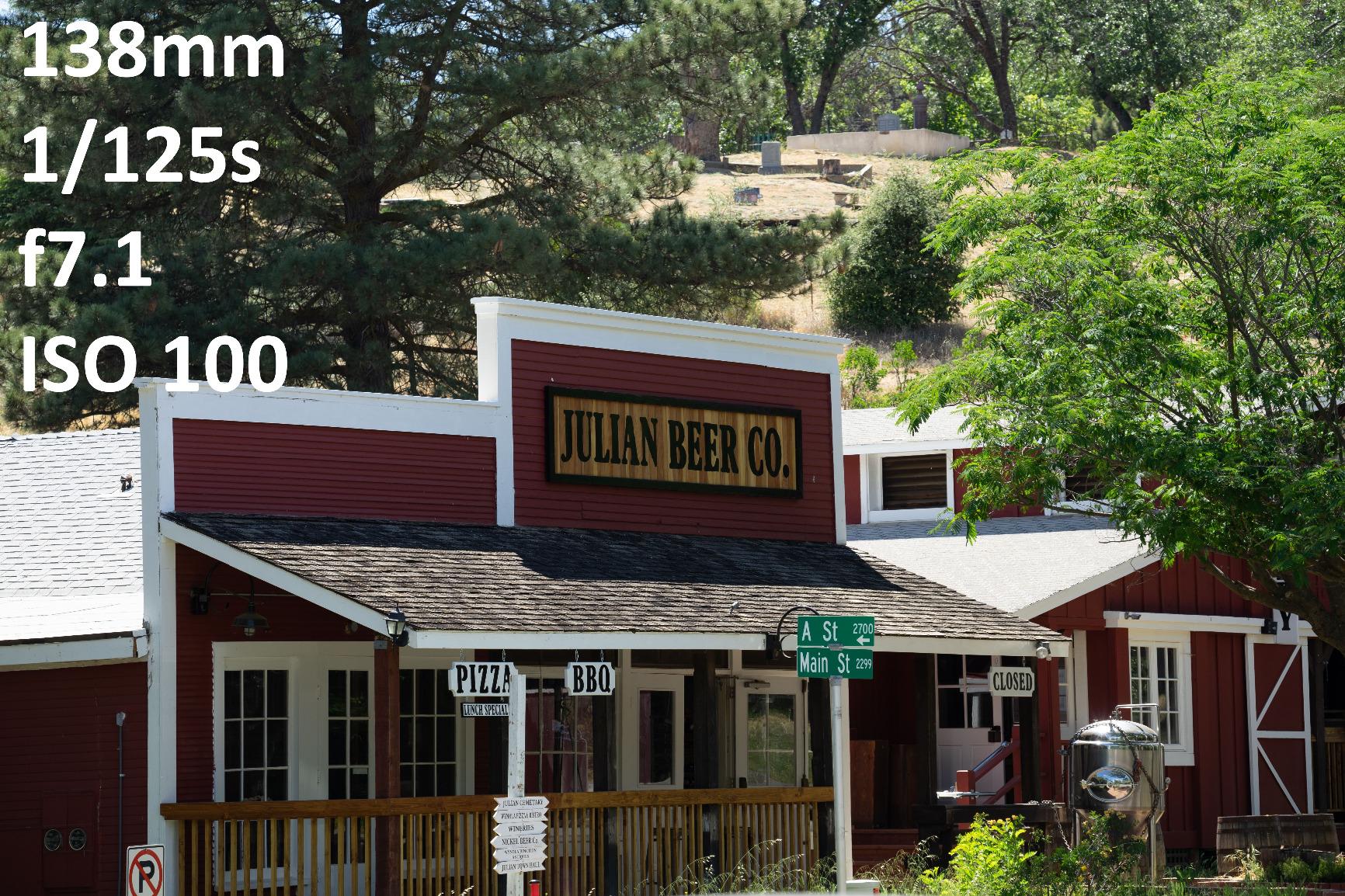
Image sharpness matches or slightly exceeds the Tamron in most scenarios. At 70mm, the Sony delivers excellent center and corner sharpness wide open. At 300mm, performance remains strong, though I noticed some softness in the extreme corners that improves by f8.
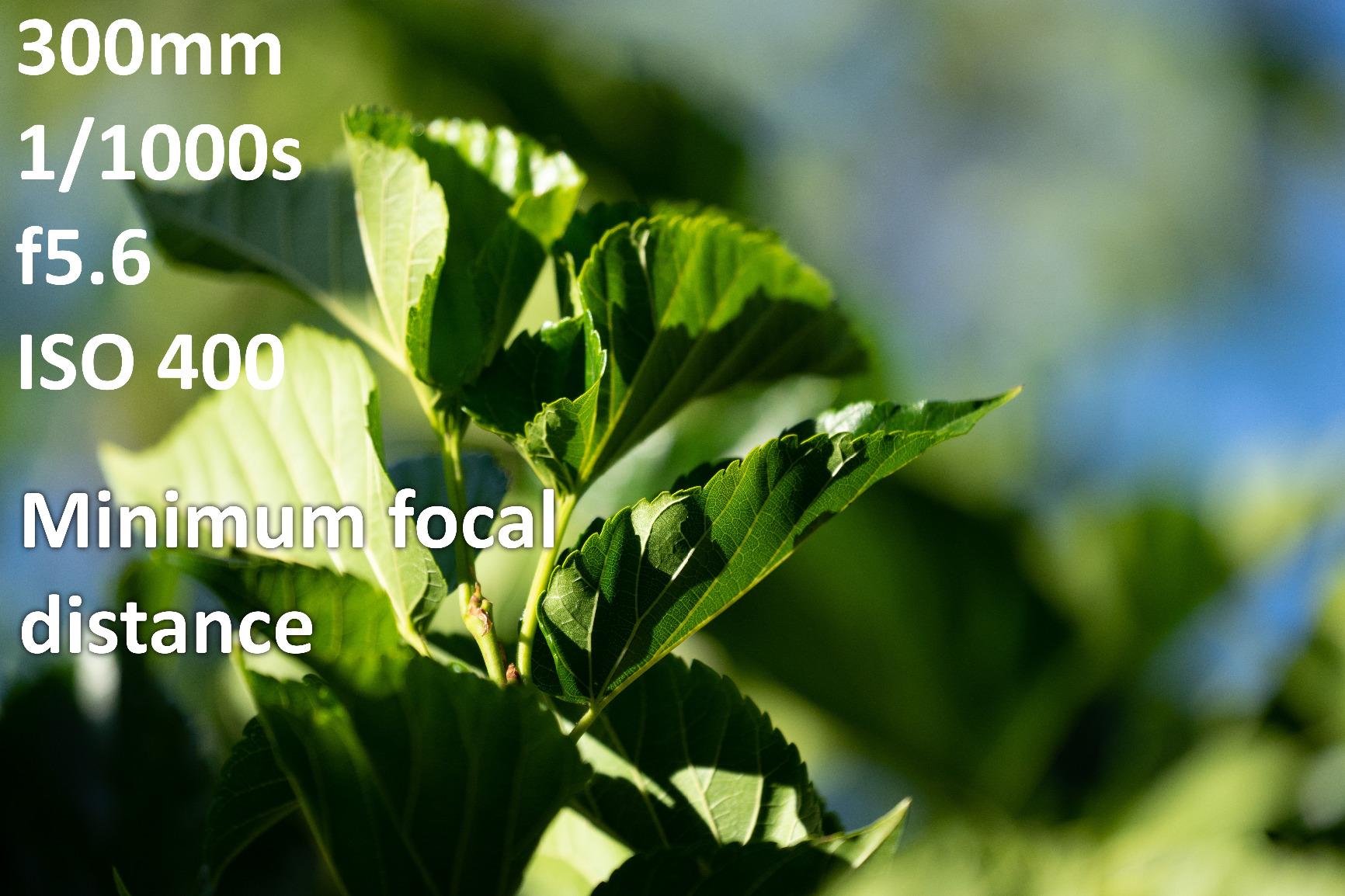
Close-focus capability stands out as a real strength. The lens focuses to less than 3 feet throughout the range, effectively doubling as a semi-macro lens. This flexibility proves valuable for nature photography where you might encounter subjects at varying distances.
The 9-blade circular aperture creates beautiful bokeh for a telephoto zoom. Background rendering remains smooth and pleasing, though not quite at the level of prime lenses. Portrait photographers will appreciate the subject separation at 300mm.
Zoom creep became my biggest frustration with this lens. When pointed downward, the barrel extends under its own weight. The zoom lock only works at 70mm, which limits its usefulness. I found myself constantly adjusting during hiking and landscape work.
The 72mm filter thread slightly increases filter costs compared to Tamron’s 67mm. If you already own 72mm filters for other Sony lenses, this becomes a non-issue. The larger thread also allows for slightly better light transmission.
Head-to-Head Comparison
Image Stabilization Analysis
The stabilization difference defines this comparison. Sony OSS provides genuine value for photographers without IBIS cameras. On my a6400 (no IBIS), the Sony enabled handheld shooting that would be impossible with the Tamron.
Testing revealed the following handheld capabilities at 300mm:
Sony with OSS enabled: Sharp results at 1/30s consistently, occasional success at 1/15s with careful technique. Tamron on A7III with IBIS: Sharp results at 1/125s consistently, 1/60s achievable with practice. Tamron on a6400 without IBIS: Required 1/500s minimum for reliable sharpness.
For APS-C users with cameras like the a6100, a6400, or a6600 without IBIS, the Sony OSS advantage cannot be overstated. The stabilization enables handheld wildlife and sports photography that would otherwise require a tripod.
Image Quality and Sharpness
Both lenses deliver impressive image quality, with subtle differences that favor different use cases. I compared resolution using standardized test charts and real-world subjects.
Center sharpness at 70mm favors the Tamron slightly. At f8, both lenses resolve excellent detail, but the Tamron shows marginally better contrast. This advantage disappears by f11 where diffraction limits both lenses equally.
At 300mm, results flip slightly. The Sony maintains better corner sharpness at the long end, though the Tamron’s center performance remains competitive. For wildlife photography where subjects typically occupy the center frame, this difference matters less.
Chromatic aberration control favors the Sony slightly. Both lenses show minimal lateral CA, but the Sony’s Nano AR Coating reduces purple fringing in high-contrast situations. Post-processing corrects CA easily for both lenses.
Vignetting appears on both lenses wide open but corrects in one click during editing. The Tamron shows slightly more vignetting at 70mm, while both lenses exhibit similar corner darkening at 300mm.
Build Quality and Handling
The weight difference transforms the shooting experience. At 19 ounces, the Tamron feels almost effortless on any camera body. I carried it for full-day hiking trips without fatigue. The Sony at 30 ounces becomes noticeable after several hours.
Weather resistance favors neither lens definitively. Tamron’s moisture-resistant construction handles light rain adequately. Sony’s G-series build inspires more confidence, but neither lens offers true weather sealing with comprehensive gasketing.
Zoom operation differs significantly. The Tamron’s zoom ring moves smoothly with appropriate resistance. The Sony’s zoom ring feels slightly stiff and suffers from zoom creep when pointed downward. For video work, the Tamron’s consistent zoom feel works better.
Filter size matters for system builders. Tamron’s 67mm thread matches their 28-200mm and 70-180mm lenses, allowing filter sharing. Sony’s 72mm thread matches some other Sony glass but creates less consistency across third-party options.
Autofocus Performance
Both lenses employ modern stepping motor technology, but implementation differs. The Tamron RXD motor prioritizes speed, while Sony’s linear actuator emphasizes smoothness.
For still photography, both systems perform admirably. Eye AF tracking on my A7III worked flawlessly with both lenses. Bird-in-flight photography produced similar keep rates, though the Tamron felt slightly snappier acquiring initial focus.
Low-light autofocus reveals the Sony’s weakness. Below EV 2, the Sony hunts noticeably more than the Tamron. This surprised me given the premium positioning. Indoor sports and evening wildlife work better with the Tamron despite the slower maximum aperture.
Video autofocus favors the Sony’s linear actuator for focus transitions. The smooth focus pulls feel more cinematic. However, the Tamron’s faster acquisition benefits run-and-gun video work where speed matters more than smoothness.
Value and Price Analysis
The price gap between these lenses defines the value conversation. The Tamron costs roughly one-quarter of the Sony while delivering 80-90% of the optical performance. This value ratio makes the Tamron an easy recommendation for most photographers.
Consider what the Sony premium buys you: OSS stabilization, G-series build quality, Nano AR Coating, and native Sony compatibility. These features matter for specific users, but many photographers will never fully utilize them.
Resale value favors the Sony. Native lenses typically hold value better than third-party options. If you plan to upgrade frequently, the Sony’s resale advantage partially offsets the higher purchase price.
Long-term ownership tilts toward the Sony for durability. The robust build should withstand more abuse over years of use. However, the Tamron’s lower weight reduces strain on camera mounts, potentially extending camera body life.
Frequently Asked Questions
Does the Tamron 70-300mm have image stabilization?
No, the Tamron 70-300mm f4.5-6.3 Di III RXD does not include optical image stabilization. It relies entirely on your camera body’s IBIS system for shake reduction. On cameras with IBIS like the Sony A7III, you can achieve sharp handheld results at 300mm with shutter speeds around 1/125s. On cameras without IBIS like the a6400, you need shutter speeds of 1/500s or faster for consistently sharp images at the long end.
Is the Tamron 70-300mm sharp enough for professional work?
Yes, the Tamron 70-300mm delivers professional-quality sharpness throughout most of its range. Center sharpness ranks excellent at all focal lengths, with corners performing well when stopped down to f8. Real-world testing shows it matches or slightly exceeds the Sony 70-300mm G OSS in center resolution. The lens performs best in good lighting conditions, with some softening at f6.3 in low light.
Is IBIS enough for hand-holding at 300mm?
IBIS provides sufficient stabilization for handheld shooting at 300mm on most modern Sony cameras. With a 5-axis IBIS system like the A7III, you can achieve sharp results at 1/125s consistently and 1/60s with careful technique. This represents approximately 3 stops of stabilization at 300mm. However, IBIS effectiveness decreases for moving subjects, where faster shutter speeds remain necessary regardless of stabilization.
What is a 70-300mm lens best used for?
A 70-300mm lens excels at wildlife photography, sports action, portraiture with compression, and travel photography. The focal range covers moderate telephoto (70mm) to true telephoto (300mm), making it versatile for various subjects. On APS-C cameras, the effective reach extends to 105-450mm equivalent, ideal for bird photography and distant wildlife. The zoom range also works well for events, airshows, and any situation requiring variable reach without changing lenses.
Is the Sony 70-300mm G OSS worth the extra cost?
The Sony 70-300mm G OSS justifies its premium price primarily through built-in Optical SteadyShot stabilization. For APS-C camera users without IBIS (a6100, a6400), the OSS system enables handheld telephoto photography that would be impossible with unstabilized lenses. For full-frame users with IBIS cameras, the value proposition diminishes significantly. The G-series build quality, Nano AR Coating, and close-focus capability add value, but most photographers will find the Tamron offers better price-to-performance ratio.
Verdict: Which Lens Should You Buy?
After extensive testing of the Tamron 70-300mm f4.5-6.3 Di III RXD vs Sony FE 70-300mm f4.5-5.6 G OSS, I can offer clear recommendations based on your specific situation.
Buy the Tamron 70-300mm if:
You own a Sony camera with IBIS (A7III, A7IV, A7R series, A7S series, A1). The weight savings transform your shooting experience, and image quality matches or exceeds the Sony in most scenarios. You get outstanding value at roughly 25% of the Sony’s price.
You prioritize travel and hiking photography. The 11-ounce weight difference matters enormously when carrying gear all day. I consistently reached for the Tamron over the Sony for travel assignments.
You already own 67mm filters from other Tamron lenses. Filter sharing reduces your overall system cost and packing complexity.
Buy the Sony FE 70-300mm G OSS if:
You shoot with an APS-C camera without IBIS (a6100, a6300, a6400, a6500). The OSS stabilization enables handheld shooting that would be impossible with the Tamron. This alone justifies the premium for APS-C users.
You need stabilization for video work. OSS provides smoother footage than IBIS alone, especially for static shots where the lens and body stabilization work together.
You prefer native Sony lenses for warranty and compatibility peace of mind. Sony service centers handle native lenses more readily than third-party options.
You frequently shoot close-up subjects. The Sony’s superior close-focus capability at less than 3 feet throughout the range provides flexibility the Tamron cannot match.
My final recommendation: For most Sony full-frame users with IBIS cameras, the Tamron 70-300mm represents the smarter purchase. The value proposition is overwhelming, and the weight advantage improves your photography by encouraging you to carry the lens more often. Save the money for other gear or experiences.
For APS-C users without IBIS, the Sony FE 70-300mm G OSS becomes almost essential. The OSS system transforms handheld telephoto photography from challenging to enjoyable. The premium price pays for itself in usable shots you would otherwise miss.