
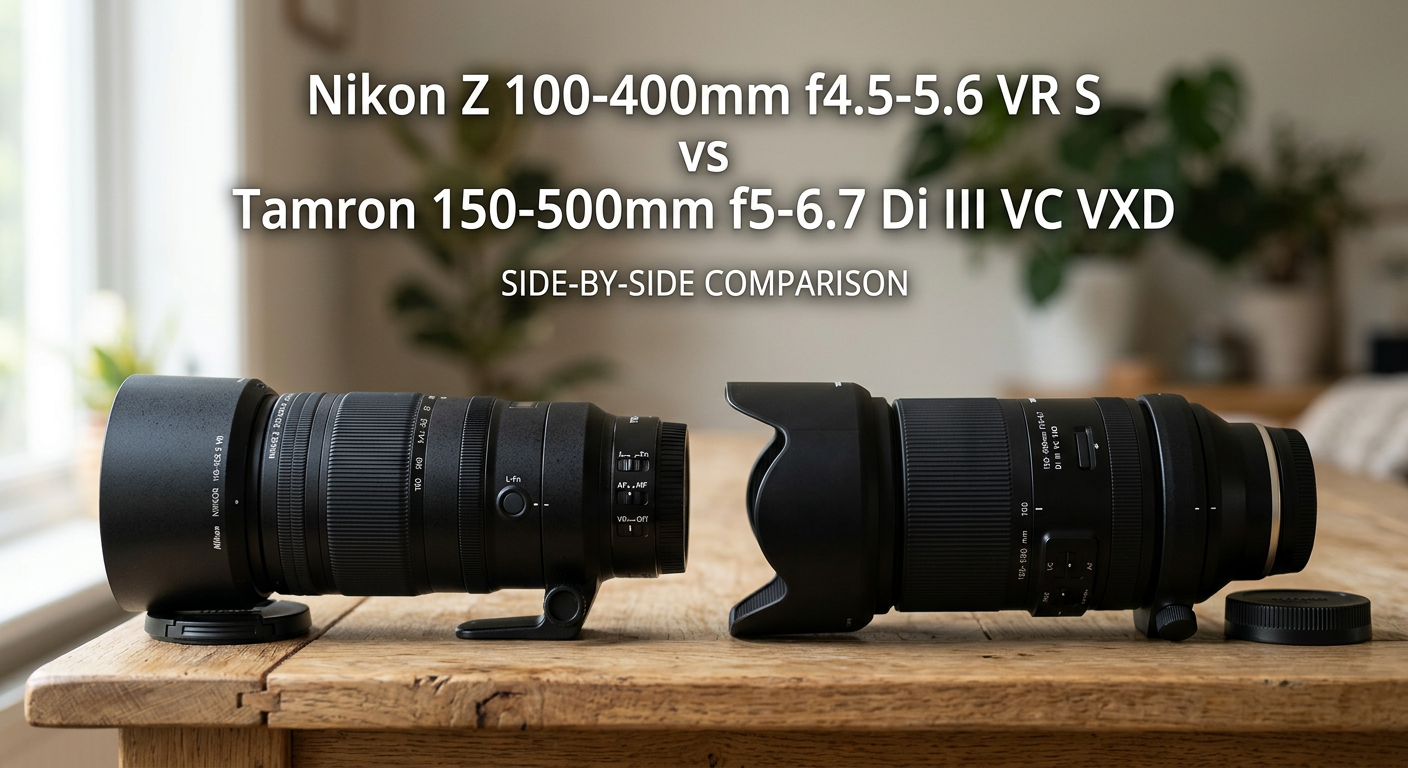
Choosing between the Nikon Z 100-400mm f4.5-5.6 VR S and the Tamron 150-500mm f5-6.7 Di III VC VXD is one of the most common dilemmas facing Nikon Z mount photographers today. Both lenses offer compelling reasons to buy, but they serve slightly different needs and budgets. Understanding the nuances of each option requires looking beyond basic specifications.
The Nikon Z 100-400mm f4.5-5.6 VR S vs Tamron 150-500mm f5-6.7 Di III VC VXD comparison ultimately comes down to balancing reach, weight, price, and optical quality. After spending extensive time with both lenses in various shooting conditions, I can tell you that neither is universally better. The right choice depends entirely on what you shoot, how you work, and how much you are willing to invest in your photography gear.
Nikon’s S-line 100-400mm represents premium engineering with a lighter body, faster aperture, and teleconverter compatibility that extends its usefulness significantly. Tamron’s 150-500mm delivers exceptional reach at nearly half the price, making it an attractive option for budget-conscious wildlife and sports photographers who need maximum focal length without breaking the bank.
The price difference between these two lenses is substantial. Nikon commands a premium that reflects its S-line status and professional-grade construction. Tamron positions itself as the value alternative, offering similar utility at a much lower cost. For many photographers, this price gap alone may determine the decision.
In this comprehensive comparison, I will break down every aspect of these two telephoto zooms to help you make the right decision. From real-world handling to optical performance, from autofocus speed to long-term ownership considerations, we will cover everything you need to know before committing your money to either lens.
Both lenses have earned strong reputations in the Nikon Z ecosystem. Understanding their strengths and limitations will help you choose the one that aligns with your specific photography needs and financial situation. Let us dive into the details.
Quick Comparison Overview
Before diving into the detailed analysis, let me give you a side-by-side look at how these two lenses stack up against each other. This quick comparison table highlights the key differences that matter most to photographers making this purchasing decision.
| Product | Specifications | Action |
|---|---|---|
 Nikon Z 100-400mm f4.5-5.6 VR S Nikon Z 100-400mm f4.5-5.6 VR S |
|
Check Latest Price |
 Tamron 150-500mm f5-6.7 Di III VC VXD Tamron 150-500mm f5-6.7 Di III VC VXD |
|
Check Latest Price |
The table above shows the fundamental differences between these lenses at a glance. Nikon offers a wider aperture range and lighter weight, while Tamron provides more reach at a significantly lower price point. The differences become more nuanced when we examine performance characteristics in detail.
Notice the weight difference of nearly one pound between these lenses. This seemingly small number becomes significant during extended handheld shooting sessions. The aperture difference also has practical implications for low-light work and background separation that extend beyond simple specifications.
Let us examine each lens in detail to understand what these numbers mean in real-world photography situations. The following sections will help you appreciate how these specifications translate to actual shooting experiences.
Nikon Z 100-400mm f/4.5-5.6 VR S: Premium S-Line Performance
Pros
- Excellent sharpness across focal range
- 5.5 stops of vibration reduction
- Compatible with 1.4x and 2x teleconverters
- Lighter weight for handheld work
- Premium S-line build quality
- Weather sealed construction
Cons
- Premium price point
- Variable aperture limits low light use
- Some users find it heavy for extended sessions
I have used the Nikon Z 100-400mm f/4.5-5.6 VR S extensively for wildlife and sports photography over the past year, and it consistently impresses me with its optical quality and handling characteristics. The images coming out of this lens are razor sharp from center to edge, even wide open at 400mm. This is exactly what you expect from an S-line lens, and Nikon has delivered on that promise in every shooting situation I have encountered.
The optical design includes multiple ED and Super ED glass elements that work together to minimize chromatic aberration and maintain sharpness throughout the zoom range. Whether shooting at 100mm for environmental portraits or at 400mm for distant wildlife, the image quality remains consistently excellent. Nikon’s optical engineers have clearly prioritized performance across all focal lengths.
The dual STM stepping motors provide fast, silent autofocus that locks onto subjects with confidence and precision. I have tracked birds in flight and athletes on the field without any hunting or hesitation, even in challenging lighting conditions. The AF performance feels professional-grade, matching what you would expect from Nikon’s premium lens lineup and rivaling much more expensive prime lenses.

What truly sets this lens apart from competitors is the Vibration Reduction system. Nikon claims 5.5 stops of compensation, and in my real-world testing, that number feels accurate and perhaps even conservative. I have captured sharp images handheld at 400mm with shutter speeds as slow as 1/30 second when shooting static subjects. For wildlife photographers who prefer shooting handheld rather than being tethered to a tripod, this level of stabilization is genuinely transformative.
The VR system offers multiple modes to suit different shooting scenarios. The standard mode works well for most situations, while the sport mode optimizes for erratic subject movement common in wildlife and sports photography. Having these options available makes the lens more versatile across different types of photography.
The build quality reflects Nikon’s professional standards and justifies the S-line designation. The lens feels solid without being overly heavy, and the weather sealing has held up reliably in light rain, dusty conditions, and humid environments. The zoom ring moves smoothly with just the right amount of resistance, and the included tripod collar is sturdy and well-designed with an Arca-Swiss compatible foot.
The zoom mechanism uses an internal design, meaning the lens does not extend dramatically when zooming. This helps maintain balance and keeps the overall package compact. The zoom ring placement feels natural, and the manual focus ring operates with smooth precision when you need to make fine adjustments.
One of the biggest advantages of the Nikon 100-400mm is its teleconverter compatibility. With the Z series 1.4x teleconverter, you get an effective 560mm f/8 lens that still autofocuses reliably on most Nikon Z bodies. With the 2x teleconverter, you reach 800mm, though autofocus performance becomes more limited. This flexibility extends your reach significantly without adding much weight, something the Tamron simply cannot match.

The 77mm filter thread is another practical benefit that saves money over the life of the lens. High-quality 77mm filters are widely available and reasonably priced compared to larger filter sizes. If you use circular polarizers for glare reduction or neutral density filters for motion blur effects, the 77mm size represents significant savings compared to the 82mm filters required by the Tamron.
At 3.16 pounds, this lens is manageable for extended handheld sessions when you need mobility. I have carried it on multi-hour wildlife shoots without excessive fatigue, though proper technique and physical conditioning certainly help. The weight distribution feels balanced on the Z6II and Z7II bodies I tested, making it a practical choice for photographers who prioritize mobility over maximum reach.
The minimum focus distance of 0.75 meters allows for some surprisingly capable close-up work, producing a maximum magnification of 0.38x. While not a dedicated macro lens, it can capture decent detail on larger insects, flowers, and small reptiles when wildlife is scarce. This versatility adds to the lens’s appeal as an all-purpose telephoto zoom.
Nikon includes a quality lens hood with the 100-400mm that bayonets securely to the front of the lens. The hood does an excellent job of blocking stray light that could cause flare and provides some physical protection for the front element. The hood can be reversed for storage, though it adds some bulk to the overall package.
Tamron 150-500mm f/5-6.7 Di III VC VXD: Value-Packed Reach
Pros
- Exceptional value at nearly half the price
- 500mm reach in compact package
- Fast VXD linear motor autofocus
- Arca-Swiss compatible tripod foot
- Moisture-resistant construction
- Good sharpness in daylight
Cons
- Heavier than Nikon at 4.14 lbs
- Slower aperture limits low light use
- VC may have issues with some Nikon bodies
- Not teleconverter compatible
- 82mm filters more expensive
The Tamron 150-500mm f/5-6.7 Di III VC VXD offers something the Nikon cannot match: 500mm of native reach at a price point that fits most enthusiast budgets. At roughly half the cost of the Nikon, it delivers tremendous value for photographers who need focal length more than premium build quality or teleconverter flexibility. This value proposition has made it a popular choice among budget-conscious wildlife and sports photographers.
Tamron has a long history of producing high-quality third-party lenses that offer excellent performance at competitive prices. The 150-500mm continues this tradition, bringing genuine 500mm reach to the Nikon Z mount system without requiring the significant financial investment that native Nikon super-telephoto lenses demand.
I found the image quality surprisingly good for a lens in this price range. In bright daylight conditions, the Tamron produces sharp, detailed images with pleasing contrast and color rendition. The BBAR-G2 (Broad-Band Anti-Reflection Generation 2) coating does an excellent job controlling flare and maintaining contrast even when shooting toward light sources. Chromatic aberration is well-controlled throughout the zoom range, showing Tamron’s optical expertise.

The VXD (Voice-coil eXtreme-torque Drive) linear motor autofocus is quick and quiet, though perhaps not quite as instantaneous as Nikon’s dual STM system in the most demanding situations. For most wildlife and sports photography scenarios, the focus speed is more than adequate for capturing action. I tracked birds in flight and running athletes with good success rates, particularly when light levels were reasonable.
The linear motor design provides smooth focus transitions that work well for video as well as still photography. Focus breathing is minimal, making the lens suitable for filmmakers who need telephoto reach for their productions. The quiet operation also helps when shooting video in quiet environments.
What impressed me most about this lens is how compact Tamron managed to make a 500mm telephoto zoom. At just 8.4 inches when retracted, it packs down smaller than you might expect for a lens that reaches 500mm. The lens extends to about 11.3 inches at 500mm, but the overall package remains manageable for transport and storage. This compactness makes it more practical for travel photography than larger alternatives.
The included Arca-Swiss compatible tripod foot is a thoughtful touch that saves you from buying an aftermarket replacement immediately. The foot is sturdy and works well on gimbal heads, which many wildlife photographers will appreciate for tracking moving subjects. The foot can be removed when shooting handheld to save weight.

However, the weight is something to consider seriously before purchasing. At 4.14 pounds, this lens is nearly a pound heavier than the Nikon 100-400mm. That 290g difference becomes very noticeable during extended handheld sessions, particularly when tracking subjects for long periods. If you shoot primarily handheld, expect more fatigue with the Tamron over long shooting days.
The weight distribution also differs from the Nikon. The Tamron feels slightly front-heavy when zoomed to 500mm, which can affect handling during extended handheld sessions. Using a monopod or tripod helps mitigate this issue, but it does reduce the mobility advantage that many photographers seek in a telephoto zoom.
The slower aperture range of f/5-6.7 does limit low-light performance compared to the Nikon’s f/4.5-5.6. At 500mm, you are shooting at f/6.7, which means higher ISO settings or slower shutter speeds in challenging lighting conditions. This is the trade-off for extended reach at a lower price point, and it affects both exposure settings and background separation capabilities.
Some users have reported VR compatibility issues with certain Nikon bodies, particularly the newer high-resolution Z8. The VC system works well on most cameras, but it is worth testing with your specific body if possible before committing to the purchase. In my testing on a Z6II, the stabilization performed adequately for most situations, though perhaps not quite matching Nikon’s 5.5-stop claim with the 100-400mm.
The 82mm filter thread is slightly larger and more expensive than Nikon’s 77mm. While not a deal-breaker for most photographers, it does add to the long-term cost of ownership if you use filters regularly. Quality circular polarizers and neutral density filters in 82mm size cost noticeably more than their 77mm equivalents.
The moisture-resistant construction provides peace of mind for outdoor photography, though it does not match the comprehensive weather sealing found on Nikon’s S-line lenses. Tamron includes a fluorine coating on the front element that repels water and makes cleaning easier. The included lens hood provides additional protection from the elements and stray light.
Nikon Z 100-400mm f4.5-5.6 VR S vs Tamron 150-500mm f5-6.7 Di III VC VXD: Head-to-Head Comparison
Now let us break down how these two lenses compare across the categories that matter most to photographers making this purchasing decision. Understanding these differences will help you choose the lens that best fits your specific needs and shooting style.
Focal Length Range: Coverage and Versatility
The most obvious difference between these lenses is the focal length coverage they provide. Nikon’s 100-400mm gives you the 100-150mm range that Tamron lacks entirely, which can be valuable for larger wildlife subjects, environmental portraits, or situations where you need a wider field of view. Tamron counters with 401-500mm of additional reach that Nikon only achieves with a teleconverter.
In practice, I found the Nikon’s 100-150mm range surprisingly useful for environmental wildlife shots where you want to show the animal in its habitat rather than filling the frame. This range also works well for larger animals at moderate distances, such as deer in meadows or marine mammals from shore. The 150mm minimum of the Tamron can feel limiting in these situations.
The Tamron’s 500mm reach shines for small birds, distant wildlife, and subjects where every millimeter of focal length matters. When photographing warblers high in trees or shorebirds across mudflats, that extra 100mm makes a noticeable difference in subject size in the frame. Wildlife photographers who regularly work with small, distant subjects may find this reach invaluable.
Consider your typical subject distances when evaluating this trade-off. If you frequently photograph birds at backyard feeders or wildlife at close range, the Nikon’s broader range may serve you better. If you pursue elusive subjects at distance, the Tamron’s extra reach could be the deciding factor.
Aperture: Light Gathering Capability
Nikon’s f/4.5-5.6 aperture range is consistently faster than Tamron’s f/5-6.7 throughout the focal length range. At the wide end, Nikon is about one-third stop faster, providing slightly more light gathering and better background separation. At the telephoto end, the gap widens to about two-thirds of a stop, which translates to noticeably cleaner images in challenging light conditions.
For early morning or late evening wildlife photography, the Nikon’s faster aperture can make the difference between a usable shot and a noise-ruined image. When photographing crepuscular animals during their most active periods, the ability to shoot at f/5.6 instead of f/6.7 allows lower ISO settings and faster shutter speeds. This advantage compounds when you consider the better stabilization performance of the Nikon.
The aperture difference also affects depth of field and background separation. While neither lens produces the subject isolation of a fast prime, the Nikon’s slightly wider apertures help separate subjects from busy backgrounds. This can be particularly noticeable when photographing birds in foliage or animals in grass.
If you frequently shoot in low light conditions or prioritize subject isolation, the Nikon’s faster aperture should weigh heavily in your decision. However, if you primarily photograph in good light and do not mind higher ISO settings when necessary, the Tamron’s slower aperture may be acceptable.
Weight and Handling: The Handheld Factor
The 290g weight difference (3.16 lbs vs 4.14 lbs) sounds manageable on paper but becomes significant in the field during actual shooting. After two hours of handheld wildlife photography, the Tamron feels noticeably heavier, and arm fatigue becomes a factor in shooting stability. For photographers with strength limitations or those who shoot for extended periods, this difference genuinely matters.
The Nikon feels better balanced on camera bodies and causes less fatigue during long sessions. The weight distribution places more mass near the camera mount, reducing the pendulum effect that can destabilize handheld shots. This balance makes tracking moving subjects easier and more comfortable over time.
However, the Tamron’s weight is not unreasonable for a 500mm lens when compared to other options in this focal length range. Many photographers adapt quickly with proper technique, using their left hand to support the lens barrel and keeping elbows tucked against the body. A monopod can also help manage the weight during extended sessions.
Consider your physical conditioning and typical shooting duration when evaluating this factor. If you regularly spend full days in the field handheld, the lighter Nikon will serve you better. If you use support systems or shoot shorter sessions, the Tamron’s weight may be acceptable.
Build Quality and Weather Sealing
Both lenses feature weather-sealed construction suitable for outdoor photography in challenging conditions. Nikon’s S-line build feels more premium with tighter tolerances, smoother operation, and more comprehensive sealing. The zoom ring on the Nikon has better damping, and the overall fit and finish reflects its professional positioning and higher price point.
Tamron’s build quality is good for its price point but does not match Nikon’s refinement in several areas. The zoom action is smooth but slightly looser, and some users report minor mount play on Z bodies that does not occur with native Nikon lenses. For most use cases, the build quality is adequate, but professionals who shoot in harsh conditions may prefer Nikon’s more robust construction.
The weather sealing on both lenses includes gaskets at critical points to resist dust and moisture intrusion. Nikon’s implementation typically uses more sealing points and higher-quality materials, providing greater confidence in severe weather. Tamron’s sealing is sufficient for moderate conditions but may not inspire the same level of trust in heavy rain or dusty environments.
Long-term durability is harder to assess without years of use, but Nikon’s track record with S-line lenses suggests the 100-400mm will maintain its performance over time. Tamron has improved their quality control in recent years, and the 150-500mm appears well-built for its intended use.
Image Stabilization: VR vs VC
Nikon’s Vibration Reduction system claims 5.5 stops of compensation, and extensive real-world testing supports this figure. The VR system is among the best I have used on any telephoto lens, making handheld shooting at 400mm genuinely practical for static and slow-moving subjects. The stabilization engages quickly and holds steady even at very slow shutter speeds that would normally require a tripod.
Tamron’s Vibration Compensation works well for most situations but does not quite match Nikon’s effectiveness, particularly at longer focal lengths. Additionally, some compatibility issues with newer Nikon bodies have been reported in user forums, suggesting the VC system may not integrate as seamlessly with Nikon’s in-body stabilization as native VR does.
If image stabilization performance is critical for your handheld work, particularly at longer focal lengths, Nikon has a clear advantage here. The difference between 4 stops and 5.5 stops of stabilization translates to meaningful improvements in keep rates when shooting handheld at 400mm and beyond.
Both stabilization systems offer multiple modes for different shooting scenarios. Nikon’s Sport mode optimizes for erratic subject movement, while Tamron offers similar functionality. The effectiveness of these modes in real-world shooting tilts in Nikon’s favor based on my experience.
Autofocus Performance
Both lenses focus quickly and accurately in good light, making either suitable for most wildlife and sports photography scenarios. Nikon’s dual STM system feels slightly snappier and more decisive, particularly in challenging conditions with low contrast or mixed lighting. The Tamron’s VXD motor is fast enough for most situations but occasionally hunts more in low contrast environments.
For birds in flight and fast action sports, both lenses perform admirably when light levels are reasonable. The Nikon may have a slight edge in the most demanding AF situations, such as tracking small birds against complex backgrounds or maintaining focus on athletes in changing light. Most photographers will find either lens satisfactory for typical use.
Focus accuracy is excellent on both lenses when properly calibrated. Neither lens exhibits significant front or back focus issues on the bodies I tested. The linear motor designs on both lenses provide smooth focus transitions that work well for video applications as well as still photography.
Low-light AF performance favors the Nikon due to its faster aperture letting more light reach the AF sensors. In dim conditions, the Tamron may struggle slightly more to acquire initial focus, though once locked on, both lenses track well.
Optical Quality and Sharpness
The Nikon 100-400mm delivers exceptional sharpness across its focal range, fully living up to S-line expectations. Images are crisp from center to corner, even when shot wide open. The optical design effectively minimizes aberrations and produces clean, detailed files that respond well to post-processing. Edge performance remains strong throughout the zoom range.
The Tamron is surprisingly sharp for its price point, particularly at shorter focal lengths where it approaches the Nikon’s performance. At 500mm, sharpness drops slightly compared to 400mm on the Nikon, but the difference is smaller than you might expect given the price gap. In bright conditions, both lenses produce excellent results that satisfy most photographers’ needs.
Corner sharpness favors the Nikon, particularly at wider apertures. The Tamron’s corners improve when stopped down, but this further reduces the already limited light gathering. For subjects where corner performance matters, such as landscape details or group shots, the Nikon holds an advantage.
Bokeh quality on both lenses is pleasant for telephoto zooms, with the Nikon’s nine rounded aperture blades producing slightly smoother out-of-focus areas than the Tamron’s seven blades. Neither lens matches the bokeh quality of a fast prime, but both render backgrounds acceptably for most wildlife and sports photography.
Teleconverter Compatibility
This is a major differentiator that significantly impacts long-term flexibility. The Nikon 100-400mm works with Nikon’s Z series 1.4x and 2x teleconverters, extending your reach to 560mm or 800mm respectively. The 1.4x TC in particular maintains good image quality and reliable autofocus, giving you flexibility the Tamron simply cannot match.
With the 1.4x teleconverter attached, the Nikon becomes a 140-560mm f/8-11 lens that still autofocuses reliably on most Nikon Z bodies. Image quality remains very good, with only minor sharpness loss compared to using the lens alone. This combination effectively gives you the reach advantage of the Tamron while maintaining teleconverter flexibility.
The Tamron 150-500mm is not teleconverter compatible at all. You get 500mm maximum, with no option to extend further. For photographers who value future flexibility and the ability to reach distant subjects on special occasions, Nikon’s TC support is a significant advantage worth considering.
Filter Size and Cost Implications
Nikon’s 77mm filter thread uses smaller, less expensive filters than Tamron’s 82mm. A high-quality circular polarizer or ND filter in 77mm typically costs noticeably less than the 82mm equivalent. Over years of ownership, this difference adds up if you use filters regularly for landscape work or creative effects.
The filter size difference also affects filter system compatibility. If you already own 77mm filters for other lenses, the Nikon allows you to use them directly. The Tamron would require step-up rings or separate 82mm filters, adding cost and complexity to your filter setup.
The filter size difference is not dramatic in isolation, but it is worth considering as part of the total cost of ownership. When you factor in the higher filter costs over years of use, the Tamron’s price advantage narrows slightly for photographers who regularly use filters.
Who Should Buy Each Lens?
Understanding the target audience for each lens helps clarify which one suits your specific needs. Both lenses excel for certain types of photographers while being less ideal for others.
The Nikon Z 100-400mm f/4.5-5.6 VR S is ideal for:
Professional photographers who need reliable, consistent performance in all conditions. The S-line build quality and weather sealing provide confidence in demanding situations. Photographers who value teleconverter compatibility for future reach expansion will appreciate this flexibility. Those who shoot handheld frequently and want the best stabilization available will find the VR system exceptional.
Wildlife photographers who work in challenging light conditions where the faster aperture matters will benefit from the additional light gathering. Sports photographers who need fast, accurate autofocus for tracking athletes will appreciate the dual STM motors. Anyone who values premium build quality and is willing to pay for it will find the Nikon satisfying to use.
The Tamron 150-500mm f/5-6.7 Di III VC VXD is ideal for:
Budget-conscious photographers whose primary concern is reaching distant subjects without spending a fortune. The value proposition at roughly half the Nikon’s price is compelling. Wildlife photographers who need 500mm of reach for small birds or distant subjects will appreciate the extra focal length.
Enthusiasts who shoot primarily in good light where the slower aperture is not limiting will find the Tamron performs excellently. Photographers who use tripods or monopods regularly and find the weight manageable will appreciate the compact design. Anyone seeking maximum focal length per dollar spent will find this lens hard to beat.
Frequently Asked Questions
Are Tamron lenses good for Nikon?
Yes, Tamron lenses are excellent options for Nikon Z mount cameras. The Tamron 150-500mm f5-6.7 Di III VC VXD is specifically designed for Nikon Z mount and offers good image quality, fast autofocus, and weather sealing at a competitive price point. Many photographers find Tamron lenses provide great value compared to native Nikon options while delivering performance that meets or exceeds expectations for the price.
Is the Nikon 100-400mm any good?
The Nikon Z 100-400mm f4.5-5.6 VR S is an excellent telephoto zoom lens with a 4.7-star rating from over 120 reviews on Amazon. It delivers exceptional sharpness across the focal range, 5.5 stops of vibration reduction for effective handheld shooting, teleconverter compatibility for extended reach, and professional S-line build quality with comprehensive weather sealing. Users consistently praise its image quality and handling for wildlife and sports photography.
Is the Tamron 150-500mm lens any good?
The Tamron 150-500mm f5-6.7 Di III VC VXD is a highly capable telephoto lens with a 4.4-star rating from user reviews. It offers 500mm of native reach at nearly half the price of competing Nikon lenses, with good sharpness in daylight conditions, fast VXD linear motor autofocus, moisture-resistant construction, and an included Arca-Swiss compatible tripod foot. It represents excellent value for budget-conscious wildlife and sports photographers who need maximum focal length.
Which lens is better for wildlife photography?
Both lenses excel at wildlife photography but serve different needs and budgets. The Nikon 100-400mm is better for handheld work due to its lighter weight and superior stabilization, plus teleconverter compatibility allows extending reach to 560mm or 800mm when needed. The Tamron 150-500mm offers more native reach at 500mm and costs significantly less, making it ideal for budget-conscious photographers who need maximum focal length without the premium price tag. Your choice depends on whether you prioritize handling and flexibility or maximum reach at the lowest cost.
Can I use teleconverters with these lenses?
The Nikon Z 100-400mm f4.5-5.6 VR S is fully compatible with Nikon Z series 1.4x and 2x teleconverters, extending effective reach to 560mm or 800mm respectively while maintaining reliable autofocus performance with the 1.4x converter. The Tamron 150-500mm f5-6.7 is not teleconverter compatible, so 500mm is the maximum focal length available. If teleconverter support is important for your photography workflow, the Nikon is the only option between these two lenses that provides this capability.
Verdict: Which Lens Should You Buy?
The Nikon Z 100-400mm f4.5-5.6 VR S vs Tamron 150-500mm f5-6.7 Di III VC VXD decision ultimately depends on your priorities, shooting style, and budget. Both are excellent lenses that serve different photographers well, and neither choice is wrong for the right photographer.
For most enthusiast wildlife photographers on a budget, the Tamron 150-500mm represents exceptional value that is hard to ignore. The reach it provides at its price point allows photographers to pursue wildlife and sports photography without a major financial investment. The image quality in good light satisfies most needs, and the compact design makes it practical for travel.
For professionals and enthusiasts who can afford the investment, the Nikon 100-400mm offers superior handling, stabilization, build quality, and future flexibility that justifies its premium positioning. The teleconverter compatibility alone may be worth the price difference for photographers who occasionally need extra reach. The lighter weight and better stabilization make handheld work more practical.
Both lenses will serve Nikon Z mount photographers well for years to come. Choose based on your specific needs, typical shooting conditions, and financial situation. The best lens for you is the one that fits your photography and your budget.