
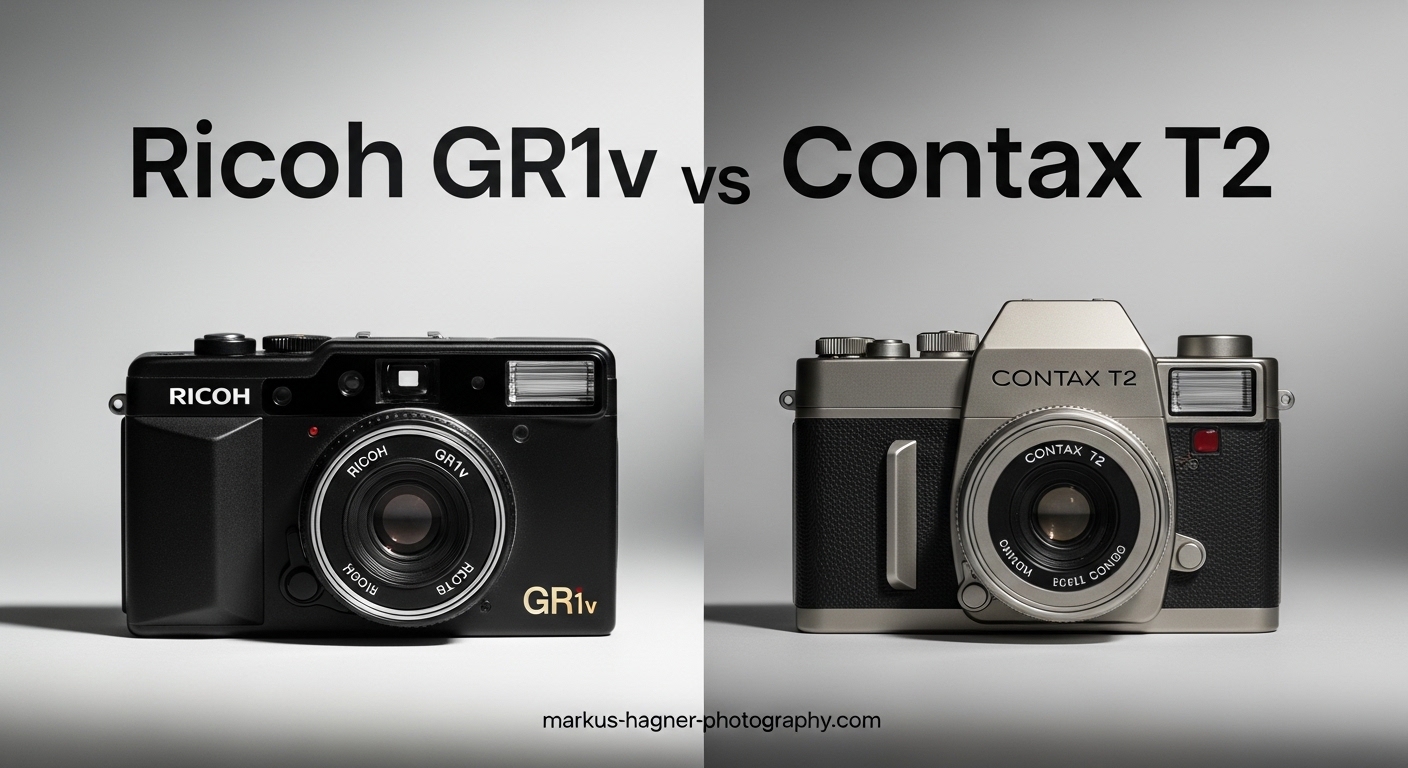
When it comes to legendary 35mm point-and-shoot film cameras, few comparisons generate as much debate as the Ricoh GR1v vs Contax T2. These two cameras represent the absolute peak of 1990s compact camera engineering, offering professional-grade optics in pocketable bodies that still command serious money decades after their release.
I have spent years shooting with both systems, and the choice between them often comes down to one fundamental question: do you prioritize a wider field of view for street photography, or do you prefer the classic 38mm focal length with legendary Zeiss rendering? Each camera has its devoted following, and for good reason.
The Contax T2 has become something of a celebrity favorite, with its titanium body and Carl Zeiss Sonnar lens commanding prices that would have seemed unthinkable just a decade ago. The Ricoh GR1v, meanwhile, has quietly maintained its reputation as the street photographer’s secret weapon, offering a wider 28mm lens and innovative snap focus system that predates modern zone focusing techniques.
In this comprehensive comparison, I will break down every aspect of these two legendary cameras to help you decide which one deserves a place in your camera bag in 2026. From build quality and lens characteristics to real-world handling and long-term reliability, we will cover everything you need to know before making this significant investment in vintage camera equipment.
Both cameras emerged during the golden age of premium compact film cameras in the 1990s, when manufacturers competed to create the ultimate everyday carry camera for serious photographers. The engineering that went into these compact marvels remains impressive today, even as digital cameras have largely replaced film for most photographers.
Ricoh GR1v vs Contax T2: Quick Comparison
Before diving into the details, let me give you a side-by-side look at how these two cameras stack up against each other. The fundamental differences become apparent immediately when you examine the specifications side by side.
| Product | Specifications | Action |
|---|---|---|
 Contax T2 Titanium Black 35mm Film Camera Contax T2 Titanium Black 35mm Film Camera |
|
Check Latest Price |
 Contax T2 Silver 35mm Camera Contax T2 Silver 35mm Camera |
|
Check Latest Price |
The most striking difference is the focal length: the Contax T2 features a 38mm Carl Zeiss Sonnar lens, while the Ricoh GR1v sports a wider 28mm GR lens. This 10mm difference fundamentally changes how you compose and approach your subjects. The weight gap is equally significant, with the Contax tipping the scales at around 295g compared to the Ricoh’s featherweight 178g.
Both cameras offer aperture-priority autoexposure as their primary shooting mode, but their control philosophies differ substantially. The Contax gives you a dedicated aperture dial on the lens barrel, offering tactile control that many photographers prefer for its direct, mechanical feel. The Ricoh uses a thumb wheel on the back, which some find faster to adjust while shooting from the hip or working quickly in changing light.
The build materials tell a story of two different design philosophies. Contax chose titanium for its premium feel and durability, creating a camera that feels substantial and luxurious. Ricoh opted for magnesium alloy, prioritizing light weight while still maintaining excellent build quality. Both approaches have merit, and your preference may depend on how you prioritize portability versus premium feel.
Contax T2: The Titanium Legend
Pros
- Titanium body construction
- Legendary Carl Zeiss optics
- Manual aperture control ring
- Optical viewfinder with 100% coverage
- Built-in flash with auto modes
Cons
- Heavy for a point and shoot
- Very high market price
- Electronic failure risk
- Limited repair options
The Contax T2 feels like a premium instrument from the moment you pick it up. The titanium body has a satisfying weight and solidity that immediately communicates quality. When I first handled one years ago, I understood why celebrities and serious photographers alike have fallen under its spell. There is something undeniably appealing about a camera that feels this substantial in your hands.
The Carl Zeiss Sonnar 38mm f/2.8 T* lens is the real star of the show and the primary reason photographers continue to seek out this camera. Zeiss coatings and optical design deliver images with that distinctive rendering many photographers describe as having exceptional micro-contrast and three-dimensional pop. Colors render beautifully, especially when shooting portrait-oriented subjects at moderate distances where the lens really shines.
Shooting with the T2 feels deliberate and considered, almost meditative. The aperture ring on the lens barrel gives you direct control over your depth of field, with settings from f/2.8 to f/16 plus an auto position for program mode. This tactile control connects you to the exposure process in a way that rear thumb wheels simply cannot match. The manual focus option, while not true manual focus, lets you set focus distance presets for zone focusing situations where speed matters more than precision.
The viewfinder is bright and clear, though some photographers with glasses find it on the small side. What you see through the finder is exactly what you get, with 100% coverage meaning no surprises at the edges of your frame. The information display shows shutter speed and focus confirmation, keeping you informed without cluttering the view or distracting from composition.
Built-in flash is available when you need it, with automatic modes that handle most situations adequately. The flash is not going to win any awards for power or sophistication, but it gets the job done for snapshots and fill flash situations. Many photographers prefer to leave it off entirely, embracing the available light approach that suits these cameras best.
My main concern with the T2, and one I cannot emphasize enough, is the electronic complexity. These cameras are now 25-30 years old, and the electronics can fail without warning. When they do, repair options are limited and expensive, if they exist at all. I have heard too many stories of T2s becoming expensive paperweights after sudden electronic failures to recommend buying one without considering this risk seriously.
The autofocus system works well for most situations, with five focusing points that cover a reasonable area of the frame. Low light focusing can be slow or uncertain, which is common for cameras of this era. The manual focus presets help in situations where autofocus might struggle or take too long.
Battery life is reasonable, with the CR123 lithium cell providing enough power for dozens of rolls of film. Carrying a spare battery is always wise, especially when traveling. The battery compartment is accessible and the door feels reasonably secure, though it is worth checking periodically to ensure it has not developed any looseness.
Film loading is motorized and generally reliable. The camera advances to the first frame automatically after you insert a canister and close the back. The motor drive advances film between shots and rewinds automatically at the end of the roll. Some photographers prefer manual rewind to save battery, but the T2 handles this automatically.
Ricoh GR1v: The Street Photographer’s Choice
The Ricoh GR1v takes a completely different approach to premium compact camera design. Where the Contax emphasizes solid feel and classic styling, the Ricoh prioritizes portability and street photography functionality above all else. At just 178g, it is significantly lighter than the T2, making it far more comfortable for all-day carry and travel photography.
The 28mm f/2.8 GR lens is remarkably sharp, delivering images with excellent edge-to-edge resolution that rivals lenses costing many times more. This wider field of view is ideal for environmental portraits, street scenes, and architectural subjects where context matters as much as the main subject. Many street photographers prefer 28mm precisely because it forces you to get closer to your subjects, creating more intimate and engaging images that feel immediate and connected.
What truly sets the GR1v apart from virtually every other compact camera is its innovative snap focus system. This feature lets you preset a focus distance, typically 1.5m or 2m, and the camera will instantly focus at that distance when you press the shutter without any autofocus delay. For street photography, this eliminates the autofocus hunting and lag that can cause you to miss fleeting moments. Combined with the wide lens and ample depth of field at typical street shooting apertures like f/8 or f/11, snap focus makes the GR1v incredibly responsive and predictable.
The magnesium alloy body does not have the same premium heft as the Contax’s titanium, but it is well-built and feels solid in hand despite the light weight. The controls are thoughtfully laid out, with the exposure compensation dial on top providing quick access to this essential adjustment. Aperture control comes via a thumb wheel on the back, which some photographers find faster to operate than the front-mounted ring on the Contax.
The LCD panel on top displays essential shooting information including aperture, shutter speed, exposure compensation, and frame counter. This information is always visible without needing to look through the viewfinder, which can be helpful when setting up shots or checking settings quickly. The display is clear and easy to read in most lighting conditions.
Spot focus mode allows for more precise focus placement when the situation demands it, giving you control over exactly where the camera focuses rather than relying on the automatic system. This flexibility makes the GR1v more versatile than cameras with simpler focusing systems.
The Achilles heel of the GR1v, and the issue that potential buyers must understand, is the LCD display failure issue. Over time, the liquid crystal segments can degrade and disappear, leaving you without critical exposure information. This is a well-documented failure point and one that is difficult to repair economically. Viewfinder display segments can also fail, though the viewfinder itself remains usable for composition even when the information display degrades.
Despite these concerns, many GR1v cameras continue to function for years with partial display failure. The core camera operation remains intact even when you cannot see all the information. Some photographers simply memorize their settings or work around the missing segments. It is an imperfect situation, but one that many owners accept given the camera’s other strengths.
The Ricoh GR1v is a vintage film camera that is no longer manufactured and is primarily available through secondary markets like eBay, dedicated camera shops, and collector sales. Prices have risen significantly as film photography has experienced a renaissance, but the GR1v generally commands less than the Contax T2, offering potentially better value for photographers who prefer the wider focal length and street photography orientation.
For photographers interested in the Ricoh GR philosophy but wanting a modern alternative, Ricoh continues the GR lineage with digital cameras like the GR IIIx, which offers similar compact dimensions and a 40mm equivalent lens in a digital format. These modern cameras provide the GR experience without the reliability concerns inherent in 25-year-old electronics.
Head-to-Head Comparison: Which Camera Wins?
Now let us break down how these two legendary cameras compare across the categories that matter most to photographers making this decision. I have shot extensively with both systems and can offer real-world perspective on where each excels.
Build Quality and Design
Winner: Contax T2
The titanium-bodied Contax T2 simply feels more substantial and premium in hand. The fit and finish are exceptional, with tight tolerances and a reassuring heft that communicates quality at every touch point. The machining and finishing of the titanium body is a testament to Kyocera’s manufacturing capabilities at the time.
The Ricoh GR1v is well-built with its magnesium alloy construction, but it does not quite match the Contax in perceived quality or tactile satisfaction. The lighter weight can actually be an advantage for carrying, but if having a camera that feels like a luxury object matters to you, the T2 wins this category decisively.
Lens Quality and Focal Length
Winner: Depends on your use case
This is not a case of one lens being objectively better than the other. Both are exceptional optics that have earned legendary status among film photographers.
The Carl Zeiss Sonnar 38mm on the Contax delivers that classic Zeiss rendering with excellent color reproduction, micro-contrast, and a distinctive rendering character that many photographers find addictive. It is ideal for portraits, travel scenes, and subjects where you want some subject isolation and that indefinable Zeiss quality.
The 28mm GR lens on the Ricoh is incredibly sharp across the frame and offers a wider perspective that many street photographers prefer. It excels at environmental portraits and situations where context matters as much as the subject. The lens has its own character, rendering scenes with clarity and precision that suits documentary and candid photography.
Both lenses are excellent; the choice depends entirely on your preferred focal length and the type of photography you pursue most often.
Portability
Winner: Ricoh GR1v
At 178g versus 295g, the Ricoh GR1v is significantly lighter, a difference of over 100 grams. This weight gap becomes very apparent during long days of shooting or extended travel. The GR1v slips into a pocket easily and disappears until you need it, making it a true everyday carry camera.
The Contax, while still compact by any reasonable standard, has a noticeable presence in your bag or pocket. The extra weight can be fatiguing during all-day shoots. For photographers who prioritize carrying their camera everywhere, the Ricoh’s light weight is a meaningful advantage.
Controls and Features
Winner: Ricoh GR1v
The snap focus system alone gives the Ricoh a significant advantage for street photography and candid work. Being able to preset a focus distance and have instant shutter response without autofocus delay is genuinely useful in real-world shooting situations. This feature predates similar zone focus techniques that have become popular with digital cameras.
The exposure compensation is also more accessible on the Ricoh, with a dedicated dial on top that allows quick adjustments without removing your eye from the viewfinder. The overall control layout feels more intuitive for quick adjustments and responsive photography.
The Contax has its aperture ring, which some photographers prefer for its tactile feel, but the Ricoh offers more flexibility for the way many photographers actually shoot in dynamic situations.
Viewfinder
Winner: Contax T2
The Contax viewfinder is brighter and offers a more pleasant viewing experience overall. The view is clear and the information display, when working properly, provides essential shooting data without cluttering the frame.
The Ricoh finder is adequate for most purposes but can feel cramped, particularly for photographers who wear glasses. The information display is more prone to failure, which can leave you shooting without critical exposure information visible. If composing through a viewfinder is important to your process, the T2 provides the better experience.
Reliability and Repair
Winner: Neither – this is the uncomfortable truth
This is the category where both cameras disappoint. They are complex electronic devices that are now decades old, and age-related failures are becoming increasingly common.
The Contax can suffer sudden electronic failure that renders it completely unusable. Stories of T2s dying mid-roll or refusing to turn on are unfortunately common in photography forums. When this happens, repair options are extremely limited and often more expensive than simply buying another camera.
The Ricoh has the well-documented LCD display degradation issue that affects virtually all surviving examples to some degree. While the camera may continue to function despite display problems, the failure is progressive and essentially irreversible without donor parts from another camera.
Neither camera is easily repairable, and qualified service options are limited and expensive. When buying either camera, you should factor in the very real possibility of eventual electronic failure. These are vintage electronics, not modern cameras with readily available parts and service. Buying from reputable sellers who offer some form of guarantee or return period is essential.
Price and Value
Winner: Ricoh GR1v (typically)
While both cameras have appreciated significantly in value, the Contax T2 generally commands higher prices on the secondary market. The celebrity association and titanium construction have created a premium that may or may not reflect actual photographic value.
The Ricoh GR1v typically sells for less while offering comparable image quality and, for street photographers, arguably superior handling characteristics. If you are primarily interested in making photographs rather than owning a status symbol, the Ricoh often represents better value.
Both cameras represent significant investments in 25-30 year old electronics. The value proposition depends largely on how much you prioritize the specific characteristics of each system and your tolerance for the inherent risks of vintage camera ownership.
What to Consider Before Buying
Before investing in either of these cameras, there are several practical factors you should carefully consider. The romantic appeal of vintage film cameras can sometimes overshadow the very real challenges of ownership.
Electronic failure is the elephant in the room with both cameras. These are complex devices with integrated circuits, flexible cables, and components that were not designed to last 30 years. Before purchasing, ask the seller about the camera’s history, whether it has been serviced, and if they offer any return period. A camera that works perfectly today may develop issues next month.
When inspecting a potential purchase, check all functions carefully. On the Contax T2, test every aperture setting, verify the autofocus works at various distances, and ensure the viewfinder display shows all information correctly. On the Ricoh GR1v, examine the LCD panel for missing segments and test the snap focus functionality across all settings.
Repair options are extremely limited for both cameras. While some independent technicians work on these models, parts availability is virtually non-existent. A repair might require cannibalizing another camera for parts, which gets expensive quickly. Factor this reality into your purchase decision and budget.
Film stock choice can affect your experience with each camera. The Contax T2 with its Zeiss lens pairs beautifully with portrait films like Kodak Portra 400 or Fujifilm Pro 400H for that classic color rendering. The wider Ricoh GR1v excels with black and white films like Ilford HP5 or Kodak Tri-X, where the lens sharpness really shines for street scenes.
Consider alternatives if the risks feel too great. The Yashica T4/T5 offers similar quality at lower prices. The Olympus mju-II (Stylus Epic) provides excellent results for a fraction of the cost. For modern alternatives, the Ricoh GR IIIx carries forward the GR philosophy without the vintage reliability concerns.
Frequently Asked Questions
Why is the Contax T2 so popular?
The Contax T2 has gained popularity due to its titanium construction, legendary Carl Zeiss Sonnar 38mm f/2.8 lens, and association with celebrity photographers. Its premium build quality and distinctive Zeiss rendering create images with micro-contrast and color reproduction that many photographers find appealing. Social media exposure has also contributed to its cult status and rising prices.
What camera is similar to the Contax T2?
Cameras similar to the Contax T2 include the Contax T3 (updated version with improved ergonomics), Ricoh GR1 series (GR1, GR1s, GR1v), Yashica T4/T5, and Nikon 35Ti. All offer premium optics in compact bodies with aperture-priority exposure. The Ricoh GR1v is the most direct competitor, offering a wider 28mm lens instead of the T2’s 38mm.
How much did the Contax T2 retail for originally?
The Contax T2 originally retailed for approximately $600-800 when it was introduced in 1990. Today, prices have risen dramatically, with working examples typically selling for $1,000-2,500 depending on condition. The price increase reflects collector demand, celebrity influence, and the limited supply of functional vintage units.
What is the focus range of the Contax T2?
The Contax T2 has a focus range from 0.5 meters to infinity. The autofocus system covers this range with five focus points, and the manual focus preset option allows setting specific distances for zone focusing applications. The minimum focus distance of 0.5 meters is typical for compact cameras of this era.
What are the common problems with the Ricoh GR1v?
The most common problem with the Ricoh GR1v is LCD display failure, where segments of the top panel display gradually fade or disappear entirely. Viewfinder display segments can also fail over time. Electronic component failure is possible, and repair options are extremely limited. The flexible cables inside can degrade with age, affecting aperture and shutter operation.
How reliable is the Ricoh GR1?
The Ricoh GR1 series is generally reliable for a 1990s electronic camera, but age-related issues are becoming increasingly common. LCD display degradation is the most frequently reported problem. Many units continue to function for years despite partial display failure. Regular use and proper storage in moderate conditions can help maintain functionality, but buyers should expect potential electronic issues with any 25-30 year old camera.
Is the Contax T2 worth the hype?
Whether the Contax T2 is worth the hype depends on your priorities as a photographer. For those who value the Zeiss rendering, titanium build quality, and premium experience, it can justify the investment. However, the high price reflects market demand and celebrity influence rather than objective superiority over alternatives. The Ricoh GR1v offers similar quality at typically lower prices, and buyers should always factor in the risk of electronic failure when purchasing vintage cameras.
Verdict: Which Should You Buy?
After extensive shooting with both cameras across multiple years and countless rolls of film, my recommendation for the Ricoh GR1v vs Contax T2 question comes down to understanding your own photographic priorities and shooting style.
Buy the Contax T2 if:
You value premium build quality and that distinctive Zeiss rendering that many photographers find irresistible. The 38mm focal length suits your style, particularly if you shoot portraits, travel scenes, or environmental subjects where the slightly longer perspective feels natural. You want a camera that feels like a special object every time you pick it up, something that rewards careful, considered photography. You are comfortable with the higher price point and the associated risks of vintage electronics failing without warning.
Buy the Ricoh GR1v if:
You are primarily a street photographer who values the wider 28mm perspective for environmental context and the ability to get close to subjects. Portability matters to you, and you want a camera you can carry all day without noticing the weight or bulk. The snap focus system appeals to your shooting style, particularly if you value quick response times over autofocus precision. You prefer faster, more intuitive controls for responsive photography in dynamic situations. The lower weight and typically lower price point fit your needs better than the premium feel of the Contax.
For street photography specifically, I give the edge to the Ricoh GR1v without hesitation. The wider lens, lighter weight, and snap focus system combine to create a more responsive tool for capturing fleeting moments on the street. The camera disappears into your pocket and reappears ready to shoot in an instant.
For travel and portrait work where you have more time to compose and the premium experience matters, the Contax T2 and its magnificent Zeiss lens might be the better choice. The camera rewards careful, deliberate photography with images that have a distinctive character many photographers love.
Both cameras represent the absolute pinnacle of 1990s compact camera design and will reward careful ownership with exceptional images that have their own unique character. The key is matching their distinct personalities to your photographic intentions and accepting the inherent risks of vintage electronics with eyes wide open.
If reliability concerns give you pause, consider that modern digital alternatives exist in both lineages. The Ricoh GR III and GR IIIx carry forward the GR philosophy in digital form, while the Contax T2 has no direct digital successor. Sometimes the best camera is the one that works reliably, even if it lacks the romantic appeal of vintage film equipment.