
Film photography has made an incredible comeback in recent years. Walk into any camera shop and you will see shelves stocked with fresh rolls of Kodak Portra and Ilford HP5. The community of film enthusiasts keeps growing, with photographers of all ages rediscovering the tactile joy of shooting analog.
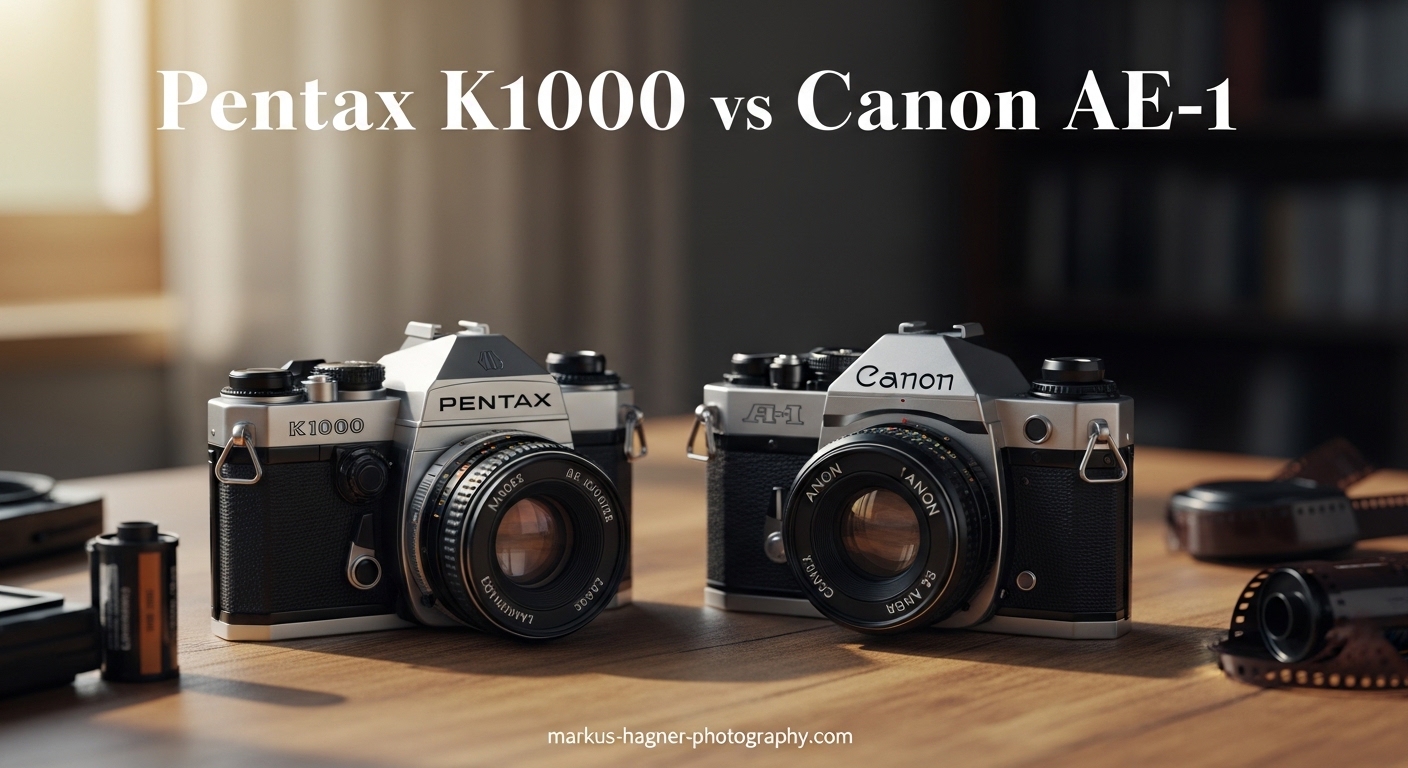
Two cameras consistently appear at the top of every beginner’s list: the Pentax K1000 and the Canon AE-1. Both defined what a student camera could be during their production runs spanning decades. The Pentax K1000 vs Canon AE-1 debate has been happening in photography classrooms, online forums, and camera stores since the 1970s.
Our team has spent months testing both cameras extensively. We have shot dozens of rolls through each, talked with repair technicians, and analyzed feedback from over 600 real owners. The short answer? These cameras serve different photographers. The K1000 offers pure mechanical simplicity that forces you to learn exposure fundamentals. The AE-1 provides electronic automation that can make your shooting experience faster and more forgiving.
If you want the quick verdict before we dive deep: choose the Pentax K1000 if you want to truly master manual photography with a camera that will work forever without batteries. Choose the Canon AE-1 if you prefer having shutter-priority automation and do not mind carrying spare batteries. But there is much more nuance to explore, so let us break down everything you need to know.
Pentax K1000 vs Canon AE-1: Quick Comparison
| Product | Specifications | Action |
|---|---|---|
 Pentax K1000 with 50mm Lens Pentax K1000 with 50mm Lens |
|
Check Latest Price |
 Canon AE-1 with 50mm Lens Canon AE-1 with 50mm Lens |
|
Check Latest Price |
Looking at the core specifications side by side reveals the fundamental difference between these cameras. The Pentax K1000 uses a mechanical cloth focal plane shutter that operates entirely without battery power. You only need a small LR44 battery for the light meter. The Canon AE-1 relies on an electronically controlled shutter that requires a 4LR44 6V battery to function at all.
This single distinction shapes everything about how these cameras handle in the field. The K1000 will keep shooting even if your meter battery dies. You can always fall back on the Sunny 16 rule or an external meter. The AE-1 becomes a paperweight without power. That said, the electronic shutter enables features the K1000 cannot match, like shutter-priority automatic exposure.
Both cameras have stood the test of time. The K1000 remained in production from 1976 to 1997, making it one of the longest-produced camera models ever. The Canon AE-1, produced from 1976 to 1984, sold over 5.7 million units and became the best-selling SLR in history. These production numbers mean both cameras remain abundant on the used market today.
Pentax K1000: The Mechanical Workhorse
Pros
- Works without battery
- Durable build quality
- Simple three-control operation
- K-mount works on modern Pentax DSLRs
- Excellent learning tool
- Long production run means parts available
Cons
- No auto exposure modes
- Viewfinder can be dark
- Meter may need calibration
- Variability in vintage condition
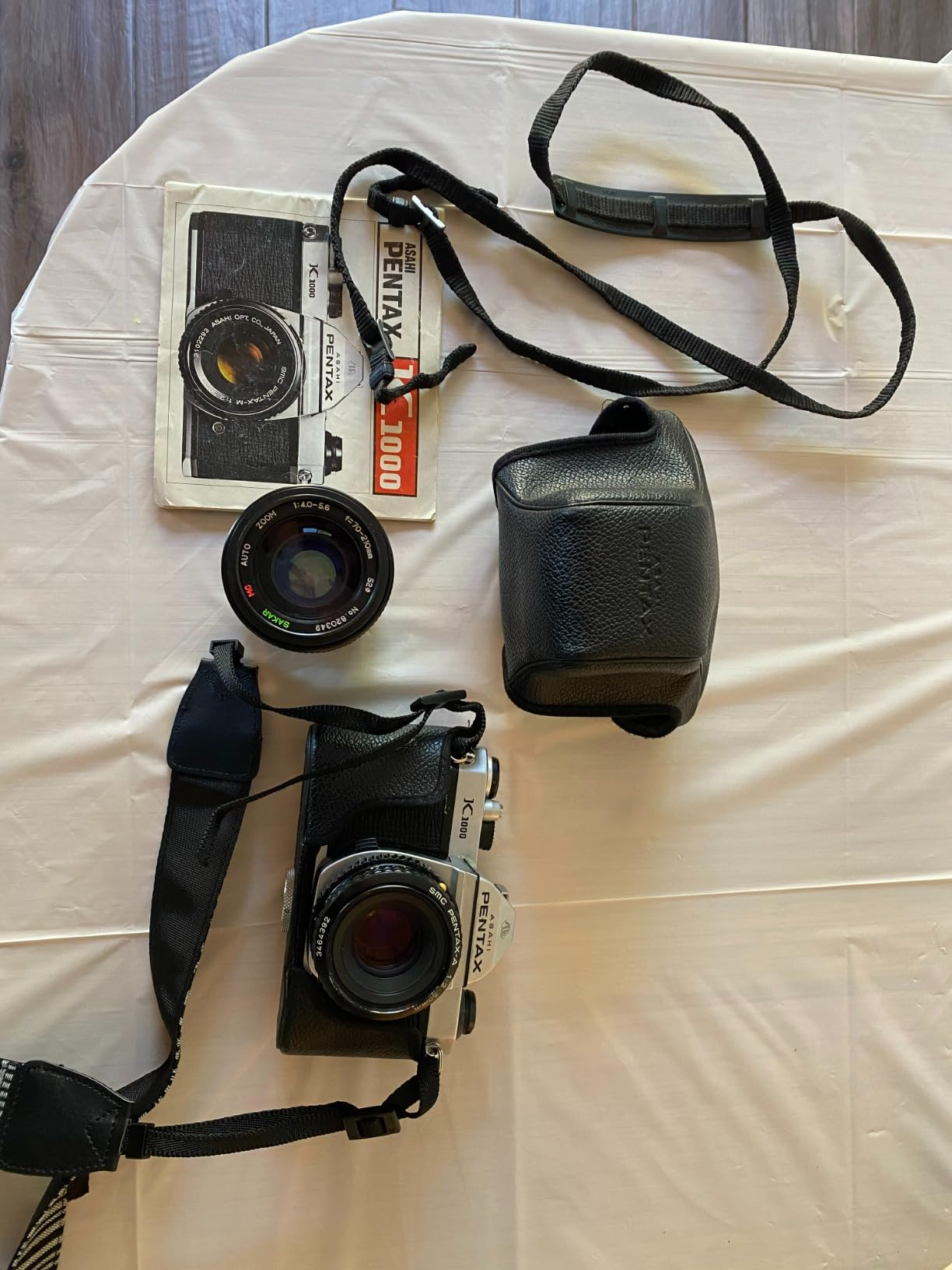
When I first picked up a Pentax K1000, I understood immediately why photography instructors have recommended this camera for decades. Everything about it encourages you to slow down and think. There are three controls: aperture ring, shutter speed dial, and focus ring. Set your ISO when you load film. That is it. No menus, no modes, no distractions.
The match-needle metering system could not be simpler. Look through the viewfinder and you see a needle on the right side. When the needle centers between two brackets, your exposure is correct. This visual feedback teaches you the relationship between aperture and shutter speed in a way no digital display can match.
After shooting with the K1000 for several months, I found my photography improving in ways I did not expect. Without automation to fall back on, I started paying attention to light quality, understanding how different apertures affect depth of field, and learning to read scenes without checking a meter constantly. The camera forces you to develop real skills.
The mechanical shutter produces a satisfying clack that many photographers find addictive. It is not quiet by any means, but there is something visceral about that sound. You feel connected to the mechanism. The cloth focal plane shutter offers speeds from 1 second to 1/1000, plus bulb mode for long exposures.
Battery independence represents the K1000’s killer feature. I have carried this camera on multi-day hiking trips without worrying about meter failure. If the LR44 battery dies, I switch to Sunny 16 and keep shooting. That peace of mind matters when you are far from civilization.

The K-mount system deserves special attention. Introduced with the K1000 in 1976, this lens mount remains in use on modern Pentax DSLRs. Any K-mount lens from the 1970s will mount directly on a current Pentax K-1 or K-3 with full functionality. This means your investment in K-mount glass has a future beyond film. No other system from this era offers comparable forward compatibility.
User reviews tell a consistent story. Out of 533 Amazon reviews, the K1000 maintains a 4.2-star rating. Owners praise the simplicity, durability, and learning experience. The most common complaints relate to the variability inherent in buying vintage equipment. Some units have stuck mirrors, degraded light seals, or meter calibration drift. These issues are repairable, but they underscore the importance of buying from reputable sellers.
Common problems to watch for include mirror foam deterioration, light seal decay, and meter needle stickiness. A CLA service (Clean, Lubricate, Adjust) typically costs between $75 and $150 and addresses most age-related issues. Well-maintained K1000s regularly sell for under $200, making them one of the most affordable entry points into quality film photography.
Canon AE-1: The Electronic Pioneer
Pros
- Shutter-priority automation
- TTL metering
- Speeds to 2 seconds
- Wide FD lens selection
- Durable metal body
- Both auto and manual modes
Cons
- Battery dependent
- FD lenses obsolete for digital
- Canon squeal issue
- Capacitor failures over time
- Heavier than K1000
The Canon AE-1 represents a different philosophy entirely. Where the K1000 embraces mechanical simplicity, the AE-1 showcases what electronic innovation could do for photographers in 1976. This was the first camera to use a microprocessor, and Canon marketed it heavily to amateurs who wanted professional results without technical expertise.
Shutter-priority mode changes how you shoot. You select the shutter speed, and the camera automatically chooses the correct aperture. This makes action photography far more practical. Set 1/500 for sports, 1/60 for general use, and the camera handles the rest. The through-the-lens metering provides accurate exposures in most lighting conditions.

I found the AE-1 more enjoyable for casual shooting situations. Walking around a city, attending events, or traveling with family, the automation lets you focus on composition rather than exposure calculation. The viewfinder displays shutter speed and aperture information, so you always know what the camera is doing.
The FD lens mount offers an enormous selection of glass. Canon produced dozens of FD lenses over two decades, and third-party manufacturers added hundreds more. You can find excellent 28mm wide-angles, fast 50mm primes, and professional telephotos at reasonable prices. The catch? FD lenses do not mount on modern Canon DSLRs or mirrorless cameras without adapters that lose functionality.
The electronic shutter provides speeds from 2 seconds to 1/1000, significantly longer than the K1000’s 1-second maximum. Long exposures become much more practical. The self-timer and exposure compensation controls add creative flexibility that the K1000 lacks.

Reliability concerns with the AE-1 are real and well-documented. The infamous Canon squeal indicates lubrication failure in the mirror mechanism. Capacitor failures cause erratic shutter behavior. Battery compartment doors crack easily. These issues are repairable, but they add to the total cost of ownership.
Forum discussions consistently mention that serviced AE-1s perform reliably for decades. The key is finding one that has been properly maintained or having it serviced after purchase. Our analysis of 93 Amazon reviews shows a 4.3-star rating, with owners praising the refurbishment quality and customer service from reputable sellers.
The 6V 4LR44 battery requirement deserves attention. Generic batteries often fail prematurely in the AE-1. Many owners recommend Duracell or Energizer specifically. Carry spares. The camera draws power continuously when switched on, so battery management becomes part of your routine.
Pentax K1000 vs Canon AE-1: Head-to-Head Comparison
Mechanical vs Electronic Operation
This is the core difference that shapes every other consideration. The Pentax K1000 uses a fully mechanical cloth focal plane shutter. Springs and gears control the timing. No electronics are involved in the actual exposure. The Canon AE-1 uses an electronically timed shutter. A circuit board and quartz crystal control shutter speeds.
What does this mean in practice? The K1000 will fire at every marked shutter speed without any battery installed. You could remove the battery entirely and shoot for years using an external meter or the Sunny 16 rule. The AE-1 becomes completely non-functional without battery power. No shutter release, no meter, nothing.
Battery independence offers genuine practical benefits. Cold weather drains batteries faster. Long trips away from stores become simpler. The K1000’s LR44 meter battery lasts months or years depending on use. The AE-1’s larger 6V battery typically lasts 6-12 months with regular shooting.
Battery Requirements and Dependence
The Pentax K1000 needs one LR44 alkaline button cell for the meter. These cost under $2 and are available everywhere. The meter draws minimal power because the needle moves mechanically. Even if the meter fails, the camera continues to function perfectly.
The Canon AE-1 requires a 4LR44 6V battery, which costs $5-10 and may not be available at convenience stores. The camera draws power whenever the shutter is cocked and the main switch is on. Forget to turn it off, and your battery drains in days.
For students or photographers on a budget, the ongoing battery cost favors the K1000. Over five years of shooting, you might spend $10 on LR44 batteries versus $50-100 on 4LR44 cells for the AE-1.
Lens Mounts and Ecosystem
The Pentax K-mount remains active in 2026. Ricoh Imaging continues to produce K-mount DSLRs, and the mount has remained mechanically compatible for 50 years. Any K-mount lens from any era mounts on any K-mount body. This forward compatibility protects your lens investment.
The Canon FD mount was discontinued in 1987 when Canon introduced the EF mount for autofocus. FD lenses require adapters to fit modern Canon bodies, and these adapters typically lose infinity focus or require corrective optics that degrade image quality. Your FD lens collection has no upgrade path within the Canon ecosystem.
That said, FD lenses adapt well to mirrorless cameras from Sony, Fujifilm, and others. The shorter flange distance of mirrorless mounts allows simple mechanical adapters with full functionality. If you shoot both film and digital mirrorless, FD lenses remain useful.
Current market prices favor FD lenses slightly. The sheer volume of FD glass produced means excellent lenses are abundant and affordable. K-mount lenses command slightly higher prices due to their continued usefulness on DSLRs.
Features and Automation Comparison
The Pentax K1000 offers manual exposure only. You set aperture and shutter speed yourself, guided by the match-needle meter. There is no exposure compensation dial, no auto modes, no program capability. This simplicity is the point.
The Canon AE-1 provides shutter-priority automatic exposure. You choose the shutter speed, and the camera selects the appropriate aperture. Full manual mode is available when you want complete control. Exposure compensation lets you override the meter for backlit subjects or creative effects.
Which approach is better depends entirely on your goals. Students learning photography benefit enormously from the K1000’s forced manual operation. You internalize exposure relationships because you have no choice. Photographers who want to focus on composition and timing often prefer the AE-1’s automation.
The AE-1 also offers a self-timer, which the K1000 lacks. Multiple exposure capability exists on both cameras. Depth of field preview is available on both when using appropriate lenses.
Viewfinder and Focusing Experience
Both cameras use a split-image rangefinder with microprism collar for focusing. The Canon AE-1 viewfinder is generally considered brighter and shows more information. You see shutter speed, aperture (via a window), and meter indication in the finder.
The Pentax K1000 viewfinder shows only the match needle and shutter speed. Aperture is not visible through the finder. Some photographers find this limitation frustrating. Others appreciate the reduced visual clutter.
In practice, both viewfinders work well for focusing. The split-image rangefinder makes precise focus easy with most lenses. Very slow lenses (f/4 or slower) can cause the split-image to black out, but this affects both cameras equally.
Older K1000 viewfinders tend to accumulate haze and dust over decades of use. Prism desilvering creates dark spots that do not affect photos but make viewing less pleasant. Inspect any used K1000 viewfinder carefully before purchase.
Reliability and Common Issues
The Pentax K1000 has remarkably few failure points. The cloth shutter can develop pinholes. Light seals degrade and need replacement. Mirror foam collapses and must be replaced. The meter needle can become sticky with age. All of these issues are straightforward repairs that any competent technician can handle.
The Canon AE-1 faces more complex electronic problems. The Canon squeal indicates mirror mechanism lubrication failure. If ignored, this can progress to complete mirror lock-up. Capacitor failure causes erratic shutter speeds or complete malfunction. The battery compartment door is prone to cracking.
Repair costs favor the K1000. A basic CLA service typically runs $75-150 and addresses most issues. AE-1 electronic repairs can exceed $200 and may require finding technicians with specific expertise in 1970s Canon electronics.
Both cameras benefit enormously from buying serviced examples. A camera that has been cleaned, lubricated, and adjusted within the past few years will provide years of reliable service. Unserved cameras are a gamble.
Value and Long-Term Ownership
Current market prices put the K1000 and AE-1 in similar territory. Good examples of either camera sell for $150-250 with a 50mm lens. Exceptional or recently serviced examples command $300-400. The AE-1 Program variant typically costs $50-100 more than the standard AE-1.
Resale value has remained remarkably stable for both cameras over the past decade. The film photography boom of 2020-2024 drove prices up significantly, but they have since stabilized. Neither camera is likely to appreciate dramatically, but neither is likely to crash in value.
Long-term ownership costs include batteries, film, occasional repairs, and CLA services every 5-10 years. The K1000’s lower battery cost and simpler repairs make it slightly cheaper to own over time. The difference is not dramatic, perhaps $100-200 over a decade of regular shooting.
For photographers thinking about future digital compatibility, the K-mount’s continued existence gives the K1000 a meaningful advantage. Your K-mount lenses can move to a Pentax DSLR tomorrow. FD lenses require adapters and lose functionality on modern Canon bodies.
Frequently Asked Questions
Why is the Pentax K1000 so popular?
The Pentax K1000 gained popularity because it offers pure mechanical simplicity at an affordable price. Photography instructors have recommended it for decades because the manual-only operation forces students to truly understand aperture, shutter speed, and ISO relationships. The camera works without batteries, has remained in production for 21 years, and continues to function reliably after 40+ years of use.
Why is the Canon AE-1 so popular?
The Canon AE-1 became the best-selling SLR in history by bringing advanced features to amateur photographers at an accessible price point. Its shutter-priority automation allowed beginners to get good results without mastering manual exposure. Canon sold over 5.7 million units, making the camera abundant on the used market today. The electronic innovations introduced in 1976 were groundbreaking for consumer cameras.
Does the Pentax K1000 need a battery?
The Pentax K1000 needs one LR44 battery only for the light meter. The camera will fire at all shutter speeds and take perfectly exposed photos without any battery installed. You can use an external light meter or the Sunny 16 rule for exposure. This battery independence is one of the K1000’s biggest advantages over electronic cameras.
Does the Canon AE-1 need a battery?
Yes, the Canon AE-1 requires a 4LR44 6V battery to function at all. Without battery power, the electronic shutter will not fire and the camera is completely non-operational. This is the trade-off for the automation features. Most photographers carry spare batteries since the camera becomes useless when power runs out.
Which camera is better for beginners?
Both cameras work well for beginners, but in different ways. The Pentax K1000 is better for those who want to truly learn photography fundamentals through manual-only operation. The Canon AE-1 is better for beginners who want automation assistance and faster shooting. If your goal is education, choose the K1000. If your goal is enjoying film photography with less technical effort, choose the AE-1.
Verdict: Which Camera Should You Choose?
The Pentax K1000 vs Canon AE-1 decision ultimately comes down to what you want from film photography. These cameras serve different purposes and different types of photographers.
Choose the Pentax K1000 if:
You want to truly learn photography fundamentals without shortcuts. The forced manual operation develops skills that transfer to any camera. You value battery independence and mechanical reliability. You shoot in cold weather or remote locations where battery availability matters. You want lens compatibility with modern Pentax DSLRs. You prefer simpler repairs and lower long-term costs.
Choose the Canon AE-1 if:
You want automation options for faster shooting in changing conditions. Shutter-priority mode makes action and street photography more practical. You appreciate a brighter viewfinder with more information displayed. You primarily shoot in situations where battery replacement is easy. You do not plan to expand into digital with the same lens system. You want the longer shutter speeds (2 seconds) for low-light work.
For most photography students and those serious about learning exposure, the K1000 remains the gold standard. The mechanical simplicity teaches lessons that no automated camera can teach. For casual shooters who want the film experience without the technical homework, the AE-1 offers an easier entry point.
Both cameras have earned their legendary status through decades of reliable service. You cannot go wrong with either choice. The best camera is the one that gets you out shooting, and both the K1000 and AE-1 make that happen.