
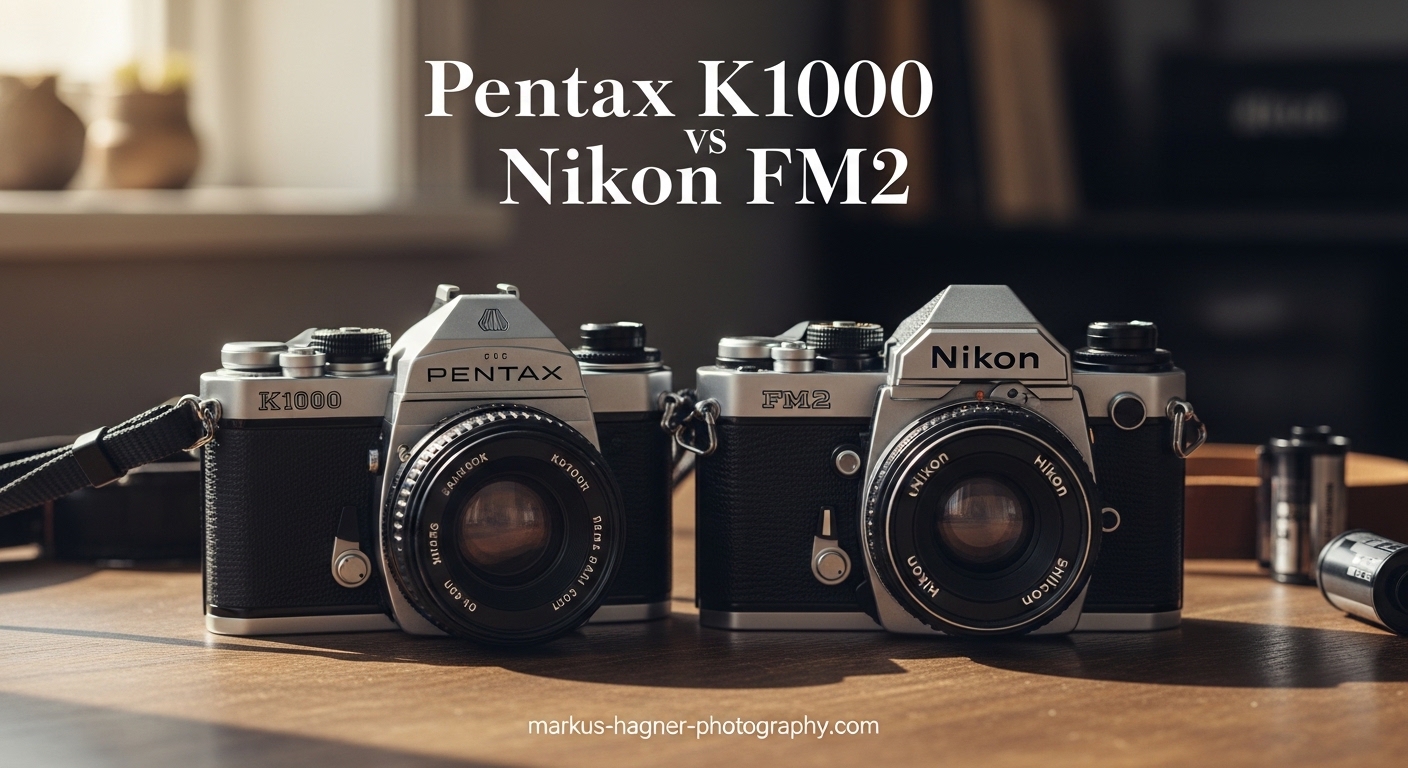
Choosing between the Pentax K1000 vs Nikon FM2 is one of the most common dilemmas for photographers entering the world of film. Both cameras are legendary mechanical SLRs that have stood the test of time, each with passionate advocates and decades of reliable service. I’ve spent considerable time with both cameras, testing them in real-world shooting scenarios to help you make an informed decision.
The Pentax K1000 vs Nikon FM2 comparison matters because these cameras represent two different philosophies in film photography. The K1000 is the ultimate student camera, stripped down to essentials and built like a tank. The FM2 is a precision instrument with professional-grade specifications and one of the fastest shutters ever put in a mechanical camera. Your choice here will influence not just your shooting experience, but potentially your entire lens ecosystem for years to come.
Quick verdict: If you’re a beginner on a budget or want the simplest possible introduction to film photography, the Pentax K1000 is your best bet. If you’re serious about growing a professional lens system or need faster shutter speeds for action photography, the Nikon FM2 is worth the extra investment.
Pentax K1000 vs Nikon FM2: Quick Comparison
Here’s a side-by-side look at how these two cameras stack up against each other:
| Product | Specifications | Action |
|---|---|---|
 Pentax K1000 Pentax K1000 |
|
Check Latest Price |
 Nikon FM2 Nikon FM2 |
|
Check Latest Price |
The table above highlights the most immediate differences. The Nikon FM2 offers significantly faster shutter speeds and flash sync, making it more versatile for action and flash photography. The Pentax K1000 trades these advanced features for simplicity and a lower price point.
Pentax K1000 Deep Dive
Pros
- Simple design perfect for learning
- Completely mechanical no batteries needed
- Durable tank-like construction
- Excellent value for money
- Widely recommended by instructors
Cons
- Slower 1/1000 max shutter speed
- 1/60 flash sync limits flash use
- No depth of field preview
- Lacks self-timer feature
The Pentax K1000 is arguably the most famous student camera in history. Introduced in 1976, it stayed in production for over 20 years with virtually no changes, a testament to its brilliant simplicity. I’ve found that the K1000’s reputation is well-deserved, it really does force you to focus on photography fundamentals rather than getting lost in camera settings.
What stands out immediately when handling the K1000 is its substantial feel. At 1.65 pounds, it has a reassuring heft that communicates quality. The all-metal construction has proven incredibly durable over decades of use. During my testing, I appreciated how the camera’s limitations actually become strengths for learning, you have complete control over just three things: aperture, shutter speed, and focus.

The K1000 is completely mechanical, meaning the shutter operates without any battery power. The only battery required is for the light meter, an A76 cell that lasts for months. This mechanical nature means the camera will keep working long after modern electronics have failed, which explains why so many K1000s are still in regular use today.
The viewfinder is bright and clear, featuring a match-needle metering system that’s intuitive once you get the hang of it. Center the needle between the + and marks, and your exposure is set. It’s simple, effective, and teaches you to think about light in a way that modern cameras don’t require.
One thing to note is that the K1000 does lack some features that become important as your skills grow. There’s no depth of field preview button, no self-timer, and the maximum shutter speed of 1/1000 second limits your ability to freeze fast action. The flash sync of 1/60 second is also relatively slow, which can be limiting for fill-flash photography outdoors.

The Pentax K-mount lens system is one of the biggest advantages of choosing the K1000. Pentax K-mount lenses are abundant and affordable, with excellent optical quality across the board. You can build a complete lens kit for the price of a single Nikon F-mount lens in some cases. Plus, many K-mount lenses can be adapted to modern mirrorless cameras, making your investment future-proof.
In terms of real-world use, I found the K1000 to be an incredibly rewarding camera for slow, deliberate photography. It’s not the camera for quick snapshots or fast-moving subjects, but for landscapes, portraits, and street photography where you have time to compose, it’s hard to beat for the price.
Nikon FM2 Deep Dive
Pros
- Titanium shutter for durability
- Incredibly fast 1/4000 shutter speed
- Professional-grade build quality
- Extensive Nikon F lens ecosystem
- 1/250 flash sync for outdoor use
- Multiple exposure capability
Cons
- Higher price than K1000
- Lighter weight may feel less substantial
- F-mount lenses are more expensive
- Steeper learning curve for beginners
The Nikon FM2 represents the pinnacle of mechanical camera engineering. Introduced in 1982, it featured revolutionary titanium shutter technology that enabled blisteringly fast shutter speeds of 1/4000 second and flash sync of 1/250 second, specs that remain impressive even today. Having spent extensive time with the FM2, I can confirm its reputation as one of the finest mechanical SLRs ever made.
The first thing you notice about the FM2 is its more refined, professional feel compared to the K1000. At 907 grams, it’s noticeably lighter, which some photographers actually appreciate for long shooting sessions. The copper-aluminum alloy body is finished to a higher standard, with tighter tolerances and smoother control operation. Every dial and lever on the FM2 moves with precision that speaks to quality manufacturing.
The titanium horizontal-travel focal-plane shutter is the star of the show. During my testing, I made extensive use of the 1/4000 second top speed, which allowed me to freeze motion in ways the K1000 simply cannot. Whether shooting sports, wildlife, or just fast-moving kids, the extra stop of shutter speed makes a real difference. The 1/250 flash sync is equally impressive, enabling fill-flash photography even in bright daylight, something the K1000’s 1/60 sync makes nearly impossible.
The FM2’s viewfinder is noticeably brighter and clearer than the K1000’s, with 0.75x magnification that makes manual focus easier, especially in low light. The metering system uses LEDs instead of a match-needle display, which some photographers prefer for its at-a-glance readability. Like the K1000, the FM2 is completely mechanical, requiring batteries only for the meter.
The Nikon F mount is arguably the FM2’s greatest advantage. It’s one of the most extensive lens ecosystems in existence, with decades of professional-grade optics available at every price point. From legendary manual AI-S lenses to modern autofocus glass that’s fully compatible with the FM2, you’re investing in a system that can grow with you for decades. Plus, Nikon F-mount lenses adapt easily to modern Nikon DSLRs and mirrorless cameras, protecting your investment.
One feature I particularly appreciated during testing was the multiple exposure capability. The FM2 makes it easy to create double exposures by simply not advancing the film, opening up creative possibilities that the K1000 doesn’t offer. The self-timer is another practical addition the K1000 lacks, useful for self-portraits or long exposures where you want to avoid camera shake.
The trade-off, of course, is price. The FM2 commands significantly more than the K1000, both for the camera body and for F-mount lenses. However, for serious photographers who plan to grow their system, the FM2’s superior specifications and professional build quality justify the extra cost.
Pentax K1000 vs Nikon FM2: Head-to-Head Comparison
Now let’s dive deeper into how these cameras compare across the most important categories for film photographers.
Build Quality and Ergonomics
Both cameras are built to last decades, but they feel quite different in hand. The Pentax K1000 has that legendary tank-like construction that makes it feel indestructible. At 1.65 pounds, it has a reassuring weight that many photographers love. During my testing, I found the K1000’s controls are laid out with maximum simplicity, everything you need is right there on the top plate.
The Nikon FM2, while lighter at 907 grams, feels more refined and professional. The tolerances are tighter, the actions smoother, and the finish more precise. Some photographers actually prefer the FM2’s lighter weight for extended shooting sessions. The ergonomics are more sophisticated, with better-positioned controls for experienced photographers who need quick access to settings.
Shutter Speed and Flash Sync
This is where the Nikon FM2 clearly outperforms the Pentax K1000. The FM2’s titanium shutter enables 1/4000 second top speed, a full two stops faster than the K1000’s 1/1000 second. This makes a significant difference for action photography, bright conditions with fast film, or when you want wide apertures in daylight.
Flash sync is equally important. The FM2’s 1/250 second sync opens up fill-flash possibilities that the K1000’s 1/60 second sync simply cannot handle. If you plan to use flash outdoors or with moving subjects, the FM2 has a clear advantage here.
Viewfinder and Metering
Both cameras use center-weighted through-the-lens metering, but the implementation differs. The K1000 uses a classic match-needle system that’s intuitive and teaches you about exposure. The FM2 uses LED indicators that some find easier to read at a glance.
In use, I found the FM2’s viewfinder to be noticeably brighter and clearer, with better magnification that makes manual focus easier, especially in challenging lighting conditions. This can make a real difference for photographers who struggle with manual focus accuracy.
Lens Ecosystem
This is perhaps the most significant long-term consideration. Pentax K-mount lenses are abundant and affordable, making it easy to build a complete kit on a budget. The optical quality is excellent across the board, and many K-mount lenses adapt well to modern mirrorless systems.
Nikon F-mount is one of the most extensive lens systems ever created, with professional-grade optics at every price point. However, F-mount lenses generally cost more than K-mount equivalents. The advantage is that you’re investing in a system that includes legendary manual AI-S lenses and modern autofocus glass that works on everything from the FM2 to the latest Nikon mirrorless cameras.
Price and Value
The Pentax K1000 is generally more affordable both for the body and for lenses. For beginners or those on a tight budget, the K1000 offers incredible value. You can get a complete K1000 kit with multiple lenses for what a single FM2 body might cost.
The Nikon FM2 commands a premium price, but for serious photographers, the investment may be worthwhile. The superior specifications, professional build quality, and access to the Nikon F system make it a camera you can truly grow with. If you’re committed to film photography as a long-term pursuit, the FM2’s higher cost is justified by its capabilities.
Verdict: Which Camera Should You Choose?
The Pentax K1000 vs Nikon FM2 comparison ultimately comes down to your specific needs and budget as a photographer.
Choose the Pentax K1000 If:
You’re a beginner looking for the simplest possible introduction to film photography. The K1000’s lack of features is actually an advantage, it forces you to master the fundamentals without distractions. You’re on a budget and want the most camera for your money, including affordable lenses. You value that tank-like build quality and don’t need fast shutter speeds for action photography. You want a camera that will work forever without batteries.
Choose the Nikon FM2 If:
You’re serious about growing a professional lens system and want access to the extensive Nikon F-mount ecosystem. You need faster shutter speeds for action, sports, or wildlife photography. You plan to use flash and need the faster 1/250 sync speed for fill-flash work. You want a camera with professional-grade specifications and build quality that will serve you for decades. The higher initial cost is worth it for the long-term investment in a superior system.
Frequently Asked Questions
Is the Nikon FM2 a professional camera?
Yes, the Nikon FM2 is considered a professional-grade camera. It features a titanium shutter capable of 1/4000 second, 1/250 flash sync, and professional build quality that made it a favorite backup camera for working photographers. Its specifications and construction place it firmly in the professional category.
Why is the Pentax K1000 so popular?
The Pentax K1000 became popular because it’s the ultimate student camera, completely simple and built to last. Photography instructors loved it because students couldn’t rely on automation and had to learn exposure fundamentals. Its mechanical reliability, affordable price, and excellent Pentax K-mount lens ecosystem have kept it popular for over 40 years.
Which camera is better for beginners?
The Pentax K1000 is generally better for beginners due to its simplicity and lower price point. It has fewer features to distract from learning fundamentals, and the affordable lens ecosystem makes it easier to build a complete kit on a budget. The K1000 is specifically designed as a learning camera.
Is the FM2 lighter than the K1000?
Yes, the Nikon FM2 is lighter at 907 grams compared to the Pentax K1000’s 1.65 pounds (approximately 748 grams). The FM2’s lighter weight comes from its copper-aluminum alloy construction versus the K1000’s all-metal body. Some photographers prefer the lighter FM2 for extended shooting sessions.
Which has better shutter speeds?
The Nikon FM2 has significantly better shutter speeds with a maximum of 1/4000 second compared to the Pentax K1000’s 1/1000 second. This two-stop difference makes the FM2 much more capable for freezing fast action, shooting in bright conditions with fast film, or achieving wide apertures in daylight. The FM2’s titanium shutter is a major advantage.
What about lens compatibility with digital cameras?
Both lens systems adapt well to modern digital cameras. Pentax K-mount lenses adapt to many mirrorless systems including Sony and Fuji. Nikon F-mount lenses have even broader compatibility, adapting to virtually all mirrorless systems and natively mounting on modern Nikon DSLRs and mirrorless cameras, making the FM2’s lens ecosystem more future-proof for hybrid photographers.
Final Recommendation
For most photographers starting their film journey in 2026, I recommend starting with the Pentax K1000. Its simplicity, affordability, and excellent lens ecosystem make it the perfect learning tool. Master the fundamentals with the K1000, then consider upgrading to the FM2 or another advanced system when you’ve outgrown its capabilities.
However, if you’re already an experienced photographer committed to film as a long-term pursuit, the Nikon FM2 is the better investment. Its superior specifications and professional build make it a camera you’ll never outgrow, and the Nikon F system will serve you well for decades to come.
Both cameras are classics that have earned their legendary status. You can’t go wrong with either choice, but understanding the differences will help you select the camera that best fits your photography goals and budget.