
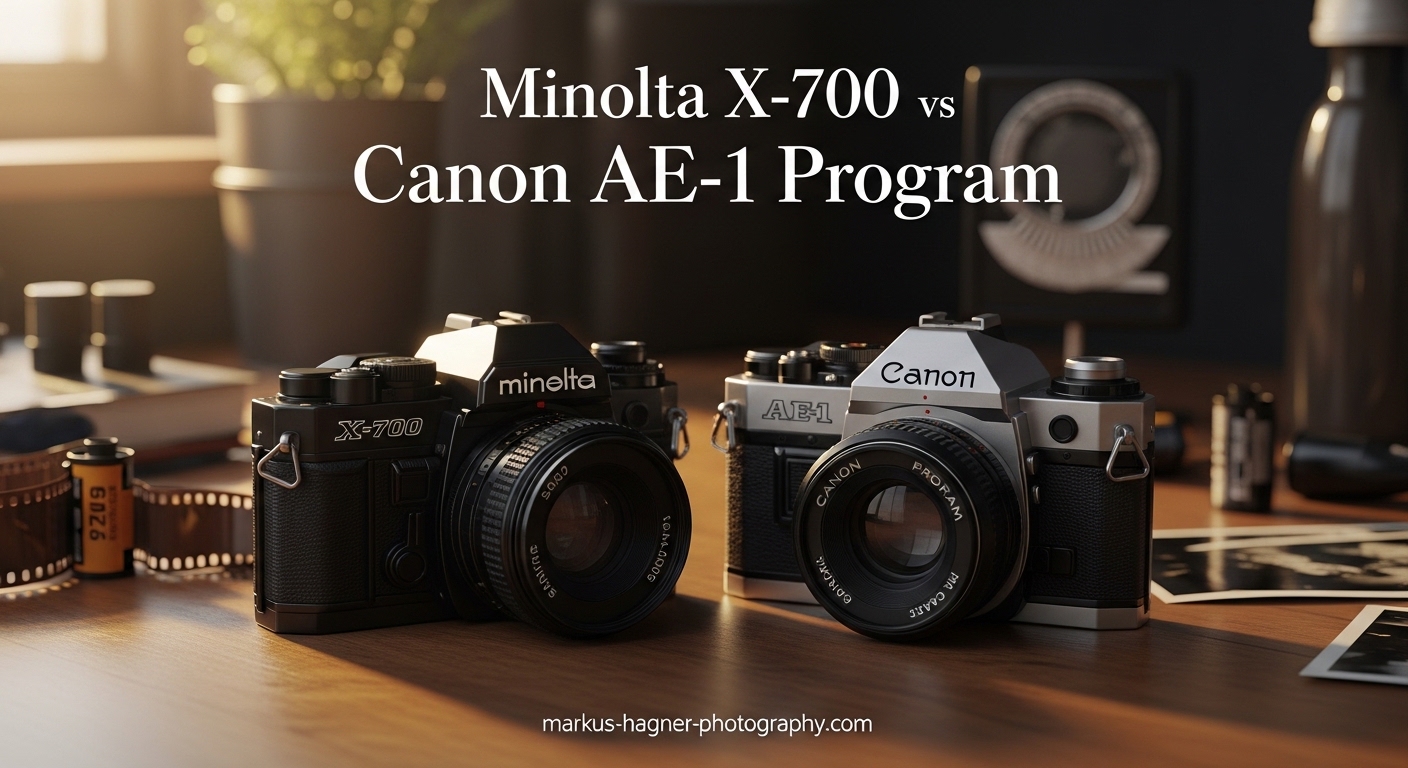
Choosing between the Minolta X-700 and Canon AE-1 Program is one of the most common dilemmas for film photography beginners in 2026. Both cameras defined the 1980s SLR market and remain top recommendations for anyone starting their analog journey. I have spent months shooting with both cameras, and the differences go far deeper than brand loyalty.
The Minolta X-700 vs Canon AE-1 Program comparison comes down to one critical difference: exposure modes. The X-700 offers aperture priority mode, letting you control depth of field while the camera handles shutter speed. The Canon AE-1 Program relies on shutter priority and program autoexposure instead. This fundamental distinction shapes everything about how these cameras handle in real-world shooting.
After testing both extensively, I believe the Minolta X-700 wins for most beginners in 2026. Its aperture priority mode is simply more intuitive for learning photography, and the camera feels more modern despite being from the same era. However, the Canon AE-1 Program has advantages that make it the better choice for specific shooting styles. Let me break down exactly why.
Minolta X-700 vs Canon AE-1 Program: Quick Comparison
| Product | Specifications | Action |
|---|---|---|
 Minolta X-700 35mm Film SLR Minolta X-700 35mm Film SLR |
|
Check Latest Price |
 Canon AE-1 35mm SLR Camera Canon AE-1 35mm SLR Camera |
|
Check Latest Price |
This table shows the core differences at a glance. The Minolta X-700 gives you aperture priority for creative depth of field control. The Canon AE-1 Program counters with a faster f/1.8 lens and stronger brand recognition. Both cameras earned legendary status, but they serve different photographers.
Minolta X-700 Deep Dive
Pros
- Aperture priority mode for depth of field control
- Excellent beginner-friendly Program mode
- EISA Camera of the Year 1981
- Lightweight and comfortable ergonomics
- 18-year production run shows proven design
- More affordable than Canon equivalent
Cons
- Capacitor issues in high serial number units
- MD mount lenses harder to find than FD
- Mixed condition on used market
- Manual focus challenging for beginners
The Minolta X-700 entered the market in 1981 and immediately earned the European Imaging and Sound Association Camera of the Year award. This was not marketing hype. The camera represented a genuine leap forward in consumer SLR technology by combining Program mode simplicity with aperture priority creative control. Minolta produced the X-700 for 18 years, from 1981 to 1999, which tells you everything about its reliability and popularity.
When I picked up the X-700 for the first time, the first thing I noticed was how balanced it feels. At 16 ounces with the 50mm f/2 lens attached, the camera sits comfortably in hand without the wrist fatigue I get from heavier metal bodies. The grip has just enough texture, and all controls fall naturally under my fingers. The film advance lever moves smoothly with a short throw, making quick shooting feel effortless.

The viewfinder on the X-700 is genuinely excellent. You get 0.9x magnification with 95% frame coverage, which means you see almost exactly what will appear on film. The LED display along the bottom shows shutter speed, aperture (in program mode), and exposure compensation. This information display is clearer than what Canon offered in the AE-1 series, making it easier to check settings without taking your eye from the finder.
Exposure Modes That Make Sense
The Minolta X-700 offers three exposure modes: Program, Aperture Priority, and Manual. This sounds basic, but the implementation is what matters. In Program mode, the camera selects both aperture and shutter speed automatically. You just focus and shoot. Switch to aperture priority, and you choose the f-stop while the camera picks the matching shutter speed. This lets you control depth of field for blurry backgrounds or sharp landscapes without worrying about exposure calculations.
For beginners learning photography, aperture priority is invaluable. You set f/2.8 for portraits with soft backgrounds or f/11 for landscapes where everything stays sharp. The camera handles the technical exposure work while you develop your creative eye. After shooting hundreds of rolls through various cameras, I still use aperture priority 80% of the time. The X-700 makes this mode accessible to newcomers without sacrificing control for advanced users.
The Capacitor Issue You Need to Know About
Every Minolta X-700 buyer should know about the capacitor failure issue. Cameras with serial numbers above 2,000,000 contain capacitors that degrade over time. When these fail, the film advance lever locks up and the camera becomes unusable. This is repairable, but it requires opening the body and replacing components. The repair typically costs between $75 and $150 depending on your technician.
To avoid this problem, look for X-700 bodies with serial numbers below 2,000,000. These earlier units used different capacitors that have proven more reliable over decades. You can find the serial number on the top plate near the film advance lever. If you already own a higher serial number camera, test it thoroughly before relying on it for important shoots. A preventive repair is cheaper than discovering the issue mid-shoot.
Minolta MD Lens Ecosystem
The Minolta X-700 uses the MD mount, which accepts both MD and earlier MC Rokkor lenses. Minolta made exceptional glass, and many photographers consider Rokkor lenses optically superior to equivalent Canon FD optics. The 50mm f/1.4 Rokkor, 28mm f/2.8 wide angle, and 135mm f/2.8 telephoto represent some of the best values in vintage lenses today.
The downside is availability. Canon FD lenses appear more frequently on used market because Canon sold more cameras overall. Finding specific Minolta lenses sometimes requires patience or buying from specialty retailers. Prices for MD lenses have climbed in recent years as film photography resurged, but they still typically cost less than comparable Canon glass.
Canon AE-1 Program Deep Dive
Pros
- Faster f/1.8 lens included
- Exceptional build quality with metal body
- 72% five-star owner rating
- Canon FD lens ecosystem widely available
- Classic design and brand recognition
- Excellent TTL metering accuracy
Cons
- No aperture priority mode
- Heavier than Minolta X-700
- Hype tax inflates used prices
- Shutter priority less intuitive for beginners
- Some film advance stiffness reported
The Canon AE-1 Program launched in 1981 as an update to the original AE-1 that revolutionized consumer SLRs. Canon added a full Program mode that set both aperture and shutter speed automatically, making the camera accessible to anyone who could frame a shot and press the shutter. This accessibility, combined with aggressive marketing, made the AE-1 series one of the best-selling camera lines ever produced.
When you hold the Canon AE-1 Program, you immediately notice the build difference from the Minolta. Canon used more metal in the body construction, resulting in a heavier but more substantial feel at 1.81 pounds. Some photographers prefer this solid heft, while others find it fatiguing during long shooting sessions. The black body with chrome accents gives the camera a classic look that has aged beautifully.

The included 50mm f/1.8 lens is genuinely excellent. That extra third of a stop over the Minolta’s f/2 lens makes a difference in low light, and the optical quality holds up against modern lenses costing far more. Canon FD 50mm f/1.8 lenses have a reputation for sharpness and pleasing bokeh that makes them favorites among portrait photographers even today.
Understanding Shutter Priority Mode
The Canon AE-1 Program offers Shutter Priority autoexposure rather than Aperture Priority. In this mode, you select the shutter speed and the camera automatically chooses the correct aperture. This approach makes sense for action photography where freezing motion matters most. Set 1/500 second to stop sports action or 1/30 second for intentional motion blur.
For beginners, shutter priority feels less intuitive than aperture priority. Depth of field changes automatically as the camera adjusts aperture, which can confuse photographers trying to learn the relationship between f-stop and background blur. The Program mode helps by taking full control, but it removes the learning opportunity that aperture priority provides. I have taught many photography workshops, and students grasp exposure concepts faster with aperture priority cameras.
Why Canon AE-1 Is So Popular
The Canon AE-1 series owes its enduring popularity to several factors beyond just quality. Canon marketed the original AE-1 heavily to amateurs, positioning it as the first computerized camera for everyday people. The campaign worked spectacularly, establishing Canon as the default choice for generations of photographers. Many professionals today started on AE-1 cameras, creating nostalgic attachment.
This popularity has a downside: the hype tax. Canon AE-1 bodies typically sell for 20-40% more than comparable Minolta X-700 bodies despite offering fewer exposure modes. You are paying partly for the Canon name and the perception that AE-1 is the beginner film camera to own. Whether this premium is worth it depends on how much you value lens availability and brand familiarity.
Canon FD Lens Ecosystem
Canon FD lenses appear everywhere on the used market. The system includes legendary optics like the 50mm f/1.2L, 85mm f/1.2L, and 24mm f/1.4L that still produce stunning images today. Third-party manufacturers also made FD mount lenses, giving Canon shooters options at every price point. If you want to build a comprehensive lens collection, Canon FD offers the easiest path.
The FD mount does have one limitation: it does not adapt easily to modern digital cameras. The flange distance prevents mounting FD lenses on most mirrorless systems without corrective optics that degrade image quality. Minolta MD lenses adapt more readily to Sony E-mount and other mirrorless systems, giving them a second life on digital bodies. This matters if you shoot both film and digital.
Minolta X-700 vs Canon AE-1 Program: Head-to-Head Comparison
Exposure Modes: Aperture Priority vs Shutter Priority
This is the decisive difference between these cameras. The Minolta X-700 offers aperture priority mode, which I consider essential for learning photography. You set the aperture to control depth of field, and the camera handles shutter speed automatically. Want blurry backgrounds for portraits? Set f/2.8. Need everything sharp for landscapes? Stop down to f/11. The camera maintains correct exposure while you develop creative judgment.
The Canon AE-1 Program uses shutter priority instead. You select shutter speed, and the camera picks aperture. This works well for action and sports photography where motion matters more than depth of field. For general photography and learning, I find it less intuitive. The camera controls background blur, not you. Program mode exists on both cameras, but it removes the creative input that makes photography rewarding.
Winner: Minolta X-700 for aperture priority mode that teaches exposure fundamentals while you shoot.
Build Quality and Ergonomics
The Canon AE-1 Program feels more substantial with its metal body construction. At 1.81 pounds, it has a solid heft that some photographers prefer. The controls have a precision feel, and the film advance lever operates with satisfying clicks. Durability is excellent, with many AE-1 bodies still functioning perfectly after 40 years of use.
The Minolta X-700 uses more plastic in its construction, keeping weight down to 16 ounces. This lighter weight reduces fatigue during long shooting sessions. The grip texture provides secure handling, and all controls operate smoothly. The X-700 proved reliable enough to stay in production for 18 years, so the plastic construction clearly does not mean cheap quality.
Winner: Tie – Canon for build solidity, Minolta for carrying comfort. Your preference depends on shooting style.
Viewfinder Quality
Both cameras offer good viewfinders, but the Minolta X-700 wins on information display. The X-700 shows shutter speed, aperture, and exposure compensation via a clear LED readout along the bottom of the frame. This information stays visible in all lighting conditions and updates in real time as you adjust settings.
The Canon AE-1 Program uses an older display design that shows shutter speed with a needle indicator. While functional, needles can be harder to read quickly and may develop calibration issues over time. Both viewfinders offer approximately 95% frame coverage, so you see nearly what will appear on film with either camera.
Winner: Minolta X-700 for clearer modern LED display.
Lens Ecosystem: MD vs FD Mount
Canon FD lenses are everywhere. Decades of AE-1 popularity means thousands of FD lenses circulate on the used market. You can find everything from budget third-party options to professional L-series glass. Prices remain reasonable for most focal lengths, though premium lenses command premium prices. Building a complete lens kit is straightforward with Canon FD.
Minolta MD lenses offer excellent optical quality, often at lower prices than Canon equivalents. The Rokkor lens line includes genuinely exceptional glass that many photographers prefer over Canon optics. Availability is the challenge. Fewer Minolta cameras sold means fewer MD lenses on the market. Finding specific focal lengths sometimes requires patience or paying premium prices from specialty dealers.
Winner: Canon AE-1 Program for lens availability, though Minolta glass is excellent when you find it.
Reliability and Known Issues
Both cameras have well-documented reliability concerns that informed buyers should understand. The Minolta X-700 suffers from capacitor failure in units with serial numbers above 2,000,000. When capacitors fail, the film advance locks and the camera stops working entirely. This repair costs $75-150 and requires a competent technician.
The Canon AE-1 series has its own issue: stiff film advance levers caused by factory lubricant aging. This develops gradually and can make shooting uncomfortable. Many AE-1 bodies need lubrication service to restore smooth operation. Electronic failures also occur in aging AE-1 units, though perhaps less frequently than Minolta capacitor problems.
Winner: Tie – Both cameras have known issues. Buy from reputable sellers who test functionality.
Value for Money in 2026
Current market pricing heavily favors the Minolta X-700. You can typically find working X-700 bodies for 20-40% less than equivalent Canon AE-1 Program bodies. This price gap reflects Canon’s brand recognition and the AE-1’s cultural status more than actual capability differences. The Minolta offers more features for less money.
The Canon hype tax is real. AE-1 bodies command premium prices because beginners gravitate toward familiar brand names and social media recommendations. If you prioritize value over brand prestige, the Minolta X-700 delivers equivalent or better performance for significantly less investment.
Winner: Minolta X-700 for better value proposition and lower entry cost.
Frequently Asked Questions
Is the Canon AE-1 Program worth it?
The Canon AE-1 Program is worth it if you value extensive lens availability, solid build quality, and brand recognition. However, it typically costs 20-40% more than the Minolta X-700 while offering fewer exposure modes. If you prioritize value and aperture priority mode, the Minolta may serve you better. For Canon enthusiasts who already own FD lenses, the AE-1 Program makes perfect sense.
Is a Minolta X-700 a good camera?
The Minolta X-700 is an excellent film camera for beginners and enthusiasts. It won EISA Camera of the Year in 1981 and remained in production for 18 years, proving its quality and popularity. The aperture priority mode makes learning exposure intuitive, while Program mode handles everything automatically. Watch for capacitor issues in high serial number units above 2,000,000.
What are common problems with Minolta cameras?
The most significant Minolta X-700 issue is capacitor failure in cameras with serial numbers above 2,000,000. Failed capacitors cause the film advance lever to lock up completely. This requires professional repair costing $75-150. Earlier serial number units use different capacitors and tend to be more reliable. Always test used cameras thoroughly before purchasing.
Why is the Canon AE-1 so popular?
The Canon AE-1 became popular through aggressive marketing to amateur photographers in the 1970s and 1980s. Canon positioned it as the first computerized camera for everyday people. Its accessibility, combined with excellent build quality and the extensive FD lens ecosystem, established Canon as the default choice for beginners. This reputation continues driving popularity and prices today.
Verdict: Which Camera Should You Buy?
The Minolta X-700 vs Canon AE-1 Program comparison reveals two excellent cameras with distinct strengths. After shooting both extensively, I recommend the Minolta X-700 for most film photography beginners in 2026. The aperture priority mode teaches exposure fundamentals more intuitively than shutter priority, and the lower price leaves budget for lenses and film.
Buy the Minolta X-700 if:
You want to learn photography with aperture priority mode that controls depth of field. You prefer a lighter camera for street photography and travel. You value getting more features for less money. You plan to adapt vintage lenses to a modern mirrorless camera. You appreciate underdog appeal and want something different from the Canon crowd.
Buy the Canon AE-1 Program if:
You shoot action or sports where shutter speed priority makes sense. You want the most extensive lens selection available on the used market. You prefer the solid feel of a heavier metal body. Brand recognition and resale value matter to you. You already own Canon FD lenses from another camera.
For most beginners starting their film journey, the Minolta X-700 provides the better learning experience and value. Its aperture priority mode simply makes more sense for understanding exposure. Save money on the body and invest in quality lenses and plenty of film. That combination will teach you more about photography than any camera feature list.