
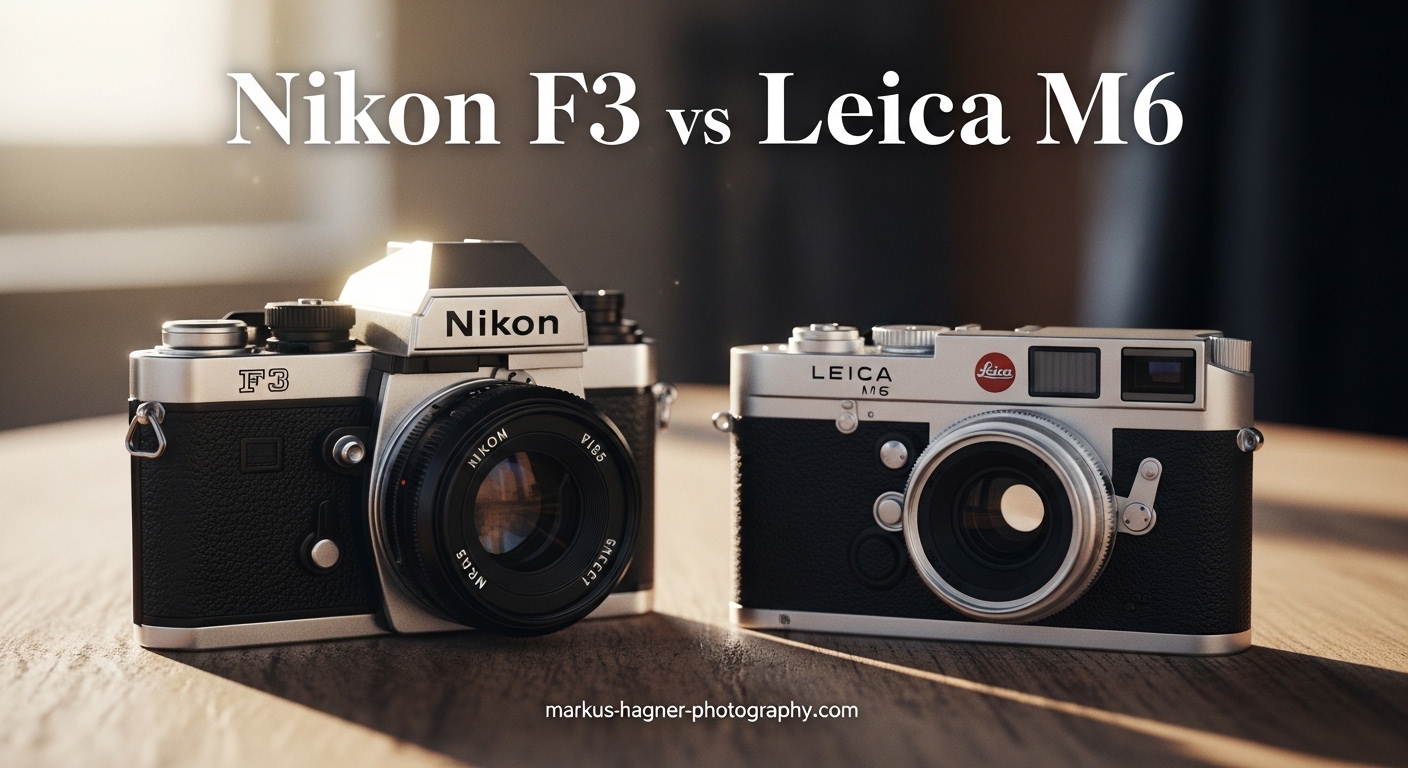
Choosing between the Nikon F3 and Leica M6 comes down to understanding two fundamentally different approaches to film photography. The Nikon F3 is a professional SLR built like a tank with through-the-lens viewing and an extensive system of accessories. The Leica M6 is a compact rangefinder prized for its quiet operation, discreet size, and legendary build quality.
Our team has spent extensive time with both cameras, and the Nikon F3 vs Leica M6 debate often centers on one key distinction: do you want the versatility of an SLR system or the intimacy of a rangefinder experience? Each camera excels in different situations, and many photographers eventually end up owning both.
The F3 served as Nikon’s flagship professional camera from 1980 to 2001, while the M6 was Leica’s main rangefinder from 1984 to 1998 (with a reissue in 2022). Both represent the pinnacle of their respective systems, and choosing between them means understanding what type of photographer you are and what subjects you pursue.
In this comprehensive comparison, we will break down every aspect of these iconic cameras to help you make an informed decision. From build quality and viewfinder experience to lens ecosystems and real-world handling, here is everything you need to know about choosing between these film photography legends.
Nikon F3 vs Leica M6: Quick Comparison
| Product | Specifications | Action |
|---|---|---|
 Nikon F3HP Camera Body Nikon F3HP Camera Body |
|
Check Latest Price |
 Leica M6 35mm Film Rangefinder Camera Leica M6 35mm Film Rangefinder Camera |
|
Check Latest Price |
The fundamental difference between these cameras is their viewing system. The Nikon F3 uses a single-lens reflex design with a mirror that shows you exactly what the lens sees. The Leica M6 uses a rangefinder system with separate viewing and taking lenses, requiring you to align a central patch for focusing.
This distinction affects everything from size and weight to shooting style and lens compatibility. The F3 is larger and heavier but offers true through-the-lens composition, interchangeable viewfinders, and aperture priority automation. The M6 is compact and quiet but requires manual exposure control and has limited telephoto options.
Nikon F3HP Camera Body Deep Dive
Pros
- Built like a tank
- Aperture priority mode
- Interchangeable viewfinders
- Extensive lens ecosystem
- Mechanical backup at 1/60s
Cons
- Heavy and bulky
- Loud shutter
- Requires batteries for full operation
- Used market condition varies
When I first picked up a Nikon F3HP, the weight immediately told me this was a serious professional tool. At nearly 1.9 pounds with a standard lens, the F3 has presence. The titanium honeycomb shutter curtain, the smooth film advance, and the reassuring click of controls all speak to decades of engineering refinement.
The F3HP designation refers to the High Eyepoint finder, which was a game-changer for eyeglass wearers. Unlike standard viewfinders that required pressing your eye right against the eyepiece, the HP design lets you see the entire frame from about 25mm away. This makes the camera far more comfortable for extended shooting sessions.
What struck me most during real-world use was the aperture priority mode. Set your aperture, and the camera handles shutter speed automatically. This seems basic now, but in 1980 it was revolutionary for a professional camera. The LEDs in the viewfinder display shutter speed clearly, even in low light where the Leica’s meter arrows can be harder to read.
Build Quality and Professional Heritage
The Nikon F3 was designed to survive professional abuse. Photojournalists, war correspondents, and studio photographers all relied on this camera. The body is built around a die-cast aluminum chassis with brass top and bottom plates. The titanium shutter was rated for 150,000 cycles, and many F3s are still going strong after four decades.
Production ran from 1980 to 2001, making it one of the longest-running professional camera models ever. This longevity means parts and service are still available, and the used market offers plenty of options. However, condition varies widely. Some units arrive with mechanical issues, so buying from reputable dealers is essential.
The System Camera Advantage
Where the F3 truly shines is its system versatility. The viewfinder is interchangeable, accepting waist-level finders for low-angle work, action finders for sports, and high-magnification finders for critical focus. Motor drives attach seamlessly for continuous shooting. Data backs imprint information between frames. The F3 adapts to almost any photographic situation.
The Nikon F mount gives access to thousands of lenses spanning decades of optical development. From vintage pre-AI manual focus glass to modern autofocus lenses (in manual mode), the ecosystem is unmatched. Wide-angle lenses work without the frame line limitations of rangefinders. Macro photography is straightforward with through-the-lens viewing. Long telephotos are fully supported.
Technical Considerations
The F3 requires two LR44 batteries for electronic operation. These power the meter and electronic shutter speeds from 8 seconds to 1/2000 second. When batteries die, you still get a mechanical backup at 1/60 second, enough to keep shooting in a pinch. Flash sync is 1/250 second, excellent for fill flash work.
The viewfinder shows approximately 100% of the frame, rare for an SLR. Focusing screens are interchangeable, allowing optimization for different tasks. The center-weighted metering pattern handles most situations well, though it lacks the sophistication of modern matrix metering.
For photographers coming from digital, the F3 feels substantial and deliberate. Every control has positive feedback. The film advance stroke is long but smooth. Loading film is straightforward with the swing-open back. This is a camera that rewards slow, methodical shooting.
Leica M6 35mm Film Rangefinder Camera Deep Dive
Pros
- Compact and discreet
- Nearly silent operation
- Exceptional build quality
- Smoothest film advance
- Holds value extremely well
Cons
- No aperture priority
- Manual exposure only
- Limited telephoto options
- Premium price point
Holding a Leica M6 for the first time is a revelation. The camera feels dense and precise in a way that few other cameras achieve. Every surface is finished perfectly, every control operates with mechanical precision. The brass top plate, the cloth shutter curtain, the film advance that feels like butter, all contribute to an experience that borders on the sublime.
The M6 is compact enough to slip into a jacket pocket with a small lens attached. This small size, combined with the quiet shutter, makes it nearly invisible on the street. Photographers who value discretion above all else gravitate toward the Leica for this reason. You can photograph people without them realizing they are being photographed.
Shooting with a rangefinder requires a different approach than an SLR. You compose through a viewfinder that shows frame lines rather than the actual image. You focus by aligning a superimposed patch in the center. The viewfinder stays bright regardless of lens aperture because you are not looking through the lens itself. This makes focusing fast primes in low light surprisingly easy.
The Rangefinder Experience
The Leica M6 uses a 0.72x magnification viewfinder with frame lines for 28mm, 35mm, 50mm, 75mm, 90mm, and 135mm lenses. The frame lines appear automatically when you mount a lens, parallax-corrected for accurate composition. The rangefinder patch has a clear rectangular border, making alignment straightforward once you develop the technique.
What surprises many photographers is how quickly rangefinder focusing becomes intuitive. The patch snaps into alignment with a satisfying precision. Street photographers especially appreciate being able to see outside the frame lines, allowing them to anticipate subjects entering the composition. The brightlines remain visible even in dim conditions where SLR viewfinders grow dark.
Build Quality and Craftsmanship
Leica cameras are handcrafted in Germany, and the M6 exemplifies this tradition. The top cover is solid brass with abrasion-resistant black lacquer. The body is built around a die-cast zinc chassis. Every control operates with mechanical precision that feels almost liquid. The cloth shutter curtain is quiet enough for the most sensitive situations.
The 2022 reissue brought the M6 back into production with several refinements. The rangefinder optics received coatings to reduce stray light sensitivity. The meter now displays via red dot and arrow symbols rather than the old needle. The battery warning indicator helps avoid surprises. Yet the essential character remains unchanged from the original 1984 design.
Manual Exposure Mastery
Unlike the F3, the M6 offers no automation. You set aperture and shutter speed manually, guided by the meter display in the viewfinder. This sounds limiting, but many photographers find it liberating. You develop an intuitive understanding of exposure. You make creative decisions rather than accepting what the camera chooses.
The meter reads light from a white dot on the cloth shutter curtain, providing center-weighted measurement. Two LR44 batteries power the meter. The shutter is fully mechanical at all speeds, meaning the camera works without batteries in aperture-priority mode you control mentally. This mechanical simplicity contributes to legendary reliability.
For street photography, the M6 excels. Zone focus at f/8 or f/11, set 1/250 or 1/500 second, and you can react instantly without raising the camera to your eye. The quiet shutter draws no attention. The compact size means you carry it everywhere. Many photographers produce their best work when the camera becomes invisible.
Nikon F3 vs Leica M6: Head-to-Head Comparison
SLR vs Rangefinder: The Fundamental Difference
The single greatest difference between these cameras is their viewing system, and this affects everything else. The F3’s SLR design shows you exactly what the lens sees through a mirror and pentaprism. What you see is what you get, including depth of field at the taking aperture. The M6’s rangefinder uses separate viewing and taking lenses, requiring you to compose within frame lines and focus via a coincident patch.
SLRs excel at close-up work, long telephoto use, and any situation where precise framing matters. Rangefinders excel at street photography, low-light work with fast lenses, and situations where seeing outside the frame helps anticipation. Neither is universally better, they serve different photographic approaches.
Build Quality and Durability
Both cameras are built to professional standards, but with different philosophies. The F3 is built for hard professional use, designed to survive daily abuse from photojournalists and studio photographers. The titanium shutter, die-cast body, and extensive sealing make it nearly indestructible.
The M6 is built for precision and longevity rather than rough handling. The brass and zinc construction is beautiful and durable, but the cloth shutter is more delicate than the F3’s titanium curtain. Both cameras have proven reliable over decades, but the F3 handles adverse conditions better while the M6 rewards careful handling.
Viewfinder and Focusing Experience
The F3HP’s high eyepoint finder shows 100% of the frame with 0.75x magnification. The LEDs displaying shutter speed are clear and readable in any light. Eyeglass wearers appreciate being able to see the entire frame without pressing against the eyepiece. Focusing screens are interchangeable for different applications.
The M6’s 0.72x finder is brighter than any SLR viewfinder because it does not lose light to a mirror. Frame lines for different focal lengths appear automatically. The rangefinder patch is bright and precise, though it requires practice to use efficiently. Some photographers find the frame lines small and prefer higher magnification finders, while others love seeing outside the composition.
Lens Ecosystem Comparison
Nikon F mount lenses number in the thousands, spanning from 1959 to present. Vintage manual focus Nikkors are affordable and excellent. Third-party options from Sigma, Tamron, and others expand choices further. Wide-angle lenses work without restrictions. Macro lenses allow close focusing with through-the-lens viewing. Telephotos up to 2000mm exist.
Leica M mount lenses are fewer in number but legendary in quality. Current production from Leica, Voigtlander, and Zeiss offers excellent options from 21mm to 135mm. The 135mm limit is a rangefinder constraint, longer focal lengths lack accurate focusing. Wide-angle lenses work superbly without SLR mirror clearance issues. Prices run significantly higher than Nikon equivalents.
Metering and Exposure Control
The F3 offers aperture priority automation, setting shutter speed automatically based on your chosen aperture. The center-weighted meter handles most situations well. Manual mode is always available when you want full control. The LED display in the finder shows exact shutter speed.
The M6 is fully manual, requiring you to set both aperture and shutter speed. The meter shows over, under, or correct exposure via arrow symbols. This lack of automation forces deliberate exposure decisions. Some photographers find this constraining, others find it liberating and educational.
Battery Requirements
Both cameras use two LR44 batteries for meter operation. The F3 requires batteries for electronic shutter speeds, though it offers mechanical backup at 1/60 second. The M6 needs batteries only for the meter, as all shutter speeds are mechanical. In practical terms, both cameras can keep shooting with dead batteries if you carry a handheld meter or use sunny-16 estimation.
Flash Photography
The F3 offers 1/250 second flash sync, excellent for fill flash outdoors. The dedicated flash system integrates smoothly with the camera’s metering. The hot shoe requires the AS-17 adapter for standard flash units, an oddity that frustrates some users.
The M6 has a standard hot shoe and 1/50 second flash sync. This slower sync speed limits fill flash effectiveness outdoors. Flash photography is not the M6’s strength, though it works fine for indoor events with appropriate technique.
Shutter Sound and Discretion
The F3’s mirror slap produces a distinctive, relatively loud sound. The titanium shutter adds a metallic click. This is not a camera for situations requiring discretion. The M6’s cloth shutter produces a gentle, nearly silent whisper. Combined with its small size, this makes the M6 nearly invisible during operation.
Use Case Winners
For street photography: Leica M6 wins with compact size, quiet operation, and zone-focus capability.
For studio work: Nikon F3 wins with precise framing, interchangeable finders, and flash capabilities.
For travel: Leica M6 wins with smaller size and lighter weight, though the F3 offers more versatility.
For landscapes: Either works well, though the F3’s depth-of-field preview and interchangeable screens give it an edge.
For portraits: Both excel, with the F3 offering easier close-up work and the M6 providing a more intimate shooting experience.
For photojournalism: Nikon F3 wins with durability, system versatility, and professional features.
Final Verdict: Which Camera Should You Choose?
The Nikon F3 vs Leica M6 comparison ultimately reveals that these are complementary rather than competing cameras. The right choice depends entirely on your photographic style and priorities.
Choose the Nikon F3 if:
You need versatility and system flexibility. The interchangeable viewfinders, extensive lens selection, and aperture priority make the F3 adaptable to virtually any photographic situation. If you photograph diverse subjects, from portraits to sports to close-ups, the F3 handles everything competently.
You prefer through-the-lens viewing. Precise framing, depth-of-field preview, and accurate macro work all benefit from SLR viewing. If you want to see exactly what the lens sees, the F3 delivers.
You want professional durability. The titanium shutter, robust construction, and proven reliability make the F3 a workhorse that survives decades of use. Photojournalists and outdoor photographers appreciate this ruggedness.
You value automation. Aperture priority mode speeds up operation significantly. The LED viewfinder display communicates clearly. The motor drive option enables continuous shooting when needed.
Choose the Leica M6 if:
You prioritize discretion and portability. The compact size and silent shutter make the M6 perfect for street photography and candid work. If you want to photograph people without drawing attention, nothing beats a Leica.
You appreciate mechanical perfection. The M6 represents the pinnacle of camera craftsmanship. Every control operates with precision that rewards deliberate, thoughtful photography. The film advance alone is worth experiencing.
You embrace manual exposure. Setting aperture and shutter speed manually develops photographic intuition. Many photographers find this constraint creatively liberating rather than limiting.
You want an investment that holds value. Leica cameras retain value exceptionally well. While the initial cost is higher, a well-maintained M6 will likely be worth what you paid years from now.
Frequently Asked Questions
Is the Nikon F3 a professional camera?
Yes, the Nikon F3 was designed as a professional camera and served as Nikon’s flagship SLR from 1980 to 2001. It was used by photojournalists, studio photographers, and photojournalists worldwide. The titanium shutter, interchangeable viewfinders, extensive system accessories, and robust construction all reflect professional-grade design. Many F3s remain in professional use today, demonstrating their durability and capability.
What is the main difference between the Nikon F3 and Leica M6?
The main difference is that the Nikon F3 is an SLR (single-lens reflex) camera while the Leica M6 is a rangefinder camera. The F3 uses a mirror to show exactly what the lens sees through the viewfinder. The M6 uses a separate viewing window with frame lines and requires aligning a coincident patch for focusing. This fundamental difference affects size, weight, lens compatibility, and shooting style.
When was the Nikon F3 discontinued?
The Nikon F3 was discontinued in 2001 after a 21-year production run from 1980. It remains one of the longest-running professional camera models ever produced. The F3 was succeeded by the F4, F5, and F6, though the later models added autofocus and other modern features that some photographers felt made them less desirable than the fully manual F3.
Which camera is better for street photography?
The Leica M6 is generally considered better for street photography due to its compact size, nearly silent shutter, and zone-focus capability. The small profile allows discreet shooting without drawing attention. However, some street photographers prefer the F3 for its faster operation with aperture priority and ability to use longer lenses. Your shooting style determines which works better for you.
Do both cameras need batteries?
Both cameras use two LR44 batteries for their light meters. The Nikon F3 requires batteries for electronic shutter speeds but offers mechanical backup at 1/60 second. The Leica M6 needs batteries only for the meter, as all shutter speeds are mechanical. Both cameras can continue operating with dead batteries using external metering or estimated exposure.
Which camera holds its value better?
The Leica M6 holds its value better than the Nikon F3, as is typical with Leica products. Well-maintained M6 cameras often sell for close to their original purchase price years later. The F3 remains affordable on the used market, making it more accessible while still maintaining reasonable value due to its professional reputation and durability.
Our Recommendation
Many photographers eventually own both cameras because they serve different purposes so well. If you must choose just one, consider your primary subjects. Street, travel, and documentary work favors the M6. Studio, photojournalism, and diverse subject matter favors the F3.
For most photographers, we recommend starting with the Nikon F3. The lower entry cost, greater versatility, and automation features make it more accessible. Once you develop your style and understand your needs, adding a Leica M6 creates a complementary system covering all bases.
Both cameras represent the best of film photography. Either choice connects you to decades of photographic tradition and produces images with character that digital cannot replicate. The question is not which camera is better, but which camera fits your vision.