
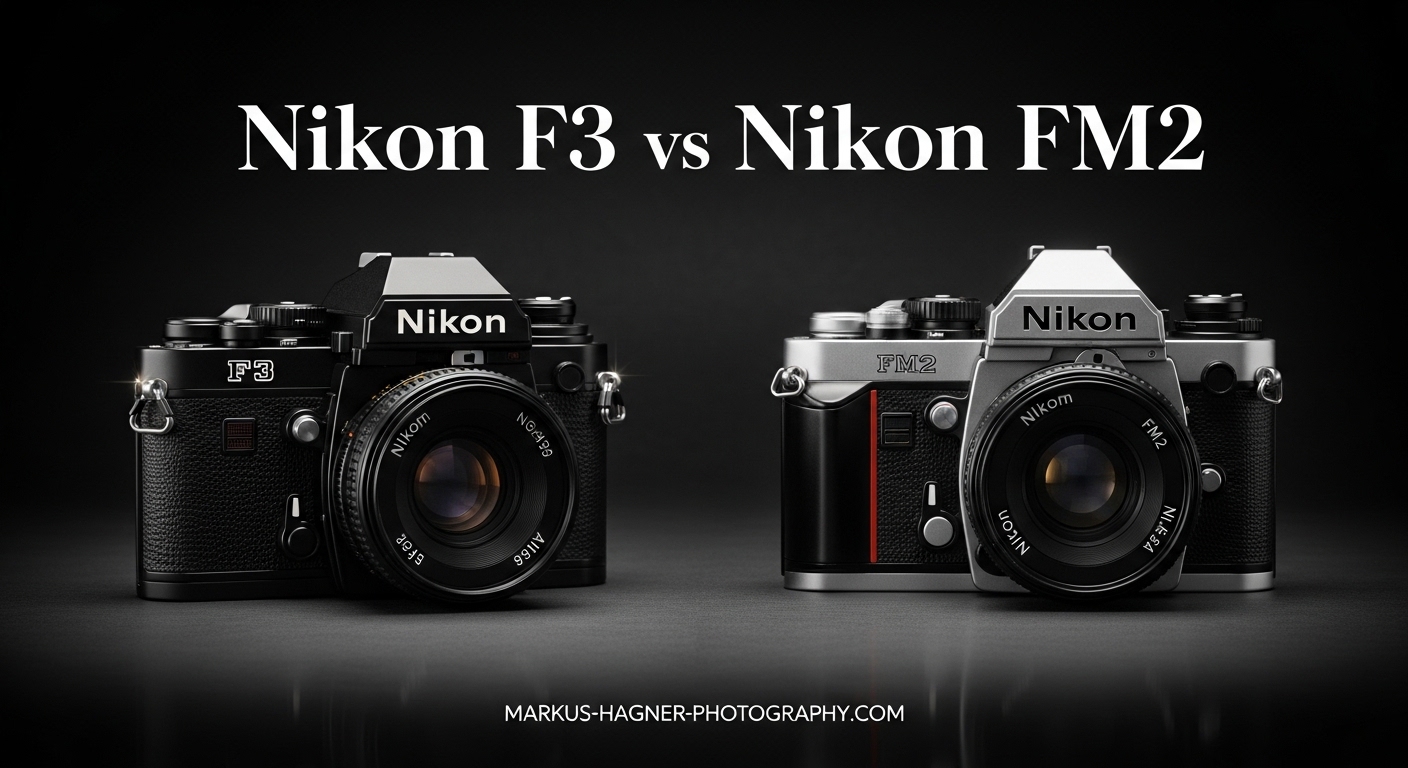
Choosing between the Nikon F3 and Nikon FM2 is one of those decisions that can define your film photography journey for years to come. I have spent countless hours shooting with both of these legendary cameras, and each brings something unique to the table.
The Nikon F3 represents the pinnacle of Nikon’s professional line, offering aperture priority automation and interchangeable viewfinders that made it the go-to choice for photojournalists and studio photographers for over two decades. The Nikon FM2, on the other hand, embodies the philosophy of mechanical simplicity with its battery-independent operation and reputation for surviving extreme conditions.
This Nikon F3 vs Nikon FM2 comparison will help you understand the real differences between these cameras beyond just specifications. We will look at how they perform in actual shooting situations, what it is like to live with each camera day to day, and which one makes more sense for your particular photography style.
After testing both cameras extensively, here is the quick verdict: choose the F3 if you want aperture priority mode and professional features like interchangeable viewfinders. Go with the FM2 if you prioritize mechanical reliability, lighter weight, and the peace of mind that comes with battery-independent operation.
Nikon F3 vs Nikon FM2: Quick Comparison
Before diving into the details, let’s look at how these two cameras stack up side by side. The main differences come down to their approach to exposure control and power dependency.
| Product | Specifications | Action |
|---|---|---|
 Nikon F3HP Camera Body Nikon F3HP Camera Body |
|
Check Latest Price |
 Nikon FM2 SLR Camera Nikon FM2 SLR Camera |
|
Check Latest Price |
The table above shows the fundamental difference between these cameras. The F3 relies on electronic sophistication while the FM2 champions mechanical simplicity. Your preference between these philosophies will largely determine which camera suits you better.
Nikon F3HP: The Professional Workhorse
Pros
- Aperture priority automation
- Interchangeable viewfinders and screens
- Excellent high eyepoint finder
- Professional heritage and support
- Smooth operation when maintained
Cons
- Battery dependent for full operation
- Larger and heavier than FM2
- Slower flash sync at 1/80
- Used condition varies significantly
When Nikon released the F3 in 1980, it was not just another camera. It was a statement of professional intent that would remain Nikon’s flagship for over 20 years. I have always found something special about shooting with a camera that has such a rich professional heritage.
The F3 was the camera of choice for photojournalists, fashion photographers, and anyone who needed reliable automation in fast-paced shooting situations. Its aperture priority mode might seem basic by modern standards, but in the early 1980s, it was revolutionary for working professionals who needed to capture moments quickly without fumbling with manual exposure settings.
What strikes me most about the F3 is its balance of automation and manual control. You get aperture priority when you want it, but full manual control remains easily accessible. The exposure compensation dial sits right where your thumb naturally rests, making quick adjustments second nature after a few rolls of film.
High Eyepoint Finder: A Game Changer for Eyeglass Wearers
The HP in F3HP stands for High eyepoint, and this feature alone has made the camera indispensable for many photographers. If you wear glasses, you know the frustration of pressing your eye against a viewfinder only to see the edges of the frame obscured.
The high eyepoint finder lets you see the entire frame while keeping your eye up to 25mm away from the eyepiece. This distance might seem small, but it transforms the shooting experience for anyone who wears glasses or prefers to shoot with both eyes open.
Beyond the practical benefits, the viewfinder image itself is bright and clear. The split-image rangefinder focusing aid combined with the microprism collar makes focusing fast and accurate, even in challenging light conditions.
Interchangeable Viewfinders: The Professional Advantage
One feature that genuinely sets the F3 apart from the FM2 is its interchangeable viewfinder system. You can swap the standard pentaprism for a waist-level finder, which completely changes how you compose images.
Shooting with a waist-level finder on the F3 gives you a medium format-like experience with 35mm film. You look down into the finder to compose, which is fantastic for street photography, candid portraits, and low-angle shots. The camera becomes less obtrusive, and your subjects often do not realize they are being photographed.
The viewfinder options do not stop there. You can also attach action finders for situations where you need to keep your eye further back, or dedicated magnifying finders for critical focus work. This flexibility makes the F3 genuinely adaptable to different shooting styles.
Battery Dependency: The Trade-off for Automation
The F3 requires batteries to function fully, which is the price you pay for aperture priority automation. Without batteries, the camera only operates at a single mechanical backup speed of 1/90 second. This limitation is worth understanding before committing to the F3.
In practice, I have found the F3 to be remarkably efficient with battery power. The camera uses readily available button cells that last for months of regular shooting. Carrying a spare set of batteries adds minimal weight to your bag, and the peace of mind they provide makes the battery dependency a non-issue for most photographers.
That said, if you regularly shoot in remote locations where replacing batteries could be problematic, this dependency becomes a genuine consideration. The FM2 offers complete battery independence, which we will explore in detail.
Flash Sync Speed Limitation
The F3’s flash sync speed of 1/80 second is notably slower than the FM2’s 1/250. This limitation comes from the electronic shutter design and affects how you can use fill flash in bright conditions.
For most photography situations, the slower sync speed does not cause problems. However, if you do a lot of outdoor portrait work with fill flash, or if you need to freeze motion with flash, the 1/80 limit becomes a real constraint.
The F3 also lacks a built-in hot shoe on the standard prism. You need to attach an accessory shoe to mount a flash directly, which adds a small hassle and cost. This design quirk reflects the camera’s origins in an era when professionals typically used off-camera flash setups.
Despite these limitations, the F3 remains a joy to use. The build quality is exceptional, with a solid feel that modern cameras rarely match. Every control operates with satisfying precision, from the film advance lever to the shutter speed dial.
Nikon FM2: The Mechanical Reliability Champion
Pros
- Works without batteries
- Faster flash sync at 1/250
- Lighter and more compact
- Faster maximum shutter speed
- Legendary reliability
Cons
- Manual exposure only
- Fixed viewfinder design
- Used condition varies
- Film advance lever issues reported
The Nikon FM2 takes a completely different approach to camera design. Where the F3 embraces electronic sophistication, the FM2 celebrates mechanical purity. Every shutter speed works without a single battery, which has made it a favorite among photographers who value reliability above all else.
I have always appreciated how the FM2 strips photography down to its essentials. You set the aperture, you set the shutter speed, and you make the exposure. There is no automation to fall back on, which forces you to really understand light and exposure.
This manual-only approach might sound limiting, but many photographers find it liberating. Without aperture priority to rely on, you develop an intuitive sense for exposure that serves you well regardless of what camera you are using.
Titanium Shutter: Built for the Long Haul
The FM2’s vertically traveling shutter uses titanium blades, and this design choice has contributed significantly to the camera’s reputation for durability. Titanium is lighter and stronger than steel, and it resists the fatigue that can eventually affect mechanical shutters.
The shutter mechanism in the FM2 has proven remarkably reliable over decades of use. Photographers have reported FM2 cameras continuing to function perfectly after years of daily professional use, which explains why these cameras maintain their value so well in the used market.
The vertically traveling design also contributes to the FM2’s faster flash sync speed of 1/250 second. This speed makes the FM2 genuinely capable for fill flash work in bright conditions, something that gives it a practical advantage over the F3 for certain types of photography.
Battery Independence: True Freedom
The FM2’s battery independence is not just a convenience feature. It is a fundamental design philosophy that affects how you approach photography. When your camera does not need batteries to function, you eliminate an entire category of potential failures.
The only thing batteries do in the FM2 is power the light meter. When batteries die, you can continue shooting using the Sunny 16 rule or a handheld meter. Many experienced film photographers actually prefer this approach because it keeps them engaged with the light rather than relying on the camera’s interpretation.
This independence makes the FM2 particularly attractive for travel photography, expedition work, or any situation where you might be far from a camera store. I have taken FM2 cameras on extended trips without spare batteries and never worried about being unable to make photographs.
Compact and Light: The Traveler’s Choice
Weighing significantly less than the F3, the FM2 is noticeably easier to carry for extended periods. The difference might seem small on paper, but after a full day of shooting, that weight reduction becomes meaningful.
The compact dimensions also make the FM2 easier to pack and less obtrusive on the street. If you enjoy candid photography or travel light, the FM2’s size and weight become genuine advantages.
Despite being lighter, the FM2 does not feel cheap. The body uses copper-aluminum alloy that provides excellent rigidity and durability. This is a camera built to professional standards even if Nikon positioned it as a semi-professional model.
The FM2’s Viewfinder: Fixed but Functional
Unlike the F3, the FM2 has a fixed pentaprism viewfinder. You cannot swap it for a waist-level finder or any other option. For most photographers, this limitation rarely matters, but it does reduce the camera’s versatility compared to the F3.
The standard viewfinder provides 93% coverage, which is good but not quite the 100% you get with the F3. The viewfinder image is bright and clear, with a split-image rangefinder and microprism collar for focusing. LED display in the viewfinder shows the meter reading, which some photographers prefer over the F3’s needle display.
The meter readout uses three LEDs that indicate overexposure, correct exposure, and underexposure. This system is simple and effective, though it provides less granular information than the F3’s needle-based display.
Nikon F3 vs Nikon FM2: Head-to-Head Comparison
Now that we have examined each camera individually, let’s compare them directly across the factors that matter most for actual photography. Understanding these differences will help you choose the right camera for your needs.
Shutter System: Electronic vs Mechanical
The fundamental difference between these cameras lies in their shutter designs. The F3 uses an electronically controlled horizontal-travel shutter, while the FM2 employs a mechanically controlled vertical-travel titanium shutter.
Electronic shutters offer precise timing and enable automation like aperture priority. However, they require battery power to function at any speed other than the mechanical backup. The F3 gives you one backup speed of 1/90 second if your batteries fail.
Mechanical shutters like the FM2’s work at all speeds without any power. This independence provides peace of mind but limits you to manual exposure control. You cannot have both automation and battery independence in a single camera design.
The vertical travel of the FM2’s shutter enables faster flash sync and potentially longer shutter life. Horizontal shutters like the F3’s have proven durable, but the design inherently limits sync speed.
Exposure Modes: Automation vs Pure Manual
The F3 offers aperture priority automation in addition to full manual control. Set your aperture, and the camera selects the appropriate shutter speed. This automation speeds up your workflow considerably when shooting in changing light.
The FM2 provides manual exposure only. You set both aperture and shutter speed for every shot. This approach requires more thought and skill, but many photographers find it more satisfying and ultimately more educational.
If you are learning photography, the FM2’s manual-only design forces you to understand exposure fundamentals. If you are an experienced photographer who sometimes needs to work quickly, the F3’s aperture priority mode becomes genuinely valuable.
Both cameras provide exposure compensation, though the F3 makes it more accessible with a dedicated dial. The FM2 requires you to adjust either aperture or shutter speed directly to compensate.
Battery Dependency Analysis
This comparison point often decides the choice for many photographers. The F3 requires batteries for anything other than 1/90 second. The FM2 only needs batteries for the meter, with all shutter speeds available mechanically.
Battery life on the F3 is actually quite good. A set of button cells typically lasts several months of regular use. The batteries are common and inexpensive, so carrying spares adds minimal weight or cost.
The FM2’s batteries last even longer since they only power the meter. Many photographers go a year or more between battery changes on an FM2.
Your shooting style should guide this decision. If you shoot primarily in urban areas or travel to places with camera stores, the F3’s battery dependency is manageable. If you venture into remote locations or simply prefer the security of battery independence, the FM2 has the advantage.
Flash Sync Speed: 1/80 vs 1/250
The flash sync speed difference between these cameras is significant. The F3 syncs at 1/80 second while the FM2 syncs at 1/250 second. This three-stop difference affects how you can use flash outdoors.
At 1/80 second, you need smaller apertures in bright conditions to maintain proper ambient exposure. This limitation can force you into diffraction territory or prevent you from achieving shallow depth of field with fill flash.
At 1/250 second, you have much more flexibility for fill flash photography. You can use wider apertures while still syncing with flash, which gives you more creative control over depth of field in mixed lighting situations.
If you do portrait work with fill flash or need to freeze motion with flash, the FM2’s faster sync speed becomes a genuine practical advantage.
Maximum Shutter Speed: 1/2000 vs 1/4000
The FM2’s 1/4000 maximum shutter speed gives you one more stop of capability compared to the F3’s 1/2000. In bright conditions with fast film or wide apertures, this extra speed can make the difference between getting the shot or not.
For most photography, 1/2000 is adequate. But if you enjoy shooting wide open in daylight or using faster ISO films, the FM2’s 1/4000 capability provides welcome flexibility.
Both cameras offer bulb mode for long exposures, so there is no difference at the slow end of the shutter speed range.
Viewfinder Coverage and Options
The F3 provides 100% viewfinder coverage, meaning you see exactly what will appear on the film. The FM2 offers 93% coverage, which shows slightly less than the full frame.
For critical composition, 100% coverage is preferable. However, 93% is adequate for most photography, and some photographers actually prefer it because it allows for slight framing corrections during printing.
The bigger difference lies in viewfinder flexibility. The F3’s interchangeable finder system lets you use waist-level finders, action finders, and other specialized options. The FM2’s fixed finder limits you to the standard pentaprism.
Size and Weight Comparison
The FM2 is noticeably lighter and more compact than the F3. The weight difference becomes apparent during long shooting sessions or when carrying the camera for extended periods.
The F3’s additional weight comes from its more complex electronic components and larger professional body. Some photographers actually prefer the F3’s heft, finding it provides better stability and a more substantial feel.
For street photography or travel where you want to remain inconspicuous, the FM2’s smaller size becomes an advantage. For studio work or situations where camera presence matters, the F3’s professional appearance can be beneficial.
Build Quality and Durability
Both cameras are exceptionally well built. Nikon designed both to professional standards, even if the FM2 was marketed to advanced amateurs. Either camera will likely outlast its owner with proper care.
The F3’s professional heritage shows in its construction. Brass top and bottom plates, precision machining, and weather sealing make it a camera built for daily professional use.
The FM2’s copper-aluminum alloy body provides excellent rigidity without the weight of brass. The mechanical simplicity means fewer components that can fail, contributing to its reputation for reliability.
Both cameras benefit from Nikon’s extensive service network. Even today, qualified technicians can service either camera, though finding parts becomes increasingly challenging.
Price and Value Assessment
Current market prices for both cameras remain relatively close, with FM2 examples often commanding slightly higher prices than equivalent F3 bodies. This price difference reflects the FM2’s reputation for reliability and the smaller number produced compared to the professional F3.
When evaluating prices, consider what is included. An F3 with the HP finder typically costs more than a standard F3. FM2 cameras with documentation and original packaging command premiums.
Both cameras hold their value well, so your purchase should be considered an investment rather than an expense. Well-maintained examples can be sold for close to their purchase price.
Ideal Use Cases for Each Camera
Choose the Nikon F3 if you need aperture priority automation, want interchangeable viewfinder options, or appreciate the professional heritage and build quality. The F3 excels for photojournalism, studio work, and situations where automation helps you work faster.
Choose the Nikon FM2 if you prioritize mechanical reliability, battery independence, or lighter weight. The FM2 is ideal for travel, expedition photography, street shooting, and any situation where simplicity and dependability matter most.
Both cameras work beautifully for learning photography, though the FM2’s manual-only design provides a more thorough education in exposure fundamentals.
Verdict: Which Camera Should You Choose?
After extensively comparing the Nikon F3 vs Nikon FM2, the right choice depends entirely on your priorities as a photographer. Neither camera is objectively better; they simply serve different needs and preferences.
Who Should Buy the Nikon F3
The Nikon F3 is the right choice if you value aperture priority automation and want the flexibility of interchangeable viewfinders. Photographers who shoot in rapidly changing light conditions will appreciate the ability to set aperture and let the camera handle shutter speed.
The F3 also appeals to photographers who want the professional experience. This camera served as Nikon’s flagship for over 20 years, and that heritage shows in every aspect of its design and operation.
If you wear glasses, the F3HP’s high eyepoint finder alone might make it the better choice. The ability to see the entire frame while keeping your eye away from the finder transforms the shooting experience.
Who Should Buy the Nikon FM2
The Nikon FM2 is ideal if you prioritize mechanical simplicity and battery independence. Photographers who venture into remote locations or simply prefer not to worry about battery failure will appreciate the FM2’s self-contained operation.
The FM2 also makes sense if you want a lighter, more compact camera for travel or street photography. Its smaller size and lighter weight become genuinely meaningful during extended shooting sessions.
If you do fill flash work outdoors or need to freeze motion with flash, the FM2’s 1/250 sync speed provides practical advantages over the F3’s 1/80 limit.
Frequently Asked Questions
Is the Nikon F3 a professional camera?
Yes, the Nikon F3 is absolutely a professional camera. It served as Nikon’s flagship professional SLR from 1980 until the F4 replaced it in 1988, though many professionals continued using the F3 well into the 1990s. The camera was standard issue for photojournalists, fashion photographers, and studio professionals worldwide. Its professional features include interchangeable viewfinders, aperture priority automation, 100% viewfinder coverage, and robust build quality designed for daily professional use.
Is the Nikon FM2 a professional camera?
The Nikon FM2 is considered a semi-professional or advanced amateur camera, though it has been widely used by professionals as a backup body. Nikon marketed it as part of their compact series rather than their professional F-series line. However, the FM2 has earned a reputation as a professional’s backup camera due to its exceptional reliability, mechanical simplicity, and ability to function in extreme conditions. Many professionals choose it specifically for situations where electronic complexity could be a liability.
Which is better: Nikon F3 or FM2?
Neither camera is objectively better; they serve different needs. The F3 offers aperture priority automation and interchangeable viewfinders, making it better for fast-paced professional work. The FM2 provides battery independence, lighter weight, and faster flash sync, making it ideal for travel, street photography, and extreme conditions. Choose the F3 for automation and professional features; choose the FM2 for mechanical reliability and simplicity. The best camera is whichever one you find in better condition.
Does the Nikon F3 need a battery?
Yes, the Nikon F3 needs batteries for full functionality. Without batteries, the camera operates only at a single mechanical backup speed of 1/90 second. Batteries power the electronic shutter control, aperture priority automation, and metering system. The F3 uses two S76 or MS76 button cells, which are readily available and typically last several months of regular use. Carrying spare batteries is recommended for extended shooting sessions.
Does the Nikon FM2 need a battery?
The Nikon FM2 does not need a battery to function. All shutter speeds work mechanically without any power source. Batteries only power the built-in light meter; when batteries die, you can continue shooting using the Sunny 16 rule, a handheld meter, or your own exposure judgment. This battery independence is one of the FM2’s most celebrated features and makes it popular for travel, expedition photography, and situations where battery replacement might be difficult.
What is the flash sync speed comparison between the F3 and FM2?
The Nikon FM2 has a flash sync speed of 1/250 second, while the Nikon F3 syncs at 1/80 second. This three-stop difference significantly affects fill flash photography. The FM2’s faster sync allows wider apertures when using flash outdoors, giving more creative control over depth of field. The F3’s slower sync speed can be limiting in bright conditions with flash. If you frequently use fill flash or need to freeze motion with flash, the FM2 has a clear practical advantage.
Final Recommendation
For most photographers choosing between these cameras in 2026, I recommend buying the one you find in better condition. Both cameras are capable of exceptional results, and a well-maintained example of either will serve you better than a rough example of the theoretically superior option.
That said, if you have no strong preference, the FM2’s mechanical reliability and battery independence make it slightly more versatile for general photography. The F3’s automation and viewfinder options make it better suited for specific professional applications.
Whichever camera you choose, you are getting one of the finest manual focus SLRs ever made. Both the F3 and FM2 represent Nikon at its best, and either will reward you with decades of excellent photography.