
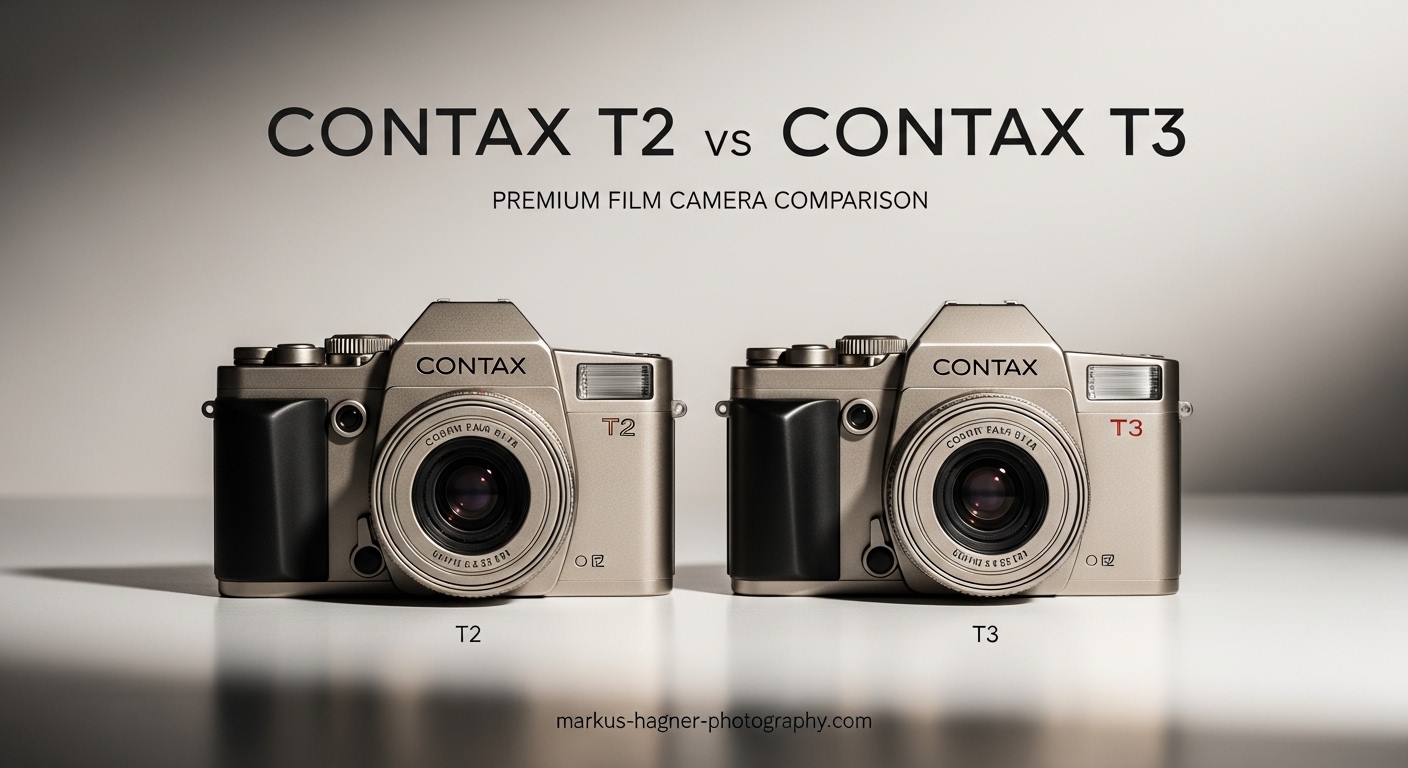
When it comes to premium 35mm film point-and-shoot cameras, the Contax T2 vs Contax T3 stand at the pinnacle of collector appeal. Both cameras feature legendary Carl Zeiss lenses and titanium bodies that have maintained their reputation for exceptional image quality decades after production ended.
The Contax T2 debuted in 1990, establishing the template for premium compact film cameras. The Contax T3 followed in 2001, refinining the formula with improved optics and a more compact design. Understanding the differences between these two cameras is essential for anyone considering entering the vintage film photography market.
Contax T2 vs Contax T3: Quick Comparison
The most significant differences between these two cameras lie in their lenses, minimum focus capabilities, and physical design. The Contax T2 features a 38mm f/2.8 Carl Zeiss Sonnar lens with a 70cm minimum focus distance, while the Contax T3 upgraded to a sharper 35mm f/2.8 Sonnar with an impressive 35cm minimum focus distance.
In terms of physical design, the T2 is larger and features a more tactile dial-based interface with an optional scale focus mechanism. The T3 is significantly smaller and uses a button-based interface with an LCD panel for settings. The price difference reflects these upgrades, with the T3 commanding a $700-1000 premium over the T2 in the current market.
Key Specifications at a Glance
- Lens: T2 – 38mm f/2.8 | T3 – 35mm f/2.8
- Minimum Focus: T2 – 70cm | T3 – 35cm
- Body: Both titanium
- Release Year: T2 – 1990 | T3 – 2001
- Current Price: T2 – $800-1200 | T3 – $1500-2500
Contax T2: The Classic Choice
The Contax T2 remains a beloved classic in the film photography community. Its Carl Zeiss Sonnar 38mm f/2.8 lens delivers beautiful, sharp images with that characteristic German lens rendering that photographers prize. The lens produces lovely color saturation and subtle vignetting that adds character to street photography.
One of the T2’s distinguishing features is its 70cm minimum focus distance. While this limits close-up work, it’s perfectly suitable for standard street and travel photography. The longer focal length of 38mm provides a slightly more compressed perspective compared to the T3’s 35mm, which some photographers prefer for its versatility.
The T2’s dial-based interface offers a more tactile shooting experience. You can manually set the focus using the scale focus option, which appeals to photographers who enjoy the mechanical connection to their camera. The lack of an LCD panel gives the T2 a more analog, retro feel that many photographers appreciate.
In terms of autofocus, the T2’s system is competent but shows its age compared to the T3. It’s reliable in good lighting conditions but can struggle in low-light situations. The autofocus is precise enough for most shooting scenarios, though there’s a noticeable lag compared to modern standards.
The larger body of the T2 provides a more substantial grip, which some photographers find more comfortable for extended shooting sessions. The rubber grip on the front of the camera provides secure handling, and the overall build quality reflects Contax’s commitment to premium construction.
Contax T3: The Refined Evolution
The Contax T3 represents the culmination of Contax’s compact camera development. Its Carl Zeiss Sonnar 35mm f/2.8 lens is widely regarded as one of the sharpest lenses ever put in a point-and-shoot camera. The upgraded optics deliver exceptional resolution and contrast, making it a favorite among detail-oriented photographers.
The most practical improvement in the T3 is its 35cm minimum focus distance – exactly half that of the T2. This opens up new possibilities for close-up photography, food photography, and environmental portraits where you want to get physically closer to your subject. The improved close-focusing capability is one of the most compelling reasons to choose the T3.
The T3’s autofocus system is noticeably faster and more accurate than the T2. This improvement is particularly noticeable in challenging lighting conditions and when photographing moving subjects. The more sophisticated AF system makes the T3 a better choice for candid photography and situations where you need to react quickly.
Despite its smaller size, the T3 features an LCD panel that displays settings clearly. The button-based interface is more modern and takes some adjustment if you’re used to the T2’s dials, but it becomes intuitive quickly. The smaller form factor makes the T3 more pocketable, which is significant for a camera you want to carry everyday.
It’s worth noting that the T3 has known reliability issues, particularly with the winding mechanism. Some owners report problems with the film advance teeth, which can be expensive to repair. This is an important consideration when purchasing a T3, and thoroughly testing the film advance mechanism before buying is essential.
Head-to-Head: Detailed Comparison
Lens Quality
The T3’s 35mm f/2.8 lens is objectively sharper than the T2’s 38mm f/2.8. In side-by-side comparisons, the T3 shows better resolution and contrast, particularly at wider apertures. However, some photographers prefer the T2’s slightly softer rendering, which can be more flattering for portraits.
The 3mm difference in focal length is subtle but noticeable in practice. The 35mm on the T3 provides a wider field of view that’s more versatile for street photography and environmental portraits. The 38mm on the T2 is closer to a standard perspective, which some photographers find more natural.
Autofocus Performance
The T3’s autofocus is faster, more accurate, and more reliable than the T2’s. This is one of the most significant practical differences between the two cameras. If you frequently shoot in challenging lighting or need to capture fleeting moments, the T3’s improved AF is worth considering.
The T2’s autofocus is adequate for most situations but shows its age. In low light, the T2’s AF can hunt or fail to lock on, while the T3 maintains better performance. For street photography in varying conditions, this can be the difference between getting the shot and missing it.
Close-Up Capability
This is where the T3 clearly wins. With a minimum focus distance of 35cm versus the T2’s 70cm, the T3 can get twice as close to your subject. This matters for food photography, detail shots, and any situation where you want to fill the frame with your subject.
If close-up photography is important to you, the T3’s capability is a game-changer. The ability to focus at 35cm opens up creative possibilities that simply aren’t available with the T2. For travel photography where you might want to capture details of architecture, food, or local products, this advantage is significant.
Build Quality and Ergonomics
Both cameras feature titanium bodies that are built to last. The T2’s larger body provides a more substantial grip and feels more like a traditional camera in your hand. The T3’s smaller size is more pocketable but can feel less substantial for photographers with larger hands.
The T2’s rubber grip provides excellent handling, while the T3’s smooth titanium body requires more careful handling. Some photographers prefer the T2’s grip, while others appreciate the T3’s sleek aesthetic. This is largely a matter of personal preference and hand size.
Viewfinder
Both cameras have bright, clear viewfinders that display focus confirmation and exposure information. The T2’s viewfinder is slightly larger due to the larger body, but both provide an accurate representation of the final image. The T3’s viewfinder includes additional information display via the LCD system.
Price and Value
The Contax T2 typically sells for $800-1200 in good working condition, while the Contax T3 commands $1500-2500. The premium for the T3 reflects its improved optics, better autofocus, and more compact design. Whether that premium is worth it depends on your specific needs and budget.
The T2 offers better value for photographers primarily interested in the vintage film experience and classic Contax quality. The T3 is worth the premium if you need the sharper lens, better autofocus, and close-focusing capability.
Reliability and Repair Considerations
Both the Contax T2 and T3 have developed reputations for being somewhat unreliable, which is a significant consideration for potential buyers. These cameras were produced in limited numbers and are now 15-35 years old, meaning many units have accumulated wear or developed issues.
The Contax T3 has a known weakness in its film advance mechanism. Some units develop problems with the winding teeth, which can cause film transport issues. This problem appears to be more common in heavily used cameras, but even well-maintained examples can develop this issue over time.
The Contax T2, being older, has had more time to develop problems. Common issues include sticky aperture blades, malfunctioning autofocus motors, and worn film advance mechanisms. However, many T2s continue to function perfectly after decades of use, especially those that have been properly maintained.
Perhaps the most concerning aspect of owning either camera is the difficulty of repair. Contax camera service was always limited, and the company no longer exists. Finding a qualified technician who can repair these cameras is increasingly difficult, and repair costs can be substantial.
My recommendation is to purchase from sellers who thoroughly test their cameras and offer return policies. Budget for the possibility of future repairs, and consider having the camera professionally CLA’d (cleaned, lubricated, adjusted) before heavy use. This can extend the camera’s life and prevent issues from developing.
Which Camera Should You Buy?
Choosing between the Contax T2 and T3 depends on your specific priorities, shooting style, and budget. Here’s my breakdown of who should consider each camera.
Choose the Contax T2 if:
- Budget is a significant consideration
- You prefer the 38mm focal length
- You enjoy the tactile dial-based controls
- Larger camera body suits your preferences
- You prefer the more analog, retro feel
- You want the rubber grip for secure handling
Choose the Contax T3 if:
- Sharpest possible lens quality is your priority
- You need close-up photography capability (35cm focus)
- Faster autofocus is important to you
- Compact size for everyday carry matters
- You prefer the more modern button interface
- You have the budget for the premium price
The Contax T3 is objectively the better camera technically, with a sharper lens, better autofocus, and improved close-focusing capability. However, the T2 offers better value and maintains the classic Contax experience at a more accessible price point.
If you’re new to vintage film cameras, I’d suggest starting with a well-tested Contax T2. You can always upgrade to the T3 later if you find the limitations frustrating. The T2 will give you the Contax experience without the premium price tag.
For photographers who already have experience with film cameras and know what they want, the T3’s improvements may justify the premium. The improved autofocus and close-focusing capability can make a real difference in your shooting experience.
As for alternatives, consider the Nikon 35Ti, Leica Minilux, and Yashica T4 if you want similar quality without the Contax premium. These cameras offer excellent lenses and build quality at lower prices, though they don’t carry quite the same collector appeal.
Frequently Asked Questions
Why is the Contax T2 so popular?
The Contax T2 became popular due to its exceptional Carl Zeiss lens quality, premium titanium body construction, and the vintage film photography revival. Celebrity endorsements, particularly from photographers like Kendall Jenner, drove up demand and prices significantly.
What makes the Contax T3 so special?
The Contax T3 is special due to its upgraded Carl Zeiss Sonnar 35mm f/2.8 lens, which is widely considered one of the sharpest lenses ever in a point-and-shoot camera. It also features improved autofocus, compact titanium body, and 35cm minimum focus distance.
What are common Contax T3 problems?
The most common Contax T3 problems include issues with the film advance mechanism, specifically the winding teeth that can break or wear out. Some units also experience sticky aperture blades and autofocus motor problems. These cameras are difficult to repair due to limited service options.
Which camera is better for street photography?
For street photography, the Contax T3 is generally better due to its faster autofocus, sharper 35mm lens, and more compact size. However, the Contax T2 with its 38mm focal length and dial controls remains a popular choice among street photographers who prefer its handling characteristics.
Is the Contax T2 worth buying in 2026?
The Contax T2 is worth buying if you can find one in good working condition at a fair price ($800-1200). Its classic Zeiss lens, tactile controls, and more accessible price point make it a great entry into premium vintage film photography.
Is the Contax T3 worth the premium price?
The Contax T3 is worth the premium if you prioritize the sharpest lens, fastest autofocus, and close-up capability. If $1500-2500 fits your budget and these features matter to you, the T3 delivers a superior shooting experience. However, budget-conscious photographers may find better value in the T2 or alternatives.
Conclusion
Both the Contax T2 vs Contax T3 represent the pinnacle of 35mm film camera design. The T3 is technically superior with a sharper lens, better autofocus, and superior close-focusing capability. The T2 offers excellent value and maintains the classic Contax experience at a more accessible price point.
Your choice should depend on your budget, shooting style, and priorities. If you’re budget-conscious or prefer the larger body and dial controls, the T2 remains an excellent choice. If you want the best possible lens quality and don’t mind the premium, the T3 delivers a superior shooting experience.
Regardless of which you choose, both cameras will deliver beautiful images that justify their legendary reputations in the film photography community.