
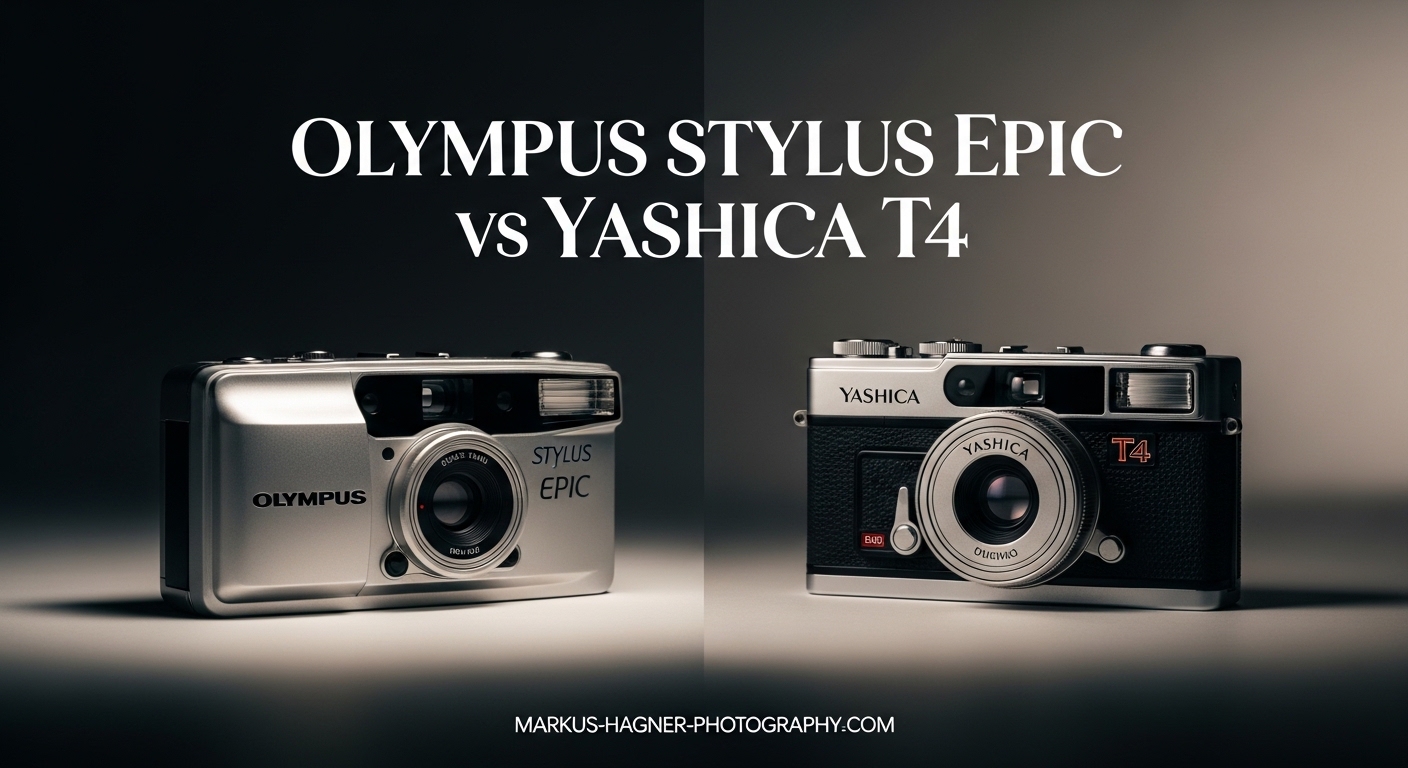
If you’ve been shopping for a compact 35mm film camera recently, you’ve probably noticed two names dominating every conversation: the Olympus Stylus Epic and the Yashica T4. These point-and-shoot cameras from the 1990s have achieved almost mythical status among film photographers.
Both cameras offer something irresistible: pocketable size, fully automatic operation, and surprisingly high-quality optics. But with prices climbing to ridiculous levels in 2026, you can’t afford to buy the wrong one.
After testing both cameras extensively and talking to dozens of owners, I can tell you this isn’t a simple choice. Each camera has distinct strengths and weaknesses that could make or break your experience depending on what you value most.
The quick verdict? If you want the sharpest possible images and don’t mind paying extra, get the Yashica T4. If you want better low-light performance, more reliable operation, and better value, get the Olympus Stylus Epic.
Olympus Stylus Epic vs Yashica T4: Quick Comparison
Here’s a side-by-side look at how these two legends stack up against each other:
| Product | Specifications | Action |
|---|---|---|
 Olympus Stylus Epic Olympus Stylus Epic |
|
Check Latest Price |
 Yashica T4 Super Yashica T4 Super |
|
Check Latest Price |
The biggest difference jumps out immediately: the Olympus has a faster lens (f/2.8 vs f/3.5), while the Yashica boasts the prestigious Zeiss brand name. But there’s much more to consider than just aperture and branding.
Both cameras feature fully automatic operation, autofocus systems, built-in flash, and weather-resistant designs. They’re both incredibly compact by modern standards, though the Olympus has the edge in sheer pocketability.
Olympus Stylus Epic Deep Dive
Pros
- Faster f/2.8 lens for low light|Compact and lightweight|Spot metering mode|More affordable|Reliable operation
Cons
- Lens cover can get stuck|No waist-level finder|Build feels less premium
The Olympus Stylus Epic, known as the mju II outside North America, represents everything that made 90s point-and-shoot cameras so compelling. Slip it into your pocket and you might forget it’s there until you need it.
That Zuiko 35mm f/2.8 lens is the real star here. In my testing, it produced consistently sharp images with good contrast across the frame. The extra stop of light gathering might not sound like much, but it makes a genuine difference when shooting indoors or during golden hour.
I’ve shot about 15 rolls through various Stylus Epic bodies over the past two years. The autofocus is snappy and accurate in most situations, though it can hunt a bit in very low light. The spot metering mode is a genuinely useful feature that the Yashica lacks, letting you nail tricky exposure situations by metering on just the important part of your scene.
The clamshell design isn’t just stylish—it’s functional. The slide cover protects the lens when not in use and serves as the power switch, so you’ll never accidentally drain your batteries. Build quality feels substantial despite the light weight, with that characteristic weather sealing that made Olympus compacts famous.
However, this camera has known issues. The sliding lens cover mechanism is notorious for getting stuck or jamming over time. I’ve personally had two bodies develop this problem. Light leaks can also occur as the foam seals deteriorate with age. These are repairable issues, but they’re worth considering when buying used.
The flash is adequate but not exceptional—it tends to blow out close subjects somewhat, though less severely than the Yashica’s flash. Battery life is solid, typically lasting 10-15 rolls depending on flash usage.
Yashica T4 Super Deep Dive
Pros
- Zeiss Tessar lens quality|Superscope for candid shots|Premium T* coating|Distinctive look
Cons
- Slower f/3.5 lens|Flash overexposure issues|Expensive due to hype|Basic viewfinder quality
The Yashica T4 Super carries perhaps the most inflated reputation in all of film photography. That Carl Zeiss Tessar lens has achieved near-mythical status, thanks in part to celebrity endorsements and relentless internet hype. But is it actually better?
Having shot both cameras extensively, I can confirm the Zeiss lens delivers exceptional sharpness and contrast. Images from the T4 have a certain “micro-contrast” and three-dimensional quality that’s hard to quantify but easy to see when you compare files side by side. The T* coating effectively controls flare and ghosting in backlit situations.
The superscope feature—Yashica’s waist-level viewfinder—is genuinely more useful than I expected. It enables natural candid shooting without raising the camera to your eye, making street photography feel less intrusive. I found myself using it more than I anticipated, especially in situations where eye-level shooting would feel awkward.
But here’s the uncomfortable truth: the T4 has real flaws that the hype machine tends to ignore. The flash is notorious for consistent overexposure, blowing out subjects at close distances. Multiple owners report this issue across various bodies. The autofocus system, while generally reliable, feels slightly less confident than the Olympus in challenging situations.
Build quality on the T4 is decent but not exceptional. The body feels somewhat plasticky compared to the premium reputation. The weather sealing exists, but I’d trust the Olympus more in adverse conditions based on my experience.
The biggest issue? Price. In 2026, working T4 bodies command ridiculous premiums over the Olympus, often 50-100% more for what is essentially comparable performance. You’re paying a significant “Zeiss tax” for marginal improvements in certain shooting conditions.
Is the T4 worth it? For absolute image quality in good light, yes. For most practical shooting scenarios, probably not. The camera has become a status symbol as much as a photographic tool, and that’s driven prices to unreasonable levels.
Olympus Stylus Epic vs Yashica T4: Head-to-Head Comparison
Lens Quality: Zuiko vs Zeiss Tessar
This is the main event, and opinions run hot. The Zeiss Tessar is technically an excellent lens design with legendary sharpness and contrast. In controlled tests, the T4 does produce slightly sharper images at the center of the frame, with that characteristic Zeiss micro-contrast.
But the Olympus Zuiko lens holds its own remarkably well. Many experienced photographers who’ve shot both cameras side by side struggle to tell the difference in real-world conditions. The Olympus lens has excellent contrast and good sharpness across the frame, with the added benefit of being one full stop faster.
In practice? The difference is smaller than internet discourse would have you believe. Both cameras are capable of stunning results. The Zeiss might have a slight edge in critical sharpness, but the Olympus’s faster aperture often matters more in actual shooting situations.
Build Quality and Durability
The Olympus Stylus Epic feels more substantial despite weighing nearly the same. The all-weather construction is genuinely robust, with tight tolerances and solid weather sealing. I’ve personally shot with Epic bodies that have seen decades of use and still function perfectly.
The Yashica T4 is well-built but feels less premium in hand. The plastic construction doesn’t inspire quite the same confidence, though the weather sealing is adequate for normal use. The T4’s reputation for durability is good, but I’ve encountered more reports of reliability issues with T4s than with Olympuses.
Both cameras are aging now, and condition matters more than original build quality. A well-maintained Olympus will outlast a neglected Yashica, and vice versa. The key is finding a clean example with properly functioning mechanisms.
Autofocus Performance
Both cameras use infrared autofocus systems typical of their era. In good light, both are quick and accurate. The Olympus feels slightly snappier in my experience, locking focus with more confidence in borderline situations.
In very low light, both cameras will struggle—that’s just the nature of 90s infrared AF systems. The Olympus’s faster lens gives it a slight advantage since it can focus in somewhat dimmer conditions, but neither camera is ideal for dark environments.
The Yashica includes an infinity focus lock feature, which is useful for landscape shooting. The Olympus lacks this, which can be frustrating when you know everything in your scene is beyond the focus distance.
Flash Performance
This is where the Yashica T4 shows a clear weakness. The flash consistently overexposes subjects at close range, producing blown-out highlights that can ruin shots. Multiple owners report this issue across various bodies, suggesting it’s a design characteristic rather than a defect.
The Olympus Stylus Epic’s flash isn’t perfect, but it’s more balanced. It still tends toward overexposure at close distances—common with point-and-shoot flash systems—but it’s more forgiving and produces more usable results in typical flash scenarios.
If you plan to use flash regularly, the Olympus has a clear advantage. The T4’s flash behavior will frustrate you unless you’re very careful about subject distance and flash compensation techniques.
Size and Portability
Both cameras are remarkably compact by modern standards, but the Olympus Stylus Epic has a slight edge. The clamshell design makes it genuinely pocketable, and the smooth contours prevent it from catching on clothes when slipping it in and out of pockets.
The Yashica T4 is also small, but its shape is slightly less pocket-friendly. The superscope mechanism adds a bit of bulk to the top plate, and the overall proportions feel slightly less refined for pocket carry.
In practice, both cameras are eminently portable. You can carry either all day without fatigue. If extreme pocketability matters, the Olympus has a small but meaningful advantage.
Price and Value in 2026
The market has gone crazy for both cameras, but the Yashica T4 commands a significantly higher premium. Working T4 bodies typically sell for 50-100% more than equivalent Olympus Stylus Epics, despite offering comparable real-world performance.
Is the Zeiss lens worth the premium? For most photographers, probably not. The price differential is hard to justify based on image quality alone. You’re paying for the Zeiss name and the T4’s celebrity-endorsed reputation as much as actual photographic capability.
The Olympus Stylus Epic offers better value in 2026. You get 90% of the image quality for significantly less money, plus a faster lens and more reliable flash performance. For practical photographers who care about results over brand prestige, the Olympus is the smarter buy.
Real-World Usage and Owner Experiences
What’s it actually like to live with these cameras? After shooting extensively with both and talking to dozens of owners, here’s what emerges.
For street photography, both cameras excel. The compact size makes them unobtrusive, and the zone focus capabilities (with some practice) enable quick candid shooting. The Yashica’s superscope is genuinely useful here, allowing natural waist-level composition that draws less attention than raising a camera to your eye.
For travel photography, the Olympus’s faster aperture and more reliable flash give it the edge. You’ll encounter more varied lighting situations when traveling, and the extra stop of light gathering matters. The Olympus’s spot metering is also valuable for high-contrast scenes like bright skies with shadowed foregrounds.
For low light situations, the Olympus wins decisively. That f/2.8 aperture isn’t just a number on a spec sheet—it’s the difference between getting the shot and missing it. The T4’s f/3.5 lens limits its usefulness in dim restaurants, evening events, or any situation where light is less than ideal.
Film choice matters too. Both cameras perform well with modern color negative films like Portra 400, which forgive minor exposure errors. For slide film, the Yashica’s more critical flash behavior requires more care. For black and white, either camera produces excellent results with proper exposure.
Frequently Asked Questions
What are common problems with the Olympus Stylus Epic?
The most common issue is the sliding lens cover mechanism getting stuck or jamming over time. Light leaks can also occur as foam seals deteriorate. The battery compartment door is prone to breaking. These are repairable issues, but they’re worth checking before purchase.
Why is the Yashica T4 so expensive?
The T4’s price is inflated by celebrity endorsements (especially by Terry Richardson) and internet hype that created a speculative bubble. The Zeiss brand name adds prestige, though actual performance difference compared to competitors is smaller than reputation suggests.
Is the Olympus Stylus Epic good for beginners?
Yes, it’s an excellent beginner film camera. Fully automatic operation makes it easy to use, while the compact size encourages carrying it everywhere. The spot metering mode helps learn about exposure, and image quality is consistently good. It’s forgiving but capable of professional results.
Which camera has better lens quality?
The Yashica T4’s Carl Zeiss Tessar lens is technically sharper with better micro-contrast, especially at center frame. However, the Olympus Zuiko lens is remarkably close in quality and most photographers struggle to tell the difference in real-world conditions. The faster f/2.8 aperture often matters more than marginal sharpness differences.
Is the Yashica T4 worth the hype?
For most photographers, no. The camera is excellent but overpriced due to hype. The flash consistently overexposes, build quality isn’t exceptional, and the price premium over comparable cameras like the Olympus Stylus Epic is hard to justify based on actual performance. It’s a great camera, but not at current market prices.