
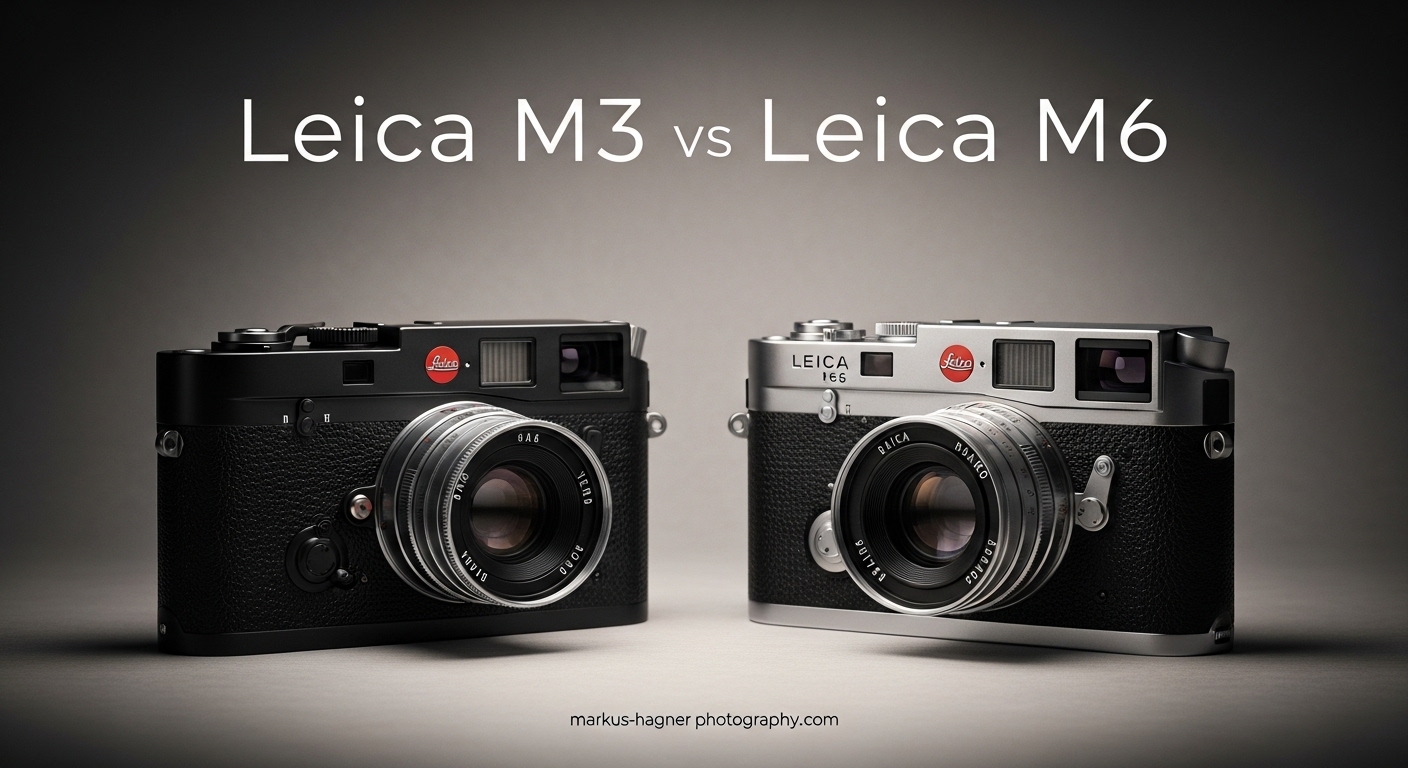
Choosing between the Leica M3 vs Leica M6 is one of the most debated topics in film photography circles. Both cameras represent the pinnacle of mechanical rangefinder design, but they serve different shooting styles and preferences. I have spent years shooting with Leica M cameras, and this comparison breaks down everything you need to know to make the right choice.
The Leica M3, produced from 1954 to 1966, is often called the finest rangefinder ever made thanks to its massive 0.91x viewfinder. The Leica M6, built from 1984 to 1998 (and again in a reissue), added a built-in light meter and broader lens compatibility. One camera prioritizes purity and viewfinder quality; the other prioritizes convenience and versatility.
Here is my quick verdict: If you shoot primarily with 50mm lenses and want the best viewfinder experience in any camera, get the M3. If you need 35mm or wider lenses, want built-in metering, and prefer a more versatile tool, the M6 is your answer.
Leica M3 vs Leica M6: Quick Comparison
| Product | Specifications | Action |
|---|---|---|
 Leica M3 Single Stroke Leica M3 Single Stroke |
|
Check Latest Price |
 Leica M6 TTL Leica M6 TTL |
|
Check Latest Price |
The table above shows the fundamental differences at a glance. The M3 offers a higher magnification viewfinder and fully mechanical operation, while the M6 provides built-in metering and support for wider lenses. Let me break down what these differences mean in actual use.
Leica M3 Deep Dive
Pros
- Legendary 0.91x viewfinder
- Smooth single stroke advance
- Pure mechanical operation
- No battery dependency
- Exceptional build quality
Cons
- No 35mm framelines
- Requires external metering
- Tricky film loading
- Higher prices for good condition
When I pick up a Leica M3, the first thing I notice is that massive, bright viewfinder. At 0.91x magnification, it is the largest and brightest viewfinder ever put in a 35mm camera. Looking through it feels almost like looking with your naked eye. The rangefinder patch is sharp and contrasty, making focusing fast and intuitive even in challenging light.
The M3 was designed around the 50mm lens, and it shows. The 50mm framelines are perfectly sized, and the higher magnification makes precise focus easier than on any other Leica. Forum users consistently describe the M3 viewfinder as magical, and I understand why. For portrait work or any situation where you are shooting at moderate distances with a 50mm, nothing beats it.
Beyond the viewfinder, the M3 has a unique mechanical character. The film advance is smoother than any other Leica I have used. Whether you get a single stroke or double stroke version, the action feels like winding a precision Swiss watch. The shutter is crisp and mechanical, producing a sound that many photographers find more satisfying than later models.
The main trade-off with the M3 is lens compatibility. Because it was designed for 50mm and longer lenses, there are no built-in 35mm framelines. You can use 35mm lenses, but you will need either goggled lenses (which add bulk) or an external viewfinder. For street photographers who love 35mm, this is often a dealbreaker.
Metering is the other consideration. The M3 has no built-in light meter, so you need to use an external handheld meter, a smartphone app, or the Sunny 16 rule. After some practice, many photographers find this slows them down less than expected. The Sunny 16 method becomes second nature, and some M3 owners say it actually improves their photography by forcing them to think about light more carefully.
Who the M3 Is Best For
The Leica M3 shines for photographers who shoot 50mm as their primary lens, prioritize viewfinder quality above all else, and appreciate the purity of fully mechanical operation. It is ideal for portrait work, landscape photography, and any situation where deliberate, careful composition matters more than speed.
Film loading on the M3 deserves mention. The removable take-up spool system can be frustrating for beginners, but experienced users often prefer it once they master the technique. It allows faster loading if you pre-load the spool, though the learning curve is steeper than the M6.
Leica M6 TTL Deep Dive
Pros
- Built-in TTL metering
- 35mm framelines included
- Wider lens support
- Modern conveniences
- More versatile overall
Cons
- Lower magnification viewfinder
- Requires batteries for meter
- Viewfinder can flare
- Two-piece construction
The Leica M6 takes everything great about the M-series and adds modern conveniences that many photographers consider essential. The built-in TTL metering is the headline feature. Three LED arrows in the viewfinder show you whether your exposure is correct, under, or over. For photographers who shoot in rapidly changing light or who are new to film, this convenience is invaluable.
The 0.72x viewfinder on the M6 is the standard that most other Leica cameras follow. While it does not have the eye-popping magnification of the M3, it offers something the M3 cannot: framelines for 28mm, 35mm, 50mm, 75mm, 90mm, and 135mm lenses. This makes the M6 a true system camera that works with virtually any M-mount lens you want to attach.
Street photographers overwhelmingly prefer the M6, and I see why. The 35mm framelines alone make it the better choice for this genre. Combined with the built-in meter, you can react to changing scenes much faster. When light is shifting constantly on the street, those LED arrows save precious seconds.
The M6 TTL variant, which is what we are focusing on here, offers a larger shutter speed dial and improved metering direction compared to the classic M6. The meter reads off-the-film, which provides accurate results with most film stocks. The trade-off is battery dependency. Without batteries, you lose metering (though the shutter is still mechanical and fires at all speeds).
Beyond the technical differences, the M6 feels slightly different in hand. The construction is two-piece rather than the M3’s one-piece design. Some photographers feel this makes it slightly less solid, while others say the difference is negligible. The angled rewind crank on the M6 is faster than the M3’s knob, which matters when you are shooting quickly.
Who the M6 Is Best For
The Leica M6 is ideal for photographers who shoot 35mm or wider lenses, need built-in metering for speed or convenience, and want the versatility to use the full range of M-mount glass. It is the better choice for street photography, travel, documentary work, and any situation where conditions change rapidly.
Head-to-Head: Leica M3 vs Leica M6
Now let me compare these cameras category by category so you can see exactly where each one excels.
Viewfinder Comparison
Winner: Leica M3
The M3 viewfinder is legendary for good reason. The 0.91x magnification is simply unmatched in any 35mm camera. The rangefinder patch is bright, contrasty, and resistant to flare. I have focused M3 cameras in dim interiors where other rangefinders struggled. The viewfinder does not show frameline pairs like the M6. Instead, it shows single framelines for 50mm, 90mm, and 135mm. This cleaner presentation is preferred by many purists.
The M6 viewfinder is no slouch. At 0.72x, it is still excellent and brighter than most cameras. However, some M6 units suffer from viewfinder flare, where bright light can cause the patch to white out. The M3 does not have this problem. For pure viewfinder quality, the M3 wins hands down.
Metering and Exposure
Winner: Leica M6
This is not close. The M6 has built-in TTL metering that works with virtually any film stock. The three-LED display in the viewfinder is simple and effective. You get instant feedback on exposure without taking your eye from the finder.
The M3 requires external metering. You can use a handheld meter, a smartphone app, or the Sunny 16 rule. All work fine, but none are as convenient as built-in metering. Some photographers prefer the slower, more deliberate approach the M3 forces. However, for speed and convenience, the M6 is the clear winner.
Lens Compatibility
Winner: Leica M6
The M6 shows framelines for 28mm through 135mm. It handles the full range of M-mount lenses without any accessories. This versatility is why many photographers consider the M6 the more practical choice.
The M3 only shows framelines for 50mm, 90mm, and 135mm. There are no 35mm framelines, which means no 28mm either. You can use wider lenses, but you need goggled lenses or external finders. Both solutions add cost and complexity. If you love 35mm, the M3 requires compromises.
Build Quality and Feel
Winner: Leica M3 (slightly)
The M3 is built as one solid piece of brass. It feels incredibly dense and substantial. The film advance is smoother than the M6, which is consistently noted in forum discussions. The M3 shutter has a more mechanical, satisfying sound.
The M6 is also beautifully built, but it uses a two-piece construction. Some photographers feel it is slightly less solid. The difference is subtle and may not matter to most users. Both cameras will outlast their owners with proper care. For pure tactile satisfaction, the M3 gets the edge.
Film Loading and Operation
Winner: Tie
The M3 has a removable take-up spool that frustrates beginners but rewards experienced users. Pre-loading spools makes changing film faster. The M6 has a fixed spool that is more intuitive for first-time users. The M6 also has an angled rewind crank that is faster than the M3’s knob.
Neither camera is clearly superior here. The M3 rewards practice. The M6 is easier from day one. For beginners, the M6 is more approachable. For experienced shooters, both work well.
Value and Availability
Winner: Leica M6
Finding a good condition M3 is challenging. Many have viewfinder issues including fading, separation, or dim patches. A pristine M3 commands a significant premium. The M6 is newer and generally easier to find in good condition.
Both cameras hold value well, but the M3 can command higher prices for excellent examples. The M6 offers more camera for the money in most cases, especially when you factor in the built-in meter.
Frequently Asked Questions
Is the Leica M3 viewfinder better than the M6?
Yes, the Leica M3 viewfinder is generally considered superior. It has 0.91x magnification compared to the M6’s 0.72x, making it larger and brighter. The M3 rangefinder patch is also more resistant to flare and stays visible in challenging light. However, the M3 only shows framelines for 50mm and longer, while the M6 includes 35mm and 28mm framelines.
Can you use 35mm lenses on the Leica M3?
Yes, you can mount and use 35mm lenses on the Leica M3, but the camera does not have built-in 35mm framelines. You will need either goggled 35mm lenses (which have built-in finders) or a separate external viewfinder that mounts to the accessory shoe. Many street photographers find this inconvenient compared to the M6’s native 35mm support.
How do you meter with a Leica M3?
The Leica M3 has no built-in meter, so you need external metering. Common options include handheld light meters (like Sekonic models), smartphone apps (many free options available), or the Sunny 16 rule (estimate exposure based on lighting conditions). Many M3 owners find that learning Sunny 16 improves their overall photography skills.
Which Leica is better for street photography?
The Leica M6 is generally better for street photography. It includes 35mm framelines (the most popular street focal length), has built-in metering for fast exposure decisions, and handles changing light conditions well. The M3 can work for street photography, but the lack of 35mm framelines and metering makes it less convenient for the rapid, reactive nature of street shooting.
Is the Leica M3 still in production?
No, the Leica M3 is not in production. It was manufactured from 1954 to 1966, with over 220,000 units produced. All M3 cameras available today are on the used market. The M6 has been reissued recently, but the M3 remains a vintage-only option. Finding one in excellent condition requires careful shopping and often a premium price.
Final Verdict: Leica M3 vs Leica M6
After comparing the Leica M3 vs Leica M6 across every category, here is my recommendation.
Buy the Leica M3 if:
You primarily shoot 50mm lenses. You want the best viewfinder experience possible. You enjoy the pure, mechanical approach to photography. You do not mind using external metering. You appreciate the historical significance of owning the first M-series camera.
Buy the Leica M6 if:
You shoot 35mm or wider lenses. You need built-in metering for speed or convenience. You want maximum versatility with your lens selection. You shoot street, travel, or documentary photography. You are buying your first Leica and want the most practical option.
Both cameras are legendary for good reason. You cannot make a wrong choice between them. The question is which philosophy of photography matches your style. The M3 rewards deliberate, careful work with unparalleled viewfinder quality. The M6 provides convenience and versatility without sacrificing the core Leica experience.
Many photographers eventually own both. I know several who keep an M3 for 50mm work and an M6 for 35mm. If you can only choose one, think about your primary lens and whether metering convenience matters to you. That decision points you toward the right camera.