
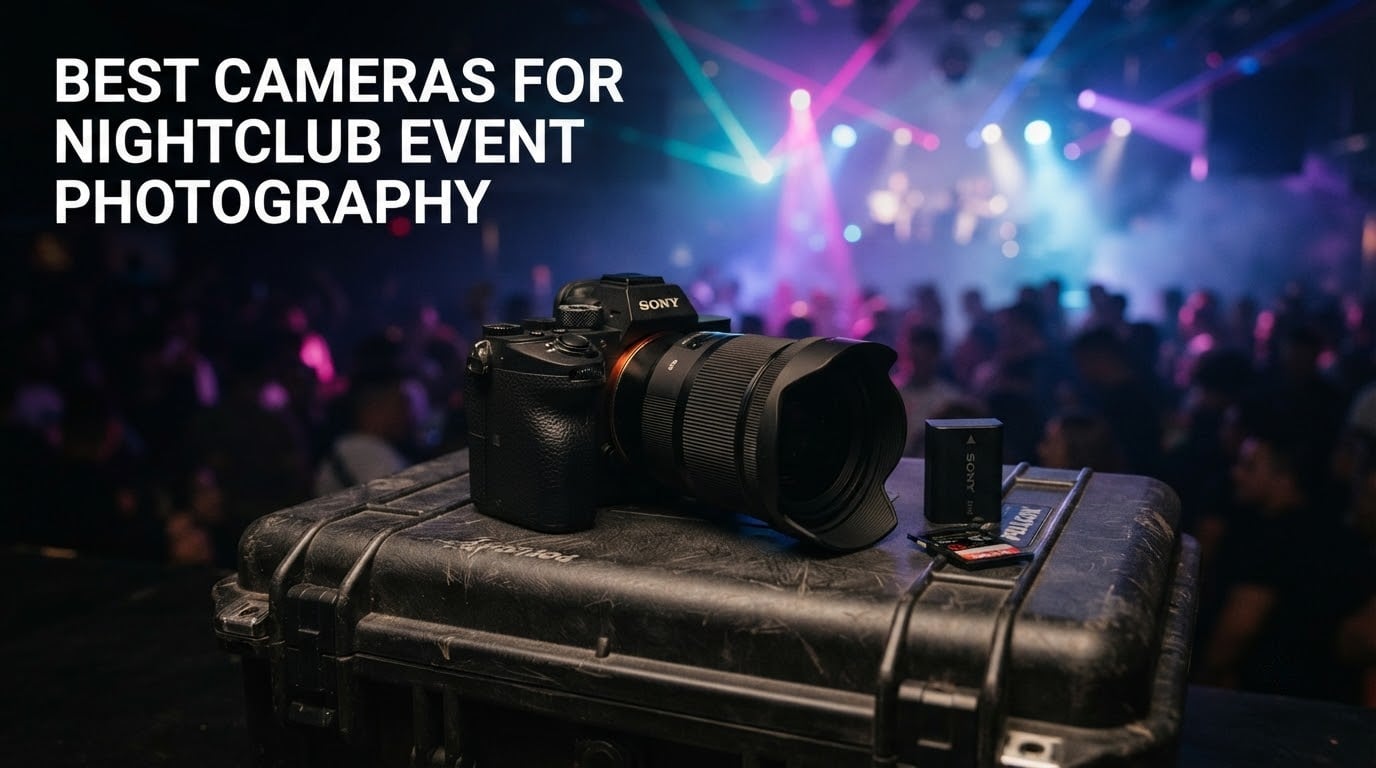
A club at 1 a.m. gives you almost nothing to work with. A colored LED wash on the walls, a mirror ball throwing moving highlights, a strobe firing twice a second, and maybe 200 people packed into a room where the only real light is the rig. The best cameras for nightclub event photography are the ones that keep files clean and faces sharp under exactly those conditions, and after years of shooting receptions, launches and live sets I can tell you exactly which ones do.
My picks below cover the whole range of real jobs. There is a full-frame hybrid for paid four-hour sets, a dedicated low-light body for rooms where you cannot add light, a video-first option for when the client wants motion as well as stills, and three smaller bodies for anyone who is starting out or working alone on a tight budget. Every rating and review count on this page comes straight from the customer data, and I have written the club-specific details that general camera roundups leave out.
If you are just starting out with this kind of work, my event photography guide covers the business side, and this full-frame low-light roundup goes deeper on sensor choice. For anyone shooting in genuinely dark rooms, I also wrote a piece on dark room and nightclub cameras that focuses on how bodies behave when there is no ambient light at all.
One thing worth saying up front: in a club, the lens matters more than the body. A 50mm f/1.8 on any of the cameras below will outperform a slow kit zoom on a more expensive body, because the aperture decides how much light reaches the sensor before the processor ever gets involved. Read the body lists first, then budget properly for glass.
Top 3 Picks for Best Cameras for Nightclub Event Photography in 2026

Canon EOS R6 Mark II
- 24.2MP full-frame sensor
- 40 fps electronic burst
- Subject detection for people and animals
- 6K oversampled uncropped 4K

Nikon Z 6II
- 24.5MP back-illuminated sensor
- 14 fps with 3.5x larger buffer
- Dual CFexpress and SD card slots
- 5-axis stabilization

Sony Alpha a7 IV
- 33MP full-frame Exmor R sensor
- 759-point hybrid AF with eye detection
- 4K 60p 10-bit 4:2:2
- 5-axis SteadyShot stabilization
The Canon EOS R6 Mark II is the one I reach for when a set is long, the room is dark and the client is paying. The Sony a7 IV is the smarter money move for most shooters, and the Nikon Z 6II wins the dual-card-slot argument that matters on paid assignments.
All 12 Best Cameras for Nightclub Event Photography in October
| Product | Specifications | Action |
|---|---|---|
| Canon EOS R6 Mark II |
|
Check Latest Price |
 Sony Alpha a7S III Sony Alpha a7S III |
|
Check Latest Price |
| Nikon Z 6II |
|
Check Latest Price |
| Sony Alpha a7 IV |
|
Check Latest Price |
 Nikon Z6 III Nikon Z6 III |
|
Check Latest Price |
 Canon EOS RP Canon EOS RP |
|
Check Latest Price |
 Sony Alpha a7C Sony Alpha a7C |
|
Check Latest Price |
 Sony Alpha a6700 Sony Alpha a6700 |
|
Check Latest Price |
 Sony Alpha a6400 Sony Alpha a6400 |
|
Check Latest Price |
 Canon EOS R50 Canon EOS R50 |
|
Check Latest Price |
 Nikon Z50 II Two-Lens Kit Nikon Z50 II Two-Lens Kit |
|
Check Latest Price |
 Sony Alpha a7R III Sony Alpha a7R III |
|
Check Latest Price |
1. Canon EOS R6 Mark II – The Best Camera for Nightclub Event Photography Overall
Canon EOS R6 Mark II Mirrorless Camera (Body Only), Full-Frame Camera, 24.2 Megapixel CMOS Sensor, Photo and Video Capabilities, Black
Pros
- Very clean low-light files from the full-frame sensor
- Fast head face eye and body detection
- 40 fps electronic burst for fleeting expressions
- Long 6K recording with effective heat management
Cons
- No mechanical shutter so the sensor is exposed during lens changes
- Single SD UHS-II card slot
- Body only so a lens must be bought separately
When I need one body for a whole night, this is the camera. The 24.2MP full-frame sensor holds together at high ISO in a way that lets me push ISO 3200 without hesitating and only climb toward 6400 when the rig drops away. Reviewers consistently describe the files as clean, which is the single most important word for this job.
The subject detection is what earns its place on paid work. Head, face, eye and body detection means I can set the camera to track a person walking toward me in near-darkness and let the system hold them, rather than fighting focus manually while a DJ is blocking half the frame. The 40 fps electronic burst gives me 40 chances at an expression that lasted a quarter of a second.

Video is a genuine strength rather than a checkbox here. The 6K oversampled uncropped 4K up to 60 fps means a B-roll cut of a DJ booth looks native rather than soft, and reviewers specifically praise the heat management that keeps long recordings from shutting down mid-set. The 3.69M dot OLED viewfinder refreshing at 120 fps is bright enough to frame a dark room without guessing.
There are real trade-offs, and the review data is clear about them. There is no mechanical shutter, so the sensor is exposed during lens changes, which matters if someone bumps you. The single SD UHS-II slot means no overflow and no backup, and recording uncropped 4K at 60 fps needs a fast high-capacity card. This is the body-only configuration, so plan on buying a fast prime separately.
Why it handles a club better than most
The combination of a low-noise full-frame sensor and reliable person detection is what stops the two classic club failures. You avoid the soft, grainy frame at ISO 6400 that no edit can rescue, and you avoid the missed focus when a subject crosses a strobe-lit wall. Neither problem is fixable in software, so solving them in hardware is worth a lot over a long set.
The bright viewfinder matters more here than on a daylight shoot. In a dark room your eyes are already adapted, and a dim finder makes framing a coin toss. A fast prime on this body also gives you the shallow depth of field that separates a working shot from a snapshot of a crowd.
Where it will disappoint you
The single card slot is my main complaint for paid assignments. If a card fails at hour three of a reception, the assignment is gone, and dual-slot bodies exist precisely for that reason. The missing mechanical shutter is a minor nuisance but shows up in crowded rooms where a jostled shoulder can swing the lens mount.
At 40 fps electronic you also get rolling-shutter distortion on fast lateral movement, and the body is not the lightest thing you can carry on a long night. If you need true dual-card redundancy, look at the Nikon Z 6II instead.
2. Sony Alpha a7S III – The Best Camera When the Room Is Genuinely Black
Pros
- Exceptional low-light performance with clean files at very high ISO
- Autofocus that holds subjects through crowded scenes
- Excellent heat management with no shutdowns
- Full-frame 4K up to 120p in 10-bit 4:2:2
Cons
- 12.1MP leaves little room for heavy cropping or large prints
- Expensive memory cards needed for the highest frame rates
- Bundled software is weak so third-party tools are often required
When a venue has almost no ambient light and the only illumination is a single moving head, this is the body I trust. The 12.1MP sensor uses very large pixels, which is exactly the physics that matters here: bigger pixels gather more light and produce less noise at the same ISO. In a room this dark, resolution is a distant priority behind a clean file.
Professional reviewers and owners both treat it as the reference for low-light and event work, citing clean high-ISO output, dependable autofocus through crowds and heat management that holds up in harsh conditions. The 759-point Fast Hybrid AF has been the part I have leaned on most in dark rooms, where contrast is low and phase detection has little to work with.
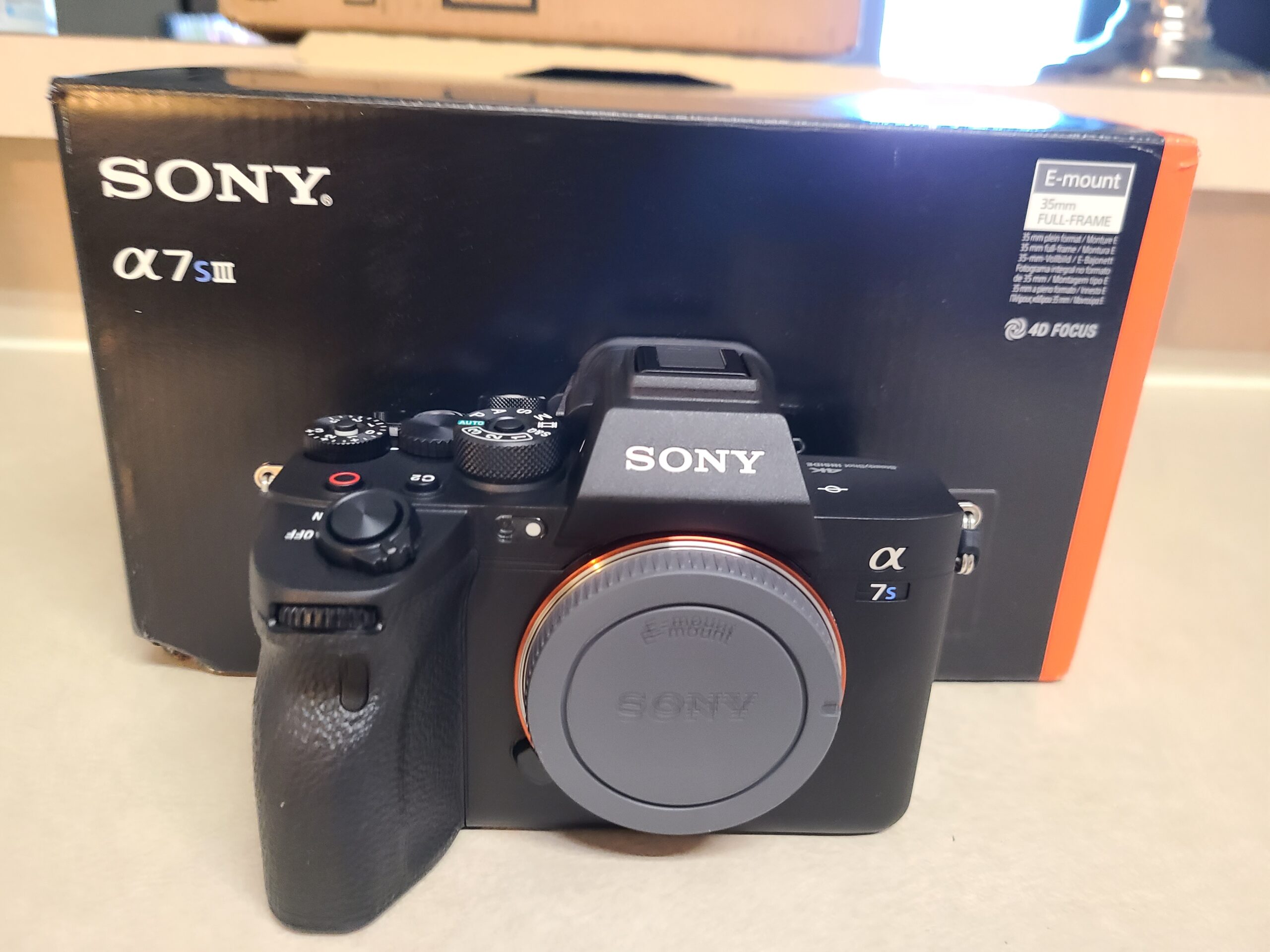
The video side is extraordinary. Full-frame 4K up to 120p in 10-bit 4:2:2 with full pixel readout in all recording modes means a club B-roll reel can be graded properly, and the S-Cinetone profile gives a filmic look without a heavy grade. ISO goes to 409600 with more than 15 stops of dynamic range, which covers a strobe hitting a white wall while the rest of the room stays black.
The recurring complaint is resolution, and it is a fair one. At 12.1MP you cannot crop hard to rescue a frame from a distant corner of a packed floor, and large prints from this sensor stay modest. Reviewers also note that the highest 120p frame rates demand fast V90 cards, and that the bundled software is weak enough that most owners edit with third-party tools.
Where its large pixels pay off
A club strobe is a brutal test for a sensor. It goes from full black to blown highlight in a fraction of a second, and anything shot in between is deep shadow. The wide dynamic range listed for this body is what lets you hold detail in a face that was lit for half a second while keeping the highlight on a mirror ball from clipping.
For silent work, the 5-axis SteadyShot INSIDE stabilization also means I can hold frames together at shutter speeds far slower than I would dare with a stills-focused body, which matters in a room where flash is not permitted.
Who should skip it
Skip it if you deliver large prints or if your clients expect heavy cropping of wide crowd shots. Twelve megapixels is a working resolution, not a fine-art one, and no amount of noise reduction changes that ceiling.
It also carries a high cost relative to the resolution on offer, so the money buys sensitivity rather than detail. If your club sets are lit enough that a standard full-frame sensor keeps up, the extra spend buys you headroom you may never touch.
3. Nikon Z 6II – The Best Nightclub Camera When a Card Failure Would Cost You the Job
Nikon Z 6II | Versatile Full-Frame mirrorless Stills/Video Hybrid Camera | Nikon USA Model
Pros
- Strong low-light performance with low noise at high ISO
- 14 fps burst with a much deeper buffer than earlier Z bodies
- Dual card slots add real redundancy for assignment work
- Excellent out-of-camera JPEG rendering
Cons
- Subject tracking can lose subjects more readily than some competing systems
- Tilting screen does not fully rotate forward for self-recording
- No dust protection shutter on the sensor
The dual card slots are why I put this body on paid assignments. One CFexpress Type B or XQD card and one UHS-II SD card means I can write simultaneously to both, so a four-hour reception does not end with one dead card and a lost night. Very few bodies in this price range give you that insurance.
The 24.5MP back-illuminated sensor delivers low noise at high ISO, and owners specifically single out low-light quality as a strength. At 14 fps with a buffer 3.5 times larger than the original Z 6, I can hold a long burst through a whole dance-floor sequence instead of watching the buffer fill after two seconds.

Two further details matter for this work. The 5-axis sensor-shift vibration reduction stabilizes both stills and video handheld, which is most of what you have to work with in a dark room. And USB-C constant power and charging means the body can run for the length of a set if you have a power bank in the bag.
The honest limitation is subject tracking. Reviewers note that tracking can lose a subject more readily than some competing systems, and in a club where a moving person crosses a strobe-lit wall, that is a real cost. The tilting screen also does not rotate fully forward, so it is not a vlogging body, and there is no dust protection shutter when you change lenses in a hazy, crowded room.

Why the buffer depth matters on a dance floor
A club moment is not repeatable. If the bracket is right but the buffer emptied three frames early, the sequence is gone. A deep buffer lets me fire through a whole run of a DJ dropping a track and still have frames left for the reaction afterward, which is the shot the client actually remembers.
The back-illuminated sensor also reads out efficiently, so ISO 3200 files come back with more usable detail than an older-generation full-frame at the same setting. That headroom is what buys you the option of shooting 1/200s at f/1.8 rather than dropping your shutter speed into motion blur.
Where it falls short
Tracking reliability is the honest weak point. If your set is mostly fast, erratic movement in heavy haze, test the AF thoroughly before you rely on it, and consider a body with stronger subject recognition.
Reviewers also point out there is no S-Line 70-200mm f/4, leaving a gap in the f/4 lens lineup, and the single battery style means packing spares for a long set. Budget for three batteries rather than two.
4. Sony Alpha a7 IV – The Best Value Full-Frame Body for Event Work
Pros
- Excellent 33MP detail and dynamic range in difficult lighting
- Reliable real-time eye autofocus for people and animals
- Full-frame 4K 60p 10-bit 4:2:2 with no pixel binning
- Dual card slots for backup or overflow
Cons
- Heavier than compact APS-C options
- 4K 60p uses a crop rather than full sensor readout
- Menu system is dense and takes time to master
This is the body I recommend to shooters who want one camera to cover a whole evening of stills and video. The 33MP Exmor R back-illuminated full-frame sensor gives detail and dynamic range in exactly the mixed-lighting conditions a club creates, and the dual card slots mean one slot takes CFexpress Type A while the second takes UHS-II SD for backup or overflow.
Reviewers describe it as a mature, dependable hybrid, and the combination that stands out is 33MP stills with full-frame 4K 60p 10-bit 4:2:2 and no pixel binning. That means a single pass through a set can produce both gallery stills and a graded B-roll cut, which is increasingly what clients actually pay for.

The 759-point Fast Hybrid AF with Real-time Eye AF holds a face in a colored wash, and the BIONZ XR engine has the processing headroom to keep noise down as you climb. The 5-axis SteadyShot system helps both handheld stills and video, and the S-Cinetone profile gives a filmic look straight out of camera.
The trade-offs are familiar. At roughly a kilogram with a lens, it is heavier than the compact options, and reviewers note the 4K 60p mode uses a crop rather than a full sensor readout. The menu system is dense enough that it takes real time to master, which is awkward when you are setting up in a dark room and need to change something fast.
Why the resolution is worth it for a working photographer
A club set is unpredictable. The frame you need may be at the far edge of a packed floor, and 33MP gives you the option to crop in and still have a usable file. The wide dynamic range listed for this sensor is what lets you hold both a colored LED wall and a lit face in the same exposure.
Dual slots also solve a problem most club shooters hit on a long night: one card filling up. You can send video to the fast card and stills to the second, or mirror everything for insurance.
Where the weight and menus bite
Over a four-hour set, the weight adds up fast, especially on a floor where you are moving constantly and cannot put the bag down. It is a trade I accept for the dual slots, but a photographer working alone should weigh it.
The menu depth is a real adjustment period. If you are switching settings repeatedly in near-darkness, learn a custom mode and a couple of shortcuts before the first paid set rather than during it.
5. Nikon Z6 III – The Best Camera for Video B-Roll and Run-and-Gun Event Coverage
Nikon Z6 III, Black | Full-Frame Mirrorless Stills/Video Camera with 6K/60p Internal RAW Recording | USA Model
Pros
- Excellent low-light image and video quality from the 24.5MP sensor
- Very fast shutter and burst with minimal rolling shutter
- 6K 60p internal RAW plus line-in audio
- Exceptionally bright and detailed 4000 nit viewfinder
Cons
- Deep and complicated menu system with many AF modes
- Awkward button and dial placement in the grip
- Autofocus can be finicky in dark conditions
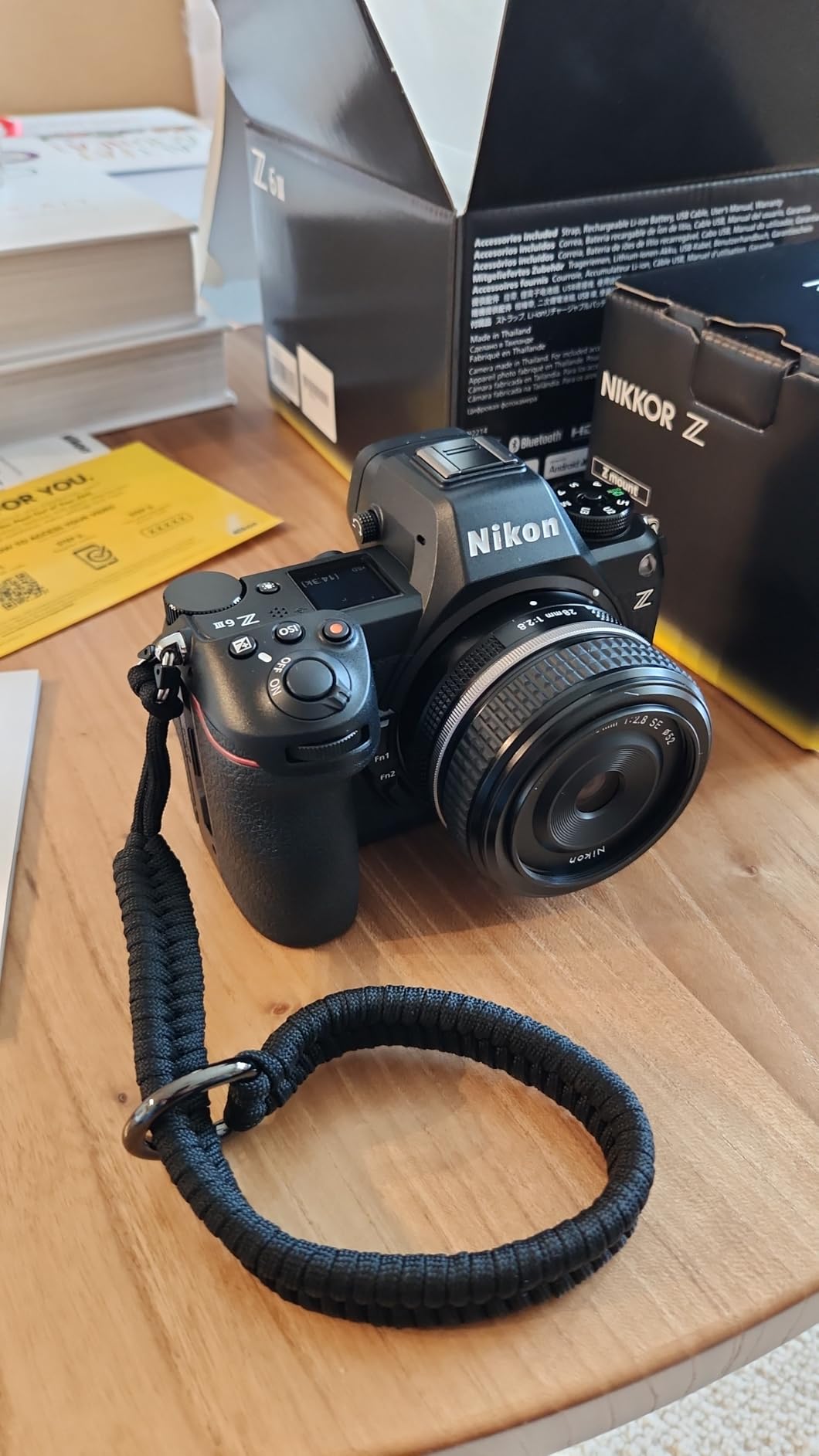
If the same set needs to deliver motion and stills, this is the most capable body here. The partially stacked 24.5MP sensor records 6K at 60p internally in N-RAW, plus oversampled 4K UHD, 4K at 120p and 1080p at 240p. For a club, that means you can grab slow-motion footage of a strobe hit without leaving the venue for a second camera.
Users report this as the best hybrid under this price point, with class-leading low-light quality and genuine internal RAW where earlier bodies fell short. Reviewers also praise the 5760k dot viewfinder at up to 4000 nits with a 120 fps refresh, which is the brightest finder in this group and a genuine help when framing a black room.
Subject detection runs down to -10 EV with multi-subject recognition, roughly 20 percent faster than the Z6II, and the ISO range covers 100 to 64000 expandable to 204800 equivalent. Hi-Res Zoom gives up to 2x during HD and 1.4x during 4K, and line-in audio with professional monitoring tools means you can record a club set with real timecode.
The negatives are specific and worth weighing. The menu system is deep and complicated with many autofocus modes to master, which is a poor match for someone new to event work. Button and dial placement is awkward, especially the front dial inside the grip. And several reviewers note autofocus can be finicky in dark conditions, so test it yourself before committing.
Why the bright viewfinder changes club work
Dark-adapted eyes plus a dim finder is a losing combination. A finder rated to 4000 nits keeps a black room framed and focusable, so you are not raising ISO by eye on a dim preview. That single feature removes a lot of the guesswork that comes with blind shooting in a pitch-black room.
The sealed body also runs cool in hot conditions, which matters in a small, packed, poorly ventilated room where a warm sensor is more likely to throttle.
Where it frustrates people
The controls are the biggest complaint. An awkward grip dial and a deep menu tree cost you time at the start of a set, and forum discussions about dark-room shooting repeatedly come back to the difficulty of changing settings when you cannot see the screen.
The 4.5 rating with 210 reviews also reflects a smaller review base than the established bodies here, so treat the feedback as less settled. Pair it with a fast prime and you have a very strong run-and-gun kit.
6. Canon EOS RP – The Best Entry Point Into Full-Frame Nightclub Work
Canon EOS RP Full-Frame Mirrorless Interchangeable Lens Camera + RF24-105mm Lens F4-7.1 is STM Lens Kit, Compact and Lightweight for Traveling and Vlogging, Black (3380C132)
Pros
- Full-frame image quality and better low-light results than APS-C
- Very light and compact body comfortable for all-day carry
- Included 24-105mm covers wide to short telephoto with stabilization
- Owners report high ISO output with little visible grain
Cons
- No in-body image stabilization on the body
- No mechanical shutter so sensor is exposed during lens changes
- 4K is cropped with Dual Pixel AF disabled and capped at 24 fps
The RP is the cheapest practical way into full-frame, and that matters in a club because sensor size is the single biggest factor in how usable your high-ISO files are. Reviewers consistently frame it that way, praising the sensor, the low-light improvement over crop bodies and the light weight for a full-frame camera.
You also get the RF 24-105mm f/4-7.1 IS STM, which covers wide angle through short telephoto with up to 5 stops of stabilization. That is a genuine advantage for event work, because you can cover a room without swapping glass in a dark corner. The 4779-point Dual Pixel CMOS AF system is broad, and the vari-angle touchscreen helps with low angles on a packed floor.
Owners report high ISO output with little visible grain, which lines up with what a club demands. At 5 fps the burst is slow for a dance floor, but candid frames are rarely missed-timing on a moving person, so the slow rate hurts less here than it would at a concert.
The limitations are documented clearly by reviewers. There is no in-body image stabilization on the body, so stabilization depends entirely on the lens. There is no mechanical shutter, which means the sensor stays exposed during lens changes and rapid bursts. And 4K is cropped with Dual Pixel AF disabled and capped at 24 fps, so this is not a hybrid video body in any meaningful sense.

Why this kit makes sense for a first paid season
The included stabilized zoom means you can walk into a first venue and cover the whole room without buying a second lens. For a shooter who does not yet know which focal lengths they use, that flexibility is worth more than a stop of aperture.
At 16 ounces it disappears in a bag all day, and the bright electronic viewfinder with a useful flip-out screen helps in a room with no ambient light. Reviewers note high ISO results with little visible grain, which is the spec that actually decides club frames.
Where the compromises show
Without in-body stabilization, you are fully dependent on a stabilized lens. Once you add a fast prime without IS, you will find yourself at slower shutter speeds, so factor in the lens cost for low-light work.
The community consensus, echoed repeatedly in reviews, is to save up toward a higher-tier body once you outgrow this one. The crop on 4K and the missing mechanical shutter also rule it out if video is a deliverable. If you shoot larger events, our corporate and conference roundup covers better options for that work.
7. Sony Alpha a7C – The Best Full-Frame Camera for Moving Unnoticed on a Club Floor
Pros
- Exceptionally small and light full-frame body for discreet mobile shooting
- 4K video with full pixel readout and no crop
- 15 stops of dynamic range and wide ISO latitude
- Reliable eye-detection autofocus covering 93% of the frame
Cons
- Single memory card slot with no redundancy
- Modest 0.59x viewfinder magnification makes framing harder
- Bundled zoom has a slow maximum aperture for low-light work
Discreet work is a real skill in a club, and a small body makes it easier. Reviewers consistently praise this as the smallest and lightest full-frame body while still delivering 4K full-readout video, wide dynamic range and dependable eye autofocus, which makes it a natural fit for run-and-gun coverage.
The 24.2MP back-illuminated sensor lists 15 stops of dynamic range and an ISO range from 50 to 204800. Dynamic range is the number that earns its keep in a club, where a strobe can blow out a white wall while a face stays in deep shadow, and 14-bit uncompressed RAW gives you the latitude to recover both.
Autofocus uses 693 phase-detection and 425 contrast points covering 93% of the frame, with reliable eye detection, and 10 fps covers candid bursts. The included 28-60mm f/4-5.6 zoom covers everyday wide to short tele framing, though its slow maximum aperture is not what you want in a dark room.
The reservations in reviews are about the small things. A single memory card slot means no redundancy, which is a problem on paid work. The 0.59x viewfinder magnification is modest enough that framing and manual focus are harder, and 10 fps is restrained for fast action. The bundled zoom’s slow aperture also means most owners replace it quickly for low-light work.

Why small matters on a crowded floor
A large body at chest height announces you, and in some rooms that changes how people behave. A small full-frame body is easier to carry for four hours, easier to angle from a low position, and less likely to knock a drink over. The wide ISO latitude means you can still shoot at high ISO with a fast prime without touching the exposure.
Full pixel readout 4K with no binning or crop also means this is a genuine hybrid for a small body, which is rare in a camera this size.
Where the compromises bite
The single slot is the deal-breaker for paid assignments. If you are covering an event for someone else, a body with dual slots and the speed to write to both is worth the extra weight.
The small viewfinder is a real constraint in a pitch-black room where you are framing by feel. And the slow bundled zoom means you will be buying glass anyway, so count that cost before deciding.
8. Sony Alpha a6700 – The Best APS-C Camera for Tracking People in Colored Light
Pros
- Very reliable AI-driven subject tracking that rarely misses the target
- Sharp detailed images with good dynamic range and low noise
- Full-width 4K 60p 10-bit 4:2:2 without a crop
- Compact light body that fits an everyday bag
Cons
- Can overheat during long 4K 60p recordings in hot conditions
- Single memory card slot with no redundancy for paid work
- High ISO output trails full-frame at the same price class
The reason this body appears in a low-light guide is its tracking. The dedicated AI processor drives real-time recognition, and reviewers call it one of the most reliable subject tracking systems available, with owners reporting it rarely misses the intended target. In a club where the light is changing every second, holding a person reliably is worth more than a stop of image quality.
The 26MP Exmor R back-illuminated APS-C sensor is sharp with good dynamic range and low noise in tough lighting, and the 759-point hybrid AF includes face and eye detection. At 11 fps it covers candid bursts, and the 5-axis sensor-shift stabilization helps with handheld stills and video.
Video is a genuine strength. Full-width 4K 60p in 10-bit 4:2:2 with no crop, plus 4K at 120p, means a single body covers stills and graded B-roll. Reviewers also praise the build quality and battery life for the class, and the body is light enough for an everyday bag at 14.5 ounces.
The cons are honest. It can overheat during long 4K 60p recordings in hot conditions and switch off, which matters in a packed, poorly ventilated room. There is a single card slot, so no redundancy for paid work. And high ISO and low-light output still trail full-frame bodies at the same price class, which is the fundamental limit of the sensor size.

Why tracking beats resolution in a crowd
A missed focus is unrecoverable. A slightly soft crop from 26MP is something you can live with, but an out-of-focus frame of a brief expression is gone. AI-based recognition lets you compose a little and let the camera hold the person, which is exactly the workflow a club floor demands.
Low noise in tough lighting also means you are not forced to denoise heavily, and reviewers are clear that heavy noise reduction smears detail that cannot be brought back.
Where the APS-C limit shows
At high ISO, the APS-C sensor simply gathers less light than a full-frame of the same generation. In a room lit only by a colored wash, that difference shows in the files, not just in the spec sheet.
The overheating behavior during extended high-frame-rate recording and the single card slot are the two practical limits to plan around. Bring spare batteries and a second card, and check on the body periodically during a long set.
9. Sony Alpha a6400 – The Best Affordable Camera With Dependable Eye Autofocus
Sony Alpha a6400 Mirrorless Camera: Compact APS-C Interchangeable Lens Digital Camera with Real-Time Eye Auto Focus, 4K Video, Flip Screen & 16-50mm Lens – E Mount Compatible – ILCE-6400L/B, Black
Pros
- Well-regarded real-time eye autofocus for people and animals
- Compact travel-friendly body with a tilting 180 degree screen
- Solid 4K video and 11 fps burst for the class
- Large Sony E mount lens ecosystem
Cons
- Older-generation sensor with lower high-ISO output
- Single UHS-I memory card slot limits backup and overflow
- Bundled 16-50mm power zoom has a modest maximum aperture
- No in-body image stabilization
This body has been on the market long enough to develop a large reviewer base, and reviewers consistently treat it as a capable compact hybrid with dependable eye autofocus and good 4K video. Roughly 83 percent of its reviews are 5-star, which tells you the core experience is solid rather than polarising.
Real-time Eye AF for people and animals is the feature that carries it into club work. On a dark dance floor, being able to lock an eye and hold it through a turn is what separates a usable frame from a missed moment, and this system does that reliably according to owners.
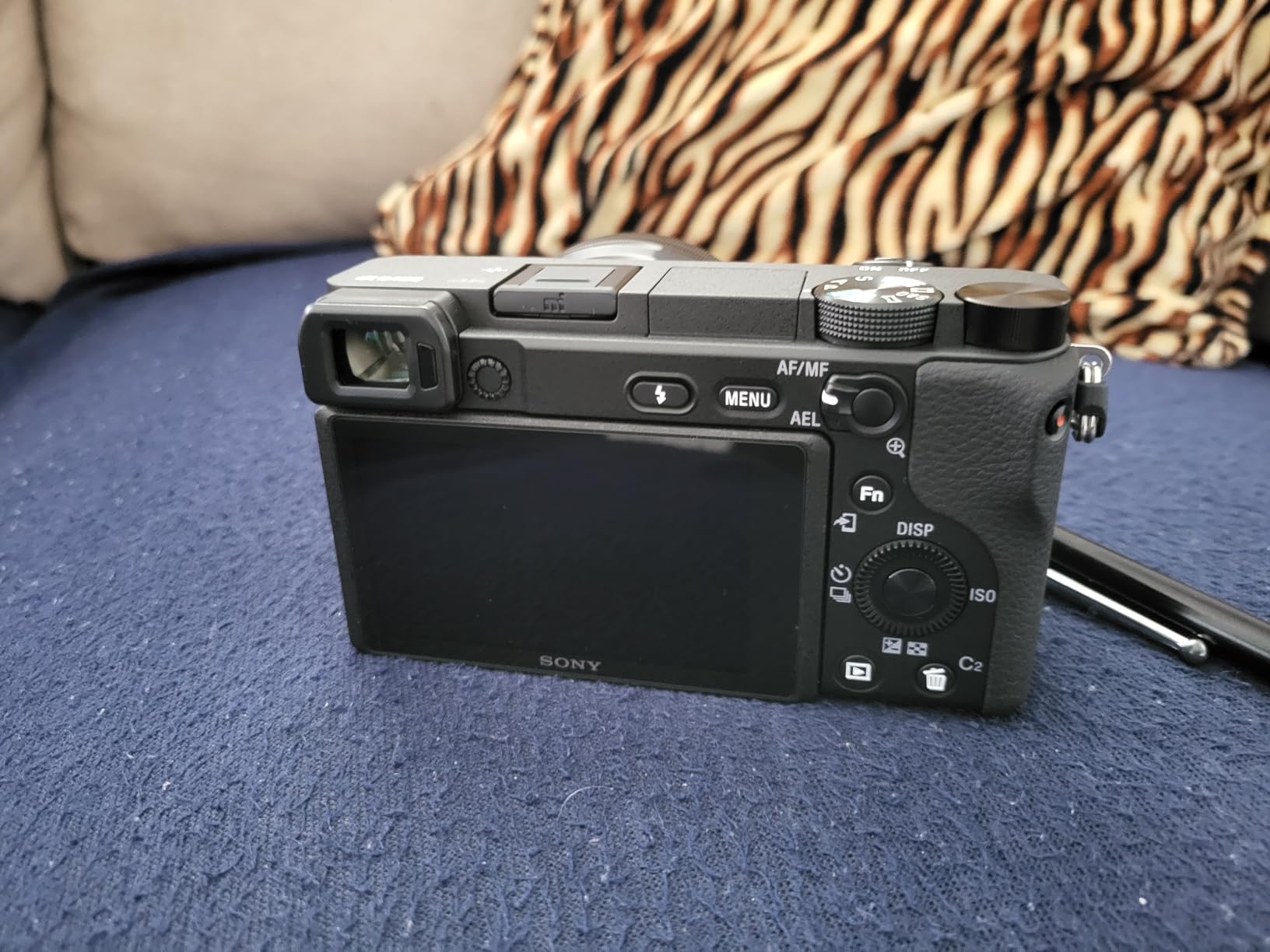
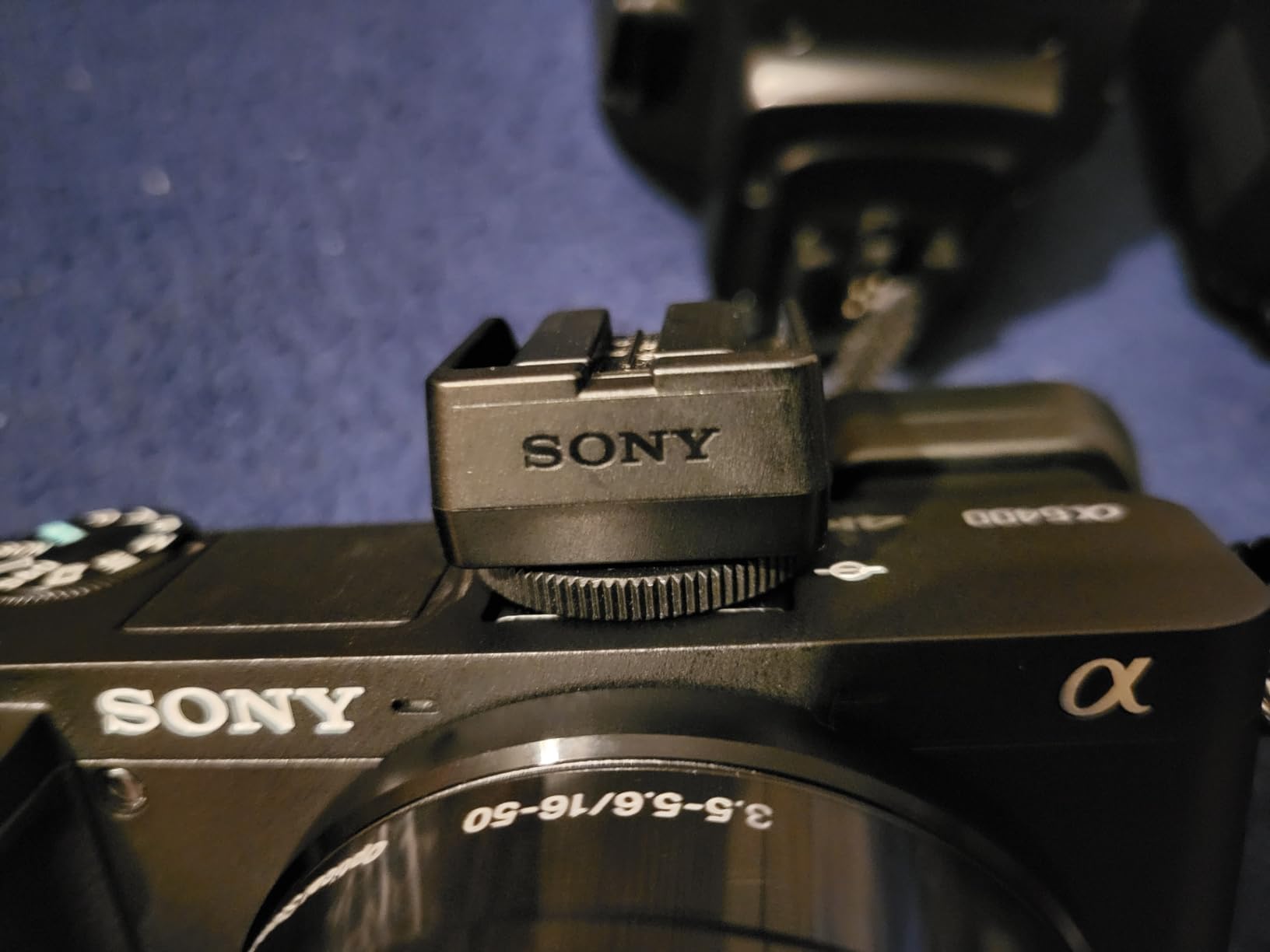
At 10.3 ounces with a 180-degree tilting screen, it disappears in a bag, and the tilting screen helps with low and awkward angles on a packed floor. The 425 phase-detection points cover 84% of the frame, and 11 fps is enough for candid bursts. The Sony E mount ecosystem also means a huge range of fast primes is available for low-light work.
The limits are clear from the review data. It is an older-generation sensor with lower high-ISO output than newer bodies, and in a dark club that is exactly the spec you feel. The single UHS-I slot limits backup and overflow, the bundled 16-50mm power zoom has a modest maximum aperture, and there is no in-body image stabilization.
Why eye autofocus carries this body
Low light reduces contrast, and contrast-based focusing struggles first. A phase-detection system with a trained recognition model can still find an eye when the wall behind it is nearly black, which is the normal state of a club. That is why the eye AF matters more here than the megapixel count.
The lens ecosystem is the quiet advantage. A fast prime on this mount is easy to find, and the mount will accept older lenses through an adapter, so you are not locked into buying new glass to work in a dark room.
Where it shows its age
The sensor is the limit. Lower high-ISO output means you push further before a file is usable, and in a room lit by a single colored source, that difference is visible. If your sets are genuinely dark, spend up for a full-frame body.
No in-body stabilization and a slow bundled zoom mean the kit as sold is not a low-light kit. Adding a fast prime is the single change that transforms it.
10. Canon EOS R50 – The Best Camera for a First-Time Nightclub Shooter
Canon EOS R50 Mirrorless Camera RF-S18-45mm F4.5-6.3 is STM Lens Kit, 24.2 Megapixel CMOS (APS-C) Sensor, 4K Video, Hybrid Camera, Photo and Video, Vlogging, Content Creator, RF Mount, White
Pros
- Very light and compact body that is easy to carry all day
- Fast accurate autofocus with people animal and vehicle detection
- Sharp 24.2MP image quality well beyond its class
- Smooth phone connectivity for transfer and remote control
Cons
- Small grip feels cramped for users with larger hands
- Bundled 18-45mm kit lens is average
- Weak low-light performance relative to full-frame bodies
- Small battery capacity for long sessions
With 1621 reviews, this is the most thoroughly owner-tested body in the list, and that makes its strengths and faults unusually well documented. Owners call it compact, lightweight and easy to learn, with genuinely good autofocus and image quality for a starter body, and roughly 80 percent of reviews are 5-star.
The Dual Pixel CMOS AF II system uses 651 zones covering 100% of the frame, with subject detection for people, animals and vehicles. At up to 12 fps with the electronic first curtain shutter and 15 fps with the electronic shutter, it will happily fire through a candid sequence on a packed floor.

Video is better than the price suggests, with 6K oversampled uncropped 4K up to 30 fps and 1080p up to 120 fps. Bluetooth and Wi-Fi with the Canon Camera Connect app make file transfer and remote control smooth, which matters if you are posting a set the same night.
The documented gripes are consistent. The small grip feels cramped for users with larger hands, and a cage or grip extension helps. The bundled 18-45mm kit lens is regarded as average, and reviewers suggest buying the body only. Low-light performance is weak relative to full-frame bodies, which is the honest limit for a club. And the small battery capacity means carrying spares for long sessions.

Why this is a sensible first club body
The 24.2MP sensor is sharp well beyond what this class usually delivers, so images do not look soft even when you push them. Full-frame AF coverage and subject detection mean you are not fighting the camera to hold a face, which matters more for a beginner than any single spec.
The combination of a small body, simple controls and full manual access means you can start on automatic and learn the exposure triangle as you go. The phone app removes the friction of getting files off the camera at the end of a night.
Where a club will frustrate you
Low light is the honest wall. Reviewers name it directly as a weakness relative to full-frame, and a 1/200s at f/1.8 exposure in a dark room forces ISO high enough that this sensor will show it. Treat it as a training body, not a paid-assignment body.
Buy it body only and put the money into a fast prime. The kit lens at f/4.5-6.3 is the wrong tool for this work, and swapping it changes what the camera can do in a dark room more than any other single purchase.
11. Nikon Z50 II Two-Lens Kit – The Best All-in-One Package for Covering a Whole Venue
Nikon Z50 II with Two Lenses | Compact mirrorless Stills/Video Camera with Easy Color presets and Wireless Photo Sharing | USA Model
Pros
- Two stabilized NIKKOR DX lenses cover wide angle through telephoto
- Compact lightweight APS-C body that fits a small bag
- Built-in flash and Night Portrait mode help in dim indoor settings
- 31 Picture Control presets make color work fast
Cons
- 5 fps burst rate is slow for fast-moving subjects
- Both bundled lenses have slow maximum apertures
- APS-C sensor gathers less light than full-frame options
- Single SD card slot with no backup
This kit is about coverage rather than peak performance. You get the NIKKOR Z DX 16-50mm f/3.5-6.3 VR and 50-250mm f/4.5-6.3 VR, both stabilized, covering wide angle through telephoto. For a shooter covering a whole venue in one pass, that range means no lens changes in a dark corner.
The built-in pop-up flash with Night Portrait mode is unusual in this class and genuinely useful in dim indoor settings, though many venues will not allow flash at all. The 31 built-in Picture Control presets with real-time preview make color work fast, and custom profiles can be downloaded from Nikon Imaging Cloud.

Autofocus detects nine subject types with dedicated bird and airplane modes, which is more than you need in a club but shows the depth of the system. Video covers 4K UHD at 60p and Full HD 120p slow motion with in-camera electronic VR, and SnapBridge handles wireless transfer.
The limitations are consistent. At 5 fps the burst is slow for fast-moving subjects, both bundled lenses have slow maximum apertures that limit low-light capability, and the DX sensor gathers less light than full-frame. The single SD slot means no backup, and at 2.4 pounds for the kit it is not the lightest thing on the floor.

Why a two-lens package fits venue work
Venue constraints are real. Limited shooting positions, blocked sightlines and no room to set gear down all push you toward a wider zoom range you can change quickly, and both included lenses are stabilized. Having a 250mm reach lets you isolate a guest across a packed room without moving into a restricted area.
The Picture Control presets are a quiet time-saver. Matching color across two lenses in a mixed rig is otherwise fiddly, and presets with real-time preview shorten that setup.
Where it will let you down
Five frames per second is the number to notice. A DJ dropping a track or a guest jumping onto a table is a split-second moment, and 5 fps gives you very few chances at it.
Both lenses are slow, so in a dark room you will be pushing ISO on a small sensor with slow glass, which is the least favorable combination available. If your sets are dark, buy one fast prime and use this as a wide and tele coverage kit rather than a low-light kit.
12. Sony Alpha a7R III – The Best Camera for Heavy Cropping of Distant Club Moments
Pros
- Very sharp autofocus that locks on quickly and recognizes eyes
- 42.4MP resolution captures fine detail like fabric texture
- Strong low-light performance even with fast f/2.8 glass
- Intuitive controls with extensive customizable buttons
Cons
- Older body design compared with current-generation models
- No subject-recognition AI of newer bodies
- Menu options differ between the original a7R III and the ILCE-7RM3A revision
The 42.4MP sensor is the reason this body is on a club list. When the only available shooting position is across the room and the moment is a guest three people deep in a crowd, resolution is a form of insurance. You can crop hard and still deliver a usable frame.
Owners highlight fast eye-aware autofocus that locks on quickly, 42MP detail, and strong low-light results when paired with fast lenses, with several noting it remains relevant years on. The ISO range of 50 to 102400 and 14-bit uncompressed RAW give plenty of latitude for mixed club lighting.

At 10 fps with AE and AF tracking it keeps up with a moving subject, and the 5-axis IBIS helps with handheld stills and video in a room with no ambient light. The 2.36 million dot tilting LCD is bright enough to review frames on the floor of a dark room.
The honest caveats are age. Reviewers note an older body design compared with current models, no subject-recognition AI of newer bodies, and menu differences between the original a7R III and the ILCE-7RM3A revision that can confuse buyers. The smaller review base of 126 also means less long-term owner data than the models above it.

When cropping headroom is the deciding factor
Cropping solves a physical problem. In a club you often cannot get closer, so a high-resolution sensor is how you simulate getting closer. The fine detail listed for this body, down to fabric texture and eyelashes, survives a crop that would destroy a 24MP file.
Reviewers also note strong low-light performance even with f/2.8 glass, which is a narrower aperture than most club shooters prefer. Pair it with a fast prime and the high resolution stops being a stills-only feature.
Why older-generation AF gives me pause
No subject-recognition AI means you are relying on older tracking behavior in exactly the conditions where tracking matters most. Forum discussion about dark-room work repeatedly raises the question of whether a current-generation AF system holds a subject in dim, colored light, and that is a reasonable concern here.
If you buy this, budget for a fast prime and a battery. If your sets are heavily reliant on tracking rather than cropping, one of the newer bodies will serve you better.
Club Lighting and Flash Rules That Decide Your Night
Most camera roundups stop at the body. In a nightclub, the lighting and the rules around flash decide whether your set works, so here is what actually happens on a club floor and how each of the cameras above responds.
Colored LED wash and moving rig light
Club lighting is rarely white. A colored LED wash across a room means your white balance is set to whatever the rig happens to be doing at that moment, and it can change every eight bars. Shooting RAW is the practical answer, because it lets you pull a frame back toward a believable skin tone later instead of committing to a mixed color cast in the moment.
A colored cast is also what makes autofocus struggle. Phase detection relies on contrast, and a flat magenta wall has none, so bodies with stronger person-detection AI hold on better in that light. This is the single biggest practical difference between the newer bodies in this list and the older ones.
How the exposure triangle plays out in a club
The club exposure triangle is fixed by physics. In a dark room you need a fast aperture, a shutter speed fast enough to freeze movement, and then whatever ISO is left over. At 1/200s and f/1.8 in typical dim venue light, photographers commonly land in the ISO 3200 to 6400 range as a working baseline, and push higher under a strobe hold.
That range is where the bodies separate. Shooters working in bars and clubs describe ISO 3200 as a normal working setting and ISO 6400 as something to experiment with, which tells you where the usable ceiling needs to sit for your own workflow. A body that is clean at 6400 gives you the freedom to keep 1/200s; a body that is not pushes you toward 1/125s and into motion blur.
Whether you can use flash at a nightclub
Many venues ban or restrict flash, and photographers regularly have to reason about it in advance rather than at the door. Ask the venue before the set, and where flash is not allowed, your only option is the available light, which is why the low-light behavior of the body matters more than any flash-related feature.
Where flash is allowed, off-camera is almost always the better choice indoors. On-camera flash in a dark room puts a hard, direct highlight on the nearest face and blows out the background; moving the light off-axis softens it. That said, flash etiquette is a venue conversation first and a technical one second.
Framing and focusing in a pitch-black room
Blind shooting is a real club problem. With no ambient light, a dim electronic viewfinder leaves you framing by guesswork, which is why a finder rated well above 4000 nits, like the one in the Nikon Z6 III, is a practical advantage rather than a spec-sheet nicety.
Shoot wide open, raise ISO until the file is acceptable rather than the shutter speed, and accept some grain. Forum shooters consistently rate usable high-ISO noise as a bigger deal than absolute resolution, and accept AI noise reduction only as a last resort at the highest settings because it smears detail that cannot be recovered.
How to Choose a Camera for Nightclub and Event Photography
Seven factors decide this purchase, and they matter in this order. Start at the top and work down, and you will end up with a body that fits the room rather than the marketing page.
1. Usable ISO beats everything else
Usable ISO is the ISO at which you can still deliver a file to a client, not the marketing ceiling printed on the spec sheet. The Sony a7S III lists ISO up to 409600 and the Nikon Z6 III expands to 204800 equivalent, but the number that matters is where the files stop being acceptable.
For club work, look for a body with large full-frame pixels and clean output at ISO 3200 to 6400. A 24MP full-frame body with large pixels will beat a 45MP body with small pixels in almost every dark frame.
2. Autofocus in dim, colored light
Person and eye detection that works in near-darkness is worth more than resolution, because a missed focus is unrecoverable while a soft crop is not. Bodies with dedicated AI processors, such as the Sony a6700, the Sony a7 IV and the Canon EOS R6 Mark II, are the ones to favor for a dance floor.
Watch the tracking behavior in colored light specifically, not just in a dim room. Forum discussion of dark-room work keeps returning to whether a current-generation AF system holds a subject reliably in low light, so test before you commit to paid assignments.
3. Dual card slots for paid work
If someone else is paying, redundancy is not optional. The Nikon Z 6II, Sony a7 IV and Sony a7S III give you two slots so you can mirror your files or separate video and stills. A single-slot body is fine for your own sets and a gamble on someone else’s.
4. Stabilization for slow shutter speeds
With no flash permitted, you are often forced to slow the shutter. In-body stabilization lets you hold a frame together at speeds you would never dare handheld, which is the difference between a sharp candids and a soft one. The Canon EOS R6 Mark II, Sony a7 IV, Sony a6700, Nikon Z 6II and Sony a7C all have in-body stabilization.
5. Video capability if the job includes motion
More clients want a moving cut from the same coverage. The Sony a7 IV records full-frame 4K 60p in 10-bit 4:2:2 with no binning, the Nikon Z6 III records 6K at 60p internally in N-RAW, and the Canon EOS R6 Mark II offers 6K oversampled uncropped 4K with long recording capability.
Be honest about whether you need it. The Canon EOS RP has cropped 4K with autofocus disabled, which rules it out as a hybrid body no matter how good the stills are.
6. Battery, cards and heat
A four-hour set is roughly 1200 frames an hour with room to spare, and screens, autofocus and video all draw power. Reviewers across this list repeatedly flag small battery capacity as a real limit, so pack at least three batteries and a USB-C power bank for bodies that support constant power delivery.
Heat is the other half. A packed, poorly ventilated room runs warm, and reviewers report bodies shutting off during long high-frame-rate recordings. Check the camera periodically rather than assuming it is fine.
7. Lens ecosystem and glass budget
Leave room in the budget for glass. A 50mm f/1.8 or 35mm f/1.8 on any of these bodies will outperform a slow kit zoom on a more expensive body, because aperture decides how much light arrives before the sensor does. The bundled lenses on most of the cheaper bodies here are not low-light tools.
Check that the mount you are buying into has fast primes you can actually get. All three major mounts covered here do, which is one reason the format survives club work.
Frequently Asked Questions
Which camera is best for low light photography?
For nightclub work, a full-frame body with large pixels that stays clean at ISO 3200 to 6400 is the priority. The Sony Alpha a7S III is built specifically around sensitivity, and the Canon EOS R6 Mark II is the strongest all-round choice for long paid sets.
What is the best camera for event photography?
The Canon EOS R6 Mark II is the best all-round event body in this list, with a low-noise full-frame sensor, 40 fps electronic burst and person detection that holds a face in a dark room. Shooters who need dual card slots for redundancy should look at the Nikon Z 6II.
Do I need full frame for nightclub photography?
Not strictly, but full frame gathers more light at the same ISO and setting, which is the difference between a usable file and a soft one in a room lit only by a rig. A crop body with a fast lens can work in brighter venues, but a genuinely dark room favors full frame.
What ISO do I need for nightclub photography?
At a 1/200s shutter speed and f/1.8 in dim venue light, most photographers land around ISO 3200 to 6400 as a working range, and push higher when a rig drops away. Choose a body that stays clean at those settings rather than one with a high maximum ISO on paper.
Can I use flash at a nightclub?
Many venues ban or restrict flash, so ask before the set rather than at the door. Where flash is allowed, off-camera light gives softer results indoors than on-camera flash, which puts a hard highlight on the nearest face and blows out the background.
Is silent shutter safe in a dark club?
It is safe to use, but the electronic shutter can distort fast lateral movement and some bodies have no mechanical shutter at all, which leaves the sensor exposed during lens changes. That matters in a crowded room where a jostled shoulder can swing the lens mount.
Should I shoot RAW at a nightclub?
Yes. Club lighting is rarely white and can change every few minutes, so RAW lets you pull a frame back toward believable skin tone later instead of committing to a mixed color cast in the moment. It also gives you more latitude to recover detail from deep shadow.
What is the best camera for filming events?
The Sony Alpha a7 IV records full-frame 4K 60p in 10-bit 4:2:2 with no pixel binning, and the Nikon Z6 III adds 6K at 60p internal N-RAW with line-in audio. Both handle stills and video from the same coverage, which is what most clients now ask for.
The Best Cameras for Nightclub Event Photography in 2026
The Canon EOS R6 Mark II is the pick. A low-noise full-frame sensor, a 40 fps electronic burst and person detection that holds a face in a near-black room make it the body I trust for a four-hour paid set, and the 6K oversampled uncropped 4K covers the motion cut clients increasingly expect. Its single card slot is the one compromise, and it is worth checking whether your work justifies a dual-slot alternative.
The Sony a7S III wins when the room is genuinely black and you are not delivering large prints. The Nikon Z 6II wins on redundancy and buffer depth, and the Sony a7 IV is the value choice that covers stills and video from a single pass. Below those, the Canon EOS RP and Sony a7C are sensible full-frame entries, and the Sony a6700, Sony a6400, Canon EOS R50 and Nikon Z50 II kit cover the lighter and cheaper end of the market.
Whatever you choose, buy one fast prime before you buy anything else. The best cameras for nightclub event photography are only as good as the light you let them gather, and a 1/200s at f/1.8 exposure is where this work lives. Check the current details for any of these bodies using the links above, and if you want more on the vertical, my nightclub and event party guide covers the wider setup in more detail.