
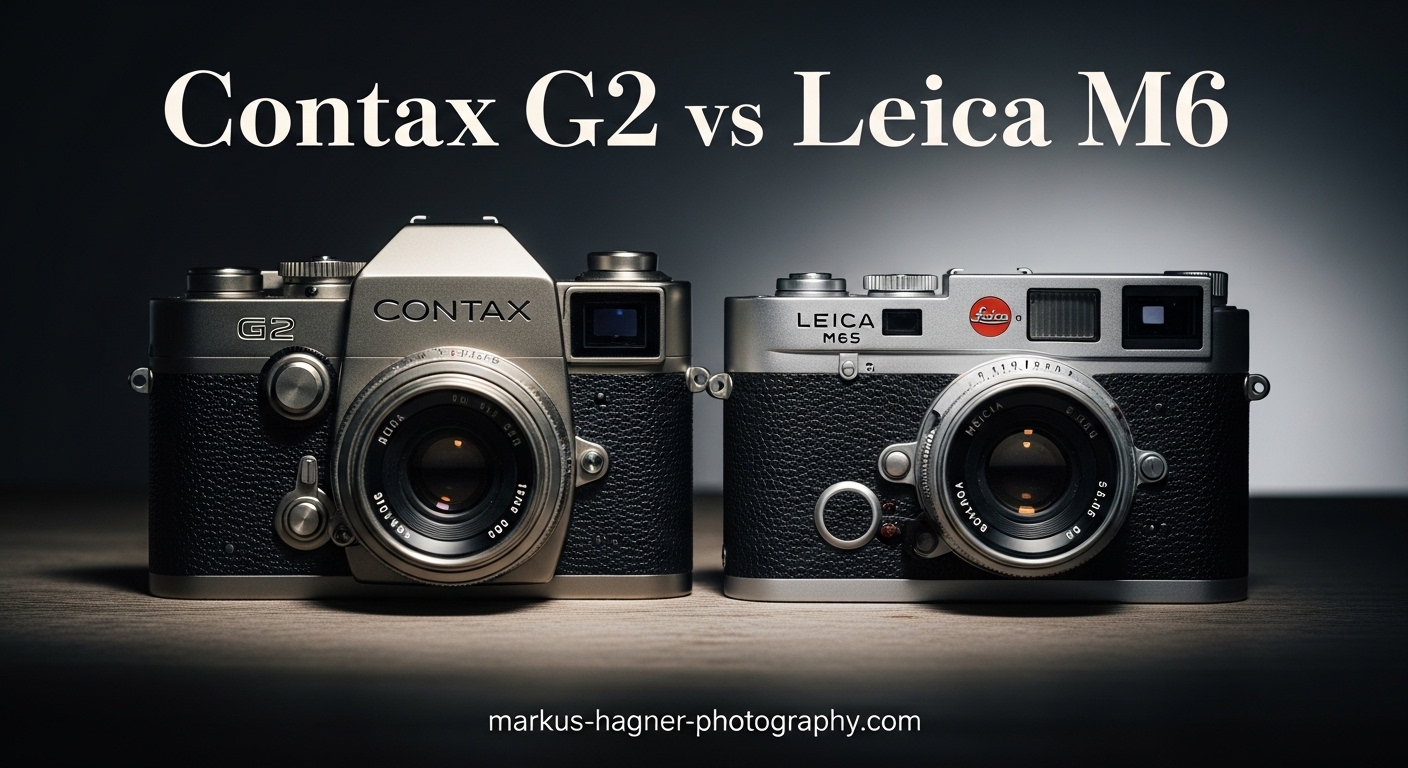
When photographers debate the ultimate 35mm rangefinder experience, the Contax G2 vs Leica M6 comparison inevitably surfaces. These two cameras represent fundamentally different approaches to film photography excellence, and choosing between them shapes your entire shooting experience.
The Contax G2 emerged in 1996 as a technological tour de force, packing autofocus, motorized film advance, and electronic controls into a titanium body designed by Porsche Design. The Leica M6, born in 1984 and reborn in 2022, embodies the pure mechanical ethos that has defined rangefinder photography for generations.
I have spent considerable time shooting both systems extensively, and the choice between them often comes down to a single question: do you prioritize shooting speed and convenience, or tactile mechanical control? The G2 offers autofocus and automation that feels surprisingly modern even by 2026 standards. The M6 delivers an uninterrupted connection between photographer and subject that no electronic camera can replicate.
Here is my quick verdict after months of real-world testing: the Leica M6 wins for photographers who value mechanical purity, lens ecosystem depth, and long-term value retention. The Contax G2 triumphs for those wanting autofocus convenience, exceptional Zeiss optics at a lower system cost, and faster handling for candid work.
Both cameras have passionate advocates, and the internet forums are filled with photographers who have switched between systems multiple times. The reality is that both are exceptional tools that produce outstanding results. Your preference depends entirely on how you like to shoot.
Let me break down exactly how these two legends compare across every metric that matters, from build quality and handling to lens ecosystems and long-term ownership costs.
Contax G2 vs Leica M6: Quick Comparison
| Product | Specifications | Action |
|---|---|---|
 Contax G2 Camera Body
|
|
Check Latest Price |
 Leica M6 Rangefinder Camera
|
|
Check Latest Price |
This table highlights the fundamental difference between these cameras. The Contax G2 relies on electronics for nearly everything: autofocus, film transport, and exposure control. The Leica M6 needs no batteries for its core functions, using mechanical precision that has proven itself over four decades of professional use.
The specification differences tell only part of the story. What matters more is how these cameras feel in use, how they handle in challenging conditions, and what the long-term ownership experience looks like. I will explore each of these aspects in depth.
Contax G2: The Autofocus Rangefinder Revolution
Pros
- Fast autofocus system
- Exceptional Zeiss lens quality
- Compact design
- Build quality excellence
- Continuous shooting mode
Cons
- Manual focus is awkward
- Autofocus can be noisy
- Repair concerns
- Battery dependent
Picking up a Contax G2 for the first time feels unlike any other rangefinder experience. The camera does not behave like a traditional rangefinder because, in many ways, it is not one. Kyocera designed the G2 as a technological statement, proving that autofocus and electronic controls could coexist with the rangefinder form factor.
The titanium body feels substantial in hand, weighing 662 grams with a quality that reflects its premium positioning. Every control falls naturally under your fingers, though the manual focus wheel on the back takes some adjustment if you are coming from traditional lens-barrel focusing. The grip is surprisingly comfortable for extended shooting sessions.
What immediately struck me was the speed of operation. The G2 powers on instantly, the autofocus snaps into position with surprising accuracy, and the motor drive advances film faster than you can wind a mechanical lever. For street photography where moments vanish in seconds, this responsiveness matters enormously.
The shooting experience feels more like using a modern digital camera than a film camera from the 1990s. Point, focus, shoot. The camera handles the mechanical tasks that would normally require your attention. This frees you to concentrate on composition and timing.
The Autofocus System: Phase Detection Meets Infrared
The Contax G2 uses a dual autofocus system combining phase detection with infrared triangulation. This hybrid approach allows the camera to focus in conditions where either system alone might struggle. The technology was genuinely innovative when introduced and remains effective today.
In practice, I found autofocus accuracy to be around 85-90% in good light, though backlit situations occasionally produced misses. The system works best with subjects that have clear contrast or vertical lines. Low-light focusing slows noticeably but remains usable down to EV 1 or so.
Close focus capability is a genuine advantage over traditional rangefinders. The G2 can focus down to 0.5 meters with normal and wide lenses, compared to the Leica M6’s 0.7 meter minimum. For environmental portraits and detail work, this extra close-focus range opens creative possibilities that traditional rangefinders cannot match.
The trade-off becomes apparent in manual focus situations. There is no rangefinder patch to align, no visual confirmation of focus lock. You turn a wheel on the camera body while watching a distance display in the viewfinder. It works, but it removes the tactile pleasure of focusing a traditional lens barrel.
For photographers who primarily use autofocus, this limitation rarely matters. But if you enjoy the deliberate process of manual focusing, the G2’s system feels clinical and disconnected compared to a traditional rangefinder.
The Viewfinder Experience
The G2 viewfinder generates more debate than any other aspect of this camera. It is an electronic viewfinder that displays frame lines and focus information on an LCD overlay. Some photographers describe it as tunnel-like or disconnected compared to the bright, optical viewfinder of traditional rangefinders.
In my experience, the viewfinder works well for composition but lacks the clarity and brightness of the Leica M6’s optical system. You see what you need to see, but there is less joy in the viewing experience. The display can appear grainy in low light, which some photographers find distracting.
The parallax correction is automatic, which is convenient. The frame lines adjust electronically as you focus closer, showing you exactly what will appear in the frame. This is technically superior to mechanical parallax correction, but some photographers miss the visual feedback of watching frame lines physically shift.
The viewfinder magnification changes automatically with different lenses, which is a sophisticated feature. Mount the 90mm lens and the viewfinder zooms to show appropriate framing. This works seamlessly and is one of the G2’s genuine innovations.
After extended use, I adapted to the viewfinder’s characteristics. It is functional and accurate, even if it lacks the optical purity that makes traditional rangefinders special. Whether this matters depends entirely on your priorities.
Zeiss G-Mount Lens Ecosystem
The Carl Zeiss T* lenses designed for the G-mount system are genuinely exceptional. The lineup includes the Biogon 21mm f/2.8, Biogon 28mm f/2.8, Planar 45mm f/2, Sonnar 90mm f/2.8, and the rare Hologon 16mm f/8. Each lens renders with the characteristic Zeiss signature: sharp, contrasty, with wonderful color rendition.
Many photographers argue that these Zeiss lenses equal or exceed their Leica M-mount equivalents in optical quality. I have compared images from both systems extensively, and the differences are subtle but real. The Zeiss lenses may have slightly more micro-contrast and pop, while Leica lenses often render transitions more smoothly.
The 45mm f/2 Planar deserves special mention. This lens is often cited as one of the finest normal lenses ever produced for any system. Images have a three-dimensional quality that immediately identifies them as coming from exceptional glass. If you buy a G2, this lens should be your first addition.
The practical advantage is cost. A complete Contax G2 system with multiple lenses often costs less than a Leica M6 body alone. For photographers wanting world-class optics without Leica pricing, the G2 system offers remarkable value that becomes harder to ignore as Leica prices continue climbing.
The limitation is ecosystem depth. Only five native lenses exist, and no new lenses will ever be produced. The system is complete but closed. For most photographers, five excellent lenses cover 95% of needs, but the lack of expansion options is worth considering.
Build Quality and Repairability
The Contax G2’s titanium construction feels indestructible, but the electronic complexity creates long-term concerns. Kyocera discontinued Contax in 2005, meaning no factory service exists. Internet forums are filled with warnings about unrepairable G2 cameras, and this reputation affects resale values.
The reality is more nuanced. Specialist repair shops like Nippon Photoclinic can service G2 cameras for many common issues. These technicians have developed expertise with the system and maintain stocks of salvaged parts. The key is finding a specialist who understands these cameras specifically.
Common failure points include the shutter gear mechanism and LCD displays. The shutter gears can strip over time, causing frame spacing issues or complete failure. LCD displays may develop leaks or fade, making the viewfinder difficult to use. These repairs are possible but not inexpensive.
My advice: buy from sellers who can demonstrate all functions working, and budget for potential service costs in your purchase decision. A G2 in good working order can provide years of reliable service, but the repair risk is real and should factor into your decision.
The electronic dependency also means the camera cannot function without batteries. Dead batteries render the G2 completely inoperable, which matters for travel, cold weather shooting, or extended trips where battery availability is uncertain.
Despite these concerns, I have found the G2 reliable in regular use. The key is buying carefully from reputable sellers and having realistic expectations about long-term serviceability.
Real-World Shooting Experience
For street photography, travel, and any situation demanding speed, the Contax G2 delivers capabilities that traditional rangefinders cannot match. The autofocus snaps into place quickly enough for candid work. The motor drive advances film quietly enough not to attract attention. The compact size makes the camera unobtrusive.
I particularly enjoy the G2 for travel photography. The automation reduces the mental load of shooting, allowing me to concentrate on finding compositions and capturing moments. Loading film is straightforward, and the motorized rewind saves time at the end of each roll.
The continuous shooting mode, while not fast by modern standards, allows you to capture action sequences that would be impossible with a manual-advance camera. This capability expands the range of subjects you can photograph effectively.
Aperture priority exposure works well for most situations. The meter is accurate and consistent, producing properly exposed negatives with minimal effort. Exposure compensation is easily accessible when you need to override the camera’s decisions.
After months of regular use, the G2 has become my go-to camera when I want to travel light and shoot quickly without sacrificing image quality. The Zeiss lenses deliver results that rival any system I have used.
Leica M6: The Mechanical Rangefinder Standard
Leica M6 Rangefinder 35mm Fully Mechanical Operation Camera (10557) + Bag + Cleaning Kit
Pros
- Legendary mechanical design
- No batteries required for core functions
- Exceptional build quality
- Vast M-mount lens ecosystem
- Holds value extremely well
Cons
- Very high price point
- Manual focus learning curve
- Minimum 0.7m focus distance
- Requires external meter for accurate exposure
Holding a Leica M6 connects you to a lineage stretching back to the original Leica M3 of 1954. The current production M6, reintroduced in 2022, maintains the core design while incorporating subtle improvements. This is not a retro reissue but a continuation of a camera that never really went away.
The weight feels different from the G2. At 3.24 pounds with the included kit, the M6 has a density that speaks to its solid brass top plate and mechanical precision. The film advance lever requires deliberate effort. The shutter fires with a distinctive snap that photographers recognize instantly. Every interaction reinforces that this is a tool built for decades of service.
What surprised me most when I first used an M6 was how quickly the manual operation becomes intuitive. Loading film, setting exposure, focusing through the rangefinder patch. Each step requires attention but slows you down in a productive way. You think more carefully about each frame because every frame requires deliberate action.
The tactile experience cannot be overstated. The film advance lever clicks into position with precision. The shutter speed dial rotates with just the right resistance. The focus ring on a good M-mount lens has a silky smoothness that makes focusing pleasurable. These sensations matter to photographers who value the craft of image-making.
The Rangefinder Focusing System
The Leica M6 uses a traditional optical rangefinder with a focusing patch in the center of the viewfinder. You align two images by rotating the lens focus ring, and when they merge, your subject is in focus. This system sounds archaic compared to autofocus, but it offers unique advantages that keep photographers loyal to the rangefinder design.
First, the focusing is always accurate when properly calibrated. No autofocus system hunts or misses because you control the focus directly. The rangefinder patch shows you exactly where focus lies, and your eye becomes the final arbiter of sharpness.
Second, you can see focus and composition simultaneously, unlike SLR cameras where focus screens can be dim or inaccurate. The rangefinder patch appears directly in the viewing area, allowing you to compose and focus in a single glance.
Third, the system works in any light where you can see the subject. Autofocus systems struggle in low contrast situations, but the rangefinder works as long as you can visually identify your subject. This low-light capability matters for available-light photographers.
The learning curve is real and should not be underestimated. Expect to miss shots while developing muscle memory. Your first few rolls will likely contain out-of-focus images as you learn the technique. This frustration is normal and temporary.
Zone focusing becomes essential for street photography. By pre-setting focus distance and aperture, you create a zone of acceptable sharpness that makes the camera effectively point-and-shoot for subjects within that range. A 35mm lens at f/8 focused at 2 meters keeps everything from 1.5 to 3 meters reasonably sharp.
Once mastered, rangefinder focusing connects you to the image in a way autofocus never will. You become an active participant in the focusing process rather than a passive observer waiting for confirmation.
The Viewfinder and Frame Lines
The 0.72x brightline viewfinder remains the gold standard for rangefinder photography. Frame lines for 28mm, 35mm, 50mm, 75mm, and 90mm lenses appear automatically when you mount a lens. The viewfinder is bright, clear, and shows more than 100% frame coverage to help you see subjects entering the frame.
The optical quality of this viewfinder sets it apart from every competitor. You see the actual scene with minimal distortion, bright frame lines overlaid for composition. The rangefinder patch appears as a slightly different color, making it easy to identify while remaining unobtrusive.
Parallax correction is mechanical and visible. As you focus closer, the frame lines move to indicate the actual image area. This visual feedback helps you understand exactly what the final image will include, something the G2’s electronic display cannot replicate with the same immediacy.
The 0.72x magnification represents a compromise that works well for most photographers. It accommodates 28mm lenses while still providing enough magnification for accurate focusing with 90mm lenses. Photographers who primarily use wider or longer lenses might prefer different magnifications, but 0.72x handles the most common focal lengths effectively.
Looking through the M6 viewfinder after using the G2 reminds me why traditional rangefinders maintain such loyal followings. The optical clarity and brightness make composition a pleasure rather than a technical exercise.
The M-Mount Lens Ecosystem
No discussion of the Leica M6 is complete without acknowledging the M-mount lens ecosystem. This mount has been in continuous production since 1953, meaning you can mount lenses from seven decades of optical development. Leica, Voigtlander, Zeiss, and other manufacturers produce M-mount lenses ranging from 12mm ultra-wides to 135mm telephotos.
The variety available is staggering. You can choose from vintage Leica lenses with distinctive character, modern Leica lenses with cutting-edge coatings, Japanese alternatives from Voigtlander and Zeiss, or even specialized lenses from smaller manufacturers. This ecosystem depth exceeds anything available for the Contax G-mount system.
The pre-owned market offers remarkable variety at various price points. A 1960s Leica Summicron performs beautifully on a modern M6, often delivering images with a character that modern lenses cannot replicate. Third-party options from Cosina-Voigtlander provide excellent quality at accessible prices.
Resale value is another significant consideration. Leica M-mount lenses typically hold their value or appreciate over time. A Summilux purchased today may be worth more in ten years. This makes the system cost more of an investment than an expense. Even if you decide the system is not for you, recovering most of your investment is realistic.
The M-mount also adapts well to digital cameras. Leica M bodies, of course, but also various mirrorless systems through adapters. This versatility extends the useful life of your lens investment beyond film photography.
Mechanical Reliability and Long-Term Ownership
The Leica M6’s fully mechanical shutter operates without batteries. The only battery-powered function is the internal light meter, which uses two LR44 cells readily available anywhere. If the meter fails or batteries die, you can still shoot using an external meter or the sunny 16 rule.
This mechanical independence matters for long expeditions, cold weather shooting, or travel to remote locations. You never worry about battery life or finding replacement cells. The camera works regardless of circumstances.
Long-term ownership stories from the community are remarkable. Many photographers report M6 cameras that have functioned flawlessly for 30 or more years with only occasional service. The mechanical simplicity means fewer failure points and easier repairs when issues do arise.
Leica service remains available for official repairs, and independent technicians can handle most maintenance tasks. CLA (clean, lubricate, adjust) services keep these cameras running smoothly for decades. Parts availability is generally good for common service items.
The mechanical simplicity means fewer failure points. No electronic boards to fail, no LCDs to degrade, no motor gears to strip. This is a camera designed to outlast its owner and potentially be passed to the next generation.
Real-World Shooting Experience
Shooting with the Leica M6 requires a different mindset than using the Contax G2. Every action is deliberate: advancing the film lever, setting the shutter speed, focusing through the rangefinder patch, then finally releasing the shutter. This slower pace encourages more thoughtful composition.
For street photography, I rely heavily on zone focusing. With a 35mm lens set to f/8 and focused at 2 meters, I can capture candid moments without raising the camera to my eye. This technique makes the M6 incredibly discreet once mastered.
The quiet shutter is genuinely quiet, not just quiet for a camera. In quiet environments, people nearby often do not notice when I take a photograph. This stealthiness opens opportunities that louder cameras would preclude.
Travel photography with the M6 feels more engaging. Without automation to handle mechanical tasks, I remain connected to the process throughout each shot. This involvement makes the experience more satisfying, even if it produces fewer images per day.
The camera has proven reliable in various conditions, from hot summer streets to cold winter mornings. The mechanical operation remains consistent regardless of temperature, unlike battery-dependent cameras that struggle in extreme cold.
Contax G2 vs Leica M6: Head-to-Head Comparison
Now let me directly compare these cameras across the factors that matter most for real-world use. Each category below represents a decision point that should influence your choice.
Autofocus vs Manual Focus
The Contax G2’s autofocus system represents its primary advantage. For moving subjects, low-light situations where the rangefinder patch becomes difficult to see, or photographers with vision issues, autofocus removes a significant barrier to accurate focusing.
The G2 focuses quickly and accurately in most conditions. I have captured running children, street scenes with moving subjects, and spontaneous moments that would have been impossible with manual focus. The technology genuinely expands what you can photograph successfully.
The Leica M6 demands manual focus mastery. This slows you down, which can be either a drawback or a benefit depending on your shooting style. Some photographers find the deliberate pace produces better images because each shot receives more consideration.
Zone focusing works excellently for street photography once you learn the technique. Pre-setting focus and aperture creates a zone of acceptable sharpness that makes the camera fast enough for candid work. But this technique requires practice and works best with wider lenses.
Winner: Contax G2 for convenience and speed. Leica M6 for control and satisfaction.
Viewfinder Quality
The Leica M6’s optical viewfinder offers superior clarity and brightness. You see the actual scene with frame lines overlaid. The rangefinder patch provides immediate focus feedback. The viewing experience is immersive and satisfying in a way that electronic displays cannot replicate.
The Contax G2’s viewfinder is functional but less engaging. The LCD overlay displays information clearly but lacks the optical purity of the M6. The display can appear grainy in low light, and some photographers never adapt to the electronic presentation.
That said, the G2’s automatic parallax correction and zooming viewfinder are technically sophisticated features that the M6 lacks. The technology works well; it just lacks the emotional appeal of a bright optical finder.
Winner: Leica M6 decisively.
Lens Ecosystem
The Contax G-mount offers five superb Zeiss lenses covering the most useful focal lengths. Quality is exceptional across the lineup, and prices remain reasonable compared to Leica equivalents. However, the system is closed: no new lenses will ever be produced, and the used market is the only source.
The Leica M-mount offers hundreds of lenses from multiple manufacturers spanning 70 years of development. New options appear regularly from Leica, Voigtlander, Zeiss, and others. Pre-owned lenses hold value well. The ecosystem is vibrant, expanding, and future-proof.
For most photographers, five excellent lenses cover nearly every need. But the M-mount’s depth provides options the G-mount simply cannot match: ultra-wide angles, fast apertures, specialized focal lengths, and price points from budget to astronomical.
Winner: Leica M6 for ecosystem depth and future-proofing.
Build Quality and Durability
Both cameras feature exceptional build quality that justifies their premium positioning. The Contax G2’s titanium body rivals any camera ever made for fit and finish. The materials and assembly quality reflect its original premium pricing.
The Leica M6’s brass construction has proven itself over decades of professional use. The mechanical precision is evident in every control. The camera feels dense and substantial in a way that inspires confidence.
Long-term reliability favors the Leica. Mechanical cameras can be repaired indefinitely with proper parts and expertise. Electronic cameras eventually become unrepairable when specialized components fail. The G2’s repair situation is improving with specialist services, but uncertainty remains.
Winner: Leica M6 for long-term reliability.
Battery Dependency
The Contax G2 requires batteries for every function. Without power, the camera is completely non-functional: no shutter, no film advance, no metering. Battery life is reasonable (several rolls per set), but you must carry spares for extended shoots.
The Leica M6 needs batteries only for the light meter. Without them, you can still focus, set shutter speeds, and fire the shutter. This independence matters for travel, cold weather, and long expeditions where battery availability is uncertain.
In cold weather, the G2’s battery dependency becomes more significant. Low temperatures reduce battery capacity, potentially leaving you with a non-functional camera. The M6 continues working regardless of temperature.
Winner: Leica M6 for operational independence.
Street Photography Performance
Street photographers split between these cameras based on shooting style. The G2’s speed and autofocus excel for capturing fleeting moments. The motor drive advances film silently enough for candid work. The camera handles quickly when speed matters.
The M6’s quiet mechanical shutter and manual operation suit a more deliberate approach. Zone focusing with a 35mm lens at f/8 makes the camera effectively point-and-shoot for distances between 1.5 and 3 meters. The smaller body is less conspicuous.
Both cameras work excellently for street photography, but they encourage different techniques. The G2 rewards quick reactions and capturing the decisive moment. The M6 rewards anticipation and pre-visualization.
Winner: Tie based on shooting style preference.
Value and Resale Considerations
Value is where this comparison becomes complex. The Contax G2 system costs significantly less than Leica M6 equivalents. A G2 body with 28mm, 45mm, and 90mm lenses often sells for less than an M6 body alone. This value proposition is compelling for photographers who want exceptional quality without Leica pricing.
However, Leica equipment holds value better. An M6 purchased today will likely sell for similar or higher prices in five years. The lens ecosystem retains value even better than the bodies. Contax G2 values have stabilized but show less appreciation potential.
Consider the total cost of ownership over time. The G2 may need expensive repairs that the M6 would not. The M6 may need periodic service that adds cost but extends useful life. These factors complicate the value calculation.
Winner: Contax G2 for initial value. Leica M6 for value retention.
Who Should Choose the Contax G2?
The Contax G2 is ideal for photographers who prioritize specific advantages:
Want autofocus convenience without sacrificing rangefinder form factor. The G2 offers speed that manual cameras cannot match, particularly for moving subjects or low-light situations where rangefinder focusing becomes difficult.
Appreciate exceptional Zeiss optics at accessible prices. The G-mount lenses deliver world-class image quality at a fraction of Leica pricing. For photographers who value optical quality above all else, the Zeiss lenses deliver exceptional results.
Prefer automated film handling. The motorized advance and rewind streamline the shooting process, reducing the mechanical steps between shots. This automation allows faster shooting and reduces missed opportunities.
Shoot street photography and want faster reaction times. The autofocus and motor drive help capture moments that might slip past with manual operation. For candid work where timing is critical, the G2 provides advantages.
Are comfortable with electronic dependency and repair uncertainty. Understanding that specialized service may be required is essential for long-term ownership. The G2 rewards photographers who accept these trade-offs for the performance benefits.
Want a complete system at a reasonable total cost. A G2 with multiple lenses costs far less than equivalent Leica equipment while delivering comparable image quality.
Who Should Choose the Leica M6?
The Leica M6 is ideal for photographers who prioritize different values:
Value mechanical purity and tactile shooting experience. Every interaction with the M6 feels deliberate and satisfying. The camera connects you to the photography process in ways electronic cameras cannot replicate.
Want access to the vast M-mount lens ecosystem. Seven decades of lens development offer unmatched variety and quality. The ecosystem continues growing with new options from multiple manufacturers.
Plan for long-term ownership and value retention. Leica equipment typically holds or increases in value over time. Your investment is more recoverable than with most camera purchases.
Appreciate battery independence for core functions. The M6 works without power, making it reliable in any situation. For travel, cold weather, or remote locations, this independence provides peace of mind.
Are willing to invest time mastering manual focus. The learning curve is real, but the rewards are lasting. Once mastered, rangefinder focusing becomes second nature and deeply satisfying.
Want a camera that can be serviced indefinitely. Mechanical simplicity ensures repairability for generations. The M6 is designed to outlast its owner.
Value discretion and quiet operation. The M6’s shutter is genuinely quiet, enabling photography in situations where louder cameras would be inappropriate.
Frequently Asked Questions
What is special about the Contax G2?
The Contax G2 is unique as the only autofocus 35mm rangefinder camera with interchangeable lenses. It combines a dual autofocus system (phase detection and infrared triangulation) with motorized film advance, titanium construction, and exceptional Carl Zeiss T* lenses. The camera offers modern convenience in a classic rangefinder form factor, making it distinct from traditional manual-focus rangefinders.
Is the Contax G2 good for street photography?
Yes, the Contax G2 excels at street photography due to its fast autofocus, motorized film advance, and relatively compact size. The camera responds quickly to capture fleeting moments, and the Zeiss lenses deliver excellent image quality. Some street photographers prefer the quieter, more discreet operation of the Leica M6, but the G2’s speed advantage makes it a strong choice for candid work where timing is critical.
Is the Leica M6 fully mechanical?
Yes, the Leica M6 features a fully mechanical shutter that operates without batteries. The only battery-powered function is the internal light meter, which uses two LR44 cells. If the meter fails or batteries die, you can still focus, set shutter speeds manually, and fire the shutter using an external meter or the sunny 16 rule. This mechanical independence makes the M6 reliable in any situation.
Can the Contax G2 be repaired?
Yes, despite internet rumors, the Contax G2 can be repaired by specialist shops such as Nippon Photoclinic. Kyocera discontinued factory service when they closed the Contax division in 2005, but independent technicians can service common issues including shutter gear problems and LCD displays. Parts availability is limited, so repair costs can be substantial and some problems may be unfixable. Buy from reputable sellers who demonstrate all functions working.
Which camera holds value better: Contax G2 or Leica M6?
The Leica M6 holds value significantly better than the Contax G2. Leica equipment typically appreciates or maintains value over time, while Contax G2 prices have stabilized without significant appreciation. A Leica M6 purchased today will likely sell for similar or higher prices in five years, making it more of an investment than an expense. The M-mount lens ecosystem also retains value exceptionally well, often appreciating over time.
Final Verdict: Contax G2 vs Leica M6
After extensive experience with both systems, here is my honest assessment for the Contax G2 vs Leica M6 decision.
Choose the Leica M6 if you view camera ownership as a long-term relationship. The mechanical design, serviceable construction, and lens ecosystem make it a camera for life. The higher initial cost amortizes over decades of use. You will likely pass this camera to your children.
Choose the Contax G2 if you prioritize shooting convenience and want exceptional Zeiss optics without Leica pricing. The autofocus and motorization make it a more versatile tool for varied shooting situations. The system delivers outstanding results at a lower total investment.
Both cameras deliver the core promise of rangefinder photography: a direct connection between photographer and subject that SLRs and digital cameras cannot replicate. Your choice depends on whether you prefer the modern convenience of the G2 or the mechanical purity of the M6.
The internet forums are filled with photographers who have owned both systems, sometimes switching multiple times. There is no wrong answer here, only different preferences. Rent or borrow both cameras if possible before committing. The right choice becomes obvious once you experience each system.
For my own photography, I keep both. The Leica M6 satisfies my appreciation for mechanical precision and deliberate image-making. The Contax G2 handles situations where speed matters more than process. Together, they cover every shooting scenario I encounter.