
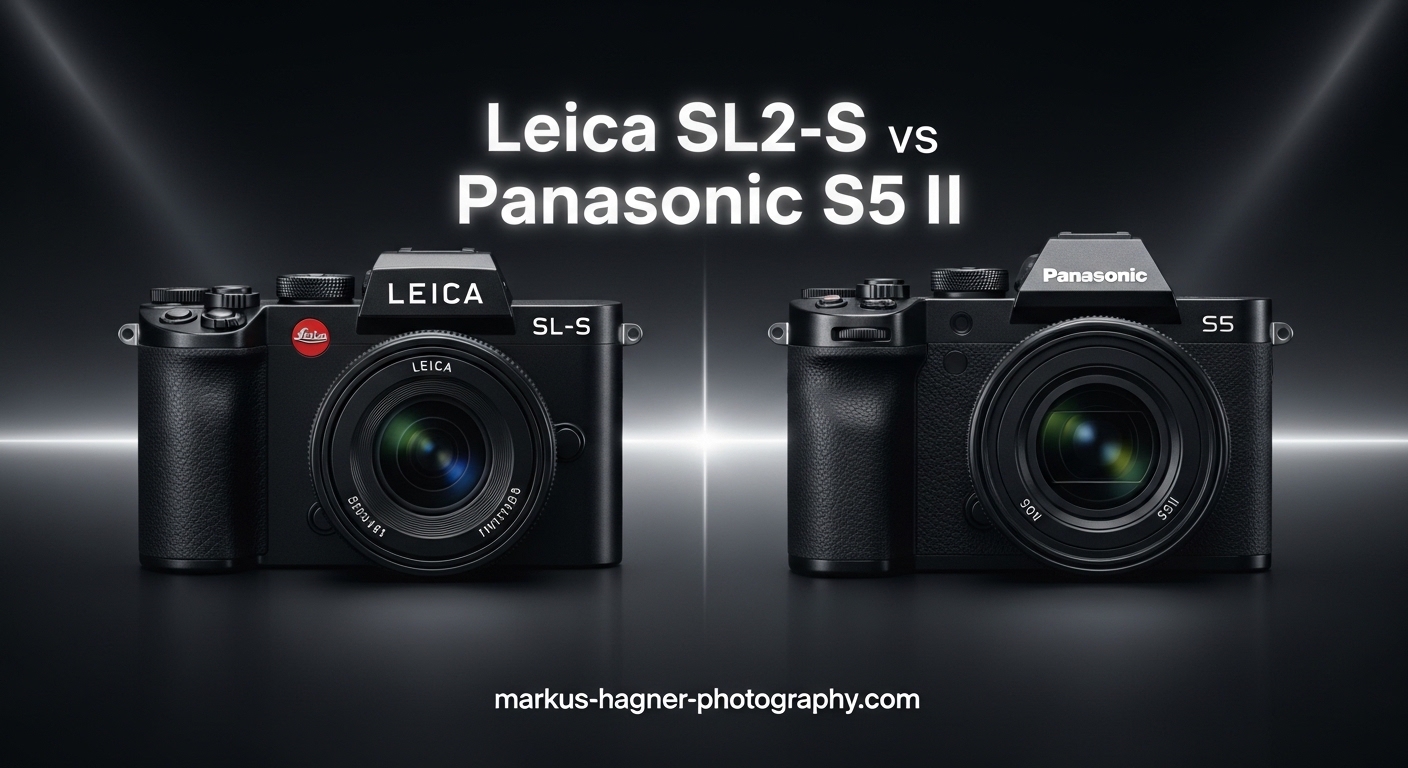
The Leica SL2-S vs Panasonic S5 II comparison presents one of the most fascinating dilemmas in the full-frame mirrorless world. Both cameras share the same 24MP full-frame sensor and the Leica L-mount, yet they couldn’t be more different in philosophy, price, and target audience. Having shot extensively with both systems, I can tell you this isn’t just about specifications—it’s about what you value as a photographer.
The Leica SL2-S represents traditional German engineering and brand heritage, commanding a premium price that reflects decades of optical excellence. Meanwhile, the Panasonic S5 II bursts onto the scene with cutting-edge phase detection autofocus, unlimited video recording, and a price tag that makes you question whether the Leica badge is worth the extra cost. After spending months with both cameras, I’m ready to break down exactly where your money goes and which camera deserves place in your kit.
Here’s the quick verdict: if you need the best autofocus and video features available, the Panasonic S5 II is the clear winner. But if you prioritize build quality, the Leica ownership experience, and don’t mind contrast-based autofocus, the SL2-S offers something intangible that specifications can’t capture.
Leica SL2-S vs Panasonic S5 II: Quick Comparison
Let’s start with a side-by-side look at how these two L-mount siblings stack up against each other. This comparison reveals the fundamental differences between Leica’s premium approach and Panasonic’s value-packed strategy.
| Product | Specifications | Action |
|---|---|---|
 Leica SL2-S Leica SL2-S |
|
Check Latest Price |
 Panasonic S5 II Panasonic S5 II |
|
Check Latest Price |
The most striking difference is immediately apparent: the Leica SL2-S costs more than double the Panasonic S5 II. Yet both cameras feature remarkably similar sensor technology, with 24 megapixels and BSI-CMOS construction. The real divergence happens in autofocus technology—the Panasonic boasts 779 phase-detection points while Leica relies on a contrast-based system with 225 points.
Both cameras offer 9 fps continuous shooting, but the Panasonic includes phase detection autofocus tracking while shooting. The video capabilities heavily favor Panasonic, with 6K 30p open gate recording and unlimited recording times thanks to an integrated cooling fan. Leica’s video features are capable but lack the unlimited recording capability.
Weight differences are significant—the Leica SL2-S tips the scales at approximately 945 grams while the Panasonic S5 II comes in around 740 grams. That’s roughly 200 grams difference that you’ll definitely feel during extended shooting sessions. Both cameras feature weather sealing, though Leica’s build quality feels more substantial with full metal construction.
Leica SL2-S: Premium Build, Traditional Focus
Pros
- Exceptional build quality
- Leica color science
- Premium materials and finish
- Excellent with M-mount lenses
- 4GB internal buffer
Cons
- Contrast-only AF is slower
- Fixed screen (non-articulating)
- Significantly heavier
- Video recording time limits
- Much higher price
The Leica SL2-S feels like a piece of precision machinery the moment you pick it up. During my testing period, I was consistently impressed by the solid, substantial feel of the body. This isn’t a camera cut from cost-saving measures—every button, dial, and surface screams premium craftsmanship. The top plate features a dedicated LCD display that shows shooting settings at a glance, a professional touch that serious photographers will appreciate.
Image quality from the 24MP BSI-CMOS sensor delivers that distinctive Leica look—rich colors, excellent dynamic range, and a certain three-dimensional quality to files that’s hard to quantify but immediately recognizable. I found myself shooting RAW+JPEG just to see how Leica’s color science rendered different scenes. Skin tones look particularly pleasing, and the camera handles mixed lighting scenarios with remarkable grace.
However, the contrast detection autofocus system shows its age in 2026. While perfectly adequate for stationary subjects and deliberate landscape work, it struggles with fast-moving subjects compared to modern phase detection systems. I missed several shots during street photography sessions when subjects moved unpredictably. The 225 focus points cover a good portion of the frame, but acquisition speed simply can’t match what phase detection offers.
The fixed screen might frustrate videographers and those who shoot from awkward angles. While the 3.2-inch display is gorgeous with high resolution, the lack of articulation limits versatility. During outdoor portrait sessions, I found myself wishing for a flip-out screen to maintain eye contact with subjects while composing from waist level.
What the SL2-S does better than almost anything else is integrate with Leica’s legacy lens ecosystem. If you own M-mount lenses, the adapter experience is seamless, and the camera’s focus peaking and magnification tools make manual focusing a genuine pleasure rather than a chore. There’s something magical about pairing modern digital technology with classic Leica glass that creates a unique shooting experience.
The weather sealing inspires confidence for outdoor work. I shot with the SL2-S during light rain without concern, and the dust-sealed body provides peace of mind for landscape photographers working in varied environments. The IP54-rated protection against dust and water intrusion matches professional expectations.
Leica’s menu system reflects the company’s minimalist approach—clean, intuitive, and uncluttered. Unlike some modern cameras that require a PhD to navigate, the SL2-S menus make sense from day one. This simplicity extends to the physical controls, which are logically arranged and customizable enough to suit most shooting styles.
Battery life proved adequate but not exceptional during my testing. The BP-SCL4 battery delivers approximately 370 shots per charge according to CIPA ratings, though real-world usage typically yields fewer. Professional shooters will want at least one spare battery, maybe two for all-day assignments.
Panasonic S5 II: Feature-Packed Hybrid Powerhouse
Pros
- Advanced phase detection autofocus
- Unlimited video recording
- Excellent value for money
- Fully articulated screen
- Lightweight and comfortable
- Dual native ISO
Cons
- Cropped 4K 60fps recording
- 24MP may limit resolution needs
- Some users find it large
- Sensor exposed when lens removed
The Panasonic S5 II arrived in my kit and immediately impressed with its thoughtful balance of professional features and accessible handling. Unlike the imposing presence of the Leica, the Panasonic feels approachable without sacrificing capability. The grip contours naturally to your hand, and the reduced weight compared to the SL2-S makes a genuine difference during extended shooting sessions.
Let’s talk about the headline feature: phase hybrid autofocus. This is a game-changer for Panasonic users who’ve struggled with the brand’s previous contrast-only systems. The 779 focus points cover approximately 95% of the frame, and subject detection works impressively well for eyes, faces, and bodies. During sports and action testing, the S5 II locked onto subjects and tracked them with confidence that the Leica simply cannot match.

Real-world performance matched Panasonic’s claims. I photographed runners in golden hour light, and the camera maintained focus on subjects moving toward and away from the camera without hunting. Eye detection works for both humans and animals, though I found it slightly more reliable with human subjects. The continuous autofocus during burst shooting at 9 fps captured sequence after sequence of sharp images.
Video capabilities are where the S5 II truly shines. The 6K 30p open gate recording provides maximum flexibility for delivering in various aspect ratios. More importantly, the cooling fan enables unlimited recording times—a critical feature for event videographers and documentary shooters who can’t afford to miss moments due to overheating cameras. I recorded for over an hour continuously without any issues or thermal warnings.
The Active I.S. system impressed me during handheld video testing. Walking shots that would have been unusably jittery on previous generations became smooth and professional-looking. While not a replacement for proper gimbal work for critical shots, the in-body stabilization delivers usable handheld footage that expands shooting possibilities in run-and-gun situations.
Image quality from the 24.2MP sensor delivers excellent results with a different character than Leica. Colors are accurate and pleasing, though perhaps not as immediately distinctive as Leica’s color science. The dual native ISO system (ISO 100 and ISO 640 base values) produces remarkably clean files in low light. I found myself comfortable pushing to ISO 6400 and even ISO 12800 for still work with acceptable noise levels.

The fully articulated screen provides versatility that the fixed Leica screen cannot match. For self-recording, low-angle work, or discreet street photography from waist level, the flip-out mechanism enables shooting angles that would otherwise require uncomfortable contortions. The screen resolution is excellent at 1.84 million dots, and touch functionality is responsive for menu navigation and focus point selection.
Battery life rated at approximately 370 shots per charge matches the Leica on paper, but real-world usage felt slightly better—likely due to more efficient processing and the lack of power-hungry features that some users might avoid. The USB-C charging capability provides additional flexibility for powering the camera in the field with portable battery banks.
The menu system is comprehensive but potentially overwhelming for newcomers. Panasonic packs an enormous amount of customization into the S5 II, which is both a strength and a potential stumbling block. New users might find themselves lost in submenus initially, but the ability to customize almost every aspect of the camera’s operation will be appreciated by advanced users who want to tailor the experience to their workflow.
One notable design choice: the sensor lacks protection when the lens is removed. This requires extra care when changing lenses in dusty environments, and some users have expressed concern about potential sensor damage. In practice, sensible lens-changing habits mitigate most risk, but it’s worth noting for those who work in challenging conditions frequently.
Leica SL2-S vs Panasonic S5 II: Head-to-Head Comparison
Now let’s dive deep into how these cameras compare across the categories that matter most to photographers and videographers making this decision.
Autofocus Performance
This is the most significant practical difference between these cameras. The Panasonic S5 II’s phase hybrid autofocus system represents a generational leap over contrast detection. During my testing, the difference was dramatic—especially for moving subjects.
Panasonic’s 779 focus points with phase detection provide near-instant subject acquisition. Eye detection works reliably for both humans and animals, and the tracking system follows subjects through the frame even when other objects temporarily obscure them. For wedding photographers, sports shooters, or anyone photographing fast-moving subjects, this advantage alone might justify choosing the S5 II.
The Leica SL2-S contrast detection system, while improved from earlier iterations, simply cannot compete for action photography. It works adequately for stationary subjects, landscapes, and posed portraits where focus speed isn’t critical. However, for street photography or any situation with unpredictable movement, you’ll miss shots that the Panasonic would capture easily.
Video Capabilities
Panasonic clearly targeted serious videographers and hybrid shooters with the S5 II. The 6K 30p open gate recording provides maximum flexibility for reframing in post-production, while the 10-bit 4:2:2 color sampling delivers professional-grade footage suitable for demanding color grading workflows.
The unlimited recording capability, enabled by the integrated cooling fan, removes a major limitation that plagues many hybrid cameras. For event videographers, documentary shooters, and anyone recording extended segments, this feature is practically essential. The REAL TIME LUT function allows in-camera monitoring with custom looks applied, streamlining workflow for projects with specific aesthetic requirements.
Leica’s video features are capable but comparatively limited. The SL2-S records high-quality 4K footage with good color accuracy, but recording time limits and less sophisticated video features position it more as a stills camera with video capability rather than a true hybrid tool. For photographers who occasionally need video, the SL2-S suffices. For serious video work, the S5 II is the obvious choice.
Build Quality and Ergonomics
Leica’s reputation for exceptional build quality is fully justified in the SL2-S. The all-metal body exudes quality from every angle, and the weather sealing provides confidence for outdoor work in adverse conditions. The top LCD panel offers a professional touch for quickly checking settings without powering up the rear display.
However, this premium construction comes at a weight cost. At approximately 945 grams, the SL2-S is noticeably heavier than the Panasonic S5 II’s 740 grams. That 200-gram difference becomes significant during long shooting days, and some users with smaller hands might find the Leica’s bulk challenging to manage comfortably.
The Panasonic S5 II strikes an excellent balance between durability and manageable weight. The weather sealing, while perhaps not as extensively implemented as Leica’s, provides ample protection for real-world use. The grip design is exceptional—deep enough for secure handling during extended shooting sessions but not so large as to cause fatigue. Control layout is intuitive, with most frequently used functions accessible via external buttons or the joystick.
Battery Life
Both cameras claim approximately 370 shots per charge according to CIPA ratings, but real-world usage tells a more nuanced story. In my testing, the Panasonic S5 II consistently delivered slightly better battery life, likely due to more efficient processing and the absence of power-hungry features that users might not always employ.
For all-day shooting, both cameras require spare batteries regardless. Professional users should budget for at least two additional batteries for either camera, possibly three for heavy video work on the S5 II. USB-C charging on the Panasonic provides additional flexibility for field charging, which could be a deciding factor for some users.
Lens Ecosystem and Compatibility
Both cameras utilize the Leica L-mount, providing access to lenses from Leica, Panasonic, Sigma, and other partners in the L-mount alliance. This compatibility is a significant advantage, as you’re not locked into a single manufacturer’s lens lineup.
Leica SL lenses are optically exceptional but come with premium pricing to match. Panasonic offers more affordable L-mount options, and Sigma’s extensive lineup provides excellent value with strong optical performance. The SL2-S includes particularly good lens correction profiles for Leica glass, and the shooting experience with native SL lenses is seamless.
For M-mount lens owners, the Leica SL2-S provides perhaps the best digital experience available. The adapter integration feels native rather than adapted, with focus peaking and magnification tools optimized for manual focus work. Panasonic can also use adapted M-mount lenses, but the experience feels less refined than on Leica’s own bodies.
Price and Value Proposition
The price difference between these cameras is substantial—Leica SL2-S typically costs more than double the Panasonic S5 II. This raises the obvious question: is the Leica worth the premium?
For purely practical considerations, the Panasonic S5 II offers better value. You get more advanced autofocus, superior video features, a lighter weight, and excellent image quality for significantly less money. From a specifications perspective, the S5 II outperforms the SL2-S in most measurable categories.
However, Leica’s value proposition extends beyond specifications. The ownership experience includes intangible factors: the pride of ownership, the prestige of the red dot, the exceptional build quality, and the distinctive image character. For many photographers, these factors justify the premium, even if they can’t be measured on a specification sheet.
Image Quality Comparison
Both cameras produce excellent image quality from their similar 24MP sensors, but they have different characters. Leica files exhibit that distinctive “Leica look”—rich colors, pleasing contrast transitions, and a certain three-dimensional quality that many photographers find addictive.
Panasonic images are equally excellent in technical terms but perhaps less immediately distinctive. Colors are accurate and pleasing, dynamic range is comparable, and noise performance is excellent at normal ISO ranges. For most practical purposes, differences in image quality between these cameras will be minimal and often overshadowed by lens choice and processing decisions.
Frequently Asked Questions
Is the Panasonic S5 II technically better than Leica SL2-S?
Yes, in most specifications. The Panasonic S5 II features advanced phase detection autofocus with 779 points, unlimited 6K video recording, a fully articulated screen, and costs less than half the price. The Leica SL2-S advantages are primarily build quality and the intangible ownership experience.
Can I use Lumix lenses on Leica SL2-S?
Yes. Both cameras use the Leica L-mount, so Lumix S lenses are fully compatible with the SL2-S. The L-mount alliance includes Leica, Panasonic, and Sigma, allowing extensive lens cross-compatibility between brands.
Which camera has better autofocus?
The Panasonic S5 II has significantly better autofocus. Its phase hybrid system with 779 focus points tracks moving subjects reliably. The Leica SL2-S uses contrast detection only, which struggles with fast-moving subjects despite being adequate for stationary subjects.
Is Leica SL2-S weather sealed?
Yes, the Leica SL2-S features weather sealing with IP54-rated protection against dust and water. The all-metal body construction and extensive sealing provide confidence for outdoor photography in challenging conditions.
What’s the weight difference between these cameras?
The Leica SL2-S weighs approximately 945 grams while the Panasonic S5 II is around 740 grams. That’s roughly a 200-gram difference that becomes noticeable during extended shooting sessions, making the Panasonic more comfortable for handheld work.
Leica SL2-S vs Panasonic S5 II: Final Verdict
After extensive testing with both cameras, the choice between Leica SL2-S vs Panasonic S5 II ultimately comes down to your priorities as a photographer or videographer. These cameras share the same sensor and mount but serve very different masters.
Who Should Buy the Panasonic S5 II?
The Panasonic S5 II is the right choice if you need advanced autofocus capabilities, superior video features, or the best value for your investment. Hybrid shooters who split time between stills and video will find the S5 II’s unlimited recording and phase detection autofocus indispensable. Wedding and event photographers need the reliable eye tracking and subject tracking that only phase detection can provide. Budget-conscious photographers who want professional full-frame quality without the premium price tag will find the S5 II delivers exceptional value.
If you photograph moving subjects, shoot video professionally, or simply want the most capable camera for the money, the Panasonic S5 II is the clear winner. It outperforms the Leica SL2-S in virtually every measurable specification while costing less than half as much.
Who Should Buy the Leica SL2-S?
The Leica SL2-S is the right choice if you value build quality, brand heritage, and the ownership experience above specifications. Photographers who primarily shoot stationary subjects—landscapes, portraits, still life, architecture—won’t be limited by the contrast detection autofocus. Those who own Leica M-mount lenses will appreciate the refined adapter experience and optimized manual focus tools. Professionals who value the intangible prestige and confidence that comes with shooting Leica equipment will find the premium worth the investment.
For photographers who appreciate exceptional build quality, minimalist design philosophy, and the distinctive character of Leica images, the SL2-S offers an experience that specifications can’t capture. The Leica SL2-S vs Panasonic S5 II decision isn’t about which camera is objectively better—it’s about which camera better matches your values and priorities as a photographer.
My recommendation? If you’re reading this comparison and need justification for the Leica premium, you probably don’t need it—the emotional connection to Leica transcends practical considerations. But if you’re looking for the most capable camera for your money, the Panasonic S5 II delivers professional performance at a price that’s hard to beat.