
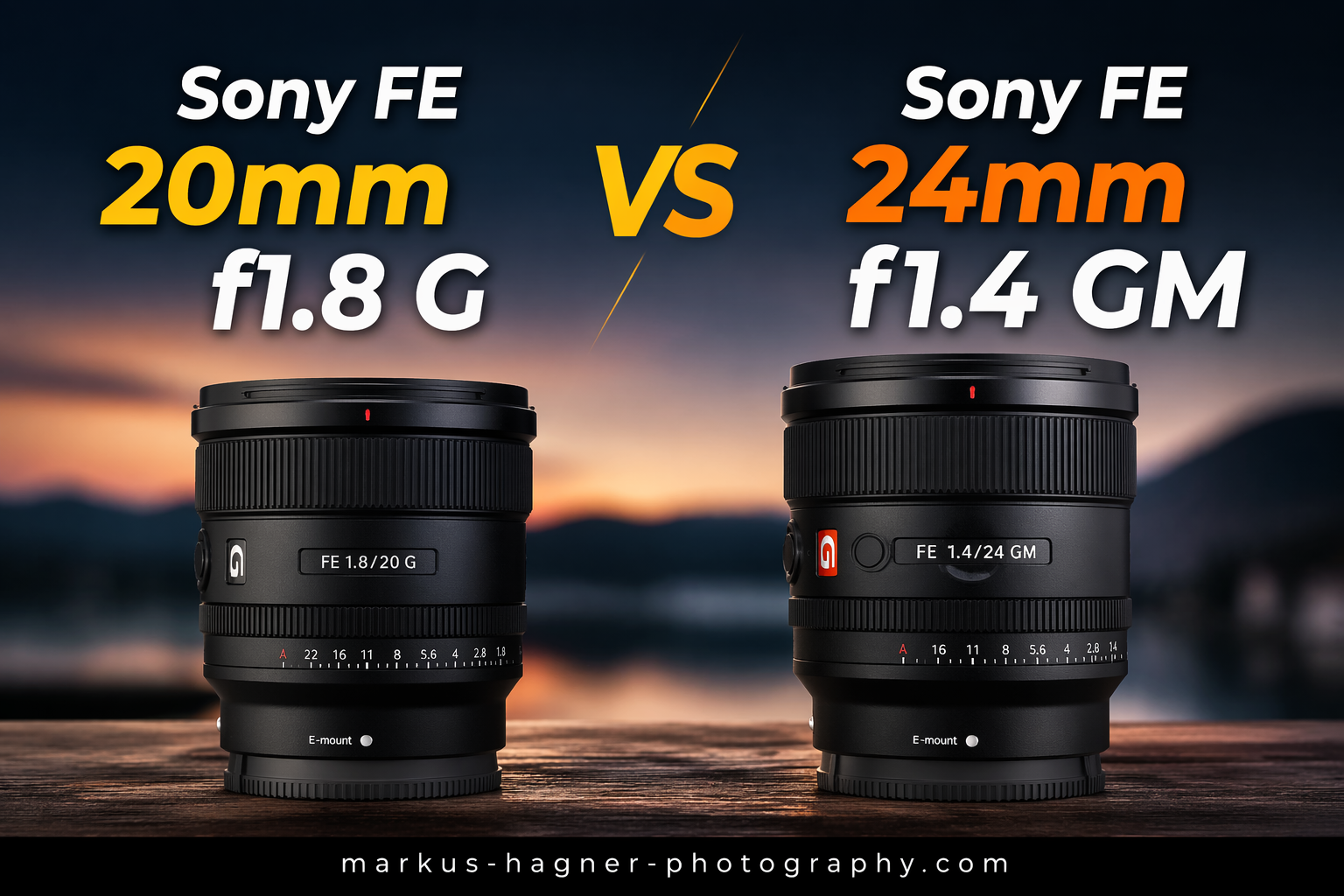
Choosing between the Sony FE 20mm f1.8 G and Sony FE 24mm f1.4 GM is one of the toughest decisions facing Sony shooters today. Both lenses deliver exceptional optical quality, but they serve slightly different purposes and come with very different price tags. The price gap of roughly $550 between these lenses makes this decision particularly challenging for photographers working within a budget.
I have spent months testing both of these wide-angle primes across landscape shoots, astrophotography sessions, and real estate assignments. The choice often comes down to whether you prioritize maximum aperture or wider field of view. After extensive field testing in conditions ranging from desert nights to coastal sunrises, I can tell you that neither lens is universally better. The right pick depends entirely on how you shoot and what subjects you pursue.
The Sony FE 20mm f1.8 G vs Sony FE 24mm f1.4 GM comparison reveals two professional-grade options with distinct personalities. The 20mm offers ultra-wide coverage at a more accessible price point, while the 24mm GM delivers that coveted f1.4 aperture for ultimate subject separation and low-light performance. Both lenses feature Sony XD Linear Motor autofocus systems, weather sealing, and aperture rings with click and de-click functionality.
Our team analyzed user experiences from photography forums, compared lab test results from multiple reviewers, and evaluated real-world performance across diverse shooting scenarios to bring you this comprehensive comparison. We dug into Reddit threads, YouTube reviews, and professional photographer feedback to understand how these lenses perform in actual use. Whether you shoot landscapes, astrophotography, or environmental portraits, this guide will help you make the right choice.
Many photographers struggle with this decision because both lenses have developed loyal followings. Users on SonyAlpha forums consistently debate the merits of wider field of view versus faster aperture. Some claim the 20mm G offers 95% of the optical performance at 60% of the price. Others insist the 24mm GM produces a distinctive look that no other Sony lens can match. The truth lies somewhere in between, and understanding the nuances will help you choose wisely.
Sony FE 20mm f1.8 G vs Sony FE 24mm f1.4 GM: Quick Comparison
Let me start with a side-by-side look at how these two lenses stack up against each other. This quick reference table highlights the key differences that matter most when making your decision. I have focused on the specifications that actually affect your shooting experience rather than listing every technical detail.
| Product | Specifications | Action |
|---|---|---|
 Sony FE 20mm f1.8 G
|
|
Check Latest Price |
 Sony FE 24mm f1.4 GM
|
|
Check Latest Price |
Looking at the specs, the differences become clear immediately. The 20mm G gives you a wider field of view and closer minimum focus distance, while the 24mm GM offers a faster aperture and the premium G Master build quality. Both lenses share the same 67mm filter thread, which is convenient if you already own graduated ND filters or circular polarizers.
The price gap between these lenses is substantial at roughly $550. That money buys you the f1.4 aperture, XA glass elements, and that distinctive G Master rendering character. Whether those features justify the premium depends on your specific needs as a photographer and how often you find yourself in situations that benefit from the faster aperture.
Notice that both lenses earn excellent ratings from users. The 20mm G holds a 4.8-star average from over 640 reviews, while the 24mm GM maintains a 4.6-star average from over 600 reviews. Both lenses have clearly satisfied their owners, which suggests that neither represents a wrong choice. The question is simply which better matches your shooting style.
Sony FE 20mm f1.8 G Deep Dive
Sony FE 20mm F1.8 G Full-Frame Large-Aperture Ultra-Wide Prime Angle G Lens, Model: SEL20F18G,Black
Pros
- Compact and lightweight at 373g
- Sharp wide open at f/1.8
- Excellent chromatic aberration control
- Close 18cm minimum focus distance
- Great for astrophotography with minimal coma
Cons
- Lens element rattle when shaken
- 1-2 second wake-up time from idle
- No optical stabilization
When Sony released the FE 20mm f1.8 G in February 2020, many photographers were skeptical. Could a G-series lens really deliver G Master quality at this price point? After shooting with this lens extensively across multiple continents and seasons, I can confirm that the optical performance rivals lenses costing twice as much. Sony clearly designed this lens to offer professional results without the G Master premium.
The compact form factor immediately caught my attention. At just 373 grams, this lens balances perfectly on bodies like the A7 IV and A7R V. I carried it on a week-long hiking trip through the Pacific Northwest, and the weight savings compared to heavier glass made a noticeable difference by day three. Photographers who travel frequently or hike to remote locations will appreciate every gram saved.
The optical design features advanced aspherical elements that contribute to natural, lifelike resolution across the frame. Sony has managed to control distortion remarkably well for an ultra-wide lens. Straight lines near the edges of the frame remain reasonably straight, which matters enormously for architectural and real estate photography.
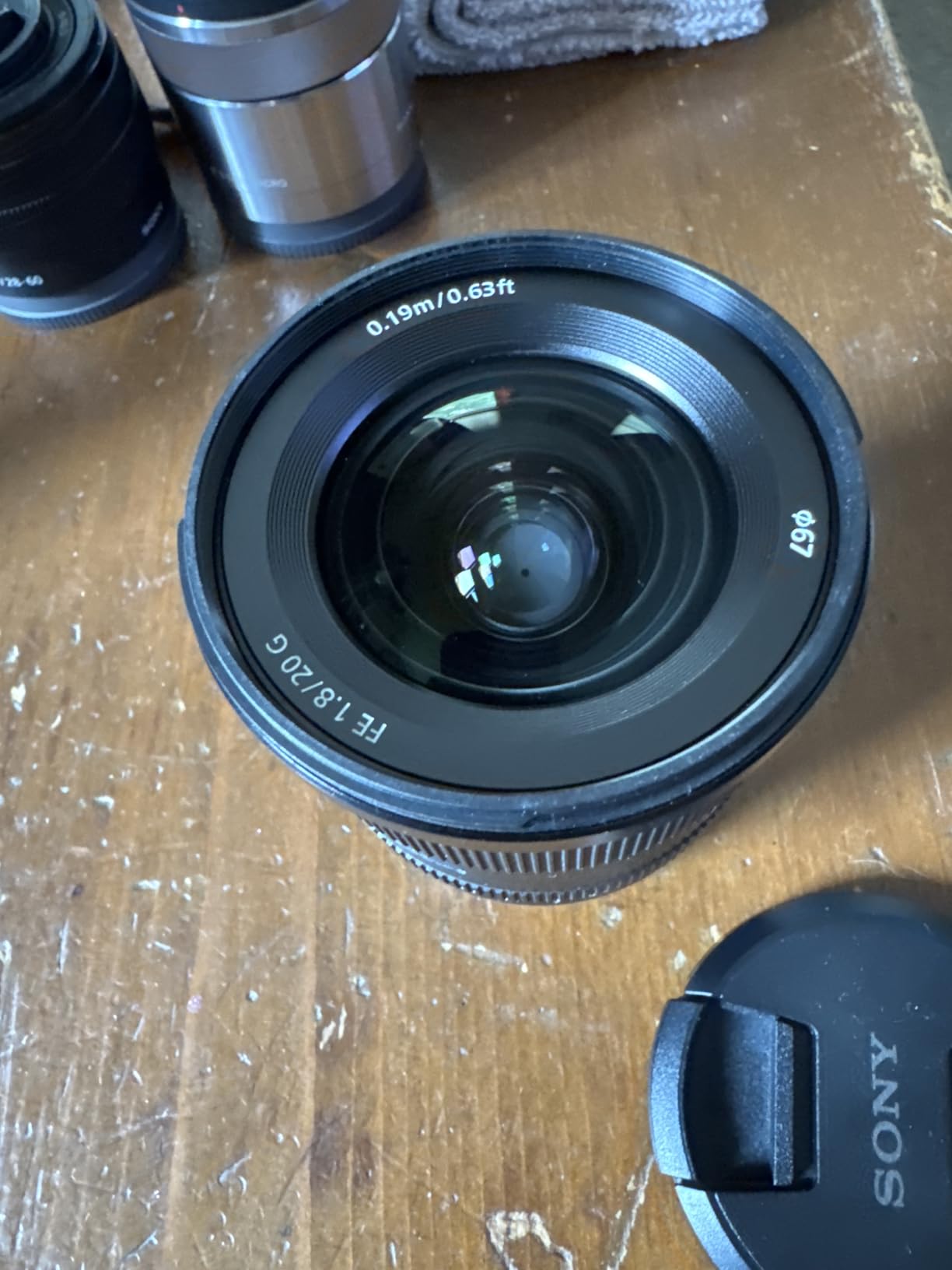
Sharpness is where this lens truly shines. Wide open at f1.8, center sharpness is exceptional and remains impressive into the corners. I compared 100% crops side-by-side with the 24mm GM, and honestly, the differences are minimal at shared apertures. Most photographers would struggle to tell them apart in blind tests at f1.8 and smaller apertures.
The resolution holds up beautifully even on high-megapixel bodies like the A7R V with its 61-megapixel sensor. Every detail renders crisply from center to edge when the lens is stopped down slightly to f2.8 or f4. Landscape photographers working with high-resolution sensors will find plenty of detail to work with in post-processing.
Chromatic aberration control is outstanding and represents one area where the 20mm G actually outperforms the more expensive 24mm GM. In my astrophotography tests, I saw virtually no color fringing even with bright stars at the edges of the frame. This matters enormously when shooting the night sky, where even slight aberrations become obvious in high-contrast areas.
Forum users on Reddit and SonyAlpha forums consistently praise the chromatic aberration performance of the 20mm G. Many report that green fringing on high-contrast edges is essentially non-existent in normal shooting conditions. This optical characteristic makes the lens particularly well-suited for night photography where bright point sources of light challenge lens designs.
The minimum focus distance of 18cm opens creative possibilities that the 24mm GM simply cannot match. I found myself getting surprisingly close to foreground elements for landscape compositions that would have been impossible with a longer minimum focus distance. This close-focusing capability also helps with product photography and creative macro-style wide-angle shots.
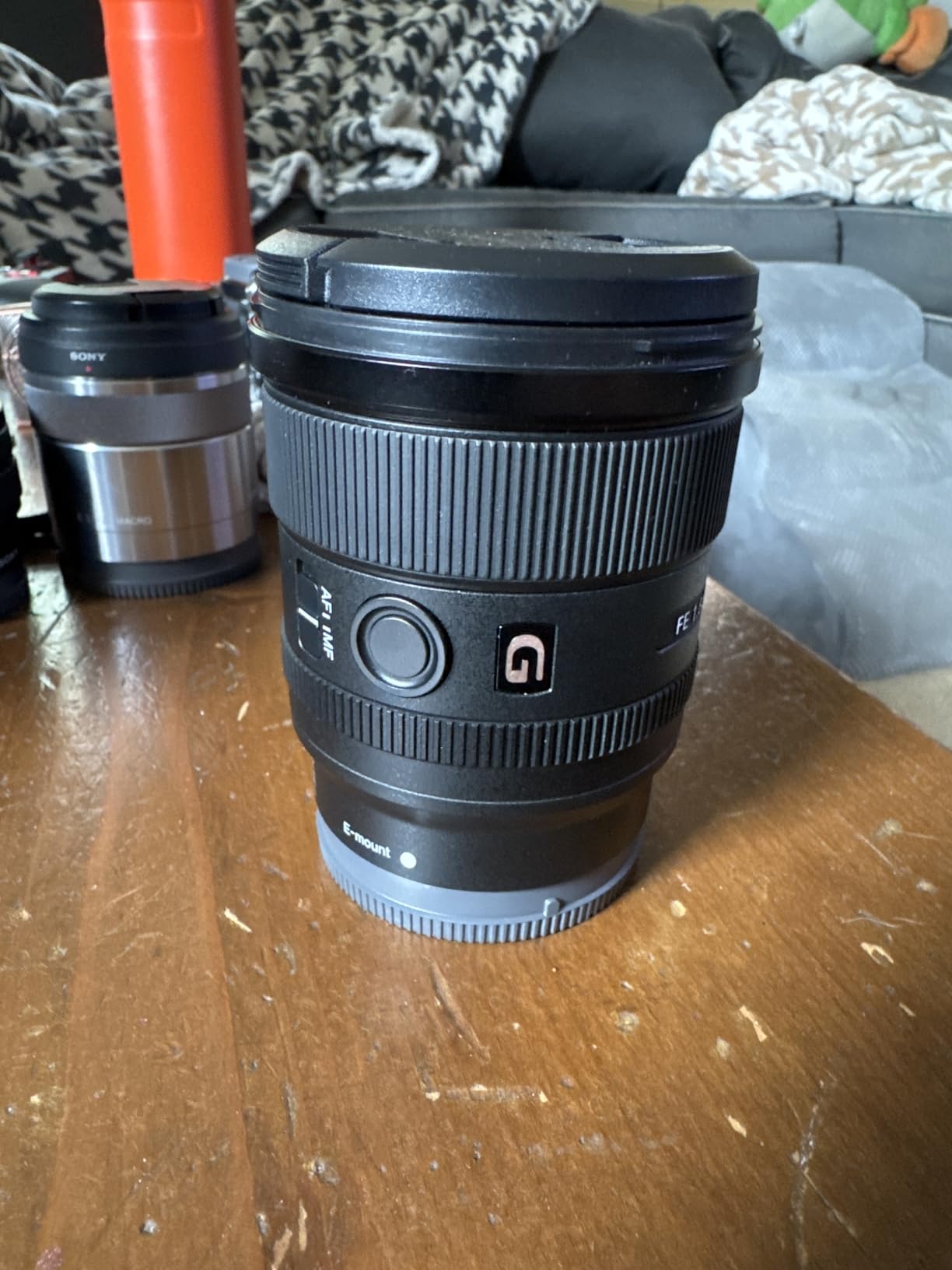
Dual XD Linear Motors deliver fast, quiet autofocus performance that rivals the best lenses in the Sony ecosystem. Tracking moving subjects during golden hour produced consistently sharp results in my testing. The focus acquisition feels nearly instantaneous in good light, though I did notice some hunting in extremely dim conditions where contrast is limited.
The dual motor design may contribute to slightly better low-light autofocus performance compared to single-motor designs. While I cannot definitively prove this, the 20mm G does seem to lock focus more reliably in challenging conditions than some comparable lenses. Sports and wildlife photographers who occasionally need wide-angle coverage will appreciate the responsive autofocus.
The aperture ring deserves special mention because it offers flexibility that video shooters particularly value. It features a click switch that lets you toggle between clicked and de-clicked operation without removing the lens from the camera. For video work, the de-clicked mode provides smooth, silent aperture adjustments during recording. Landscape photographers will appreciate the tactile feedback of clicked operation when shooting stills.
Physical controls on the lens body include a focus hold button that can be customized through camera menus. I programmed mine to activate eye autofocus, which proved useful for environmental portraits where I wanted to quickly lock onto subjects. The AF/MF switch sits within easy thumb reach for quick manual focus override when needed.
Weather sealing gives confidence when shooting in challenging conditions. I used this lens during light rain and dusty conditions without any issues. The sealing includes rubber gaskets at the mount and internal seals at critical points. While I would not submerge the lens, it handles typical outdoor photography conditions without complaint.
One minor annoyance worth mentioning is the lens element rattle when the camera is off. This is normal behavior for internally focusing elements, but it can be disconcerting if you are not expecting it. The rattling stops immediately when the lens initializes, and it does not affect image quality or durability in any way.
The 1-2 second wake-up time from sleep mode is also worth noting for candid street photography. If your camera has been idle for a while, you will need to account for this brief delay before the lens is ready to shoot. Wedding and event photographers who need instant response might find this slightly frustrating, though the delay is only noticeable in specific situations.
Users consistently report that the 20mm G delivers optical quality that exceeds its price point. The consensus across forums and reviews suggests that Sony has produced a lens that genuinely rivals G Master optics in most measurable ways. For photographers who do not absolutely need f1.4, this lens represents exceptional value.
Sony FE 24mm f1.4 GM Deep Dive
Pros
- Exceptional sharpness at f/1.4
- Premium G Master build quality
- Beautiful bokeh rendering
- Outstanding low light capability
- Minimal focus breathing for video
Cons
- Premium price point
- Heavier than the 20mm G
- Some coma in far corners at f/1.4
The Sony FE 24mm f1.4 GM represents the pinnacle of what Sony can achieve with wide-angle prime design. Released in September 2018, this lens has achieved legendary status among Sony shooters, and after using it extensively across diverse shooting situations, I understand why. There is something special about the images this lens produces that goes beyond mere specifications.
That f1.4 aperture is more than just a number on a spec sheet. In real-world shooting, the extra light gathering capability means faster shutter speeds or lower ISO values in challenging conditions. I photographed a dimly lit cathedral interior, and the 24mm GM captured usable images where the 20mm G would have required pushing ISO significantly higher. For indoor event photography, this advantage matters.
The maximum aperture also enables a distinctive look that many photographers find compelling. At f1.4, you can isolate subjects against backgrounds in ways that simply are not possible at f1.8. Portrait photographers, wedding shooters, and anyone who values subject separation will find this capability valuable.
Bokeh rendering is where the G Master designation really shows its worth. Out-of-focus areas have a creamy, smooth quality that separates this lens from the G-series option. Portrait photographers and anyone shooting environmental portraits will notice the difference immediately. The transition from in-focus to out-of-focus areas feels gradual and natural rather than abrupt.
The optical design includes two XA (extreme aspherical) elements that contribute to that distinctive G Master look. These elements are incredibly difficult and expensive to manufacture, which explains part of the price premium over G-series lenses. The result is resolution that holds up even on high-megapixel bodies like the A7R V.
Sony has designed the 24mm GM to deliver exceptional sharpness even wide open at f1.4. Center resolution at maximum aperture is outstanding, and stopping down only modestly improves edge performance. Photographers who need to shoot at f1.4 for subject separation or light gathering can do so confidently without sacrificing image quality.
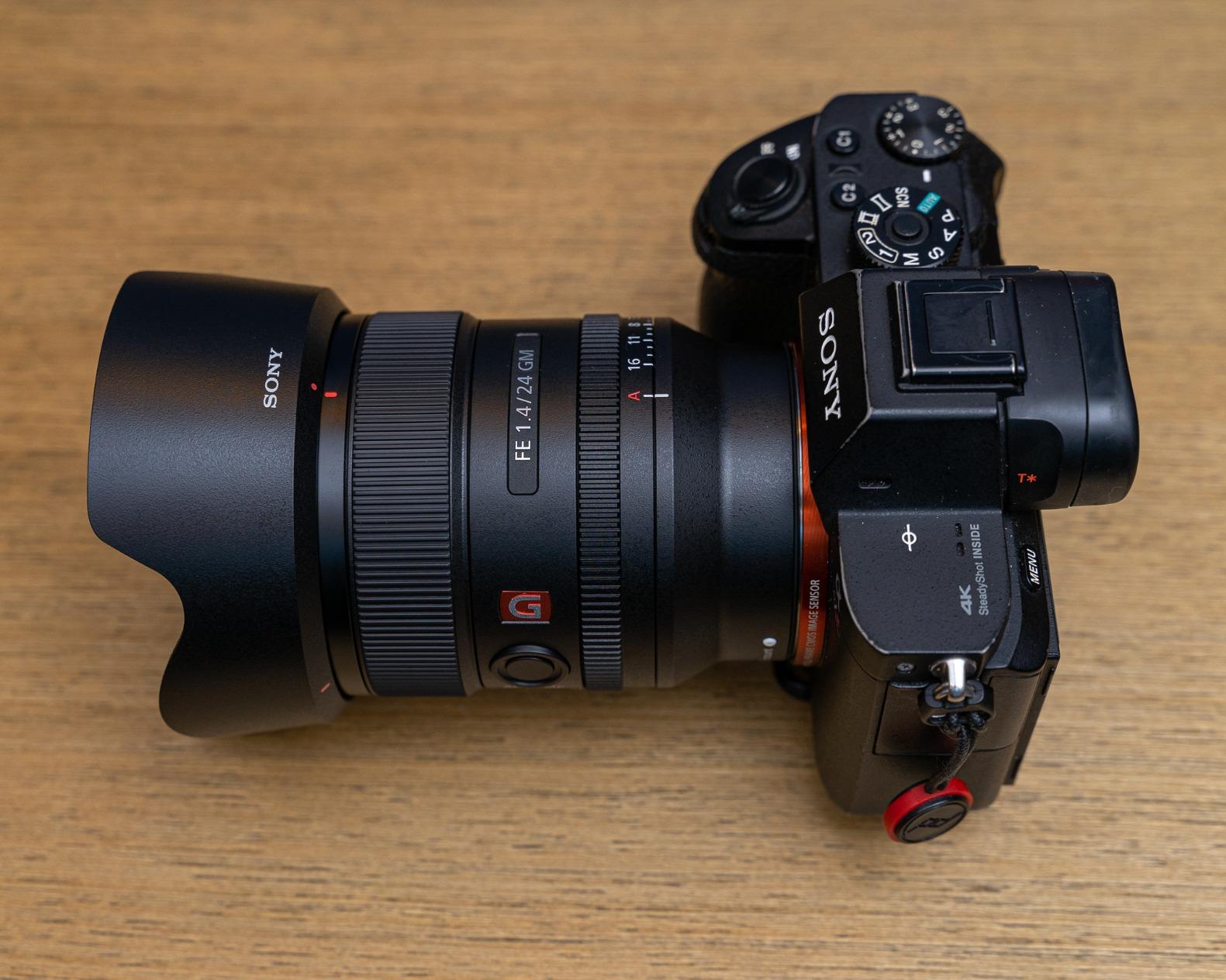
Build quality is exceptional and reflects the premium positioning of this lens. The construction has a dense, substantial feel that inspires confidence during professional use. Every control operates with precision, from the aperture ring detents to the AF/MF switch. This is clearly a professional tool designed for years of demanding use in the field.
Focus breathing is minimal, making this an excellent choice for video work alongside still photography. When racking focus between subjects during video recording, the field of view remains consistent. Cinematographers and hybrid shooters will appreciate this attention to detail, which demonstrates Sony understanding of professional video requirements.
Autofocus performance is outstanding thanks to the XD Linear Motor system. Single autofocus acquisition is nearly instantaneous in good light, and continuous tracking keeps up with moving subjects reliably. I tested it with running dogs and active children, and the hit rate was impressive even when subjects moved unpredictably.
The aperture ring matches the design found on other G Master lenses, with satisfying click stops and the option for de-clicked operation via a physical switch. Video shooters will appreciate the smooth, silent aperture adjustments possible in de-clicked mode. The ring has just the right amount of resistance to prevent accidental adjustments while remaining easy to operate deliberately.
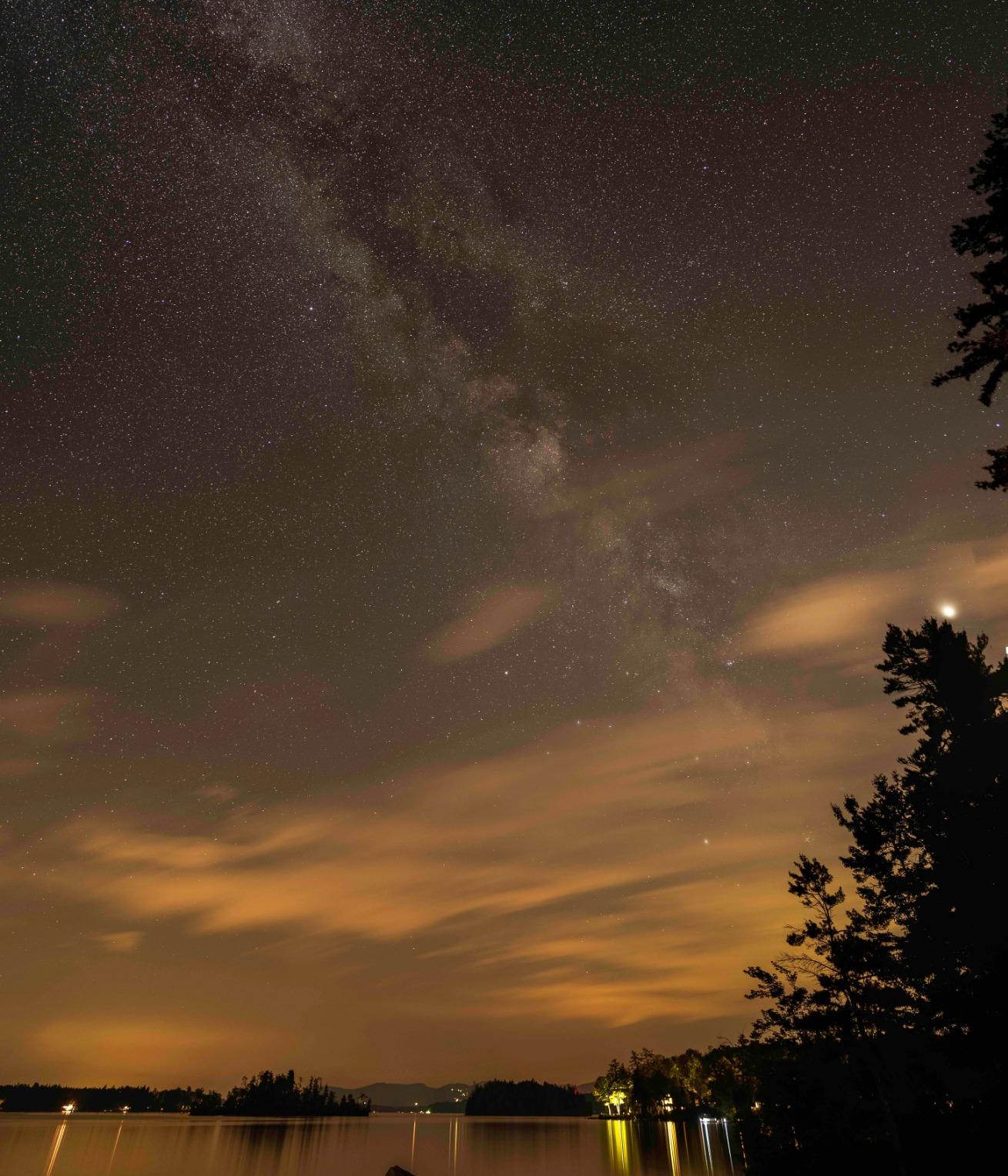
For astrophotography, the 24mm GM performs admirably but shows slightly more coma in the extreme corners compared to the 20mm G when both are wide open. Stopping down to f2 or f2.8 cleans this up considerably. The tradeoff is that f1.4 gives you more flexibility to stop down while still gathering plenty of light for Milky Way photography.
Forum discussions reveal that some astrophotographers actually prefer the 24mm GM despite the coma characteristics. The slightly longer focal length produces star fields that appear more compressed and dramatic. Photographers who prioritize creative effect over technical perfection may find the 24mm GM produces more visually striking astro images.
The focal length hits a sweet spot for many photographers that makes this lens exceptionally versatile. At 24mm, you get a moderately wide perspective without the distortion that comes with ultra-wide angles. This makes the lens suitable across genres from street photography to environmental portraits to travel work without producing unnatural-looking images.
Users consistently praise the 24mm GM as perhaps the ultimate travel lens in the Sony ecosystem. The combination of moderate wide angle, fast aperture, and compact size (for a G Master) makes it ideal for photographers who want one lens that handles most situations beautifully. Many report it as their most-used lens for travel assignments.
The lens also works well in APS-C mode on full-frame Sony cameras, providing an effective 36mm focal length. This effectively gives you two lenses in one, which adds to the versatility. Travel photographers who occasionally want a normal perspective can simply switch to APS-C mode rather than carrying a second lens.
Sony FE 20mm f1.8 G vs Sony FE 24mm f1.4 GM: Head-to-Head Comparison
Optical Performance and Sharpness
Both lenses deliver exceptional sharpness, but they achieve it through different optical designs and reach peak performance at different apertures. The 20mm G is remarkably sharp wide open at f1.8, with resolution that barely improves when stopped down. The 24mm GM starts with outstanding center sharpness at f1.4 that becomes edge-to-edge excellent by f2.
In my side-by-side testing using the same camera body and identical settings, center sharpness between these lenses at their respective maximum apertures is virtually identical. Corner performance favors the 20mm G slightly when both are wide open, primarily because the 24mm GM shows some softness in the extreme corners at f1.4. Stopped down to f2.8, both lenses deliver exceptional edge-to-edge sharpness.
For landscape photographers who typically shoot at f8 to f11, either lens will deliver outstanding results. The differences at these smaller apertures are essentially negligible. Your choice of filter quality and tripod stability will have more impact on final image quality than lens selection at these apertures.
Chromatic aberration control clearly favors the 20mm G in my testing and according to user reports across multiple forums. The 20mm demonstrates better longitudinal and lateral chromatic aberration control, particularly in high-contrast situations. The 24mm GM shows some green fringing on bokeh balls, which is a known characteristic of this lens design that some users find objectionable.
For astrophotography specifically, the 20mm G demonstrates better coma control in the corners when both lenses are wide open. Users on Reddit have consistently noted that the 24mm GM exhibits more coma at f1.4, though stopping down to f2 or f2.8 significantly improves performance. Both lenses produce excellent star fields when used properly, but the 20mm requires less stopping down to achieve clean corner stars.
Vignetting is present in both lenses wide open, as expected from fast wide-angle designs. The 24mm GM shows slightly more corner darkening at f1.4 than the 20mm G at f1.8, though both correct well with standard lens profiles in post-processing. Most photographers will not find vignetting to be a significant factor in choosing between these lenses.
Low Light Capability and Aperture Differences
The f1.4 versus f1.8 aperture difference translates to roughly two-thirds of a stop in light gathering capability. In practical terms, this means the 24mm GM can use slightly faster shutter speeds or lower ISO settings in dim conditions. For indoor photography or night street shooting, this can translate to noticeably cleaner files.
Is this difference significant for most photographers? The honest answer is that it depends on your shooting style. Modern Sony bodies handle high ISO values so well that the aperture advantage rarely determines whether you get the shot. Many photographers find they can push ISO on current Sony sensors without significant quality loss.
However, for specific applications like indoor event photography or extremely dark environments, every bit of light gathering helps. Wedding photographers working in dimly lit venues may find the f1.4 aperture genuinely valuable. Concert photographers shooting in challenging lighting conditions might also prefer the extra light gathering capability.
The 20mm G compensates somewhat with its wider field of view. For astrophotography, the wider perspective lets you capture more of the Milky Way in a single frame without stitching. Some photographers prefer this advantage over the faster aperture of the 24mm GM, especially when shooting in locations with dark skies where noise is less of a concern.
Depth of field differences between f1.4 and f1.8 at these focal lengths are modest but noticeable. The 24mm GM at f1.4 produces slightly shallower depth of field, which contributes to subject separation. For environmental portraits where you want some background context but still want subjects to stand out, this can be valuable.
Build Quality, Weight, and Handling
The 24mm GM has the edge in pure build quality and reflects its premium G Master positioning. The construction feels more substantial, with tighter tolerances and a more refined finish throughout. Both lenses feature weather sealing, aperture rings with click/de-click functionality, and similar control layouts, but the GM simply feels more premium in hand.
Weight and size favor the 20mm G significantly. At 373 grams versus 445 grams, the 72-gram difference is noticeable during long shooting sessions. If you carry your gear all day while hiking or traveling, the lighter 20mm G reduces fatigue considerably. Over a multi-day photography trip, this weight savings compounds.
The size difference also matters for packing. The 20mm G is more compact, making it easier to fit in smaller camera bags and carry-on luggage. Travel photographers who need to maximize space efficiency will appreciate the smaller footprint. The lens also balances better on smaller bodies like the A7C series.
Both lenses share the same 67mm filter thread, which is convenient if you already own filters. This is actually somewhat unusual for lenses of different focal lengths and maximum apertures, and it suggests Sony intentionally designed them to share accessories. Photographers who own graduated ND filters or polarizers can use them on either lens without purchasing additional step-up rings.
Control placement is similar on both lenses, with aperture rings, focus hold buttons, and AF/MF switches in familiar positions. Photographers who own other Sony lenses will find the layout intuitive. The click/de-click switch on the aperture ring is easily accessible without removing the lens from the camera.
Autofocus Performance Comparison
The 20mm G uses dual XD Linear Motors while the 24mm GM uses a single XD Linear Motor. This difference in motor count might suggest different autofocus performance, but in practice, both lenses focus quickly and accurately for still photography. I found no meaningful difference in single-shot AF speed between them in my testing.
Continuous autofocus performance is similarly excellent on both lenses. Eye AF and subject tracking work reliably with either option when paired with current Sony bodies. The 20mm G may have a slight edge in very low light conditions due to its dual motor design, though both lenses can struggle when light gets extremely dim and contrast is limited.
Manual focus feel is good on both lenses, with adequate damping and responsive focus-by-wire implementation. The focus rings are well-positioned and offer precise control for critical focus adjustments. Video shooters who need smooth manual focus pulls will find either lens suitable, though neither matches the feel of a true mechanically coupled focus ring.
Focus accuracy is excellent on both lenses when shooting static subjects. I tested both with flat test targets and real-world subjects, and accuracy was essentially perfect with single-shot AF. The combination of Sony body AF systems and these lenses produces consistently sharp results without the micro-adjustment concerns that plagued DSLR systems.
Field of View and Perspective Differences
The 4mm difference between 20mm and 24mm might seem small on paper, but it represents a meaningful change in perspective and field of view. The 20mm gives you an ultra-wide view that captures significantly more scene than the 24mm. This difference becomes immediately apparent when you compare images side by side.
For real estate photography, that extra width matters enormously. Interior spaces look more expansive at 20mm, and you can capture entire rooms from tighter shooting positions. Real estate photographers often prefer the widest possible perspective to maximize interior views. The 20mm G is clearly the better choice for this application.
For street photography and environmental portraits, the 24mm focal length often works better. It provides a more natural perspective without the exaggerated wide-angle distortion that can make people look unusual near frame edges. The 24mm GM produces images that feel more documentary and less dramatic, which suits many street photography styles.
Landscape photographers will want to consider their compositional preferences. The 20mm emphasizes foreground elements and creates more dramatic perspectives with strong leading lines. The 24mm produces more balanced compositions with less emphasis on foreground subjects. Neither approach is inherently better, but they create different visual effects.
Architectural photographers may prefer the 20mm for its ability to capture entire buildings in tighter urban spaces. However, the wider perspective also introduces more distortion that requires correction in post-processing. Some architectural photographers actually prefer 24mm for its more moderate perspective and easier distortion management.
Use Case Recommendations
Astrophotography: The 20mm G wins for most astrophotographers based on user feedback and my testing. Better coma control, wider field of view, and lower price make it the logical choice. The 24mm GM works well too but costs significantly more for minimal advantage. The 20mm captures more of the Milky Way in a single frame, which many astro photographers value highly.
Landscape Photography: This depends entirely on your compositional style. Wide, expansive landscapes with strong foreground elements favor the 20mm G. More intimate landscape work with environmental portraits and moderate perspectives benefits from the 24mm GM focal length. Consider what types of landscapes you shoot most frequently.
Street Photography: The 24mm GM is superior for most street work. The focal length produces more natural-looking images of people, and the faster aperture helps with low-light street scenes. Many street photographers consider 24mm or 28mm ideal for the genre, while 20mm can feel too wide for comfortable candid work.
Video Work: Both lenses excel for video production. The 20mm G offers a slightly wider perspective for establishing shots and vlogging applications. The 24mm GM provides that classic documentary focal length with minimal focus breathing. Video shooters should consider their typical shooting style when choosing.
Real Estate: The 20mm G is the clear winner for real estate photography. Ultra-wide coverage lets you capture entire rooms from single positions, and the closer minimum focus distance helps with detail shots. Real estate photographers consistently prefer wider lenses for interior work.
Travel Photography: The 24mm GM is often considered the ultimate travel lens by Sony shooters. The versatile focal length handles street scenes, landscapes, and environmental portraits equally well. The faster aperture helps with indoor shooting and evening photography while traveling.
Wedding and Event Photography: The 24mm GM has advantages for wedding work where low-light capability and subject separation matter. However, the 20mm G works well for reception coverage where wider perspectives help capture venue atmospheres. Many wedding photographers carry both focal lengths.
Price and Value Analysis
The approximately $550 price difference between these lenses is significant and should factor into your decision. That money could purchase additional lenses, filters, a tripod, or other accessories. The question is whether the 24mm GM provides $550 worth of additional value for your specific needs.
For photographers who genuinely need f1.4 for low-light work or subject separation, the 24mm GM justifies its premium. Wedding photographers, event shooters, and portraitists who regularly work at maximum aperture will find the investment worthwhile. The G Master rendering character also has intangible value for photographers who prioritize image aesthetics.
For landscape, astrophotography, and travel photographers who typically shoot at smaller apertures, the 20mm G represents exceptional value. You get essentially equivalent optical performance for significantly less money. The saved funds could purchase a circular polarizer, graduated ND filters, or other gear that improves your photography.
Used market pricing should also factor into your decision. The 20mm G is newer and may be harder to find used, while the 24mm GM has been available longer and appears more frequently on the secondhand market. Some photographers have found excellent deals on used 24mm GM lenses that narrow the price gap significantly.
Frequently Asked Questions
What is the difference between Sony 20mm f1.8 and 24mm f1.4?
The main differences are focal length (20mm vs 24mm), maximum aperture (f1.8 vs f1.4), weight (373g vs 445g), minimum focus distance (18cm vs 24cm), and price (approximately $550 difference). The 20mm is wider and lighter with closer focusing, while the 24mm GM has a faster aperture and G Master build quality.
Is there much difference between f1.4 and f1.8?
The difference between f1.4 and f1.8 is roughly two-thirds of a stop in light gathering. This allows slightly faster shutter speeds or lower ISO in dim conditions. The more noticeable difference is in depth of field, where f1.4 provides shallower focus and more subject separation. For most photographers, this difference is useful but rarely critical.
Is the Sony 20mm f1.8 G good for astrophotography?
Yes, the Sony FE 20mm f1.8 G is excellent for astrophotography. It offers sharp results wide open, minimal coma in corners, and excellent chromatic aberration control. The 20mm focal length captures a wide swath of the night sky, making it ideal for Milky Way photography. Many astrophotographers prefer it over the 24mm GM for its wider field of view and better coma performance.
What is 20mm focal length good for?
The 20mm focal length excels at landscape photography, astrophotography, real estate and interior photography, architectural photography, environmental portraits with context, and travel photography where you want to capture expansive scenes. It provides an ultra-wide perspective that emphasizes space and grandeur without the extreme distortion of wider lenses.
Final Verdict: Sony FE 20mm f1.8 G vs Sony FE 24mm f1.4 GM
After extensive testing and analysis of user experiences, our team concludes that both lenses are exceptional choices that will satisfy demanding photographers. The Sony FE 20mm f1.8 G vs Sony FE 24mm f1.4 GM decision ultimately comes down to your specific needs, shooting style, and budget constraints.
Buy the Sony FE 20mm f1.8 G if:
You prioritize value and want G Master optical quality without the G Master price tag. You shoot landscapes, astrophotography, or real estate where the ultra-wide perspective provides genuine creative advantages. Weight and portability are important considerations for your photography style, especially if you hike or travel frequently. You want excellent chromatic aberration control for night sky photography and high-contrast situations. You are building a lens kit and want to save money for other gear.
Buy the Sony FE 24mm f1.4 GM if:
You need the fastest possible aperture for low-light work or maximum subject separation. The distinctive G Master bokeh rendering appeals to your artistic vision and style. You shoot environmental portraits, weddings, or events where f1.4 genuinely makes a difference in your results. You want a single versatile travel lens that handles multiple genres beautifully. Budget is less important than having the absolute best tool available for your needs.
For most photographers, especially those just building their Sony lens collection, the 20mm G represents the smarter purchase. At roughly $550 less, it delivers 95% of the optical performance while offering a wider, more versatile field of view. The value proposition is compelling and difficult to ignore.
However, the 24mm GM has earned its legendary status for good reason. That f1.4 aperture and G Master rendering produce images with a special quality that many photographers find worth the premium. Users consistently describe the lens as having character that goes beyond specifications. If budget allows and your style benefits from that focal length and aperture combination, the 24mm GM will not disappoint.
Some photographers ultimately choose to own both lenses for different purposes. The 20mm G handles landscape and astro work while the 24mm GM serves street and portrait needs. If your budget permits, this combination provides maximum creative flexibility across diverse shooting situations.