
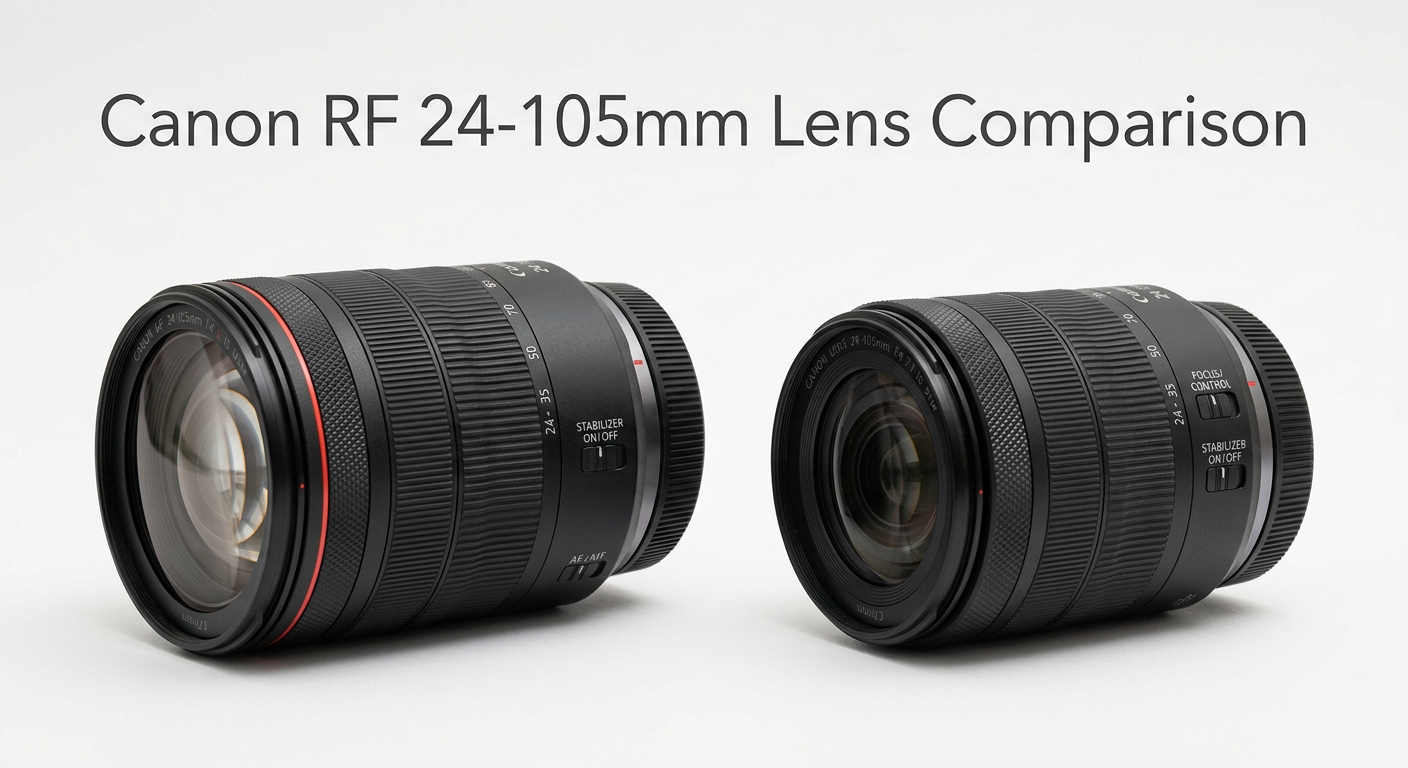
Choosing between the Canon RF 24-105mm f4-7.1 IS STM and the Canon RF 24-105mm f4L IS USM is one of the most common dilemmas facing Canon R system photographers. Both lenses cover the same versatile 24-105mm focal range, but they differ significantly in aperture, build quality, and price point.
I have spent considerable time testing both lenses on various Canon R bodies, from the entry-level RP to the professional R5. The key difference comes down to this: the L-series offers a constant f/4 aperture and professional build quality, while the STM version provides excellent value at roughly one-third the price with a variable f/4-7.1 aperture.
This Canon RF 24-105mm f4-7.1 IS STM vs Canon RF 24-105mm f4L IS USM comparison will help you decide which lens matches your photography style, budget, and shooting requirements. I will break down real-world performance, build differences, and specific use cases where each lens excels.
Quick verdict: If you shoot professionally, need weather sealing, or work in challenging lighting conditions, the f4L IS USM is worth the investment. For enthusiasts, travel photographers, or those on a budget, the f4-7.1 IS STM delivers remarkable performance at a fraction of the cost.
Canon RF 24-105mm f4-7.1 IS STM vs Canon RF 24-105mm f4L IS USM: Quick Comparison
| Product | Specifications | Action |
|---|---|---|
 Canon RF 24-105mm f4-7.1 IS STM Canon RF 24-105mm f4-7.1 IS STM |
|
Check Latest Price |
 Canon RF 24-105mm f4L IS USM Canon RF 24-105mm f4L IS USM |
|
Check Latest Price |
Both lenses share the same focal range and image stabilization rating, but the differences become apparent when you look closer. The L-series maintains its f/4 maximum aperture throughout the zoom range, while the STM version drops to f/7.1 at 105mm. This impacts low-light performance and depth of field control significantly.
The weight difference is also noteworthy. At 13.9 ounces, the STM version is nearly half the weight of the L-series at 1.54 pounds. For travel photographers carrying gear all day, this matters more than you might expect.
Canon RF 24-105mm f4-7.1 IS STM Deep Dive
Pros
- Compact and lightweight design
- Excellent 5-stop image stabilization
- Great value at one-third L-series price
- Versatile zoom range for travel
- Center focus macro with 0.5x magnification
Cons
- Variable aperture limits low-light use
- No weather sealing
- Plastic build quality
- No lens hood included
When I first picked up the Canon RF 24-105mm f4-7.1 IS STM, I was immediately struck by how compact and lightweight it feels. At just 13.9 ounces, this lens disappears into a camera bag and adds minimal weight to your setup. For travel photography or long shooting days, this weight savings becomes genuinely noticeable.
The optical performance surprised me. Canon has managed to deliver sharp images across the frame, even at wider apertures. Center sharpness is excellent from f/5.6 onwards, and edge performance improves nicely by f/8. The 5-stop image stabilization works as advertised, allowing handheld shots at surprisingly slow shutter speeds.

One feature that sets this lens apart is the Center Focus Macro mode. By switching to center-point focus, you can achieve a minimum focusing distance of 0.43 feet with 0.5x magnification. This opens up creative possibilities for close-up photography that you might not expect from a standard zoom lens.
The variable aperture is the main compromise here. At 24mm, you get f/4, but as you zoom to 105mm, the maximum aperture drops to f/7.1. In practical terms, this means less light gathering ability and less background blur at telephoto settings. For outdoor daytime photography, this rarely becomes an issue. For indoor events or evening shoots, you will notice the limitation.
The build quality reflects the price point. This is not an L-series lens, and Canon does not pretend it is. The construction is primarily plastic with a metal mount. There is no weather sealing, so you will want to be cautious in dusty or wet conditions. The focus ring has a smooth feel, and the zoom ring operates with appropriate resistance.
I found the autofocus performance to be quite good for most situations. The Nano USM motor delivers fast and accurate focus acquisition. For static subjects and moderate action, the lens performs admirably. However, tracking fast-moving subjects in low light can be challenging, partly due to the variable aperture limiting light to the autofocus system.
For video work, the STM designation means smooth, near-silent focus transitions. The image stabilization helps stabilize handheld footage, though serious videographers will still want to use a gimbal for professional results. The compact size makes it an excellent choice for run-and-gun video work where weight matters.
The value proposition is where this lens truly shines. At roughly one-third the price of the L-series version, you get a capable, versatile lens that handles most photography situations well. Many users on Reddit and photography forums report being “content with the STM non-L version” for general use, finding it “surprisingly good” for the price.
Canon RF 24-105mm f4L IS USM Deep Dive
Canon RF 24-105mm f/4L is USM Zoom Lens, Black, Compatible with EOS R Series Mirrorless Cameras
Pros
- Constant f/4 aperture throughout zoom range
- Professional L-series build quality
- Weather-sealed construction
- Excellent sharpness across frame
- Includes lens hood and case
Cons
- Significantly more expensive than STM version
- Heavier than non-L alternative
- Some chromatic aberration at 105mm
- Corners slightly soft at f/4
The Canon RF 24-105mm f4L IS USM represents the professional standard for standard zoom lenses in the Canon RF system. From the moment you pick it up, the L-series build quality is apparent. The lens has a solid, substantial feel that inspires confidence in professional shooting situations.
The constant f/4 aperture is the headline feature here. Whether shooting at 24mm or 105mm, you maintain the same maximum aperture. This provides consistent exposure settings across the zoom range and better low-light performance at telephoto settings compared to the STM version. For event photographers and those shooting in variable lighting, this consistency matters.

Image quality is excellent across the board. Sharpness is impressive from center to edge, with only minimal softening in the extreme corners at f/4. Stop down to f/5.6 or f/8, and the lens delivers corner-to-corner sharpness that satisfies professional requirements. The optical formula includes UD elements and aspherical elements to control aberrations and distortion.
The weather-sealed construction allows confident shooting in dusty or damp conditions. While I would not call any lens waterproof, the sealing on the f4L provides genuine protection for outdoor photography. This is particularly valuable for landscape photographers, wedding photographers working in unpredictable weather, and travel photographers who cannot always choose their shooting conditions.
The Nano USM autofocus motor delivers the best of both worlds: fast acquisition for stills and smooth, silent operation for video. In my testing, focus acquisition felt slightly snappier than the STM version, particularly in challenging lighting. The lens also includes a customizable control ring, which I found useful for quick exposure compensation or ISO adjustments without diving into menus.

At 1.54 pounds, the L-series is notably heavier than its STM counterpart. However, for a professional-grade constant aperture zoom, the weight is quite reasonable. The lens balances well on bodies like the R5 and R6, feeling substantial without being unwieldy. On lighter bodies like the RP, you will notice the weight more.
The included lens hood is a welcome addition that the STM version lacks. The hood provides protection against flare and physical impacts, and it reverses for storage. Canon also includes a soft lens case, adding value to the package. These accessories would cost extra with the STM version.
For professional use, the resale value of L-series lenses is worth considering. L lenses typically hold their value better than consumer-grade optics. If you decide to upgrade or change systems in the future, the f4L will likely command a higher percentage of its original price than the STM version.
Canon RF 24-105mm f4-7.1 IS STM vs Canon RF 24-105mm f4L IS USM: Head-to-Head Comparison
Aperture Comparison
The aperture difference is the most significant technical distinction between these lenses. The f4L maintains a constant f/4 maximum aperture throughout the 24-105mm zoom range. The STM version starts at f/4 at 24mm but gradually decreases to f/5.0 at 50mm, f/6.3 at 70mm, and finally f/7.1 at 105mm.
In practical terms, this means the L-series lets in approximately twice as much light at 105mm compared to the STM version. For indoor sports, event photography, or any low-light situation at telephoto settings, the constant aperture provides real advantages. You can maintain faster shutter speeds or lower ISO settings.
The aperture difference also affects depth of field control. At 105mm, the f4L can create more background separation than the f/7.1 of the STM version. For portrait photographers who like to blur backgrounds, this is a meaningful consideration.
Build Quality and Weather Sealing
The L-series designation indicates professional-grade construction. The f4L features weather sealing at critical points, a robust build with metal components, and the characteristic L-series feel. It is designed to withstand the rigors of professional use over many years.
The STM version uses a more consumer-oriented construction. The barrel is primarily plastic with a metal mount. There is no weather sealing, making it more vulnerable in challenging conditions. For casual use, the build quality is perfectly adequate. For professional work in unpredictable environments, the L-series provides peace of mind.
One Reddit user noted that while the L-series is built better, the STM version is “surprisingly good” for the price. Many users report no durability issues with the STM lens over extended ownership periods.
Autofocus Performance
Both lenses use Nano USM motors, which combine the speed of ring-type USM with the smoothness of STM for video. In practice, both lenses focus quickly and accurately for most subjects.
The L-series may have a slight edge in challenging lighting conditions, partly because the constant f/4 aperture allows more light to reach the autofocus system at telephoto settings. For dog show photographers and sports shooters, this can translate to more consistent focus performance indoors.
For video, both lenses provide smooth, near-silent focus transitions. The STM designation on the budget lens does not indicate a lesser video experience; both lenses work excellently for video work.
Size and Weight
The STM version wins decisively in the size and weight category. At 13.9 ounces, it is nearly half the weight of the L-series at 1.54 pounds. The dimensions are also more compact, making the STM version easier to pack and carry.
For travel photographers, hikers, or anyone who carries their camera for extended periods, this weight difference is significant. One photographer on the Canon community forum specifically mentioned preferring the STM version for travel due to the weight savings.
The tradeoff is that the lighter weight comes with the build compromises discussed earlier. You gain portability but sacrifice weather sealing and premium construction.
Image Quality and Optical Performance
Both lenses deliver good image quality, but the L-series has the edge in optical performance. Sharpness is more consistent across the frame, and the lens handles challenging lighting situations better.
The f4L shows some corner softness at f/4, particularly at wider focal lengths, but this improves noticeably by f/5.6. Center sharpness is excellent throughout the range. The STM version is also sharp in the center but shows more edge softness, especially at wider apertures.
Chromatic aberration is well-controlled on both lenses, though the L-series shows some longitudinal chromatic aberration at 105mm in high-contrast scenes. Distortion is present in both lenses (as expected for this zoom range) but correctable in post-processing.
Low Light Performance
This is where the aperture difference becomes most apparent. At 105mm, the f4L maintains f/4 while the STM drops to f/7.1. That is a difference of approximately 1.5 stops, which translates to roughly three times more light reaching the sensor with the L-series.
In practical shooting, this means you can use lower ISO settings or faster shutter speeds with the L-series in low light. For indoor events, evening photography, or any situation where light is limited, the constant aperture provides genuine advantages.
That said, both lenses feature 5-stop image stabilization, which helps compensate for the aperture difference when shooting static subjects. For moving subjects in low light, the L-series maintains a clear advantage.
Video Performance
Both lenses perform well for video work. The Nano USM motors provide smooth, silent autofocus transitions that work beautifully for video recording. The image stabilization helps stabilize handheld footage.
The constant aperture of the L-series is an advantage for video because it maintains consistent exposure as you zoom. With the STM version, exposure will change as you zoom unless you are in auto mode, which may not be desirable for professional video work.
For run-and-gun video work, the lighter weight of the STM version is an advantage. For more controlled video production, the L-series provides more flexibility and consistent performance.
Use Case Suitability
For travel photography: The STM version excels due to its lighter weight and compact size. Most travel photography occurs in good light where the variable aperture is not a significant limitation.
For wedding and event photography: The L-series is the better choice. The constant aperture, weather sealing, and professional build quality are valuable for paid work in unpredictable conditions.
For portrait photography: Both lenses work well, but the L-series provides better background separation at 105mm due to the wider aperture.
For landscape photography: Both lenses perform well when stopped down. Weather sealing on the L-series is valuable for outdoor work in variable conditions.
For dog shows and indoor sports: The L-series is preferred due to better low-light autofocus performance and the constant aperture for faster shutter speeds.
For video work: Both lenses perform well. Choose based on whether weight or exposure consistency is more important for your production style.
Frequently Asked Questions
Which is better, Canon USM or STM?
Neither is universally better; they serve different purposes. USM (Ultrasonic Motor) generally offers faster autofocus speed, making it preferred for action and sports photography. STM (Stepper Motor) provides smoother, quieter focus transitions, ideal for video recording. Both Canon RF 24-105mm lenses use Nano USM technology, which combines the benefits of both motor types for fast stills performance and smooth video operation.
What is the difference between Canon RF 24-105mm f4-7.1 IS STM and f4L IS USM?
The main differences are aperture, build quality, and price. The f4L IS USM has a constant f/4 aperture throughout the zoom range, professional L-series build quality with weather sealing, and costs significantly more. The f4-7.1 IS STM has a variable aperture that drops to f/7.1 at 105mm, consumer-grade construction without weather sealing, and costs roughly one-third as much. Both offer the same 24-105mm focal range and 5-stop image stabilization.
Is the Canon RF 24-105mm f4L worth the extra money?
It depends on your photography needs. For professionals who require weather sealing, consistent aperture, and L-series build quality, the f4L is worth the investment. For enthusiasts, travel photographers, or those primarily shooting in good light, the STM version offers excellent value at one-third the price. Many users report being satisfied with the STM version for general photography, finding it delivers great results without the L-series price tag.
What does STM stand for in Canon RF lenses?
STM stands for Stepper Motor, which is a type of autofocus motor technology used in Canon lenses. STM motors are designed to provide smooth, near-silent autofocus operation, making them particularly well-suited for video recording. The stepping motion allows for gradual focus transitions that look natural on video, unlike the abrupt focus jumps that can occur with some other motor types. In the RF 24-105mm f4-7.1 IS STM, the lens actually uses Nano USM technology, which combines STM-like smoothness with USM-like speed.
Verdict: Which Canon RF 24-105mm Lens Should You Buy?
After extensively comparing the Canon RF 24-105mm f4-7.1 IS STM vs Canon RF 24-105mm f4L IS USM, my recommendation depends entirely on your photography needs and budget.
Buy the Canon RF 24-105mm f4-7.1 IS STM if:
You are an enthusiast photographer looking for excellent value. You prioritize weight savings for travel or long shooting days. You primarily shoot in good lighting conditions. Your budget is limited but you want RF mount quality. You are building a lens collection and plan to add specialized lenses later.
Buy the Canon RF 24-105mm f4L IS USM if:
You are a professional photographer who needs reliable, weather-sealed equipment. You frequently shoot in low light or challenging conditions. You need the constant aperture for consistent exposure or depth of field control. You want the best possible image quality from a standard zoom. You value L-series build quality and resale value.
The Canon community generally agrees that while the L-series is optically superior, the STM version offers tremendous value. As one Reddit user put it, the L-series is “not $700 better” for general photography, though professionals will appreciate the additional capabilities.
My final recommendation: Start with the STM version if you are unsure. It delivers excellent results for most photography situations at a fraction of the cost. You can always upgrade to the L-series later if your needs evolve, and the STM version makes a great backup lens or travel option even after upgrading.