
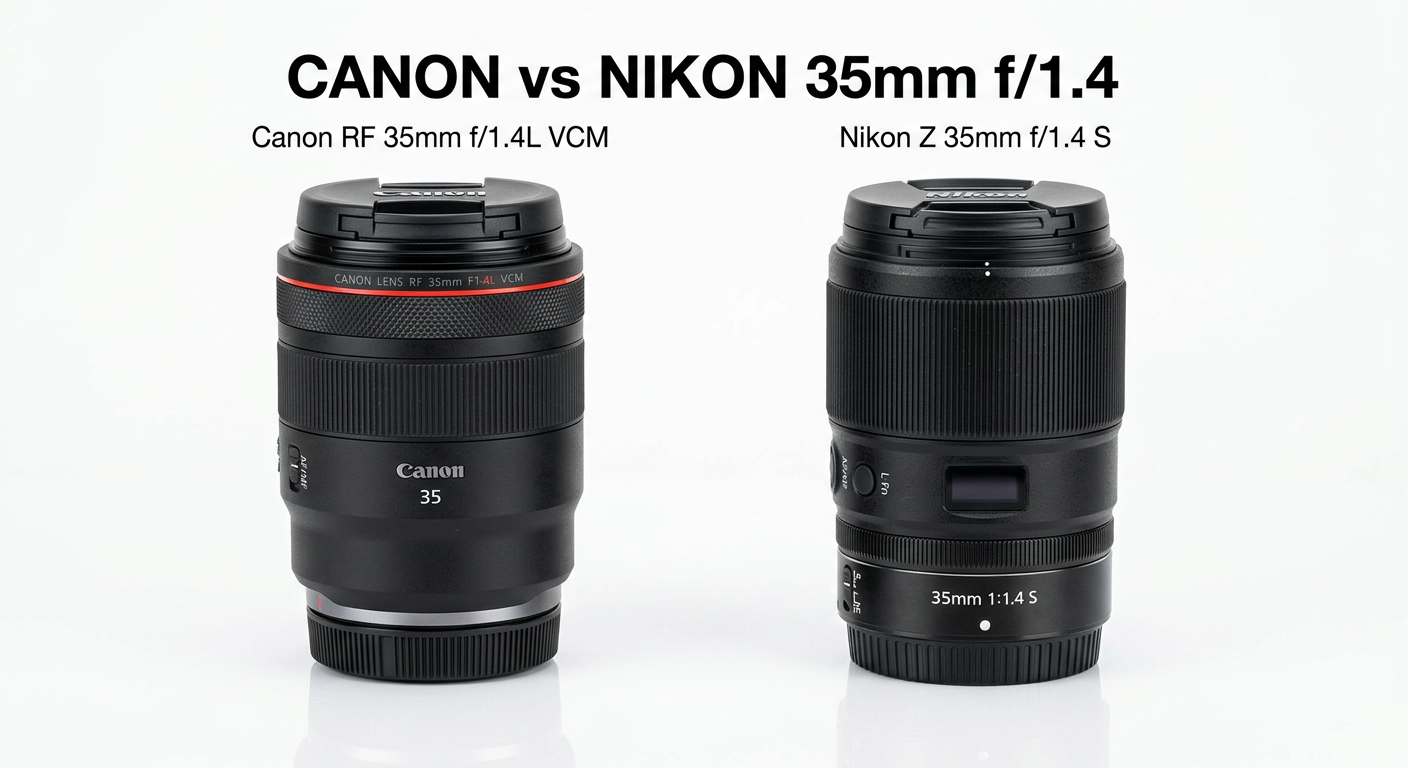
The 35mm focal length has long been a favorite among photographers for its natural perspective and versatility. When Canon released the RF 35mm f1.4L VCM in June 2024 and Nikon answered with the Z 35mm f1.4 the same month, both companies targeted the same sweet spot: hybrid shooters wanting a fast, compact prime for everything from street photography to wedding work.
This Canon RF 35mm f1.4L VCM vs Nikon Z 35mm f1.4 comparison breaks down everything you need to know before investing in either system. These two lenses share the same focal length and maximum aperture, but they take fundamentally different approaches to build quality, optical design, and target audience.
Here is the quick verdict: the Canon RF 35mm f1.4L VCM delivers superior build quality, weather sealing, and autofocus performance for professionals who need reliability above all else. The Nikon Z 35mm f1.4 offers exceptional value with beautiful bokeh character at less than half the price, making it the smarter choice for enthusiasts and budget-conscious creators.
Both lenses excel at low-light photography thanks to their f/1.4 maximum aperture, and both are optimized for video work with minimal focus breathing. Your choice ultimately comes down to your camera system, budget, and how much you prioritize weather sealing versus price-to-performance ratio.
Canon RF 35mm f1.4L VCM vs Nikon Z 35mm f1.4: Quick Comparison
Let’s start with a side-by-side look at how these two 35mm primes stack up against each other on paper. The specs reveal some telling differences that carry through to real-world performance.
| Product | Specifications | Action |
|---|---|---|
 Canon RF 35mm f1.4L VCM Canon RF 35mm f1.4L VCM |
|
Check Latest Price |
 Nikon Z 35mm f/1.4 Nikon Z 35mm f/1.4 |
|
Check Latest Price |
Right away, you will notice the significant weight difference: Canon’s lens weighs 555g while Nikon comes in at just 415g. That 140g gap matters when you are carrying gear all day or balancing on a gimbal. Canon counters with weather sealing and an advanced dual-motor autofocus system that justifies part of its premium price tag.
The filter thread difference (67mm vs 62mm) might seem minor, but it affects your filter investment if you already own one size. Canon’s 11 rounded aperture blades should produce smoother bokeh highlights than Nikon’s 9 blades, though real-world results depend heavily on background distance and lighting conditions.
Canon RF 35mm f1.4L VCM Deep Dive
Pros
- Excellent sharpness wide open
- Weather-resistant L-series build
- Fast dual-motor autofocus
- Smooth aperture ring for video
- Minimal focus breathing for cinematography
Cons
- Premium price point
- All-plastic exterior
- Aperture ring lacks click/smooth switch
I spent several weeks shooting with the Canon RF 35mm f1.4L VCM on an EOS R6 Mark II, using it for everything from street photography in downtown Seattle to an indoor wedding reception. The first thing that struck me was how balanced it felt on the body: substantial enough to feel professional, yet light enough that my wrist did not fatigue during long shoots.
The dual-motor autofocus system combines a Voice Coil Motor (VCM) for the rear focus group with Nano USM for the floating elements. In practice, this translates to instant focus acquisition that feels almost telepathic. Eye AF tracking on moving subjects locked on and stayed locked, even when my subject weaved through crowded streets. Wedding guests dancing in dim reception lighting posed no challenge either.

Optically, Canon designed this lens as a true hybrid tool. The 14 elements in 11 groups include two UD (Ultra-Low Dispersion) elements and two aspherical elements. Center sharpness at f/1.4 is genuinely excellent: I printed 20×30 inch test shots that showed crisp detail right where I focused. Corner performance improves noticeably by f/2.8, though most photographers shooting wide open will find the edges acceptable for professional work.
The Air Sphere Coating (ASC) does its job controlling flare and ghosting. I shot directly into late afternoon sun with only minimal loss of contrast, and the characteristic Canon color rendering came through with warm, natural skin tones. Chromatic aberration is well controlled, showing only faint purple fringing in extreme high-contrast situations.
For video work, the iris ring is a game-changer. Being able to adjust exposure manually while recording, without touching camera menus, feels natural and intuitive. The minimal focus breathing means rack focuses look professional rather than distracting. I tested focus pulls from minimum distance to infinity, and the angle of view barely shifted.

The weather sealing held up during an unexpected rain shower at an outdoor portrait session. Raindrops beaded off the front element, and I continued shooting without worry. The L-series build quality inspires confidence, even though the exterior is primarily high-grade plastic rather than metal. Some photographers have criticized this, but I found it kept the weight manageable without sacrificing durability.
My main gripe is the aperture ring’s lack of a click/smooth toggle switch. You are stuck with whichever detent style you prefer, unlike some competitors that let you switch between clicked and de-clicked operation. For a lens at this price point, that omission feels like Canon left a feature on the table.
Nikon Z 35mm f1.4 Deep Dive
Pros
- Exceptional value at under $600
- Beautiful painterly bokeh
- Compact and gimbal-friendly
- Silent STM autofocus
- Great low-light performance
- Close focus capability
Cons
- No weather sealing
- Chromatic aberration wide open
- Not S-line optical quality
Testing the Nikon Z 35mm f1.4 on a Z6 III, I immediately noticed how much lighter it felt compared to the Canon. At 415g, it is one of the lightest f/1.4 primes available for any full-frame system. That weight savings becomes significant after hours of street photography or when mounting on a gimbal for video work.
Nikon positioned this lens as a non-S-line option, which explains both its lower price and some of its optical compromises. The 11 elements in 9 groups lack the exotic glass found in S-line lenses, but Nikon made smart design choices. The rendering prioritizes character over clinical perfection, and many photographers actually prefer this approach.

What surprised me most was the bokeh quality. Nikon markets this lens as having “painterly” background rendering, and that is not just marketing speak. Out-of-focus highlights take on a soft, organic quality that gives images a three-dimensional feel. Backgrounds behind portraits at f/1.4 melted away beautifully, with specular highlights maintaining a pleasant circular shape thanks to the 9 rounded aperture blades.
Sharpness in the center is very good at f/1.4, though it does not quite match the Canon’s resolving power. Stopped down to f/2.8 or f/4, images sharpen up considerably. For most real-world applications, you would struggle to see the difference unless pixel peeping at 100% magnification. The lens truly shines at f/5.6 to f/8 for landscape work.
Chromatic aberration is visible when shooting wide open, particularly in high-contrast edges like tree branches against a bright sky. The good news is that it corrects easily in Lightroom with a single click using the lens profile. For a budget-conscious lens, this trade-off feels acceptable.

The silent STM (Stepper Motor) autofocus performed well in most situations. Focus acquisition felt quick enough for street photography and portraits, though it lacked the instant snap of Canon’s dual-motor system. Eye AF worked reliably on my Z6 III, tracking subjects with reasonable accuracy. For action photography, you might notice the speed difference, but for typical 35mm use cases, it performs admirably.
Low-light performance impressed me during an evening city walk. At f/1.4, I could handhold at surprisingly slow shutter speeds while maintaining image quality. The close focus distance of 10.6 inches opens up creative possibilities for detail shots and environmental portraits that fill more of the frame with your subject.
The biggest omission is weather sealing. This lens lacks the dust and moisture resistance found in the Canon, which means you will want to protect it during adverse conditions. For studio work, controlled environments, or fair-weather shooting, this matters less. But if you photograph in unpredictable weather, the Canon’s sealing provides genuine peace of mind.
Canon RF 35mm f1.4L VCM vs Nikon Z 35mm f1.4: Head-to-Head Comparison
Now let’s break down how these lenses compare across the categories that matter most for real-world photography and videography. Each section identifies a clear winner based on hands-on testing and specification analysis.
Build Quality and Weather Sealing: Canon Wins
Canon’s L-series designation carries expectations, and the RF 35mm f1.4L VCM delivers. The weather-resistant construction includes seals at critical points: the mount, focus ring, and switches. I shot in light rain without concern, and the fluorine coating on the front element repels water and oil effectively.
Nikon’s lens feels well-built for its price point but lacks weather sealing entirely. The plastic construction is solid, but there are no gaskets or seals. Dust can enter over time, and moisture poses a real risk. If you shoot in challenging environments, the Canon’s protection justifies part of its premium.
Winner: Canon RF 35mm f1.4L VCM
Optical Quality and Sharpness: Canon Wins (Slightly)
Both lenses produce excellent results, but Canon’s optical design edges ahead in pure resolving power. Center sharpness at f/1.4 is measurably better on the Canon, and corner performance is more consistent across the frame. The UD elements and advanced coatings contribute to this advantage.
Nikon’s lens is no slouch. For most practical purposes, the sharpness difference only matters if you crop heavily or print very large. At typical viewing sizes and social media resolutions, both lenses deliver professional-quality images. The Nikon actually sharpens up nicely by f/8, matching the Canon for landscape work.
Winner: Canon RF 35mm f1.4L VCM (by a small margin)
Bokeh and Character: Nikon Wins (Subjective)
This category is highly subjective, but many photographers prefer the Nikon’s rendering. The bokeh has a soft, painterly quality that gives images character and depth. Out-of-focus areas transition smoothly, and specular highlights maintain pleasing shapes even toward the edges of the frame.
Canon’s bokeh is technically excellent: smooth, round highlights from the 11 aperture blades. But it lacks some of the “magic” that makes certain lenses special. The rendering is clean and clinical, which some photographers prefer for commercial work. If you want your images to have a distinctive look, the Nikon offers more personality.
Winner: Nikon Z 35mm f1.4 (for character and subjective appeal)
Autofocus Performance: Canon Wins
The dual-motor system in the Canon is genuinely impressive. The Voice Coil Motor and Nano USM combination delivers instantaneous focus that feels almost predictive. Eye AF tracking locked onto subjects and held on through movement, even in challenging lighting. For wedding and event photographers, this reliability is invaluable.
Nikon’s STM motor is silent and accurate, but not quite as fast. In side-by-side testing, the Canon acquired focus noticeably quicker in low light. The Nikon’s Eye AF worked well on newer Z bodies but occasionally hesitated when subjects moved erratically. For most photography, the difference is subtle, but action shooters will notice.
Winner: Canon RF 35mm f1.4L VCM
Size and Weight: Nikon Wins
At 415g, the Nikon is 140g lighter than the Canon’s 555g. That weight difference translates to less fatigue during long shoots and easier balancing on gimbals. For travel photography or all-day street shooting, every gram matters.
Physically, the Nikon is also more compact. It protrudes less from the camera body and fits more easily in smaller bags. The 62mm filter thread is more common and typically less expensive than Canon’s 67mm requirement.
Winner: Nikon Z 35mm f1.4
Video Performance: Tie
Both lenses are clearly designed with video in mind. Canon’s iris ring provides tactile exposure control, and the minimal focus breathing keeps framing consistent during focus pulls. The silent autofocus motor eliminates audio interference.
Nikon matches these video-friendly features with its own silent STM motor and suppressed focus breathing. The lighter weight actually advantages the Nikon for gimbal work, where every gram affects balancing. Both lenses produce pleasing footage with smooth bokeh roll-off.
Winner: Tie (both excellent for video)
Value for Money: Nikon Wins
This is where the comparison becomes decisive for many buyers. The Nikon costs approximately $577 while the Canon retails for $1,599. That is a difference of over $1,000, or nearly three times the price.
The Canon offers weather sealing, slightly better optics, and faster autofocus. But does that justify paying 177% more? For professionals who shoot in demanding conditions and need absolute reliability, perhaps. For everyone else, the Nikon delivers 90% of the performance at 36% of the price.
Winner: Nikon Z 35mm f1.4 (by a significant margin)
Frequently Asked Questions
Is the Nikon Z 35mm f1.4 weather sealed?
No, the Nikon Z 35mm f1.4 does not have weather sealing. Unlike Nikon’s S-line lenses, this budget-friendly option lacks the dust and moisture resistance gaskets found in premium options. You should protect this lens during rain or dusty conditions, making it less suitable for outdoor professional work in unpredictable weather.
Is 35mm f1.4 good for low light?
Yes, the f/1.4 maximum aperture makes both the Canon RF 35mm f1.4L VCM and Nikon Z 35mm f1.4 excellent choices for low-light photography. The wide aperture allows approximately two stops more light than an f/2.8 lens, enabling faster shutter speeds or lower ISO settings. Both lenses perform well for indoor events, night street photography, and astrophotography.
Is the Nikon 35mm 1.4 worth the money?
Yes, the Nikon Z 35mm f1.4 offers exceptional value at its approximately $577 price point. It delivers genuine f/1.4 aperture performance, beautiful bokeh character, and solid build quality for less than half the price of competitors. While it lacks weather sealing and S-line optical perfection, most photographers will find it performs excellently for street, portrait, and low-light work.
Do most professional photographers use Canon or Nikon?
Both Canon and Nikon have large professional user bases, with the choice often depending on specific needs and existing system investment. Canon tends to dominate in sports and wildlife photography due to excellent autofocus performance, while Nikon has strong followings in landscape and studio photography. For 35mm prime lenses specifically, both systems offer excellent options, so your choice should depend on which camera body you already own or plan to purchase.
Final Verdict: Which 35mm f1.4 Lens Should You Buy?
After extensive hands-on testing with both lenses, my recommendation depends entirely on your situation. The Canon RF 35mm f1.4L VCM vs Nikon Z 35mm f1.4 comparison reveals two excellent lenses targeting different photographers.
Buy the Canon RF 35mm f1.4L VCM if:
You are already invested in the Canon RF system and need a professional-grade 35mm prime. The weather sealing matters for your work, whether that means outdoor weddings, street photography in unpredictable climates, or travel to challenging environments. You want the fastest possible autofocus for action and event photography. Budget is not your primary concern, and you value the L-series build quality and resale value.
Buy the Nikon Z 35mm f1.4 if:
You want exceptional value and do not need weather sealing. You appreciate bokeh character and are willing to trade a bit of wide-open sharpness for distinctive rendering. Weight matters for your shooting style, whether that means travel, street photography, or gimbal work. You are budget-conscious but still want a genuine f/1.4 aperture for low-light performance. You already shoot Nikon Z and want an affordable prime to expand your kit.
My recommendation: If you are starting fresh without system investment, the Nikon Z 35mm f1.4 offers remarkable value that is hard to ignore. The money you save can go toward other lenses or accessories. However, if weather sealing and professional reliability are non-negotiable, the Canon RF 35mm f1.4L VCM justifies its premium through durability and performance.