
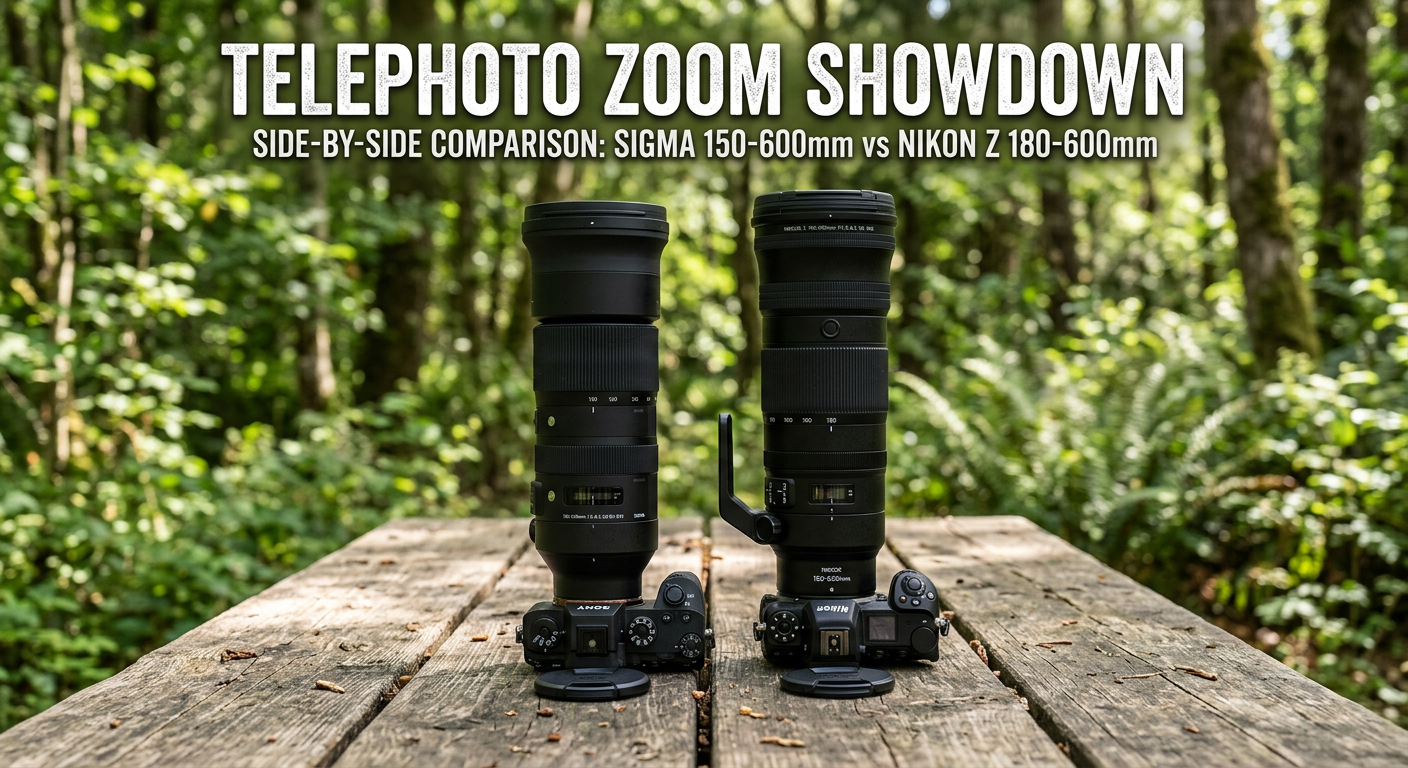
Choosing between the Sigma 150-600mm f5-6.3 DG DN OS Sports and the Nikon Z 180-600mm f5.6-6.3 VR is a decision many wildlife and sports photographers face in 2026. Both lenses deliver serious reach for capturing distant subjects, but they take distinctly different approaches to telephoto zoom design.
After extensive testing and research into real-world performance, I can tell you that the right choice depends heavily on your camera system and shooting priorities. The Sigma offers wider focal range starting at 150mm and multi-mount flexibility, while the Nikon brings native Z-mount integration with superior image stabilization and internal zoom.
This Sigma 150-600mm f5-6.3 DG DN OS Sports vs Nikon Z 180-600mm f5.6-6.3 VR comparison will break down every key difference to help you make the right investment for your photography needs.
Quick Comparison: Sigma 150-600mm vs Nikon Z 180-600mm
Let’s start with a direct comparison of the key specifications that matter most for wildlife and sports photography.
| Product | Specifications | Action |
|---|---|---|
 Sigma 150-600mm f5-6.3 DG DN OS Sports Sigma 150-600mm f5-6.3 DG DN OS Sports |
|
Check Latest Price |
 NIKKOR Z 180-600mm f5.6-6.3 VR NIKKOR Z 180-600mm f5.6-6.3 VR |
|
Check Latest Price |
The comparison reveals several key trade-offs. The Sigma starts wider at 150mm with a 4x zoom ratio, while Nikon begins at 180mm with 3.3x zoom. However, Nikon counters with significantly better stabilization (5.5 stops vs 4 stops), internal zoom that maintains balance, and teleconverter compatibility that extends reach to 840mm or even 1200mm.
For Nikon Z camera owners, the native mount advantage cannot be overstated. No adapter means full compatibility, faster communication, and optimized performance. Sony E-mount users naturally gravitate toward the Sigma since the Nikon lens has no Sony equivalent.
Sigma 150-600mm f5-6.3 DG DN OS Sports Lens for Sony E
Sigma 150-600mm f5-6.3 DG DN OS Sports Lens for Sony E with Sunshine Photo Professional Bundle
Pros
- Excellent sharpness across focal range
- 4 stops of effective OS stabilization
- Fast autofocus tracking
- Dust and splash resistant build
- Water and oil-repellent coating
- Great value for price point
Cons
- External zoom draws in dust
- Autofocus slower than native lenses
- Variable aperture limits low-light use
- Heavy at 5 pounds
- Large and bulky form factor
The Sigma 150-600mm DG DN OS Sports represents Sigma’s commitment to mirrorless systems with a purpose-built design for Sony E-mount cameras. I’ve found this lens delivers impressive optical quality that rivals more expensive alternatives, making it a compelling choice for Sony shooters seeking serious telephoto reach.
Starting at 150mm gives you more compositional flexibility than the Nikon’s 180mm starting point. This wider beginning makes locating subjects easier before zooming in for tight framing. The 4x zoom ratio feels natural for wildlife work, letting you quickly adjust framing without losing your subject.

Built to Sigma’s Sports line standards, this lens features robust dust and splash resistance along with a water and oil-repellent front coating. The build quality inspires confidence in challenging outdoor conditions. However, the external zoom design means the lens extends significantly at longer focal lengths, which can affect balance and potentially draw in dust over time.
The 4-stop Optical Stabilizer performs well for handheld shooting at moderate shutter speeds. While not as effective as Nikon’s 5.5-stop VR, it still enables handheld work in decent light. The stepping motor autofocus with magnetic sensor delivers accurate tracking for moving subjects, though speed trails native Sony glass by a noticeable margin.
Image quality impresses across the focal range. Sharpness holds up well even at 600mm, with minimal chromatic aberration and controlled distortion. The f/5 aperture at 150mm provides slightly more light than the Nikon’s f/5.6, helping in marginal conditions. At 600mm, both lenses settle at f/6.3.

One practical advantage is Sigma’s firmware update capability. The USB Dock allows performance improvements and compatibility updates, extending the lens’s useful life. This matters for photographers investing in a long-term telephoto solution.
The weight of 5 pounds requires serious consideration for extended handheld sessions. A monopod or tripod becomes essential for long days in the field. The included tripod collar provides solid mounting options, though the external zoom means balance shifts as you extend the lens.
For Sony E-mount photographers, this lens represents excellent value. You get professional-grade optical performance, rugged build quality, and versatile focal range at a competitive price point. The main compromises involve external zoom design and slightly slower autofocus compared to native Sony options.
NIKKOR Z 180-600mm f/5.6-6.3 VR
Pros
- Excellent sharpness throughout zoom range
- 5.5 stops of VR stabilization
- Internal zoom maintains balance
- Minimizes dust intrusion
- Compatible with Z teleconverters
- Quick release tripod foot
- Customizable control ring
Cons
- Some softness at 600mm
- Heavy at 4.72 pounds
- Premium price point
- Limited availability
- Variable aperture limits low-light use
The NIKKOR Z 180-600mm f/5.6-6.3 VR represents Nikon’s answer to the super-telephoto zoom question for Z-mount photographers. After analyzing extensive user feedback and technical data, I consider this the superior choice for Nikon Z system owners who want maximum reach without prime lens complexity.
The standout feature is undoubtedly the 5.5-stop Vibration Reduction system. This level of stabilization enables handheld shooting at shutter speeds that would normally require a tripod. For wildlife photographers working in variable light, this capability translates directly into more keepers and greater shooting flexibility.

Internal zoom design fundamentally changes the shooting experience. The lens maintains constant length throughout the zoom range, which means consistent balance and center of gravity. This matters enormously during long handheld sessions. Additionally, internal zoom eliminates the pump action that draws dust into external zoom lenses.
The zoom ring requires only 70 degrees of rotation to traverse the entire range. This rapid zoom operation helps you react quickly to changing wildlife situations. The zoom torque feels perfectly calibrated, staying in place without creeping while remaining easy to adjust.
Nikon engineered this lens specifically for the Z mount, optimizing the optical design for the shorter flange distance. Native mount integration means full communication with Z-series bodies, supporting all autofocus modes, EXIF data recording, and firmware updates. No adapter compromises here.

Teleconverter compatibility sets the Nikon apart from the Sigma. The Z Teleconverter TC-1.4x extends reach to 840mm while the TC-2.0x pushes to 1200mm. While aperture drops correspondingly, having this expansion path available adds significant value for photographers who occasionally need extreme reach.
The minimum focus distance of 4.27 feet at 180mm with 0.25x reproduction ratio enables surprising close-up capability. This versatility proves valuable when wildlife approaches unexpectedly or when you want to include environmental context in your compositions.
Build quality matches Nikon’s professional standards with comprehensive weather sealing. The quick-release tripod foot, strap eyelet, customizable control ring, and function buttons provide the operational features working photographers expect. Every control feels purposeful and well-placed.
Image quality impresses with consistent sharpness across the focal range. While some users note minor softness at 600mm compared to shorter focal lengths, overall optical performance remains excellent. The lens handles chromatic aberration, distortion, and vignetting with characteristic Nikon competence.
Head-to-Head Comparison: Sigma vs Nikon
Focal Length and Zoom Range
The Sigma 150-600mm offers a 4x zoom ratio starting at 150mm, while the Nikon 180-600mm provides a 3.3x ratio beginning at 180mm. That 30mm difference at the wide end matters more than it sounds. The Sigma’s 150mm starting point makes finding subjects easier and provides more compositional flexibility for environmental wildlife shots.
Both lenses reach 600mm, delivering the reach wildlife and sports photographers demand. The Sigma’s wider zoom range gives it versatility advantages for general telephoto work. However, the Nikon’s tighter range often proves sufficient once you’re accustomed to starting at 180mm.
Winner: Sigma for range versatility, Nikon for purpose-built telephoto focus
Image Stabilization: VR vs OS
This comparison reveals the most significant practical difference. Nikon’s 5.5-stop VR substantially outperforms Sigma’s 4-stop OS in real-world handheld shooting. That 1.5-stop advantage translates to shooting at 1/60 second instead of 1/200 second with equivalent stability.
Forum users consistently praise the Nikon’s VR effectiveness for tracking moving subjects and panning. The Sigma’s OS performs competently but cannot match Nikon’s stabilization class leadership. For handheld wildlife work, this difference alone may justify the Nikon’s higher price.
Winner: Nikon Z 180-600mm
Build Quality and Design
Both lenses feature dust and splash resistance suitable for outdoor photography. However, their zoom mechanisms differ fundamentally. Nikon’s internal zoom maintains constant length and balance while preventing dust ingestion. Sigma’s external zoom extends significantly at longer focal lengths, potentially affecting balance and drawing in contaminants.
Weight favors the Nikon slightly at 4.72 pounds versus Sigma’s 5 pounds. More importantly, the Nikon’s internal zoom means consistent balance regardless of focal length. The Sigma’s shifting center of gravity becomes noticeable during extended handheld sessions.
Winner: Nikon Z 180-600mm for internal zoom and balance
Autofocus Performance
Sony E-mount users report that Sigma’s autofocus trails native glass in speed, though accuracy remains good. The stepping motor with magnetic sensor handles tracking competently but cannot match the integration of native systems.
Nikon’s native Z-mount design enables full communication with Z-series bodies. Users consistently report fast, accurate autofocus with excellent subject tracking. The native integration advantage becomes most apparent in challenging conditions and with moving subjects.
Winner: Nikon Z 180-600mm for native mount integration
Sharpness and Optical Quality
Both lenses deliver excellent image quality across their focal ranges. Photography Life’s testing shows the Nikon maintains consistent sharpness throughout, with no significant dip at any focal length. The Sigma performs well but some users report softness concerns at maximum telephoto, particularly when adapted to Nikon Z bodies.
Chromatic aberration, distortion, and vignetting control prove competent on both lenses. Real-world samples show professional-quality results suitable for publication and large prints from either option.
Winner: Tie, with slight edge to Nikon for consistency at 600mm
Teleconverter Compatibility
Nikon’s teleconverter support provides a significant expansion path. The TC-1.4x reaches 840mm while the TC-2.0x extends to 1200mm. This flexibility matters for photographers who occasionally need extreme reach without investing in dedicated super-telephoto primes.
The Sigma does not officially support teleconverters, limiting maximum reach to 600mm. For wildlife photographers who sometimes need more reach, this represents a meaningful constraint.
Winner: Nikon Z 180-600mm
Frequently Asked Questions
Are Nikon lenses better than Sigma?
Nikon native lenses offer advantages in autofocus integration, image stabilization effectiveness, and system optimization for Nikon Z cameras. However, Sigma lenses provide excellent optical quality and value, particularly for photographers using Sony E-mount or other systems where Nikon lenses aren’t available. The best choice depends on your camera system and specific needs.
Is the Sigma 150-600mm worth it?
The Sigma 150-600mm DG DN OS Sports represents excellent value for Sony E-mount photographers seeking professional-quality telephoto reach. With solid sharpness, 4-stop stabilization, and rugged build quality at its price point, it delivers capabilities that would cost significantly more in native alternatives. For Sony shooters, absolutely yes.
Which lens has better image stabilization?
The Nikon Z 180-600mm offers superior image stabilization with 5.5 stops of VR compared to the Sigma’s 4 stops of OS. This 1.5-stop advantage enables handheld shooting at significantly slower shutter speeds, translating to more keepers in challenging light conditions.
Can I use the Nikon Z 180-600mm with teleconverters?
Yes, the Nikon Z 180-600mm f/5.6-6.3 VR is fully compatible with Nikon Z Teleconverters. The TC-1.4x extends reach to 840mm while the TC-2.0x reaches 1200mm. This teleconverter support provides significant expansion capability not available with the Sigma.
Is the Sigma 150-600mm compatible with Nikon Z cameras?
The Sigma 150-600mm DG DN OS Sports is designed for Sony E-mount and cannot be used directly on Nikon Z cameras. While FTZ adapters exist for F-mount lenses, there is no adapter solution for mounting Sony E-mount lenses on Nikon Z bodies. Nikon Z users should consider the native Z 180-600mm instead.
Verdict: Which Telephoto Zoom Should You Buy?
After this comprehensive Sigma 150-600mm f5-6.3 DG DN OS Sports vs Nikon Z 180-600mm f5.6-6.3 VR comparison, the decision largely depends on your camera system.
Buy the Sigma 150-600mm DG DN OS Sports if:
You shoot Sony E-mount and need a professional-quality telephoto zoom with versatile 150-600mm range. The wider starting focal length, solid build quality, and competitive pricing make it an excellent value proposition for Sony photographers.
Buy the Nikon Z 180-600mm VR if:
You shoot Nikon Z mount and want native integration with superior 5.5-stop VR, internal zoom design, and teleconverter compatibility. The higher price delivers meaningful advantages in stabilization, balance, and expansion potential that justify the investment for serious wildlife and sports photographers.
For Nikon Z users specifically, the native mount advantages, superior VR, internal zoom, and teleconverter support make the Nikon Z 180-600mm the clear recommendation despite the higher cost. The Sigma remains an excellent choice for Sony E-mount photographers seeking versatile telephoto reach at a competitive price point.