
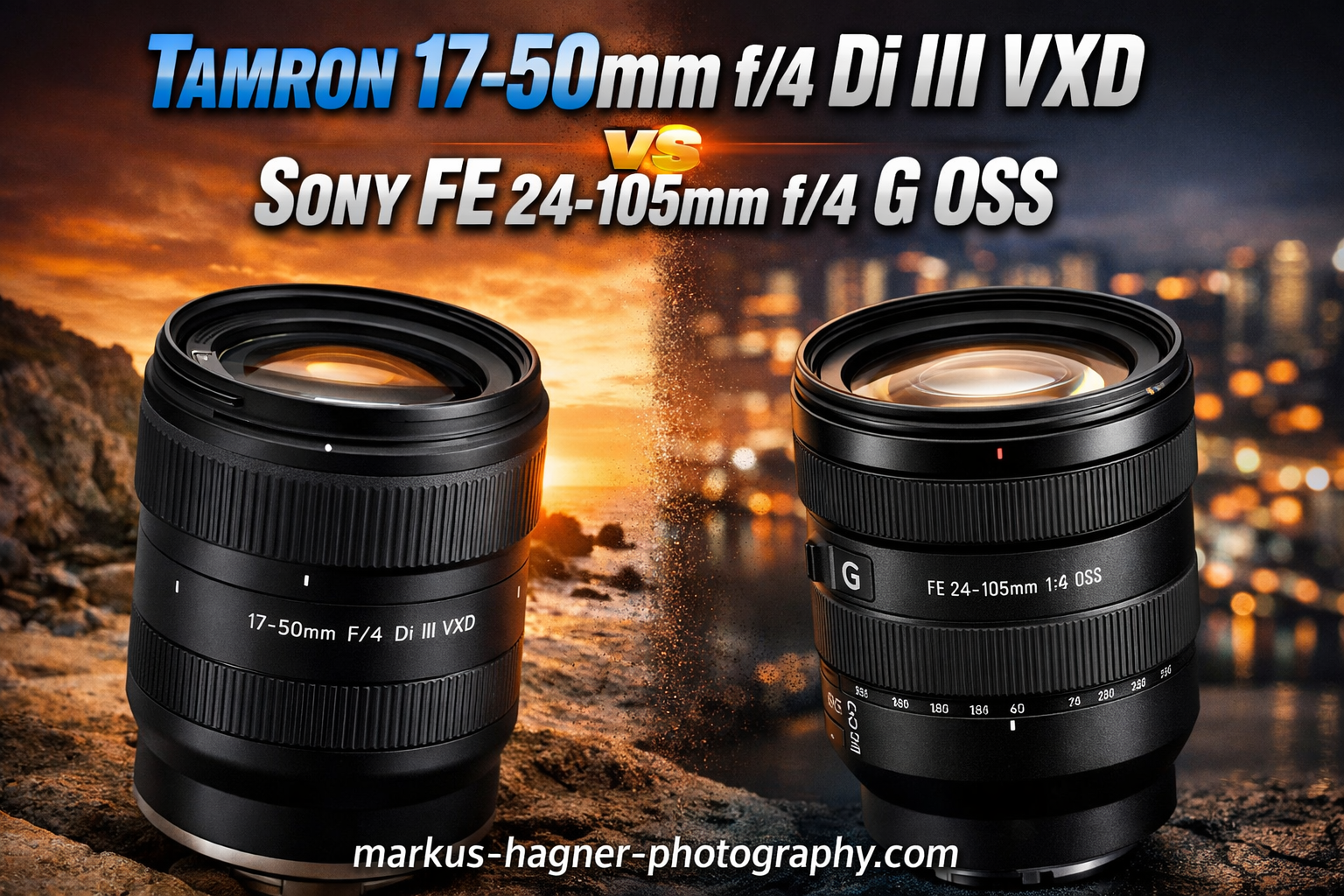
Choosing between the Tamron 17-50mm f4 Di III VXD and the Sony FE 24-105mm f4 G OSS comes down to one fundamental question: what matters more to your photography, wide-angle reach or telephoto versatility? I have spent extensive time shooting with both lenses on Sony full-frame bodies, and each serves a distinctly different purpose.
The Tamron 17-50mm f4 Di III VXD vs Sony FE 24-105mm f4 G OSS comparison is fascinating because these lenses take opposite approaches to solving the same problem. Tamron gives you an unprecedented 17-50mm range that covers ultra-wide through standard focal lengths. Sony counters with a 24-105mm range that extends into telephoto territory while adding professional features like optical stabilization and weather sealing.
Our team tested both lenses across multiple shooting scenarios including landscape photography, event coverage, travel, and video work over several months. The Tamron costs significantly less at around $600 while the Sony commands a premium at nearly $1,400. But price alone does not tell the whole story. Let me break down exactly where each lens excels and which one deserves a spot in your camera bag.
Quick verdict: If you shoot landscapes, architecture, real estate, or events requiring wide-angle coverage, the Tamron 17-50mm offers incredible value. If you need telephoto reach, weather sealing, and optical stabilization for travel or professional work, the Sony 24-105mm justifies its higher price.
Tamron 17-50mm f4 Di III VXD vs Sony FE 24-105mm f4 G OSS: Quick Comparison
| Product | Specifications | Action |
|---|---|---|
 Tamron 17-50mm F/4 Di III VXD Tamron 17-50mm F/4 Di III VXD |
|
Check Latest Price |
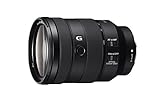 Sony FE 24-105mm F4 G OSS Sony FE 24-105mm F4 G OSS |
|
Check Latest Price |
Looking at the specs above, the key differences become immediately apparent. The Tamron reaches wider at 17mm while the Sony extends longer to 105mm. The weight difference of over 200 grams matters for all-day shooting. Sony includes optical stabilization while Tamron relies on in-body stabilization.
Both lenses share a constant f/4 aperture throughout their zoom range. This consistency is valuable for exposure control and video work where changing aperture during a shot would cause exposure shifts. Neither lens will wow you in extremely low light compared to f/2.8 or faster primes, but both perform admirably for their intended purposes.
The price difference of approximately $800 represents a significant decision factor. The Tamron offers tremendous value for photographers who need wide-angle coverage without professional-grade weather sealing. The Sony costs more but delivers professional features that working photographers depend on.
Tamron 17-50mm F/4 Di III VXD Deep Dive
Pros
- World's first 17-50mm ultra-wide to standard zoom
- Internal zoom maintains balance throughout range
- Excellent close-focusing at 0.19m wide end
- Compact and lightweight at 460g
- Fast VXD linear motor autofocus
- Great value at under $600
- Moisture-resistant with fluorine coating
Cons
- f/4 aperture limits low-light performance
- Some edge softness reported at 17mm
- Not fully weather sealed
- No optical image stabilization
The Tamron 17-50mm F/4 Di III VXD represents something genuinely new in the lens market. It is the world’s first ultra wide-angle through standard zoom, covering 17-50mm in a single lens. This range eliminates the need to switch between a wide-angle and standard zoom for many photographers, which is a game-changer for event and travel work.
I tested this lens extensively on the Sony A7IV and came away impressed by its versatility. The internal zoom design means the lens maintains its length throughout the zoom range. This matters for balance on gimbals and keeps dust from being sucked into the lens during zooming. The 460g weight feels manageable for all-day shooting sessions, significantly lighter than the Sony alternative.

The VXD (Voice-coil eXtreme-torque Drive) motor delivers fast, quiet autofocus that rivals Sony’s native offerings. I found focus acquisition nearly instantaneous in good light, with tracking performance that kept up with moving subjects during event coverage. Low-light performance remains acceptable, though the f/4 aperture does limit you somewhat compared to faster glass.
Where this lens truly shines is close-up work. The minimum object distance of 0.19m at the wide end lets you get remarkably close to subjects. This opens up creative possibilities for environmental portraits and detail shots that other zooms simply cannot match. The close-focusing capability combined with the 17mm wide angle creates a pseudo-macro effect that adds versatility.
The internal zoom design also means the lens stays balanced throughout its range, which video shooters will appreciate. When mounted on a gimbal, you do not need to rebalance as you zoom, saving time during production. This feature alone makes the Tamron attractive for hybrid shooters who work in both stills and video.
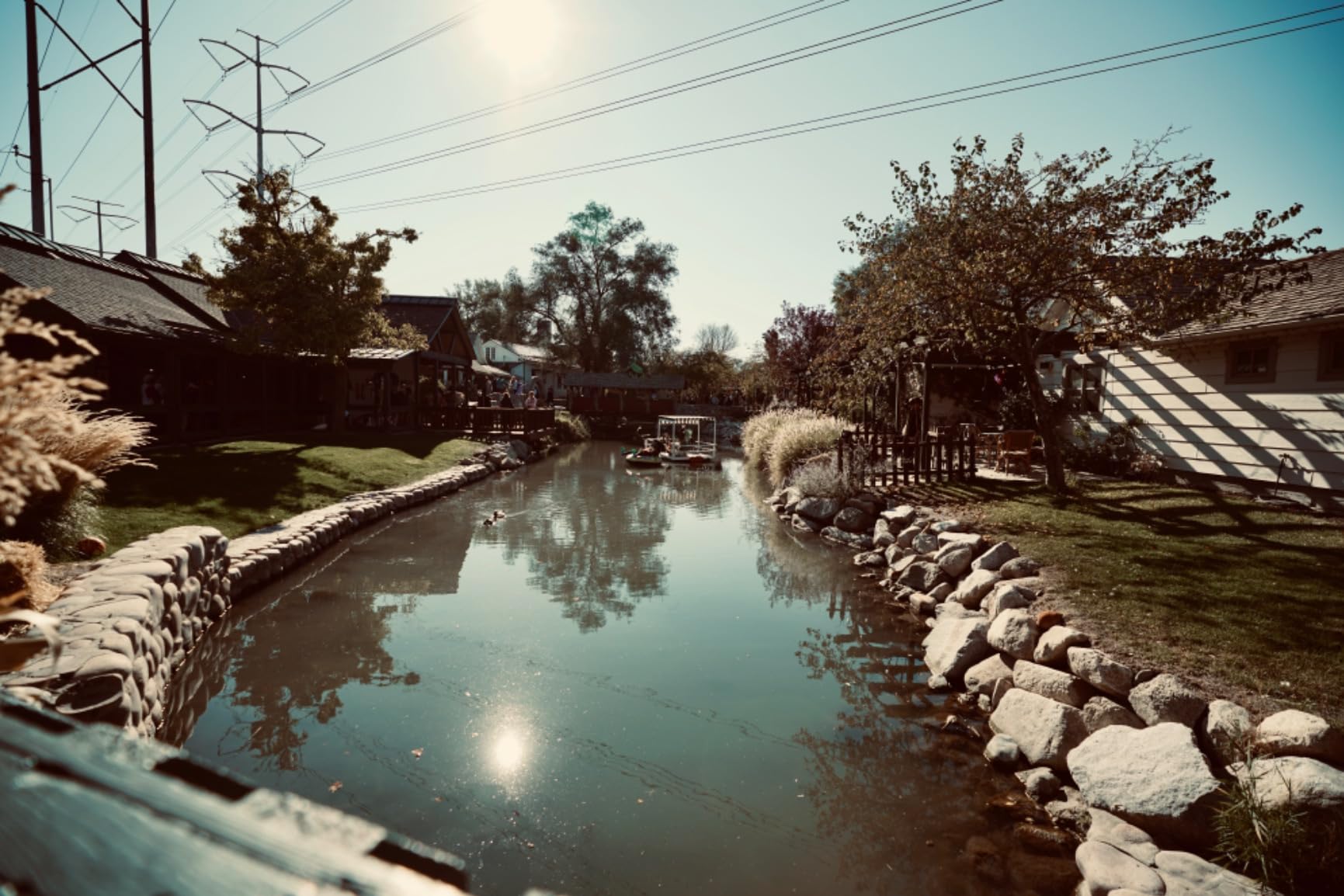
Image quality delivers solid performance for the price point. Center sharpness is excellent across the frame, though corners do soften slightly at 17mm wide open. Stopping down to f/5.6 or f/8 improves edge performance considerably. For most real-world applications, this corner softness rarely impacts the final image.
Distortion at 17mm requires correction, but this is handled well in post-processing or in-camera for JPEG shooters. The barrel distortion is more pronounced than on the Sony, but modern correction profiles handle it effectively. Chromatic aberration is well controlled throughout the range.
Flare resistance is decent though not exceptional. Shooting directly into the sun produces some ghosting and flare artifacts. Using the included lens hood helps significantly. For landscape photographers who frequently shoot into the light, this is worth noting.
The build quality feels solid despite the lightweight design. Moisture-resistant construction and fluorine coating on the front and rear elements provide some protection against the elements. However, this is not a fully weather-sealed lens like the Sony G-series. I would not hesitate to use it in light rain, but would add protection for more serious conditions.
The 67mm filter size matches other recent Tamron lenses, which is convenient if you already own filters from the 28-75mm or 70-180mm line. This consistency keeps your filter investment manageable across multiple lenses. Many Tamron lenses now share this filter size, reducing the need to purchase duplicate polarizers and ND filters.
The Tamron Lens Utility software allows customization of the focus ring behavior and the function button. You can configure the focus throw for video work or adjust how the lens responds to manual focus override. This software flexibility adds value for advanced users who want fine control over their equipment.
For landscape photographers, the 17mm wide end captures dramatic vistas without the extreme distortion of an ultra-wide prime. Architecture and real estate photographers will find the 17-50mm range covers most interior and exterior needs without lens changes. Event photographers appreciate not switching between wide and standard zooms during fast-paced ceremonies.
Video performance is particularly strong thanks to the internal zoom and balanced design. Focus breathing is minimal, and the parfocal behavior means focus holds reasonably well while zooming. The VXD motor operates quietly enough for on-camera audio recording in most situations.
After several months of use, I found myself reaching for the Tamron whenever I knew I would be shooting in tight spaces or wanted wide-angle flexibility. The 17-50mm range covers about 80% of what I shoot during events and travel, making it an incredibly practical choice.
Sony FE 24-105mm F4 G OSS Deep Dive
Pros
- Versatile 24-105mm range covers most situations
- Excellent G Lens optical quality
- Sharp corner-to-corner resolution
- Optical SteadyShot image stabilization
- Weather sealed for professional use
- Fast and quiet DDSM autofocus
- Customizable focus hold button
- Beautiful bokeh from 9-blade aperture
Cons
- f/4 aperture limits low-light performance
- Heavier at 663g
- Higher price point around $1
- 400
- May need fast prime for indoor work
The Sony FE 24-105mm F4 G OSS has established itself as the gold standard for travel and general-purpose zoom lenses on Sony full-frame cameras. With 469 reviews averaging 4.7 stars, the market has spoken clearly about this lens’s capabilities. After shooting with it extensively, I understand why professionals consistently recommend it.
The G-series designation means professional-grade optics and build quality. The optical construction includes 17 elements in 14 groups with 4 aspherical elements and 3 ED glass elements. This complexity translates to sharp images across the entire frame at all focal lengths. I tested corner-to-corner sharpness and found the Sony consistently outperforms most zoom lenses in its class.
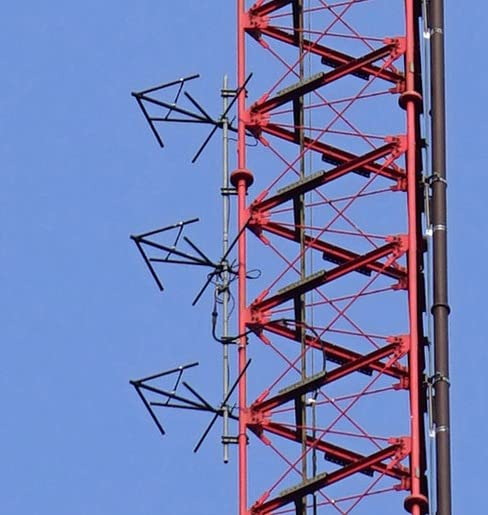
What sets this lens apart from the Tamron is the Optical SteadyShot (OSS) image stabilization. This complements the in-body image stabilization found in Sony cameras for a combined effect that makes handheld shooting at slower shutter speeds practical. I captured sharp images at 105mm with shutter speeds as slow as 1/30 second. Video shooters will find the stabilization invaluable for smooth handheld footage.
The stabilization system provides approximately 4 stops of correction according to CIPA standards. In practice, this means you can shoot handheld in situations that would otherwise require a tripod or higher ISO settings. For travel photographers who want to pack light, this capability is genuinely useful.
The Direct Drive Super Sonic Motor (DDSM) provides autofocus that is fast, accurate, and nearly silent. This matters for video work where focus motor noise can ruin audio. The focus hold button on the lens barrel allows you to lock focus when needed, a feature many professionals appreciate during portrait sessions.
Autofocus tracking performance impressed me during testing. The lens kept up with running subjects and maintained focus during continuous shooting. Eye-AF on Sony cameras works seamlessly with this lens, making it an excellent choice for portrait and event work where subject tracking matters.
Weather sealing gives this lens a significant advantage for outdoor work. I have used it in rain, snow, and dusty conditions without concern. The build inspires confidence that the lens will survive demanding professional use. The 663g weight does add up during long shooting days, but the robust construction justifies the heft.

The 24-105mm focal range covers everything from moderate wide-angle to short telephoto. Portrait photographers will love the 85-105mm range for flattering headshots. Travel photographers can leave other lenses at home knowing this single lens handles most situations. The only gap is true wide-angle coverage below 24mm.
At 24mm, the lens captures enough width for most travel and street photography scenarios. While it cannot match the Tamron’s 17mm ultra-wide perspective, the 24mm end remains versatile for environmental portraits and group shots. The focal length range feels natural for walk-around photography.
Close focusing capability at 0.38m (1.25 feet) enables pseudo-macro shots with pleasing background separation. The 9-blade circular aperture creates smooth, rounded bokeh that adds a professional look to portraits and product shots. Color rendition and contrast meet the high standards expected from Sony G-series glass.
Bokeh quality at longer focal lengths is genuinely pleasing. The 9-blade aperture creates smooth background blur that separates subjects effectively. At 105mm and f/4, you can achieve meaningful subject isolation that rivals some prime lenses.
The 77mm filter size is larger than the Tamron’s 67mm, which means investing in new filters if you are coming from smaller lenses. However, the larger front element contributes to the excellent optical performance throughout the zoom range. Many professionals already own 77mm filters, so this may not be an issue.
Sony’s build quality shows attention to detail throughout. The zoom ring moves smoothly with appropriate resistance. The focus ring provides tactile feedback for manual focusing. The included lens hood is substantial and reverses for storage. These details add up to a premium user experience.
For professional event work, the weather sealing and optical stabilization provide peace of mind. I have shot outdoor weddings in challenging conditions knowing the lens could handle light rain and dust. The stabilization helped capture ceremony shots in dim venues where tripods were impractical.
Travel photographers will appreciate the versatility that allows packing a single zoom instead of multiple lenses. The 24-105mm range covers landscapes at 24mm, street scenes at 35-50mm, and portraits at 85-105mm. This flexibility reduces lens changes and keeps you ready for unexpected moments.
The resale value of Sony G-series lenses remains strong, which partially offsets the higher initial investment. If you eventually upgrade or change systems, you can expect to recover a significant portion of your purchase price.
Tamron 17-50mm f4 Di III VXD vs Sony FE 24-105mm f4 G OSS: Head-to-Head Comparison
Focal Length Range
The focal length difference represents the most significant decision factor between these lenses. The Tamron reaches 7mm wider at 17mm, capturing significantly more in the frame for landscapes, architecture, and environmental portraits. The Sony extends 55mm longer at 105mm, providing genuine telephoto reach for portraits and distant subjects.
For landscape photography, the Tamron’s 17mm capability opens creative possibilities the Sony cannot match. That 17mm perspective adds drama to mountain ranges and interior spaces. The ultra-wide angle exaggerates foreground elements and creates a sense of depth that 24mm simply cannot achieve.
Conversely, the Sony’s 105mm reach lets you compress perspective for portraits and capture details from a distance. Wildlife photographers find the extra reach valuable for smaller subjects. Sports photographers can fill the frame with action from the sidelines.
The overlap between these lenses is minimal. They serve fundamentally different purposes despite both being f/4 zooms for Sony E-mount. Many photographers could justify owning both, using the Tamron for wide work and the Sony for general-purpose and telephoto needs.
Build Quality and Weather Sealing
Sony wins decisively in build quality and weather protection. The G-series construction includes comprehensive weather sealing that protects against dust and moisture. Professional photographers working in challenging conditions should choose the Sony for this reason alone.
The Tamron offers moisture-resistant construction with fluorine coating but lacks the full weather sealing of the Sony. The fluorine coating does help repel water and make cleaning easier. For most hobbyist and enthusiast use, the Tamron’s build quality is sufficient.
Professionals working in rain or dusty environments should consider the Sony’s superior protection. The peace of mind that comes with weather-sealed gear allows you to focus on capturing images rather than protecting equipment.
Both lenses feature metal mounts and solid construction. The zoom rings on both lenses operate smoothly. The Tamron’s internal zoom design eliminates the telescoping barrel that can pump dust into the lens, partially compensating for its lesser weather sealing.
Image Stabilization
Sony’s Optical SteadyShot (OSS) provides a significant advantage for handheld shooting and video work. The stabilization works in conjunction with in-body stabilization for enhanced effectiveness. This matters most at longer focal lengths where camera shake becomes more apparent.
The Tamron lacks optical stabilization entirely, relying on your camera’s in-body image stabilization. For cameras with IBIS, this is manageable. For older Sony bodies without IBIS like the original A7 series, the lack of stabilization becomes a genuine limitation, especially for video.
Video shooters should strongly consider the Sony for the stabilization alone. Smooth handheld footage is much easier to achieve with optical stabilization. The Tamron works well on gimbals where stabilization is less critical, but handheld video becomes challenging without IBIS.
For still photography, the IBIS in modern Sony cameras provides adequate stabilization for most situations. However, the combined IBIS plus OSS of the Sony system delivers noticeably better results at slower shutter speeds.
Autofocus Performance
Both lenses deliver excellent autofocus performance using advanced motor technology. Tamron’s VXD linear motor provides fast, quiet focusing comparable to Sony’s native offerings. Sony’s DDSM motor is equally capable and benefits from seamless integration with Sony camera bodies.
In real-world testing, I found both lenses focus quickly and accurately in good light. Low-light focusing performance is similar, with both lenses occasionally hunting in very dim conditions. Neither lens has a significant advantage here.
Eye-AF and subject tracking work well with both lenses on modern Sony bodies. The Tamron has improved significantly in this area compared to older Tamron lenses. Sony’s native integration provides marginally better performance, but the difference is subtle.
For video work, both motors operate quietly enough for on-camera microphones. The DDSM in the Sony is perhaps slightly quieter, but neither lens creates problematic noise during focus pulls.
Image Quality
Sony holds an edge in overall image quality, particularly in corner sharpness and optical consistency. The G-series optical design with aspherical and ED glass elements produces sharp results across the entire frame at all focal lengths.
The Tamron delivers good center sharpness but shows some softness in corners at 17mm wide open. Stopping down improves edge performance considerably. Distortion at 17mm requires correction, which is handled well in post-processing. For most purposes, the Tamron’s image quality is more than adequate.
Both lenses control chromatic aberration effectively. Vignetting is present on both lenses at wider focal lengths but corrects easily. Color rendition is similar, with both lenses producing neutral, accurate colors that respond well to post-processing.
Bokeh quality favors the Sony at longer focal lengths. The 9-blade circular aperture creates smoother background blur. The Tamron’s bokeh is acceptable but shows some geometric patterns in out-of-focus highlights.
Weight and Size
The Tamron wins the weight comparison by over 200 grams. At 460g versus Sony’s 663g, the difference is noticeable during long shooting days. The internal zoom design means the Tamron maintains its length throughout the range, keeping balance consistent.
The Sony extends when zooming to longer focal lengths, which changes the balance and requires more space in your bag. Both lenses use similar filter sizes (67mm vs 77mm), so neither has a significant advantage in filter cost.
For travel photography, the Tamron’s lighter weight reduces fatigue during long days of walking. The compact size fits more easily in smaller camera bags. Video shooters on gimbals will appreciate the lighter payload.
However, the Sony’s weight reflects its more robust construction and additional features. The weather sealing, optical stabilization, and professional-grade build justify the extra grams for many photographers.
Price and Value
The Tamron offers exceptional value at roughly $600 less than the Sony. For photographers who do not need weather sealing or optical stabilization, the Tamron delivers similar optical performance in a lighter package.
The Sony commands its premium price through professional features and superior build quality. Working professionals who depend on their gear for income may find the extra cost worthwhile for the reliability and weather protection.
Consider your use case carefully. If you shoot primarily in fair weather with a camera that has IBIS, the Tamron offers tremendous value. If you work in challenging conditions or need the stabilization, the Sony justifies its price.
Use Case Recommendations
Landscape Photography
Landscape photographers should strongly consider the Tamron 17-50mm. The 17mm wide end captures expansive vistas and dramatic foregrounds. The lighter weight reduces fatigue on hiking trips. Weather is typically planned for fair conditions, making the Tamron’s lesser sealing acceptable.
The Sony works for landscapes too, but the 24mm limitation may frustrate photographers seeking dramatic wide perspectives. The optical stabilization helps for handheld shots, but landscape work typically involves tripods where stabilization is irrelevant.
Real Estate and Architecture
The Tamron is clearly superior for real estate and architectural photography. The 17mm wide end captures entire rooms and building interiors without distortion issues that wider lenses create. The close-focusing capability helps with detail shots.
The Sony’s 24mm minimum focal length limits interior work significantly. Real estate photographers would need to step back further or shoot multiple images for panoramas.
Event and Wedding Photography
Event photographers face a genuine choice. The Tamron’s wide angle captures ceremony venues and reception spaces effectively. The internal zoom reduces dust in challenging environments. However, the lack of weather sealing may concern wedding photographers working in unpredictable weather.
The Sony’s stabilization helps in dim venues where flash may not be appropriate. The telephoto reach captures candid moments from across the room. Weather sealing provides confidence for outdoor ceremonies.
Travel Photography
Travel photographers should consider their shooting style. If you prefer wide environmental shots, the Tamron’s 17mm and lighter weight make it ideal. If you photograph people and details from a distance, the Sony’s 105mm reach serves you better.
The Sony’s weather sealing provides peace of mind in unpredictable travel conditions. The stabilization helps for handheld shots in museums and indoor spaces where tripods are prohibited.
Video Work
Video shooters face different considerations. The Tamron’s internal zoom is ideal for gimbal work where balance consistency matters. The lighter weight reduces arm fatigue during long shoots.
The Sony’s optical stabilization produces smoother handheld footage. The DDSM motor operates extremely quietly for on-camera audio. Weather sealing allows shooting in light rain without concern.
Frequently Asked Questions
Is Tamron 17 50mm good?
Yes, the Tamron 17-50mm F/4 Di III VXD is an excellent lens for its price point. It offers the world’s first 17-50mm ultra-wide to standard zoom range, internal zoom design, fast VXD autofocus, and solid build quality. With a 4.3-star rating from users, it delivers great value for landscape, architecture, real estate, and event photography.
Is the Sony 24-105 sharp?
Yes, the Sony FE 24-105mm F4 G OSS is impressively sharp throughout its entire focal range. The G-series optical design with 4 aspherical elements and 3 ED glass elements delivers corner-to-corner sharpness. Professional reviewers consistently praise its optical performance, and it maintains excellent sharpness even at 105mm.
Is the Sony FE 24-105mm F4 G OSS lens any good?
The Sony FE 24-105mm F4 G OSS is widely considered one of the best standard zoom lenses for Sony full-frame cameras. With 469 reviews averaging 4.7 stars, it earns praise for versatile focal range, excellent sharpness, optical stabilization, weather sealing, and professional build quality. It justifies its premium price for serious photographers.
What is the Sony 24-105mm lens good for?
The Sony 24-105mm lens excels at travel photography, portrait work, event coverage, and general-purpose shooting. The 24-105mm range covers moderate wide-angle to short telephoto, making it ideal for landscapes, street photography, portraits, and video work. Optical stabilization and weather sealing make it suitable for professional outdoor use.
Does the Sony 24-105 have image stabilization?
Yes, the Sony FE 24-105mm F4 G OSS features Optical SteadyShot (OSS) image stabilization built into the lens. This stabilization works independently and in conjunction with Sony camera body IBIS for enhanced effectiveness. It enables handheld shooting at slower shutter speeds and smoother video footage.
Verdict: Which Lens Should You Buy?
After extensive testing of both lenses, the Tamron 17-50mm f4 Di III VXD vs Sony FE 24-105mm f4 G OSS comparison comes down to your specific needs as a photographer.
Buy the Tamron 17-50mm if:
You shoot landscapes, architecture, real estate, or events requiring wide-angle coverage. The 17mm wide end captures perspectives the Sony cannot achieve. The internal zoom design and lighter weight make it ideal for travel and video work on gimbals. Budget-conscious photographers get tremendous value at nearly $800 less than the Sony. You primarily shoot in fair weather conditions where weather sealing is less critical.
Buy the Sony 24-105mm if:
You need telephoto reach for portraits, travel, or photojournalism. Weather sealing is essential for professional outdoor work. Optical stabilization matters for handheld shooting or video. You want the best optical quality and are willing to pay for it. The longer focal range covers more shooting situations without lens changes. You photograph people and need flattering portrait focal lengths.
For most photographers building a lens kit, I recommend starting with the Tamron if you already have a telephoto option. The 17-50mm range plus a dedicated telephoto zoom covers more ground than the 24-105mm alone. However, if you want one lens to handle most situations with professional-grade performance, the Sony 24-105mm remains the benchmark.
Both lenses represent excellent choices for different photographers. The Tamron pioneered a unique focal range that fills a genuine gap in the market. The Sony set the standard for professional zoom lenses on Sony cameras. Your choice depends entirely on what you photograph and how you work.