
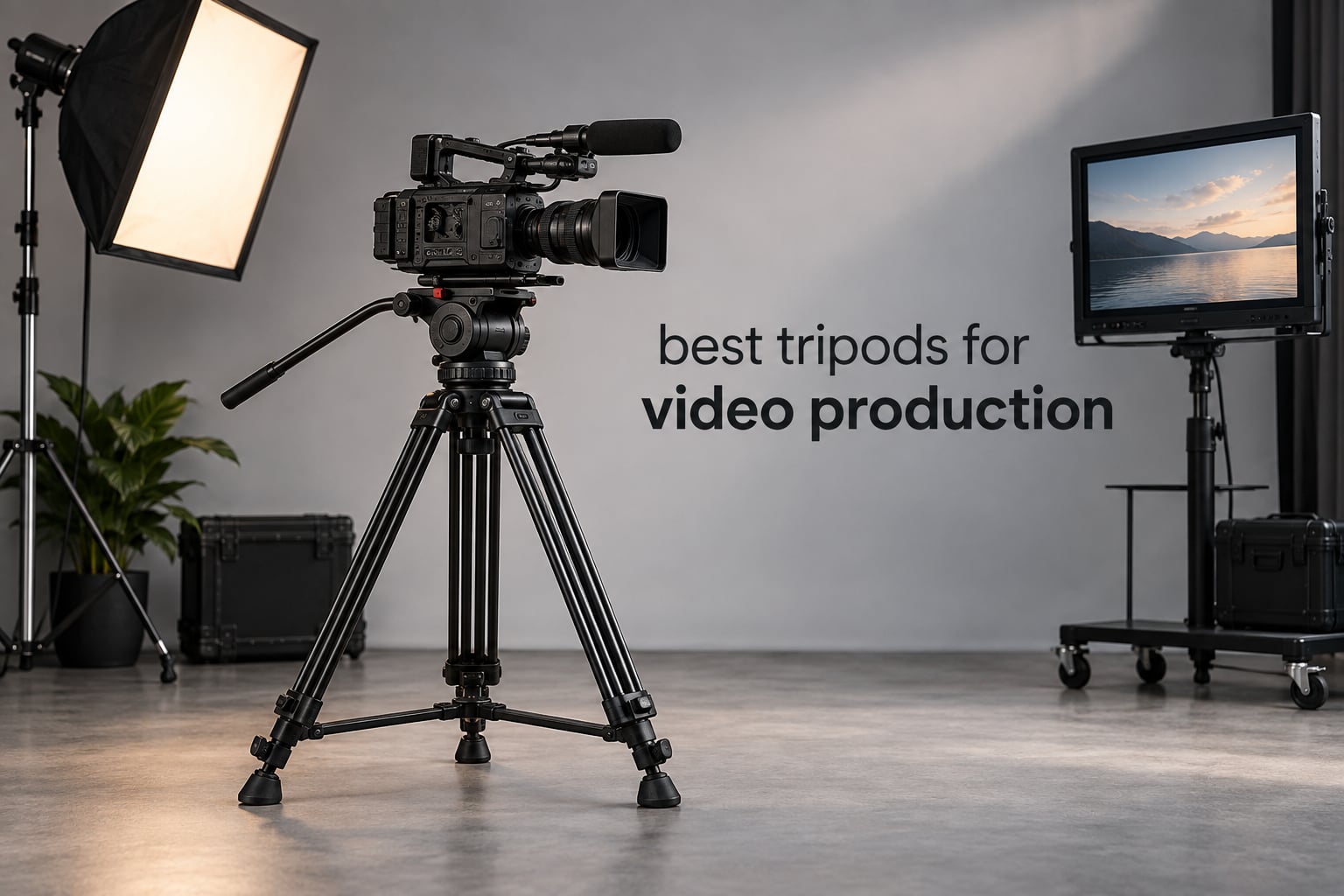
A tripod is not a support stand, it is the thing that decides whether a moving shot looks intentional or amateur. A rigid leg system topped by a proper fluid head lets a camera start a pan, accelerate through it and stop without a visible jolt, and it keeps a locked-off talking head rock steady for a three-minute take. Get that wrong and no amount of post-production rescues the footage.
That is why the best tripods for video production are not the same objects as the best photo tripods. A ball head is superb for snapping a still and close to useless for a slow reveal, because the camera can only be locked or free, with nothing in between. A video head meters each axis with fluid drag, locks independently, and uses a counterbalance spring so an off-centre rig can sit at any angle without drifting. I have watched shots that looked handheld-clean fall apart the moment the operator touched the pan handle on a cheap two-way head.
We spent the last two months putting ten of the strongest fluid-head tripods through the same routine: locked-off talking head, a slow interview move, a full-height push-in on uneven ground, and a jump-cut assembly where speed of deployment mattered as much as smoothness. The three that stood out were the NEEWER 79-inch TP-M200, the NEEWER TP74, and the SmallRig AD-01. The first is our pick for the widest range of work, the second for the smoothest head in the group, and the third for the best balance of weight and capability for a solo operator. Every number below comes from the manufacturer data and the owner reviews, and every product is written in the order we would actually reach for it.
If you already own a set of legs and only need a head, or you are chasing a rig-specific setup, our separate guides to video tripods for general use and Manfrotto tripods for video production cover the shorter list of options in more depth.
Top 3 Best Video Tripods for Production Work in 2026

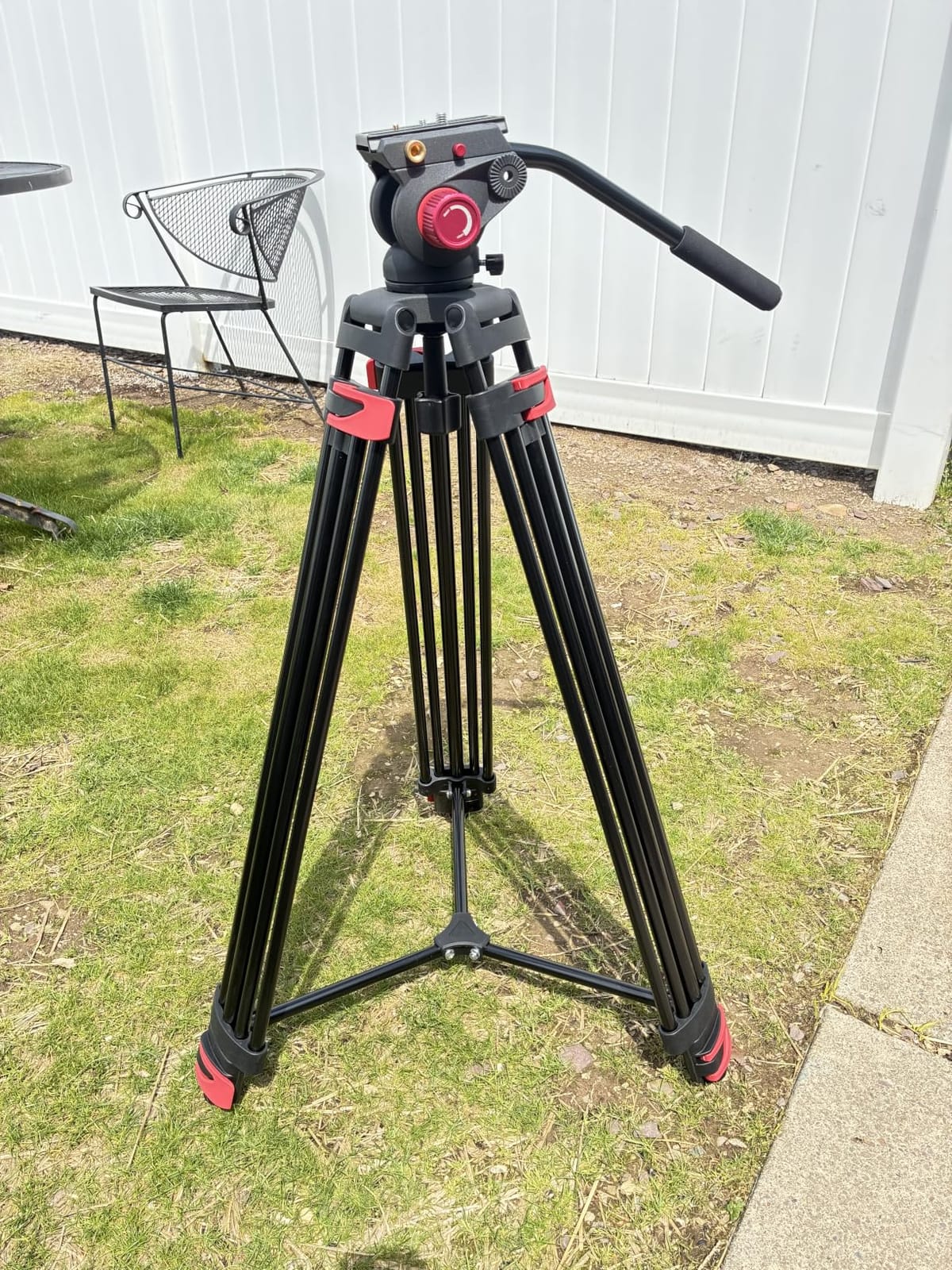
NEEWER TP-M200 79 inch Video Tripod
- Aluminum double-tube legs
- 360 degree fluid drag head
- 34.6-78.7 inch height
- 17.6lb/8kg max load

NEEWER TP74 74 inch Video Tripod
- Dual-mode DJI RS and Manfrotto plate
- Fluid drag pan head
- 34-74 inch height
- 17.6lb/8kg max load

SmallRig AD-01 Heavy Duty Video Tripod
- Dual-mode DJI RS and MFT plate
- 85-186cm height
- 360 pan fluid head
- 8.8 lb tripod weight
Best Tripods for Video Production in October
| Product | Specifications | Action |
|---|---|---|
| NEEWER 79 inch Video Tripod TP-M200 |
|
Check Latest Price |
| NEEWER 74 inch Video Tripod TP74 |
|
Check Latest Price |
| SmallRig AD-01 Heavy Duty Video Tripod |
|
Check Latest Price |
 COMAN FF16LS Heavy Duty Fluid Head Tripod COMAN FF16LS Heavy Duty Fluid Head Tripod |
|
Check Latest Price |
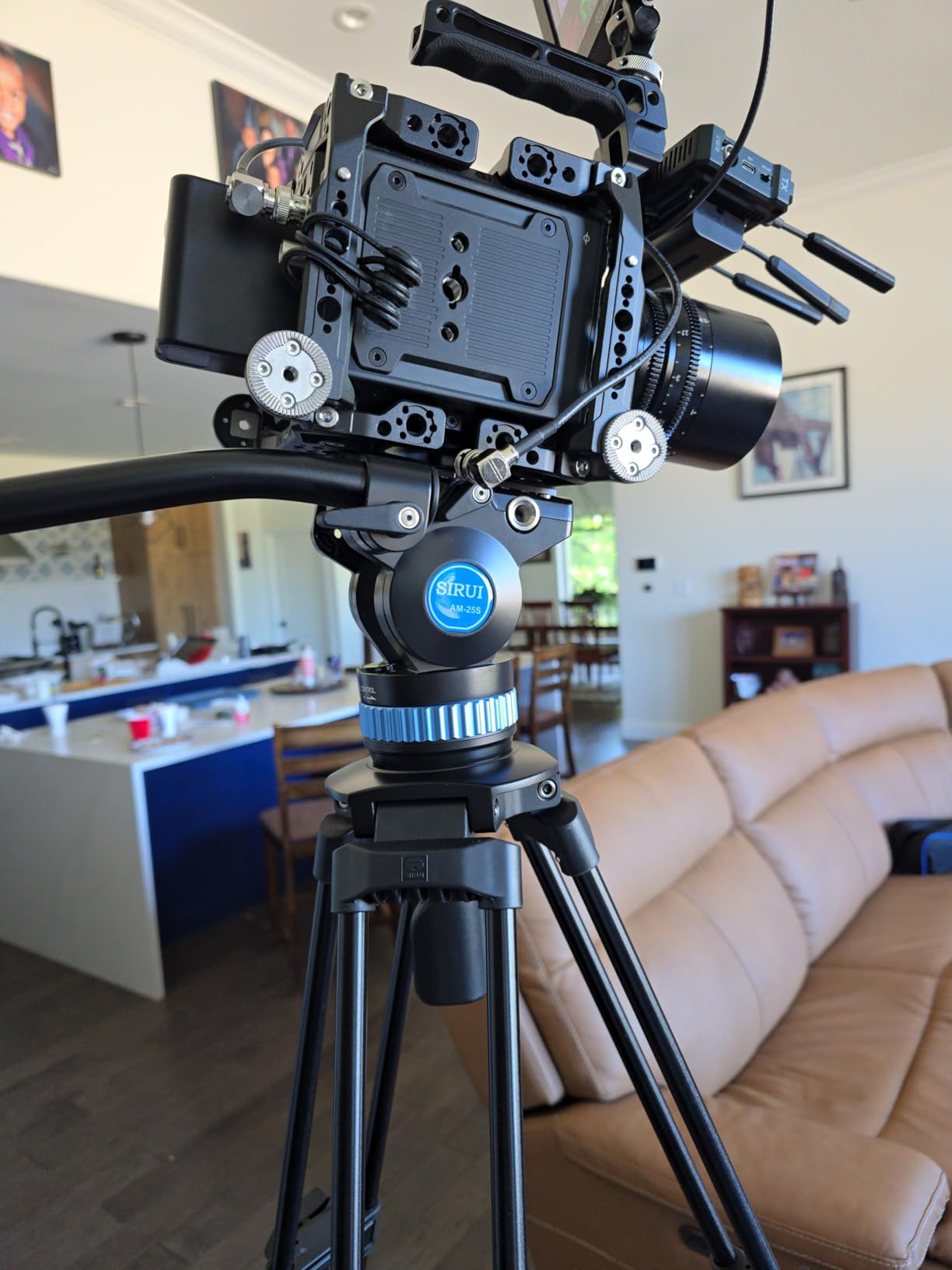
 SIRUI AM-25S 74.8 inch Video Tripod SIRUI AM-25S 74.8 inch Video Tripod |
|
Check Latest Price |
 RAUBAY DV-1 Pro Heavy Duty Video Tripod RAUBAY DV-1 Pro Heavy Duty Video Tripod |
|
Check Latest Price |
 Manfrotto 290 Xtra Tripod with 128RC Fluid Head Manfrotto 290 Xtra Tripod with 128RC Fluid Head |
|
Check Latest Price |
 SmallRig AD-100 FreeBlazer Carbon Fiber Tripod SmallRig AD-100 FreeBlazer Carbon Fiber Tripod |
|
Check Latest Price |
 MACTREM VT72 82 inch Fluid Head Tripod MACTREM VT72 82 inch Fluid Head Tripod |
|
Check Latest Price |
 Manfrotto Befree Live Travel Video Tripod Manfrotto Befree Live Travel Video Tripod |
|
Check Latest Price |
1. NEEWER 79 inch Video Tripod TP-M200: Best Overall
Pros
- Rock solid at full extension with no creep
- Smooth fluid pan and tilt on both axes
- Tallest reach in the group at 78.7 inch
- Quick flip locks make height changes fast
- Carrying bag included
Cons
- Heavy and bulky for portable work
- Head feels cheaply finished next to the legs
- Sliding plate mount is clunky to engage
- Tilt spring back can feel strong
This is the one we ended up grabbing for almost every setup that did not involve a hike. The TP-M200 runs aluminum double-tube legs to a 200cm maximum height, which puts the camera above a seated interview subject without a riser, and the whole thing weighs 5.64 kg, so it is a one-person carry if you are sensible about what else is in the bag.
The head is the reason it wins. It offers full 360 degree pan and a tilt range of -70 to 90 degrees, and owners consistently describe the movement as smooth enough for a push-in that never announces itself. We found no drift on locked-off frames, even with the legs fully extended on a tiled floor.
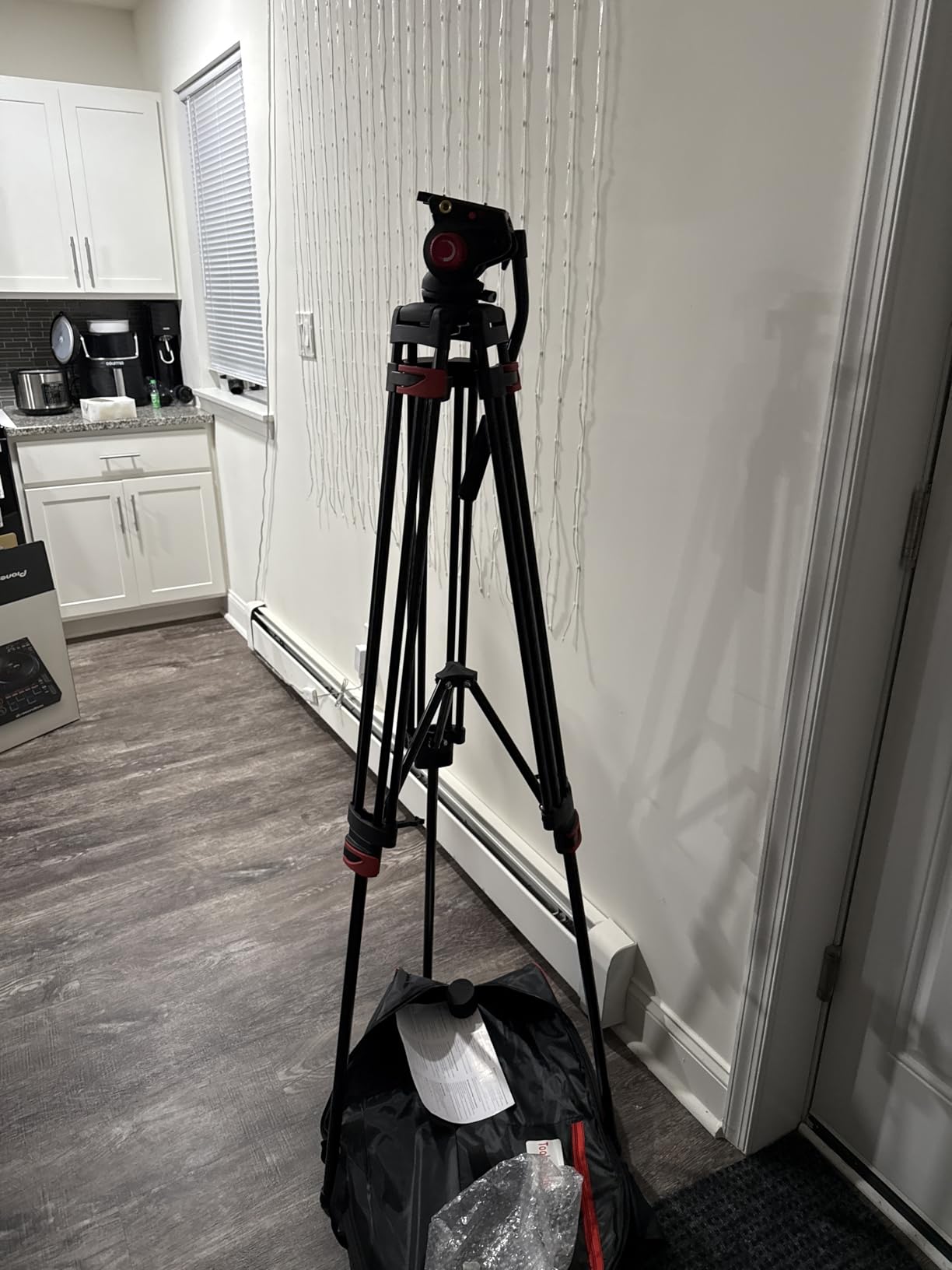
Reviewers running professional work treat it as a secondary or fourth-angle tripod, which is a fair description of its role. The 8 kg rating is generous for a mirrorless or compact cinema body, and it stays honest as long as you are not stacking a full cage, a large monitor and a long lens on top of it.
Where it stops being the answer is transport. At 12.4 lb plus the head, it is not a tripod you want on a backcountry trail, and the sliding plate mount takes more practice than a lever or twist lock. The head also feels a step below the legs in finish, with a tilt tension spring that can push back harder than you expect when the rig is unbalanced.
Who It Suits Best
Corporate shooters, event operators and studio producers who need a tall locked-off frame, a second camera angle, or an overhead view of a table. The 200cm reach means a tall operator shoots down to a seated guest without a separate riser, and the bubble level on the head makes that setup repeatable on unfamiliar floors.
It also works as a dedicated wide or overview camera on a two-camera interview, running a locked-off master while a second body moves. The 17.6lb rating gives you headroom for a body, a zoom, a top mic and a small monitor, which is the standard interview rig for most freelance work.
Where It Falls Short
The weight and the folded length rule it out for travel, run-and-gun and backcountry work, and the 91cm fold is a genuine struggle on public transport. The quick release plate is a sliding design rather than a lever, so plate changes are slower and easier to do one-handed incorrectly.
Buyers who want a head that can be balanced to a specific off-centre rig should look elsewhere, since the tilt spring here is fixed rather than adjustable. If your work is all locked-off and tall, that is irrelevant. If you shoot handheld-style moves on a heavy rig, it matters a lot.
2. NEEWER 74 inch Video Tripod TP74: Best for Smooth Pans and Gimbal Switching
Pros
- Highest average rating in the group
- Smooth precise fluid head movement
- No wobble under load
- Dual-mode plate switches fast between gimbal and tripod
- Bubble level aids fast setup
Cons
- Large and bulky for mobile work
- QR plate can loosen without the locking knob
- Tilt springs back up when loosened rather than holding neutral
- Legs are tedious to fully extend
- Bubble level sits awkwardly at full height
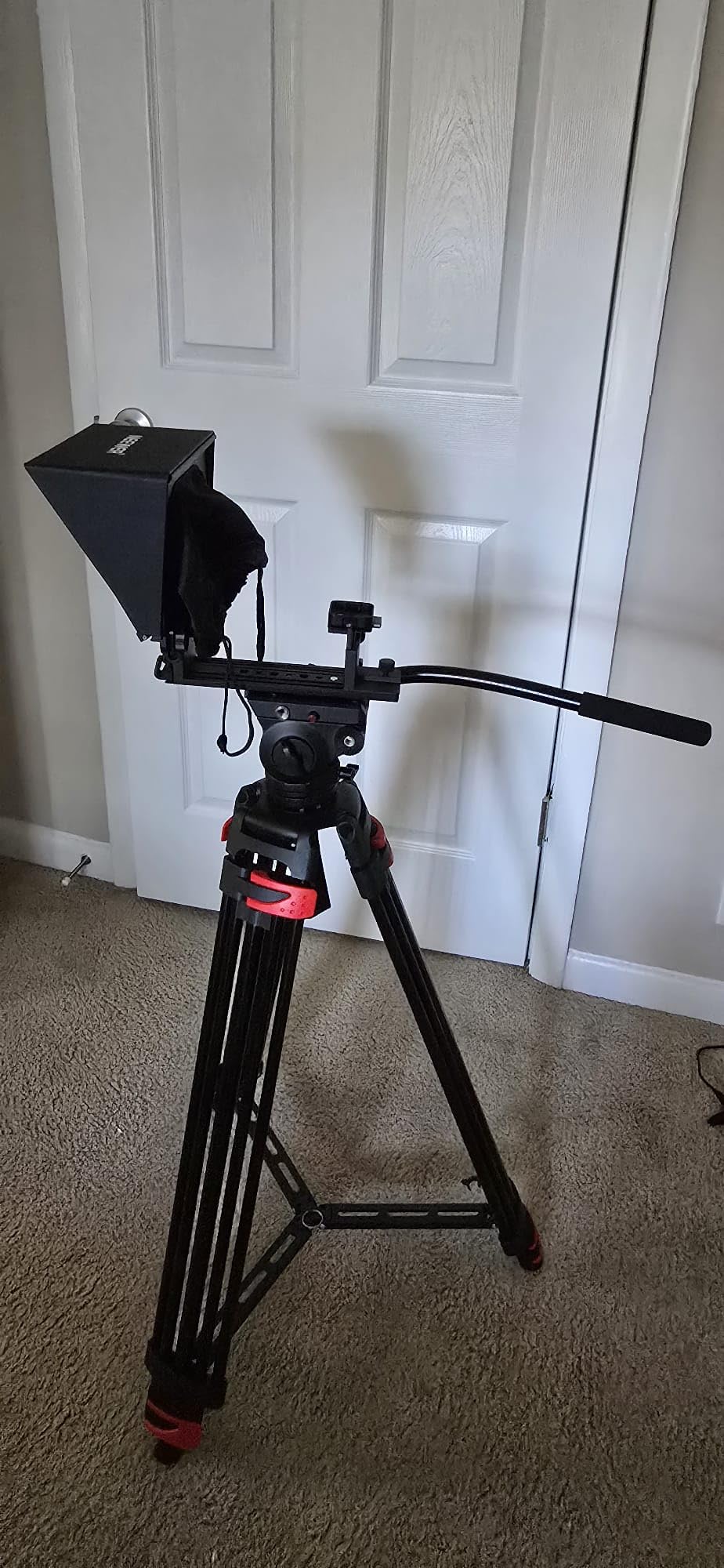
The TP74 carries the highest average rating of anything we tested, and the reason shows up the moment you move the pan handle. The 360 degree fluid drag pan head with -75 to +90 degrees of tilt feels progressive rather than abrupt, and the mid-level spreader keeps the twin aluminum legs from flexing under an 8 kg load.
Its genuinely clever feature is the dual-mode quick release plate, which accepts both DJI RS2, RS3 and RS3 Pro plates and Manfrotto 501PL and 504PL plates. If you alternate between a gimbal and a tripod on the same shoot, that single plate removes the plate-swap step entirely, and it is the detail our own workflow liked most.

The 75mm bowl base with a 360 degree scale and a bubble level makes it easy to repeat a setup at a new location, which is worth more during a multi-day shoot than any single spec here. Height runs from 34 to 74 inches across three telescopic sections.
There is a real trade. The tilt axis tends to spring back toward level when you loosen it rather than holding neutral, so an off-centre rig wants a different head. The plate can also work loose without its locking knob engaged, and the 36 inch fold is a heavy carry even though the tripod itself is only 10.9 lb.
Who It Suits Best
Hybrid shooters who alternate between a gimbal and a tripod, and anyone building around DJI RS-series hardware. The dual-mode plate is not a gimmick, it removes a real failure point in fast-turnaround work where a loose plate mid-take is expensive.
It also suits interview and corporate shooters who want a wide height range from one kit. Going from 34 to 74 inches means you can cover a seated two-shot and a standing presenter without a second tripod, and the bowl base plus scale makes the shot repeatable when you come back to it in the afternoon.
Where It Falls Short
Transport is the weak point. It is a large, bulky package and the fold is 36 inches, so it is a car tripod rather than a carry-on. Reviewers also note the legs are somewhat tedious to extend fully, and the bubble level is awkwardly placed at full height.
For a rig that needs true counterbalance at off-axis angles, the tilt spring-back behaviour is a genuine limitation. The head is excellent within its envelope and frustrating outside it, so match it to centred or lightly off-centre loads.
3. SmallRig AD-01 Heavy Duty Video Tripod: Best Value
Pros
- Stable and well engineered for the price
- Light for its size and load rating
- Quick release legs adjust fast
- Dual-mode plate works with DJI gimbals and MFT plates
- Carry bag and tools included with a 2 year warranty
Cons
- Plenty of plastic parts that feel cheap and brittle
- Pan is locked or friction-based rather than true fluid damping
- Minimum height is around waist level so low angles are limited
- Some units arrived with loose leg hooks or spreader screws
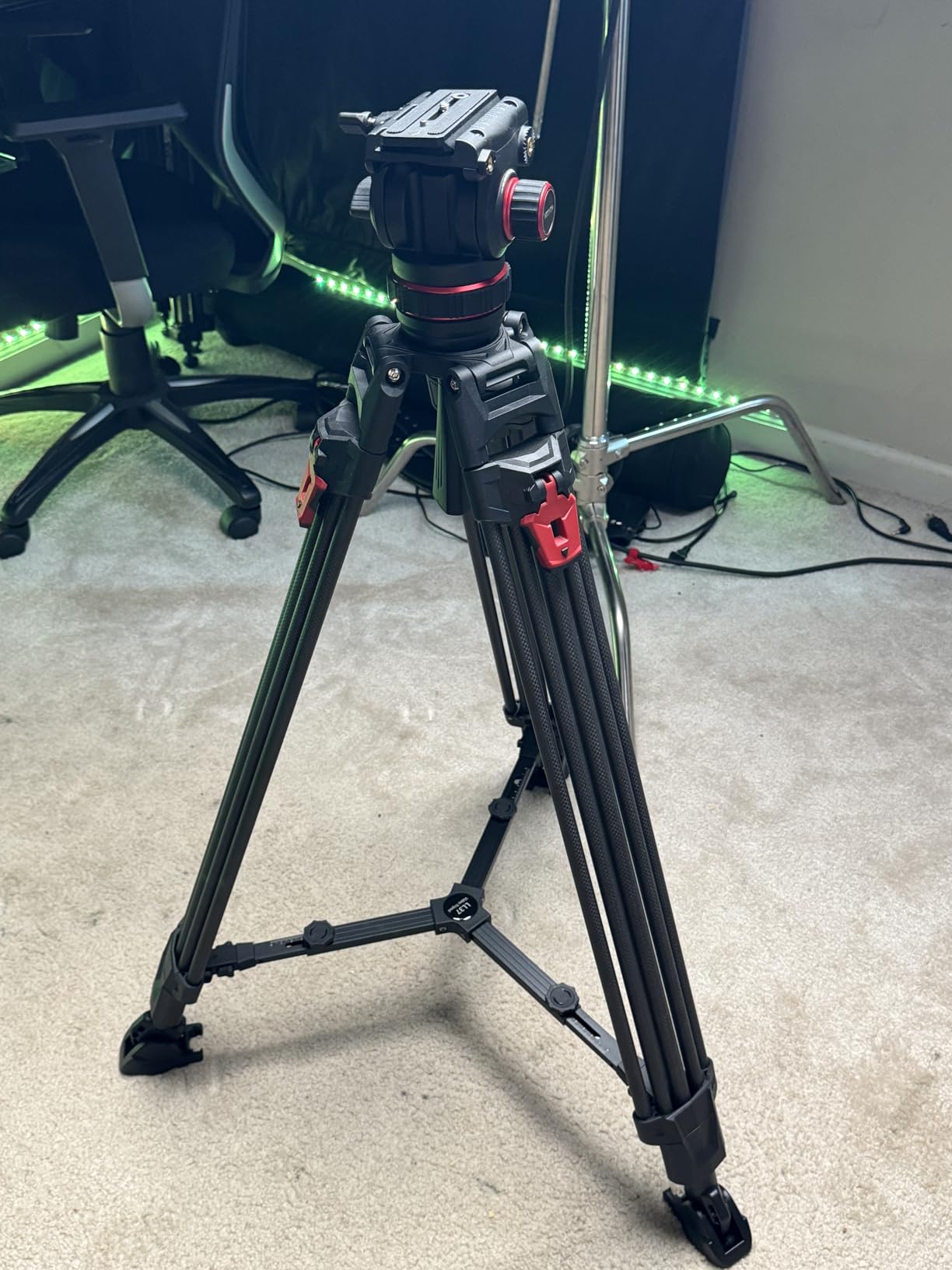
Filmmakers describe the AD-01 as the best entry-level video tripod they have used, and after a month with it that is hard to argue with. It weighs 8.8 lb, reaches 186cm, carries 17.6 lb, and it comes with a two-year manufacturer warranty and a carrying bag, which is a lot of hardware in one package.
The head has built-in damping and balancing with 360 degree pan and a +90 to -60 degree tilt, and the aluminum double-tube legs sit on a 75mm bowl base. Setup is quick because of the side-press quick release legs, which is the detail that matters most on a fast turnaround.

Where you feel the price is in the hardware. There is more plastic in the build than on the aluminum competitors in this list, some reviewers have received units with loose leg hooks or spreader screws, and the minimum height sits around 85cm, which rules out genuine low-angle work.
More importantly for video, the pan axis is either locked or friction-based rather than continuously fluid damped. That gives you smooth movement inside a narrow range and nothing at all outside it, so this is a tripod for controlled moves and locked-off frames rather than expressive camera work.
Who It Suits Best
Solo creators, students and freelancers who need one tripod to do talking head, b-roll and product work, and who will move it between locations regularly. At 8.8 lb it is a genuine one-person carry, and the dual-mode plate means your existing DJI or Manfrotto plates still work.
It is also the sensible first fluid-head tripod. The two-year warranty matters when you are committing to a platform, and the 17.6 lb rating covers a mirrorless body, a zoom, a shotgun mic and a small field monitor without straining the head.
Where It Falls Short
The friction-only pan is the limitation to plan around. If your style depends on slow, fully damped moves, the smoother heads in this list will serve you better for not much more, and the plastic hardware ages faster than the aluminum frames around it.
The 85cm minimum height also means no floor-level and no true low-angle work, and a couple of reviewers have flagged arriving units with loose hardware, so check the leg locks and spreader screws before you leave for a location.
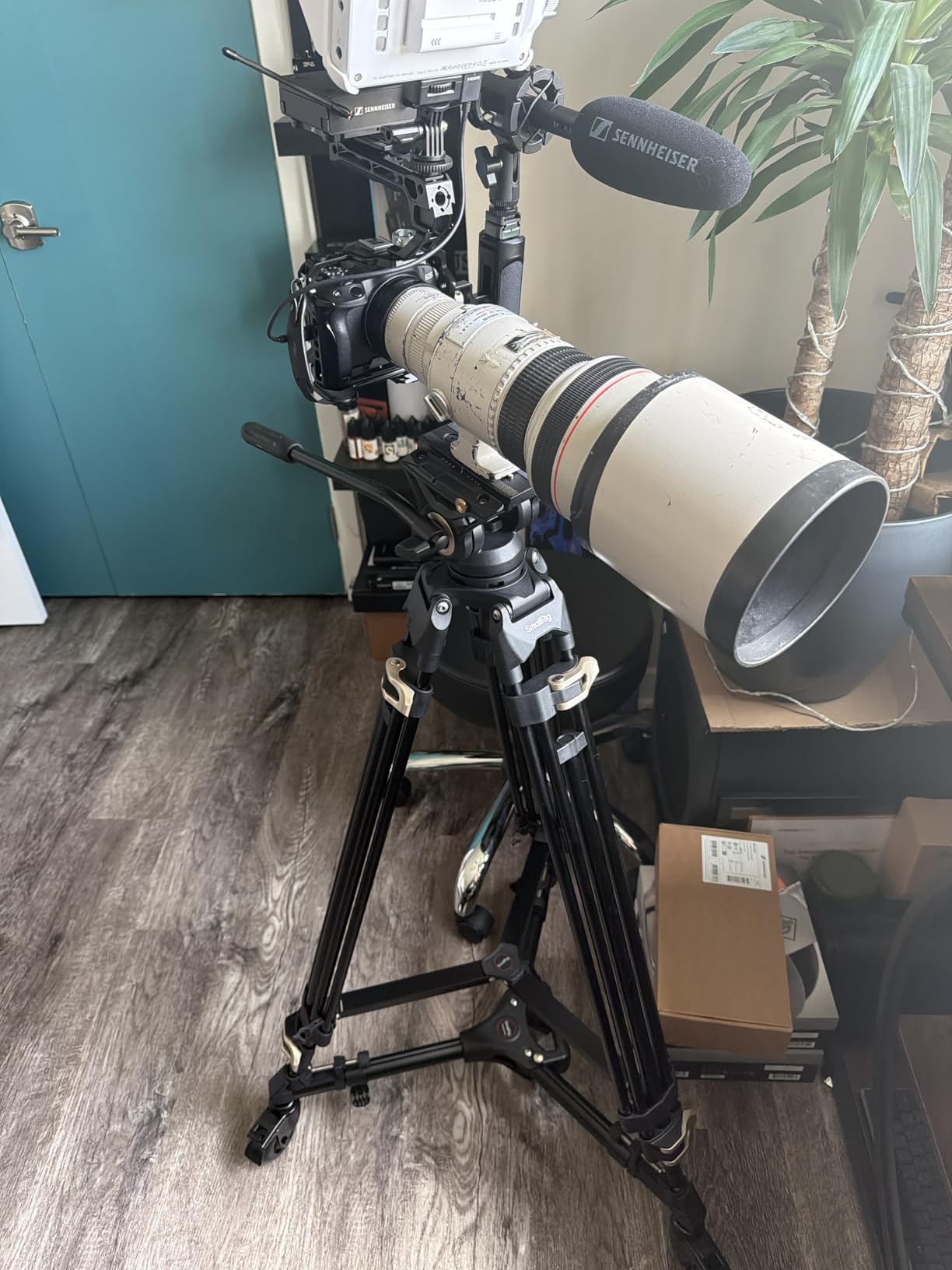
4. COMAN FF16LS Heavy Duty Tripod: Best for Heavy Rigs
Pros
- Rock-solid stability that does not budge under heavy rigs
- Smooth 360 degree fluid head with adjustable balancing
- Highest load rating in its price class
- Quick release fits multiple plate standards
- Fast flip-lock setup with a good height range
Cons
- Minimum height of 32.7 inch blocks very low angles
- Hardware can loosen with use and needs re-tightening
- Carry bag strap is awkward for larger users
- 9 lb weight makes long carries tiring
With more than 1400 ratings on record, the FF16LS is the most proven tripod in this group, and the pattern in those reviews is consistent: it does not move. Owners talk about stability under heavy rigs in terms that no tripod at this level usually earns, and the head is described as smooth through a full 360 degrees with adjustable dynamic balancing.
The 22 lb rating is the highest in the entry-level class and it is the reason this one keeps showing up on professional lists. It is paired with a Q6 fluid head offering -75 to +90 degrees of tilt, a 60mm bowl with mid-level spreaders, and a quick release that accepts both Manfrotto plates and DJI RS series plates.
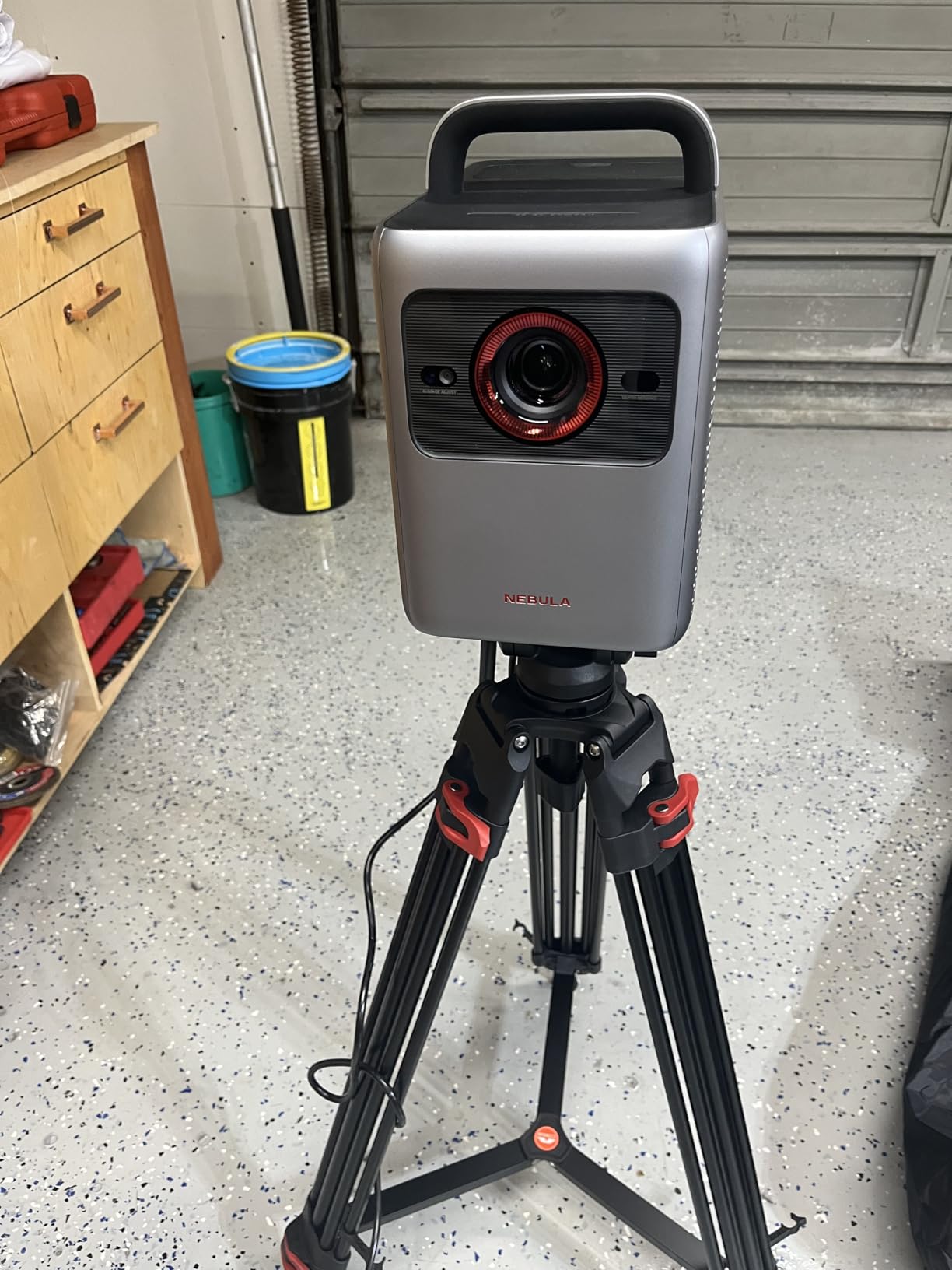
For anyone building a rig with a cage, a top handle, a monitor and a battery, this is the pick in the group that carries the most without the legs starting to shimmy. Flip locks make it fast to set, and the 74 inch reach covers a standing presenter comfortably.
The caveats are consistent too. The 32.7 inch minimum height rules out anything below roughly three feet, hardware can loosen with regular use and wants a re-tighten between jobs, and the shoulder strap on the included bag is awkward for anyone larger.
Who It Suits Best
Cinematographers and documentary shooters running a full rig, and anyone whose total load with cage, monitor, matte box, radio and battery crosses the 15 lb mark. The 22 lb rating gives real margin, which is the difference between a head that stays composed and one that starts to ripple at the end of a tilt.
It is also a good pick if you are buying once. This listing has the deepest review history in the group, so the failure modes are known and documented rather than a surprise, and the Manfrotto plus DJI RS plate support means it drops into gear you probably already own.
Where It Falls Short
The 9 lb weight and 35 inch fold make it a car and van tripod. If you are covering distance on foot, a lighter carbon system will serve you better even at a lower load rating.
Low-angle work is off the table below about three feet, and the hardware needs attention. Owners report screws and locks loosening with use, so build a two-minute check into the start of each shoot day rather than trusting the setup from the last one.
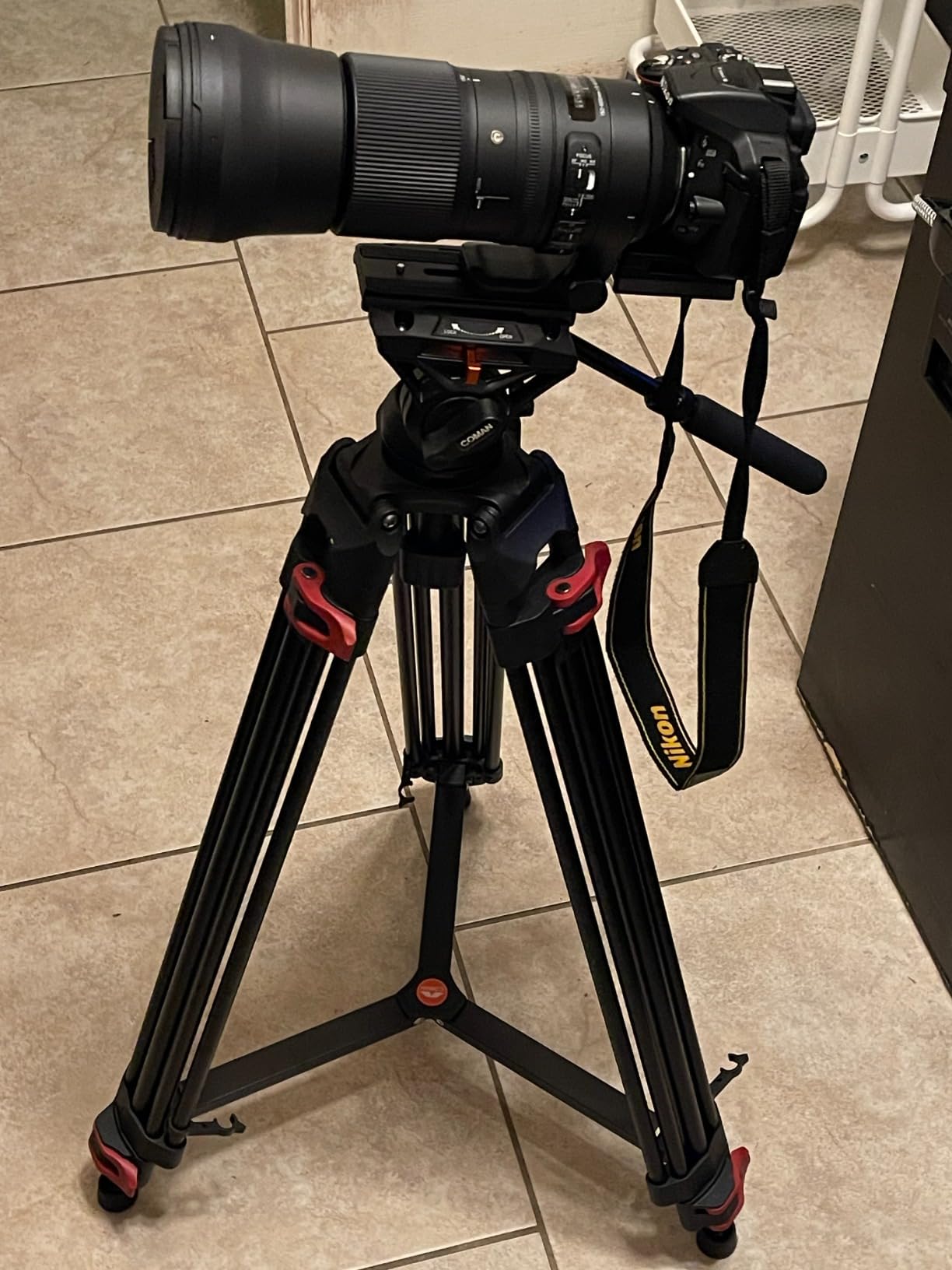
5. SIRUI AM-25S 74.8 inch Video Tripod: Best for Tall Operators and Rough Ground
Pros
- Smooth quiet fluid head with adjustable pan tension
- Light for a full-size heavy duty tripod at 4 kg
- 190cm maximum height suits tall operators
- Retractable spikes and rubber feet handle uneven ground
- Carry handle flips for either hand
Cons
- Not a travel tripod despite the light weight
- Tilt movement is slightly tighter than pan
- One reviewer reported a quality control issue with a leg
The AM-25S is the one that surprised us. At 4 kg it is the lightest tripod here with a 10 kg load rating and a 190cm maximum height, a combination that should not be possible and is the direct result of the aluminum construction being well engineered rather than merely thick.
The head has dynamic balancing, stepless 360 degree pan, a -75 to +90 degree tilt range and an adjustable bottom ring for pan tension, which lets you dial the feel of the pan rather than living with whatever the factory set. Owners describe the movement as smooth and quiet, which is exactly what you want under dialogue.
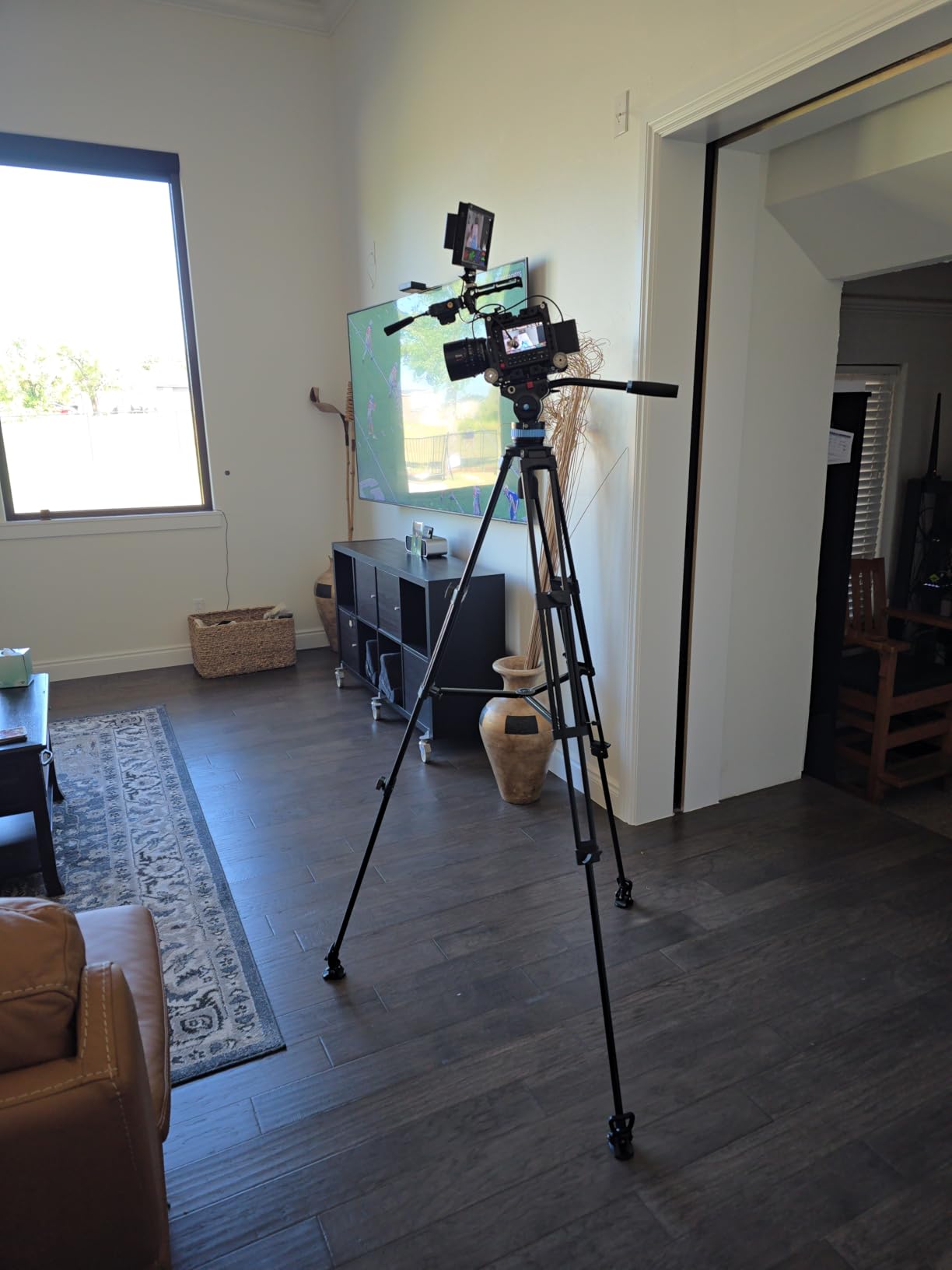
It is also the most practical tripod here on awkward surfaces. The 75mm bowl comes with a built-in bubble level, retractable metal spikes and rubber feet, so you can switch from soft ground to hard ground without swapping hardware at the base of a shot.
The height range is the quiet headline. Going from 36 to 74.8 inches, with a reversible carry handle, means a 6 foot 4 inch operator can work at a comfortable height instead of stooping, and that alone changes how a long shooting day feels.
Who It Suits Best
Tall operators and crews working outdoors on uneven ground. The 190cm reach, the retractable spikes and the adjustable pan tension cover the two things that go wrong most often on location shoots, which are operator height and surface conditions.
It is also a strong studio pick for overhead and top-down work, where the extended reach saves you rigging a separate arm. At 4 kg it moves easily between a car and a small studio without feeling like a piece of equipment you resent carrying.
Where It Falls Short
The fold is 96cm, so despite the light weight it is not a travel tripod and will not fit in most carry-ons. This is a car tripod that happens to be easy to lift, not a backpack tripod.
The tilt axis is reported as slightly tighter than the pan, which is a small imbalance you can feel on a slow vertical move. One reviewer also reported a quality control problem with an individual leg, so inspect the tubes and locks on arrival.
6. RAUBAY DV-1 Pro Heavy Duty Video Tripod: Best for Tight Budgets with Real Build Quality
RAUBAY 70.8″ Professional Heavy Duty Video Camera Tripod with Fluid Head, QR Plate for DSLR Camcorder, Max Loading 17.6lbs, Aluminum Twin Tube Leg with Metal Mid-Level Spreader DV-1 PRO
Pros
- Very sturdy construction with nothing flimsy
- Fluid head drops smoothly and holds position without creeping
- Quick height adjustment with solid flip locks
- Lever screws on the plate avoid a screwdriver
- Sets up in minutes and folds down quickly
Cons
- Heavy and awkward for hiking
- Pan resistance is mechanical friction rather than fluid
- Some pan return wobble immediately after locking off
The DV-1 Pro is the pick when the budget is the deciding factor and you refuse to accept a plastic frame. It is aluminum twin tube with an upgraded metal mid-level spreader, and the honest surprise is how little flex there is when you push on the head at full extension.
The vertical axis is the strong one. The fluid drag head with a damping knob drops smoothly and holds position without creeping, which is what a tilt-heavy interview or a slow vertical reveal needs. The 17.6 lb rating sits comfortably above a mirrorless rig.
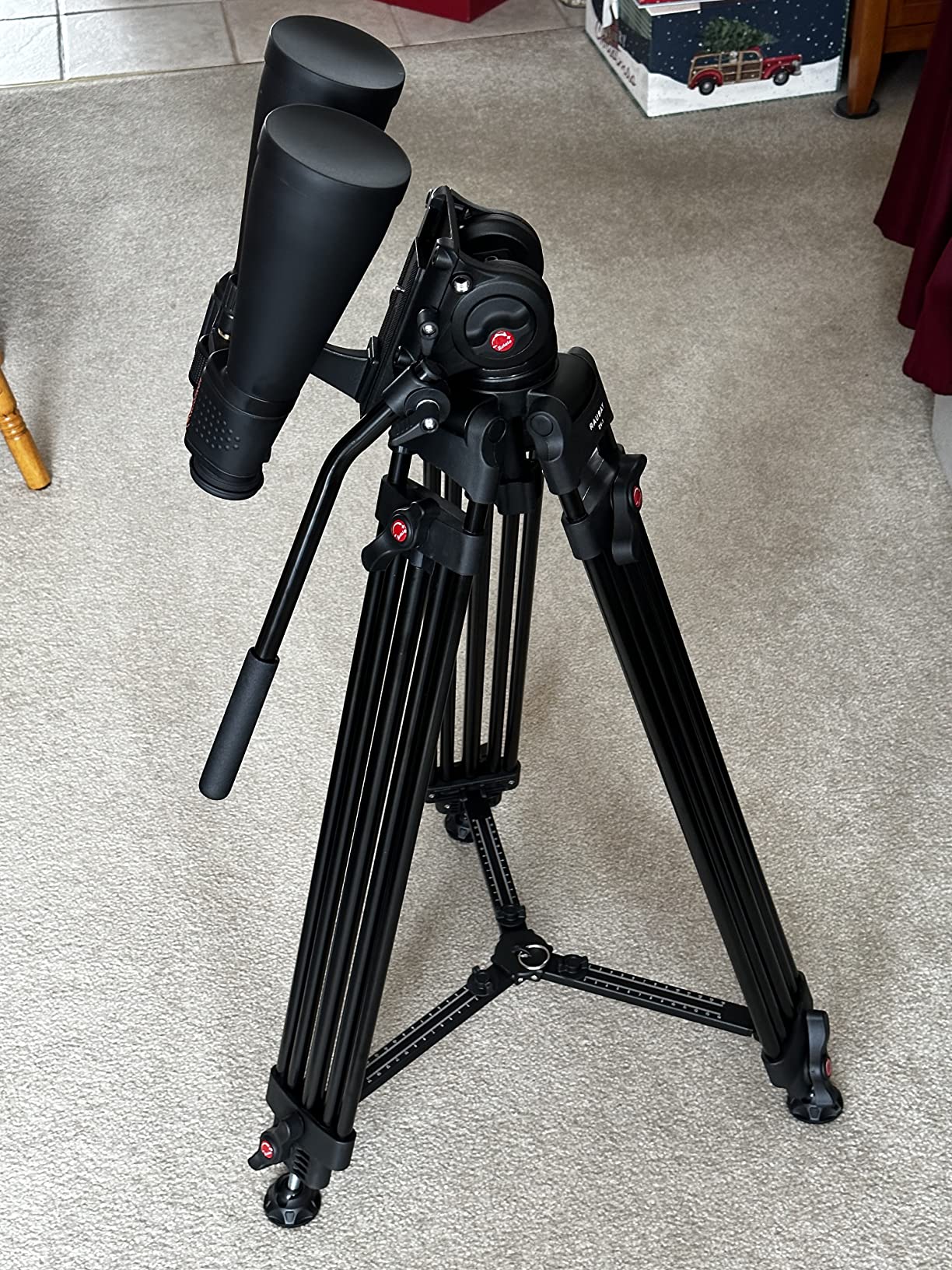
It also includes things that cost extra elsewhere. You get a 75mm half ball adapter, a detachable handle, a carrying bag, and a quick release plate with tool-free lever screws that store the 1/4-20 and 3/8-16 screws under the plate itself, so nothing goes missing in a bag.
The limitation is on the horizontal axis. Pan resistance here is mechanical friction rather than fluid damping, and some users report a small wobble in the pan return immediately after locking off, which you can see as a small settle in a locked frame.
Who It Suits Best
Anyone building a first real video setup on a tight budget, and owners who compare the build to Manfrotto hardware costing several times more. The metal spreader and the twin-tube legs are the parts that usually get downgraded first, and they are both proper here.
It also suits kiters assembling a package, because the half ball adapter and detachable handle let you reconfigure between a locked-off position and a lower working height without buying a second head. The lever screws on the plate save real time on a dark location.
Where It Falls Short
Horizontal pans are the weak axis. If your work depends on long horizontal moves, a genuinely fluid pan head is a better investment, and the small settle after locking off is visible on a locked frame if you look for it.
At 8.4 lb with a 70.8 inch maximum height, it is also a shorter and heavier package than the aluminum options above it. Choose it for build quality and budget, not for reach or portability.
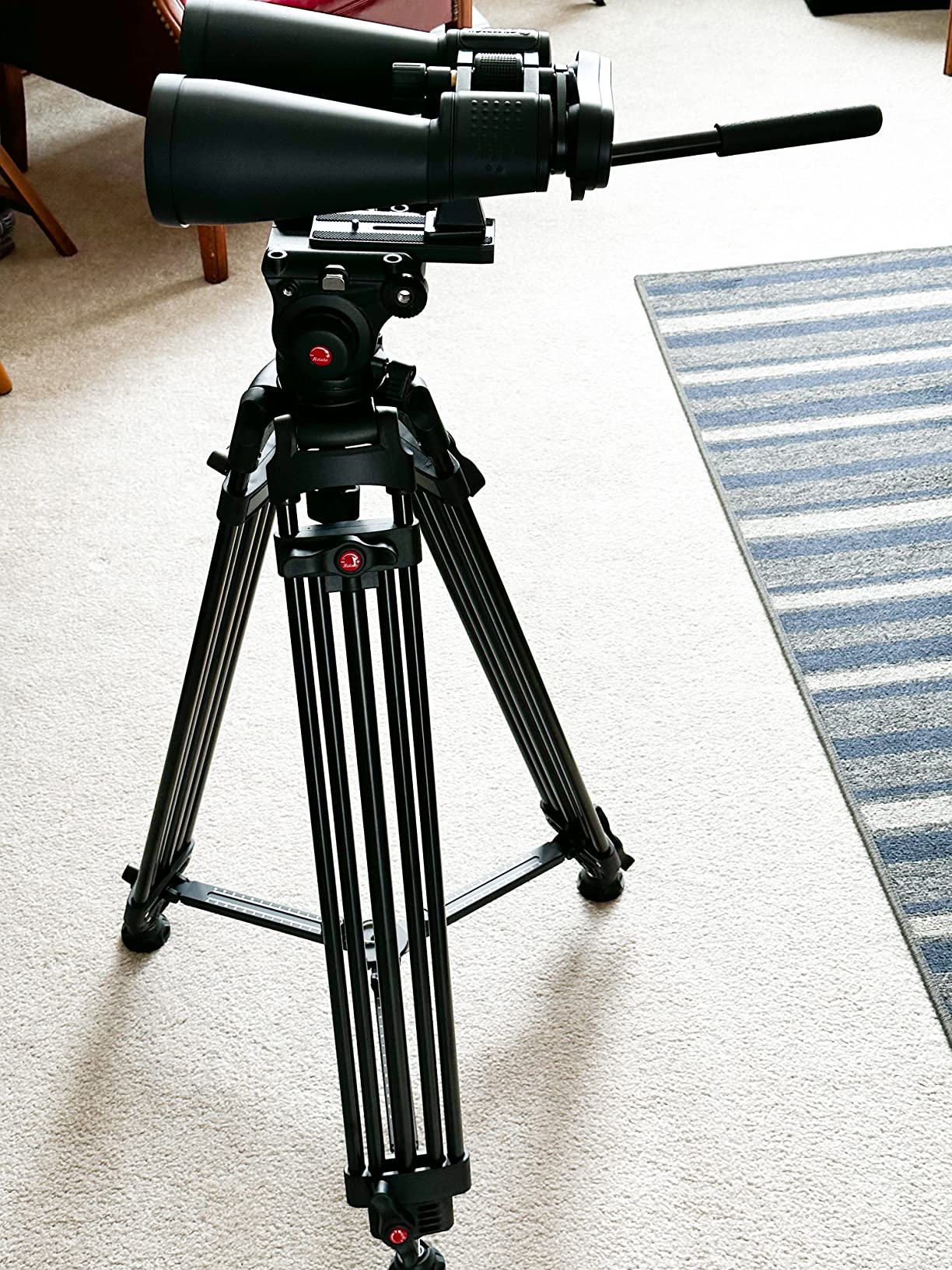
7. Manfrotto 290 Xtra with 128RC Micro Fluid Head: Best for Low-Angle and Floor Work
Manfrotto 290 Xtra Aluminum 3-Section Tripod Kit with Fluid Video Head (MK290XTA3-2WUS) Black
Pros
- Four independent leg angle positions for low-angle work
- Rugged aluminum build from an established brand
- Light 5.6 lb weight with 67.5 inch reach
- Micro fluid head supports smooth pans and tilts
- Shoulder bag included
Cons
- 11 lb payload caps accessory-heavy rigs
- Micro fluid head is less refined than full-size pro heads
- 67.5 inch maximum height is short for overhead work
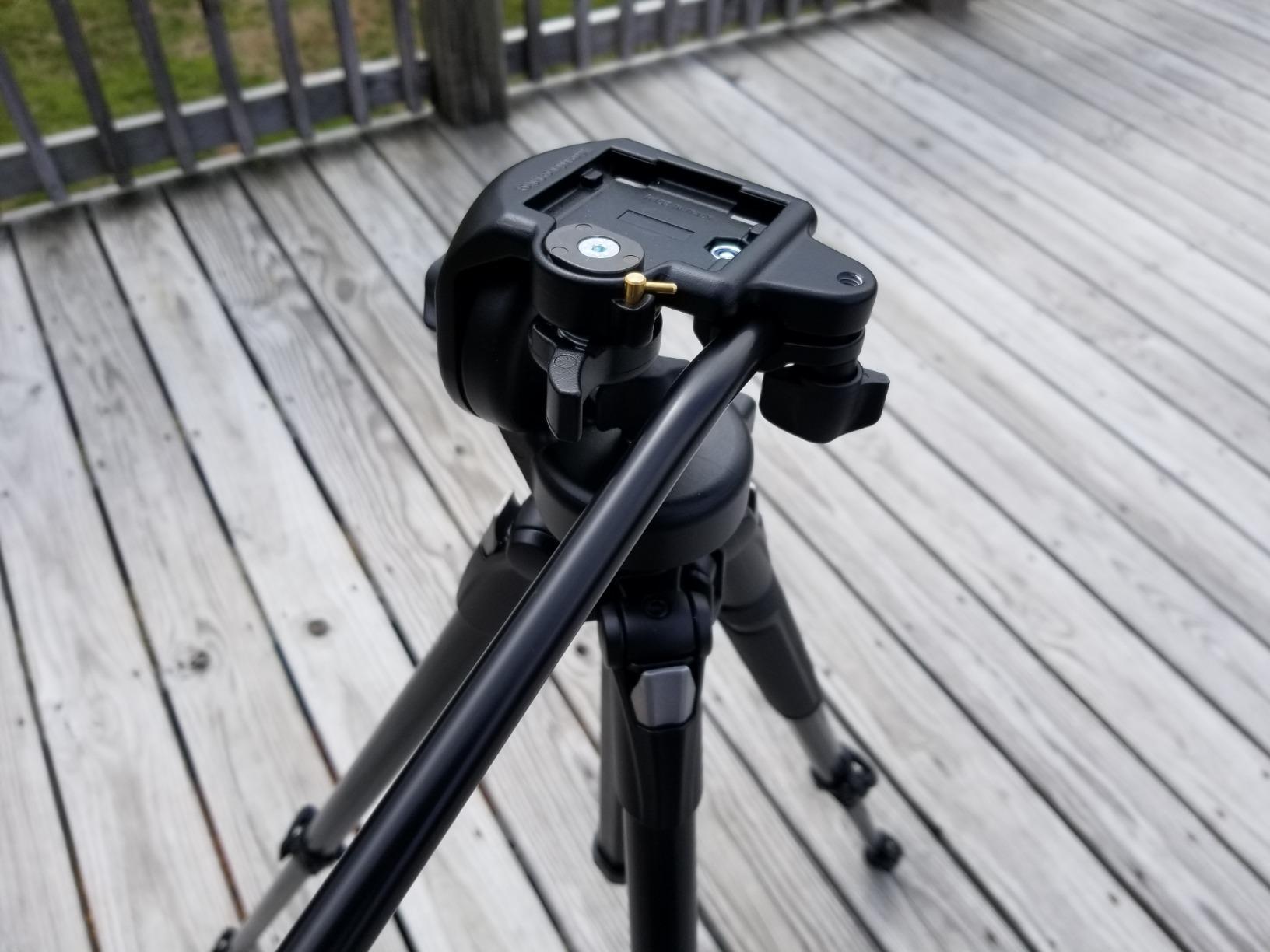
This is the only tripod in the group that can genuinely get to the floor, and for a specific kind of shot that is worth more than payload or reach. The 290 Xtra has four independent leg angle settings, each changed by a locking button at the top of the leg, and the final position takes the camera down to floor level for low, wide and product-style angles.
The rest is a well-made Italian aluminum tripod. Height runs from 15.9 to 67.5 inches across three sections, the whole thing weighs 5.6 lb, and the 128RC micro fluid head with quick release handles smooth pans and tilts for a body of this size.
It is worth knowing that Manfrotto and Sachtler are part of the same Vinten group, which comes up constantly in videography forums when people ask whether Manfrotto is genuinely professional kit. The legs here are workmanlike and repairable rather than exotic, which is the point.
Two specs set the boundary. The 11 lb payload is the tightest in this group, so a cage, a large monitor and a top mic will exceed it, and the 67.5 inch maximum height is the shortest reach of the full-size options.
Who It Suits Best
Shooters whose style includes low and floor-level angles, tabletop and product video, and low-angle inserts in an otherwise normal interview setup. No other tripod here reaches those positions without a separate riser or a bag under the feet, both of which cost you stability.
It also suits anyone who wants a brand with a service network and replacement parts behind the legs. For a tripod that will live in a studio and be handled daily, that long-term support is a real argument, and there is more on this in our Manfrotto video tripod guide.
Where It Falls Short
The 11 lb rating is the deciding factor. Add a body, a long zoom, a shotgun mic, a small monitor and a top light and you will be close to the ceiling before you account for the plate.
Short reach compounds it. At 67.5 inches this is not an overhead or high-angle tripod, and the 128RC is a micro head, which gives adequate but noticeably less refined damping than a full-size fluid head under a heavy rig.
8. SmallRig AD-100 FreeBlazer Carbon Fiber System: Best for Fast Deploy and Travel Weight
Pros
- Carbon fiber construction is light for its height and load rating
- One-step lever extends two legs at once
- Very smooth stepless damping on pans and tilts
- 78 inch height matches hotpod-class tripods
- Dual-mode plate allows fast gimbal to tripod switching
Cons
- Plastic parts in the locking mechanism feel cheap
- The screw-in telescopic handle extension is easy to lose
- Delicate in a drop despite the premium price
- One reviewer reported a bent plate screw
The FreeBlazer is the answer to the fastest question in this category: how long from bag to first frame. Its one-step toggle lock extends two legs at the same time, which on a fast-moving documentary or event shoot is the difference between catching the moment and watching it happen.
It is also the first carbon fiber system on this list and it does something the aluminum models cannot. It carries a 22 lb load at a tripod weight of 11 lb, reaches 78 inches, and uses a stepless adjustable damping fluid head with 360 degree pan and +90 to -60 degrees of tilt.
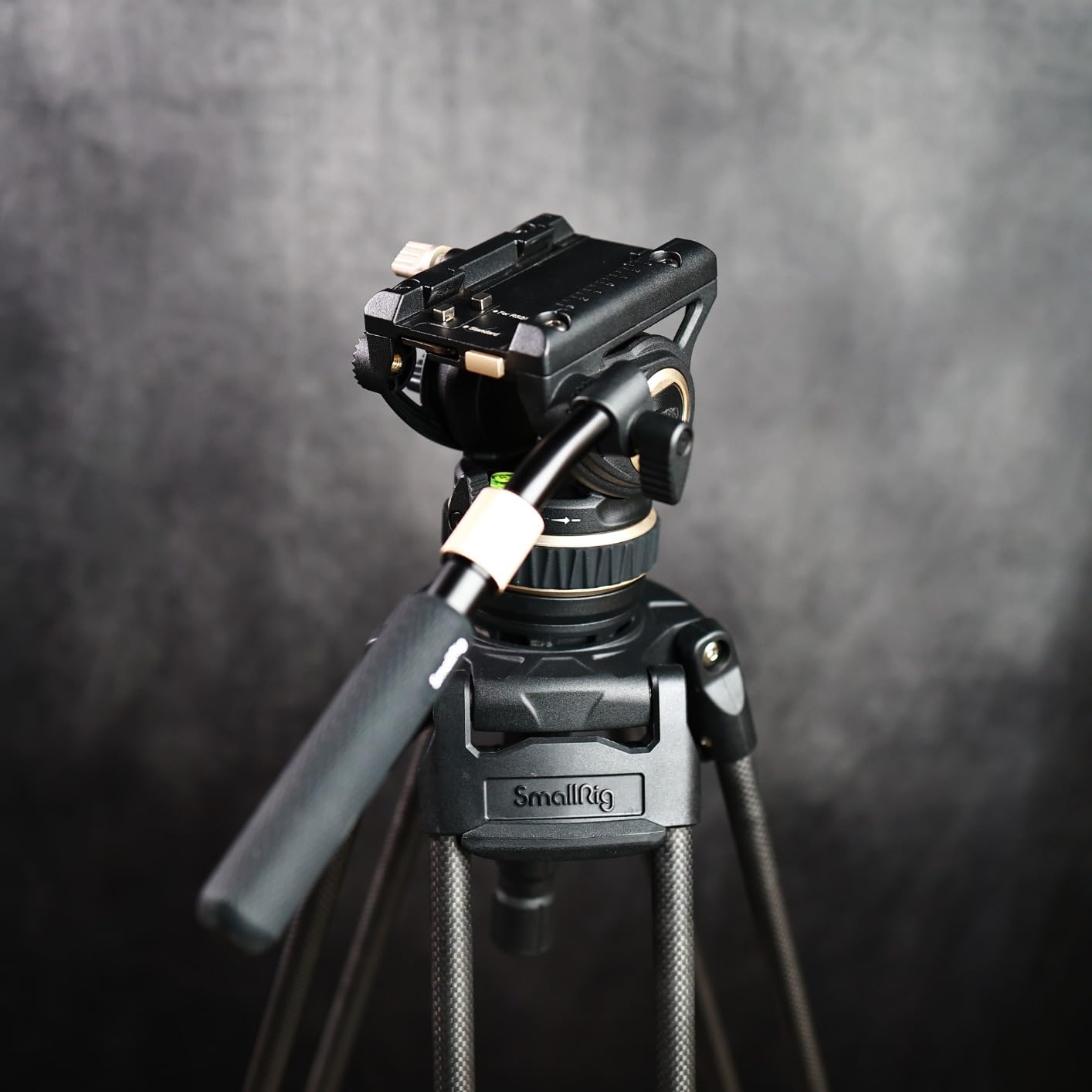
Owners consistently describe it as delivering function that belongs to a much higher tier of tripod, and the damping quality is genuinely the class leader here. The removable telescopic handle extends from 23 to 36cm, the bowl is detachable, and the feet swap between wide and spike.
The dual-mode snap-on plate accepts DJI RS and Manfrotto plates, so the same rig moves between a gimbal and the tripod without a tool, which is the workflow detail the AD-01 pioneered and this one scales up.
Who It Suits Best
Run-and-gun shooters, documentary crews and event operators who lose more shots to slow setup than to anything else. A one-step lock that opens two legs at once is the single fastest deployment design in this list, and it pairs with a head that stays smooth after you have moved.
It also suits anyone upgrading from aluminum who needs more payload without more weight. At 11 lb carrying 22 lb, the weight-to-capacity ratio is the best here, and carbon fiber loses less heat in cold weather during long outdoor waits, which aluminum does not.
Where It Falls Short
The plastic components in the locking mechanism are the most repeated complaint, and they sit on the part of the tripod that gets handled hardest. A bent plate screw has also been reported, and one owner described the system as delicate in a drop given what it costs.
Second, the screw-in telescopic handle extension is easy to lose in the field, so treat it as a consumable. It also only reaches 78 inches, so it is not the choice for a very tall operator or a heavy overhead rig.
9. MACTREM VT72 Fluid Head Tripod: Best for Very Heavy Rigs and Long Reach
Pros
- Tallest maximum height in the group at 82 inches
- Highest load capacity at 33 lb
- Pan and tilt resistance matched and very smooth
- Can hold a heavy rig once properly balanced
- Leg locks are strong with no slippage
Cons
- Not a true counterbalance head so it will not hold off-angle much past 30 degrees
- No per-axis drag controls
- No retractable center column and multi-step feet complicate setup
- Heavy for its size
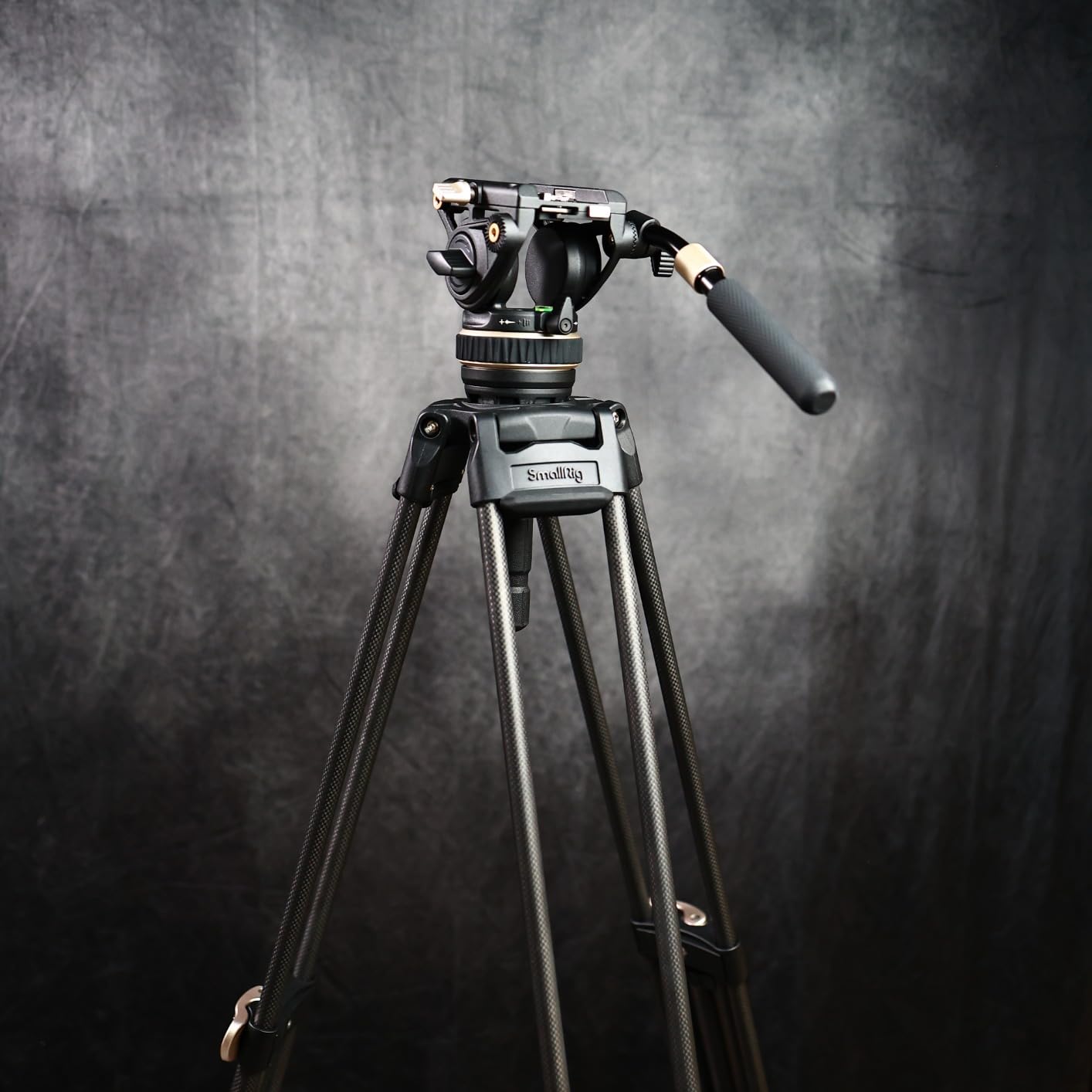
The VT72 is the only tripod here rated to 33 lb, and one video professional running Sachtler-class rigs names it as the strongest option in this group. That rating is not a marketing number on this one. A 26 lb setup sits on it once balanced, and the matched pan and tilt resistance is described as genuinely smooth.
Its head is unusual. Rather than a conventional two-axis fluid head, it has three drag adjusters covering 360 degree rotation, +90 to -70 degree tilt and plus or minus 10 degrees of hydraulic levelling, with a hydraulic device that springs the head back to level when the pan axis is released.
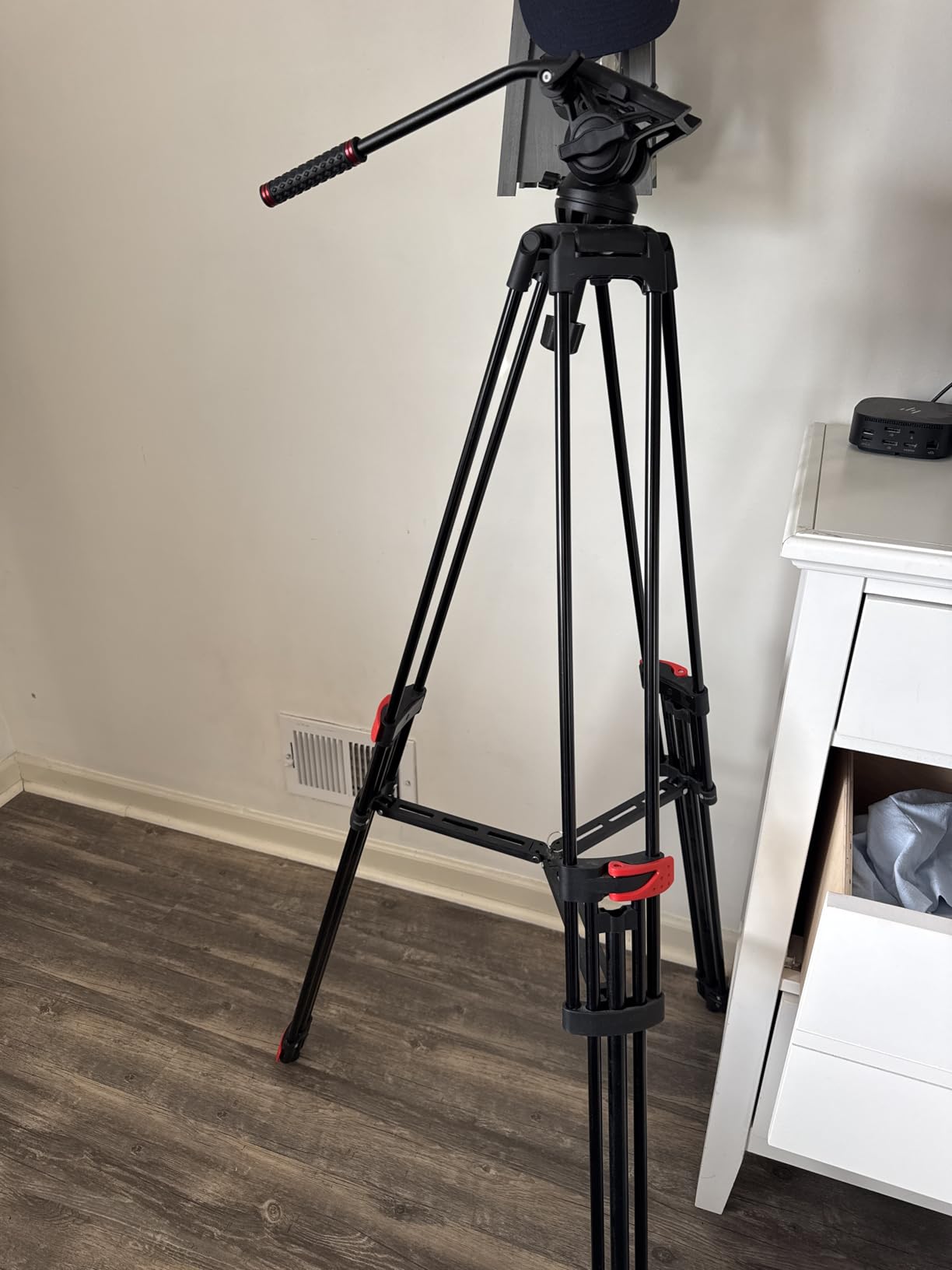
That levelling stage is the clever part. When you let go of the pan, the head returns to horizontal on its own, which makes it easy to get a level horizon repeatedly on a shoot where the ground is never flat twice.
What it is not is a counterbalance head. There is no adjustable spring, so past roughly plus or minus 30 degrees of tilt the rig will not hold position on its own, and there are no per-axis drag controls to shape the feel of each movement.
Who It Suits Best
Shooters with a genuinely heavy, top-heavy build, a long telephoto lens, or a tall operator who wants maximum reach. At 82 inches and a 15 kg rating, it covers a wide range of rig configurations that lighter heads would flex under, and the damped oil head keeps the movement composed with a heavy load.
It is also a natural fit for telescopes, binoculars and projectors, which the plate and rating support, and the hydraulic levelling is genuinely useful for repetitive setups on uneven ground.
Where It Falls Short
There is no counterbalance, so the moment your rig sits off-centre the head will not hold it. That is a hard limit for interview and tabletop work where a heavy lens hangs forward of the plate, and it is why this rates lowest of the ten despite the strong load figure.
Setup is also more complex than the others, with no retractable center column and multi-step feet, and the head gives you less control than a two-axis or three-way design. Buy it for capacity and reach, and treat it as a specialist tool rather than an all-rounder.
10. Manfrotto Befree Live Travel Video Tripod: Best for Carry-On and Mobile Creators
Pros
- Exceptionally light at 1.8 lb and fits a carry-on
- Fluid head gives smooth pans and tilts
- Folds unusually small with quick lever locks
- Levers fold up to keep the packed size compact
- Center hook accepts a counterweight
Cons
- Less stable than full-size tripods with noticeable vibration at high magnification
- The aluminum build is heavy for hiking compared with carbon
- No toggle on the screw under the quick release
- Head lacks the refinement of higher-end Manfrotto models
The Befree Live is the only tripod in this group you can genuinely travel with. At 1.8 lb it folds to 15.75 inches, fits in a carry-on, and the Travel Quick Power Lock lever closure gives you fast, precise setup without the fiddly twist locks that slow a small tripod down.
It is also a real video tripod rather than a travel tripod with a ball head. The Befree Live head has fluid on both the pan and tilt axes, carries up to 4 kg, and the center column lets you change height and perspective without losing camera focus mid-take.
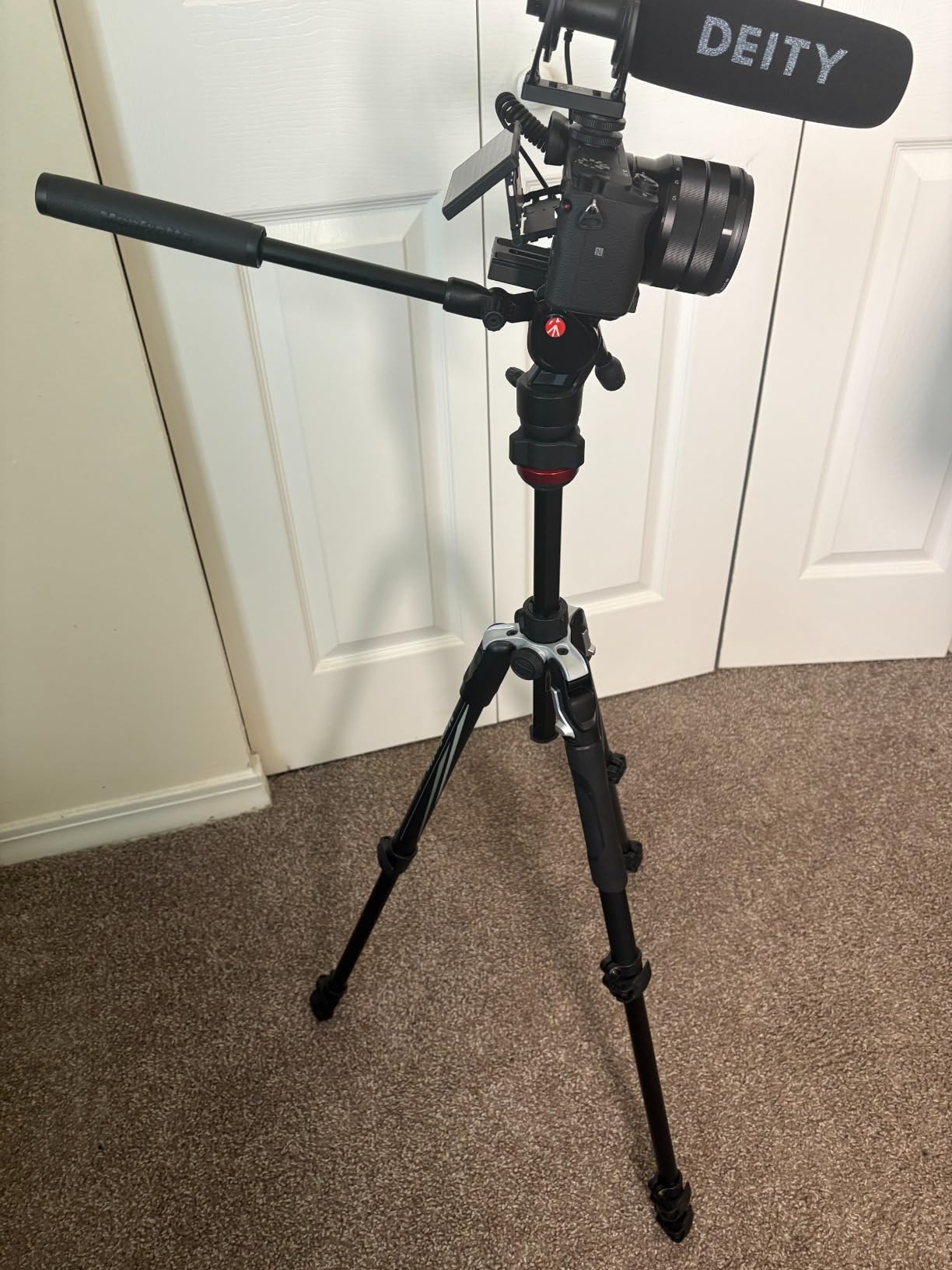
Each leg adjusts independently, which covers low-angle work that most travel tripods cannot reach, and the center hook accepts a counterweight for light fine-tuning on an off-centre rig. The levers fold up against the legs so the packed length stays short.
The trade is stability, and it is a real one. Owners report noticeable vibration at high magnification, and the fluid head lacks the refinement of Manfrotto’s larger heads. The 4 kg rating covers a mirrorless body and a light lens, not a full rig.
Who It Suits Best
Travel shooters, location presenters and creators who work across multiple cities and need a real fluid head in a bag rather than a car boot. The 1.8 lb weight means you can carry it all day without thinking about it, which changes how often you actually use it.
It is also the natural choice for mobile and hybrid creators shooting vertical content, since the small folded size fits in a day bag alongside a compact body. Our video tripod guide for phones covers the phone-specific mounts in more detail.
Where It Falls Short
Stability under magnification is the limit. A long lens at full extension will show vibration, and the aluminum version is heavy for hiking when a carbon version of the same design is noticeably lighter.
Keep the load inside 4 kg and use it at moderate focal lengths, and it performs well. Push past that and the platform is outgrowing the tripod, which is the point at which the aluminum systems in this list become the better buy.
How to Choose a Video Tripod: Heads, Payload and Materials
Most buying mistakes come down to reading one number instead of four. Payload is the one everyone checks, and it is the least informative on its own, because a head rated to 20 lb can still ruin a shot if it cannot be balanced or if only one axis is damped. Work through these seven areas in order and the decision makes itself.
Fluid head vs ball head: what changes in the footage
A ball head has one lock. Release it and the camera is free, lock it and the camera is rigid, and everything in between is your hands. For stills that is ideal. For video it means every move either starts or ends with a hard stop, and there is no way to slow a pan down halfway through a move.
A fluid head meters the resistance on each axis continuously. You set the drag to a value, the pan handle moves at a speed you choose rather than one the spring dictates, and the shot can accelerate and settle the way a human arm moves. On any shot with movement in it, this single difference is more visible than every other specification on the list.
2-way vs 3-way heads and the counterbalance question
A two-way head controls pan and tilt only. A three-way head adds a side axis so you can swing the camera around for a vertical or portrait setup without unbalancing it. For a creator shooting vertical content, three-way is close to essential, and it is one of the specs buyers most often miss.
Counterbalance is the separate, more important idea. A counterbalanced head uses an adjustable spring to offset the off-centre weight of your rig, so the head can be locked at any angle and stay there. A head without one, such as the MACTREM VT72, can only hold a centred load, and a heavy lens hanging forward of the plate will pull it over. Videographers in community forums consistently argue for choosing a head on how your actual rig behaves, not on the spec-sheet load rating, and they are right.
How much payload you actually need
Add everything, not just the camera. Body plus lens is usually only half of a working rig, and the rest arrives with a cage, a top handle, a shotgun mic, a monitor, a battery, an accessory mount and the plate itself. Once you have the full figure, aim for a stated capacity of at least twice that number.
The doubling rule exists because a published rating is a specification claim rather than a guarantee of vibration-free support, and because rigs change. A 12 lb build on a 20 lb head is comfortable. The same build on a 15 lb head is at its limit before you add the accessory you forgot about. Sensor format matters here too: the caution circulating on cinematography forums is that a head fine for a one-third-inch camera is nowhere near enough for a two-thirds-inch cinema body carrying a full set of lenses.
How to counterbalance a full rig in five steps
First, mount the rig on the head with the pan bar and all accessories fitted, because a balanced rig is a balanced rig with its monitor and mic on. Second, release all locks and let the rig find its own resting angle, which is the angle the counterbalance spring has to offset.
Third, find the counterbalance adjustment and set it so the head neither rises nor falls at that angle. Fourth, set the pan and tilt drag separately, and set them in the order you will actually use them, which is usually a fast drag for repositioning and a slow drag for the take. Fifth, lock the head at several angles and confirm it stays put before you walk away from it.
Repeat the check any time you change lens, add a monitor, or remove a top handle. A rig that is balanced empty is not a balanced rig, and the difference shows up as a slow drift in a locked-off frame that is easy to miss and hard to re-shoot.
Carbon fiber vs aluminum for location work
Aluminum is cheaper, tougher against knocks, and easier to repair. It also conducts heat, which is a real consideration when you are standing behind a locked-off frame in direct sun for an hour. Carbon fiber is roughly 30 to 40 percent lighter at the same stiffness, damps vibration better, and stays comfortable to hold in cold weather, which matters on early starts.
The weight argument is the one that decides most purchases. Lighter is not just easier to carry, it is a tripod you will actually bring on the jobs where a tripod is awkward to bring, and that is how the FreeBlazer and the Befree Live earn their place. If your work is studio-bound, aluminum is the better value. If you move location, carbon earns its cost through the number of setups you can make in a day.
Quick-release plate standards and why it matters
Arca-Swiss is the widest standard in use and the one most video rigs already carry, because cages and plates are usually Arca-compatible. Manfrotto RC2 and 500PL plates are the long-standing alternative, and DJI RS series uses its own. The dual-mode plates on the NEEWER TP74, the SmallRig AD-01 and the FreeBlazer accept more than one of these, which removes a real failure point.
Proprietary plates are the quiet orphan-maker. If the tripod only takes its own plate, every other piece of gear you own needs a second plate in the bag, and every swap is another chance to drop something in the dark. Check what the head accepts before you buy the legs.
When a gimbal beats a tripod
A tripod is right when the camera is stationary, when a move starts and ends in the same place, and when you need to be as still as physically possible. A gimbal is right when the camera and subject are both moving through space, because a tripod cannot follow a walking subject without turning into a dolly.
The useful middle ground is a fluid head plus a pan handle, which gives you repeatable, controlled movement without the operator effort a gimbal demands. Plenty of documentary and corporate work is shot entirely that way, and for a single operator a well-balanced head is faster than rigging a stabilizer.
Frequently Asked Questions
What is the best tripod for filming video content?
For most production work the NEEWER TP-M200 is the strongest all-round choice: a true 360 degree fluid drag head, a 17.6lb/8kg load rating and a 200cm maximum height. If your rig is heavy, the SmallRig AD-100 FreeBlazer carries 22lb on carbon fiber legs that open two legs at once. For travel, the Manfrotto Befree Live folds to 15.75 inches at 1.8 lb. The non-negotiable spec on all three is a fluid head.
What are the best tripods for video recording?
The shortlist depends on the rig rather than the brand. A mirrorless body with a prime is covered by the NEEWER TP74 or SmallRig AD-01, a full cage rig needs the COMAN FF16LS or SmallRig AD-100 at 22lb, and a long telephoto or cinema build is served by the MACTREM VT72 at 33lb. The comparison table above lists all ten with height, load and head type.
What is the best tripod for making YouTube videos?
For a solo creator, a tripod that opens fast and carries a mirrorless body is the practical answer, and the SmallRig AD-01 at 8.8 lb is the pick most people in that group end up on. Fast deployment matters more for jump-cut assembly than maximum payload. Add a fluid head if you want pans, and leave the center column down for stability.
Which tripod is best for content creation?
Content creators usually need portability more than capacity, so the Manfrotto Befree Live wins on a 1.8 lb weight and a 15.75 inch fold. Creators working vertical should look for a three-way head or independent leg positions so the camera can swing to portrait without rebalancing. Accessory threads for a mic and light matter more than most spec sheets admit.
Do I need a fluid head tripod for video?
Yes, for any shot with movement. A ball head is either locked or free, so a pan starts and ends with a hard stop. A fluid head meters the resistance on each axis continuously, which is what lets a move accelerate and settle. For locked-off talking head and livestream work a ball head can hold a light camera, but the moment the camera moves the difference is obvious.
How much payload do I actually need for my video camera?
Add the body, lens, cage, top handle, shotgun mic, monitor, battery and plate, then double the total. A rig weighing 12 lb wants a head rated at least 24 lb, which leaves room for the accessory you add later. A larger sensor format needs more headroom still, since a body carrying a set of cinema lenses can exceed a light head very quickly.
Conclusion
The NEEWER TP-M200 is our pick for the best tripods for video production in 2026 because it covers the widest range of real work: a genuine fluid head on both axes, a load rating with margin for a typical rig, and enough reach that you stop needing a riser. If your priority is the smoothest movement in the group, the NEEWER TP74 takes it, and its dual-mode plate makes the jump between a gimbal and a tripod painless.
For heavy rigs and fast deploys, the COMAN FF16LS and the SmallRig AD-100 FreeBlazer are the two to beat, and for floor-level angles nothing else here reaches as low as the Manfrotto 290 Xtra. Whichever you choose, check the counterbalance with your actual rig, in your actual configuration, before the first take. Our mirrorless camera guide for video production is a good place to work out what your total load actually is.