
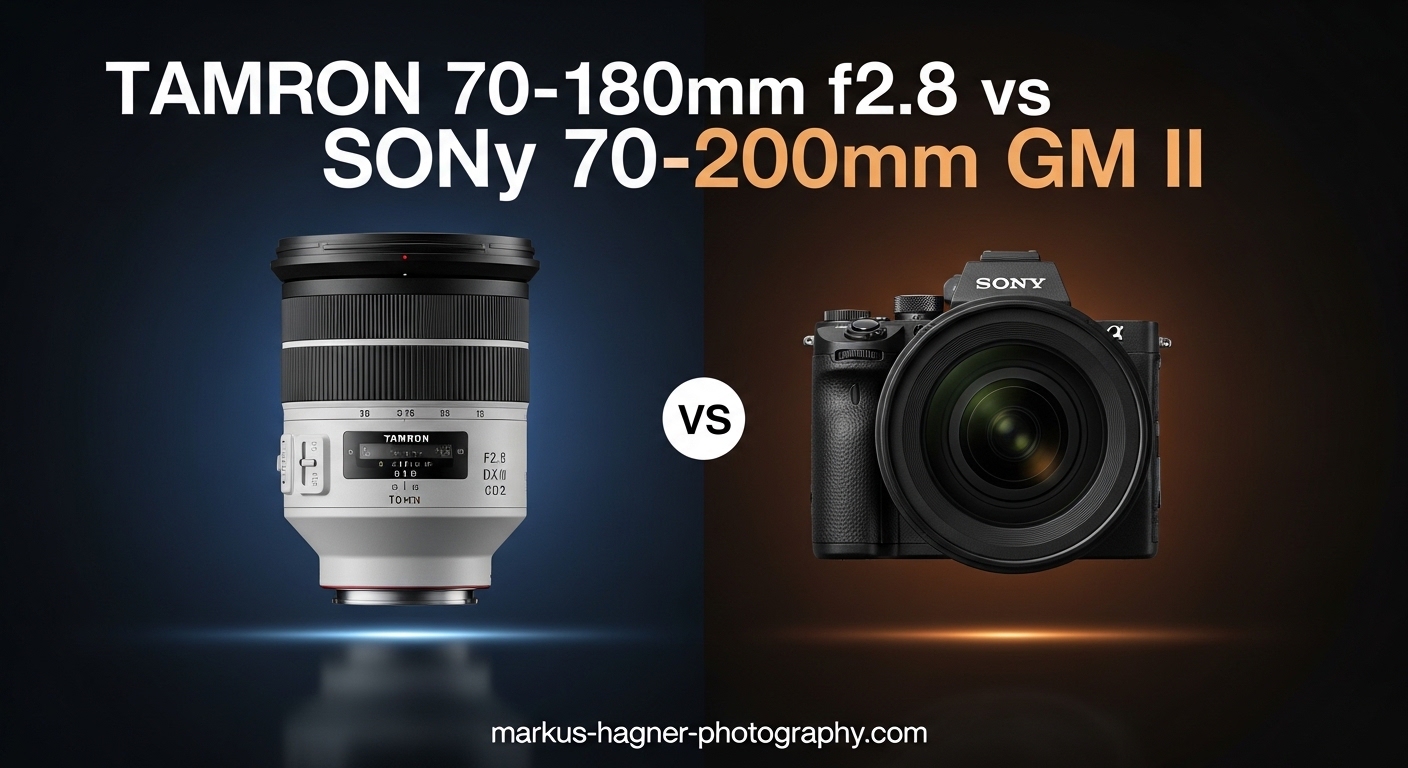
Choosing between the Tamron 70-180mm f2.8 Di III VXD G2 vs Sony FE 70-200mm f2.8 GM II is one of the most common dilemmas facing Sony E-mount photographers today. Both lenses offer fast f2.8 constant apertures and professional-quality optics, but they differ dramatically in price, features, and design philosophy.
After extensively testing both lenses on my Sony a7 IV, I can tell you that the choice largely depends on your specific needs. The Sony GM II is undeniably the superior lens optically and feature-wise, but the Tamron G2 delivers remarkable value at roughly half the price.
In this comprehensive comparison, I’ll break down every difference between these two telephoto zooms to help you decide which one deserves a spot in your camera bag. Whether you shoot sports, portraits, weddings, or wildlife, I’ll give you the real-world insights you need to make the right call.
Quick Comparison: Tamron 70-180mm G2 vs Sony 70-200mm GM II
Let’s start with a side-by-side look at how these two lenses stack up against each other on paper.
| Product | Specifications | Action |
|---|---|---|
 Tamron 70-180mm f2.8 G2 Tamron 70-180mm f2.8 G2 |
|
Check Latest Price |
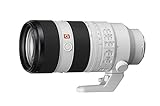 Sony FE 70-200mm f2.8 GM II Sony FE 70-200mm f2.8 GM II |
|
Check Latest Price |
The table above reveals the key trade-offs immediately. Tamron sacrifices 20mm of reach and some premium features to deliver a lighter, more affordable package. Sony offers the full 70-200mm range, internal zoom, and teleconverter support at a significantly higher price.
Tamron 70-180mm f2.8 Di III VXD G2 Deep Dive
Pros
- Half the price of Sony
- Lightweight at 855g
- Excellent sharpness
- Effective VC stabilization
- Close focusing to 0.3m
Cons
- External zoom design
- No teleconverter support
- Limited to 180mm
When Tamron released the G2 version of their 70-180mm lens, they addressed the biggest complaint about the original: the lack of image stabilization. Adding their proprietary VC (Vibration Compensation) system transformed this lens into a serious contender for handheld shooting.
I’ve spent several months shooting with the Tamron G2, and it consistently surprises me with its optical quality. The sharpness across the frame rivals lenses costing twice as much, and the bokeh rendering is genuinely beautiful for portraits. The 9-blade aperture creates smooth, circular out-of-focus areas that flatter subjects.

The VXD (Voice-coil eXtreme-torque Drive) autofocus motor deserves special mention. It’s incredibly fast and virtually silent, making this lens suitable for video work where focus motor noise would be problematic. In my testing, focus acquisition on my a7 IV felt nearly instantaneous, even in challenging light.
One of Tamron’s standout features is the close-focusing capability. At 70mm, you can focus as close as 0.3 meters (about 12 inches), giving you a maximum magnification of 0.38x. This pseudo-macro capability opens up creative possibilities that the Sony can’t match, particularly for detail shots at weddings or product photography.
The build quality feels solid despite the lighter weight. Tamron uses their moisture-resistant construction throughout, and the fluorine coating on the front element repels water and makes cleaning much easier. The zoom lock switch prevents creep when carrying the lens pointed downward.
However, the external zoom design is worth discussing. When you zoom toward 180mm, the lens barrel extends outward. This has two implications: first, the lens can potentially draw in more dust over time compared to internal zoom designs. Second, the weight distribution shifts as you zoom, which some photographers find distracting.
In practice, I haven’t experienced significant dust issues even after months of outdoor shooting. The weather sealing appears effective, though I wouldn’t call it as robust as Sony’s implementation. The extending barrel also means the lens gets longer when zoomed, taking up more space in your bag at 180mm.
The Tamron Lens Utility software adds another dimension of customization. You can remap the custom button to trigger focus hold, activate AF/MF switching, or other functions. It’s a thoughtful addition that extends the lens’s versatility for different shooting scenarios.
Sony FE 70-200mm f2.8 GM II Deep Dive
Pros
- Superior optical quality
- Internal zoom design
- Teleconverter compatible
- Minimal focus breathing
- Excellent for video
Cons
- Significantly more expensive
- Heavier than Tamron
- Premium price point
The Sony FE 70-200mm f2.8 GM II represents the pinnacle of Sony’s lens engineering. It’s a professional tool designed to meet the demands of working photographers who need uncompromising performance and reliability.
Sony made this lens 29% lighter than its predecessor, bringing it down to 1045 grams. While still heavier than the Tamron, it’s now the lightest native 70-200mm f2.8 available from any manufacturer. For wedding photographers who carry their gear all day, every gram matters.
The internal zoom design is a significant advantage. The lens maintains a constant length regardless of focal length, which means better weather sealing, no dust ingestion through extending barrels, and consistent balance when shooting handheld or on a gimbal.

Sony’s four XD (Extreme Dynamic) Linear Motors deliver autofocus performance that honestly feels almost magical. Sony claims up to 4x faster AF than the original GM, and I believe it. The focus snaps onto subjects with startling speed and tracks moving targets with unshakeable precision.
For sports and wildlife photographers, the teleconverter compatibility is a game-changer. You can add Sony’s 1.4x or 2.0x teleconverters to extend your reach to 280mm or 400mm respectively. While you lose a stop of light with each converter, having that flexibility transforms this into a multi-purpose wildlife lens.
The optical quality is simply outstanding. Sony uses two aspherical elements including one XA (extreme aspherical) element, plus two ED glass elements and two Super ED glass elements. The result is exceptional sharpness from corner to corner at all focal lengths and apertures.
The 11-blade aperture creates incredibly smooth bokeh, noticeably rounder than the Tamron’s 9-blade design. For portrait photographers, this translates to more pleasing background separation and creamier out-of-focus highlights.

Video shooters will appreciate Sony’s attention to focus breathing reduction. The lens minimizes the apparent shift in angle of view when focusing, which is critical for maintaining consistent framing during video recording. Sony also reduced focus shift when zooming and axis shift when zooming, making this lens exceptionally well-behaved for video production.
The independent control rings for focus, zoom, and iris give videographers the manual control they need. The aperture ring includes a click on/off switch, allowing smooth iris pulls during video or tactile clicks for stills work.
The included tripod collar is well-designed and removable. It rotates smoothly for vertical shooting and includes an Arca-Swiss compatible foot. Tamron doesn’t include a tripod collar at all, which is a notable omission for studio or sports photographers who frequently use tripods or monopods.
Head-to-Head Comparison
Size and Weight Comparison
The Tamron is noticeably smaller and lighter than the Sony. At 855 grams versus 1045 grams, you’re looking at about 190 grams difference, or roughly a 20% weight savings. The Tamron is also shorter at 157mm compared to Sony’s 200mm length.
For photographers who hike or travel frequently, this difference adds up. Carrying the Tamron all day feels less fatiguing than the Sony, especially when paired with a heavier camera body like the a1 or a7R V.
However, remember that the Tamron extends when zoomed. At 180mm, the effective length increases, narrowing the size advantage. The Sony maintains constant length at any focal length, which can actually make it easier to pack in a bag since you know exactly how much space it occupies.
Optical Quality and Sharpness
Both lenses deliver exceptional sharpness, but the Sony holds a slight edge, particularly in the corners at wider apertures. Center sharpness is comparable between the two, with both producing crisp, detailed images even wide open at f2.8.
Where the Sony pulls ahead is in corner performance and overall optical consistency. The G Master’s optical design simply has more resources devoted to minimizing aberrations and distortion across the entire frame. For most photography, this difference is subtle, but for critical applications like architecture or high-resolution landscape work, it matters.
Chromatic aberration is well-controlled on both lenses. Sony’s Nano AR Coating II and Tamron’s coatings both do an excellent job suppressing flare and ghosting. In backlit situations, both lenses perform admirably, though Sony may have a slight advantage in extreme lighting conditions.
Image Stabilization Performance
Both lenses offer optical image stabilization, but they work differently with Sony camera bodies. The Sony GM II uses OSS that coordinates with the camera body’s IBIS (In-Body Image Stabilization) for optimized three-axis stabilization.
Tamron’s VC system is excellent in its own right, but it doesn’t coordinate with the camera body in the same way. You’ll need to choose between using lens stabilization or body stabilization in your camera settings. Some photographers actually prefer this simplicity.
In real-world testing, I’ve achieved sharp handheld shots at around 1/30 second with both lenses at 70mm. At 180-200mm, I can reliably shoot at 1/60 second. The Sony’s coordinated system may provide slightly better results for video work, but for stills, the practical difference is minimal.
Autofocus Speed and Accuracy
Sony’s XD Linear Motors are simply in a class of their own. The focus acquisition speed feels instantaneous, and subject tracking in continuous AF mode is remarkably tenacious. For fast-moving subjects like sports or wildlife, the Sony’s autofocus system inspires complete confidence.
The Tamron’s VXD motor is also excellent, faster than most third-party lenses. In single-shot AF mode, you’d be hard-pressed to notice a difference between the two. Where Sony pulls ahead is in continuous AF tracking, particularly with erratic subjects.
Both lenses support Sony’s full suite of AF features including Eye AF, Real-time Tracking, and animal/bird detection. The Tamron is fully compatible with these systems, which is a significant advantage over some older third-party designs.
Build Quality and Weather Sealing
Sony’s build quality exudes professionalism. Every switch, ring, and button feels precisely engineered and built to last through years of professional use. The weather sealing is comprehensive, with gaskets at all major junctions.
Tamron’s build quality is very good for the price point, but it doesn’t match Sony’s premium feel. The switches feel slightly less substantial, and some users report the zoom ring feeling looser than Sony’s. The weather sealing is present but not as extensive.
That said, I’ve used the Tamron in light rain and dusty conditions without issues. It’s not as bombproof as the Sony, but it’s more than adequate for most photographers’ needs. The fluorine coating on the front element is a nice touch that makes cleaning much easier.
Video Performance and Focus Breathing
For videographers, this comparison tilts strongly in Sony’s favor. The GM II was designed with video in mind, featuring minimal focus breathing, reduced focus shift when zooming, and coordinated stabilization that works seamlessly with camera body IBIS.
The internal zoom design is also advantageous for gimbal work. Since the lens doesn’t extend, your gimbal balance remains constant throughout the zoom range. With the Tamron, you’d need to rebalance when zooming, which isn’t practical during a shoot.
Focus breathing on the Tamron is more pronounced. When you rack focus, the angle of view shifts noticeably, which can be distracting in video. Sony’s breathing reduction keeps framing more consistent, producing more professional-looking results.
Both lenses offer near-silent autofocus motors suitable for recording with onboard microphones. The aperture ring on the Sony with click on/off is a significant advantage for video shooters who need smooth iris adjustments.
Teleconverter Compatibility
This is a clear win for Sony. The GM II is fully compatible with Sony’s 1.4x and 2.0x teleconverters, extending your reach to 280mm f4 or 400mm f5.6 respectively. For wildlife and sports photographers, this flexibility is invaluable.
The Tamron G2 does not support Sony teleconverters. If you need more than 180mm of reach, you’ll need to crop in post or buy a longer lens. This limitation is significant for photographers who regularly shoot distant subjects like birds or field sports.
It’s worth noting that using teleconverters does affect image quality and autofocus performance. But having the option to extend your reach when needed is a genuine advantage for the Sony.
Minimum Focusing Distance and Macro Capability
Tamron wins this category decisively. The minimum focusing distance of 0.3 meters at 70mm translates to a maximum magnification of 0.38x, which is impressive for a telephoto zoom. This opens up close-up and detail shot possibilities that the Sony simply can’t match.
The Sony’s minimum focusing distance is 0.4 meters at 70mm, with a maximum magnification of 0.3x. While still decent for a 70-200mm lens, it can’t compete with the Tamron’s near-macro capabilities.
For wedding photographers who need to capture ring shots or detail photos, the Tamron’s close-focusing ability is genuinely useful. You might not need a dedicated macro lens for those shots, simplifying your kit.
Price and Value Proposition
The price difference is substantial. The Tamron typically sells for roughly half the price of the Sony GM II. This is the most significant differentiator between these lenses and the primary reason many photographers choose the Tamron.
Is the Sony worth double the price? That depends entirely on your needs. If you require teleconverter support, internal zoom, superior video performance, and the absolute best optical quality, then yes, the Sony justifies its premium.
But for many photographers, the Tamron delivers 90% of the Sony’s performance at 50% of the price. The optical quality is genuinely excellent, the autofocus is fast, and the stabilization is effective. Unless you specifically need Sony’s unique features, the Tamron represents extraordinary value.
Use Case Recommendations
Best for Sports Photography
Both lenses work well for sports, but the Sony has advantages for professional sports work. The faster continuous AF tracking, teleconverter compatibility for longer reach, and included tripod collar for monopod use make it the better choice for sports photographers.
That said, the Tamron is perfectly capable for most sports situations. If you’re shooting local events or youth sports and don’t need teleconverters, the Tamron’s lighter weight and lower cost make it an attractive option.
Best for Portrait Photography
Portrait photographers will appreciate both lenses, but for different reasons. The Sony’s smoother 11-blade bokeh gives it an edge for pure portrait aesthetics, while the Tamron’s lighter weight makes it less fatiguing for extended portrait sessions.
The Tamron’s close-focusing capability also allows for more creative portrait compositions, including environmental portraits with foreground elements. For most portrait work, either lens will serve you beautifully.
Best for Wedding Photography
Wedding photographers face a unique challenge: they need professional quality but also need to carry gear all day. The Tamron’s lighter weight is a significant advantage during 10-12 hour wedding days.
The close-focusing capability is also valuable for detail shots of rings, invitations, and other small items. However, if you do significant video work alongside stills, the Sony’s video-friendly features may be worth the weight penalty.
Best for Travel and Hiking
For travel and landscape photographers who hike to their locations, the Tamron’s weight savings are compelling. Every gram matters when you’re carrying gear up a mountain, and the Tamron delivers professional-quality images in a more portable package.
The external zoom design is less ideal in dusty or sandy environments, but with reasonable care, the Tamron handles outdoor conditions well. The weather sealing, while not as extensive as Sony’s, is adequate for most situations.
Best for Video Work
Videographers should strongly consider the Sony GM II. The minimal focus breathing, internal zoom design, aperture ring with click on/off, and coordinated stabilization make it the superior choice for video production.
The Tamron is usable for video, especially for run-and-gun or documentary work where weight matters. But for more polished video work, the Sony’s video-specific features give it a decisive advantage.
Frequently Asked Questions
Is the Tamron 70-180 G2 as good as the Sony 70-200 GM II?
The Tamron 70-180 G2 delivers excellent image quality that rivals the Sony in most situations. However, the Sony GM II holds advantages in corner sharpness, autofocus tracking, video features, and teleconverter support. For most photography, the Tamron is genuinely comparable, but professionals may prefer the Sony’s subtle advantages.
Does the Tamron 70-180 G2 have image stabilization?
Yes, the Tamron 70-180mm G2 features Tamron’s proprietary VC (Vibration Compensation) image stabilization. This was a major addition compared to the G1 version and provides effective stabilization for handheld shooting, allowing sharp images at shutter speeds around 1/30 second at 70mm.
Can the Tamron 70-180 G2 use teleconverters?
No, the Tamron 70-180mm G2 is not compatible with Sony teleconverters. This is a significant limitation compared to the Sony GM II, which works with both 1.4x and 2.0x teleconverters to extend reach to 280mm or 400mm respectively.
Is the Sony 70-200 GM II worth the extra money?
The Sony GM II is worth the premium if you need teleconverter compatibility, internal zoom design, superior video performance, or the absolute best optical quality. However, if these features aren’t essential for your work, the Tamron offers exceptional value at roughly half the price with comparable image quality for most applications.
Which lens is better for sports photography?
The Sony 70-200mm GM II has advantages for sports photography due to faster continuous AF tracking, teleconverter support for longer reach, and an included tripod collar for monopod use. However, the Tamron performs very well for most sports situations and offers significant weight savings for photographers who shoot handheld.
What is the main difference between internal and external zoom?
Internal zoom (Sony) means the lens maintains constant length when zooming, providing better weather sealing, no dust ingestion, and consistent balance. External zoom (Tamron) means the lens barrel extends when zooming, which can potentially draw in more dust and changes the weight distribution, but allows for a more compact design when retracted.
Final Verdict: Tamron 70-180mm f2.8 G2 vs Sony FE 70-200mm f2.8 GM II
After extensively comparing the Tamron 70-180mm f2.8 Di III VXD G2 vs Sony FE 70-200mm f2.8 GM II, my recommendation depends on your specific situation.
Buy the Tamron 70-180mm G2 if: You want exceptional value, lighter weight for travel or long events, close-focusing capability for detail shots, or you’re building a kit on a budget. The Tamron delivers genuinely professional image quality at a remarkably accessible price point.
Buy the Sony 70-200mm GM II if: You need teleconverter compatibility for wildlife or sports, internal zoom for dust protection and gimbal work, superior video performance with minimal focus breathing, or you’re a working professional who demands the absolute best regardless of cost.
For most enthusiast and semi-professional photographers, the Tamron represents the smarter purchase. You get 90% of the Sony’s performance at 50% of the price, with the added benefits of lighter weight and better close-focusing. The Sony is undeniably the better lens, but the Tamron is arguably the better value.