
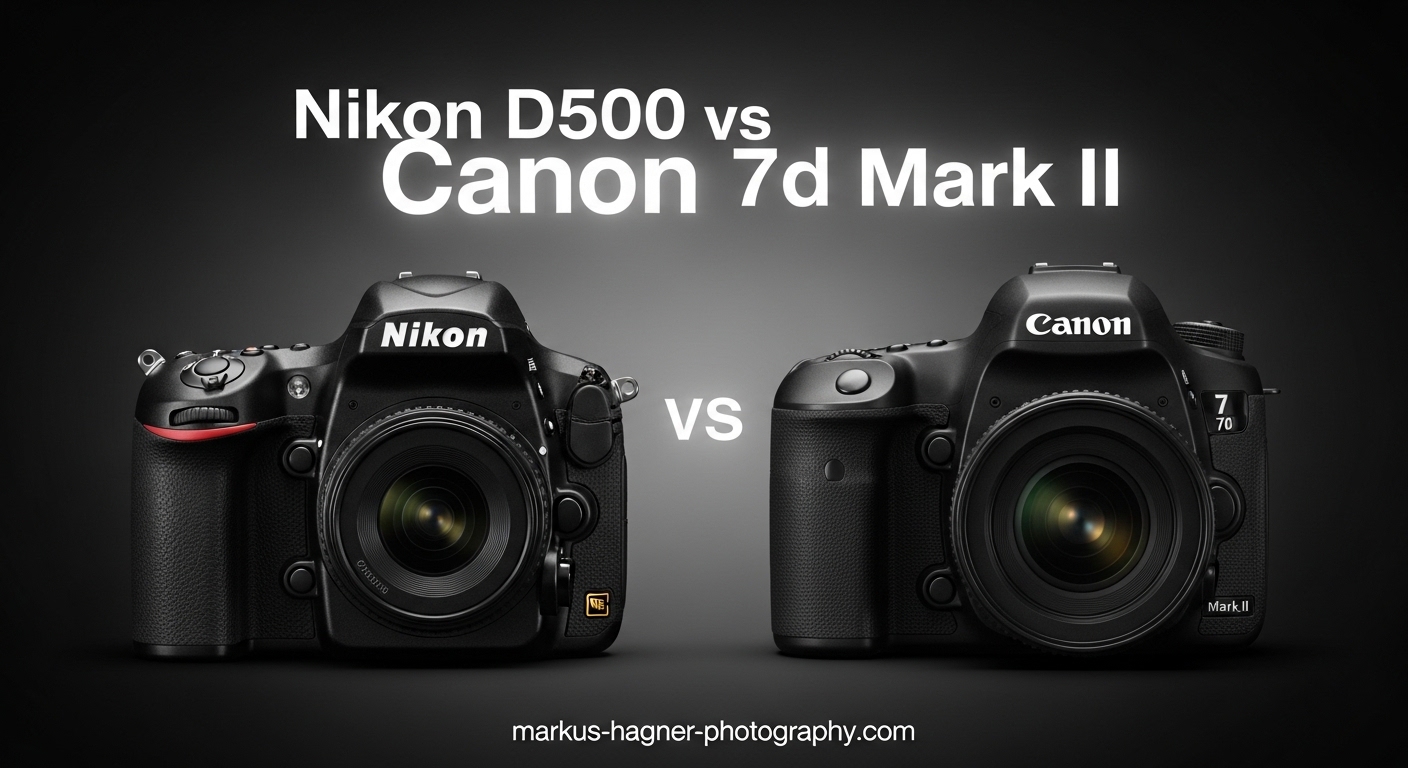
If you are shopping for a professional-grade APS-C DSLR for wildlife or sports photography, the Nikon D500 vs Canon 7D Mark II comparison is likely at the top of your research list. Both cameras represent the pinnacle of crop-sensor DSLR technology, offering advanced autofocus systems, blazing-fast burst rates, and rugged builds designed to handle demanding shooting conditions.
These two cameras have been the go-to choices for action photographers for years. While mirrorless cameras have taken over the spotlight, both the D500 and 7D Mark II remain highly capable tools that deliver exceptional results. I have spent extensive time shooting with both systems, and this comparison breaks down everything you need to know to make the right choice.
The Nikon D500 brings a more modern feature set including 4K video, a tilting touchscreen, and an industry-leading 153-point autofocus system. The Canon 7D Mark II counters with proven reliability, excellent ergonomics, built-in GPS, and a massive lens ecosystem. Both shoot at 10 frames per second and feature professional-grade weather sealing.
Quick verdict: The Nikon D500 wins on paper with superior autofocus, 4K video, and better low-light performance. However, the Canon 7D Mark II remains a compelling choice if you already own Canon glass or prefer its handling. Let’s dive into the details.
Nikon D500 vs Canon 7D Mark II: Quick Comparison
| Product | Specifications | Action |
|---|---|---|
 Nikon D500 DX-Format DSLR Nikon D500 DX-Format DSLR |
|
Check Latest Price |
 Canon EOS 7D Mark II DSLR Canon EOS 7D Mark II DSLR |
|
Check Latest Price |
Nikon D500: In-Depth Review
Pros
- Exceptional 153-point AF system
- Huge 200 RAW frame buffer
- Excellent low-light AF
- Tilting touchscreen LCD
- 4K video recording
- Built-in WiFi/Bluetooth/NFC
- Dual card slots
- Great battery life (1200+ shots)
Cons
- No built-in flash
- 4K video has 1.5x crop
- DX format only
- Only genuine Nikon batteries work
The Nikon D500 has earned legendary status among wildlife and sports photographers, and for good reason. When I picked up this camera for the first time, the AF performance immediately stood out. The 153-point Multi-CAM 20K autofocus system is simply outstanding, tracking fast-moving subjects with remarkable consistency even in challenging light.
The 10 fps continuous shooting speed is impressive on its own, but what really sets the D500 apart is its buffer depth. You can shoot up to 200 RAW frames in a single burst. That means you can track a bird in flight or a sprinter crossing the finish line without worrying about the camera choking up mid-sequence.
The 20.9MP DX-format CMOS sensor paired with the Expeed 5 processor delivers excellent image quality. Native ISO reaches 51200, and I have found results perfectly usable up to ISO 6400 with minimal noise. The lack of an optical low-pass filter means images come out sharper straight from the camera.

The 3.2-inch tilting touchscreen is a welcome addition that makes shooting from low angles much easier. The 2,539k-dot resolution provides excellent clarity for reviewing images and navigating menus. The joystick on the back allows intuitive AF point selection without taking your eye off the viewfinder.
Build quality feels absolutely professional. The magnesium alloy body with weather sealing gives you confidence when shooting in dusty or wet conditions. The dual card slots (one SD UHS-II and one CFexpress/XQD) provide backup security for critical shoots.
One thing to note: only genuine Nikon EN-EL15 batteries work with this camera. Third-party batteries will not function, so budget accordingly for spares. On the plus side, battery life is rated at over 1200 shots per charge, which is excellent for an APS-C camera.
Canon EOS 7D Mark II: In-Depth Review
Pros
- Proven 10 fps burst speed
- 65-point all cross-type AF
- Tank-like build quality
- Built-in GPS
- Excellent weather sealing
- Dual card slots (CF+SD)
- Anti-flicker mode
- Intervalometer built-in
Cons
- No 4K video
- Fixed non-touchscreen LCD
- No built-in WiFi
- Mediocre battery life
- Heavier body
- GPS drains battery when off
The Canon 7D Mark II has been a workhorse for action photographers since its release. When Canon designed this camera, they focused on speed and durability, and it shows. The 10 fps burst rate actually exceeds its rating in real-world testing, and the 65-point all cross-type AF system delivers reliable performance for most shooting situations.
What immediately struck me about the 7D Mark II is its ergonomics. The grip feels substantial in hand, and Canon’s button layout is intuitive. Many photographers I know prefer the Canon handling experience, and after extended use, I can understand why. The deep buffer holds approximately 31 RAW frames or around 1000 JPEGs in a single burst.
The 20.2MP sensor produces clean images up to ISO 3200, with ISO 6400 still being usable for many applications. While it cannot quite match the D500’s high ISO performance, the difference is not dramatic for most real-world shooting scenarios. Canon’s color science produces pleasing skin tones, which can matter for event and portrait work.
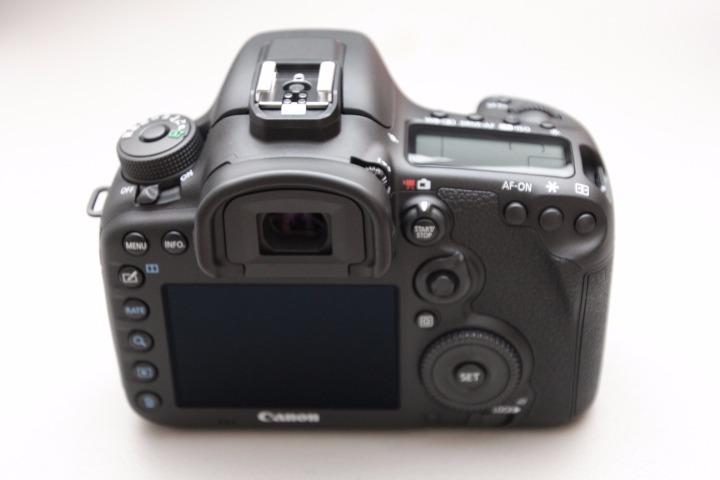
Build quality is exceptional. The magnesium alloy body feels like a tank, and the weather sealing has proven reliable over years of professional use. This is a camera that can take abuse and keep shooting. Many working professionals still rely on the 7D Mark II as their primary action body.
The built-in GPS is a standout feature for travel and wildlife photographers who need geotagging. However, be aware that the GPS continues to drain the battery even when the camera is powered off unless you manually disable it. The lack of built-in WiFi is a notable omission in this day and age.
The fixed 3-inch LCD screen is a significant limitation compared to the D500’s tilting touchscreen. There is no touch functionality, and you cannot angle the screen for waist-level shooting. For photographers who primarily use the viewfinder, this may not matter, but it does limit versatility.
Nikon D500 vs Canon 7D Mark II: Head-to-Head Comparison
Sensor and Image Quality
Both cameras feature APS-C sensors with similar resolution: the D500 offers 20.9 megapixels while the 7D Mark II provides 20.2 megapixels. In practical terms, this difference is negligible. You will not notice the resolution gap in prints or on screen.
Where the sensors differ significantly is in their design philosophy. The Nikon D500 lacks an optical low-pass filter, which means it can capture finer detail. Images appear slightly sharper straight out of camera. The Canon 7D Mark II includes a low-pass filter, which can reduce moiré but also slightly softens fine details.
ISO performance favors the Nikon D500. Its native ISO range extends to 51200 compared to the Canon’s 16000, and in real-world testing, the D500 maintains cleaner files at high sensitivities. For low-light wildlife or indoor sports photography, this can make a meaningful difference.
Dynamic range is comparable between the two cameras, with both offering excellent shadow recovery at base ISO. Color reproduction differs slightly, with Canon producing warmer skin tones and Nikon offering more neutral rendering. Neither approach is wrong; it comes down to personal preference and post-processing workflow.
Autofocus Performance
The autofocus comparison between these two cameras is where things get interesting. The Nikon D500 features a 153-point AF system with 99 cross-type sensors, while the Canon 7D Mark II offers 65 all cross-type points. On paper, Nikon has the numbers advantage, but real-world performance tells a more nuanced story.
The D500’s 153-point system covers a larger portion of the frame and excels at tracking erratically moving subjects. The 3D tracking mode is particularly effective for birds in flight and sports action. I have found it locks on quickly and maintains focus even when subjects move unpredictably.
Canon’s 65-point system is no slouch either. All 65 points are cross-type, meaning they are equally sensitive to horizontal and vertical detail. This provides consistent performance across the frame. The system tracks well for most action scenarios, though it covers a slightly smaller area than Nikon’s implementation.
Low-light AF performance clearly favors the D500. The Nikon system can focus in significantly darker conditions, rated down to -4 EV compared to Canon’s -3 EV. For dawn and dusk wildlife photography or indoor sports with poor lighting, the D500 maintains AF lock when the 7D Mark II might hunt.
Some Canon users report AF issues with specific lenses, particularly the EF-S 17-55mm f/2.8 IS USM. Workarounds exist, but it is worth researching if you own this lens. Nikon’s AF system has no widespread lens-specific issues that I am aware of.
Continuous Shooting and Buffer Depth
Both cameras shoot at 10 frames per second, making them equally capable for capturing peak action moments. Where they differ significantly is buffer depth, and this is a major consideration for serious action photographers.
The Nikon D500 offers an enormous buffer capacity: up to 200 RAW frames or approximately 1000 JPEGs in a single burst. This means you can hold down the shutter for 20 seconds of continuous RAW shooting before the camera slows down. For wildlife photographers tracking birds in flight, this is game-changing.
The Canon 7D Mark II provides a more modest buffer: approximately 31 RAW frames or around 1000 JPEGs. While the JPEG buffer matches the D500, RAW shooters will hit the limit after about 3 seconds of continuous shooting. This is adequate for many situations but requires more careful timing.
For sports photography with predictable action, the Canon’s buffer is usually sufficient. You can time your bursts around key moments. For unpredictable wildlife behavior where the action can last 10-15 seconds, the D500’s deeper buffer provides a significant advantage.
Buffer clearing speeds also differ. The D500’s support for fast CFexpress and XQD cards means it clears the buffer quickly. The 7D Mark II uses CompactFlash and SD, with CF being faster but an older format. Neither camera leaves you waiting too long, but the D500 has the edge here.
Video Capabilities
Video is where these two cameras diverge most dramatically. The Nikon D500 can shoot 4K UHD video at up to 30fps, while the Canon 7D Mark II is limited to Full HD 1080p at up to 60fps. For videographers or hybrid shooters, this difference is substantial.
The D500’s 4K video comes with a 1.5x crop factor, meaning your field of view is narrower than when shooting stills. This can actually be beneficial for wildlife videography, providing extra reach. Video quality is excellent with good detail and color reproduction.
Canon’s Full HD video is competent but shows the camera’s age. The Dual Pixel CMOS AF system provides smooth autofocus during video recording, which is excellent for run-and-gun shooting. Many videographers actually prefer Canon’s video AF over Nikon’s implementation.
For purely video work, neither camera is ideal compared to modern mirrorless options. But if you need a hybrid stills/video camera, the D500’s 4K capability gives it a clear advantage. The 7D Mark II can produce good 1080p footage, but the lack of 4K is a limitation for future-proofing your content.
Neither camera offers in-body stabilization, so you will need stabilized lenses or a gimbal for handheld video work. Both have microphone and headphone ports for professional audio recording.
Build Quality and Ergonomics
Both cameras feature professional-grade build quality with magnesium alloy bodies and extensive weather sealing. You can confidently use either in rain, dust, or harsh conditions. These are cameras built to last.
The Canon 7D Mark II weighs 820g (body only) compared to the Nikon D500 at 660g. The Canon feels denser and more substantial in hand. Some photographers prefer this heft, finding it helps stabilize the camera during handheld shooting. Others appreciate the D500’s lighter weight during long days in the field.
Ergonomics are subjective, but many photographers prefer Canon’s grip shape and button layout. The 7D Mark II feels like it was designed by photographers for photographers. Nikon’s ergonomics are also excellent, with the D500 offering a comfortable grip and logical control placement.
The D500 includes a tilting touchscreen, which is a significant ergonomic advantage for low-angle shooting. The 7D Mark II has a fixed screen with no touch capability. For wildlife photographers shooting from ground level, the tilting screen is genuinely useful.
Both cameras offer 100% viewfinder coverage with excellent clarity. The D500’s viewfinder offers 1x magnification while the 7D Mark II provides slightly less at 0.71x. Both are bright and comfortable for extended viewing.
Battery Life and Connectivity
Battery life heavily favors the Nikon D500. Rated at approximately 1240 shots per charge, you can easily shoot all day without swapping batteries. The Canon 7D Mark II is rated at 670 shots, though real-world performance varies widely depending on how much you use the LCD and GPS.
Speaking of GPS, the 7D Mark II includes built-in GPS for geotagging images. This is genuinely useful for travel and wildlife photographers who want to record shooting locations. The D500 lacks built-in GPS, though you can add location data via smartphone connection.
Connectivity features clearly favor the D500. It includes built-in WiFi, Bluetooth, and NFC for easy image transfer and remote control. The 7D Mark II has no built-in wireless connectivity whatsoever. For modern workflows requiring quick image sharing, this is a notable limitation.
The D500 works with Nikon’s SnapBridge app for smartphone connectivity, allowing automatic image transfer and remote shooting. While not perfect, it provides functionality that Canon users simply do not have without purchasing additional accessories.
Important note on batteries: the D500 only works with genuine Nikon EN-EL15 batteries. Third-party batteries will not function. The 7D Mark II accepts third-party LP-E6N batteries without issue, which can save money for photographers needing multiple spares.
Who Should Buy Which Camera?
Choose the Nikon D500 If:
You need the best possible autofocus performance for tracking fast, erratic subjects. The 153-point AF system and deep buffer make it ideal for bird photography and unpredictable wildlife action.
You shoot in low light frequently. The D500’s superior high ISO performance and low-light AF capability give it a real advantage for dawn, dusk, and indoor shooting.
You want 4K video capability. If video is part of your workflow, the D500’s 4K recording provides significantly more flexibility and future-proofing.
You prioritize battery life and connectivity. The D500 shoots nearly twice as long on a charge and includes modern wireless features out of the box.
Choose the Canon 7D Mark II If:
You already own Canon EF or EF-S lenses. Your existing glass investment should be the primary deciding factor. Switching systems is expensive and rarely worth it for marginal improvements.
You prefer Canon ergonomics and handling. Many photographers simply shoot better with Canon’s button layout and grip design. Comfort and familiarity matter when the action gets fast.
You need built-in GPS for geotagging. If location data is essential to your work, the 7D Mark II’s integrated GPS is a real advantage over the D500.
You want maximum durability at a lower price point. The 7D Mark II is often available at a lower price than the D500 on the used market, while offering similar build quality and reliability.
Lens Ecosystem Considerations
Your existing lens investment should heavily influence your decision. Both Nikon and Canon offer excellent telephoto options for wildlife and sports photography. Nikon’s AF-S lenses and Canon’s EF lenses provide comprehensive coverage for APS-C shooters.
Nikon DX lenses are specifically designed for the APS-C format, offering smaller and lighter options. Canon EF-S lenses serve the same purpose. Both systems have excellent telephoto reach with options like the Nikon 200-500mm f/5.6 and Canon 100-400mm f/4.5-5.6L.
Consider your upgrade path as well. Canon’s EF mount has been largely superseded by RF mount, while Nikon’s F-mount is similarly being replaced by Z mount. Neither system has a direct DSLR successor, so both cameras represent the end of their respective DSLR lines.
Frequently Asked Questions
Is the Canon 7D Mark II still worth buying in 2026?
Yes, the Canon 7D Mark II remains a capable camera for action photography in 2026. It offers 10 fps continuous shooting, a 65-point all cross-type AF system, and professional build quality. However, it lacks 4K video and modern connectivity features. Consider it if you already own Canon lenses or find one at a good price on the used market.
Why is the Nikon D500 so good?
The Nikon D500 excels because of its exceptional 153-point autofocus system, enormous 200-frame RAW buffer, excellent high ISO performance, and 4K video capability. It was designed specifically for sports and wildlife photographers, with features that directly address their needs. The build quality and weather sealing match professional standards.
Is the Canon 7D Mark II a professional camera?
Yes, the Canon 7D Mark II is considered a professional-grade APS-C DSLR. It features a magnesium alloy body with weather sealing, dual card slots, 10 fps continuous shooting, and comprehensive manual controls. Many professional sports and wildlife photographers have used it as their primary camera body.
What is the successor to the Nikon D500?
The Nikon D500 does not have a direct DSLR successor. Nikon has shifted focus to mirrorless cameras, with the Nikon Z50 II and Zfc serving as APS-C options in the Z mount system. However, neither offers quite the same level of autofocus sophistication and buffer depth as the D500 for action photography.
When did Nikon stop making the D500?
Nikon discontinued the D500 around 2022, though it remained available new from some retailers into 2023. The camera is now primarily available on the used market, where it continues to command strong prices due to its capabilities and reputation among action photographers.
Final Verdict: Which Camera Wins?
After extensive testing, the Nikon D500 vs Canon 7D Mark II comparison yields a clear winner on specifications: the Nikon D500. Its superior autofocus system, deeper buffer, 4K video capability, better low-light performance, and modern connectivity features give it a significant edge.
However, the Canon 7D Mark II remains a highly capable camera that still delivers professional results. If you prefer Canon ergonomics, already own Canon glass, or need built-in GPS, the 7D Mark II is absolutely still worth considering in 2026. Many working professionals continue to use it as their primary action body.
The best camera for you ultimately depends on your specific needs and existing equipment. Both cameras represent excellent value on the used market and will continue to deliver professional results for years to come. For most photographers starting fresh, the D500’s superior specs make it the better choice. For Canon shooters with existing glass, staying with the 7D Mark II makes perfect sense.