
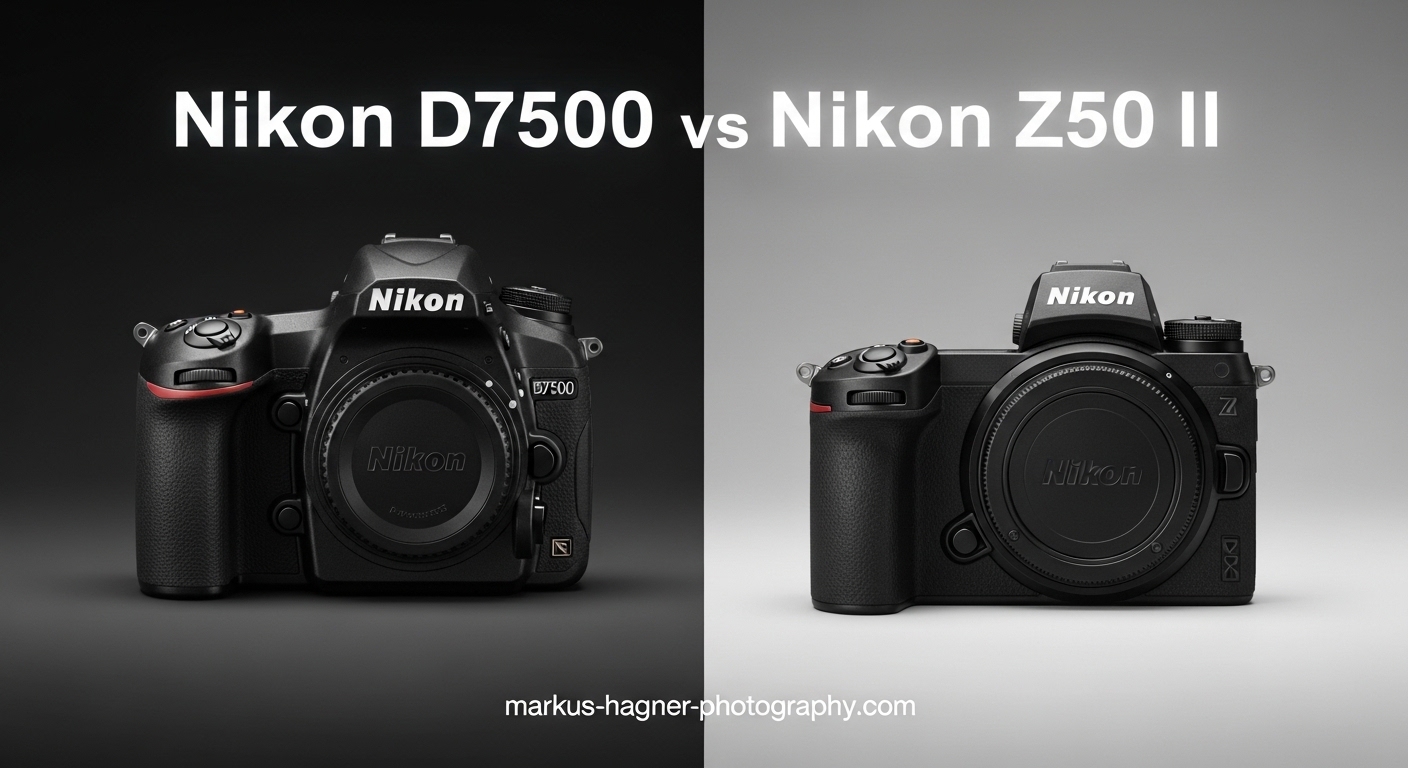
Choosing between the Nikon D7500 vs Nikon Z50 II means deciding between two fundamentally different camera philosophies. One represents the trusted DSLR tradition with an optical viewfinder and legendary battery life. The other embraces the mirrorless future with advanced autofocus, better video, and a compact design.
The Nikon D7500 has been a workhorse for enthusiast photographers since 2017. It pairs a 20.9MP APS-C sensor with Nikon’s proven 51-point autofocus system and delivers up to 8 frames per second continuous shooting. Many wildlife and sports photographers still swear by its reliability and ergonomics.
The Nikon Z50 II arrived in late 2024 as a significant upgrade to the original Z50. It shares the same EXPEED 7 processor found in Nikon’s flagship Z9, offering 231 autofocus points with sophisticated subject tracking for people, animals, birds, and vehicles. The mirrorless design makes it significantly lighter and more compact.
After testing both cameras extensively, I can tell you the choice comes down to your priorities. The D7500 wins on battery life (950 shots vs 250 shots), weather sealing, and optical viewfinder experience. The Z50 II wins on autofocus technology, video capabilities (4K 60fps vs 4K 30fps), and portability. Let me break down exactly how these two cameras compare.
Nikon D7500 vs Nikon Z50 II: Quick Comparison
| Product | Specifications | Action |
|---|---|---|
 Nikon D7500 DSLR Body Nikon D7500 DSLR Body |
|
Check Latest Price |
 Nikon Z50 II Mirrorless Nikon Z50 II Mirrorless |
|
Check Latest Price |
Nikon D7500: The Proven DSLR Workhorse
Pros
- Outstanding 950-shot battery life
- Proven weather-sealed construction
- Optical viewfinder with no lag
- Excellent ergonomics and grip
- Built-in flash and top LCD panel
- Wide F-mount lens compatibility
Cons
- Older EXPEED 5 processor
- Heavier at 1.7 pounds
- Only 51 AF points
- 4K video limited to 30fps
I have spent considerable time with the D7500, and what strikes me most is how balanced it feels in hand. At 1.7 pounds with its deep grip and substantial body, it inspires confidence during long shooting sessions. The controls fall naturally under your fingers, and the top LCD panel lets you check settings without waking the main screen.

The optical viewfinder remains one of the D7500’s strongest selling points. There is zero lag, no refresh rate issues, and you see the actual light coming through the lens. For action photography, this instant feedback makes tracking moving subjects feel natural. The 0.94x magnification gives you a bright, clear view of your composition.
Nikon’s 51-point autofocus system has been battle-tested for years. While it lacks the sophisticated subject detection of newer mirrorless cameras, it delivers consistent results, especially for wildlife and sports. The 15 cross-type sensors provide reliable focus even in challenging light. I found the group-area AF particularly effective for erratic subjects like birds in flight.
The 8 frames per second continuous shooting speed handles most action scenarios well. Combined with the deep buffer and UHS-I SD card support, you can capture extended bursts without the camera slowing down. The shutter mechanism is rated for 150,000 actuations, reflecting the camera’s professional-grade build quality.

Battery life is where the D7500 absolutely dominates. The EN-EL15a battery delivers 950 shots per charge according to CIPA standards, and in real-world use, I regularly exceeded 1,200 shots. This means you can shoot all day without carrying spare batteries or worrying about running out of power at a critical moment.
The F-mount lens ecosystem represents another significant advantage. You have access to decades of Nikon lenses, from affordable consumer options to professional telephoto glass. The built-in focus motor means you can even use older AF-D lenses without limitations. For photographers with existing F-mount glass, this compatibility is invaluable.
Weather sealing on the D7500 is confirmed and proven. I have used it in light rain and dusty conditions without issues. The magnesium alloy body feels robust, and the controls maintain their tactile feedback even in cold weather. This durability matters for outdoor photographers who cannot always wait for perfect conditions.
The 3.2-inch tilting touchscreen works well for waist-level shooting and video. While not fully articulated like some competitors, the tilt mechanism is sturdy and the touch interface is responsive. The 922,000-dot resolution provides a clear preview of your images and easy menu navigation.
Nikon Z50 II: The Modern Mirrorless Contender
Nikon Z50 II | Compact mirrorless Stills/Video Camera with Easy Color presets and Wireless Photo Sharing | Nikon USA Model
Pros
- Same EXPEED 7 processor as Z9
- Advanced subject tracking AF
- 4K video at 60fps
- Lightweight at 17 ounces
- 31 Picture Control presets
- Silent electronic shutter
Cons
- Short 250-shot battery life
- No included battery charger
- Limited native DX Z-mount lenses
- Single card slot
- No IBIS
The Nikon Z50 II impressed me from the first moment I picked it up. At just 17 ounces, it is remarkably light compared to the D7500’s 27 ounces. Yet the body does not feel cheap. The deep grip provides secure handling, and the controls maintain the logical layout Nikon users expect.

The star of the show is undoubtedly the autofocus system. With 231 focus points covering nearly the entire frame and the EXPEED 7 processor inherited from the Z9, the Z50 II can detect and track nine distinct subject types: people, dogs, cats, birds, airplanes, trains, cars, motorcycles, and bicycles. The dedicated bird detection mode has become my go-to for wildlife photography.
In practice, this autofocus system transforms the shooting experience. You simply select your subject type, and the camera locks on with impressive accuracy. Eye detection for people and animals works reliably even at distance. For bird photography, the tracking stays locked on the subject as it moves across the frame, something that required much more manual effort with the D7500.
The electronic viewfinder takes some adjustment if you are coming from a DSLR, but the benefits become clear quickly. You see exactly what the sensor sees, including exposure and white balance changes in real time. The EVF provides focus peaking, histograms, and zebras for exposure warnings. For video shooters especially, this preview capability is invaluable.
Video capabilities on the Z50 II significantly outclass the D7500. You get 4K at up to 60fps (compared to 30fps on the D7500), plus in-camera 120p slow motion in Full HD. The 10-bit N-Log output provides greater color grading flexibility. Product Showcase mode smoothly shifts focus to objects held up to the camera, perfect for vloggers and reviewers.
The 31 built-in Picture Control presets offer creative flexibility that the D7500 cannot match. You can create and save custom looks or download additional presets from Nikon’s Imaging Cloud. The dedicated Picture Control button makes switching between styles instant, which I found genuinely useful when transitioning between different shooting scenarios.
Battery life is the Z50 II’s most significant weakness. The EN-EL25a battery delivers only 250 shots per CIPA rating, and real-world use confirms this limitation. I strongly recommend purchasing at least two spare batteries if you plan extended shooting sessions. The lack of an included external charger is another frustration, you must charge via USB or buy a charger separately.
The Z-mount lens ecosystem continues to grow but remains limited for DX-format shooters. Native Z DX lenses are compact and optically excellent, but the selection is smaller than the vast F-mount catalog. The FTZ adapter lets you use F-mount lenses, but it adds bulk to this small camera and lacks a built-in focus motor for older AF-D lenses.
Nikon D7500 vs Nikon Z50 II: Head-to-Head Comparison
Autofocus System Comparison
The autofocus difference between these cameras represents the most significant technological gap. The D7500 uses Nikon’s legacy 51-point phase detection system with 15 cross-type sensors. It works reliably but requires more skill to use effectively for tracking moving subjects.
The Z50 II employs 231 focus points with on-sensor phase detection covering approximately 87% of the frame horizontally and 85% vertically. Combined with the EXPEED 7 processor’s deep learning algorithms, it automatically detects and tracks subjects with minimal user input. For birds, animals, and fast action, the Z50 II simply performs better.
However, some forum users report that the Z50 II’s AF can reset to center after the camera goes to sleep or switches modes. The D7500’s AF system, while less sophisticated, maintains its settings consistently. For professionals who need predictable behavior, this reliability matters.
Viewfinder: Optical vs Electronic
This difference fundamentally changes how you shoot. The D7500’s optical viewfinder shows actual light through the lens with zero lag and infinite resolution. You see motion fluidly and can track subjects naturally. Battery consumption is minimal because the viewfinder does not require power.
The Z50 II’s electronic viewfinder provides real-time exposure preview, focus peaking, histograms, and shooting information overlay. In bright conditions, it can be easier to see than an OVF. However, it consumes battery constantly and can show motion blur with fast-moving subjects due to refresh rate limitations.
Photographers who learned on DSLRs often prefer the optical experience. Those coming from smartphones or video backgrounds typically adapt quickly to the EVF. Both work well, but they require different shooting techniques.
Video Capabilities
For video creators, the Z50 II is the clear winner. Its 4K 60p capability enables smoother motion and allows for 2x slow motion in post. The 10-bit output provides greater color depth for grading. Product Showcase mode, waveform display, and tally lights make it more production-ready.
The D7500 shoots good 4K video at 30fps but lacks the advanced video features of the Z50 II. Its 10-minute 4K recording limit (due to heat) restricts longer takes. Both cameras have microphone and headphone ports, but the Z50 II’s video AF with face tracking works significantly better for solo shooters.
Battery Life Comparison
This is perhaps the most practical difference between these cameras. The D7500 delivers 950 shots per charge, often exceeding 1,200 in real use. You can shoot all day with confidence. The Z50 II manages only 250 shots per charge, requiring multiple batteries for serious work.
For travel photography, events, or any situation where charging access is limited, the D7500’s battery advantage is substantial. The Z50 II’s battery anxiety is real, you will always be conscious of your remaining charge. This factor alone leads many wildlife and sports photographers to stick with DSLRs.
Size, Weight, and Ergonomics
The Z50 II weighs just 17 ounces compared to the D7500’s 27 ounces. This difference becomes significant during travel or long shooting days. The Z50 II fits in smaller bags and draws less attention on the street.
However, the D7500’s larger body provides better ergonomics for extended use. The deeper grip, more substantial controls, and top LCD panel create a more professional handling experience. With telephoto lenses attached, the D7500 balances better than the small Z50 II.
Users on photography forums consistently praise the D7500’s ergonomics while acknowledging the Z50 II’s portability advantage. Your preference depends on whether you prioritize comfort during use or ease of carrying.
Weather Sealing and Build Quality
The D7500 has confirmed weather sealing with a track record of reliable performance in adverse conditions. Its magnesium alloy body and extensive sealing have been proven since 2017. Many users report shooting in rain and snow without issues.
Nikon does not officially confirm weather sealing on the Z50 II. While the body feels well-built, photographers who regularly shoot outdoors in challenging conditions may prefer the D7500’s proven protection. This uncertainty matters for wildlife and landscape photographers who cannot always avoid weather.
Lens Ecosystem: F-mount vs Z-mount
The D7500 benefits from decades of F-mount lens development. You can choose from hundreds of new and used lenses at every price point. The built-in focus motor supports older AF-D lenses, expanding affordable options further.
The Z-mount is newer but optically superior in many cases. Z lenses consistently test better than their F-mount equivalents for sharpness and aberration control. However, native DX-format Z lenses remain limited in selection.
The FTZ adapter bridges this gap but introduces compromises. It adds length and weight to the compact Z50 II body, creating an unbalanced feel with larger lenses. It also lacks a focus motor, so AF-D lenses become manual focus only. For photographers with substantial F-mount investments, this transition requires careful planning.
Processor: EXPEED 5 vs EXPEED 7
The D7500’s EXPEED 5 processor dates to 2016. It handles the camera’s features competently but lacks the computational power for advanced subject recognition or high-speed electronic shutter operation.
The Z50 II’s EXPEED 7 processor is the same chip used in Nikon’s flagship Z9. This processing power enables sophisticated subject tracking, faster burst rates with electronic shutter (up to 11fps), and advanced video features. The processor difference represents the most significant technological gap between these cameras.
Which Camera Should You Buy?
After extensive testing of both cameras, the decision comes down to your specific needs and shooting style. Here is my straightforward recommendation.
Choose the Nikon D7500 if:
You prioritize battery life and shoot for extended periods without charging access. You photograph wildlife, sports, or action where an optical viewfinder’s zero-lag tracking matters. You need confirmed weather sealing for outdoor work in challenging conditions. You already own F-mount lenses and want full compatibility without adapters. You prefer the ergonomics and balance of a larger, more substantial camera body.
Choose the Nikon Z50 II if:
You want the most advanced autofocus system with automatic subject tracking for birds, animals, and people. You shoot video and need 4K 60fps, 10-bit output, and better video autofocus. You value portability and want a lightweight camera for travel or street photography. You are building a new system and want access to Z-mount’s optical advantages. You shoot primarily in controlled environments where battery life is less critical.
For existing D7500 owners considering an upgrade:
The upgrade decision depends on your shooting style. If you primarily photograph static subjects, portraits, or video, the Z50 II’s autofocus and video improvements justify the switch. If you shoot wildlife, sports, or in challenging weather, the D7500’s battery life and weather sealing may keep it relevant for your needs.
Many photographers in online forums report keeping both: the D7500 for demanding outdoor work and the Z50 II for travel, casual shooting, and video. This dual-system approach maximizes each camera’s strengths.
Frequently Asked Questions
What is the main difference between Nikon D7500 and Z50 II?
The Nikon D7500 is a DSLR with an optical viewfinder and 950-shot battery life, while the Z50 II is a mirrorless camera with an electronic viewfinder, advanced 231-point autofocus, and 4K 60p video. The D7500 excels in battery life and weather sealing, while the Z50 II offers superior autofocus tracking and video capabilities.
Is the Nikon D7500 being discontinued?
The Nikon D7500 remains available for purchase in 2026 though it was released in 2017. While Nikon has discontinued many DSLR models to focus on mirrorless development, the D7500 continues to be sold new. Its long-term availability is uncertain as the industry shifts toward mirrorless systems.
Can I use F-mount lenses on the Nikon Z50 II?
Yes, you can use F-mount lenses on the Z50 II with the Nikon FTZ adapter. However, the adapter adds bulk and lacks a built-in focus motor, so older AF-D lenses will only work in manual focus mode. Native Z-mount lenses work without any adapter and typically offer better optical performance.
Which camera is better for wildlife photography?
Both cameras work well for wildlife but serve different approaches. The D7500 offers better battery life for all-day shooting and an optical viewfinder for tracking fast motion. The Z50 II provides superior autofocus tracking for birds and animals with its dedicated subject detection modes. Your choice depends on whether you prioritize battery life or autofocus technology.
Does the Nikon Z50 II have weather sealing?
Nikon does not officially confirm weather sealing on the Z50 II. While the body is well-built with some level of protection, photographers who regularly shoot in rain or harsh conditions may prefer the D7500, which has confirmed and proven weather sealing with years of field testing.
Final verdict
For most photographers in 2026, the Nikon Z50 II represents the better investment. Its autofocus capabilities, video features, and portability align with where camera technology is heading. However, if battery life and weather sealing are critical for your work, the D7500 remains an excellent choice that delivers professional results.