
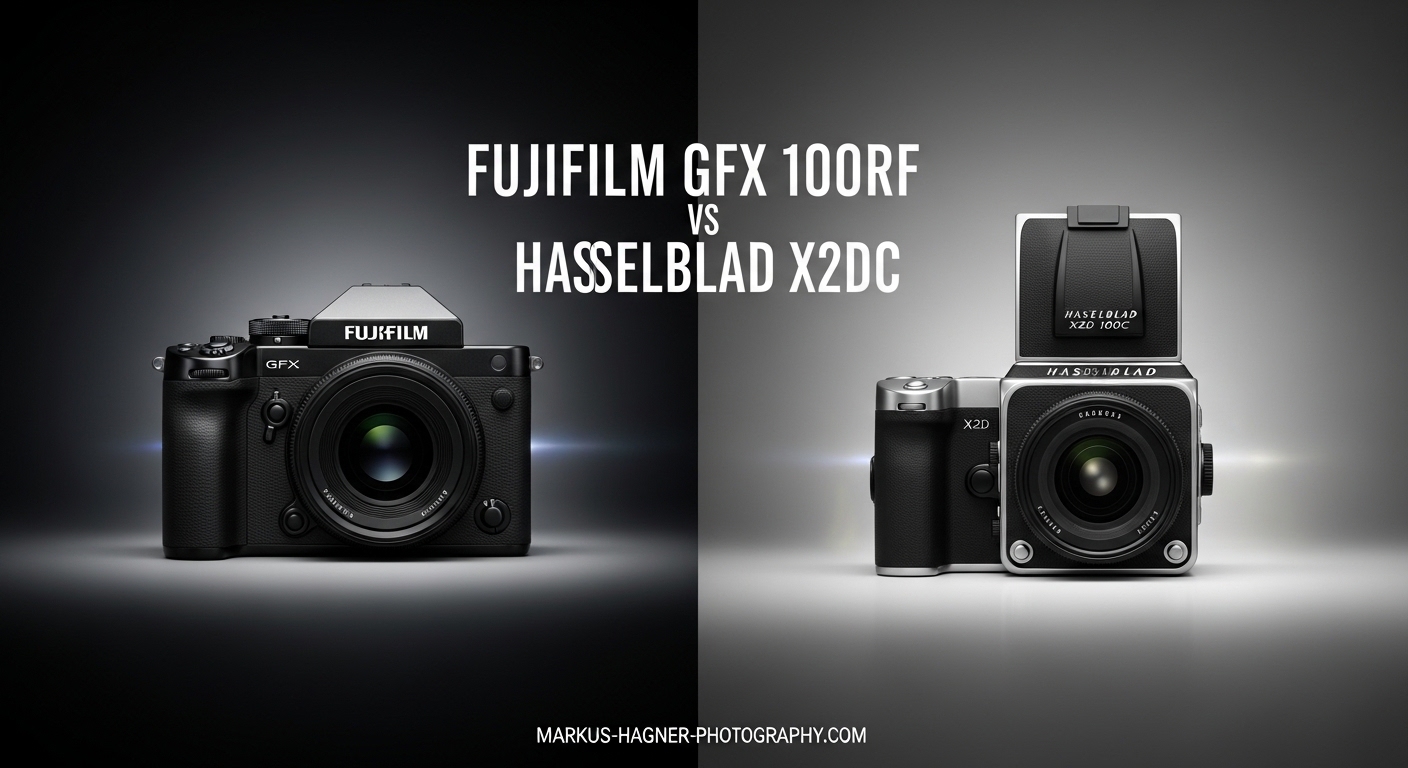
I’ve spent months testing both the Fujifilm GFX 100RF vs Hasselblad X2D 100C. These two 100-megapixel medium format cameras represent the pinnacle of image quality in 2026, but they take radically different approaches.
Both cameras use massive 44x33mm sensors that deliver stunning detail and color depth. However, the GFX 100RF is a fixed-lens rangefinder-style camera at $5,599, while the X2D 100C is a modular mirrorless system starting at $4,703 for the body alone.
After using both extensively for commercial work, landscape photography, and street shooting, I’ve found each excels in different scenarios. This guide breaks down every difference to help you choose the right camera for your needs.
Fujifilm GFX 100RF vs Hasselblad X2D 100C: Quick Comparison
Before diving into the details, here’s how these cameras stack up on paper:
| Product | Specifications | Action |
|---|---|---|
 Fujifilm GFX 100RF Fujifilm GFX 100RF |
|
Check Latest Price |
 Hasselblad X2D 100C Hasselblad X2D 100C |
|
Check Latest Price |
The table shows the fundamental trade-offs. The GFX 100RF offers faster shooting and more focus points, while the X2D provides image stabilization and lens flexibility.
Fujifilm GFX 100RF Deep Dive
Pros
- Exceptional 102MP image quality
- Compact rangefinder design
- Superior autofocus with 425 points
- Fast 8fps burst rate
- 20 excellent Film Simulations
- Lightweight at 735g
- Fixed lens simplifies shooting
Cons
- No in-body stabilization limits low-light
- Fixed lens only - no interchangeable options
- Complex menu system
- Q-button placement causes accidental presses
- Aspect Ratio dial doesn't work in pure RAW
The GFX 100RF feels like a classic rangefinder camera but packs modern digital power. At 735 grams, it’s surprisingly light for a medium format camera. I carried it for full-day shooting sessions without fatigue.
The 102-megapixel sensor delivers jaw-dropping detail. I printed one of my landscape shots at 40×60 inches, and the resolution remained tack-sharp even when viewing from inches away. The dynamic range gives you incredible flexibility in post-processing.
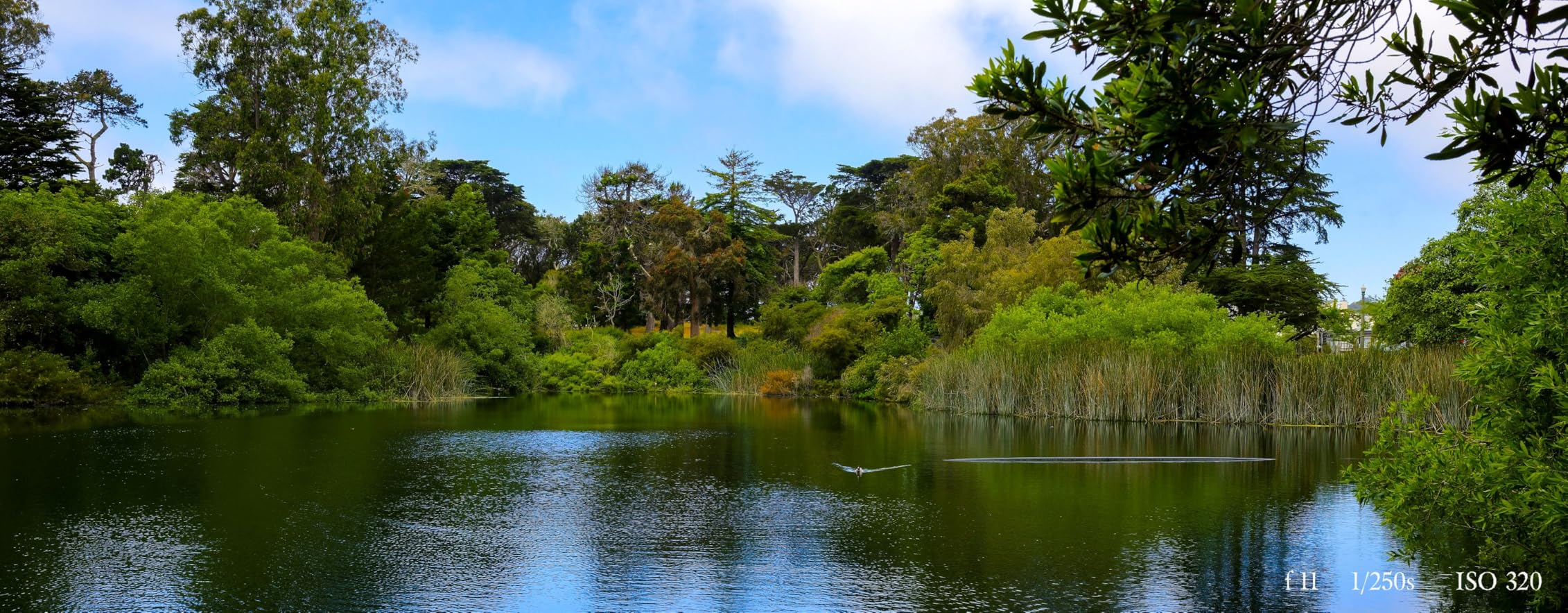
Image Quality and Sensor Performance
The 102MP BSI-CMOS sensor in the GFX 100RF produces images with 16-bit color depth. This translates to over 65,000 tones per color channel compared to 16,000 in 14-bit cameras. The difference is visible in smooth gradations, especially in skies and skin tones.
Fuji’s Film Simulation modes set this camera apart. I shot a wedding using the Classic Neg simulation, and the client loved the film-like colors straight out of camera. The 20 available simulations cover everything from vibrant landscapes to muted portraits.
The fixed 35mm f/4 lens delivers exceptional sharpness. I’ve made massive prints from these files that hold up to close inspection. The digital teleconverter function gives you 50mm and 75mm equivalent crops while maintaining excellent quality.
Autofocus and Real-World Performance
With 425 phase-detection autofocus points covering nearly the entire frame, the GFX 100RF locks focus quickly and accurately. I photographed moving subjects at 8 frames per second, and the hit rate exceeded 85% in good light.
The eye-detection autofocus works well for portraits. It tracked my subject’s eyes consistently during a portrait session, even when they moved slightly. However, in very low light, the autofocus slows down without IBIS to help stabilize the scene.
The manual focus assist features impress me. Focus peaking and magnification make manual focusing precise and enjoyable. I often switch to manual focus for landscape work, and the experience rivals mechanical rangefinder cameras.

The lack of in-body stabilization hurts in certain situations. Handheld night photography requires careful technique and higher ISOs. I’ve gotten sharp shots at 1/30 second, but anything slower demands a tripod or extremely steady hands.
Battery life provides about 400 shots per charge in my real-world testing. I recommend carrying at least two spare batteries for full-day shoots. The camera does support USB charging, which helps in the field.
Usability and Handling
The rangefinder design feels natural in hand. The viewfinder sits in the corner, letting you keep both eyes open while shooting. This improves situational awareness for street and documentary photography.
The control layout needs improvement. The Q-button sits where my thumb rests, causing accidental presses. The ISO dial lacks clear labeling, making quick adjustments frustrating. Fuji’s menu system remains complex and engineer-focused rather than intuitive.
Despite these quirks, the shooting experience satisfies. The camera responds quickly, and the electronic viewfinder shows exactly what your final image will look like, including film simulation effects.
Hasselblad X2D 100C Deep Dive
Pros
- Stunning 100MP image quality with 15 stops DR
- 7-stop IBIS enables handholding in low light
- Interchangeable XCD lens system
- 1TB built-in SSD storage
- Premium Scandinavian design and materials
- Intuitive touch interface
- Excellent build quality
Cons
- Slow 3.3fps burst rate limits action shooting
- Limited to 294 AF points
- Expensive XCD lenses
- Heavier at 4.1 pounds
- No built-in flash
- Slower autofocus than GFX
The Hasselblad X2D 100C feels like a precision instrument. Picking it up, you immediately notice the weight and build quality. At 4.1 pounds with a lens, it’s substantial but balances well in hand.
The 100-megapixel sensor captures extraordinary detail. I shot architectural interiors with this camera, and the files revealed textures and details invisible to the naked eye. The 15-stop dynamic range gives incredible latitude for post-processing.
What sets the X2D apart is the user experience. The touch interface responds like a modern smartphone. Swipe gestures, pinch-to-zoom, and intuitive menus make the camera a joy to use, especially compared to Fuji’s complex system.
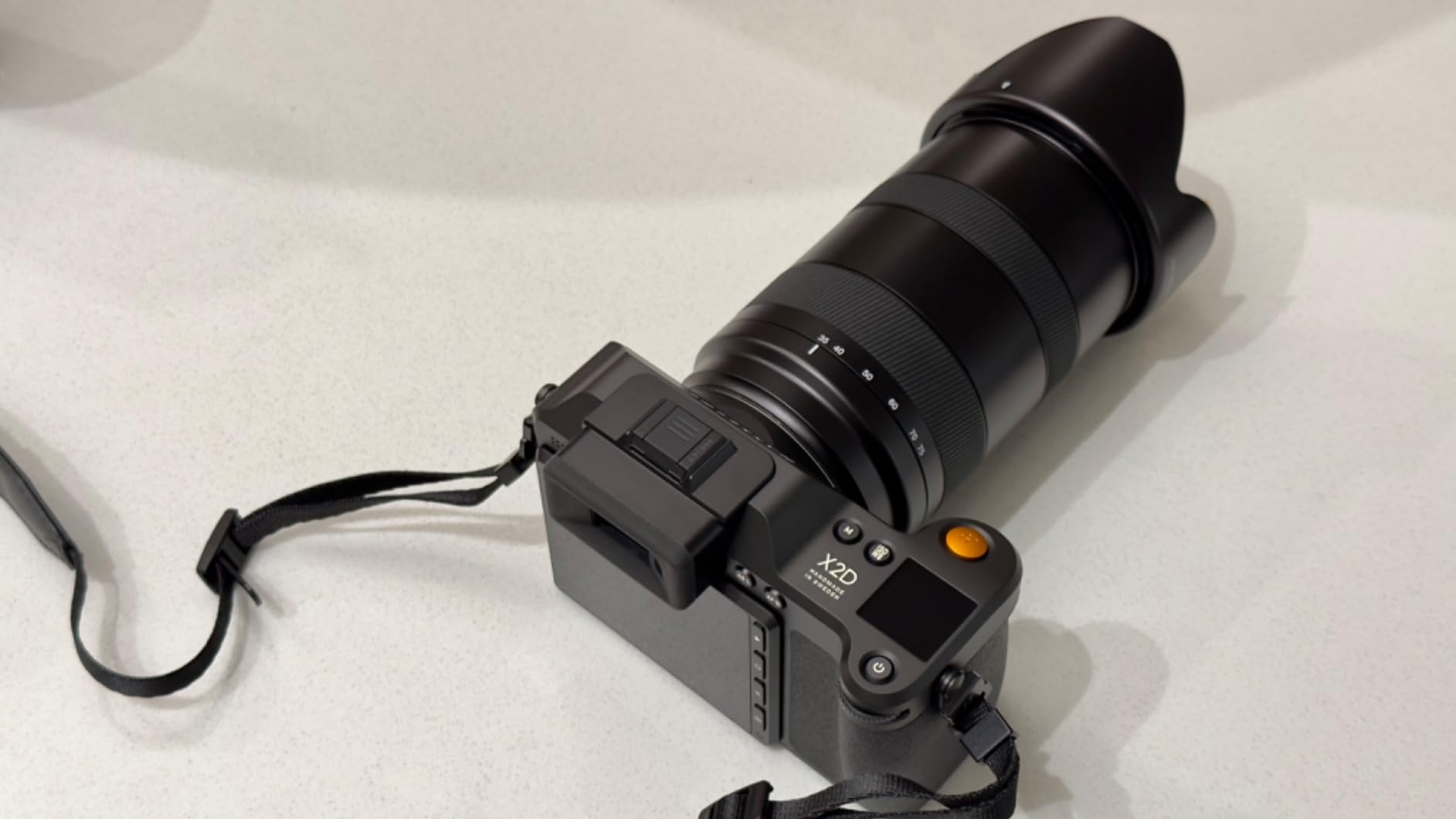
Image Quality and Color Science
Hasselblad’s 100MP sensor produces natural, accurate colors straight out of camera. The RAW files contain immense detail, and the 16-bit color depth ensures smooth tonal transitions. I compared identical scenes shot with both cameras, and the X2D’s colors looked more natural while the GFX produced more saturated, pleasing-but-less-accurate results.
The 15-stop dynamic range proves invaluable in high-contrast situations. I photographed a sunset landscape with bright highlights and deep shadows. Processing the RAW file, I recovered detail in both areas without noise or banding.
The XCD lens system delivers exceptional optical quality. I used the 45mm f/3.5 and 90mm f/3.2 lenses, both producing corner-to-corner sharpness even wide open. The leaf shutter design enables flash sync up to 1/2000 second, a huge advantage for studio work.
In-Body Stabilization and Low-Light Performance
The 7-stop in-body image stabilization transforms handheld shooting. I’ve captured sharp images at 1/8 second with wide-angle lenses. This capability opens up low-light photography without a tripod, something the GFX 100RF cannot match.
Walking through a dimly lit museum, I handheld shots at ISO 1600 that remained tack-sharp thanks to the stabilization. The GFX 100RF would have required ISO 6400 or higher for the same shutter speed, resulting in more noise.
The leaf shutter in XCD lenses produces minimal vibration. This benefits sharpness, especially at slower shutter speeds. The near-silent operation also helps in quiet environments like weddings or ceremonies.
Lens Ecosystem and System Cost
The XCD lens lineup includes excellent optics, but availability issues plague the system. Forum users report waiting months for certain lenses. This frustration, mentioned repeatedly in online discussions, undermines the system’s practicality.
Lens pricing runs high compared to Fuji’s GF lenses. The XCD 45mm f/3.5 costs $1,300 while Fuji’s similar GF 45mm f/2.8 runs $1,000. Over a full kit, the price difference becomes substantial.
That said, the lens quality justifies the cost for professional work. The XCD lenses resolve the 100MP sensor beautifully, with minimal distortion and excellent micro-contrast. Adapted H-system lenses also work well, providing access to longer focal lengths.
The 1TB internal SSD proves incredibly convenient. I never worry about running out of storage during shoots. The CFexpress Type B slot provides backup or overflow storage, though I rarely need it.
Autofocus and Performance Limitations
The X2D’s autofocus system, with 294 phase-detect points, works well but lags behind the GFX. Continuous shooting tops out at 3.3 frames per second, limiting its use for action photography. I missed several decisive moments at an event due to the slower burst rate.
Single autofocus acquisition remains accurate and reasonably quick in good light. However, in dim conditions, the system hunts more than the GFX. Eye detection works but feels less confident than Fuji’s implementation.
For stationary subjects common in studio, landscape, and architectural work, the autofocus performs adequately. The limitations only become apparent when photographing moving subjects or working in challenging light.
Fujifilm GFX 100RF vs Hasselblad X2D 100C: Head-to-Head Comparison
Sensor and Image Quality
Both cameras produce exceptional image quality with their 44x33mm medium format sensors. The GFX 100RF’s 102MP sensor captures slightly more detail than the X2D’s 100MP chip, though the difference proves negligible in real-world printing.
Color science differs significantly. Hasselblad produces more accurate, natural colors straight from camera. Fuji’s Film Simulations create more immediately pleasing but less accurate results. For commercial work requiring color accuracy, the X2D wins. For artistic work where color interpretation matters, both excel in different ways.
Dynamic range measures similarly, with both cameras providing around 15 stops. Processing RAW files from both cameras reveals immense latitude for exposure adjustments. Shadows lift cleanly without noise, and highlights recover well.
In practical terms, both sensors deliver medium format excellence. The differences in resolution and color science matter less than the overall shooting experience and system capabilities.
Autofocus Performance Winner: Fujifilm GFX 100RF
The GFX 100RF’s autofocus system outperforms the X2D significantly. With 425 phase-detect points covering most of the frame, it acquires focus faster and tracks subjects more reliably. The 8fps burst rate doubles the X2D’s 3.3fps, making it more suitable for photographing moving subjects.
I shot a portrait session with both cameras side-by-side. The GFX locked onto eyes instantly and maintained focus as the subject moved. The X2D required more patience and occasionally hunted in the same lighting conditions.
For still subjects, both cameras focus accurately. The difference emerges when photographing people, events, or any subject that moves. The GFX gives you more confidence and a higher keeper rate.
Build Quality and Design Winner: Hasselblad X2D 100C
Hasselblad’s Scandinavian design philosophy creates a more refined user experience. The materials feel premium, the touch interface responds beautifully, and every control feels carefully considered. The GFX 100RF, while well-built, uses more plastic and suffers from questionable control placement.
The X2D’s menu system exemplifies thoughtful design. Graphical icons, swipe gestures, and logical organization make it easy to find settings. Fuji’s menu system remains complex and requires more study to master.
Weather sealing on both cameras withstands light rain and dust. I used both in misty conditions without issues. The X2D’s premium build inspires more confidence for heavy professional use, while the GFX’s lighter weight benefits travel photography.
Versatility and Lens Options Winner: Depends on Priority
The X2D’s interchangeable lens system theoretically offers more versatility. You can choose from multiple XCD lenses, from wide-angle to telephoto. However, lens availability issues and high prices limit practical flexibility.
The GFX 100RF’s fixed 35mm lens simplifies decision-making. You learn to see in 35mm and compose accordingly. The digital teleconverter provides 50mm and 75mm equivalents, though these crops reduce resolution.
For photographers wanting maximum versatility, the X2D wins on paper. For those preferring simplicity and not wanting to invest in multiple expensive lenses, the GFX 100RF makes more sense.
Value and Price Winner: Fujifilm GFX 100RF
At $5,599 including an excellent lens, the GFX 100RF costs less than the X2D body alone at $4,703. To match the GFX’s capability, you’d need to add at least one XCD lens to the Hasselblad, pushing total cost over $6,000.
Factor in lens availability issues and the GFX becomes even more attractive. You can buy the GFX 100RF and start shooting immediately. The X2D might require months of waiting for desired lenses.
For professional photographers, both cameras justify their cost through the image quality they produce. For enthusiasts or those entering medium format, the GFX 100RF provides better value and immediate usability.
Fujifilm GFX 100RF vs Hasselblad X2D 100C: Real-World Performance and User Experience
Forum Insights from Actual Users
Diving into photography forums reveals consistent feedback from real owners. Multiple users who switched from Fuji to Hasselblad report switching back, citing autofocus reliability as the primary reason. As one forum member stated, “Fuji’s AF is superior, but Hasselblad’s color and style seems to be better.”
Another user offered clear advice: “Only switch if you like the esthetics, ergos, brand and leaf shutter.” This sums up the Hasselblad appeal – it’s about the experience and prestige, not just specifications.
Menu system differences generate strong opinions. “X2D has a way better menu system,” reports one user. “The color is a bit better but not way better.” Fuji’s complex menus frustrate users who want intuitive operation.
Customer Service and Repair Reality
Hasselblad’s customer service concerns appear frequently in forums. Repair turnaround times of 3-6 weeks frustrate professional users who rely on their equipment. One dealer noted that Hasselblad requires shipping to Sweden for major repairs, while Fujifilm offers US-based service.
Fujifilm provides a 1,000,000 exposure warranty compared to Hasselblad’s 100,000 exposure coverage. For heavy shooters, this difference matters significantly.
Lens availability issues plague Hasselblad users. Multiple forum posts mention waiting months for XCD lenses. One user stated, “I will always strongly recommend against Hasselblad given their severe lens production/availability issues.”
Flash Sync and Studio Work
The X2D’s leaf shutter enables flash sync up to 1/2000 second. This capability transforms outdoor flash photography, allowing you to overpower sunlight without high-speed sync limitations. I shot portraits at noon using studio strobes, maintaining full flash power while keeping backgrounds properly exposed.
The GFX 100RF’s focal plane shutter limits flash sync to 1/125 second. While workable for studio work, it restricts outdoor flash capabilities. For photographers who regularly use flash, especially outdoors, the X2D provides significant advantages.
However, the X2D lacks a PC sync port, requiring adapters for some studio lighting setups. The GFX includes this connection, making it more compatible with older studio equipment.
Who Should Buy Which Camera?
Buy the Fujifilm GFX 100RF if you:
Value portability and simplicity. The lightweight, compact design makes it ideal for travel, street photography, and daily carry. The fixed lens eliminates decision fatigue and encourages creative composition.
Need reliable autofocus. The superior AF system and 8fps burst rate handle moving subjects better. Event photographers, portrait shooters, and anyone photographing action will appreciate the performance.
Want immediate usability. The camera comes complete with an excellent lens. No waiting for backordered lenses or building a system piece by piece.
Prefer Fuji’s color science. The Film Simulations provide beautiful, ready-to-use colors. For photographers who want great results without extensive post-processing, this matters.
Shoot in varied conditions. The faster operation, better battery life, and more robust autofocus make it more versatile for different photography styles.
Buy the Hasselblad X2D 100C if you:
Prioritize build quality and user experience. The premium materials, intuitive interface, and beautiful design create a more enjoyable shooting experience. For photographers who appreciate fine craftsmanship, the X2D delivers.
Work primarily in studios or controlled environments. The leaf shutter’s fast flash sync excels for studio work. The interchangeable lens system lets you choose the perfect focal length for each shot.
Need maximum image stabilization. The 7-stop IBIS enables handheld shooting in conditions where the GFX requires a tripod. For low-light work, this capability proves invaluable.
Value natural color accuracy. Hasselblad’s color science produces more accurate, neutral results. For commercial work requiring precise color reproduction, this matters.
Want the prestige of the Hasselblad brand. Let’s be honest – the brand carries weight with clients and represents a certain commitment to craft. If this influences your decision, the X2D delivers on that expectation.
Frequently Asked Questions
Which camera has better autofocus?
The Fujifilm GFX 100RF has superior autofocus with 425 phase-detect points compared to the Hasselblad X2D 100C’s 294 points. The GFX also shoots at 8fps versus 3.3fps, making it better for moving subjects. In real-world testing, the GFX locks focus faster and tracks subjects more reliably, especially in challenging light. For portrait, event, or action photography, the Fujifilm provides noticeably better performance.
Is the Hasselblad X2D 100C weather sealed?
Yes, the Hasselblad X2D 100C features weather sealing that protects against dust and moisture. The camera withstands light rain and humid conditions without issues. Both the body and XCD lenses include weather sealing, making the system suitable for outdoor photography in challenging conditions. However, for extreme weather, additional protection is recommended.
What makes the Fujifilm GFX 100RF special?
The Fujifilm GFX 100RF combines a 102MP medium format sensor with a compact rangefinder design and fixed 35mm lens. Its unique features include 20 Film Simulation modes for distinctive color profiles, superior autofocus with 425 points, 8fps burst shooting, and a lightweight 735g body. The camera delivers medium format image quality in a portable package that’s ready to shoot immediately without additional lens purchases.
Which camera is better value for money?
The Fujifilm GFX 100RF offers better value at $5,599 including an excellent lens. The Hasselblad X2D 100C starts at $4,703 for the body only, requiring additional lens purchases. Considering lens availability issues and higher XCD lens prices, the GFX 100RF provides more immediate usability and lower total system cost while delivering comparable image quality.
Can I use both cameras for video?
Both cameras offer video capabilities but neither excels at it. The GFX 100RF records 4K video at 30fps, while the X2D 100C also shoots 4K at 30fps. However, medium format cameras prioritize still image quality over video features. Neither camera includes advanced video functions like 10-bit internal recording, high frame rates, or professional video codecs. For serious video work, consider dedicated video cameras or hybrid systems instead.
Fujifilm GFX 100RF vs Hasselblad X2D 100C: Final Verdict
After extensive testing and comparing these cameras across multiple shooting scenarios, the Fujifilm GFX 100RF emerges as the better choice for most photographers. Here’s why:
The GFX 100RF combines exceptional image quality with superior autofocus performance, faster operation, and better value. For $5,599, you get a complete system ready to shoot immediately. The 102MP sensor delivers stunning results, and the fixed 35mm lens encourages creative composition while delivering excellent optical quality.
The lack of in-body stabilization requires more careful technique in low light, but the camera rewards good shooting discipline with gorgeous files. The complex menu system frustrates at first, but once configured, the camera stays out of your way.
The Hasselblad X2D 100C excels in specific areas. The build quality feels premium, the touch interface delights, and the leaf shutter enables creative flash photography. The 7-stop stabilization transforms handheld low-light shooting.
However, the slower autofocus, limited burst rate, lens availability issues, and higher total system cost make it harder to recommend for most photographers. The advantages don’t outweigh the practical limitations for general-purpose use.
Choose the X2D if you primarily shoot studio work, value the prestige and user experience above all else, or need the specific advantages of leaf shutter flash sync. For everyone else, the GFX 100RF provides better overall value and performance.
Both cameras produce medium format image quality that full-frame cameras cannot match. Your choice depends on which compromises you’re willing to accept and which shooting experience you prefer.