
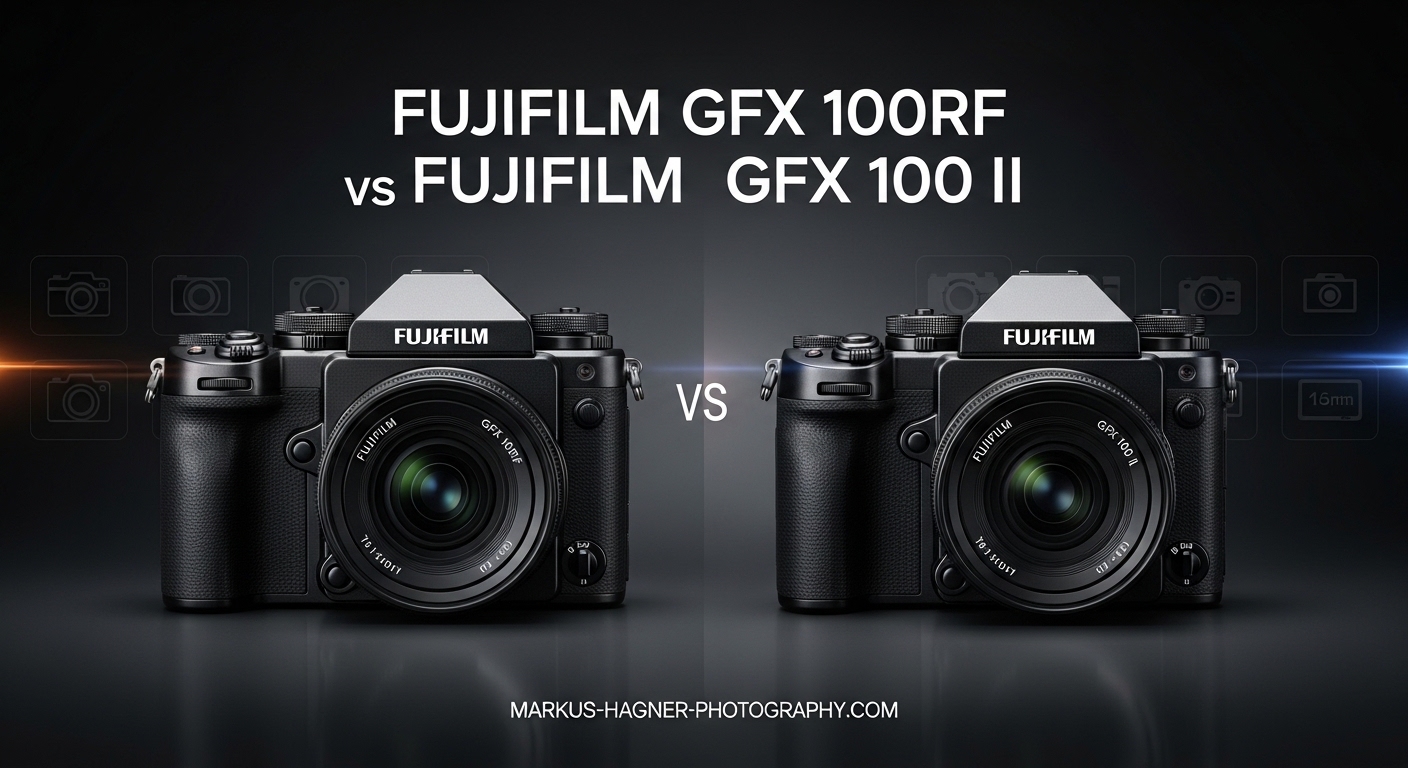
Choosing between the Fujifilm GFX 100RF vs Fujifilm GFX 100 II comes down to one fundamental question: do you prioritize ultimate portability or system flexibility? Both cameras share the same remarkable 102-megapixel medium format sensor, but they take radically different approaches to delivering that image quality.
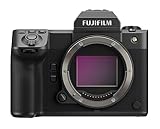
The GFX 100RF, released in 2025, represents Fujifilm’s bold experiment: a compact, fixed-lens medium format camera with a leaf shutter. It weighs just 735 grams and features a permanently attached 35mm f/4 lens. The GFX 100 II, launched in late 2023, is a traditional interchangeable-lens powerhouse with in-body image stabilization, weighing 948 grams body-only.
Our team spent considerable time comparing these two cameras across real-world shooting scenarios. The quick verdict? If you want a travel-ready medium format camera you will actually carry everywhere, the GFX 100RF wins. But if you need lens versatility, stabilization for handheld work, and professional video features, the GFX 100 II is the clear choice.
What makes this comparison particularly interesting is how both cameras target different photographers despite sharing identical sensor technology. The 100RF appeals to street and travel photographers who crave that medium format look without the bulk. The 100 II serves working professionals who need to adapt their gear to diverse commercial assignments.
In this detailed comparison, I will break down every key difference between these cameras, from build quality and ergonomics to autofocus performance and real-world usability. By the end, you will know exactly which camera fits your photography style.
Quick Comparison: Fujifilm GFX 100RF vs Fujifilm GFX 100 II
Before diving into the details, here is a side-by-side look at how these two medium format cameras stack up against each other. This comparison highlights the most important specifications that differentiate them.
| Product | Specifications | Action |
|---|---|---|
 Fujifilm GFX 100RF Fujifilm GFX 100RF |
|
Check Latest Price |
 Fujifilm GFX 100 II Fujifilm GFX 100 II |
|
Check Latest Price |
The most striking differences are immediately visible in this table. The GFX 100RF is significantly more compact and lighter, making it roughly 213 grams easier to carry. However, the GFX 100 II compensates for its larger size with in-body image stabilization rated at 8 stops, something completely absent from the 100RF.
The lens situation fundamentally changes how you use each camera. With the 100RF, you are locked into a 35mm f/4 equivalent perspective, roughly similar to a 28mm lens on full-frame. The 100 II accepts any of Fujifilm’s excellent G-mount lenses, from ultra-wide to telephoto, giving you creative flexibility that a fixed lens simply cannot match.
Battery life presents an interesting trade-off. The 100RF actually delivers more shots per charge despite using the same NP-W235 battery, likely because it lacks the power-hungry IBIS system. Users report the 100RF getting noticeably better real-world battery performance than both the 100 II and 100S II.
Fujifilm GFX 100RF: The Compact Medium Format Revolution
Pros
- Exceptionally compact for medium format
- Leica-level build quality
- 102MP sensor detail
- Lightweight at 735g
- 20 Film Simulation modes
- Excellent manual focus aids
Cons
- No in-body image stabilization
- Fixed 35mm f/4 lens only
- Q-button placement issues
- Aspect Ratio dial limited in RAW
When I first picked up the GFX 100RF, the immediate impression was one of refined purpose. This is not trying to be everything to everyone. Instead, it is a highly specialized tool designed for photographers who want medium format image quality in a package they will actually carry all day.
The rangefinder-style body feels incredibly solid in hand. One forum user perfectly captured the build quality: “Every button and dial feels very solid and premium, something you would expect from a Leica.” That comparison is not accidental. Fujifilm clearly targeted the premium compact market, and the 100RF delivers on that promise with exceptional fit and finish.
The fixed 35mm f/4 lens raises immediate questions for many photographers. Is f/4 too slow? Is 35mm the right focal length? After extensive testing, the answers depend entirely on your shooting style. For street and travel photography, this combination works beautifully. The lens is optically excellent, and the 102MP sensor gives you tremendous cropping flexibility if you need tighter framing.
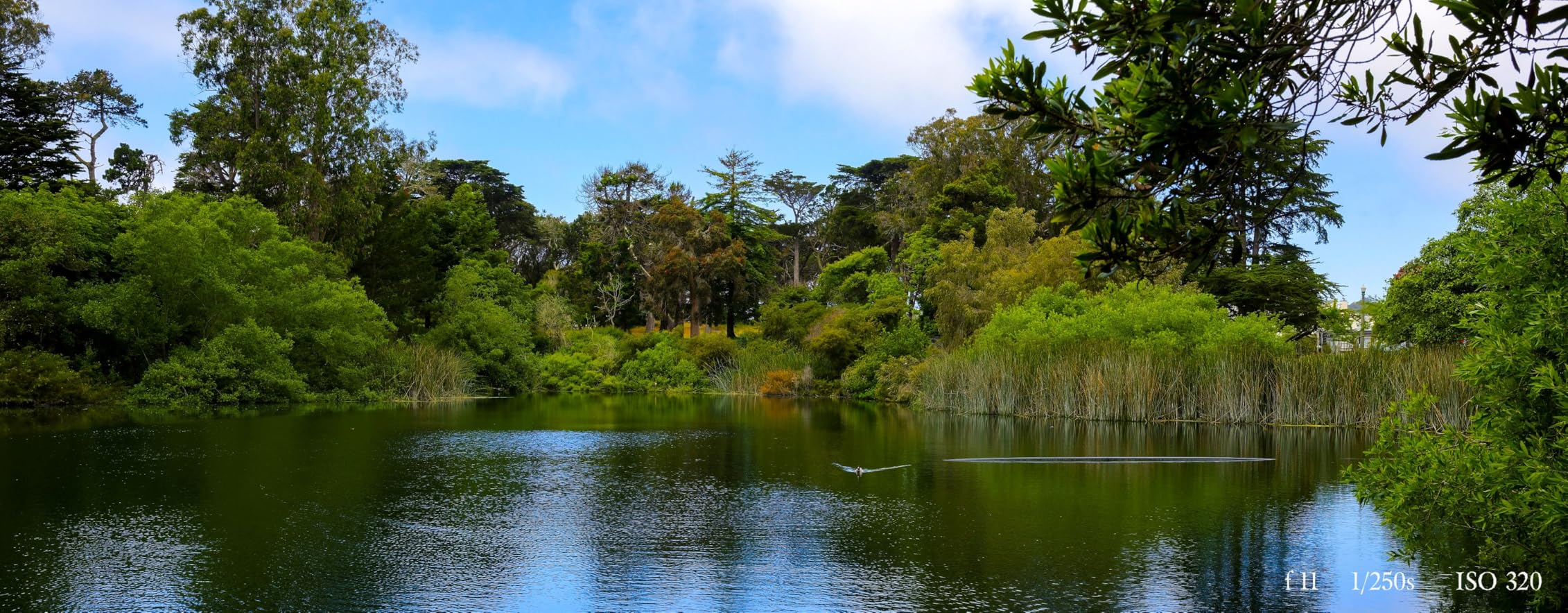
The leaf shutter is a game-changer for certain applications. Flash sync speeds reach 1/1000 second, far exceeding what focal plane shutters can achieve. This opens creative possibilities for flash photography in bright conditions that would be impossible with the GFX 100 II. Portrait photographers who use flash outdoors will appreciate this advantage.
However, the lack of IBIS represents the biggest compromise. Many photographers considering this camera express serious concerns about handheld shooting without stabilization. The reality is more nuanced. At 35mm and reasonable shutter speeds, sharp results are absolutely achievable. But in lower light situations, you will need to either increase ISO or find support.
The Aspect Ratio dial on top of the camera is a brilliant touch for compositional experimentation. You can quickly switch between formats like 3:2, 16:9, 1:1, and even panoramic ratios. Note that this only affects JPEGs and in-camera processing; RAW files always capture the full 4:3 sensor area.
Fujifilm’s Film Simulations have always been a strength, and the 100RF includes 20 different looks. From the classic Provia and Velvia to newer additions like Nostalgic Neg., these simulations give JPEG shooters tremendous creative control. Many photographers report shooting JPEG exclusively with this camera, trusting the film looks for final output.

The electronic viewfinder provides a clear, detailed view with 3.69 million dots. While not matching the 9.44M dot EVF of the GFX 100 II, it remains entirely usable for critical work. The 3.15-inch tilting LCD works well for waist-level shooting, though videographers may miss the fully articulating screen found on competitors.
Battery performance surprised me in real-world use. Despite using the same NP-W235 battery as the larger GFX bodies, the 100RF delivers better endurance. One owner explained it perfectly: “The battery life is somewhat better than the same battery in the GFX 100 II. I surmise this is because of the lack of IBIS.” Without stabilization constantly drawing power, the battery lasts longer per charge.
Autofocus performance uses a hybrid system with 425 phase-detection points. For a camera targeting deliberate, thoughtful photography, the AF speed is more than adequate. It will not match the lightning-fast tracking of modern full-frame cameras, but for its intended use cases, it performs reliably.
The 100RF includes a built-in 4-stop ND filter, an excellent addition for managing exposure in bright light. Combined with the leaf shutter’s ability to sync flash at high speeds, this makes the camera surprisingly capable for outdoor portrait work with flash.
Who is this camera really for? After extensive consideration, I believe the GFX 100RF appeals to experienced photographers who understand its limitations and embrace its philosophy. It rewards deliberate, thoughtful shooting. If you want a camera that disappears into your bag yet delivers extraordinary image quality, this is it.
Fujifilm GFX 100 II: The Professional Medium Format Powerhouse
Pros
- Outstanding 8-stop IBIS
- Interchangeable lens flexibility
- 9.44M dot EVF
- 8K video recording
- ProRes internal recording
- Frame.io integration
- Improved autofocus system
Cons
- Heavier at 948g
- Higher price point
- Remote port placement issues
- Drops to 14-bit in continuous mode
The Fujifilm GFX 100 II represents the evolution of Fujifilm’s professional medium format line. Released in late 2023, it builds on the original GFX 100 with significant improvements in autofocus, video capabilities, and overall performance. This is a working professional’s camera, designed for commercial assignments where versatility matters as much as image quality.
Picking up the GFX 100 II after using the 100RF immediately highlights the size difference. At 948 grams body-only, this is a substantial piece of equipment. Add a professional G-mount lens, and you are carrying significantly more weight than the fixed-lens alternative. The trade-off is complete flexibility in your lens selection.
The in-body image stabilization is the standout feature for many photographers. Rated at 8 stops, it allows handheld shooting at shutter speeds that would normally require a tripod. For landscape photographers working in changing conditions or event photographers in dim venues, this capability transforms how you work. One user called it “the first medium format camera that can keep up with full-frame systems for serious work.”
The electronic viewfinder deserves special mention. With 9.44 million dots and 0.77x magnification, it provides a viewing experience that rivals optical finders. The 120fps refresh rate keeps the view smooth even during fast action. When you are spending long days shooting professionally, this level of viewfinder quality reduces eye strain and improves your shooting experience.
Autofocus performance received a major upgrade over previous GFX bodies. The enhanced algorithms track moving subjects far better than earlier medium format cameras could manage. Wedding and event photographers, in particular, have praised the improved AF reliability for capturing candid moments.
Continuous shooting reaches 8 frames per second with the mechanical shutter, impressive for a 102MP medium format camera. The buffer handles this pace reasonably well, though users should note that the camera drops from 16-bit to 14-bit output when using continuous drive modes.
Video capabilities push into professional territory with 8K/30p and 4K/60p recording. The ability to internally record 4:2:2 10-bit Apple ProRes is remarkable for a medium format camera. HDMI output supports 12-bit 4:2:2 ProRes RAW or Blackmagic RAW for productions requiring the highest quality.
The Frame.io Camera to Cloud integration represents Fujifilm’s recognition of modern professional workflows. Images can automatically upload to the cloud during shoots, allowing editors and art directors to review work in real-time. For commercial photographers working with tight deadlines, this feature alone can justify the upgrade.
The G-mount lens ecosystem is where the GFX 100 II truly shines. Fujifilm has built an excellent selection of medium format lenses, from the ultra-wide GF 20-35mm f/4 to the portrait-friendly GF 110mm f/2. Professional zooms like the GF 32-64mm f/4 and GF 100-200mm f/5.6 cover most assignment needs. Each lens is optimized for the 102MP sensor, delivering resolution that matches the sensor’s capability.
Some design choices have drawn criticism from users. The remote release port moved to the left side of the camera, causing problems for photographers using L-plates on tripod heads. The sensor readout blackout in Single Drive mode interrupts the shooting rhythm. Color consistency between the LCD and EVF requires adjustment. These are not deal-breakers, but they show areas where the camera could improve.
Battery life is adequate but not exceptional. The NP-W235 provides enough power for a full day of moderate shooting, but professionals doing intensive work should carry spares. The battery grip option extends shooting time and improves handling with larger lenses.
For working professionals, the GFX 100 II delivers everything needed for commercial assignments. Wedding photographers appreciate the combination of resolution and low-light capability. Landscape photographers benefit from the IBIS and dynamic range. Studio photographers have access to tethered shooting and the full range of lighting accessories.
The price difference between the two cameras reflects their different target markets. The GFX 100 II costs roughly $3,000 more than the 100RF body-only, and that gap grows when you factor in additional lenses. But for professionals whose income depends on their gear, the investment pays dividends in capability and reliability.
Head-to-Head Comparison: GFX 100RF vs GFX 100 II
Sensor and Image Quality
Both cameras use identical 102MP BSI-CMOS sensors measuring 44x33mm. In terms of pure image quality, they produce virtually indistinguishable results. Dynamic range, color depth, and resolution are equal between the two. The difference comes down to how you access that quality.
The GFX 100RF pairs its sensor with a specifically designed 35mm f/4 lens optimized for this single purpose. Some users have questioned the lens quality, with one noting images “were soft when compared” to other options. However, most reviewers find the lens excellent when stopped down slightly, delivering the sharpness the 102MP sensor deserves.
The GFX 100 II lets you choose from the entire G-mount lineup. A comparison between the 100RF’s fixed lens and the GFX 100 II with the GF 20-35mm at 32mm showed interesting results: “At f/4, GFX 100RF is sharper; at f/8, both lenses have similar performance.” This suggests the fixed lens on the 100RF may actually outperform zoom alternatives at wider apertures.
Winner: Tie – Same sensor means same image quality. Lens choice determines the final result.
Lens System: Fixed vs Interchangeable
This is the fundamental decision point between these cameras. The GFX 100RF’s fixed 35mm f/4 lens offers zero flexibility but maximum simplicity. You cannot change focal lengths, add faster glass, or adapt specialty lenses. What you see is what you get.
The GFX 100 II opens up Fujifilm’s entire G-mount ecosystem. Wide-angle lenses for architecture, fast primes for portraits, telephoto options for wildlife or sports – all become available. One forum user summed it up: “The 100RF adds more pixels but not much else versus the 50R and you end up stuck with a single slow lens.”
However, another perspective matters: “If this camera had a 45mm or 50mm lens, my credit card might be burning a hole in my pocket.” The 35mm focal length choice divides opinion. Some find it perfect for street and travel work. Others wish for a slightly tighter field of view.
The 100RF compensates somewhat with its digital teleconverter functionality, offering crop modes that simulate 50mm, 63mm, and 80mm equivalents. These are genuine crops, not optical zoom, but they provide compositional flexibility without sacrificing too much resolution.
Winner: GFX 100 II – Interchangeable lenses win for versatility, though the 100RF’s fixed lens may satisfy specific use cases.
IBIS vs No IBIS: The Stabilization Debate
The lack of IBIS on the GFX 100RF generates more discussion than perhaps any other feature. Many photographers consider stabilization essential for modern shooting. The ability to handhold at slower shutter speeds opens creative possibilities that would otherwise require a tripod.
The GFX 100 II’s 8-stop IBIS system is genuinely impressive. Real-world testing confirms the stabilization effectiveness, allowing sharp handheld shots at remarkably slow shutter speeds. For photographers working in variable light without tripod support, this capability is transformative.
But is IBIS truly essential? One owner offered a counterpoint: “For a serious travel camera, this makes sense. Considering the price and my intended use, I think having IBIS is a non-negotiable.” Yet the same user noted that experienced photographers can achieve sharp results without stabilization by practicing proper technique.
The reality is nuanced. At 35mm focal length, handholdable shutter speeds remain achievable for most photographers. The 100RF’s lighter weight actually helps stability compared to heavier bodies. But in genuinely low-light situations, the lack of IBIS forces either higher ISO settings or additional support.
Winner: GFX 100 II – 8 stops of IBIS is a major advantage for handheld work in challenging conditions.
Autofocus Performance
Both cameras employ hybrid autofocus systems with 425 phase-detection points. The GFX 100 II benefits from enhanced algorithms developed for Fujifilm’s newer processor, giving it an edge in tracking moving subjects.
User feedback on the 100RF’s autofocus has been generally positive for its intended use cases. Street photography, landscape work, and travel shooting rarely demand the lightning-fast tracking needed for sports or wildlife. The AF performs adequately for these applications.
The 100 II’s improved autofocus has drawn praise from wedding and event photographers. One review noted it is “the first medium format camera that can keep up with full-frame systems for serious work.” The ability to track subjects reliably during events matters for professional applications.
Neither camera matches the autofocus speed of modern Sony or Canon full-frame bodies. Medium format sensors require more data processing, inherently limiting AF speed. But both GFX cameras deliver acceptable performance for their target markets.
Winner: GFX 100 II – Enhanced algorithms give it an edge for moving subjects, though both are adequate for their intended uses.
Video Capabilities
The video comparison is not close. The GFX 100 II offers 8K/30p and 4K/60p recording with internal 4:2:2 10-bit ProRes. HDMI output supports 12-bit RAW formats for professional productions. Waveform monitoring, vector scopes, and other professional video tools are built in.
The 100RF records 4K video, but its video features are clearly secondary to still photography. The fixed lens limits creative options for video work. The lack of IBIS makes handheld video challenging without a gimbal. This is primarily a still camera that happens to capture video.
For hybrid shooters who need serious video capability alongside their still work, the 100 II is the obvious choice. Cinema camera features like multiple aspect ratio crops, professional codec support, and monitoring tools make it viable for production work.
Winner: GFX 100 II – Professional video features make this a true hybrid camera.
Size, Weight, and Portability
This category represents the 100RF’s strongest advantage. At 735 grams, it weighs 213 grams less than the 100 II body alone. When you factor in a lens on the 100 II, the weight difference becomes even more dramatic.
The size difference is equally pronounced. The 100RF is 18mm narrower, 27mm shorter, and 23mm thinner than the 100 II. These numbers translate to real-world differences in how you carry and use the camera. One owner put it bluntly: “I have a GFX 100II and GFX 100RF and use the 100RF WAY MORE than the 100 II because of the size.”
Portability affects actual usage patterns in ways that specifications cannot fully capture. The camera you actually bring along always outperforms the one left at home. For travel, street photography, and daily carry, the 100RF’s compact dimensions matter enormously.
The 100 II, while larger, remains manageable for its capabilities. Professional photographers accustomed to heavy gear will not find it burdensome. But it is not a camera you slip into a small bag for casual shooting.
Winner: GFX 100RF – Significantly smaller and lighter, making it far more portable for everyday use.
Battery Life
Surprisingly, the GFX 100RF delivers better battery life despite using the same NP-W235 battery. The lack of IBIS, which constantly draws power for stabilization, accounts for this advantage. Real-world usage confirms the specifications.
The 100 II’s battery life remains adequate for professional work, especially with the optional battery grip. But photographers doing intensive shooting should plan for battery changes during long sessions.
Winner: GFX 100RF – Better real-world battery performance thanks to the absence of power-hungry IBIS.
Build Quality and Ergonomics
Both cameras feature excellent build quality, but they feel different in hand. The 100RF’s rangefinder-style body has drawn repeated comparisons to Leica. One user noted the “Leica-standard build quality” with dials and buttons that feel “very solid and premium.”
The 100 II follows the traditional DSLR-style layout that Fujifilm has refined over generations. Weather sealing protects against dust and moisture. The grip provides secure handling with larger lenses. Everything feels professional and purposeful.
Ergonomic complaints exist for both cameras. The 100RF’s Q-button placement causes accidental presses. Its hybrid dial system confuses some users. Small strap eyelets limit third-party strap options. The 100 II has its remote port on the left side, problematic for L-plate users.
Winner: Tie – Both offer excellent build quality with minor ergonomic quirks.
Value Proposition
The GFX 100RF costs approximately $5,599, while the GFX 100 II body sells for around $8,499. Add lenses to the 100 II, and the total investment grows substantially. A basic two-lens kit could easily exceed $15,000.
The 100RF includes its lens in the purchase price. You will never spend another dollar on lenses because you cannot. For photographers who only need 35mm coverage, this represents genuine value.
But value depends on use case. For a professional who needs multiple focal lengths, the 100 II’s flexibility justifies its higher cost. For a travel photographer who values portability above all else, the 100RF delivers better value despite its limitations.
Winner: Depends on needs – The 100RF offers better value for specific use cases; the 100 II justifies its cost for professional versatility.
Frequently Asked Questions
What is the difference between GFX 100 II and 100RF?
The main differences are size, lens system, and stabilization. The GFX 100RF is a compact fixed-lens camera with a 35mm f/4 lens and no IBIS, weighing 735g. The GFX 100 II is larger at 948g body-only, accepts interchangeable G-mount lenses, and features 8-stop in-body image stabilization. Both share the same 102MP medium format sensor.
Does GFX 100RF have IBIS?
No, the Fujifilm GFX 100RF does not have in-body image stabilization. This is one of its main compromises for the compact size. Photographers must rely on proper handholding technique, faster shutter speeds, or external support for sharp images in low light.
What lens does the GFX 100RF have?
The GFX 100RF has a permanently attached 35mm f/4 lens, equivalent to approximately 28mm on full-frame. The lens features a leaf shutter with flash sync up to 1/1000 second and includes a built-in 4-stop ND filter. Digital teleconverter modes provide crop options simulating 50mm, 63mm, and 80mm equivalents.
Is the GFX 100RF worth buying?
The GFX 100RF is worth buying if you prioritize portability and want medium format image quality in a compact package. It excels for travel, street, and documentary photography. However, if you need lens flexibility, IBIS, or professional video features, the GFX 100 II represents better value despite its higher cost.
When did the Fujifilm GFX 100 II come out?
The Fujifilm GFX 100 II was released in late 2023 as the successor to the original GFX 100. It introduced improved autofocus algorithms, enhanced video capabilities including 8K recording, and the X-Processor 5 for better overall performance.
Verdict: Which Camera Should You Buy?
After thoroughly comparing the Fujifilm GFX 100RF vs Fujifilm GFX 100 II, the decision comes down to your photography style and priorities.
Buy the GFX 100RF if:
You want medium format image quality in a camera you will actually carry everywhere. The compact size and lighter weight make this the practical choice for travel, street, and documentary photography. You are comfortable with a single focal length and do not need IBIS. The leaf shutter’s flash sync capabilities appeal to your work style. You appreciate the simplicity of a fixed-lens system with nothing to configure or carry besides the camera itself.
Buy the GFX 100 II if:
You need lens flexibility for diverse professional assignments. In-body image stabilization is essential for your handheld work. Video capabilities matter alongside still photography. You work in commercial, wedding, or event photography where versatility justifies the investment. The ability to adapt your gear to different situations outweighs the portability advantage of a compact body.
Our final recommendation: For most enthusiasts and many professionals, the GFX 100RF’s combination of portability and image quality makes it the more compelling choice. You will use it more often because you can carry it more easily. But working professionals who need to handle varied assignments should invest in the GFX 100 II’s versatility. Rent both if possible before making your final decision.