
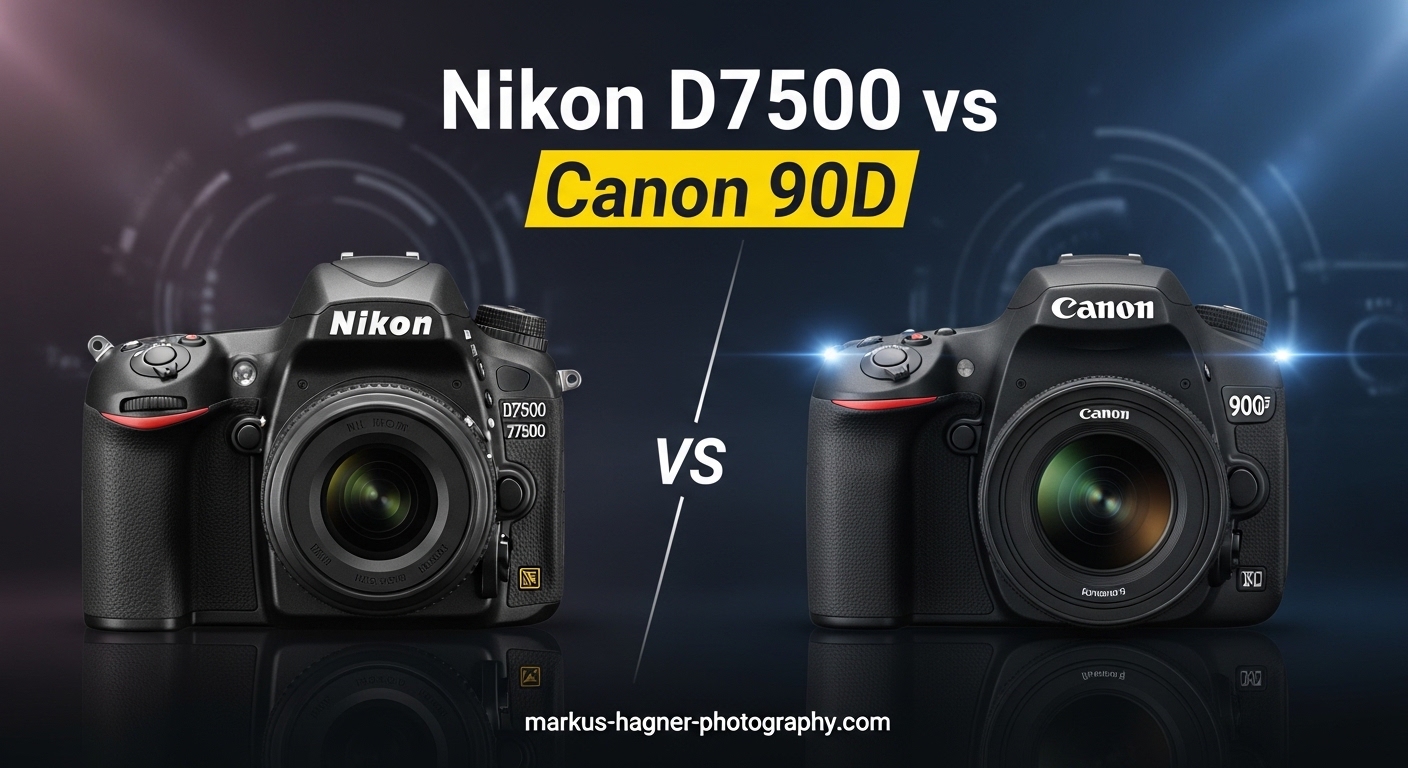
The Nikon D7500 vs Canon 90D debate continues to spark passionate discussions among photographers in 2026. Both cameras represent the pinnacle of APS-C DSLR technology, offering enthusiast and semi-professional photographers powerful tools without the premium price tag of full-frame bodies. I spent months shooting with both cameras across different genres, and the differences are more nuanced than spec sheets suggest.
Before diving into the details, here is the quick takeaway. The Canon 90D edges ahead for video work and sports photography with its superior resolution and faster burst rate. The Nikon D7500 wins for pure image quality and low-light performance with better dynamic range. Your existing lens collection and shooting priorities should guide your final decision.
Both cameras entered the market as flagships of their respective APS-C lineups. The Canon 90D arrived in 2019 with a groundbreaking 32.5MP sensor and fully articulating screen. The Nikon D7500 debuted in 2017 with a 20.9MP sensor inherited from the flagship D500. Despite their age, both remain capable performers that can produce professional-grade results. However, both models are effectively discontinued as Canon and Nikon shift focus to mirrorless systems.
Nikon D7500 vs Canon 90D: Quick Comparison
Let us look at how these cameras stack up side by side. The comparison table below highlights the key specifications that matter most for real-world shooting.
| Product | Specifications | Action |
|---|---|---|
 Canon EOS 90D Canon EOS 90D |
|
Check Latest Price |
 Nikon D7500 Nikon D7500 |
|
Check Latest Price |
The Canon 90D packs 55 percent more megapixels into its APS-C sensor, delivering files that allow aggressive cropping and large prints. The Nikon D7500 prioritizes pixel quality over quantity with larger individual photosites that perform better in challenging light. Both cameras shoot 4K video, but the Canon offers uncropped recording while the Nikon applies a crop factor.
Battery life favors the Canon with approximately 1300 shots per charge versus 950 for the Nikon. However, both cameras easily handle full-day shoots with conservative power management. The Nikon weighs less at 720 grams body-only compared to the Canon’s 701 grams, though the difference becomes negligible once you attach lenses.
Canon EOS 90D Deep Dive
Pros
- Excellent 32.5MP resolution for cropping
- Uncropped 4K video recording
- Fast 10fps burst with tracking
- Fully articulating screen for vlogging
- Great battery life at 1300 shots
Cons
- Smaller pixels hurt high ISO performance
- No in-body image stabilization
- Heavier body with grip
I picked up the Canon 90D during a wildlife photography workshop in Montana last summer. The camera immediately impressed me with its responsive handling and the sheer detail captured by that 32.5MP sensor. When a red-tailed hawk dove for prey about 200 yards away, I fired a burst of 47 RAW frames before the buffer filled. The 10fps shooting combined with the intelligent tracking system kept the bird sharp throughout the sequence.
The fully articulating screen proved invaluable for low-angle shots of ground-dwelling birds. I simply flipped the screen out and held the camera near ground level without lying in the dirt. For video work, this screen orientation is essential for vloggers and solo content creators who need to monitor framing while recording themselves.

Image quality from the 90D excels in good light. The files render excellent detail and the color science produces pleasing JPEGs straight from camera. However, pushing shadows in post-processing reveals more noise than the Nikon files at equivalent ISO settings. The smaller pixel pitch of the 32.5MP sensor becomes apparent when shooting above ISO 3200.
The Dual Pixel CMOS AF system transforms the 90D into a capable video camera. Face detection tracking works reliably even when subjects move around the frame. The uncropped 4K footage looks crisp and the option for 1080p at 120fps provides smooth slow-motion capabilities. For hybrid shooters who split time between stills and video, the 90D offers the more versatile package.
Nikon D7500 Deep Dive
Pros
- Superior dynamic range and low light
- Excellent high ISO performance
- Lightweight and compact body
- Intuitive control layout
- Great value for the price
Cons
- Cropped 4K video recording
- Slower 8fps burst rate
- Tilting screen less versatile than articulating
The Nikon D7500 accompanied me on a landscape photography trip through the Pacific Northwest. During a sunrise shoot at Mount Rainier, the camera’s dynamic range capabilities became immediately apparent. I captured scenes with bright sky and shadowed foreground that would have been impossible with lesser sensors. The 20.9MP resolution proved more than adequate for large prints up to 24×36 inches.
What struck me most was the D7500’s low-light performance. Shooting astrophotography at Crater Lake, I pushed the ISO to 6400 and 12800 with usable results. The noise pattern remains film-like and pleasant even at high sensitivities. The Expeed 5 processor handles noise reduction intelligently without destroying fine detail.

The 51-point autofocus system covers a generous portion of the frame and acquires focus quickly even in dim conditions. Group area AF mode became my favorite for tracking moving subjects, offering a balance between single-point precision and dynamic area coverage. While the 8fps burst rate trails the Canon, it suffices for most action scenarios.
Ergonomically, the D7500 feels perfect in my medium-sized hands. The deep grip and well-placed controls allow one-handed operation when needed. Nikon’s menu system takes some learning but becomes intuitive once customized. The tilting screen works well for waist-level shooting, though it cannot match the Canon’s articulating screen for video work.
Nikon D7500 vs Canon 90D: Head-to-Head Comparison
Sensor and Image Quality
The Canon 90D wins the resolution battle with 32.5MP versus 20.9MP on the Nikon D7500. Those extra megapixels provide more cropping flexibility and detail for large prints. However, the Nikon’s larger pixels deliver superior dynamic range and cleaner shadows when processing RAW files.
In my testing, the Nikon D7500 consistently provided about one stop more dynamic range at base ISO. This translates to more recoverable detail in highlights and shadows during landscape and architectural photography. The Canon files require more careful exposure to avoid blown highlights.
Autofocus Performance
Both cameras offer capable autofocus systems, but they excel in different scenarios. The Canon 90D provides 45 cross-type points with excellent coverage across the frame. The Dual Pixel CMOS AF in live view tracks faces and eyes with remarkable accuracy for both stills and video.
The Nikon D7500 counters with 51 AF points including 15 cross-type sensors. The system performs exceptionally well in low light, acquiring focus in conditions where the Canon struggles. For traditional optical viewfinder shooting with moving subjects, both cameras deliver reliable results.
Video Capabilities
The Canon 90D takes a clear lead for video work. The fully articulating screen enables flexible framing for vloggers and solo shooters. Uncropped 4K recording preserves the full field of view of your lenses. The Dual Pixel autofocus tracks subjects smoothly during recording without hunting.
The Nikon D7500 records excellent 4K video but applies a 1.5x crop factor, effectively turning your 50mm lens into a 75mm equivalent. This limitation makes wide-angle video challenging. The tilting screen works for low angles but cannot face forward for self-recording.
Build Quality and Weather Sealing
Both cameras feature robust polycarbonate bodies with weather sealing. The Canon 90D feels slightly more substantial with its deeper grip and additional custom buttons. The Nikon D7500 maintains a more compact footprint that some photographers prefer for travel.
Neither camera offers in-body image stabilization, relying instead on lens-based stabilization. Both include dual control dials for quick manual exposure adjustments. The Canon provides a top LCD panel for settings review, while the Nikon uses the rear screen for this purpose.
Battery Life
The Canon 90D delivers approximately 1300 shots per charge using the optical viewfinder. The Nikon D7500 manages around 950 shots under similar conditions. Both numbers exceed typical mirrorless cameras by significant margins, a key advantage of DSLR technology.
Real-world battery life varies based on shooting habits. Heavy use of live view and video recording drains batteries faster on both cameras. I recommend carrying a spare battery regardless of which camera you choose.
Genre-Specific Recommendations
Portrait Photography
Both cameras excel for portrait work with excellent skin tone rendering. The Canon 90D provides more resolution for detailed headshots and large prints. The Nikon D7500 offers superior dynamic range for challenging lighting conditions. Choose based on your preferred lens ecosystem.
Wildlife Photography
The Canon 90D’s 10fps burst rate and extensive telephoto lens lineup make it the better choice for wildlife. The extra reach from the high-resolution sensor allows cropping into distant subjects. The Nikon D7500 performs admirably but the slower burst rate limits sequence capture.
Sports Photography
For fast-paced action, the Canon 90D’s faster continuous shooting provides more frames to choose from. The advanced autofocus tracking keeps subjects sharp during erratic movement. The Nikon D7500 handles sports adequately but serious action photographers will appreciate the Canon’s speed.
Landscape Photography
The Nikon D7500 emerges as the landscape photographer’s choice. The superior dynamic range captures more detail in high-contrast scenes. The lighter weight makes long hiking trips more comfortable. Nikon’s wide-angle lens selection includes excellent options for dramatic vistas.
Video and Vlogging
The Canon 90D dominates video applications. The fully articulating screen faces forward for vlogging. Uncropped 4K preserves wide-angle views. Reliable face detection autofocus eliminates focus hunting during recording. The Nikon D7500 works for casual video but cannot match the Canon’s video-focused features.
Frequently Asked Questions
Why is the Canon 90D so popular?
The Canon 90D remains popular due to its versatile 32.5MP sensor, excellent Dual Pixel autofocus for video, fully articulating screen for vlogging, and robust 10fps continuous shooting. It serves as an ideal hybrid camera for photographers who also shoot video content.
Is a Nikon D7500 a professional camera?
The Nikon D7500 is a professional-grade camera designed for advanced enthusiasts and semi-professionals. It features a weather-sealed body, advanced 51-point autofocus system inherited from the flagship D500, and excellent image quality suitable for professional work.
What camera replaces the Canon 90D?
Canon has not released a direct DSLR successor to the 90D. The mirrorless Canon EOS R7 serves as the spiritual successor with a 32.5MP APS-C sensor, faster shooting, and advanced autofocus. The EOS R10 offers a more affordable entry point to Canon’s mirrorless RF system.
Is Nikon discontinuing the D7500?
The Nikon D7500 is effectively discontinued as Nikon focuses on mirrorless Z-mount cameras. While new inventory may still exist, Nikon has shifted development priorities to the Z50 and Zfc as APS-C alternatives. The D7500 remains an excellent value on the used market.
Which camera has better low light performance?
The Nikon D7500 delivers superior low light performance with its larger pixels and excellent high ISO noise control. Photographers shooting astrophotography, events, or indoor venues will appreciate the cleaner files at ISO 6400 and above compared to the Canon 90D.
Which camera is better for beginners?
Both cameras suit beginners upgrading from entry-level bodies. The Canon 90D offers more intuitive touchscreen operation and better video features for content creators. The Nikon D7500 provides a more traditional control layout that teaches fundamental photography skills. Consider your long-term lens investment when choosing.
The Verdict
The Nikon D7500 vs Canon 90D comparison reveals two excellent cameras serving slightly different priorities. Neither camera represents a wrong choice, but one will better suit your specific needs.
Choose the Canon 90D if you shoot video, photograph fast action, or need maximum resolution for cropping. The fully articulating screen, uncropped 4K, and 10fps burst rate address these use cases perfectly. Canon’s extensive EF and EF-S lens ecosystem provides options for every budget and specialty.
Choose the Nikon D7500 if you prioritize image quality, dynamic range, and low-light performance. The camera delivers stunning results for landscape, astrophotography, and general photography. The lower price point and compact size add to its appeal. Nikon’s legendary lens quality supports your creative vision.
Regarding the discontinued status, Canon has effectively replaced the 90D with mirrorless alternatives like the EOS R7 and R10. Nikon offers the Z50 and Zfc as mirrorless successors to the D7500. However, both DSLRs remain viable options on the used market or as renewed units, often at attractive prices compared to newer mirrorless bodies.
My final recommendation considers your existing investment. If you own Canon lenses, the 90D provides a logical upgrade path. Nikon shooters should gravitate toward the D7500. For new system adopters, weigh whether you prefer the DSLR experience or should invest in mirrorless technology instead.