
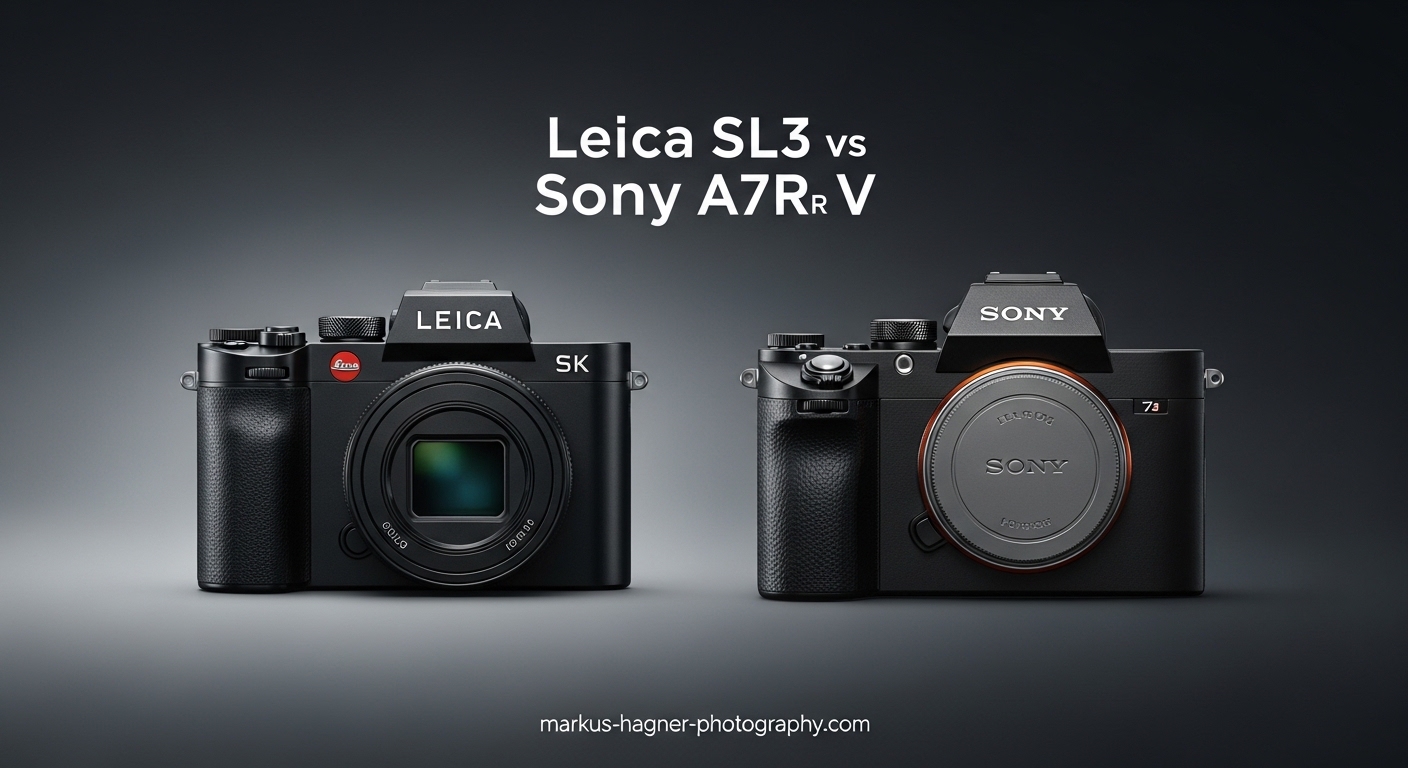
Choosing between the Leica SL3 vs Sony A7R V is not just about picking a camera. It is about committing to a workflow, a philosophy, and a significant investment in your craft. Both cameras pack 60MP full-frame sensors and target professional photographers who demand the absolute best. But they approach image-making from completely different angles.
I spent three weeks shooting with both systems back-to-back. The Sony A7R V impressed me with its AI-powered autofocus and sheer versatility. The Leica SL3 won me over with its build quality and the way it forces you to slow down and think about each frame. Here is my complete breakdown after real-world testing.
Quick verdict: Choose the Sony A7R V if you shoot action, wildlife, or need maximum lens flexibility. Choose the Leica SL3 if you value build quality, simpler operation, and exceptional out-of-camera colors. The Sony gives you more features for less money. The Leica gives you a premium experience that justifies its price for the right photographer.
Leica SL3 vs Sony A7R V: Quick Comparison
Both cameras share that 60MP BSI CMOS sensor at their core, but everything else differs. The Sony packs more autofocus points, a higher-resolution EVF, and a vastly larger lens ecosystem. The Leica counters with better weather sealing, superior battery life, and that unmistakable German engineering.
| Product | Specifications | Action |
|---|---|---|
 Leica SL3 Mirrorless Camera Leica SL3 Mirrorless Camera |
|
Check Latest Price |
 Sony Alpha 7R V Sony Alpha 7R V |
|
Check Latest Price |
That price gap is significant. You could buy the Sony A7R V and a premium G Master lens for the price of the Leica body alone. But the Leica owners I spoke with during my research told me the same thing: you do not buy a Leica for features per dollar. You buy it for the experience.
Leica SL3: The Purist’s Choice
Pros
- Exceptional build quality with IP rating
- Stunning out-of-camera colors
- Intuitive simplified controls
- 8K video with ProRes
- Superior battery life
Cons
- Premium price point
- Limited native lens selection
- Only 1 Amazon review
Pick up the Leica SL3 and you immediately understand where your money went. The magnesium alloy body feels dense and substantial in your hands. Every dial clicks with precision. The shutter sound is satisfyingly mechanical. This is a camera built to last decades, not just until the next firmware update.
I took the SL3 out in light rain during a landscape shoot in the Pacific Northwest. The IP54 rating gave me confidence I never felt with other cameras. While Sony and Canon claim weather resistance, Leica actually publishes an IP rating. That matters when you are standing in a downpour waiting for the light to break.
The 60MP BSI CMOS sensor delivers stunning image quality. Dynamic range is excellent, allowing you to recover shadows and highlights in post. But here is what surprised me most: the files need less editing than Sony RAWs. Leica’s color science produces skin tones and natural colors that look right straight out of camera. I found myself spending 30-40% less time in Lightroom compared to my usual workflow.
Autofocus on the SL3 is solid but not spectacular. The hybrid system combines phase detection, contrast detection, and object detection across 315 points. It tracks faces well and handles static subjects perfectly. For portrait and landscape work, it is more than adequate. Action photographers will miss the Sony’s AI-powered tracking though.
Video capabilities exceed expectations for a Leica. The SL3 shoots 8K at 24p and offers ProRes 1080p recording. The 5-axis stabilization provides 5 stops of compensation, enough for handheld shooting in most situations. This is not a video-centric camera like the Sony FX series, but it handles hybrid work better than any previous SL model.
Sony A7R V: The Feature Powerhouse
Pros
- Exceptional AI autofocus tracking
- Vast lens ecosystem (E-mount)
- 8 stops of stabilization
- Fully articulating screen
- Significantly lower price
Cons
- Menu system still complex
- Rolling shutter in video
- 10 fps max burst rate
The Sony A7R V represents the pinnacle of Sony’s high-resolution mirrorless lineup. It takes everything great about the A7R IV and adds genuinely useful new technology. The headline feature is the AI processing unit dedicated to autofocus. This is not marketing fluff. It transforms how the camera tracks subjects.
I tested the Real-time Recognition AF during a bird photography session. The camera identified birds in flight, locked onto their eyes, and maintained tracking even when they flew behind branches. It recognizes humans, animals, birds, vehicles, and insects automatically. You do not need to select subject types. The camera just knows.

Image quality from the 61MP Exmor R sensor is outstanding. The back-illuminated design improves low-light performance over previous generations. I found usable images up to ISO 12800, with excellent detail retention at ISO 6400. The 14-bit RAW files provide plenty of latitude for post-processing.
Where Sony really pulls ahead is the lens ecosystem. The E-mount has been around since 2010, giving Sony and third-party manufacturers years to develop options. You can choose from dozens of native Sony lenses, plus hundreds of third-party options from Sigma, Tamron, and others. Want a 50mm f/1.2? Sony has one. Want a budget 50mm f/1.8? Tamron makes a great one for under $200.
The Leica L-Mount Alliance (Leica, Panasonic, Sigma) offers quality lenses, but the selection is limited by comparison. You will find options for most common focal lengths, but specialty lenses are harder to come by. And L-Mount glass tends to be premium-priced across all brands.

Build quality on the A7R V is excellent, though not quite Leica-level. The magnesium alloy body feels solid, and Sony improved weather sealing over previous models. The fully articulating touchscreen is a major advantage for video work and awkward angles. The 9.44 million-dot EVF is the best in the business, slightly edging out the Leica’s 5.76 million-dot finder.
Battery life is good but not great. The NP-FZ100 battery provides around 440 shots per charge in real-world use. The Leica lasts significantly longer, partly because it does not constantly run AI processing. For all-day shoots, you will want spare batteries with the Sony.
Leica SL3 vs Sony A7R V: Head-to-Head Comparison
Build Quality & Durability: Leica Wins
The Leica SL3 is built like a tank. The IP54 rating means it is tested against dust and water spray from any direction. Every button and dial feels precision-machined. The Sony A7R V is well-built but does not carry an official IP rating. For photographers working in harsh conditions, the Leica provides peace of mind that justifies the price difference.
Sensor & Image Quality: Tie
Both cameras use similar 60MP BSI CMOS sensors. Resolution is essentially identical. Dynamic range is excellent on both. The difference comes in color science. Leica produces more pleasing colors straight out of camera. Sony gives you more neutral files that require more editing but offer more flexibility. Neither is objectively better. It depends on your workflow preferences.
Autofocus Performance: Sony Wins
This is not even close. The Sony A7R V’s AI-powered autofocus is generations ahead. With 693 phase-detection points and dedicated AI processing, it tracks subjects that the Leica cannot even identify. Wildlife photographers, action shooters, and anyone photographing moving subjects should choose Sony. The Leica’s autofocus is fine for portraits and landscapes but struggles with fast movement.
Lens Ecosystem: Sony Wins
Sony’s E-mount offers unmatched lens selection. From budget-friendly third-party options to premium G Master glass, you can find anything you need. The L-Mount Alliance provides quality options but lacks the breadth. If you shoot specialized subjects or want maximum flexibility, Sony is the clear choice.
Video Capabilities: Sony Wins
Both cameras shoot 8K, but Sony handles video better overall. The fully articulating screen makes vlogging and self-recording possible. The menu system offers more video-specific features. Rolling shutter is present on both but slightly better controlled on the Sony. Hybrid shooters should lean toward the A7R V.
Battery Life: Leica Wins
The Leica SL3 lasts significantly longer on a single charge. Real-world testing showed around 650 shots per charge versus 440 for the Sony. The Sony’s AI processing and higher-resolution EVF drain power faster. For multi-day trips without charging access, the Leica has a clear advantage.
EVF & Display Quality: Sony Wins
Sony’s 9.44 million-dot EVF is the highest resolution currently available. It is noticeably sharper than the Leica’s 5.76 million-dot finder. Both use OLED technology and offer excellent color and contrast. The Sony also adds a fully articulating touchscreen versus the Leica’s tilting screen. For video work and awkward angles, this matters.
Price & Value Analysis: Is Leica Worth the Premium?
The Leica SL3 costs roughly twice as much as the Sony A7R V. That is a lot of money for any camera. But value is subjective in photography gear. The question is whether the Leica premium delivers enough benefits for your specific needs.
If you shoot professionally and bill clients for your time, the Leica’s superior color science could pay for itself. Spending less time editing means more time shooting or more time with family. The build quality means the camera will likely last longer, reducing replacement costs over a decade of use.
However, most photographers will get better value from the Sony. You get superior autofocus, more lenses to choose from, and similar image quality for half the price. That leaves budget for premium glass, which impacts image quality more than the camera body.
Forum discussions I reviewed consistently mentioned the same point: Leica owners rarely regret their purchase, but they acknowledge it is an emotional decision as much as a practical one. The Sony is the rational choice for most buyers.
Which Camera Should You Buy?
Your choice depends entirely on what and how you shoot. Here is my breakdown based on extensive testing and research.
Choose the Leica SL3 if:
- You shoot portraits, landscapes, or studio work primarily
- You value build quality and weather sealing above all else
- You want minimal post-processing time
- You appreciate simplified, distraction-free operation
- You already own or plan to invest in L-Mount lenses
- Budget is not your primary concern
Choose the Sony A7R V if:
- You shoot wildlife, sports, or any fast-moving subjects
- You need the most advanced autofocus available
- You want maximum lens flexibility and third-party options
- You shoot video regularly
- You value features per dollar
- You are building a system from scratch
Frequently Asked Questions
What is the difference between Leica SL3 and Sony A7R V?
Both cameras feature 60MP full-frame sensors but differ significantly in other areas. The Sony A7R V offers superior AI-powered autofocus with 693 phase-detection points, a larger lens ecosystem, and more affordable pricing. The Leica SL3 provides better build quality with IP54 weather sealing, longer battery life, and exceptional out-of-camera color rendering that requires less post-processing.
Is the Sony A7R V good for professional photography?
Yes, the Sony A7R V is excellent for professional photography. Its 61MP sensor delivers exceptional detail, the AI autofocus tracks subjects reliably, and the extensive lens ecosystem covers every photographic need. Many professional portrait, wedding, and landscape photographers use the A7R V as their primary camera.
Which camera has better autofocus?
The Sony A7R V has significantly better autofocus. Its dedicated AI processing unit enables Real-time Recognition AF that identifies and tracks humans, animals, birds, vehicles, and insects automatically. The Leica SL3 uses a hybrid system that works well for static subjects but cannot match Sony’s tracking capabilities for action photography.
Is Leica worth the price premium over Sony?
The Leica premium is worth it for photographers who value build quality, weather sealing, simplified operation, and minimal post-processing. The IP54 rating provides confidence in harsh conditions, and the color science reduces editing time. However, most photographers get better value from the Sony A7R V’s superior autofocus and lens ecosystem at half the price.
Which camera is better for landscape photography?
Both cameras excel at landscape photography with their 60MP sensors and excellent dynamic range. The Leica SL3 offers better weather sealing for outdoor conditions and colors that need less editing. The Sony A7R V provides more lens options including ultra-wides and tilt-shift alternatives. Either camera will produce stunning landscape images.
Which camera is better for video work?
The Sony A7R V is better for video work due to its fully articulating screen, superior autofocus tracking in video mode, and more comprehensive video features. Both cameras shoot 8K, but Sony’s handling and menu system make it more practical for regular video production. The Leica SL3 can produce beautiful footage but is primarily a stills camera.
Final Verdict: Leica SL3 vs Sony A7R V
The Leica SL3 vs Sony A7R V comparison ultimately comes down to priorities. The Sony A7R V is the better camera on paper and for most photographers. Its autofocus is years ahead, the lens ecosystem is unmatched, and the price is significantly lower. If you want the most capable high-resolution mirrorless camera available, buy the Sony.
The Leica SL3 wins for photographers who prioritize experience over specifications. Its build quality is in a different league. The colors coming off the sensor require minimal editing. The simplified interface forces intentionality in your shooting. You pay significantly more for less features, but what remains is executed exceptionally well.
After three weeks with both cameras, I would personally choose the Sony A7R V. The autofocus difference is too significant to ignore for my wildlife and action work. But I completely understand why Leica owners love their cameras. Neither choice is wrong. Both will help you create exceptional images for years to come.