
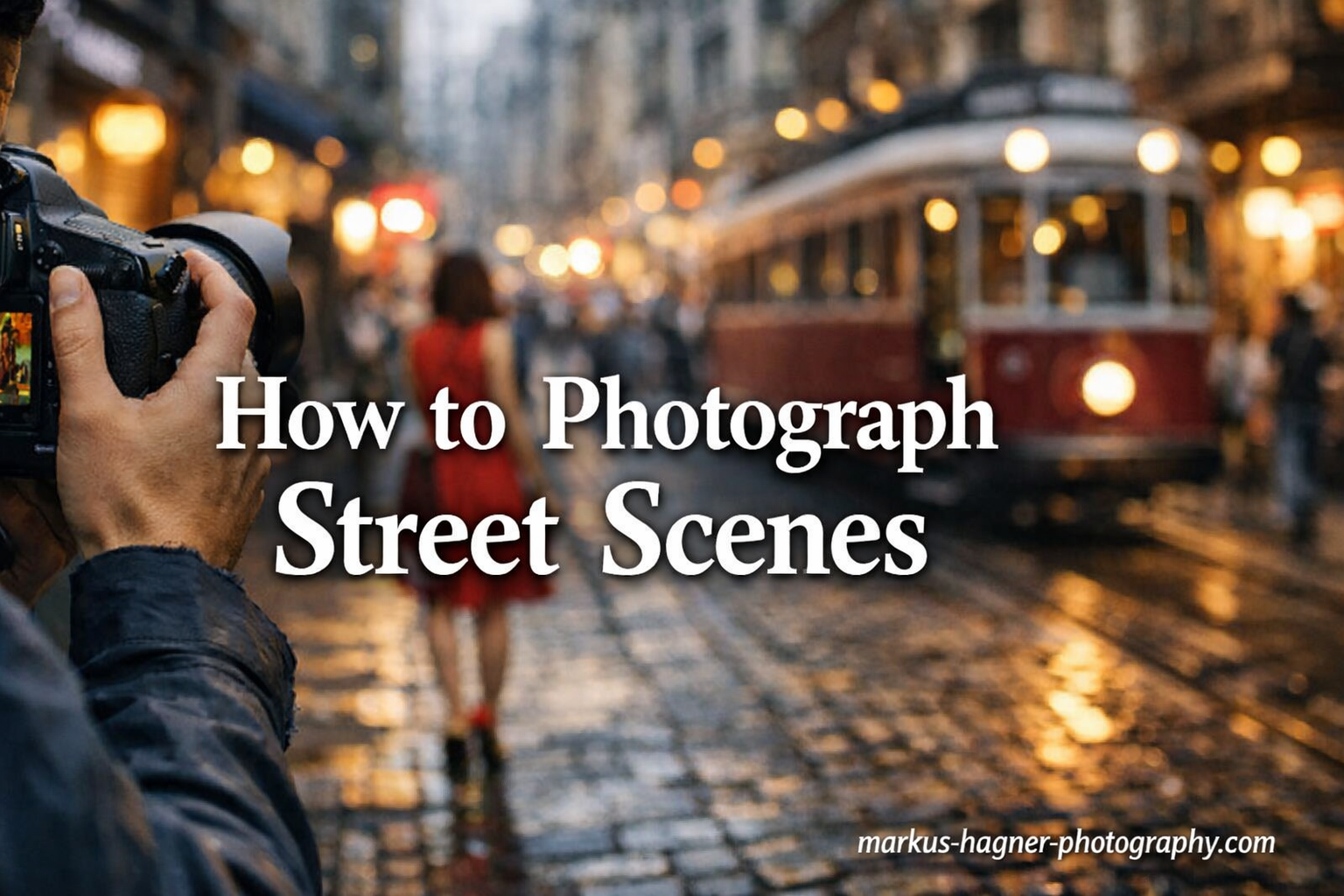
Walking through the narrow streets of Lisbon at golden hour, I watched a weathered fisherman mend his nets while tourists streamed past without noticing. That single frame captured more of Portugal’s soul than any landmark could. Street photography transforms ordinary moments into extraordinary stories, and mastering it is what separates travel snapshots from compelling visual narratives.
In this guide, I will share everything I have learned from 15 years of photographing street scenes across 40 countries. Whether you are just starting or looking to refine your approach, these techniques will help you capture authentic moments that transport viewers directly into the heart of your travel experiences.
Learning how to photograph street scenes like a travel photographer requires more than technical skill. It demands patience, confidence, and a willingness to step outside your comfort zone. The good news? Every photographer I know started exactly where you are now, feeling that mix of excitement and nervousness before clicking the shutter.
How to Overcome Fear of Photographing Strangers In 2026?
The biggest barrier to great street photography is not your gear or settings. It is fear. I remember my hands shaking the first time I raised my camera to photograph a stranger in Paris. Fifteen years later, I still feel that initial hesitation sometimes, but I have learned to move through it.
Your fear is normal and shared by virtually every street photographer. The difference between those who create compelling work and those who hesitate is simple: they photograph anyway. Start by acknowledging that discomfort is part of the process, not a sign you should stop.
Begin in tourist areas where cameras are common. People expect to be photographed in places like markets, festivals, and busy squares. This gives you psychological cover while you build confidence. I spent my first six months shooting only in crowded markets before venturing into quieter neighborhoods.
Reframe your mindset from “taking” to “capturing.” You are not stealing anything; you are documenting real life as it unfolds. Street photography is a respected art form with a rich history spanning over a century. Understanding this heritage helped me view my work as contribution rather than intrusion.
Practice the “three-second rule.” When you see a potential shot, you have three seconds to raise your camera and capture it. Overthinking creates hesitation, and hesitation kills spontaneity. Trust your instincts and shoot first, evaluate later.
Camera Settings for Street Photography
Street scenes demand specific camera settings that balance speed, sharpness, and flexibility. After testing dozens of configurations across different lighting conditions, here are the settings I recommend starting with.
Set your aperture to f/8 for daylight shooting. This provides enough depth of field to keep subjects sharp even if your focus is slightly off. In lower light, open to f/5.6 or f/4, but avoid going wider unless necessary. Too shallow a depth of field makes street photography challenging when subjects move unpredictably.
Choose a shutter speed of at least 1/500 second when people are walking, and 1/1000 second for faster movement. Motion blur can be artistic, but as a beginner, prioritize sharp images while you develop your eye. When subjects are stationary, you can drop to 1/250 or even 1/125 if you have steady hands.
Keep ISO as low as possible while maintaining your target shutter speed. Modern cameras handle high ISO well, so do not be afraid of 1600 or even 3200 in dim conditions. Grain is preferable to blur from slow shutter speeds. I regularly shoot at ISO 3200 during evening street scenes.
White balance should stay on auto unless you are shooting under consistent artificial lighting. Street environments change constantly, and manual white balance becomes impractical. Shoot RAW to give yourself flexibility in post-processing.
For autofocus, use continuous mode (AF-C or AI Servo) with a single focus point. Zone focusing is even better once you learn it, which brings us to the next section. Avoid automatic area selection; it often focuses on the wrong element in busy street scenes.
Zone Focusing: The Pro Technique
Zone focusing transformed my street photography more than any other technique. This manual focus method predates autofocus and remains the secret weapon of experienced street photographers who need instant, reliable focusing.
The concept is simple: you pre-focus your lens to a specific distance, then use depth of field to create a “zone” of acceptable sharpness. Everything within that zone appears sharp without needing to focus for each shot. This eliminates shutter lag and lets you shoot instantly when the moment appears.
Here is how to set it up. First, switch your lens to manual focus. Set your aperture to f/8 or f/11 for maximum depth of field. Then focus your lens to approximately 2 meters (6.5 feet) away. On a 35mm lens at f/8, this gives you a zone of sharp focus from about 1.5 meters to 3 meters, perfect for street photography.
Use the distance scale on your lens barrel to verify focus placement. If your lens lacks distance markings, focus on something about two meters away, then note your position relative to the focus ring. Many street photographers tape their focus rings in place once set.
Practice estimating distances. Stand in your living room and guess how far away the opposite wall is, then check with a tape measure. After two weeks of daily practice, you will intuitively know when subjects enter your focus zone.
The beauty of zone focusing is speed. When that perfect moment unfolds, you simply raise your camera and shoot. No focus hunting, no missed shots, no hesitation. This technique is why experienced street photographers consistently capture moments that beginners miss.
Composition Techniques That Transform Street Photos
Strong composition separates amateur snapshots from professional street photography. While rules are meant to be broken, understanding these fundamentals gives you a foundation to build upon.
The rule of thirds remains essential. Imagine your frame divided into nine equal sections by two horizontal and two vertical lines. Place your main subject at the intersection of these lines rather than dead center. This creates visual tension and interest that draws viewers into the image.
Leading lines guide the eye through your photograph. Streets, alleys, railings, and shadows can all serve as lines directing attention toward your subject. I look for natural lines everywhere now, from sidewalk cracks to sunlit patches on pavement.
Frame within the frame using doorways, windows, arches, or even gaps between buildings. This technique adds depth and context while isolating your subject from busy backgrounds. Some of my favorite street photos use architectural elements as natural frames.
Light and shadow are your most powerful compositional tools. Look for dappled sunlight filtering through trees, long shadows at golden hour, or dramatic contrast between lit and shaded areas. A subject stepping from shadow into light creates natural visual drama.
The decisive moment concept, popularized by Henri Cartier-Bresson, is crucial for street photography. This is the exact instant when all elements align perfectly: expression, gesture, composition, and light. Developing the patience to wait for this moment separates good photographers from great ones.
Essential Shooting Techniques
Mastering specific shooting techniques will dramatically improve your success rate in street photography. These methods have become second nature to me after years of practice.
Shooting from the hip means photographing without raising the camera to your eye. This technique feels awkward initially but becomes invaluable for candid shots. Hold your camera at waist level, pre-focused using zone focusing, and click the shutter when interesting subjects pass by. Your subjects remain unaware, resulting in completely natural expressions and body language.
Practice hip shooting at home first. Walk around your neighborhood holding the camera at your side, estimating what the frame captures without looking. Review your shots to understand your natural framing. After 500 practice frames, you will instinctively know what the camera sees.
Vary your perspective constantly. Most amateur street photos are shot from standing height, creating a repetitive, predictable look. Get low for dramatic angles. Find elevated positions for bird’s-eye views. Shoot through objects for layered compositions. Different perspectives reveal scenes that others overlook.
Patience is not passive waiting; it is active observation. Find an interesting location with good light and compelling background, then wait for the right subject to enter the scene. I once waited 45 minutes in a Marrakech alleyway for someone in a blue djellaba to walk past a yellow wall. The resulting photograph was worth every minute.
Blend into your environment by dressing appropriately and moving calmly. Avoid sudden movements that draw attention. In many cultures, tourists with cameras are expected; act confident and most people will ignore you. Confidence is your best camouflage.
How to Approach Strangers for Street Portraits
While candid photography captures authenticity, there is also value in direct street portraits. Approaching strangers requires confidence, respect, and clear communication.
Your body language speaks before you do. Approach with open posture, making eye contact and smiling. Avoid hiding your camera; holding it openly signals transparency. I keep my camera on a shoulder strap, visible but not threatening.
The direct approach works best: “Excuse me, I am photographing interesting people in this city, and your look/style is exactly what I am hoping to capture. Would you mind if I took your portrait?” This compliment-first approach works surprisingly well. Most people are flattered to be asked.
Accept rejection gracefully. Not everyone wants to be photographed, and that is their right. Thank them politely and move on. I am rejected about 30 percent of the time, and it never bothers me. The 70 percent who agree provide more than enough opportunities.
When someone agrees, work quickly. Take a few frames, show them the results on your camera screen, and offer to email the photos if they provide contact information. This builds goodwill and sometimes leads to interesting conversations about local life.
Learn a few phrases in the local language: “May I photograph you?” and “Thank you” go a long way. Even terrible pronunciation usually earns smiles and appreciation for the effort. People respond to genuine respect and interest in their culture.
Legal and Ethical Considerations
Understanding your legal rights and ethical responsibilities is essential for street photography. Laws vary significantly by country, and ignorance is not a defense.
In the United States and most of Europe, photographing people in public spaces is generally legal without consent. Public spaces include streets, parks, and sidewalks. However, private property owners can restrict photography on their premises, and some locations like airports and military installations have specific restrictions.
France and other parts of Europe have stronger privacy protections. While street photography remains legal, publishing identifiable images of people without consent can create legal exposure. When in doubt, err on the side of caution and seek permission.
Many Asian countries have complex regulations around photography. Japan allows public photography but has strong cultural norms against it. Some Middle Eastern countries restrict photographing women. Always research local customs before traveling.
Ethics matter regardless of legality. Never photograph vulnerable people in ways that exploit their circumstances. Children require extra consideration; I always seek parental permission before photographing minors. Be especially respectful during religious ceremonies or cultural events.
If confronted, remain calm and polite. Explain that you are a travel photographer documenting daily life. Offer to delete photos if someone is genuinely upset. Most confrontations de-escalate quickly with respectful communication.
Travel-Specific Street Photography Tips
Street photography while traveling presents unique challenges and opportunities. These tips will help you navigate unfamiliar environments successfully.
Cultural sensitivity is paramount. What is acceptable in New York might be offensive in Bangkok. Research local customs regarding photography before you travel. In some cultures, photographing the soles of feet is disrespectful. In others, photographing women is highly restricted. Understanding these nuances prevents uncomfortable situations.
Pack light but smart. One camera body and two lenses (a 35mm prime and a wider zoom) cover most situations. Leave the heavy telephoto at home; street photography requires proximity, not distance. Carry spare batteries and memory cards, as travel days are long and charging opportunities unpredictable.
Stay safe by remaining aware of your surroundings. Tourists with expensive cameras are targets for theft in some areas. Use a cross-body strap that cannot be snatched. Keep your gear insured and backed up daily when possible.
The best street photography locations are often off the main tourist routes. Explore residential neighborhoods, local markets, and areas where daily life unfolds naturally. Ask locals for recommendations; they often know the most photogenic spots that tourists miss.
Shoot during golden hour and blue hour for the most beautiful light. Midday sun creates harsh shadows that are challenging to work with. Early morning offers quiet streets and soft light, while evening brings activity and warm tones.
Frequently Asked Questions
What techniques are used in street photography?
The main techniques include zone focusing for quick shooting, shooting from the hip for candid captures, patience and anticipation for decisive moments, varying perspectives through different angles and heights, and blending in with your environment. Successful street photographers also master composition rules like the rule of thirds and leading lines while paying close attention to light and shadow.
What is the 20-60-20 rule in photography?
The 20-60-20 rule suggests that 20 percent of your photos will be technically poor, 60 percent will be acceptable but unremarkable, and 20 percent will be your best work. This helps photographers maintain perspective and keep shooting despite immediate results that may seem disappointing.
What are the 5 C’s of photography?
The 5 C’s are Composition, Contrast, Color, Cropping, and Clarity. These five elements work together to create compelling images. Composition arranges visual elements, contrast creates depth, color sets mood, cropping removes distractions, and clarity ensures sharpness and proper focus.
What is the 1/3 rule in photography?
The 1/3 rule, also known as the rule of thirds, divides your frame into nine equal sections using two horizontal and two vertical lines. Place important elements at the intersection points or along the lines rather than centering them. This creates more dynamic, visually interesting photographs.
What lens is best for street photography?
A 35mm prime lens is the most popular choice for street photography because it closely matches human field of view while providing enough context. Some photographers prefer 28mm for wider scenes or 50mm for more intimate portraits. Prime lenses are preferred over zooms for their smaller size, faster apertures, and lighter weight.
Is street photography legal?
In the United States and most of Europe, photographing people in public spaces is generally legal without consent. However, laws vary significantly by country. France and some European nations have stronger privacy protections. Many Asian and Middle Eastern countries have specific restrictions. Always research local laws before photographing in unfamiliar destinations.
Conclusion
Learning how to photograph street scenes like a travel photographer is a journey, not a destination. Every photographer you admire started exactly where you are now, fumbling with settings and feeling nervous about raising their camera. The difference is they kept shooting.
Start with one technique from this guide. Practice zone focusing until it becomes automatic. Work on your composition in familiar surroundings before traveling. Build confidence by photographing in busy tourist areas before venturing into quieter neighborhoods.
Remember that the best street photography comes from genuine curiosity and respect for the people you photograph. Your camera is a passport into moments of authentic human experience. Use it thoughtfully, and you will create images that resonate far beyond the frame.
The streets are waiting. Go capture something extraordinary.