
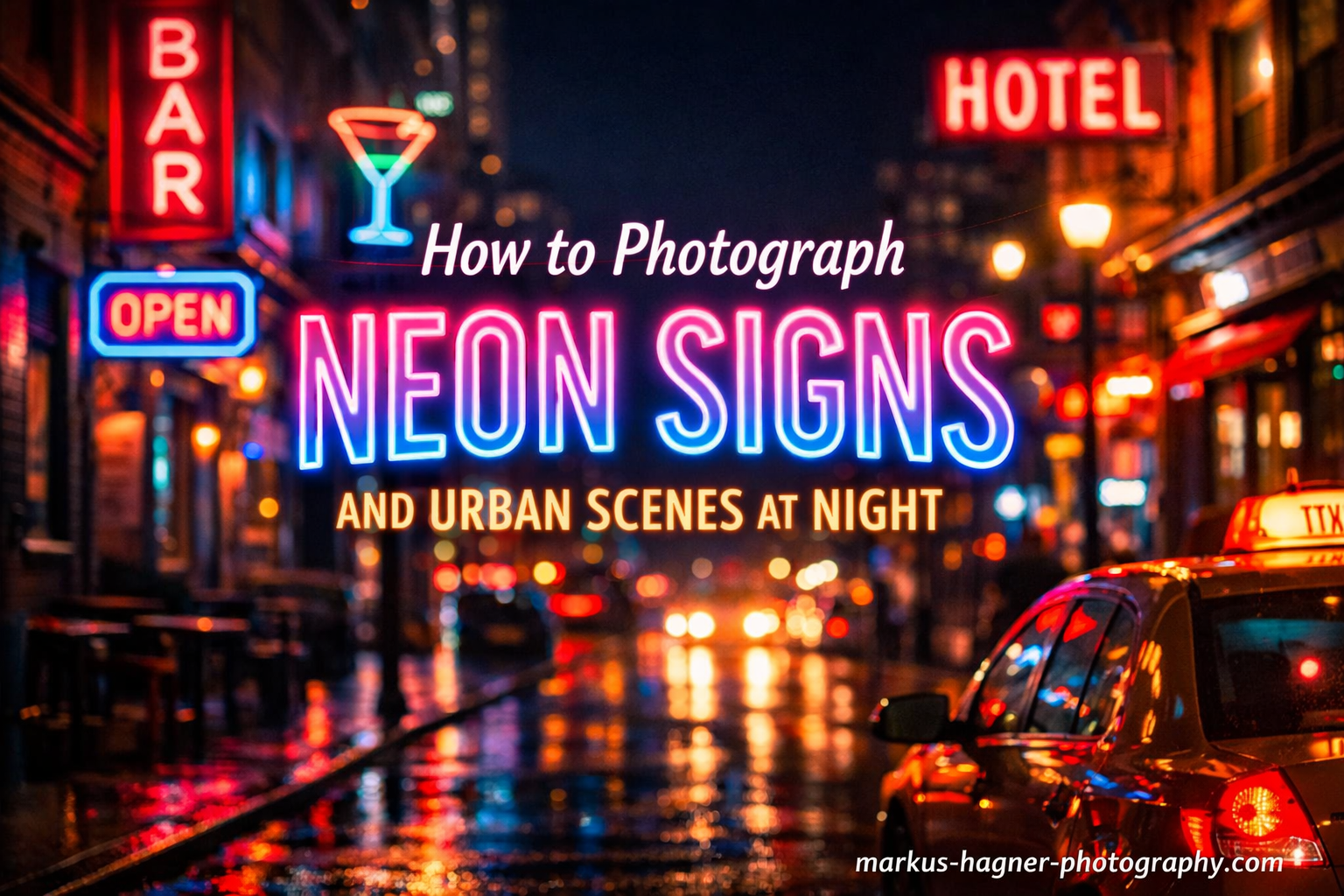
There’s something magical about city streets after dark. The glow of neon signs against dark buildings creates a visual drama that daytime photography simply can’t match. I’ve spent countless nights exploring urban landscapes, capturing the vibrant energy that only emerges when the sun goes down.
In this comprehensive guide for 2026, I’ll show you how to photograph neon signs and urban scenes at night. Whether you’re shooting with a professional camera or just your iPhone, you’ll learn practical techniques to capture stunning neon photos that do justice to the real thing.
Neon photography presents unique challenges. The extreme brightness of illuminated signs against dark surroundings can fool your camera’s meter. Focus becomes tricky in low light. And getting those colors to look authentic requires specific settings and techniques.
But master these challenges, and you’ll create images that capture the essence of urban nightlife in 2026.
Essential Equipment for Neon Photography
The good news about neon photography is that you don’t need specialized gear. Any camera with manual controls will work. I’ve captured great neon shots with everything from full-frame mirrorless cameras to entry-level DSLRs.
That said, some equipment makes the job easier:
A tripod is non-negotiable for most neon shots. Long exposures are essential for capturing the full glow of neon signs, and camera shake will ruin your images. You don’t need an expensive one—any stable tripod will do. I’ve used budget tripods that worked perfectly fine for night photography.
For lenses, wide-angle zooms in the 24-70mm range are versatile for urban scenes. They let you capture neon signs while including enough context. Prime lenses with wide apertures (f/1.8 or wider) are excellent for portraits with neon backgrounds, creating that beautiful bokeh effect.
A remote shutter release or intervalometer helps eliminate camera shake during long exposures. If you don’t have one, use your camera’s built-in timer set to 2 seconds.
Optional accessories that can elevate your neon photography: ND filters for very bright signs, star filters to create light spikes, and a flashlight for seeing your camera controls in the dark.
Camera Settings for Neon Sign Photography
Getting your settings right is crucial for neon photography. The extreme contrast between bright signs and dark surroundings confuses camera meters. Here are the settings I use as my starting point:
ISO: Keep it low. I start at ISO 100 or 200. Higher ISOs introduce noise that becomes obvious in dark areas of your photos. Neon signs are bright enough that you don’t need high ISOs unless you’re deliberately trying to capture the surrounding environment at the expense of the neon.
Aperture: f/4 to f/8 is my sweet spot. This gives me good depth of field while letting in enough light. If I want that creamy bokeh effect in the background, I’ll shoot wide open at f/1.8 or f/2.8. Just know that very wide apertures can make focus tricky on neon text.
Shutter speed: This varies widely based on the effect you want. For sharp neon signs, I might use 1/125 to 1/250 second. For light trails from passing cars, I’ll go as long as 10-30 seconds. The key is to experiment and check your histogram.
Shoot in RAW format. This is non-negotiable for neon photography. JPEGs don’t give you enough latitude to recover blown highlights or adjust white balance effectively. RAW files preserve all the color data that makes neon photography so compelling.
Manual focus is often necessary. Autofocus struggles with bright point lights like neon tubes. Switch to manual focus, use your camera’s focus peaking if available, and zoom in on your LCD to verify sharpness. I focus on the edges of the neon tubing, not the center of the glowing letters.
How to Photograph Neon Signs and Urban Scenes at Night In 2026?
Now let’s walk through my step-by-step process for capturing neon signs and urban night scenes. This workflow has evolved through years of trial and error, and it consistently delivers results.
Step 1: Scout during the day. I’ll walk through an area during daylight to identify promising neon signs and compositions. I note where signs are positioned, what angles might work best, and what obstacles might exist at night. This prep saves valuable shooting time when light is limited.
Step 2: Arrive before complete darkness. The best time to photograph neon is during blue hour—that period after sunset when the sky has a deep blue glow. This ambient light balances beautifully with neon signs, preventing them from appearing as floating lights in a void. I aim to start shooting about 30 minutes after sunset.
Step 3: Set up your tripod and compose. I look for interesting angles that include context. A straight-on shot of a neon sign is boring. I try to include architectural elements, street elements, or reflections. Low angles often work well for making neon signs appear more dominant in the frame.
Step 4: Dial in your base settings. I start at ISO 100, f/5.6, and a shutter speed that gives me a proper exposure based on my meter. Then I check the histogram. I want the highlights pushed to the right edge but not clipped. The neon should be bright but still show color and detail.
Step 5: Refine and adjust. I take a test shot and zoom in to check focus and sharpness. If the neon looks blown out, I’ll decrease ISO or use exposure compensation. If the background is too dark, I might increase ISO slightly or use a longer shutter speed if no elements are moving.
Step 6: Shoot variations. I never settle for one shot. I’ll bracket exposures, try different compositions, and experiment with long exposures. Having options in post-processing is always better than having one shot that didn’t quite work.
Long Exposure Techniques for Urban Night Scenes
Long exposures transform urban night scenes. Moving cars become streaks of light, crowds blur into ghostly forms, and still neon signs glow with impossible brightness. This is where night photography becomes truly creative.
For light trails from traffic, I use exposures of 10-30 seconds depending on traffic speed. Faster traffic needs shorter exposures to prevent the trails from becoming washed out. I position myself where cars are moving toward or away from me for the most dramatic trails.
Multiple exposure techniques can solve the extreme contrast problem. I’ll shoot one exposure optimized for the neon sign (shorter shutter speed to prevent blowout) and another for the ambient environment (longer shutter speed to capture shadow detail). In post-processing, I blend these images using luminosity masks.
Star filters create dramatic spikes from bright neon tubes. These screw-on filters turn point light sources into stars with anywhere from 4 to 16 points depending on the filter. I use them sparingly—a little goes a long way with star effects.
For extremely high contrast scenes, HDR photography can help. I’ll shoot 3-5 exposures at different EV values and merge them in post-processing. This preserves detail in both the brightest neon and darkest shadows. Just be careful not to create unnatural-looking HDR effects.
White Balance and Color Management
Getting authentic neon colors requires careful white balance management. Neon signs come in various color temperatures, from cool blues to warm reds. Your camera’s auto white balance will often get this wrong.
I typically start with a custom white balance around 3200-4000K for urban night scenes. This preserves the warm glow of orange and red neon while keeping blue tones looking natural. If you’re shooting RAW, you can fine-tune this in post-processing, but getting it right in camera saves time.
For mixed lighting situations—common in urban environments—I pay attention to which light source is dominant. If a neon sign is my subject, I’ll set white balance for that sign and let other lights fall where they may.
A common issue is color casting from various light sources. Sodium vapor street lights add an orange cast, while fluorescent lights can add green. In post-processing, I use selective color adjustments to neutralize unwanted casts while preserving the neon’s intended colors.
Never rely on your camera’s LCD for accurate color judgment. Screens are deceptive at night. Trust your histogram and check your images on a calibrated monitor when possible.
Smartphone and iPhone Neon Photography
You don’t need a dedicated camera to capture great neon photos. Modern smartphones are remarkably capable for night photography, and I’ve captured stunning neon shots with nothing but my iPhone. Here’s how to get the best results from your phone:
Use Night Mode intentionally. iPhone and Android Night modes can produce excellent results with neon, but you need to understand how they work. These modes take multiple exposures and combine them. For very bright neon signs, Night Mode might overexpose. In these cases, I manually reduce the exposure time that Night Mode wants to use.
Lock exposure and focus. Tap and hold on your phone screen to lock focus and exposure. This prevents the phone from readjusting as you recompose. I lock on the neon sign itself, then adjust the exposure slider down slightly to prevent blowout.
Stabilize your phone. Night Mode needs steady hands or support. I lean my phone against buildings, use makeshift stands, or carry a small smartphone tripod. Even a few seconds of stability can dramatically improve your results.
Use third-party camera apps for more control. Apps like ProCamera, Camera+ 2, or Adobe Lightroom Mobile give you manual control over ISO, shutter speed, and focus. This control is essential for challenging neon situations where the phone’s auto modes struggle.
Shoot in RAW if your phone supports it. Most flagship phones now offer RAW capture. This gives you much more flexibility in post-processing, especially for recovering highlights and adjusting colors.
Avoid digital zoom. Digital zoom degrades image quality, and it’s especially problematic in low light. Move closer to your subject if possible, or plan to crop in post-processing.
Shooting in Different Weather Conditions
Weather dramatically affects neon photography, often in surprising ways. Rain, fog, and humidity can transform an ordinary neon scene into something extraordinary. I actually prefer shooting neon in less-than-perfect weather.
Rain is my favorite condition for neon photography. Wet surfaces become mirrors, reflecting neon signs beautifully. Puddles on the ground create perfect symmetrical reflections. I seek out locations where rain has accumulated—alley ways, curbs, and any depressed surface. The combination of direct neon and its reflection creates visual complexity that makes images sing.
Protect your gear, of course. I use a rain cover for my camera and keep a microfiber cloth handy to wipe down the lens. A lens hood helps prevent water droplets from landing directly on the front element.
Fog creates atmospheric effects. Thick fog diffuses neon light, turning harsh signs into soft glowing orbs. Light scattering in fog creates halos and glows that can be ethereal. I increase exposure slightly in foggy conditions—the meter will want to underexpose because of all the brightness.
Snow transforms urban night scenes. Fresh snow reflects enormous amounts of light, including neon. This can reduce contrast and make exposures more forgiving. I look for locations where snow has accumulated on unusual surfaces—sign frames, awnings, architectural details.
Clear nights have their own advantages. Without weather effects, you can focus on sharp details and precise compositions. Clear nights are also best for star effects from filters and for capturing architectural details around neon signs.
Composition and Angles for Neon Photography
Great neon photography requires thoughtful composition. The subject is often inherently interesting, but how you frame it makes the difference between a snapshot and a compelling image. Here are composition strategies I use consistently:
Include context, not just the sign. A neon sign floating in darkness tells less of a story than a sign integrated into its urban environment. I include architectural elements, street activity, or surrounding buildings to give the neon context and scale.
Shoot from unexpected angles. Most people photograph neon signs from eye level, straight on. I crouch low to make signs appear larger and more dominant. I shoot from above when possible, using high vantage points to show neon in relation to street patterns and urban grids.
Use leading lines. Urban environments are full of lines that can lead the eye to your neon subject. Streets, sidewalks, architectural edges, even light trails from traffic can all serve as leading lines. I position myself so these lines converge toward my primary neon subject.
Look for reflections. Windows, puddles, polished metal surfaces—any reflective surface can multiply the visual impact of neon. I’m especially fond of shooting through windows that show both the neon sign and its reflection, creating layered compositions.
Frame within frames. Doorways, arches, even gaps between buildings can frame neon signs. This technique adds depth and can help exclude distracting elements from your composition.
Include human elements when appropriate. People walking through neon scenes add life and scale. I use long exposures to turn people into ghostly blurs, suggesting activity without distraction. For portraits with neon backgrounds, I position subjects so the neon illuminates them from behind or the side.
Location Scouting for Neon Photography
Finding great neon subjects is part of the fun. Over years of night photography, I’ve developed strategies for identifying photogenic neon locations:
Entertainment districts are obvious starting points. Theaters, bars, restaurants, and nightclubs often feature the most elaborate neon signage. These areas also have the most ambient light, which helps balance exposures.
Older commercial areas often have vintage neon. I seek out neighborhoods that haven’t been extensively redeveloped. These areas are more likely to retain original neon signs from earlier eras, which often have more character than modern LED equivalents.
Ethnic neighborhoods frequently have distinctive neon. Chinatowns, Koreatowns, and other ethnic enclaves often feature neon signage in different scripts and with different design aesthetics. These can add visual variety to your neon portfolio.
Route planning saves time. I map out routes that connect multiple neon locations in a logical sequence. This minimizes travel time between shots and maximizes productive shooting time during optimal lighting conditions.
Online research helps. I search for “neon signs” plus my city name before heading out. Local photography forums, Yelp reviews, and even tourism sites can reveal promising locations I might otherwise miss.
Safety Considerations for Night Urban Photography
Photographing at night in urban environments requires awareness and preparation. I’ve learned through experience that safety should always be a priority:
Shoot with a partner when possible. There’s safety in numbers, and having someone to watch your gear while you compose shots is invaluable. If I must shoot alone, I let someone know where I’m going and when I expect to return.
Stay aware of your surroundings. It’s easy to become focused on your camera and lose situational awareness. I periodically look up from my viewfinder to assess who’s around me and what’s happening in my environment.
Protect your gear. Night photography requires carrying valuable equipment in less populated areas. I keep gear close to my body, use inconspicuous bags, and avoid setting up in obviously risky locations.
Respect private property. Some neon signs are on private property or in areas that clearly prohibit photography. I’m respectful of these restrictions and find alternative vantage points when necessary.
Carry a flashlight. Navigating dark urban areas is safer with illumination. A small flashlight also helps you see your camera controls and avoid tripping hazards while moving between locations.
Portrait Photography with Neon Lights
Portraits against neon backdrops create striking images that blend technical skill with creative vision. The contrast between human subjects and glowing signs produces compelling photographs. Here’s how I approach neon portraits:
Use the neon as your key light. Position your subject so the neon sign illuminates their face from the side or behind. This creates dramatic rim lighting that separates the subject from the background. The closer the subject to the sign, the more dramatic the effect.
Wide apertures create beautiful bokeh. I shoot at f/1.8 or f/2.8 for portraits with neon backgrounds. The wide aperture renders the neon signs as soft glowing orbs while keeping the subject sharp. The key here is focusing precisely on your subject’s eyes.
Consider fill light for the subject. If the neon alone isn’t illuminating your subject adequately, you might need additional light. A small LED panel can provide subtle fill without overpowering the neon effect. For very dark situations, I sometimes use flash with a colored gel that complements the neon.
Pose subjects to interact with the neon. Have your subject touch the sign, lean against it, or position themselves so the neon text relates to them in some way. These interactions create more engaging portraits than simply placing someone in front of a sign.
Watch for color casting on skin tones. Colored neon can cast unflattering hues on skin. In post-processing, I selectively adjust skin tones to appear more natural while preserving the neon’s intended color in the background.
Post-Processing and Editing Neon Photos
Capturing the image is only half the battle. Post-processing is where good neon photos become great ones. My editing workflow for neon images has been refined through years of experimentation:
Start with exposure and highlight recovery. Even with careful shooting, neon highlights sometimes clip. I first recover any blown highlights using the highlight slider. If the highlights are completely gone (showing as pure white with no detail), I might have to accept some loss or blend with a darker exposure.
Adjust white balance for accurate colors. Neon’s signature look comes from its specific colors. I adjust the temperature and tint sliders until the colors match what I remember seeing. This often means cooler settings than the camera chose, around 3200-3800K.
Enhance saturation selectively. Neon colors should be vibrant but not artificial. I increase saturation slightly but use the HSL panel to target specific neon colors. Reducing saturation of oranges and yellows while boosting reds and blues often produces more authentic neon colors.
Apply noise reduction to dark areas. Even at low ISOs, dark areas of night photos can show noise. I apply noise reduction selectively to shadow areas while preserving detail in the neon signs themselves. Topaz DeNoise and Lightroom’s noise reduction both work well.
Use radial gradients to guide the eye. I often apply a radial gradient centered on the main neon subject, slightly brightening and clarifying this area. This draws attention to the most important part of the image while creating subtle vignetting at the edges.
Consider black and white conversions. Some neon images work beautifully in black and white. The contrast between bright signs and dark surroundings translates well to monochrome. I try conversions on images where color isn’t essential to the impact.
Common Mistakes to Avoid In 2026
Over years of teaching neon photography workshops, I’ve seen the same mistakes repeatedly. Avoid these pitfalls, and your neon photography will improve immediately:
Overexposing neon signs is the most common error. Bright neon can fool your camera’s meter into underexposing the overall scene, but if you compensate too much, the neon loses all color and becomes white. Check your histogram and aim to keep the brightest highlights just below clipping.
Wrong white balance creates unnatural colors. Auto white balance often misreads neon, resulting in colors that look nothing like reality. I always set a custom white balance or shoot RAW and adjust in post-processing.
Skipping the tripod limits your options. I know carrying a tripod is inconvenient, but trying to shoot handheld at night severely limits your creative options. Long exposures, light trails, and sharp details all require tripod stability.
Ignoring composition basics. Neon signs are inherently interesting, which can make photographers lazy about composition. The same rules that apply to daytime photography—rule of thirds, leading lines, framing—matter just as much at night.
Not shooting RAW. JPEGs simply don’t have enough dynamic range for the extreme contrast in neon scenes. You’re throwing away the ability to recover highlights and adjust colors effectively. Always shoot RAW for neon photography.
Relying on autofocus. Autofocus systems struggle with bright point lights like neon tubes. Switch to manual focus, use focus peaking if available, and zoom in to verify sharpness. Your eyes are more reliable than your camera’s autofocus in these conditions.
Creative Techniques and Experiments
Once you’ve mastered the fundamentals, neon photography offers endless creative possibilities. Here are advanced techniques I use to create unique images:
Intentional camera movement creates abstract effects. During long exposures, I sometimes pan, tilt, or rotate the camera slightly. This turns neon signs into streaks of light while preserving some recognizable elements. The key is subtlety—too much movement creates chaos rather than art.
Double exposure blends scenes. Some cameras allow in-camera multiple exposures. I’ll shoot a neon sign sharp, then a second exposure with camera movement or a different focus distance. The blend can create dreamlike effects that hint at the neon without showing it explicitly.
Light painting adds elements. I sometimes bring a small LED light and “paint” additional elements into the scene during a long exposure. This might mean illuminating a foreground element or adding streaks of light that complement the existing neon.
High-key neon inverts expectations. Most neon photography is low-key with dark backgrounds. For variety, I sometimes shoot during blue hour when the sky is bright, creating high-key images where neon is just one element rather than the dominant feature.
Reflections multiply the impact. I seek out mirrors, windows, and other reflective surfaces. Shooting neon through a reflective surface can create layered images with the neon appearing multiple times—once directly, once as reflection. This complexity makes images more interesting.
Frequently Asked Questions
What are the best camera settings for photographing neon signs?
Start with ISO 100-200, aperture f/4 to f/8, and adjust shutter speed based on the scene. For sharp neon signs, use faster shutter speeds (1/125-1/250). For light trails and motion blur, use longer exposures (10-30 seconds). Always shoot in RAW format for maximum flexibility in post-processing. Manual focus is often necessary as autofocus struggles with bright point lights.
How do I avoid blown out neon photos?
The key is proper metering and exposure. Use spot metering on the neon sign itself, then adjust exposure compensation to prevent clipping. Check your histogram frequently—the neon peaks should be near the right edge but not pushed off the chart. Shoot during blue hour when ambient light balances the neon brightness, or use exposure bracketing to capture multiple versions for blending in post.
Can I photograph neon signs with my smartphone?
Absolutely. Modern smartphones are capable of excellent neon photography. Use Night Mode intentionally, but manually reduce exposure time for very bright signs. Lock focus and exposure by tapping and holding on your screen. Stabilize your phone against surfaces or use a small tripod. For more control, use third-party camera apps that offer manual settings. Shoot in RAW if your phone supports it for better post-processing options.
What is the best time to photograph neon signs?
Blue hour—the period after sunset when the sky has a deep blue glow—is ideal. This ambient light balances beautifully with neon signs, preventing them from appearing as floating lights in darkness. Start shooting about 30 minutes after sunset. Twilight provides enough ambient light to capture surrounding context while still allowing neon to stand out. Complete darkness works too but requires more careful exposure balancing.
How do I get sharp focus on neon text at night?
Switch to manual focus, as autofocus struggles with bright point lights. Use your camera’s focus peaking feature if available to identify sharp edges. Zoom in on your LCD to verify focus is crisp on the neon tubing edges, not the center of the glowing letters. For very challenging situations, use a flashlight to briefly illuminate the scene for autofocus acquisition, then switch to manual before shooting.
What white balance should I use for neon photography?
Start with a custom white balance around 3200-4000K for urban night scenes. This preserves warm orange and red neon while keeping blue tones natural. Auto white balance often misreads neon colors. If shooting RAW, you can fine-tune white balance in post-processing, but getting it close in camera saves time. For mixed lighting, set white balance for your primary neon subject and let other lights fall where they may.
How do I photograph neon signs in the rain?
Rain is actually excellent for neon photography. Wet surfaces become mirrors, creating beautiful reflections of neon signs. Seek out puddles and wet pavement for symmetry effects. Protect your gear with a rain cover and use a lens hood to prevent water droplets on the front element. The combination of direct neon and its reflection creates visual complexity that elevates your images beyond ordinary neon shots.
Can I shoot neon without a tripod?
You can, but you’ll be limited creatively. Without a tripod, you’ll need faster shutter speeds that require higher ISOs, introducing noise. Long exposures, light trails, and maximum sharpness all require tripod stability. If you must shoot handheld, brace against surfaces, use image stabilization if available, and accept that you won’t capture the same range of effects. For serious neon photography, a tripod is essential equipment.
Conclusion
Learning how to photograph neon signs and urban scenes at night opens up a world of creative possibilities. The techniques we’ve covered in this 2026 guide—from proper camera settings to composition strategies to post-processing workflows—provide a foundation for capturing stunning neon images.
The key takeaways? Keep your ISO low to minimize noise. Use a tripod for long exposures. Shoot during blue hour to balance neon brightness with ambient light. Always work in RAW format for maximum flexibility. And don’t be afraid to experiment with angles, weather conditions, and creative techniques.
Neon photography rewards persistence. Your first attempts might not perfectly capture what you envisioned, but each shoot teaches you something new. Pay attention to what works and what doesn’t. Study your histogram. Refine your settings based on actual results rather than theoretical settings.
The urban landscape is constantly changing. New neon signs appear, old ones disappear, and weather creates different effects each night. There’s always something new to photograph, always a new angle to explore, always a new technique to master.
Grab your camera, head out after dark, and start capturing the vibrant energy of neon-lit city streets. The techniques you’ve learned in this 2026 guide will help you create images that do justice to the colorful glow of urban nightlife. Practice regularly, experiment freely, and develop your own vision for how to photograph neon signs and urban scenes at night.