
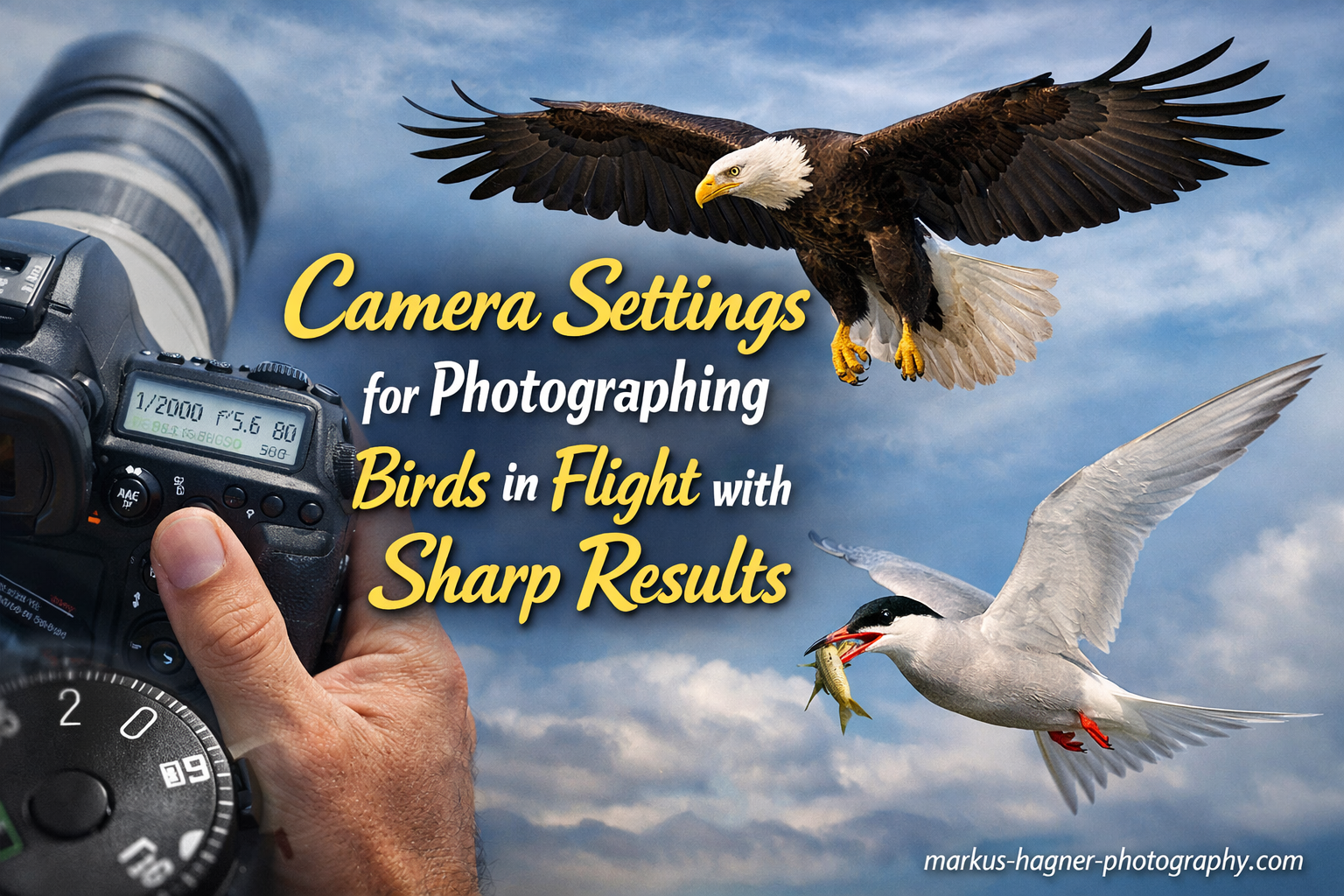
Photographing birds in flight is one of the most challenging yet rewarding pursuits in wildlife photography. I’ve spent countless hours in the field testing different settings, and I can tell you that getting consistently sharp flight shots isn’t about luck—it’s about having the right camera configuration.
This guide will show you the exact camera settings for photographing birds in flight with sharp results. Whether you’re shooting fast-moving swallows or soaring eagles, these settings will help you capture crisp, detailed images that showcase the beauty of avian flight.
Quick Settings Reference
Before diving into the details, here are the core settings you need for sharp birds in flight photography:
1. Shutter Speed: 1/2000 to 1/4000 second for most birds
2. Autofocus Mode: AF-C (Nikon/Sony) or AI Servo (Canon)
3. Focus Area: Dynamic Area AF or Zone AF with subject tracking enabled
4. Aperture: f/5.6 to f/8 for adequate depth of field
5. ISO: Auto ISO with ceiling of ISO 3200-6400
6. Camera Mode: Manual mode with Auto ISO
7. Drive Mode: Continuous high-speed burst
These settings work together to freeze motion, maintain focus on moving subjects, and deliver properly exposed images. Now let’s break down each setting and understand why it matters.
Camera Settings for Photographing Birds in Flight with Sharp Results
Getting sharp flight shots requires understanding how your camera settings interact. Shutter speed freezes the bird’s motion, autofocus keeps the subject sharp as it moves, and your exposure settings balance these needs against available light.
Shutter Speed: The Critical Factor
Shutter speed is the single most important setting for sharp bird in flight photography. I recommend starting at 1/2000 second for most birds, but different situations call for different speeds.
For small, fast birds: 1/3200 to 1/4000 second
Songbirds, swallows, and hummingbirds beat their wings rapidly. These tiny subjects move incredibly fast, requiring the fastest shutter speeds you can manage. I’ve found that anything slower than 1/3200 often results in blurred wing tips on these species.
For medium birds: 1/2000 to 1/3200 second
Gulls, ducks, and hawks fall into this category. They move quickly but not as frantically as small birds. A shutter speed of 1/2000 is usually sufficient to freeze their wings completely, though I bump it to 1/3200 when they’re diving or performing aggressive maneuvers.
For large birds: 1/1600 to 1/2000 second
Eagles, herons, and pelicans have slower wing beats and more predictable flight patterns. You can get away with slightly slower shutter speeds, but I still recommend staying at or above 1/1600 to ensure sharpness.
Weather considerations: On bright sunny days, you’ll have plenty of light to support fast shutter speeds. In cloudy conditions or during dawn/dusk, you may need to compromise on shutter speed or push your ISO higher. I’d rather accept some noise than miss the shot entirely due to motion blur.
Autofocus Configuration for Moving Subjects
Your autofocus system must continuously track birds as they move through your frame. This requires both the right autofocus mode and proper focus area selection.
Continuous autofocus mode: This is non-negotiable for flight photography. Different camera brands use different terminology:
- Canon: AI Servo
- Nikon: AF-C (Continuous-servo AF)
- Sony: Continuous AF
- Panasonic: AFC
- Olympus/OM System: C-AF
- Fujifilm: Continuous AF
Regardless of what your camera calls it, this mode tells your camera to keep adjusting focus as long as you hold the shutter button halfway down. Without continuous autofocus, your camera will lock focus once and then stop tracking as the bird moves.
Focus area selection: I recommend using Dynamic Area AF (Nikon), Zone AF (Canon), or Wide/Zone tracking (Sony) rather than a single focus point. Birds move unpredictably, and a single point is too easy to lose. A zone covering 9-15 focus points gives your camera more latitude to maintain tracking while you keep the general area on the bird.
Subject detection: Modern mirrorless cameras offer animal and bird detection autofocus. Enable this feature—it’s a game-changer. Your camera will automatically recognize birds and prioritize focus on their eyes or heads. I’ve seen dramatic improvements in my keeper rate since switching to cameras with bird detection AF.
Focus point placement: Start with your focus zone in the center of your frame. It’s easier to track a bird when you’re not fighting your camera’s autofocus points. You can always crop later for better composition. As you gain experience, you can experiment with off-center compositions.
Aperture and Depth of Field Settings
Aperture affects both your exposure and your depth of field—the amount of your image that appears acceptably sharp from front to back.
The sweet spot: I recommend f/5.6 to f/8 for most bird in flight photography. This range gives you enough depth of field to keep the entire bird sharp even if the autofocus misses slightly, while still letting in enough light to support fast shutter speeds.
Avoiding wide apertures: Shooting wide open at f/2.8 or f/4 might seem appealing for low light, but it creates an extremely shallow depth of field. If your autofocus shifts from the bird’s eye to its wing tips, you’ll end up with soft images. The slightly smaller apertures provide a margin of error that’s crucial for moving subjects.
Background considerations: Birds in flight are often photographed against distracting backgrounds like trees, water, or sky. Apertures around f/5.6 to f/8 help separate your subject from the background while keeping the bird entirely sharp. This creates that pleasing background blur that makes your subject pop without sacrificing detail.
ISO and Auto ISO Configuration
ISO determines your camera’s sensitivity to light. Higher ISOs allow faster shutter speeds in dim conditions but introduce digital noise. The key is finding the right balance.
Auto ISO is your friend: I strongly recommend using Auto ISO for bird in flight photography. You’re dealing with constantly changing light conditions as birds move between sun and clouds, and you don’t want to miss shots while fiddling with ISO settings.
Setting your Auto ISO limits: Configure your Auto ISO with a maximum of ISO 3200 to 6400, depending on your camera. Modern cameras handle high ISO remarkably well, and a slightly noisy sharp photo is always better than a blurry clean one. I’d rather deal with noise in post-processing than motion blur that can’t be fixed.
Minimum shutter speed setting: Some cameras let you set a minimum shutter speed in Auto ISO mode. If yours does, set it to 1/2000 second. This ensures your camera won’t drop below your minimum threshold for sharp flight shots as light levels change.
Camera Mode Selection
Choosing the right camera mode determines which settings you control manually and which your camera handles automatically. For bird in flight photography, I have a clear recommendation.
Manual mode with Auto ISO: This is the best approach for most situations. You manually set your shutter speed and aperture—the two settings that directly affect image quality—while letting your camera handle ISO through Auto mode. This gives you precise control over motion freezing and depth of field while ensuring proper exposure.
Why it works: Birds move through varying light conditions constantly. A white gull against bright sky requires different exposure than a dark hawk against shadowed forest. Manual mode with Auto ISO lets your shutter and aperture remain constant while ISO adjusts to maintain proper exposure.
Shutter Priority alternative: If you’re uncomfortable in Manual mode, Shutter Priority (Tv on Canon, S on other brands) is a viable alternative. You set your shutter speed, and your camera adjusts both aperture and ISO. The risk is that your camera might choose apertures that are too wide or too narrow for optimal sharpness.
When to use each: Start with Manual mode and Auto ISO. It’s the most reliable approach for consistent results. Only switch to Shutter Priority if you’re struggling with Manual mode or in rapidly changing light where you’re frequently missing exposure.
Advanced Techniques for Sharper Flight Shots
Once you have the basic settings dialed in, these advanced techniques will take your bird in flight photography to the next level.
Back Button Focus
Back button focus separates autofocus activation from the shutter button. Instead of achieving focus with a half-press of the shutter, you assign autofocus to a button on the back of your camera (usually AF-ON or AE-L/AF-L).
Why it’s superior for BIF: With back button focus, you can track a bird continuously without worrying about accidentally capturing an out-of-focus image. When the moment is right, a full press of the shutter captures the shot immediately without refocusing. This separation dramatically increases your keeper rate.
How to set it up: Check your camera’s custom settings menu for “AF-ON” or “Shutter/AF-ON button” options. Disable autofocus from the shutter button and assign it to the rear button. It takes a few days to get used to, but once you do, you’ll never go back.
Burst Mode and Buffer Management
Birds move unpredictably, and capturing the perfect wing position often requires shooting multiple frames in rapid succession.
Continuous high-speed shooting: Set your camera to its fastest continuous drive mode. This might be 10-20 frames per second on modern mirrorless cameras or 6-10 fps on DSLRs. The more frames you capture, the better your chances of getting that one perfect moment.
Buffer considerations: Your camera’s buffer is the memory that stores images before writing them to your card. When shooting bursts, you’ll eventually hit the buffer limit and your frame rate will drop. Use fast SD cards (UHS-II or CFexpress) to minimize this issue.
Shooting in bursts vs. single frames: Don’t just hold down the shutter button indiscriminately. Time your bursts to key moments—takeoff, landing, or when a bird changes direction. This approach preserves buffer space and makes culling easier later.
Mechanical vs Electronic Shutter
Modern cameras offer both mechanical and electronic shutter options, and the choice matters for bird photography.
Mechanical shutter: This is the traditional shutter with physical curtains. It’s generally superior for bird in flight photography because it doesn’t suffer from rolling shutter distortion. When birds move quickly across your frame, electronic shutters can create a skewed, warped appearance in wings. Mechanical shutters freeze motion more naturally.
Electronic shutter benefits: The electronic shutter is completely silent and can shoot faster bursts. If you’re photographing skittish birds that might be startled by shutter noise, the electronic shutter has value. Just be aware of potential rolling shutter issues with very fast subjects.
Electronic front curtain shutter: Many cameras offer a hybrid mode called electronic first curtain (EFCS) or silent live view. This provides some noise reduction without the rolling shutter issues of full electronic shutter. It’s a good compromise for many situations.
Panning Technique
Panning involves moving your camera to follow a bird’s flight path, creating a sharp subject against a motion-blurred background.
When to pan: Panning works best when you want to convey a sense of speed or when light conditions prevent using ultra-fast shutter speeds. It’s particularly effective for large birds with predictable flight paths like pelicans or herons.
How to pan effectively: Stand with your feet shoulder-width apart, rotate at your waist rather than your shoulders, and follow the bird smoothly before, during, and after the shot. Start with slightly slower shutter speeds around 1/1000 to 1/1600 when learning the technique.
Panning limitations: For the crispest, sharpest images with completely frozen wings, stick with fast shutter speeds and a stable shooting position rather than relying on panning. Panning is an artistic choice, not a substitute for proper shutter speed.
Tripod vs Handheld Shooting
The choice between tripod and handheld shooting depends on your gear and the situation.
Handheld advantages: Most bird in flight photography is done handheld. It gives you the freedom to follow birds in any direction quickly. Modern cameras with excellent image stabilization make handheld shooting viable even with long telephoto lenses.
Image stabilization: If your lens has vibration reduction (VR), image stabilization (IS), or optical stabilization (OS), keep it turned on for handheld shooting. It helps compensate for camera shake, though it won’t freeze bird motion—that’s what shutter speed is for.
Tripod benefits: A tripod with a gimbal head is excellent for heavy lenses and when photographing birds with predictable flight paths. It reduces fatigue during long sessions and can help maintain consistent framing. However, tripods limit your ability to react quickly to birds appearing from unexpected directions.
Monopod middle ground: A monopod offers some support while maintaining more mobility than a tripod. It’s a good choice for very heavy lenses when you need both stability and freedom of movement.
Troubleshooting: Why Your Bird Photos Aren’t Sharp?
Even with the right settings, you may encounter issues. Here’s how to diagnose and fix common problems.
Subject Blur vs Camera Shake
First, determine whether your soft images are caused by subject motion (not fast enough shutter speed) or camera shake (your movement during exposure).
Subject blur signs: The bird shows motion blur but stationary elements in the background are sharp. This means your shutter speed is too slow for the bird’s movement. Increase shutter speed until the bird is frozen.
Camera shake signs: Everything in the image is slightly soft, including the background. This indicates camera movement during exposure. Use faster shutter speeds, better stabilization technique, or camera support.
Autofocus Issues
If your exposure looks right but focus is off, check these common autofocus problems.
Focus on background instead of bird: This happens when your camera’s autofocus decides the background is more interesting. Switch to a smaller focus zone or enable bird detection AF if your camera has it. Also check that continuous autofocus mode is actually engaged.
Autofocus hunting: If your lens is constantly hunting back and forth, you may have hit your focus limit. Birds can fly closer than your lens’s minimum focusing distance. Either switch to manual focus for very close subjects or reposition to maintain proper focus distance.
Focus points visible in viewfinder: If you see all your focus points lighting up instead of a cluster around the bird, your camera is probably using all-points autofocus. Switch to a smaller zone or single-point pattern for more precise control.
Environmental Challenges
Sometimes the problem isn’t your settings—it’s the shooting conditions.
Atmospheric distortion: On hot days, heat waves between you and the bird can create a shimmering effect that softens images. This is especially problematic at long distances and with super telephoto lenses. Early morning shooting when air is cooler reduces this issue.
Backlighting problems: When birds are between you and the sun, your camera may underexpose to preserve highlights. Use exposure compensation (+1 to +2 EV) or switch to spot metering on the bird. Better yet, reposition so the sun is behind you.
Lens limitations: Consumer telephoto lenses may struggle with autofocus speed and sharpness at their longest focal lengths. If you’re consistently getting soft results, your lens might be the limiting factor. Consider stopping down to f/8 or upgrading glass if bird photography is a serious pursuit.
Settings by Scenario
Different shooting conditions call for adjustments to your baseline settings. Here’s how to adapt:
Bright sunny day: Shutter 1/2500-1/4000, Aperture f/6.3-f/8, ISO 100-400 (Auto ISO), Continuous AF with bird detection
Cloudy/overcast: Shutter 1/2000-1/3200, Aperture f/5.6, ISO 400-1600 (Auto ISO), Continuous AF
Dawn/dusk: Shutter 1/1600-1/2000, Aperture f/5.6, ISO 1600-3200 (Auto ISO), Continuous AF
Small fast birds: Shutter 1/3200-1/4000, Aperture f/5.6-f/6.3, ISO Auto, Continuous AF with small focus zone
Large slow birds: Shutter 1/1600-1/2000, Aperture f/6.3-f/8, ISO Auto, Continuous AF with larger zone
Frequently Asked Questions
What are the best camera settings for birds in flight?
The best camera settings for birds in flight are: shutter speed between 1/2000-1/4000 second depending on bird size, continuous autofocus mode (AF-C or AI Servo), aperture of f/5.6 to f/8, and Auto ISO in Manual mode. Enable subject tracking if your camera has bird detection autofocus.
What shutter speed should I use for birds in flight?
Use 1/2000 to 1/4000 second for birds in flight. Small fast birds like swallows require 1/3200-1/4000 second. Medium birds like gulls and hawks need 1/2000-1/3200 second. Large birds like eagles can be captured at 1/1600-1/2000 second. Always err on the side of faster shutter speeds to ensure sharp wing freeze.
How to get sharp photos of birds in flight?
Getting sharp photos of birds in flight requires fast shutter speeds (minimum 1/2000 second), continuous autofocus mode (AF-C/AI Servo), proper panning technique, and stable camera support or good handheld technique. Enable bird detection autofocus if available, use burst mode to capture multiple frames, and practice tracking birds smoothly through your frame.
What aperture is best for bird photography?
The best aperture for bird photography is f/5.6 to f/8. This range provides enough depth of field to keep the entire bird sharp while still allowing enough light for fast shutter speeds. Avoid shooting wide open at f/2.8 or f/4 as the shallow depth of field makes it difficult to maintain focus on moving subjects.
What focus mode for birds in flight?
Use continuous autofocus mode for birds in flight: AF-C on Nikon and Sony cameras, AI Servo on Canon, or Continuous AF on other brands. Combine this with a medium-sized focus zone (Dynamic Area AF or Zone AF) and enable subject tracking or bird detection if your camera supports it. Never use single-shot autofocus for flying birds.
Should I use manual or aperture priority for bird photography?
Manual mode with Auto ISO is the best choice for bird in flight photography. It gives you direct control over shutter speed and aperture—the two settings that most affect image quality—while letting your camera handle ISO automatically. This approach ensures consistent shutter speeds for sharp results while maintaining proper exposure as lighting conditions change.
What ISO should I use for bird photography?
Use Auto ISO for bird photography with a maximum setting of ISO 3200-6400 depending on your camera. Modern cameras handle high ISO very well, and it’s better to accept some noise than miss shots due to motion blur. Set Auto ISO to adjust automatically while you maintain control over shutter speed and aperture in Manual mode.
How to photograph fast-moving birds?
To photograph fast-moving birds, use the fastest shutter speed possible (1/3200-1/4000 second), enable continuous autofocus with subject tracking, use burst mode to capture multiple frames, and practice smooth panning technique. Anticipate bird behavior and pre-focus on likely flight paths when possible. A camera with fast autofocus and high frame rates will significantly improve your success rate.
Conclusion
Mastering camera settings for photographing birds in flight with sharp results takes practice, but the right foundation makes all the difference. Start with the core settings outlined here—shutter speed of 1/2000 or faster, continuous autofocus, f/5.6 to f/8 aperture, and Auto ISO in Manual mode—and adjust based on your specific conditions and subjects.
Remember that different bird sizes require different approaches, and environmental factors like light and weather should inform your settings. Don’t be afraid to experiment and find what works best for your gear and the species you photograph most often.
The most important tip I can offer is to get out and practice. Bird in flight photography rewards persistence. The more you shoot, the better you’ll become at anticipating bird behavior, tracking movement, and knowing exactly when to press that shutter button. Before long, sharp flight shots will become second nature rather than lucky accidents.