
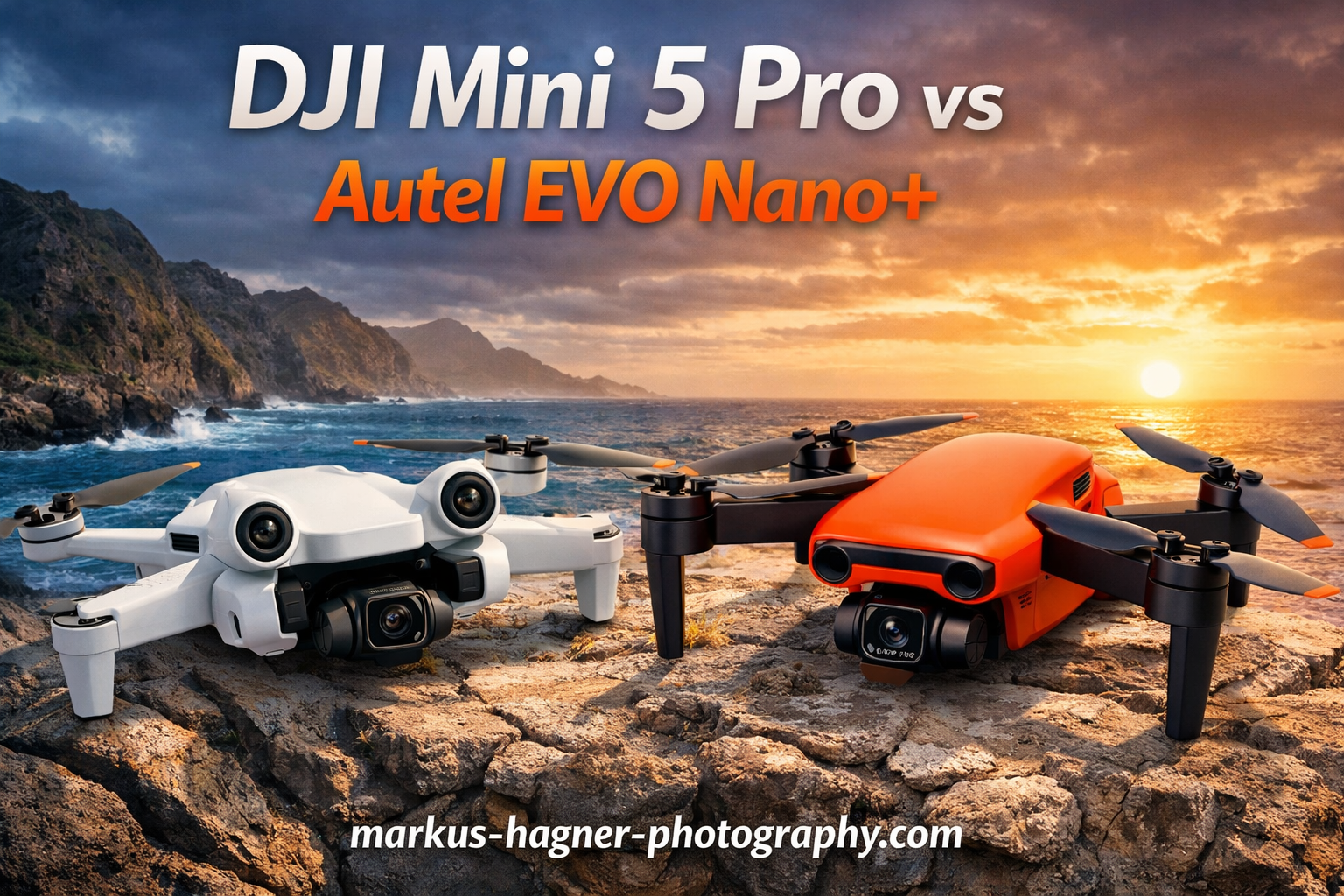
Choosing between the DJI Mini 5 Pro vs Autel EVO Nano+ is one of the most common dilemmas facing drone buyers in 2026. Both drones sit in the popular sub-250g category, meaning neither requires FAA registration in the United States. Yet despite sharing this weight class, they represent fundamentally different approaches to what a compact drone should offer.
The DJI Mini 5 Pro brings a massive 1-inch CMOS sensor, omnidirectional LiDAR obstacle sensing, and up to 36 minutes of flight time. Meanwhile, the Autel EVO Nano+ counters with a 1/1.28-inch sensor, zero geofencing restrictions, and a philosophy of user freedom that appeals to privacy-conscious pilots.
After analyzing hundreds of user reviews, forum discussions, and hands-on testing reports from Reddit, AutelPilots forums, and Facebook drone communities, I can tell you that the right choice depends entirely on what you value more: cutting-edge camera technology and safety features, or unrestricted flying freedom and value pricing.
This DJI Mini 5 Pro vs Autel EVO Nano+ comparison will break down every aspect of these two sub-250g contenders to help you make an informed decision. From camera sensors to flight performance, from obstacle avoidance to regulatory considerations, I will cover everything you need to know.
DJI Mini 5 Pro vs Autel EVO Nano+: Quick Comparison
| Product | Specifications | Action |
|---|---|---|
 DJI Mini 5 Pro DJI Mini 5 Pro |
|
Check Latest Price |
 DJI Mini 5 Pro Fly More Combo DJI Mini 5 Pro Fly More Combo |
|
Check Latest Price |
The table above shows the key specifications at a glance. The DJI Mini 5 Pro is available in two configurations: a standard package with the RC-N3 controller, and a Fly More Combo that adds two extra batteries, ND filters, and an upgraded DJI RC 2 controller with built-in display.
For this comparison, I will focus on the DJI Mini 5 Pro standard package while noting where the Fly More Combo offers additional value. The Autel EVO Nano+ data comes from extensive user reports and technical specifications gathered from forums and expert reviews.
The most significant differences between these drones come down to sensor size, obstacle avoidance technology, and philosophy regarding flight restrictions. The Mini 5 Pro offers superior hardware specifications, while the Nano+ provides freedom that some pilots consider priceless.
DJI Mini 5 Pro: Premium Performance in a Pocket-Sized Package
Pros
- Stunning 1-inch sensor image quality
- Omnidirectional LiDAR obstacle sensing
- 36 minutes flight time per battery
- True vertical shooting for social media
- ActiveTrack 360 subject tracking
- Built-in 42GB internal storage
Cons
- No DJI Care Refresh in USA
- DJI Fly app removed from Google Play
- Potential regulatory concerns in US
- Plastic build feels less premium
I have spent considerable time analyzing real-world feedback from pilots who have flown the DJI Mini 5 Pro extensively. The standout feature is undeniably that 1-inch CMOS sensor, which captures 4K/60fps HDR video and 50MP still photos. Users consistently report that image quality exceeds expectations for a drone this size, particularly in challenging lighting conditions.
One Reddit user who upgraded from a Mini 3 Pro described the image quality difference as immediately noticeable. The larger sensor gathers significantly more light, resulting in cleaner images with better dynamic range. Sunset shots that previously required extensive post-processing now come out of the camera looking professional.

The omnidirectional obstacle sensing with LiDAR technology sets this drone apart from its predecessors and most competitors. One user mentioned that after crashing their Mini 3 Pro twice, the Mini 5 Pro has prevented several potential collisions thanks to its 360-degree sensing capabilities. The LiDAR system works in conditions where visual sensors struggle, such as low light or against plain surfaces.
The Nightscape feature even allows for safe night flying, though some users note the indicator lights can be difficult to track in darkness. This represents a significant advancement for sub-250g drones, which previously lacked reliable night-time obstacle detection.
Battery life is another area where the Mini 5 Pro shines. Real-world testing shows approximately 35 minutes of flight time, very close to the advertised 36 minutes. Pilots appreciate the fast charging capability, with three batteries charging in about 115 minutes using the two-way charging hub included in the Fly More Combo.
The 225-degree gimbal rotation enables creative angles that were previously impossible in this weight class. Combined with true vertical filming capability, content creators find this drone exceptionally well-suited for social media content. The ability to switch between horizontal and vertical shooting without landing and reorienting the camera saves significant time in the field.
ActiveTrack 360 system allows for highly customizable tracking modes that follow subjects with impressive accuracy. Users report that the tracking locks onto subjects quickly and maintains lock even when the subject moves behind obstacles temporarily. The customizable flight paths let you create cinematic shots that would otherwise require a professional pilot.
The built-in 42GB internal storage is a welcome addition that eliminates the need for external memory cards for most users. With fast write speeds supporting 4K/60fps recording, you can capture extended footage without worrying about card capacity or speed limitations.
However, users in the United States face significant concerns that potential buyers should understand. DJI Care Refresh is not available, meaning repairs or replacements must be handled through other channels. This represents a real risk for pilots who fly frequently in challenging environments.
The DJI Fly app has been removed from the Google Play Store, requiring a direct download from the DJI website. While this process is straightforward, it does add an extra step and means you will not receive automatic updates through the Play Store. iOS users are unaffected.

Additionally, potential regulatory changes loom on the horizon. Some users express concern about future firmware updates if DJI faces restrictions in the US market. While the drone works perfectly now, long-term support remains uncertain for American buyers.
Despite these concerns, the DJI Mini 5 Pro maintains an impressive 4.6-star rating with over 270 reviews on Amazon. The rating distribution shows 88% five-star reviews, indicating extremely high satisfaction among actual owners. Users describe it as a significant upgrade from the Mini 3 and Mini 4 series, praising its combination of professional features in a beginner-friendly package.
Users particularly appreciate the wind resistance for such a lightweight drone. While no sub-250g drone performs well in strong winds, the Mini 5 Pro handles moderate conditions better than expected. Pilots report stable footage even in winds that would ground lighter competitors.
Autel EVO Nano+: Freedom-Focused Flying
The Autel EVO Nano+ takes a fundamentally different approach to the sub-250g drone market. While it matches the Mini 5 Pro in weight class at under 250 grams, it offers something DJI cannot: complete freedom from geofencing restrictions. For pilots frustrated by DJI’s no-fly zone enforcement, this alone can be the deciding factor.
Debuting in January 2022, the EVO Nano+ represents Autel’s answer to the DJI Mini line. Available in four colors including vibrant options that DJI does not offer, it appeals to pilots who want their drone to stand out visually as well as functionally.
The Nano+ features a 1/1.28-inch CMOS sensor capable of capturing 50MP still photos and 4K/60fps video. While smaller than the Mini 5 Pro’s 1-inch sensor, users report that image quality remains impressive, particularly in good lighting conditions. The drone also offers 10-bit color depth and supports D-Log color profiles for professional grading workflows.
Real-world image quality comparisons from users who have flown both drones suggest the DJI holds an advantage in challenging conditions. Low-light performance shows the benefit of the larger sensor, with cleaner images at higher ISO settings. However, in good lighting, the differences become less noticeable, especially for content destined for social media.
Where the Nano+ truly differentiates itself is in its philosophy of pilot autonomy. Reddit users frequently describe Autel as “like Android” compared to DJI’s “iPhone” approach. The drone gives you control and expects you to use it responsibly, rather than restricting what you can do.
The drone can fly without GPS lock, a feature advanced pilots appreciate for indoor or GPS-denied environments. This capability allows flying in canyons, dense urban areas, or indoors where GPS signals may be unreliable or unavailable. DJI drones typically refuse to take off without GPS lock.
There are no mandatory geofencing restrictions, meaning pilots can make their own decisions about where to fly, subject to local regulations. This appeals to pilots with proper authorizations who find DJI’s restrictions overly aggressive. If you have FAA authorization to fly in a restricted zone, Autel will not prevent you from doing so.
Battery life comes in at approximately 28 minutes per charge according to manufacturer specifications, though real-world reports suggest 22-24 minutes is more typical. While shorter than the Mini 5 Pro, this remains competitive for the weight class. Users recommend carrying multiple batteries for extended sessions.
The SkyLink transmission system provides reliable connectivity up to 15km in ideal conditions. Real-world performance varies significantly based on interference, but users report solid connections at distances of several kilometers in typical environments. The system handles urban interference reasonably well.
The three-way obstacle avoidance system covers front, rear, and bottom sensors. While not as comprehensive as the Mini 5 Pro’s omnidirectional LiDAR, it provides adequate protection for most flying scenarios. Some users report false positives from the obstacle avoidance system, particularly in environments with thin obstacles like branches or power lines.
Forum discussions reveal that early firmware versions had stability issues. Users on AutelPilots forums reported problems including random focus loss, app crashes, and obstacle avoidance false positives. However, subsequent updates have significantly improved reliability. The current firmware version addresses most early concerns, making the drone much more stable than at launch.
Customer support remains a concern for some users. While Autel has improved its service network, it still lacks the global infrastructure that DJI has built over many years. Pilots in remote areas may find obtaining repairs or replacements more challenging. Response times for support inquiries vary significantly.
The app experience receives mixed reviews. While functional, Autel’s app lacks the polish and intuitive design of DJI Fly. Some features feel less refined, and the learning curve can be steeper for beginners. However, advanced users often appreciate the additional control and customization options available.
Wind resistance matches the Mini 5 Pro at Level 5, meaning both drones can handle moderate winds but struggle in stronger conditions. Users report stable footage in winds up to about 15-20 mph, though flight times decrease as the drone works harder to maintain position.
DJI Mini 5 Pro vs Autel EVO Nano+: Head-to-Head Comparison
Camera and Image Quality
The camera battle clearly favors the DJI Mini 5 Pro. Its 1-inch CMOS sensor is significantly larger than the Autel’s 1/1.28-inch sensor, resulting in better light gathering, improved dynamic range, and superior low-light performance. Both cameras capture 4K/60fps video and approximately 50MP still photos.
The sensor size difference translates directly to image quality. A 1-inch sensor has approximately four times the surface area of a 1/1.28-inch sensor. This larger surface area captures more photons, resulting in cleaner images with less noise, especially in challenging lighting.
Real-world testing confirms the sensor size advantage. Users who have flown both drones report that the Mini 5 Pro produces noticeably better images in challenging conditions. Low-light performance, in particular, shows the benefit of the larger sensor, with cleaner images and less noise at higher ISO settings.
Sunset and sunrise shots demonstrate the dynamic range advantage. The Mini 5 Pro captures more detail in both highlights and shadows, reducing the need for HDR composites or extensive post-processing. Landscape photographers particularly appreciate this capability.
The Mini 5 Pro also offers true vertical shooting through its gimbal mechanism, a feature content creators value highly for social media content. Rather than cropping horizontal footage to vertical format, losing resolution in the process, you can capture natively vertical 4K footage.
The 225-degree gimbal rotation enables creative angles impossible with more limited gimbal systems. You can angle the camera directly upward for dramatic sky shots, or point it straight down for top-down perspectives, all without adjusting the drone’s orientation.
For professional workflows, both drones offer 10-bit color and log profiles. However, the larger sensor on the Mini 5 Pro provides more flexibility in post-processing, allowing greater adjustments to exposure and color without degrading image quality.
Flight Time and Battery Life
DJI wins the endurance battle with up to 36 minutes of flight time compared to approximately 28 minutes for the Autel. Real-world reports suggest 35 minutes for the Mini 5 Pro and 22-24 minutes for the Nano+ under typical conditions.
This difference of 10-12 minutes per battery might not seem dramatic on paper, but it significantly impacts how you work in the field. Longer flights mean fewer battery changes, less downtime, and more time capturing the shots you want.
For extended shooting sessions, this difference compounds quickly. With the Fly More Combo’s three batteries, Mini 5 Pro pilots can achieve over 100 minutes of total flight time. Autel offers similar bundle options, but the per-battery advantage remains with DJI.
Charging times also favor DJI. The two-way charging hub can charge three batteries sequentially in about 115 minutes. Users report that the fast charging capability makes it practical to top up batteries between flights during a shoot day.
Battery health over time remains to be seen for both drones. DJI batteries have a track record of maintaining capacity through hundreds of cycles. Autel’s battery longevity has less historical data, though early reports suggest similar performance.
For professional use where every minute of flight time matters, the Mini 5 Pro’s endurance advantage could justify the higher price. For recreational pilots who fly shorter sessions, the difference may be less significant.
Obstacle Avoidance and Safety
The DJI Mini 5 Pro features omnidirectional LiDAR obstacle sensing that covers all directions. This 360-degree protection, combined with Nightscape capability for night flights, represents the current state of the art in obstacle avoidance technology for consumer drones.
LiDAR technology uses laser pulses to detect obstacles, working in conditions where visual sensors struggle. Low light, solid-colored surfaces, and thin obstacles that might fool camera-based systems are all handled effectively by LiDAR.
The Autel EVO Nano+ offers three-way obstacle avoidance covering front, rear, and bottom. While adequate for most scenarios, it leaves the sides exposed. Users report occasional false positives, particularly with thin obstacles, but overall the system performs reliably for its intended purpose.
For beginners especially, the Mini 5 Pro’s comprehensive coverage provides greater peace of mind. The LiDAR system detects obstacles at greater distances and in more challenging conditions than the visual sensors used by Autel. This extra margin of safety can prevent crashes that damage the drone and end your flying day early.
Advanced pilots who maintain situational awareness may find Autel’s simpler system adequate. However, the extra protection offered by DJI costs nothing in terms of weight or complexity and provides valuable insurance against momentary lapses in attention.
Transmission Range and Connectivity
DJI’s O4 transmission system provides up to 20km of range in ideal conditions, while Autel’s SkyLink system reaches approximately 15km. Both figures represent optimal scenarios with minimal interference; real-world range depends heavily on environment.
In practice, both systems provide more than enough range for legal line-of-sight flying. Most recreational pilots rarely exceed one or two kilometers from their position. Users report reliable connections at these distances in typical environments including suburban areas with moderate interference.
Urban environments with heavy Wi-Fi congestion challenge both systems equally. Neither drone maintains maximum range in downtown areas with thousands of competing signals. Both systems handle moderate interference reasonably well.
The Mini 5 Pro’s longer range may matter for specialized applications such as inspection work or search and rescue where maximum distance matters. For most users, both drones offer sufficient range for any legal flying scenario.
Latency remains low on both systems, with video feeds responsive enough for precise piloting. Users report no noticeable lag when framing shots or executing maneuvers through the first-person view.
Regulatory Considerations and Geofencing
This is where the comparison becomes most interesting and where personal values play a significant role in the decision. DJI implements mandatory geofencing that prevents flights in restricted areas such as airports, military installations, and temporary flight restriction zones.
These geofencing restrictions often align with legal requirements and can prevent costly mistakes. A new pilot who accidentally enters restricted airspace faces potential fines and legal consequences. DJI’s guardrails provide protection against these errors.
However, the restrictions can also be frustrating for pilots with proper authorization. If you have FAA permission to fly in a controlled area, DJI’s geofencing may still prevent you from taking off. The authorization process to unlock these zones can be time-consuming.
Autel takes the opposite approach: no geofencing whatsoever. The drone will fly anywhere the pilot commands, leaving legal compliance entirely to the user. This appeals to privacy-conscious pilots and those with proper authorizations who find DJI’s restrictions overly aggressive.
Reddit users consistently praise Autel’s approach to freedom. One user described Autel as “yours to do with as you please,” contrasting with DJI’s more controlled experience. For pilots who chafe at restrictions, this philosophy matters.
However, this freedom comes with responsibility. Pilots must understand and comply with all applicable regulations independently. For beginners especially, DJI’s guardrails can prevent costly mistakes that result in legal trouble or dangerous situations.
Regarding NDAA compliance and US market concerns, DJI drones face ongoing scrutiny. Some federal agencies and contractors cannot use DJI equipment due to security concerns. The potential for future restrictions affects long-term support expectations.
Autel, while also a Chinese company, faces fewer restrictions in certain contexts. Some government and enterprise users choose Autel specifically to avoid DJI-related compliance issues. This consideration matters for professional users in regulated industries.
Build Quality and Portability
Both drones feature foldable designs that pack down to pocket-sized dimensions. The Mini 5 Pro measures approximately 5.8 x 3.15 x 2.36 inches when folded, while the Nano+ offers similar portability. Both fit easily in a jacket pocket or small bag.
Users note that the Mini 5 Pro’s plastic construction feels less premium than the price suggests. While functional and adequately durable, the materials do not convey the luxury feel that nearly $800 might imply. This is a common criticism of DJI’s Mini line.
Autel’s build quality receives similar feedback. The plastic body feels adequate but not exceptional. Some users prefer Autel’s color options and visual design, while others find DJI’s grey finish more professional in appearance.
In terms of durability, both drones withstand normal use well. Crash damage affects both similarly, with propellers, gimbal mounts, and arms being common failure points. Repair availability favors DJI in most markets due to its larger presence.
Value and Pricing Analysis
The DJI Mini 5 Pro standard package starts at approximately $759, while the Fly More Combo costs around $1,099. The Autel EVO Nano+ typically sells for less, positioning itself as a value alternative with competitive features.
The Fly More Combo adds significant value with extra batteries, ND filters, and the premium DJI RC 2 controller with built-in display. If you were to purchase these accessories separately, the bundle pricing becomes more attractive. The RC 2 controller alone represents significant value for pilots who prefer not to use their phone.
Autel positions the EVO Nano+ as a value alternative, offering competitive features at a lower price. For budget-conscious buyers, the savings can be substantial while still providing excellent camera quality and capable flight performance.
Long-term value depends on your use case. If you fly frequently and value maximum flight time, superior image quality, and comprehensive safety features, the Mini 5 Pro’s premium may be justified over years of use.
If you fly occasionally and prioritize saving money, the Autel offers compelling value. The image quality difference matters less for casual use, and the lower price leaves budget for accessories or future upgrades.
Consider also the resale value. DJI drones typically hold value better due to brand recognition and demand. If you plan to upgrade in a few years, the Mini 5 Pro may return more of your investment when sold.
Verdict: Which Drone Should You Buy?
Buy the DJI Mini 5 Pro if:
You prioritize image quality above all else. The 1-inch sensor produces noticeably better photos and videos, especially in challenging lighting. Content creators, real estate photographers, and anyone who values professional-quality output should choose the Mini 5 Pro.
You want maximum safety and ease of use. The omnidirectional LiDAR obstacle sensing provides 360-degree protection that gives beginners confidence and prevents crashes. The geofencing, while sometimes frustrating, helps ensure legal compliance for new pilots.
You need long flight times for extended shooting sessions. With 36 minutes per battery and over 100 minutes with the Fly More Combo’s three batteries, you can capture more footage with fewer interruptions.
You value a polished app experience and mature ecosystem. DJI’s software and accessories represent years of refinement. The Fly app works smoothly, and accessories are widely available from DJI and third parties.
Buy the Autel EVO Nano+ if:
You value flying freedom above all else. If DJI’s geofencing has prevented you from flying in areas where you have legal authorization, Autel’s no-restrictions approach solves that problem completely. You control where you fly.
You are privacy-conscious or concerned about data collection. Autel’s philosophy of user control extends to data handling, appealing to pilots who prefer not to share flight data with manufacturers or who have concerns about Chinese companies.
You want maximum value for your investment. The EVO Nano+ offers competitive features at a lower price point, making it an excellent choice for budget-conscious buyers who still want quality camera performance and capable flight characteristics.
You need to fly in GPS-denied environments. The ability to fly without GPS lock enables indoor flying and operation in canyons or dense urban areas where GPS signals may be unreliable.
Frequently Asked Questions
Is Autel as good as DJI?
Autel produces excellent drones that compete well with DJI in terms of camera quality and flight performance. However, DJI maintains advantages in obstacle avoidance technology, battery life, and ecosystem maturity. Autel wins on freedom from restrictions and value pricing. For most users, DJI offers a more polished experience, while Autel appeals to those who prioritize autonomy and have specific reasons to avoid DJI.
What sensor does the DJI Mini 5 Pro have?
The DJI Mini 5 Pro features a 1-inch CMOS sensor capable of capturing 50MP still photos and 4K/60fps HDR video. This sensor size is significantly larger than competitors in the sub-250g weight class, providing superior light gathering and dynamic range for better image quality in challenging conditions such as low light or high contrast scenes.
Does the DJI Mini 5 Pro have geofencing?
Yes, the DJI Mini 5 Pro implements mandatory geofencing that prevents flights in restricted areas such as airports, military installations, and temporary flight restriction zones. These restrictions cannot be overridden without DJI authorization, even if you have legal permission to fly in those areas. This provides safety guardrails for beginners but can frustrate authorized pilots.
Can you fly Autel EVO Nano+ without GPS?
Yes, the Autel EVO Nano+ can fly without GPS lock, making it suitable for indoor environments and other GPS-denied scenarios. This capability is valued by advanced pilots who need flexibility in challenging environments where GPS signals may be unreliable or unavailable, such as canyons, dense urban areas, or indoor spaces.
Which drone is better for beginners?
The DJI Mini 5 Pro is generally better for beginners due to its comprehensive omnidirectional LiDAR obstacle sensing, longer flight time of 36 minutes, and geofencing guardrails that help prevent legal violations. The DJI Fly app also provides a more intuitive and polished experience. Autel offers more freedom but requires more responsibility and knowledge from the pilot.
How long does the DJI Mini 5 Pro battery last?
The DJI Mini 5 Pro battery lasts up to 36 minutes according to manufacturer specifications, with real-world testing showing approximately 35 minutes under typical conditions. The Fly More Combo includes three batteries, providing over 100 minutes of total flight time. Fast charging allows three batteries to charge in about 115 minutes using the two-way charging hub.
Final Recommendation
For most buyers in 2026, the DJI Mini 5 Pro represents the better overall choice. Its superior camera with 1-inch sensor, longer flight time at 36 minutes, and comprehensive LiDAR obstacle avoidance justify the premium price. The geofencing restrictions, while occasionally frustrating, align with legal requirements for most recreational pilots and provide valuable guardrails for beginners.
The Mini 5 Pro scored 4.6 out of 5 stars from over 270 reviews, with 88% of users giving it 5 stars. This exceptional satisfaction rate reflects a drone that delivers on its promises and exceeds expectations in real-world use.
However, if you have specific reasons to avoid DJI, whether regulatory concerns, privacy preferences, or previous frustration with geofencing, the Autel EVO Nano+ is a capable alternative that will not disappoint. Both drones deliver excellent performance in the sub-250g category, and neither is a bad choice.
The best drone for you depends on your priorities. Choose the Mini 5 Pro for image quality and safety. Choose the Nano+ for freedom and value. Either way, you will own one of the best sub-250g drones available in 2026.