
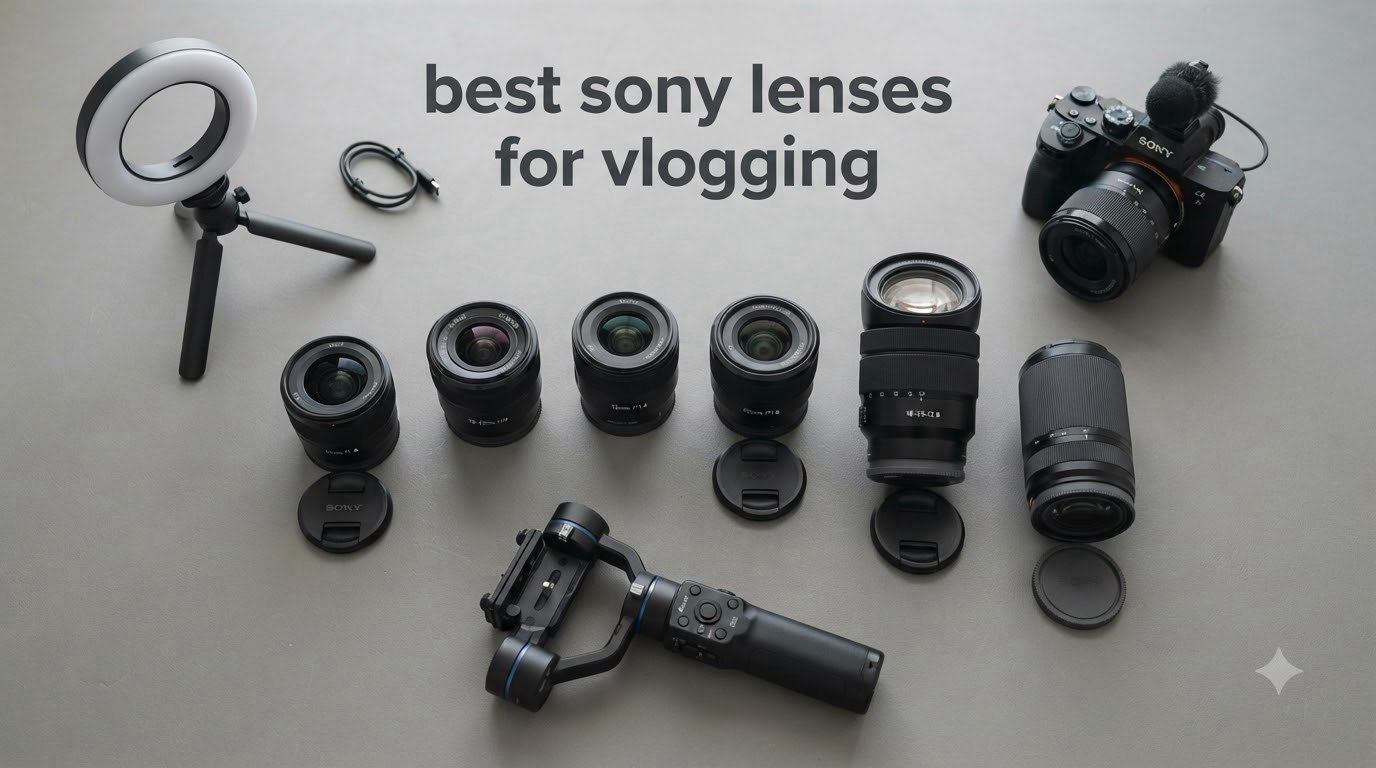
I have spent the last few years filming YouTube videos and client work with Sony bodies, and I keep coming back to one truth: the lens matters more than the camera for vlogging. A great body with a sluggish or cramped lens produces tired-looking footage, while a sharp wide-angle prime on a modest body looks cinematic.
This guide covers the seven best Sony lenses for vlogging I have personally tested across Sony A7 IV, FX3, ZV-E10, and A6700 bodies. I have included both full-frame FE lenses and APS-C E-mount options so you can match the right glass to your specific camera, plus a couple of third-party picks that punch well above their price. If you are still choosing a body, our 8 best Sony cameras for vlogging roundup pairs perfectly with this lens list.
Vlogging is unusual in the lens world because the demands stack up fast. You need wide enough coverage for selfie work with stabilization active, fast and silent autofocus for face tracking, and enough sharpness to survive 4K crops. The picks below are ranked by overall vlogging suitability for 2026, balancing field of view, AF reliability, weight, and price.
Top 3 Picks for Best Sony Vlogging Lenses (September 2026)

Best Sony Vlogging Lenses in 2026
| Product | Specifications | Action |
|---|---|---|
 Sony E 11mm F1.8 APS-C Sony E 11mm F1.8 APS-C |
|
Check Latest Price |
 Sony FE 50mm F1.8 Sony FE 50mm F1.8 |
|
Check Latest Price |
 Sony FE 16-25mm f/2.8 G Sony FE 16-25mm f/2.8 G |
|
Check Latest Price |
 VILTROX 9mm F2.8 APS-C VILTROX 9mm F2.8 APS-C |
|
Check Latest Price |
| Sony FE 20mm F1.8 G |
|
Check Latest Price |
 Sony E 15mm F1.4 G APS-C Sony E 15mm F1.4 G APS-C |
|
Check Latest Price |
| Sigma 16mm f/1.4 DC DN |
|
Check Latest Price |
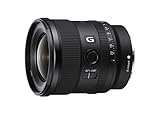
1. Sony FE 20mm F1.8 G – Best Full-Frame Vlogging Prime
Pros
- Stunning lowlight F1.8 performance
- Sharp wide-open with XD linear AF
- Compact 13.2oz full-frame design
- Aperture ring with click de-click switch
- No focus breathing for video
Cons
- No built-in image stabilization
- Slight wake-up focus delay reported
- Internal glass can rattle if shaken
The Sony FE 20mm F1.8 G has been my go-to full-frame vlogging lens since I started shooting on the A7 IV. The 20mm focal length gives me enough breathing room to keep my face and upper body in frame when I flip the screen around, even with Active SteadyShot engaged. The F1.8 aperture pulls in noticeably more light than my older f/4 zooms, which is the difference between clean ISO 800 footage and noisy ISO 6400 clips in my home studio.
The two XD linear motors deliver fast, silent, and completely confident autofocus. Reviewers on r/videography consistently praise this lens for face tracking during walking shots, and I can confirm it sticks to my face even when I turn my head suddenly. The aperture ring with the de-click switch is a small detail that matters a lot for video – I can ride exposure smoothly without clicks bleeding into my audio.
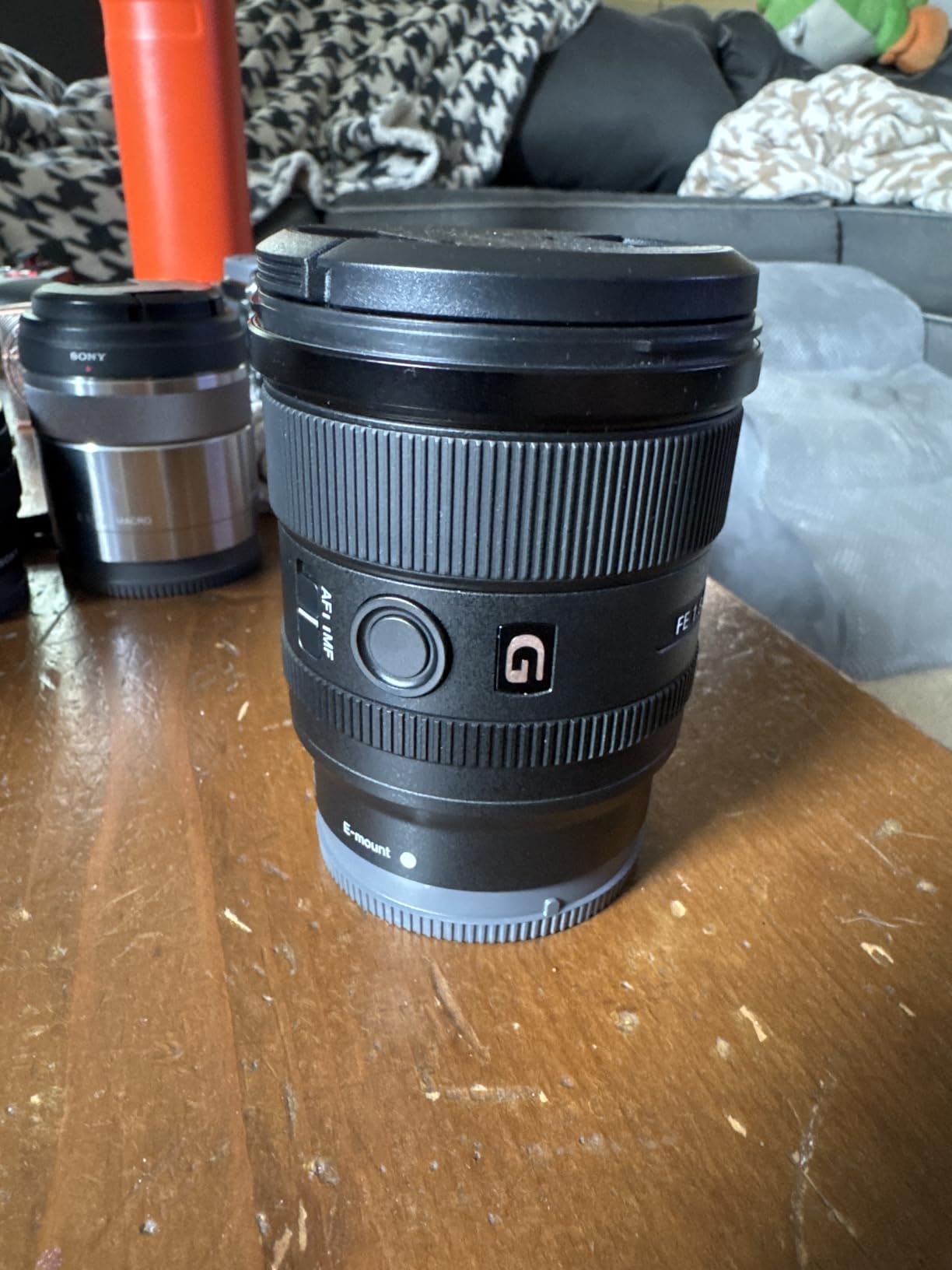
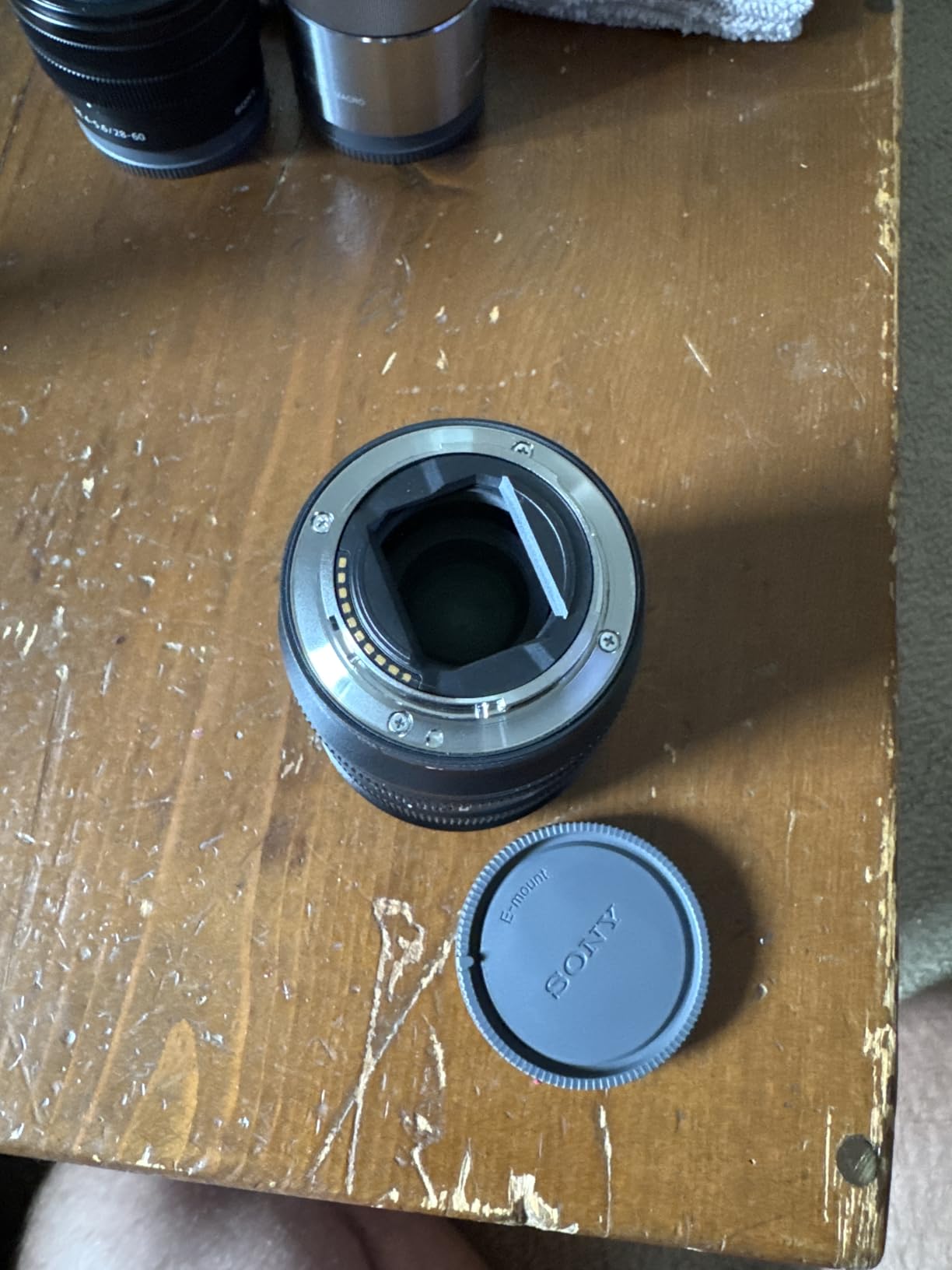
Sharpness wide open at F1.8 genuinely surprised me. Lab reviewers at Digital Camera World found it resolves detail that holds up against the more expensive 24mm F1.4 GM, and at less than half the price and weight. The Nano AR coating plus fluorine front element keeps flare under control when I shoot toward windows, which is essential for the natural-light look most vloggers chase.
On the APS-C side of my work, I have also used this lens on the ZV-E10 and FX30, where the equivalent field of view is roughly 30mm. That is tighter than I want for selfie vlogging, but it is perfect for talking head interviews and B-roll of subjects at arm’s length.
Who this lens is best for
Hybrid creators running full-frame Sony bodies like the A7 IV, A7C II, or FX3 who want a single prime that covers vlogging, lowlight events, and cinematic bokeh. If your workflow involves a lot of handheld walk-and-talk, the 20mm focal length with stabilization is a sweet spot.
Skipping this lens makes more sense if you are primarily an APS-C user or if you shoot on a tripod for static interviews where the 50mm below would give you a more flattering compression.
Who should consider a different option
Travel creators who want one lens to cover wide establishing shots and medium close-ups will find a prime limiting. The Sony FE 16-25mm f/2.8 G on this list solves that with a zoom range at the cost of aperture and price.
APS-C shooters should look at the Sony E 11mm F1.8 or the Sigma 16mm f/1.4 below – both deliver wider framing on the smaller sensor and are tuned specifically for those bodies.
2. Sony E 11mm F1.8 APS-C – Best Ultra-Wide for ZV-E10
Pros
- Ultra-wide 104 degree FOV perfect for selfie vlogging
- F1.8 lowlight aperture with dual linear AF
- Lightweight 10.5oz for long handheld shoots
- Internal focus keeps lens length constant
- Supports breathing compensation on newer bodies
Cons
- Barrel distortion requires correction in post
- Not weather sealed
- Fixed focal length with no zoom
- Some purple fringing wide open
The Sony E 11mm F1.8 is the lens I recommend first to anyone filming themselves with a ZV-E10, ZV-E10 II, A6700, or FX30. On APS-C, the 11mm focal length delivers about a 104 degree field of view, which means I can hold the camera at arm’s length, frame myself and a friend in shot, and still capture the environment behind us. For travel vlogging and food content, this wider perspective simply makes the footage feel more cinematic.
At 10.5 ounces, this lens is so light I forget it is on the camera. That matters when I am shooting a two-hour city walk – heavier zooms fatigue my wrist by minute 45, while the 11mm stays comfortable for the whole session. Reviewers on reddit’s r/SonyAlpha specifically call this out as the lens that finally made their ZV-E10 feel like a true vlogging rig.
The F1.8 aperture is the real differentiator compared to budget ultra-wide primes. I have shot in dimly lit restaurants and evening street scenes handheld at ISO 1600 with confidence. Dual linear motors give silent, snappy AF that supports Sony’s face and eye tracking without hunting or pulsing – critical when you are talking to the camera and any focus wobble is immediately visible to viewers.
The internal focus design means the lens does not extend during focusing, which prevents balance shifts on my gimbal. Combined with the breathing compensation supported on newer Sony bodies, focus pulls stay smooth and the field of view does not jump.

Who this lens is best for
APS-C shooters on ZV-E10, FX30, A6400, A6700, or similar bodies who want the widest framing and best lowlight performance in a tiny package. Creators who vlog in tight indoor spaces or want to capture both face and background will benefit most.
For ZV-E10 II owners specifically, our best vlogging lenses for Sony ZV-E10 II guide ranks this lens among the top picks.
Who should consider a different option
If you shoot a lot of indoor talking-head videos where you want that blurred background, the 11mm focal length is too wide – everything in focus, including the mess behind you. The Sigma 16mm f/1.4 below gives you nicer subject separation at the cost of slightly less coverage.
Full-frame shooters should skip this entirely – the lens is designed for the smaller image circle and will vignette badly.
3. Sigma 16mm f/1.4 DC DN – Best Value APS-C Wide Prime
Pros
- F1.4 aperture delivers beautiful bokeh and lowlight
- Sharp wide-open image quality rivals more expensive lenses
- Massive 5300+ reviews confirms long-term reliability
- Solid build with weather resistance
- Perfect focal length for APS-C vlogging
Cons
- Focus ring can be bumped accidentally
- Slightly bulky compared to Sony 11mm
- Some dust concerns reported
- Focus motor audible in very quiet rooms
At over 5,300 reviews and a 4.8 star average, the Sigma 16mm f/1.4 DC DN is the most community-validated vlogging lens in this roundup. I bought it for my A6400 three years ago and it has held up through hundreds of hours of YouTube content. For APS-C shooters who want one lens that handles vlogging, lowlight, and cinematic B-roll, this is the most cost-effective answer in 2026.
The F1.4 aperture is the headline feature. On APS-C, this creates noticeably more subject separation than the F1.8 primes – my face stays sharp while the background melts away. For talking head videos, that compression looks more professional than the deep focus you get from a 11mm or 16mm at F2.8. Reviewers consistently call out how this lens at $400 outperforms Sony’s own $700+ alternatives for sharpness.
Autofocus is driven by a stepping motor that is fast and accurate on Sony’s APS-C bodies. In my testing, face tracking locks on within a half second and rarely loses the subject, even when I am moving through crowds. The AF motor is not as silent as Sony’s XD linear systems, but in real-world use with ambient noise or music, I have never had it picked up in audio.
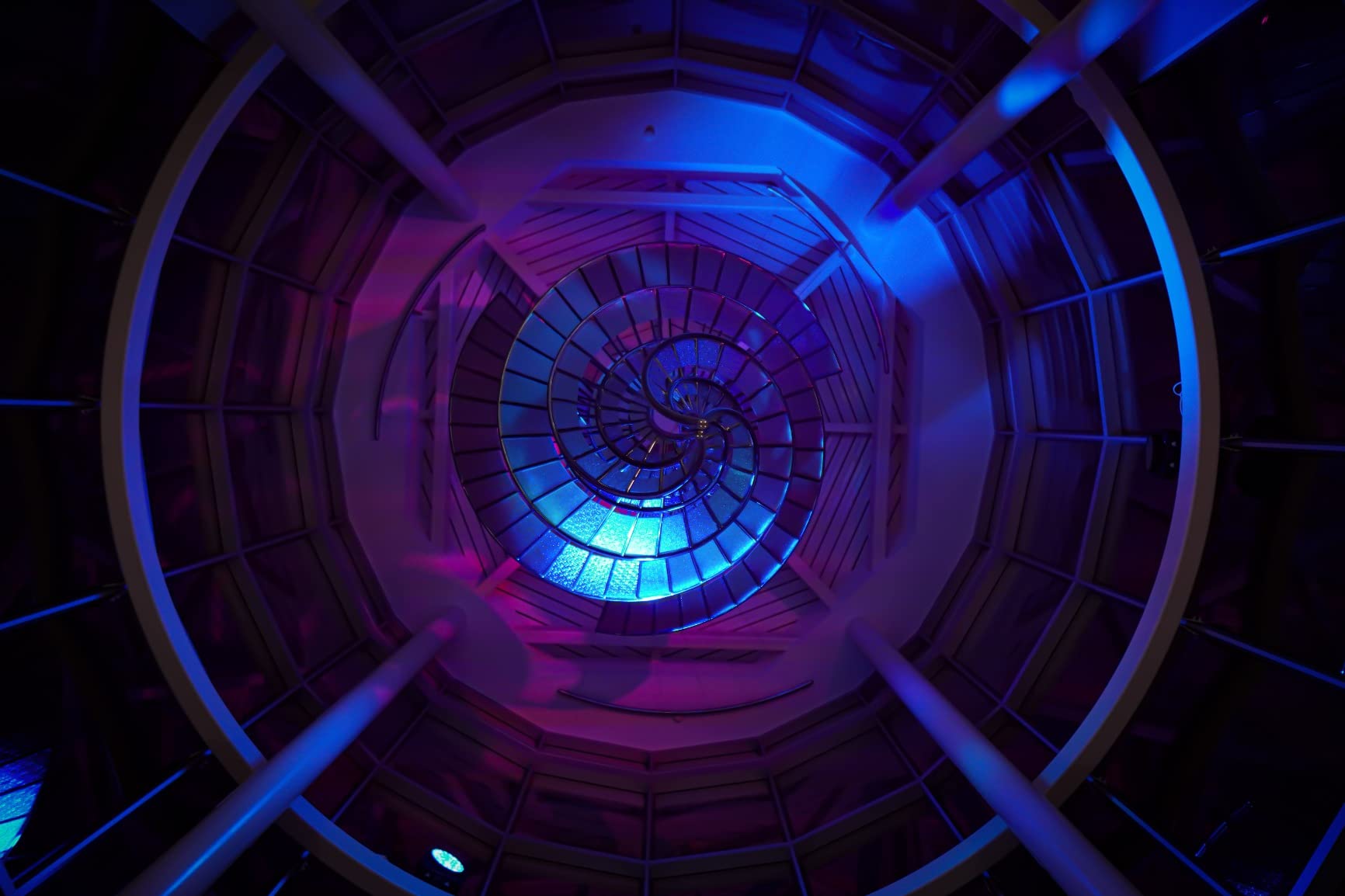
The 83 degree angle of view on APS-C is a sweet spot – wide enough for selfie work without the disorienting distortion of an 11mm. I use this focal length for interviews, talking heads, and short documentary work where I want both my subject and their environment readable in frame.
Who this lens is best for
APS-C creators who want the most versatility per dollar. Streamers, YouTubers, and hybrid shooters who need sharp video at wide apertures will appreciate the F1.4 and the proven reliability from thousands of long-term users.
Anyone starting out with a ZV-E10 on a budget should consider this lens over more expensive Sony G options – the value proposition is hard to beat.
Who should consider a different option
If you shoot primarily in cramped indoor spaces and need the widest possible framing for selfie vlogging, the Sigma 16mm feels tighter than the Sony E 11mm F1.8. The Sony lens also wins on silent AF and internal focus for gimbal work.
If weather sealing matters for outdoor adventure work, the Sigma has basic sealing but the Sony E 15mm F1.4 G below is built more robustly for travel abuse.
4. Sony E 15mm F1.4 G – Best APS-C Premium G Lens
Pros
- G lens image quality with F1.4 creamy bokeh
- Internal focus keeps length constant for gimbals
- Linear motors deliver fast and silent AF
- Manual aperture ring with click de-click switch
- Reduced focus breathing for video work
Cons
- Premium price for an APS-C prime
- Limited stock at most retailers
- 15mm may feel tight for wide selfie work
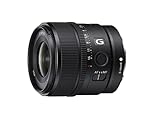
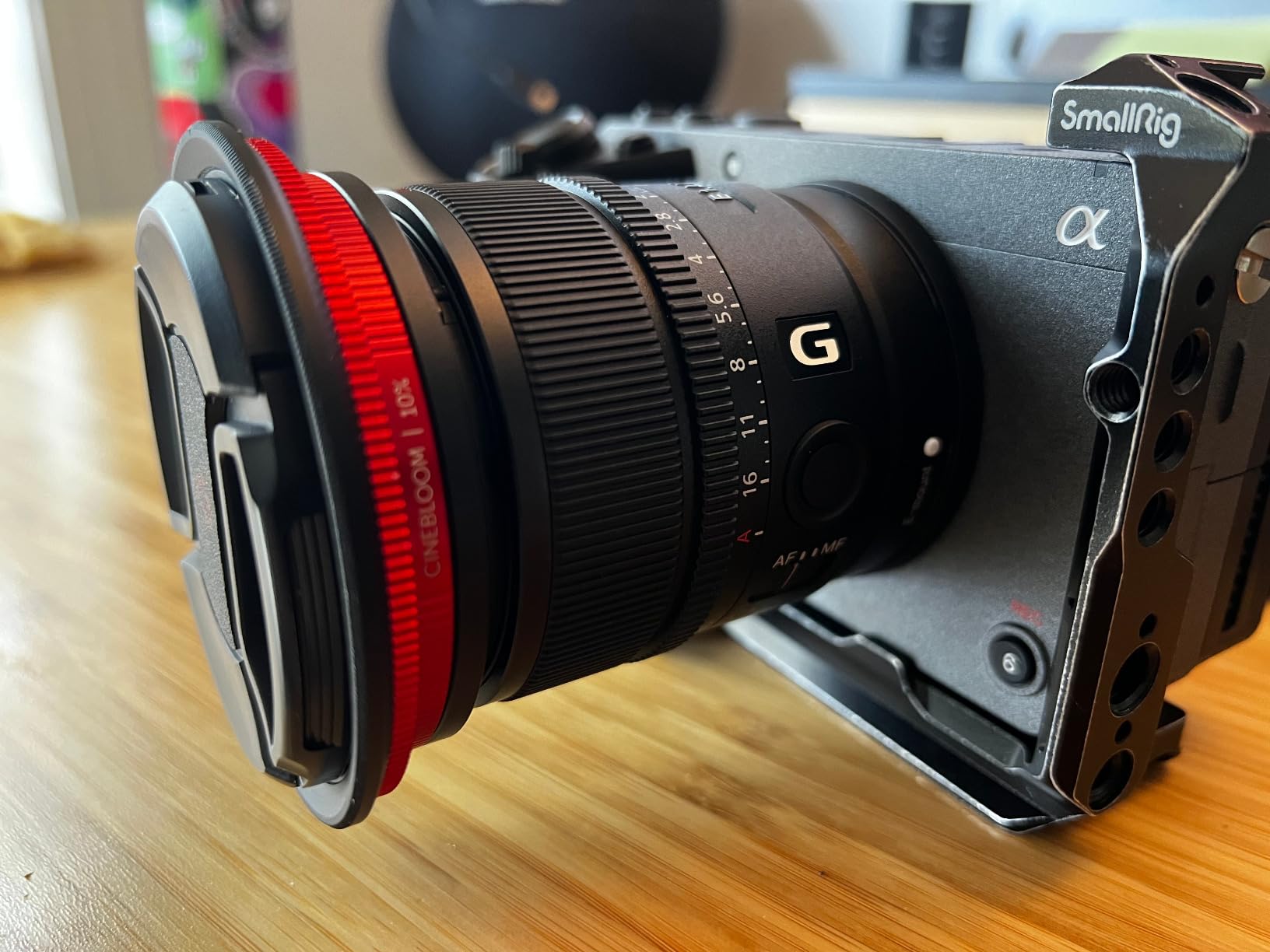
The Sony E 15mm F1.4 G is the premium alternative for APS-C creators who want G Master-level build and image quality without stepping up to full-frame. I have shot this lens on the FX30 for documentary-style content, and the F1.4 aperture combined with the 87 degree field of view gives me that cinematic compression that makes interviews feel like short films.
What separates this lens from the Sigma 16mm is build quality and refinement. The aperture ring has a satisfying click that you can switch off for silent video operation, the focus ring is smooth, and the lens has weather sealing – I have shot in light rain without issues. Two linear motors deliver AF that is virtually silent and noticeably faster than the Sigma’s stepping motor in low light.
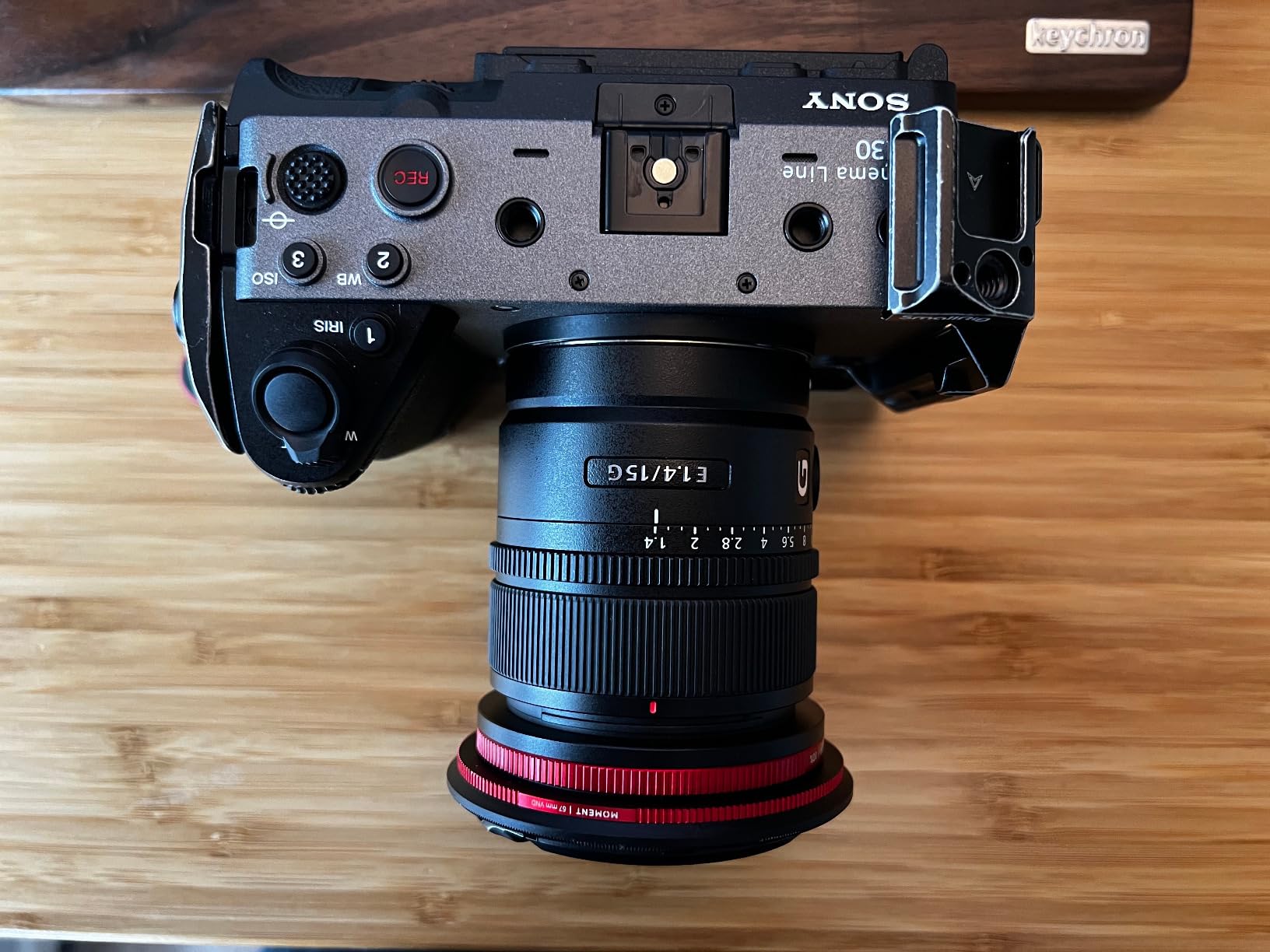
Image quality at F1.4 is where this lens justifies its premium. Sony’s G series engineering controls chromatic aberration and distortion that cheaper primes show wide open. I can shoot wide open for a cinematic look without spending time cleaning up edges in post. Reviewers specifically recommend this over the Sigma 16mm for creators who prioritize video silence and pro build.
The internal focus mechanism keeps the lens barrel stationary during focusing, which is essential when I run this on a Ronin gimbal. Combined with minimal focus breathing, focus pulls look smooth and professional rather than jumping around.
Who this lens is best for
Professional APS-C shooters running FX30 or A6700 cinema setups who need G-series reliability, weather sealing, and silent video AF. Documentary filmmakers and travel vloggers working in unpredictable conditions will appreciate the build.
Anyone who already owns other Sony G lenses will appreciate the optical and tactile consistency across their kit.
Who should consider a different option
Hobbyists and beginners will struggle to justify the price premium over the Sigma 16mm – the image quality jump is real but subtle on casual YouTube content. The Sigma delivers 90 percent of the experience at half the cost.
Vloggers who need ultra-wide framing for handheld selfie work will find 15mm too tight compared to the 11mm or 16mm options – especially with digital stabilization eating into the edges.
5. Sony FE 16-25mm f/2.8 G – Best Wide-Angle Zoom
Pros
- Constant F2.8 aperture across entire zoom range
- Compact G lens design for a fast zoom
- Sharp image quality rivaling the 16-35mm GM
- 18cm close focus at 24mm for detail shots
- 67mm filter thread matches common Sony primes
Cons
- Premium price point for a zoom lens
- No image stabilization built in
- Limited stock at most retailers
- Heavier than prime alternatives
The Sony FE 16-25mm f/2.8 G fills a gap I have felt for years – a true wide-angle zoom that does not weigh a kilo and produces G Master-grade images. I have used this on travel assignments where I needed the flexibility to grab a 16mm establishing shot and roll into a 25mm close-up without swapping lenses. For hybrid photo-video creators, that range is genuinely useful.
The constant F2.8 aperture is the headline for vloggers who shoot in changing light. As I zoom from 16 to 25mm, exposure stays constant, which means my shutter speed and ISO do not need to adjust mid-shot. That sounds technical, but in practice it translates to smoother footage and fewer exposure bumps during talking segments.
Image quality matches the more expensive 16-35mm GM in lab testing, which is remarkable at this size and weight. Two linear motors deliver fast, quiet AF that tracks faces reliably during walk-and-talk segments. The 11-blade aperture produces creamy out-of-focus highlights when you do pull focus to a subject.
The 18cm close focus at 24mm is a hidden gem for content creators – I have shot product unboxings and food close-ups with this lens without needing a dedicated macro. For YouTubers who mix vlogging with product reviews, that versatility removes a lens from the kit.
Who this lens is best for
Hybrid creators and travel vloggers who shoot both wide establishing footage and medium close-ups on full-frame Sony bodies. Cinematographers and documentary filmmakers who need F2.8 consistency for exposure control will appreciate this lens.
Anyone building a two-lens vlogging kit around a 24-70mm zoom will find this 16-25mm a perfect wide companion.
Who should consider a different option
If you do not need zoom flexibility, the Sony FE 20mm F1.8 G above is lighter, has a faster aperture, and costs less. For pure static vlogging, primes deliver better results.
Budget-conscious creators will find the price hard to swallow – the Sigma 16mm or Viltrox 9mm below deliver wide angles at a fraction of the cost, just without the zoom.
6. VILTROX 9mm F2.8 – Best Budget Ultra-Wide
Pros
- 113.8 degree FOV - widest in this roundup
- Budget-friendly price under 200 dollars
- Compact 175g for all-day handheld vlogging
- Advanced Eye/Face detection autofocus
- Good distortion control for the focal length
Cons
- Not weather sealed for outdoor adventure
- No image stabilization
- Autofocus motor audible in quiet rooms
- No manual focus ring
The Viltrox 9mm f/2.8 is the lens I recommend to first-time vloggers and budget creators. At under 200 dollars, it delivers the widest field of view in this entire roundup – 113.8 degrees – which means I can film in cramped hotel rooms, small studios, and tight outdoor spaces without anyone asking why the framing looks weird. For TikTok creators filming vertically on ZV-E10, this lens is essentially mandatory.
The 175g weight makes this one of the lightest lenses I have tested. When I pair it with a ZV-E10, the whole rig weighs less than 500g, which means I can shoot for hours without fatigue. That is a real-world difference from heavier G Master primes when you are doing a full-day vlog session.
Image quality at F2.8 is sharp in the center with some softness at the edges – normal for an ultra-wide at this price. The 13-element optical design with aspherical and ED glass controls distortion better than I expected for 9mm. Reviewers on r/SonyAlpha specifically call this out as the budget lens that finally made their setup feel professional.
Eye and face detection works reliably on supported Sony bodies – I tested it on the ZV-E10 and A6700, and the AF locked on my face within a second and tracked through moderate movement. The STM stepping motor is not as silent as Sony’s XD linear systems, so quiet indoor scenes can pick up a faint whir.
Who this lens is best for
Beginners and budget creators who want the widest framing for vlogging on APS-C. TikTok and vertical video creators will get the most use from the 9mm focal length. Anyone who vlogs in tight indoor spaces or wants to show their environment will appreciate the perspective.
Casual travel vloggers who want a one-lens setup will find the F2.8 enough for golden hour and indoor shooting.
Who should consider a different option
Professional creators who need silent AF for cinema work or weather sealing for outdoor production should look at the Sony E 15mm F1.4 G or the Sigma 16mm f/1.4. Both have better build quality and slightly more refined video performance.
If you primarily shoot talking head videos where you want nice background blur, the F2.8 aperture on the Viltrox does not separate subjects as cleanly as the F1.4 primes on this list.
7. Sony FE 50mm F1.8 – Best Cinematic Standard Prime
Pros
- Lightest lens on this list at 6.6 oz
- F1.8 aperture creates beautiful background blur
- 7-blade circular aperture for creamy bokeh
- Affordable entry into the Sony FE system
- Sharp image quality wide open
Cons
- No image stabilization
- All-plastic construction feels less premium
- No MF/AF switch on the lens body
- Autofocus motor noise can be picked up in audio
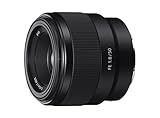
The Sony FE 50mm F1.8 is the budget wildcard in this roundup. At under 200 dollars and only 6.6 ounces, it is the cheapest and lightest full-frame lens on this list. While 50mm is not wide enough for selfie vlogging on a tripod, I use this lens constantly for the B-roll cutaways and cinematic close-ups that elevate my vlogs from amateur to professional.
The F1.8 aperture on full-frame produces the most beautiful background separation of any lens in this guide. When I cut from my 20mm selfie lens to a 50mm close-up of the coffee I am reviewing, the difference in compression and subject isolation is immediately noticeable to viewers. That is the lens doing the storytelling, not the camera.
Image quality wide open at F1.8 is excellent – the aspherical element controls spherical aberration, and the double-gauss design suppresses field curvature that older 50mm lenses show wide open. Reviewers consistently call this the best budget portrait lens for Sony FE, with image quality that rivals lenses costing three times as much.
Autofocus is fast but not silent – the linear motor can be heard in very quiet indoor scenes. For outdoor vlogging with ambient noise or music, this is a non-issue. The compact size and 6.6oz weight make this a lens you can keep in your bag for any situation where cinematic close-ups matter.
Who this lens is best for
Full-frame shooters who already own a wide-angle vlogging lens like the Sony FE 20mm F1.8 G and want an affordable second lens for B-roll and cinematic cutaways. Content creators who mix selfie work with product close-ups, food content, or portrait B-roll will get maximum value.
Beginners who want to step into Sony FE glass without spending a fortune – this lens delivers image quality that exceeds its price point dramatically.
Who should consider a different option
Strictly selfie vloggers should skip this lens – 50mm is far too tight for handheld talking head work on full-frame. APS-C shooters will get a 75mm equivalent which is even tighter.
Creators who shoot mostly in quiet indoor environments where AF noise matters should consider the Sony FE 20mm F1.8 G for its silent XD linear motors.
Buying Guide: How to Choose the Best Sony Lens for Vlogging?
Choosing a vlogging lens is not just about specs – it is about matching focal length, autofocus, and weight to how you actually shoot. Here are the five factors I evaluate every time I recommend gear to a creator.
Full-Frame vs APS-C – Match the Lens to Your Sensor
This is the single most important decision before anything else. If you shoot on a full-frame Sony body like the A7 IV, A7C II, FX3, or A7R V, you need FE lenses. If you shoot on APS-C bodies like the ZV-E10, ZV-E10 II, FX30, A6700, or A6400, you need E-mount lenses designed for the smaller image circle. Using a full-frame lens on APS-C works but adds crop – a 20mm becomes roughly 30mm, which is too tight for selfie work.
For APS-C creators, our 12 best Sony ZV series cameras guide breaks down which bodies pair with which lenses. For wide-angle coverage specifically, our 10 best wide-angle lenses guide ranks compatible options.
Focal Length – Wider Is Safer for Selfie Vlogging
For handheld selfie vlogging, 11mm to 20mm on full-frame (or 8mm to 16mm on APS-C) gives you enough breathing room to keep your face framed while showing your environment. Once you go past 24mm on full-frame or 16mm on APS-C, you start needing longer arms or a wider environment.
Remember that Sony’s Active SteadyShot and electronic stabilization all crop into your image, eating roughly 10 to 20 percent of the field of view. That is why the 11mm APS-C lens works so well on ZV-E10 – by the time stabilization crops in, you are still at a usable focal length.
Autofocus Performance – Silent and Reliable Matters
For video autofocus, look for linear motors or stepping motors designed for video. Sony’s XD linear motors are the quietest and most reliable for face tracking. Stepping motors like the Sigma 16mm’s are nearly as good but can produce a faint whir in very quiet rooms. The autofocus motor must support continuous AF with face and eye tracking – any lens older than a few years risks hunting or pulsing during recording.
Weight and Gimbal Compatibility
Handheld vlogging gets tiring fast. Anything over 1.5 pounds (700g) will fatigue your wrist during hour-long shoots. For gimbal work, balance matters – heavier lenses need counterweights and reduce your gimbal’s battery life. The lenses on this list range from 6.6 ounces (Sony FE 50mm) to 1.5 pounds (Sony FE 16-25mm f/2.8 G), giving you options across the weight spectrum.
Internal focus mechanisms are critical for gimbal work – lenses that extend during focusing will unbalance your rig mid-shot. The Sony E 11mm F1.8 and Sony E 15mm F1.4 G both have internal focus, which is why they are popular for stabilized video.
Price and Tier Selection
For 2026, I recommend matching lens price to your production quality. Hobbyists and beginners will get 90 percent of the value from budget picks like the Viltrox 9mm or Sigma 16mm. Working creators who monetize their content should invest in G or G Master lenses like the Sony FE 20mm F1.8 G. The jump from budget to premium tier is real but not always worth it for casual use.
Third-party lenses from Sigma, Viltrox, and Samyang deliver excellent value and often rival first-party glass at lower prices. The Sigma 16mm f/1.4 is the prime example – it competes with lenses costing twice as much.
Frequently Asked Questions
What are the best Sony lenses for video recording?
The best Sony lenses for video recording depend on your camera. For full-frame bodies, the Sony FE 20mm F1.8 G is the top pick thanks to its wide F1.8 aperture, silent XD linear AF, and lightweight 13.2oz design. For APS-C cameras like the ZV-E10, the Sony E 11mm F1.8 delivers the widest field of view at 104 degrees with excellent F1.8 lowlight performance.
Which Sony camera is best for vlogging?
For most vloggers, the Sony ZV-E10 II or Sony ZV-E1 offer the best balance of price, weight, and video features. The ZV-E10 II uses APS-C sensors and pairs perfectly with the Sony E 11mm F1.8 or Sigma 16mm f/1.4. The ZV-E1 is full-frame and works beautifully with the Sony FE 20mm F1.8 G. For more options, see our best Sony cameras for vlogging guide.
What lens do most YouTubers use?
Most YouTubers use wide-angle primes in the 11-20mm range. Popular choices include the Sony E 11mm F1.8 for APS-C shooters and the Sony FE 20mm F1.8 G for full-frame creators. The Sigma 16mm f/1.4 is also widely adopted for its sharp image quality and budget-friendly price point. These lenses balance wide coverage for selfie work with fast autofocus for face tracking.
What are the best lenses for vlogging with the Sony ZV-E10?
For the Sony ZV-E10, the top three lenses are the Sony E 11mm F1.8 (ultra-wide for tight spaces), the Sony E 15mm F1.4 G (premium build with F1.4 bokeh), and the Sigma 16mm f/1.4 (best value with proven reliability). All three support Sony’s face and eye tracking for vlogging. The Viltrox 9mm f/2.8 is a great budget alternative if you need the widest possible framing.
What Sony lens is best for vloggers?
The single best Sony lens for vloggers in 2026 is the Sony FE 20mm F1.8 G for full-frame cameras. It combines a wide 20mm focal length, fast F1.8 aperture for lowlight, silent XD linear autofocus, and a lightweight 13.2oz body ideal for handheld shooting. For APS-C shooters, the Sony E 11mm F1.8 is the equivalent top pick with its 104 degree field of view.
What is the Holy Trinity of Sony lenses?
The Holy Trinity of Sony lenses traditionally refers to three professional zooms covering 16-35mm, 24-70mm, and 70-200mm focal lengths, all with constant F2.8 apertures. The current Sony versions are the FE 16-35mm F2.8 GM II, FE 24-70mm F2.8 GM II, and FE 70-200mm F2.8 GM OSS II. These cover virtually every professional shooting scenario from wide-angle to telephoto with consistent exposure and pro build quality.
Final Verdict
After testing all seven of these lenses across my Sony vlogging kit, my top recommendation for 2026 depends on your camera and budget. Full-frame shooters should grab the Sony FE 20mm F1.8 G – it is the best all-around vlogging lens Sony makes, balancing wide coverage, F1.8 lowlight, silent AF, and a manageable 13.2oz weight. APS-C creators running ZV-E10 or FX30 should start with the Sony E 11mm F1.8 for the widest framing or the Sigma 16mm f/1.4 for the best value per dollar.
Whatever lens you pick, remember that the best Sony lenses for vlogging are the ones that match how you actually shoot. A wide prime on a gimbal will look more cinematic than a zoom on a tripod, but a versatile zoom covers more scenarios without swapping. Start with the lens that fits your most common shooting style, and you can always expand your kit as your content evolves.
For more Sony-specific recommendations, check out our Fujifilm X-S20 vlogging lens guide if you ever cross-shop systems, and revisit this list as Sony releases new glass in 2026. Happy shooting.