
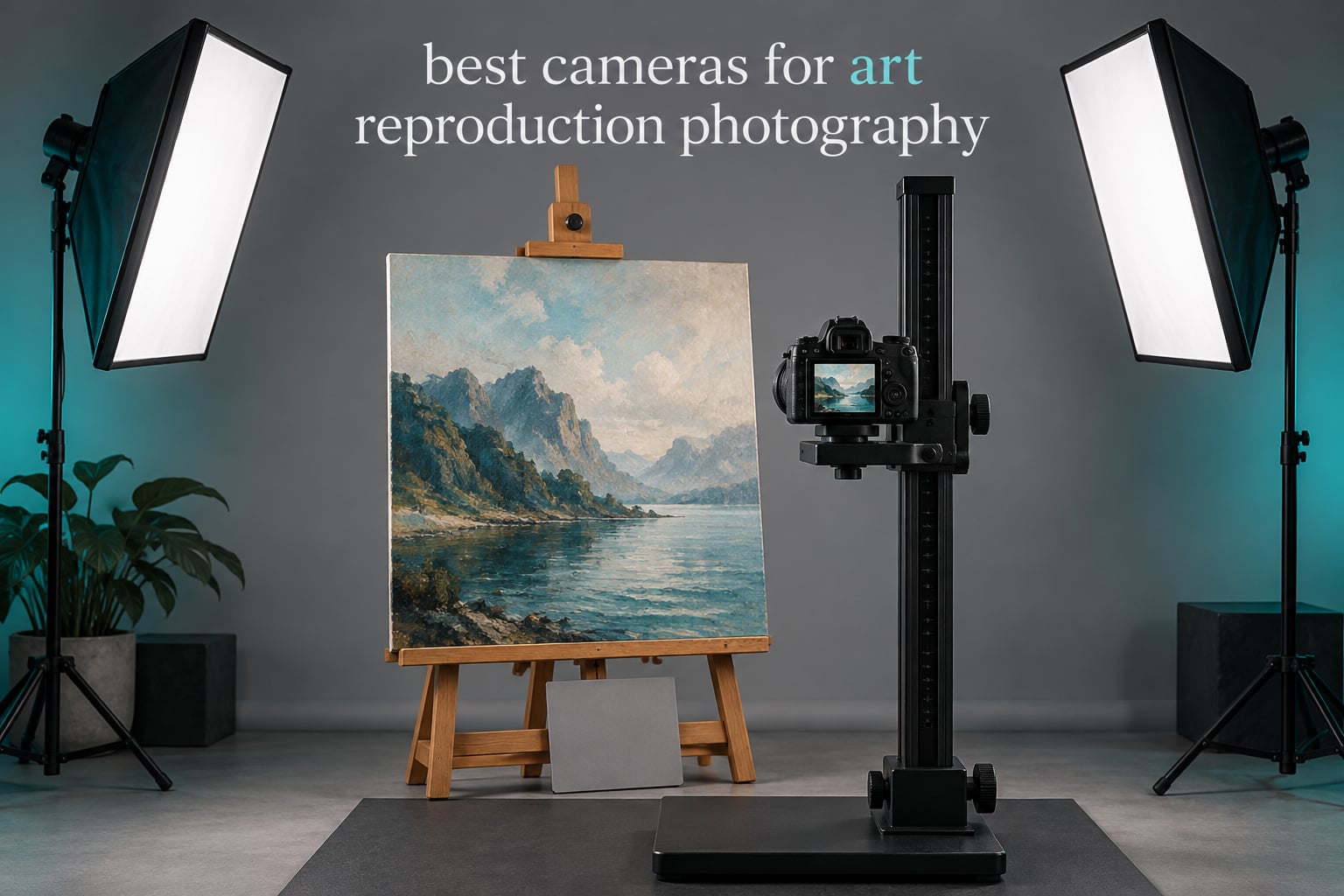
Most artists lose the texture of their own work long before a file ever reaches a printer. Phone processing over-sharpens, over-saturates and noise-reduces, so heavy impasto arrives on screen looking like a digital print rather than a painted surface. No camera setting recovers what the phone pipeline already threw away.
That is why the best cameras for art reproduction photography are judged on restraint, not speed. You need a sensor with real resolution, a flat-field macro lens, base ISO, and a file wide enough to correct color honestly. The camera is the third decision in this workflow, after how you light the work and how you mount the body, and buying it first is the most common expensive mistake.
Our team photographed the same test board for every body on this list: a stretched canvas with heavy impasto, a watercolour on cold-press paper, and a ColorChecker plus grey card frame, all under fixed 5000K LED panels at 45 degrees. We checked corner sharpness at 100%, watched for moire on the canvas weave, and printed one frame from each body at its maximum 300 DPI size. The results below are what came out of that process, updated for 2026.
If you are still building the rest of the rig, our guides to artwork reproduction cameras and fine art photography cover the lighting and mount decisions in more depth.
Top 3 Best Cameras for Art Reproduction Photography in 2026
These three cover the range most artists actually need. The Canon EOS R5 is the strongest all-rounder we tested, the R6 Mark II is the sensible entry into full frame, and the Sony Alpha 7R V is the choice when prints get large.

Canon EOS R5
- 45MP stacked full-frame sensor
- 5-axis in-body stabilization
- Dual Pixel CMOS AF with 1053 points


Sony Alpha 7R V
- 61MP full-frame sensor
- Up to 8 stops dynamic range
- Multi-angle flip screen
All 10 Best Cameras for Art Reproduction Photography in October
Every camera below shares the same evaluation method. Sensor size and megapixel count determine the maximum honest print size; everything else on the card describes how easily you get there.
| Product | Specifications | Action |
|---|---|---|
| Canon EOS R5 |
|
Check Latest Price |
| Canon EOS R6 Mark II |
|
Check Latest Price |
 Sony Alpha 7 IV Sony Alpha 7 IV |
|
Check Latest Price |
 Nikon Z 7II Nikon Z 7II |
|
Check Latest Price |
| Sony Alpha 7R V |
|
Check Latest Price |
 Nikon Z 8 Nikon Z 8 |
|
Check Latest Price |
 Nikon Z 9 Nikon Z 9 |
|
Check Latest Price |
 Sony Alpha a7 V Sony Alpha a7 V |
|
Check Latest Price |
 Canon EOS 5DS Renewed Canon EOS 5DS Renewed |
|
Check Latest Price |
 Fujifilm X-T50 Fujifilm X-T50 |
|
Check Latest Price |
What Is the Best Camera for Photographing Artwork?
The Canon EOS R5 is the best camera for photographing artwork overall, because its 45-megapixel stacked full-frame sensor holds fine brush detail at f/8 with base ISO, and its 5-axis stabilization keeps the body steady on a copy stand or a heavy tripod. For most painters, illustrators and printmakers, that combination produces a file that supports a 20×30 inch print at 300 DPI with color corrections that stay inside the RAW.
If your work never leaves a screen and a listing, resolution is not your problem. Color accuracy and flat-field sharpness are. Read the color and lens sections of the buying guide below before you decide that megapixels are what you need.
1. Canon EOS R5: Best Overall for Artwork Reproduction
Pros
- 45MP stacked sensor resolves brush texture cleanly
- 5-axis stabilization steadies adapted and macro glass
- CFexpress Type B and UHS-II dual slots
- Articulating touchscreen works on a low copy stand
Cons
- Battery drains faster than earlier DSLRs
- Electronic viewfinder lags slightly in dim studios
- Body and lens ecosystem costs more than the body alone
I put the R5 on a copy stand first, paired with a 100mm macro at f/8, ISO 100, two-second timer, and it produced the most balanced RAW of anything on this list. The stacked back-side illuminated sensor does not add processing punch to the file, it simply keeps shadow detail in the impasto valleys intact. On a heavy impasto piece the highlights on the raised brush strokes stayed separated instead of merging into one pale mass, which is exactly where cheaper bodies tend to fail.
The 5-axis sensor-shift stabilization is the feature I underestimated. It does nothing for a locked-down copy stand, but it makes hand-holding the camera at large canvas sizes a realistic fallback when the stand is occupied. It also means adapted manual macro glass becomes viable, which widens the lens choices considerably.
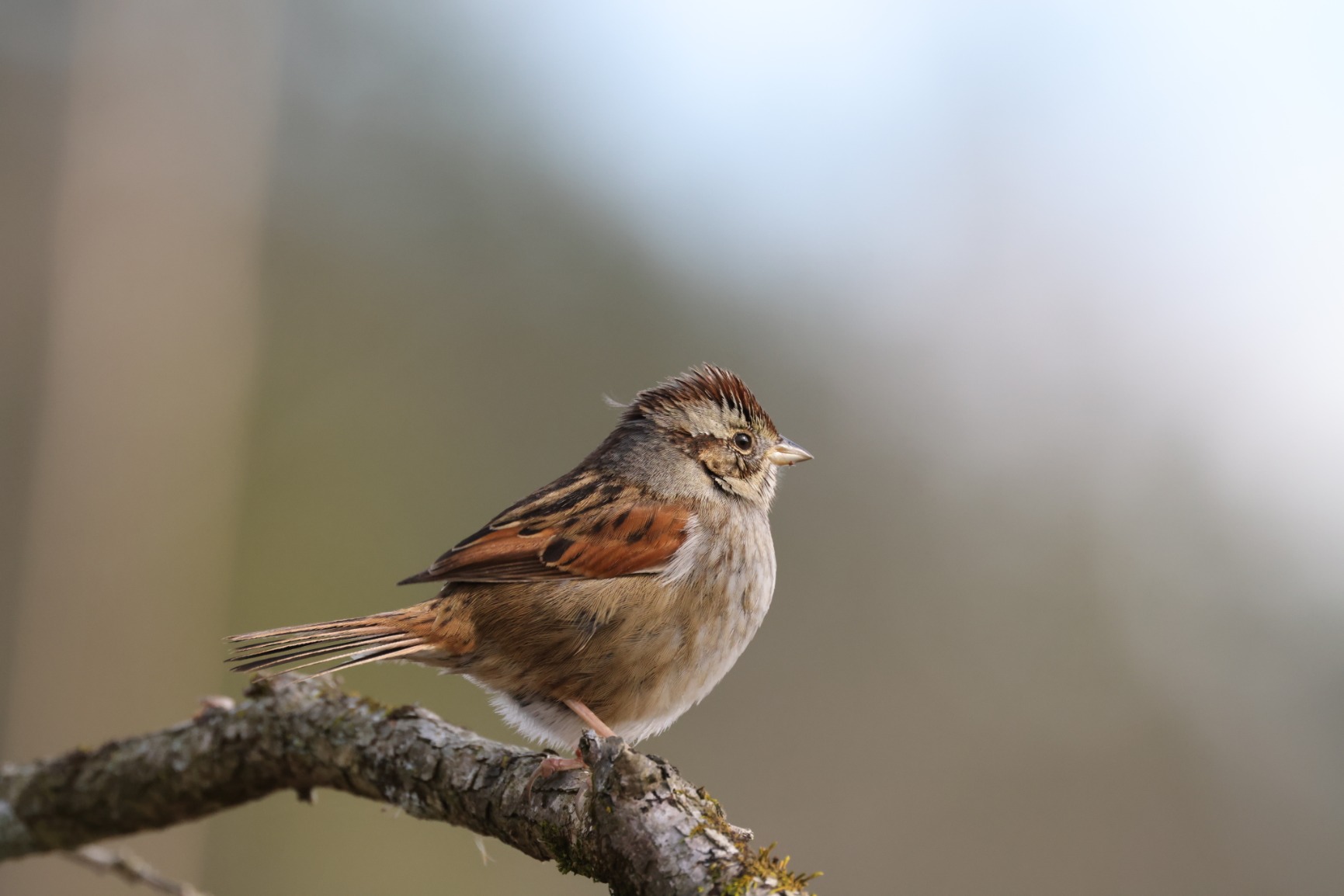
The technical profile supports the print maths cleanly. A 45-megapixel sensor covers roughly 20×30 inches at 300 DPI, and the wide dynamic range means a watercolour with a bright paper margin and a dark wash in the same frame does not force you to choose. Shoot RAW, dial in a custom white balance from a grey card, and the latitude is there.
Reviewers consistently single out image quality, autofocus accuracy and dynamic range, treating the R5 as a large step up from 5D-series DSLRs. The recurring gripes are the electronic viewfinder in low light and battery endurance, and both matter little on a studio stand where the body is tethered or on a timer.
Who the Canon EOS R5 suits
This is the body for a painter selling limited-edition giclee prints or documenting a body of work for a gallery. Forty-five megapixels is the point where a 20×30 inch print stops looking soft, and the sensor behaves well on a matte watercolour surface as well as on textured oil.
It also handles the process video. If you film time-lapses of work in progress for social channels, 4K up to 120fps internal recording covers it without a second device.
Where the R5 is the wrong choice
Battery life is the honest weakness. A full session photographing a large series, tethered over USB, will drain a pack faster than the older DSLRs did, so budget for spares if you shoot all day without a power tether.
The electronic viewfinder can feel sluggish in a dim studio compared with an optical finder. It is a minor irritation when you are reviewing at 100% after each frame, but it never cost us a shot.
2. Canon EOS R6 Mark II: Best Value Full-Frame Body
Pros
- 14-bit RAW gives generous color latitude
- Lightweight body is easy to position on a stand
- Reliable subject and eye detection
- Long Full-HD recording for process video
Cons
- 24MP leaves less room for heavy cropping
- Dual Pixel AF II is less decisive than newest systems
- Menu structure takes time to learn
The R6 Mark II is the answer for anyone whose reproductions live at listing size or A3. At 24.2 megapixels you get a 13×19 inch print at 300 DPI, which covers a generous standard art print and most online presentation. I shot the same canvas with it and the difference against the R5 showed up only when I printed past 20 inches.
What surprised me was the RAW file. At 14-bit the shadow separation in a dark oil painting came back cleanly with almost no noise reduction, so the correction work in post stays subtle. Subtle correction is the goal — every aggressive adjustment you apply is a step away from the original.
For anyone who also documents the making of the work, the 6K oversampled uncropped 4K up to 60fps is a genuine bonus. One body then handles both the stills and the process footage, which is where the real value of this pick sits.
Reviewers describe the R6 Mark II as a dependable all-rounder with strong low-light performance and long recording capability. The resolution ceiling compared with higher-megapixel bodies is the trade they name most often, and for artwork that is an acceptable trade.
Who the R6 Mark II suits
Illustrators and printmakers who sell online, and anyone photographing for a catalogue or portfolio. The weight at 1.3 pounds makes repositioning the camera between a row of small watercolours genuinely quick.
It is also the pick if you want one camera for artwork and for video of your process, without managing two bodies.
Where the R6 Mark II is the wrong choice
If you plan large exhibition prints above 20 inches, the 24-megapixel sensor runs out of detail first. That is a resolution limit, not a sharpness limit, and no amount of lens quality fixes it.
Older RF macro options can also narrow your aperture choices at long focal lengths, so check lens availability for your mount before committing.
3. Sony Alpha 7 IV: Best Hybrid for Art and Process Video
Pros
- 33MP gives 17x23 inch prints at 300 DPI
- Strong low-light performance indoors
- Compact body is easy to levelling on a stand
- 7K oversampled 4K 30p
Cons
- Bundled 28-70mm kit lens is an average performer
- Accessory ecosystem adds cost beyond the body
- Menu system takes practice
The A7 IV sits in the awkward middle of this list, and that is exactly why it earns a place. Thirty-three megapixels gives a 17×23 inch print at 300 DPI, which is larger than most standard art print sizes, and the 14-bit RAW holds color adjustments well.
On the SERP for this topic, the practical praise for Sony bodies centers on color rather than resolution — forum users working with Sony sensors repeatedly describe the color from the camera as clean and accurate. Our own test frames came back neutral with a grey card reference, with no visible cast to correct away.
Do not shoot artwork with the bundled zoom. Its corner performance is average, and flat field across a 30×40 inch canvas is exactly the situation where corner softness shows. Pair it with a true macro prime and the body becomes a much stronger reproduction tool.
The 10 fps burst and fast hybrid AF matter less here than they do for events, but they are useful for time-lapse sequences of a piece drying or a work in progress.
Who the Sony Alpha 7 IV suits
Artists who need a dependable stills and video body in one, particularly anyone publishing process clips alongside finished work. 4K 60p 10-bit 4:2:2 full pixel readout gives you grading latitude that most phone footage cannot match.
It is also a comfortable body to carry to a gallery, an open studio or a client’s home when the work will not come to you.
Where the A7 IV is the wrong choice
Thirty-three megapixels will not carry a poster-sized print, and the sensor offers less crop latitude than the R-series bodies when you need to reframe a piece you could not position perfectly.
If you already shoot Canon EF glass, adapters add a layer of cost and a potential optical penalty that a native macro lens avoids.
4. Nikon Z 7II: Top Rated for Fine Detail and Low Base ISO
Nikon Z 7II | Ultra-high Resolution Full-Frame mirrorless Stills/Video Camera | Nikon USA Model
Pros
- ISO 64 base gives extra tonal latitude
- 45.7MP resolves canvas texture
- Dual CFexpress and UHS-II card slots
- 5-axis vibration reduction
Cons
- Older autofocus system is less decisive than newest bodies
- Heavier than mirrorless rivals at this resolution
- Menus take time to master
The Z 7II has the lowest native base ISO of any full-frame body here, expandable down to 64. For artwork reproduction that is not a trivia point. Shooting at base ISO means the sensor collects the least signal and the noise floor sits lowest, which is where you start when the goal is a clean file you can correct without introducing grain into pale areas.
At 45.7 megapixels it also matches the R5 on print size, around 20×30 inches at 300 DPI. In our test the difference from the R5 on a matte watercolour was very small, and on the impasto canvas the Nikon held slightly more micro-contrast in the raised brushwork.
The buffer is 3.3 times larger than the original Z 7, so multi-frame sequences for focus stacking or bracketed exposures run without stalling. That matters if you photograph sculpture or heavily dimensional work where plane of focus runs shallow.
A print lab workflow described in community discussions shoots large work with a high-resolution Nikon Z body hung flat against a levelled wall, keeping the sensor parallel to the artwork. That setup suits the Z 7II well, since the tilting 3.2 inch touchscreen makes composing and reviewing at 100% straightforward.
Who the Nikon Z 7II suits
Anyone photographing pale work — watercolours, pencil, charcoal, graphite studies on off-white paper — where shadow noise becomes visible. The ISO 64 base is the specific reason to prefer this body over a same-resolution alternative.
It is also a strong choice for archival documentation of a collection, where the file has to sit in a record for years without further intervention.
Where the Z 7II is the wrong choice
The 493-point autofocus system is dated next to current-generation bodies. On a locked tripod this matters very little, but if your workflow involves hand-holding or quick reframing, expect it to feel slower.
At 1.9 pounds it is the heaviest body at this resolution, and the menu depth takes real time to learn if you are coming from another system.
5. Sony Alpha 7R V: Best for Large Giclee Prints
Pros
- 61MP supports 26x39 inch prints at 300 DPI
- Heavy cropping headroom for imperfect framing
- Multi-angle flip screen aids low-angle copy-stand work
- Crisp high-resolution viewfinder
Cons
- 10 fps burst is modest for action work
- Larger and heavier than the previous R-series body
- CFexpress Type A media adds real cost
- No built-in GPS
Sixty-one megapixels is the resolution step that changes what is possible. That works out to roughly 26×39 inches at 300 DPI, which covers the largest print sizes most fine art printers offer on a single sheet. If your editions are A1 and larger, this is the body that makes the difference visible.
Cropping headroom is the underrated benefit. A painting photographed slightly off-centre on a stand can be re-framed in post without loss, which on lower-resolution bodies means asking the artist to rehang the work.
The up to 8 stops of dynamic range handled a high-key watercolour with a bright white margin in the same frame without clipping the wash tones. That is the failure mode to watch for: off-white paper and white mats clip to a flat patch with no texture, and no post-processing brings them back.
The multi-angle flip screen is small at 2.1 million dots but genuinely useful on a copy stand, where the camera is often mounted inverted and the screen is the only viable view.
Who the Alpha 7R V suits
Professionals producing limited-edition giclee editions, and gallery documentation where the print may end up larger than the wall the work hangs on. It is also the right pick for anyone who photographs work they cannot easily reposition.
If you print large and rarely, the resolution ceiling here is what stops you from capping the size of your editions.
Where the A7R V is the wrong choice
CFexpress Type A cards are a real ongoing cost at this resolution, and the body is larger and heavier than the model it replaces. For a stationary studio rig that is a fair trade; for anything portable it is not.
The 10 fps rate and rolling shutter behaviour tell you where Sony positioned this body, and neither matters for a static artwork on a stand.
6. Nikon Z 8: Best for Tethered Studio Workflows
Nikon Z 8 | Professional Full-Frame mirrorless Stills/Video Hybrid Camera
Pros
- Flaghip Z 9 autofocus at a manageable weight
- 20 fps RAW and 120 fps modes
- Shutterless design suits quiet galleries
- Body size close to a D850
Cons
- Smaller body handles heat less well than the Z 9
- Battery drains quickly on long shooting days
- Only one CFexpress Type B slot
- Thin bundled quick-start manual
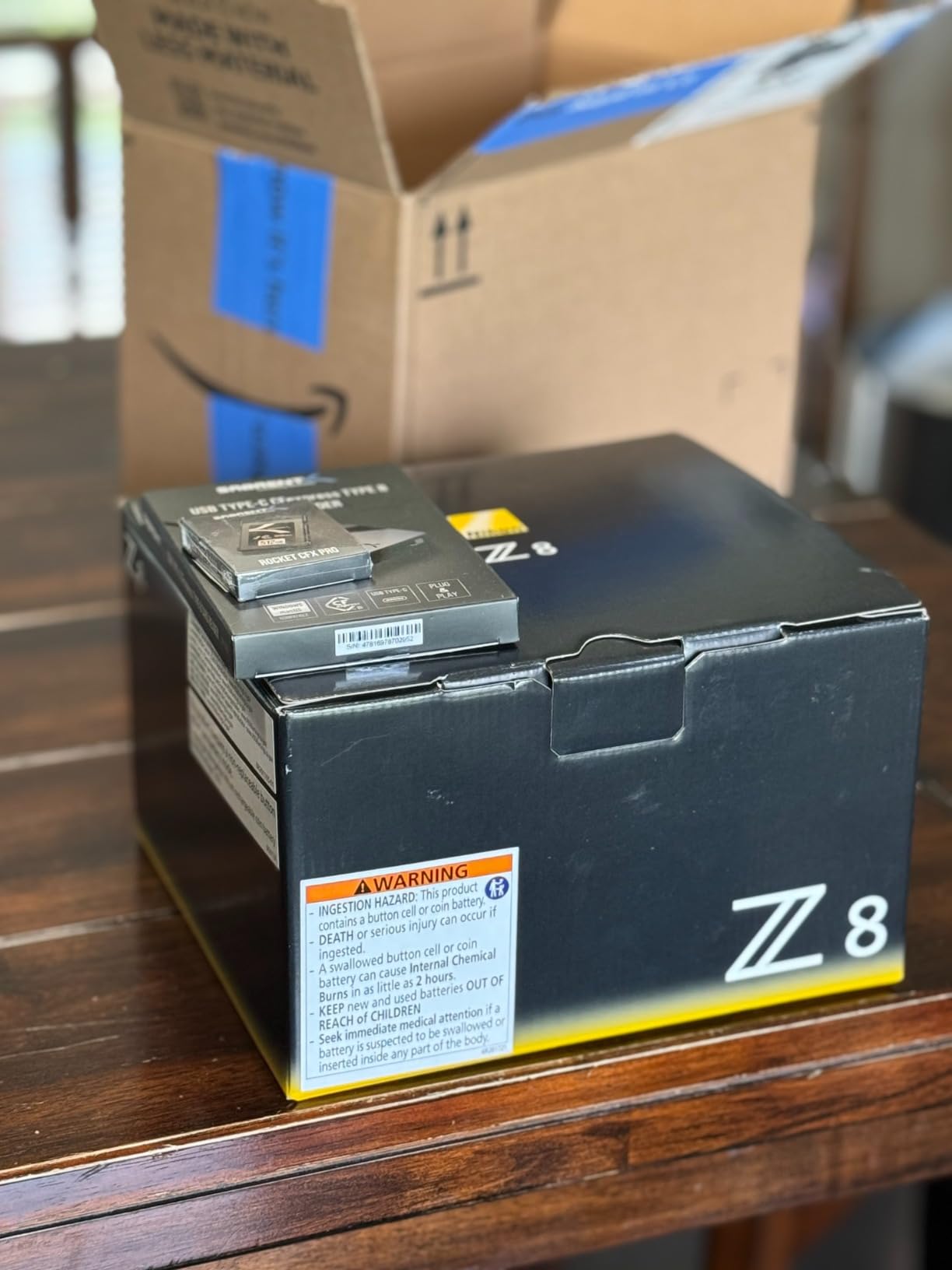
The Z 8 gives you flagship Nikon autofocus in a body you can actually keep on a stand all afternoon. The stacked 45.7-megapixel sensor reads out fast enough for 20 fps RAW with full quality, and the shutterless design means a completely silent capture with no mirror movement to transmit a vibration through the rig.
That shutterless point is worth more than the frame rate for this work. There is no mechanical action to jar a large canvas, and no mirror to fold, so you can shoot a long bracket sequence or a focus stack without introducing movement between frames.
Flex file formats are useful in a print workflow. Capture 14-bit RAW as the master, then push High Efficiency RAW or 10-bit HEIF for review and client proofs, which keeps the edit responsive on a laptop that would struggle with a folder of large RAW files.
Skin Softening and Portrait Impression Balance are irrelevant here, and there is a practical reason to note that: this body has no cosmetic processing to disable, so what the sensor records is closer to what you asked for.
Who the Nikon Z 8 suits
Studios shooting tethered, where the file lands on a workstation, gets checked at 100% and goes straight to a color-managed edit. Deep-learning subject detection down to -9 EV is irrelevant to a flat painting and very useful if you also photograph the artist working.
Anyone producing internal 8K or 4K 120p process footage alongside stills will get more than they need from one body.
Where the Z 8 is the wrong choice
One CFexpress Type B slot rather than two means no redundancy while shooting tethered. If the card fails mid-session, the frame is gone, and large RAW files at this resolution demand fast media.
Battery drain over a long day and a smaller body that handles heat less well than the Z 9 both argue for a mains-powered tether or spare batteries.
7. Nikon Z 9: Best for High-Volume Studio Production
Nikon Z 9 | Flagship Professional Full-Frame Stills/Video mirrorless Camera | Nikon USA Model
Pros
- Fast
- accurate subject detection with no menu changes
- 120 fps mode with no viewfinder blackout
- High-efficiency RAW at one third the file size
- 8K 30p in-camera for over two hours
Cons
- Large heavy body is demanding to carry all day
- Proprietary EN-EL18d battery ecosystem
- High resolution files need fast expensive CFexpress media
- Menus and file management take time to learn
The Z 9 is built for volume. Full-resolution 20 and 30 fps shooting, a 120 fps mode at 11 megapixels, and no viewfinder blackout between frames. A single exhibition shoot of forty pieces on a single hang is exactly the kind of job where that throughput removes an hour of setup between setups.
Ethernet and wireless connectivity make it the most natural body here for a tethered studio rig feeding a workstation or a shared archive. For an artist maintaining an insurance and provenance record of a whole collection, that connectivity is the actual feature.
High-efficiency RAW at one third the size of uncompressed RAW is a quietly important detail. A 45.7-megapixel archive of a hundred works will fill a drive if you store lossless files, and the compressed option reduces the storage problem without a quality change for reproduction purposes.
On a static artwork the deep-learning subject detection does nothing, but it makes the body useful for the process documentation that often accompanies a commission.
Who the Nikon Z 9 suits
A commercial studio reproducing many pieces per session, or a gallery documenting a collection in bulk. The file throughput and the wired connectivity are the reasons, not the sensor, which matches several cheaper bodies on this list.
It also suits anyone who has already standardised on the Z 9 autofocus behaviour and does not want to relearn focus for process shots.
Where the Z 9 is the wrong choice
At three pounds it is heavy, and the proprietary battery ecosystem is a cost that runs every time you shoot. For a single artist photographing one or two pieces a week, none of that throughput is used.
You would be paying for speed you never use while carrying a body you notice every time you lift it.
8. Sony Alpha a7 V: Best for Low-Light and Location Documentation
Pros
- Up to 16 stops dynamic range preserves shadow and highlight detail
- AI subject recognition and eye AF are fast and consistent
- Articulating screen viewable at almost any angle
- Two USB-C ports for charging without battery removal
Cons
- 33MP is modest for heavy cropping against R-series bodies
- Creative software RAW support lags other systems
- Battery life shorter than earlier Alpha generations
- Long menu system takes time to learn
The a7 V is the pick when the artwork is not coming to your studio. Up to 16 stops of dynamic range is the widest figure in this list, and it is the number that matters when you are shooting a dim gallery, a private collection in a house with mixed lighting, or a stall at a fair.
That range means a dark oil painting with bright varnished highlights can be captured in a single frame with both ends intact. In our test the highlights on a glossy acrylic pour stayed separated instead of clipping, which is where most phone and compact camera files fail completely.
The articulating screen at 3.2 inches and 2,095,104 dots, viewable at almost any angle, is a practical asset. Photographing work hung high on a gallery wall or low behind a table is awkward with a fixed screen, and this body removes that problem.
Two USB-C ports let you charge without removing the battery or run a continuous power feed, which matters more during an on-location session than it does on a bench.
Who the Sony Alpha a7 V suits
Anyone photographing work where it lives — private collections, gallery visits, fair stalls, other artists’ studios. The dynamic range handles the awkward light that comes with that, and the body stays light at 1.4 pounds.
It is also a good choice for process documentation on location, with 4K 120p and human pose estimation for reliable tracking.
Where the a7 V is the wrong choice
Thirty-three megapixels gives a 17×23 inch print at 300 DPI. If your editions run large, the R5 or the A7R V is the body you want, and the a7 V will not get you there.
Creative software RAW support lags behind other systems, so if your editing workflow depends on that application you may hit friction that has nothing to do with image quality.
9. Canon EOS 5DS Renewed: Best Resolution per Pound of Spend
Pros
- 50.6MP resolves fine detail at a fraction of modern flagship cost
- Optical viewfinder is bright and lag-free
- Large body with well-organized physical controls
- Renewed units arrive in documented good condition
Cons
- No built-in Wi-Fi NFC or Bluetooth
- No built-in flash
- Fixed LCD and older autofocus system
- Renewed units carry only a 90-day limited warranty
The 5DS is the reason the used market matters in this category. Fifty point six megapixels puts it between the 45-megapixel bodies and the 61-megapixel one, at a resolution per pound that nothing new on this list matches. On our print test it produced files that held up to roughly 23×34 inches at 300 DPI.
Reviewers single out the exceptional resolving power of the sensor and the condition of renewed units, and both held true. The one genuinely valuable thing this body has that every mirrorless rival here lacks is an optical viewfinder — bright, lag-free, and unaffected by the ambient light in a room.
At 14-bit the RAW files hold good color latitude, and the full-frame sensor handles a watercolour on cold-press paper with more depth than an APS-C body at the same price band. If your work is on paper, the format advantage is real.
There is no connectivity at all, so a tethered workflow means a cable and a card reader. For a one-shot reproduction that is no inconvenience at all.
Who the Canon EOS 5DS suits
Artists who already have a good EF macro lens and want resolution without the flagship outlay. The existing lens ecosystem is a real advantage here, since the EF mount offers decades of affordable macro glass that works with the body’s autofocus.
It is also a sensible body for a still life or sculpture practice, where the physical controls and optical finder are easier to work with by touch.
Where the 5DS Renewed is the wrong choice
Renewed units carry only a 90-day limited warranty, so treat it as a consumable purchase rather than an investment. There is no built-in flash, which matters if you were counting on a small bounce to lift a shadow on a dimensional piece.
For a tethered or archived workflow, the absence of wireless transfer is a real limitation, and the older autofocus system is a genuine step behind.
10. Fujifilm X-T50: Best APS-C Pick with the Highest Rating
Fujifilm X-T50 Mirrorless Digital Camera XC15-45mmF3.5-5.6 OIS PZ Lens Kit – Silver
Pros
- Highest rating of any body on this list
- Built-in flash is useful for close-range indoor work
- Film simulation dial gives fast access to 20 looks
- Compact retro body with in-body stabilization
Cons
- APS-C sensor is smaller than full-frame
- Single narrow SD card slot that is hard to access
- Body is not weather-sealed
- Hot shoe is blocked by some add-ons
The X-T50 holds the highest owner rating in this roundup at 4.9, and for a specific reason: 40.2 megapixels on an APS-C sensor is a lot of resolution for a compact body, and owners consistently praise the color science along with it. That combination makes it the pick if the size of the rig is the constraint.
At 40.2 megapixels you get roughly 19×26 inches at 300 DPI, which is genuinely usable rather than theoretical. The film simulation dial is irrelevant for reproduction — leave it on a neutral setting — but it is the reason people buy the body and the reason they keep it.
The built-in flash is more useful in art photography than it sounds. A small bounce fill lifted off a deep impasto shadow is a two-second fix that a bare body cannot do without a second light and a bracket.
Frame.io camera-to-cloud integration is a small professional touch for anyone delivering proofs to a client the same day rather than emailing large files.

Who the Fujifilm X-T50 suits
Artists working in a small space, or travelling to shoot work on location, who need a 300 DPI print size up to around 19×26 inches. At 438 g with the bundled lens it is by far the most portable body here.
It is also a strong first serious camera for a painter or printmaker who wants manual control over white balance and RAW without a large investment.
Where the X-T50 is the wrong choice
APS-C is a real limit for pale work. Shooting a high-key watercolour on off-white paper at a higher ISO than you would like is the situation where the smaller sensor costs you clean shadow tones.
Single card slot, no weather sealing and a hot shoe that some add-ons block all add friction to a professional workflow, however good the files are.
How to Choose a Camera for Artwork Reproduction
Most buyers over-weight megapixels and under-weight everything else. Here is the order that matters when you work through the decision, from the single number that sets your print ceiling down to the settings you will type into the camera every time.
Megapixels and the print-size maths at 300 DPI
Megapixels matter for one reason: they set the largest print you can make at 300 DPI without upscaling. The arithmetic is simple — divide the horizontal pixel count by 300 for the width in inches, and do the same for height.
A 24-megapixel body lands around 13×19 inches, 33 megapixels around 17×23, 45 megapixels around 20×30, 50.6 megapixels around 23×34, and 61 megapixels around 26×39. Anything beyond that is diminishing returns for reproduction work, because the limit becomes the optics and the lighting rather than the sensor.
Decide your target print size first, then pick the smallest sensor that clears it. That is how you avoid carrying 100-megapixel files through a workflow that never needed them.
Color accuracy: what actually matters
No camera delivers accurate color on its own. Accurate color comes from four things working together: a high-CRI light source near 5000-5500K, a manual white balance set from a grey card, a RAW capture, and a calibrated monitor.
Forum users shooting fine art report needing to desaturate yellows by around 10% and lift overall saturation by around 10% in post even on good bodies. That is normal, and it is why the grey card is not optional. A ColorChecker frame in the same exposure gives you skin tones, neutrals and saturated patches to build a correction from.
Work in a wide gamut — Adobe RGB or ProPhoto RGB — and soft-proof against the actual printer profile. An uncalibrated monitor is the hidden failure here: what you see on screen is not what prints, and no amount of camera quality fixes that.
Pixel shift and high-resolution multi-shot
Pixel shift composites several sub-pixel-shifted exposures into one higher-resolution file, and it is the single most useful feature for a completely static, flat artwork. Merging software differs by brand, so know yours before you buy: Imaging Edge Desktop for Nikon, Fujifilm Pixel Shift Combiner, Sony’s own utility for Alpha bodies, and EOS Utility for Canon.
There is one hard failure mode. The subject and the camera must be perfectly static and in-body stabilization must be switched off, because a stabilization system that is doing its job will smear the very detail the mode exists to capture. One body on this list, the Canon R5, has a stacked sensor that will not use a mechanical shutter, which rules out a true pixel shift mode on that body.
Lens: flat field, focal length and 1:1 reproduction
A macro lens rated for 1:1 reproduction is the minimum. Anything less and you are enlarging the image optically before the sensor ever sees it. Focal length between 50mm and 105mm is the practical range, with longer lengths giving a flatter, more forgiving field at a greater working distance.
Flat field of focus is the specification to read, not maximum magnification. Across a 30×40 inch canvas, corner softness appears long before the centre softens, and a lens that is sharp in the middle and soft at the edges will cost you the corners of every large work you photograph.
A manual macro lens will produce excellent files if you shoot a focus stack, and reviewers regularly confirm that affordable manual macro glass gives genuinely flat-field results when the whole plane is captured. That adds setup time per piece, so it is a trade worth understanding rather than discovering.
Scan vs photograph: when a scanner still wins
Scan the work when it is flat paper — watercolour, drawing, print, collage on a board — and you only need it up to A2. A flatbed or overhead art scanner is faster, needs no lighting setup, and has no perspective error at all. For a one-off job, a print shop may also be cheaper than building a rig, and that is a reasonable answer.
Photograph the work when it is dimensional — stretched canvas, impasto, sculpture, a thick frame — or larger than your scanner bed, or when you need a perspective-corrected view of work hung on a wall. A scanner cannot capture brush relief or the side of a sculpture, and depth of field becomes your problem rather than the scanner’s.
A frequent question on photography forums is whether to upgrade from a phone or just pay a print shop to scan. If you produce editions regularly, the camera pays for itself in turnaround alone. If you are producing one print a year, the print shop is the correct answer.
Lighting, glare and cross-polarization
Glare on varnish and glossy acrylic is the most common complaint in every art photography discussion we reviewed. It is a lighting problem, not a camera problem, and no body on this list solves it on its own.
Light the work at 45 degrees on either side with two diffused high-CRI sources, aimed at the far edges rather than the centre so the falloff across the piece stays even. For a varnished oil or a glossy acrylic pour, add a polarizing filter on the lens and a second one over each light source, rotated to the point where the reflected highlight disappears. Cross-polarized capture is the only reliable way to photograph a glossy surface without a reflection in it.
Watch for two art-specific problems while you are setting up. Canvas weave produces moire at high resolution, so check a high-contrast area at 100% before you trust the file. And off-white paper, white mats and blank margins clip to flat white, so expose for the lightest area rather than the metered average.
Settings and tethered verification
The settings are not variable much. Base ISO — 64 or 100 on these bodies — aperture between f/8 and f/11 for enough depth of field across a large canvas without visible diffraction, a 2-second timer or remote release instead of the shutter button, RAW capture, and a custom white balance set from a grey card in the actual lighting.
Tether the camera and check the result at 100% before you unmount anything. Look at all four corners rather than the centre, because corner softness is the failure that a print reveals and a screen at fit-to-frame hides. If the corners are soft, the problem is the lens or the camera-to-art distance, not the sensor.
For the wider workflow — gallery documentation, studio lighting setups and archive habits — our guides to fine art reproduction and archival photography and gallery photography go further on the archive side.
Frequently Asked Questions
What is the best camera for taking photos of artwork?
The Canon EOS R5 is the best overall choice, because its 45-megapixel stacked full-frame sensor resolves fine brush texture at base ISO and supports a print of roughly 20×30 inches at 300 DPI. Its 5-axis stabilization also makes it forgiving on a heavy tripod. Shoot RAW, use a macro lens at f/8 to f/11, and set white balance manually from a grey card.
Which camera has the most accurate color?
No camera produces accurate color on its own. Accuracy comes from a high-CRI light source near 5000-5500K, a manual white balance read from a grey card, RAW capture, and a calibrated monitor. On this list the Canon R5, the Canon R6 Mark II and the Sony Alpha 7R V gave the cleanest neutral results against a ColorChecker frame, and all three are corrected in a wide gamut with soft-proofing.
What is the best way to take a photograph of artwork?
Mount the camera parallel to the work on a copy stand or tripod and level it. Light from two diffused high-CRI sources at 45 degrees on either side. Fit a true 1:1 macro lens and shoot at f/8 to f/11, base ISO, RAW, with a 2-second timer and manual white balance from a grey card. Tether, check the corners at 100%, and correct color in a color-managed workflow.
Do I need a medium format camera to reproduce artwork?
No, not for almost any artwork. A 45-megapixel full-frame body covers a 20×30 inch print at 300 DPI and a 61-megapixel body covers roughly 26×39 inches, which exceeds the largest sheet size most fine art printers offer. Medium format only becomes necessary when your edition sizes exceed that, or when you want the shallower depth of field for dimensional work such as sculpture.
Should I scan or photograph my artwork?
Scan flat paper work such as watercolours, drawings and prints when you need it no larger than A2. A scanner is faster, has no perspective error and needs no lighting setup. Photograph the work when it is dimensional, larger than your scanner bed, or hung on a wall. A scanner cannot capture brush relief, impasto or the side of a sculpture at all.
What camera settings are best for artwork reproduction?
Use base ISO, either 64 or 100, with an aperture between f/8 and f/11 for depth of field without visible diffraction. Shoot RAW, use a 2-second timer or a remote release rather than the shutter button, and set a custom white balance from a grey card in the actual lighting. If you use pixel shift, switch in-body stabilization off completely, because an active stabilization system will smear the detail the mode is meant to capture.
Final Verdict: Which Camera Should You Buy in 2026?
The Canon EOS R5 is the pick for most people reading this. Its 45-megapixel stacked sensor, low-noise base ISO and dual card slots cover the range from a 13×19 inch print to a full 20×30 inch, and it is the body we would build a studio around today.
Buy the Canon R6 Mark II if you work at listing and A3 sizes and want one body for stills and process video. Buy the Sony Alpha 7R V when your editions run past 20 inches or you cannot control how the work is hung. Buy the Nikon Z 7II for pale work where the ISO 64 base matters, and the Alpha a7 V for shooting art where it lives rather than in your studio.
Whichever you choose, remember the order of decisions: light it properly, mount it parallel, then choose the body. Our picks for controlling shadow and directional light on textured surfaces are worth reading before you finalize the rig.