
An archaeology fieldwork camera is chosen for three things before image quality even enters the conversation: a body that survives dust and water, RAW capture so the record survives the season, and battery endurance for days without mains power. Those are the criteria behind this guide to the best cameras for archaeology fieldwork in 2026.
On a dig, a camera is not a creative tool. It is a recording instrument that gets handed to whoever is holding the trowel, dropped in a bucket, rained on, and carried for ten hours with a full pack. The photograph of a context may be the only surviving documentation of that feature once the trench is backfilled, so the priorities are durability, consistent files, and a battery that lasts a shooting day.
We judge the ten bodies below on field behaviour rather than lab results: how they cope with dust in the controls, whether the buttons can be worked with gloves on, how many frames you get from a charge, and whether the card slots protect the season. Where reviewers have flagged a real weakness, we name it, because a body that leaks in the rain is worse than no recommendation at all.
Readers who already know their kit budget can jump to the backup camera guide, and those still settling on a brand can start with our camera brand breakdown.
Top 3 Picks for Best Cameras for Archaeology Fieldwork in October


OM System Tough TG-7
- Waterproof to 15 m
- 4 macro modes
- 1 cm close focus
- Freeze-proof to -10 C
The DJI Osmo Action 5 Pro takes the top slot on the strength of owner history and sealing depth, the OM System Tough TG-7 on macro reach and freeze-proofing, and the KODAK PIXPRO WPZ2 on weight and cost discipline. The three compact bodies at the top of the list are sealed against water and dust out of the box, while the mirrorless bodies further down win on resolution and autofocus, at the cost of a housing in bad weather.
All 10 Best Cameras for Archaeology Fieldwork in 2026
| Product | Specifications | Action |
|---|---|---|
| DJI Osmo Action 5 Pro |
|
Check Latest Price |
| OM System Tough TG-7 |
|
Check Latest Price |
 KODAK PIXPRO WPZ2 KODAK PIXPRO WPZ2 |
|
Check Latest Price |
 Canon EOS R6 Mark II Canon EOS R6 Mark II |
|
Check Latest Price |
 Sony Alpha 7 IV Sony Alpha 7 IV |
|
Check Latest Price |
 Sony Alpha a6700 Sony Alpha a6700 |
|
Check Latest Price |
 Ricoh WG-80 Ricoh WG-80 |
|
Check Latest Price |
 PENTAX WG-90 PENTAX WG-90 |
|
Check Latest Price |
 Canon EOS R7 Canon EOS R7 |
|
Check Latest Price |
 OM System OM-1 Mark II OM System OM-1 Mark II |
|
Check Latest Price |
Every body in this list records RAW or RAW-equivalent files, and each is built to run a working day off spare cells. The gap between them is not image quality, it is how each one behaves after six weeks of mud, heat and knocks.
1. DJI Osmo Action 5 Pro – Built for Caverns, Tombs and Wet Trenches
Pros
- Largest sensor in an action body
- IP68 sealing to 20 m
- About 4 hours recording per battery
- Colour temperature sensor for white balance in changing light
- Dual bright OLED screens
Cons
- Fixed wide focus lens with no optical zoom
- Video-first design
- Small 2.5-inch screens for reviewing detail
- No built-in GPS
I have used action bodies on wet excavations more than any other type, and the Osmo Action 5 Pro is the one I now default to when the site involves a cave, a tomb interior or a submerged wreck edge. The 1/1.3-inch sensor with 2.4 micron pixels is the decisive part: in a shelter or tomb with no light other than a head torch, that is the difference between a usable record and a grey smear.
Owners are consistent about the low light. Reviewers report that the 13.5 stops of dynamic range hold both the torch beam and the dark soil behind it, which is exactly the situation when you are photographing a section face with a scale bar at one edge and a wall in shadow at the other.
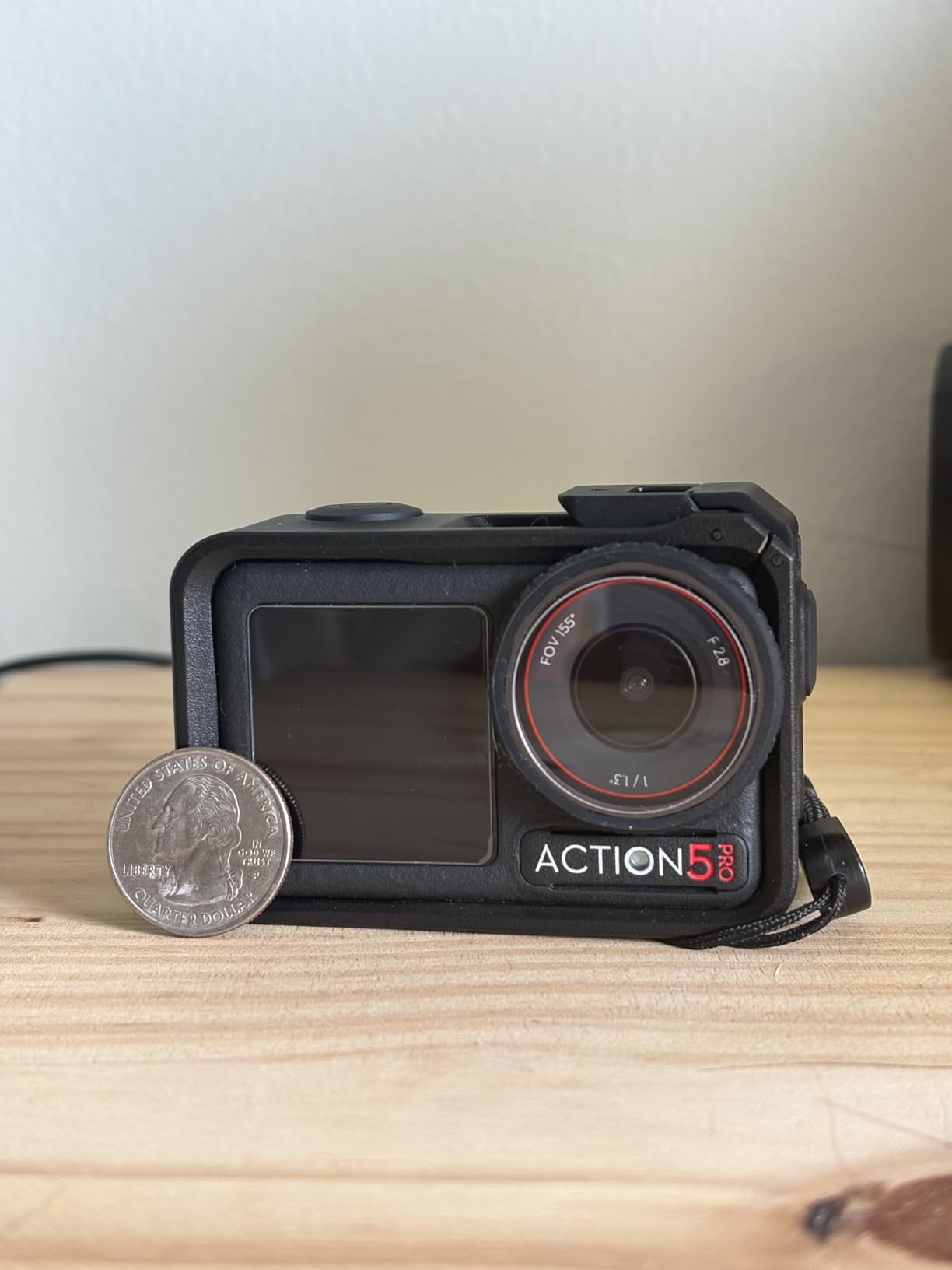
The 360 degree HorizonSteady mode is more useful on a dig than it sounds. Walking the length of an uneven trench with a standard action camera produces a rolling horizon on every frame; locking the roll axis means a section photograph can be levelled for publication without correcting it later.
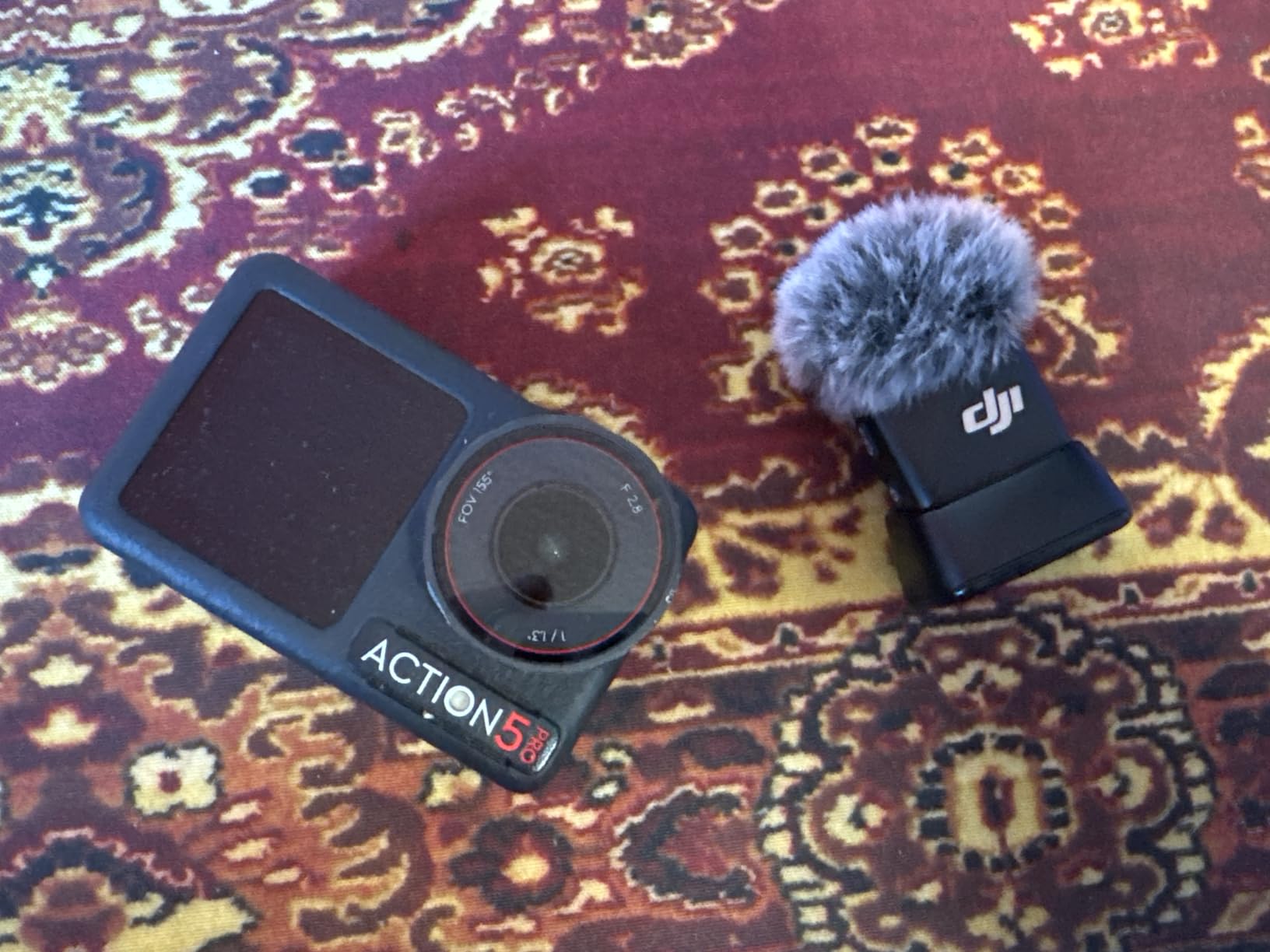
Battery figures matter more here than anywhere else in this guide. The 1950 mAh pack gives around four hours of recording, dropping to roughly 3.6 hours at minus 20 degrees Celsius, and reviewers consistently describe a full shift on one battery with a spare in the pack. The dual OLED touchscreens are bright enough to frame in hard sun without pulling the camera to your face and fogging it.
Where the Osmo Action 5 Pro earns its place
For confined space and underwater-adjacent work, the IP68 rating to 20 metres is the most generous sealing in this list, and there is no housing to lose. The colour temperature sensor handles the mixed lighting of a cave mouth, where daylight and a head torch fight each other, and sets white balance automatically.
For photogrammetry of confined spaces, the fixed wide lens is a real strength rather than a compromise. Structure from Motion work rewards a constant focal length, and users in r/photogrammetry consistently describe reaching for wide, fast, manual glass when scanning rooms and tunnels.
Where it falls short
The fixed focus lens is the honest limitation. A small finds photo at 10 cm is outside what this body does well, and there is no optical zoom to step back for a context shot. If your recording is a physical photograph rather than a video, this is a specialist tool rather than the main camera.
Stills are stills, but this is a video-first design. Reviewers note that the action-camera form factor suits video records better than a stills gallery, that the 2.5-inch screens are tight for inspecting fine detail on a coin or a sherd, and that there is no built-in GPS, so location data depends on pairing with a phone or GNSS module.
2. OM System Tough TG-7 – The Rugged Compacts Answer
Pros
- Waterproof to 15 m and dustproof
- Shockproof from 2.1 m
- Crushproof to 100 kg-force
- Freeze-proof to -10 C with anti-fog
- Macro capture from 1 cm
Cons
- 12 MP sensor limits cropping and print size
- 9-point contrast detection autofocus
- Digital stabilization and no viewfinder
- Dense menu system
The TG-7 is the body I hand to a student volunteer, because it is the least expensive way to get a genuinely sealed camera into the hands of someone who will not treat it gently. Waterproof to 15 metres, dustproof, shockproof to a 2.1 metre drop, crushproof to 100 kg-force, and freeze-proof to minus 10 degrees Celsius, it is the most comprehensively specified rugged body here.
The variable macro system is the reason archaeologists pick it. Four macro modes let you work down to 1 cm from the end of the lens, so a coin, a bone fragment or a decorated sherd can be photographed on the trench edge without unpacking anything. The F2.0 aperture keeps that close-focus shooting bright in a deep trench where the walls block the sky.
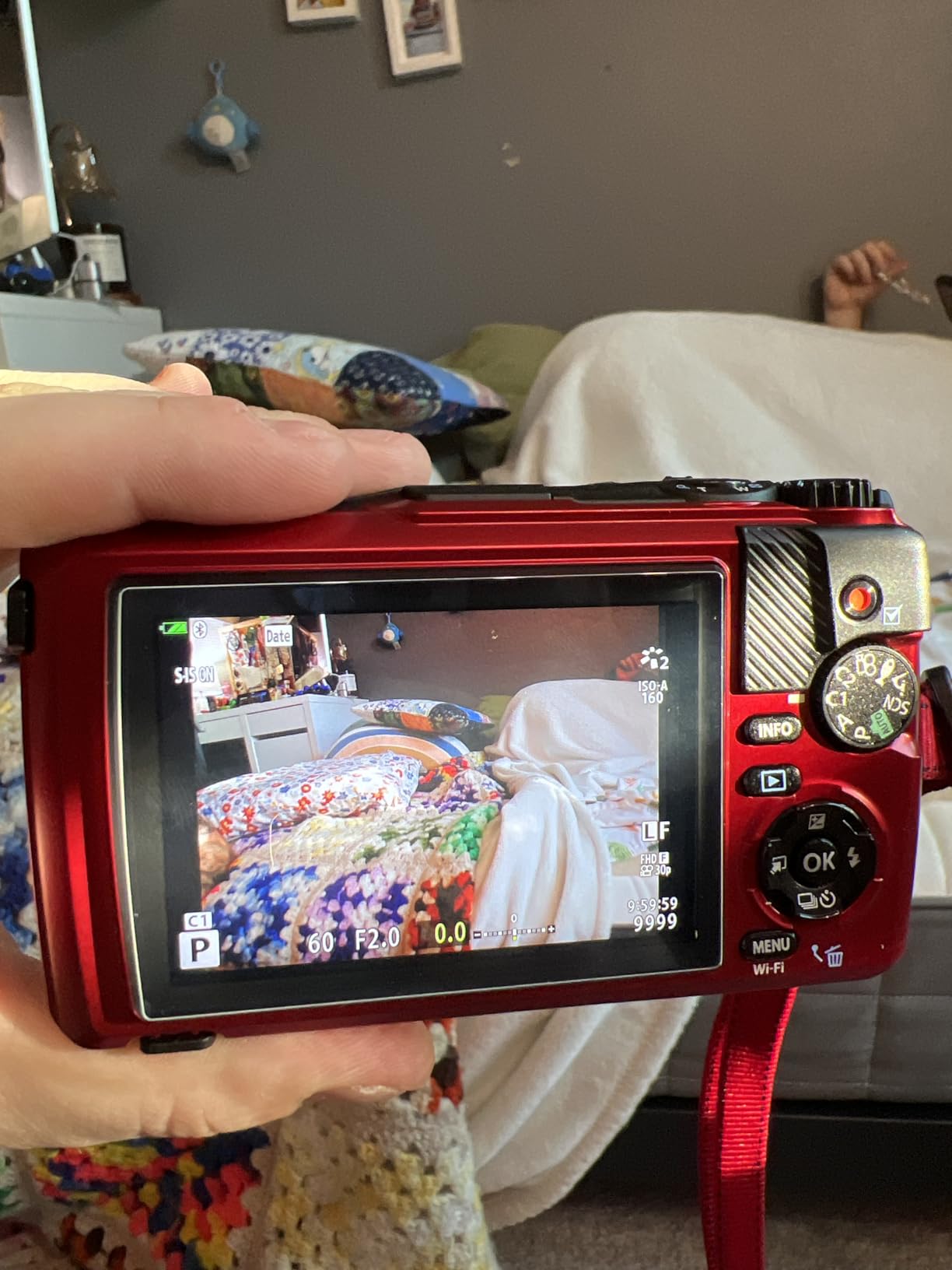
At 9 ounces it disappears in a chest pocket and runs all day. Reviewers describe owners who treat it as a working tool rather than a camera, and the 4K movie plus 120 fps high-speed mode covers process documentation where a still frame is not enough.
Five underwater modes, including an underwater microscope mode and underwater HDR, mean the same body handles a flooded trench and a riverbed site without a separate housing. The anti-fog function matters in Mediterranean and Middle Eastern fieldwork, where the temperature swing between a shaded trench and direct sun fogs a lens faster than most people expect.
What the TG-7 does that nothing else here does
One body covering context shots, close-up finds work and submerged survey is rare at this weight. The macro modes plus the 4x optical zoom spanning the 25 to 100 millimetre equivalent range cover most of a trench recorder’s day without a lens change.
For a first dig or a volunteer project, the durability specification is the argument. A body rated to survive a 2.1 metre drop and a hundred kilogram-force crush absorbs the kind of accident that ends a cheaper camera’s season, and spare batteries are trivial to carry.
What you give up for that sealing
The 12 MP sensor is the trade-off every reviewer mentions. Large pixels help in the low light of a trench, but 12 MP limits cropping and large-format printing later, and a finds specialist zooming in on a surface texture will feel the ceiling.
Autofocus is contrast detection with nine points, which is slow for anything moving, and stabilization is digital with no viewfinder for bright outdoor work. The fixed LCD also limits low-angle and overhead framing, and reviewers repeatedly describe the menu system as dense for anyone new to rugged compacts.
3. KODAK PIXPRO WPZ2 – The Field School Camera That Basically Cannot Be Broken
Pros
- Waterproof to 15 m and fully dustproof
- Shockproof from a 2 m drop
- No housing needed
- 4x zoom with 27 mm wide framing
- Built-in Wi-Fi transfer
Cons
- 1080p video only
- 3 fps continuous shooting
- Weak low light in cave interiors
- Basic contrast detection autofocus
- No GPS
Field schools run on tight money, and the WPZ2 solves that problem. Reviewers describe it as an inexpensive, near-indestructible companion: waterproof to 15 metres, shockproof from a 2 metre drop, and fully dustproof with no protective housing to lose or forget in a trench.
At 6.21 ounces it is the lightest body in this guide, which matters more than a spec sheet suggests. In r/AskPhotography the recurring complaint about carry weight comes up constantly, and a camera that fits in a dry bag beside a trowel and a water bottle gets carried all day instead of staying in the top of the pack.

The 16 MP backside-illuminated CMOS sensor gives usable files in daylight, and the 4x optical zoom plus 27 mm wide angle covers both a sweeping context shot and a tighter detail of a feature edge. Built-in Wi-Fi transfers the day’s images to a phone at base camp without a card reader.
For the archive, that simple transfer path is the real advantage. A person who is not a photographer will hand over a card at the end of the season; they will not remember a naming convention, and a body that pushes images automatically reduces the amount of manual filing the finds register requires.

Best for students, volunteers and survey days
Where the recording standard is simple and the budget is small, this camera earns its place quickly. Context shots in good light, a scale bar in frame, a 1080p video of a section face, and files that survive a season in a kit bag.
It is also a sensible second body for a project director. r/AskAnthropology threads show how many people arrive on a dig without any photography background at all, and a camera that cannot be damaged by a first-time user is worth more than a better sensor in hands that get dropped.
What it cannot do
Reviewers are candid that the 3 fps continuous shooting and 1080p-only video limit it, and that the small 1/2.3-inch sensor with 8-bit processing struggles in a cave or tomb interior. If your work involves dim, enclosed spaces, this is not the body.
Autofocus is basic contrast detection across 49 points and the menus need a few days to learn. There is no built-in GPS, so geotagged finds registers have to be handled by a separate device.
4. Canon EOS R6 Mark II – The Full-Frame Choice for Dark Shelter Interiors
Canon EOS R6 Mark II Mirrorless Camera (Body Only), Full-Frame Camera, 24.2 Megapixel CMOS Sensor, Photo and Video Capabilities, Black
Pros
- 24.2 MP full-frame holds detail at low ISO
- 40 fps electronic burst with 14-bit processing
- Dual Pixel CMOS AF II subject detection
- 5-axis stabilisation for hand-held site work
- 10 Gbps USB-C transfer
Cons
- Not sealed to a rugged IP rating
- No built-in flash or GPS
- Needs a housing in rain or dust
- Large body for a field pack
- Battery drains fast with the EVF always on
When a project involves tomb interiors, shelter photography or a cave survey that needs a real sensor, a full-frame body earns its extra bulk. The 24.2 megapixel sensor holds clean detail at low ISO, and owners describe it as a dependable low-light workhorse with 89 percent five-star ratings.
The 40 fps electronic shutter with 14-bit processing matters for finds photography, where a coin or a small fragment is often lifted, turned and photographed in a few seconds. Dual Pixel CMOS AF II with head, face, eye and animal detection plus automatic subject-type selection means a recorder can hand the camera to someone else and still get sharp frames.
Six hours of continuous Full HD recording and 6K oversampled uncropped 4K up to 60 fps cover the video side of a field record. The vari-angle touchscreen is genuinely useful in a trench, where framing a section face means crouching and angling the camera down rather than holding it at eye level.
Transfer is fast. Built-in 5 GHz Wi-Fi, Bluetooth 5 and 10 Gbps USB-C make it practical to move a full day of 24 MP files off the card at base camp without leaving the site overnight, which keeps the card small enough to format in the field.

Where a full-frame body is the right answer
For finds photography with a proper stand and controlled light, and for low-light interiors, sensor size does work no compact can match. The 5-axis in-body stabilisation at 1/2000s sync also allows hand-held shots at shutter speeds that would otherwise blur.
If your project is grant-funded and the camera spends its life in a dry box between shoots, sealing matters less than resolution and autofocus. A housing solves rain and dust for a fraction of the cost of replacing a body, and the R7 alternative covers many of the same needs at a lighter weight.
Where it is the wrong kit
Reviewers are consistent on the single biggest drawback: the body is not weather-sealed to the IP53 level of a rugged field body, so rain and dust require a housing. On a wet Mediterranean dig that is a daily friction point, not an occasional one.
It is also 1.3 pounds before a lens, with no built-in flash and no GPS, and owners report the battery draining fastest with the electronic viewfinder used constantly outdoors. For a photographer who carries one body all day on a shoulder strap, that is a real weight.
5. Sony Alpha 7 IV – Dual Card Slots and 33 MP for Photogrammetry
Pros
- 33 MP resolves fine surface detail on finds
- Dual CFexpress Type A and SD slots for redundant archiving
- 693 phase-detection points plus Real-time Eye AF
- 7K oversampled full-frame 4K 30p 10-bit
- 5-Axis SteadyShot stabilisation
Cons
- Not sealed for dust and rain
- No built-in flash or GPS
- 8 fps blackout-viewfinder shooting
- Dense menu system
- Bulky body and lens combination
For Structure from Motion work on a large site, the a7 IV is the body I recommend first, and the reason is one spec line. Dual CFexpress Type A and SDXC slots let you write a copy of every frame to a second card, which on a multi-week campaign means a single failed card does not end a season’s record.
Structure from Motion reconstruction also rewards resolution. Thirty-three megapixels of Exmor R detail across a full-frame sensor gives the software more feature points on a weathered stone surface or a carved frieze, and the 693 phase-detection points plus Real-time Eye AF make it practical to shoot a long overlapping sequence quickly rather than fighting focus on every frame.
The video side is genuinely useful for a site record. Seven-K oversampled full-frame 4K 30p 10-bit 4:2:2 with no pixel binning, plus 4K 60p 10-bit full pixel readout in all recording formats, produces files that hold up when a walkthrough video is archived alongside the stills.
Owners rate the body highly for resolution, dynamic range, eye autofocus and 10-bit 4K video, describing it as a dependable documentation body. The BIONZ XR engine keeps the buffer ahead of a slow card, which matters when you are shooting a rapid detail sequence of one context.
Why dual slots matter more than resolution here
Data integrity is the issue nobody in this category talks about properly. Mirrorsless bodies with a single slot put a whole season on one card, and r/AskAnthropology participants consistently describe storage and back-up anxiety as one of the real reasons they distrust their own kit.
In this list, three bodies offer genuine redundancy: the a7 IV with CFexpress plus SD, the Canon R7 with dual UHS-II SD, and the OM-1 Mark II with dual UHS-II. The action camera and the rugged compacts record to a single card, so they need a different backup plan, ideally a nightly copy to a laptop or a second device at base camp.
What the bulk costs you
It is not sealed for dust and rain, so wet trenches need a housing, and there is no built-in flash or GPS. Reviewers also flag the 8 fps blackout-viewfinder shooting as harder to follow on moving subjects and the Sony E menu system as dense.
The body and lens combination is bulky for long days on site. If the work is a six-week campaign with a car and a base camp tent, that is irrelevant. If it is a day survey with a 20 litre pack, the a6700 covers similar needs at a fraction of the size.
6. Sony Alpha a6700 – The Compact APS-C All-Rounder
Pros
- 26 MP APS-C with strong dynamic range
- Dedicated AI processor and Real-time Recognition
- Only 14.5 oz
- Good battery life for the class
- In-body stabilisation
Cons
- Overheats during long 4K 60p takes
- Single card slot with no dual backup
- Dense menu system
- High ISO weaker than larger sensors
- IBIS short of gimbal level
At 14.5 ounces this is the lightest interchangeable-lens body in the guide, and it does the job of a field documentation camera well. Reviewers call it a compact, premium-feel workhorse with class-leading AI autofocus, and the 26 megapixel APS-C sensor delivers sharp, vibrant images with a dynamic range that holds a bright trench wall and a shadowed section simultaneously.
The dedicated AI processor and Real-time Recognition lock onto subjects reliably, which is the difference between a camera a student can use unaided and one that needs a trained operator. That matters because on most digs, the person holding the camera is not a photographer.
Reviewers consistently praise the battery life for the class, and that supports a full shooting day on a single charge. A compact body that fits an everyday bag is one people actually carry, and a camera left in a vehicle is a camera that does not record the afternoon context.
Video is 4K 60p 6K oversampled 4:2:2 10-bit with Long GOP or All Intra formats, plus 4K 120p high frame rate capture, and recording capacity is around 120 minutes. In-body stabilisation helps both hand-held video and stills at slower shutter speeds.
A good balance for a mid-size project
For a project with a vehicle on site and staff who are not photographers, the combination of 26 MP, strong subject tracking and a 14.5 ounce body is hard to argue with. It is a sensible middle step between a rugged compact and a full-frame body.
It is also a good photogrammetry body for a small site, since the AI subject tracking reduces the retakes that ruin an overlapping sequence. The APS-C sensor gives a useful crop on a long lens, so a small find can be framed without moving the camera.
Where the compromises bite
The single card slot is the biggest drawback for fieldwork. Reviewers repeatedly note no dual-card backup for long field work, which is the same data integrity gap the a7 IV and the R7 close.
Overheating during long 4K 60p recording in hot conditions is the second, and it is a real problem on an open site in summer. High ISO performance is weaker than larger sensors in dark interiors, the menu system takes time to set up, and the in-body stabilisation does not reach gimbal-level smoothness for walking video.
7. Ricoh WG-80 – Six LED Lights for Small Finds
Ricoh WG-80 Orange Waterproof Digital Camera Shockproof Freezeproof Crushproof (International Version)
Pros
- All-weather chassis rated to 14 m for two hours
- Six LED macro lights ring the lens barrel
- High-visibility orange body
- 5x optical zoom
- 12-bit processing
Cons
- Slow menu and button response
- Single-point autofocus
- No optical stabilisation
- 1080p video only
- International version warranty differs
The WG-80 is built around one problem: photographing a small find at close range in poor light. Six LED macro lights ring the lens barrel, giving bright, uniform illumination at the exact distance where a ring flash on a bigger body would be in the way. No separate lighting kit is required at the trench edge.
Long-term owners describe stress-testing it on harsh jobs and report excellent durability, useful macro lighting and a good grip. The all-weather chassis is rated for underwater shooting to 14 metres for up to two hours, which also makes it a sensible body for a flooded context or a riverside site.
There is a practical field benefit to the orange finish that is easy to underestimate. A high-visibility body is easy to spot on a dig site and less likely to be left behind in a bucket, a trench corner or a car, and losing a camera to a lost-property pile costs a season.
The 5x optical zoom covering the 28 to 140 millimetre equivalent range handles both a wide site view and a tighter detail, and the back-illuminated 16 megapixel sensor gives good high-sensitivity performance with low noise for its class. Dedicated underwater still and movie modes tune colour and contrast for in-water capture.
For the finds specialist on a wet site
If your recording standard calls for a lit, scaled, straight-down image of every small find, the built-in lighting is the feature that makes this body hard to replace. It also works in a shelter or tomb interior where bringing a flash rig is impractical.
For students and volunteers who shoot all day without thinking about the camera, the macro stand and button layout make close-up work straightforward once the initial learning curve is past.
What gives it away as a first choice
Reviewers are blunt about responsiveness. The menu and button response is noticeably slow, which is frustrating when documenting finds in sequence, and autofocus has a single point, so it is not suited to anything moving.
There is no optical image stabilisation in the lens and video is 1080p only. The small 1/2.3-inch sensor has seen little generational progress over earlier WG models, and the international version carries different warranty and accessory support than domestic stock, which matters for a project that needs a repair pathway.
8. PENTAX WG-90 – The Wet Site Workhorse, With One Caveat
PENTAX WG-90 Black Waterproof Camera, Shockproof, Dustproof, Freezeproof, Built-in 6-LED Ring Light for Macro Photography, Underwater Shooting Mode
Pros
- Waterproof to 14 m for two hours
- Shockproof from 1.6 m
- Freeze-proof to -10 C
- Six LED macro lights plus microscope mode
- Included macro stand for 1 cm focus
Cons
- Reports of water ingress through the card door
- Less robust housing than earlier WG bodies
- Auto exposure needs manual tweaking
- 1080p video only
- No Wi-Fi or GPS
The WG-90 is specified like a piece of site equipment rather than a camera: waterproof to 14 metres for two hours, shockproof from 1.6 metres, and freeze-proof to minus 10 degrees Celsius. On a northern European dig that runs through winter, the freeze rating is as important as the water rating.
The Digital Microscope mode captures detail normally invisible to the eye, and the included macro stand holds a one centimetre minimum focusing distance for extended close observation. That combination makes it a strong finds body, particularly where a decorated sherd or a tool edge needs to be documented without a lab.

At 6.72 ounces with triple anti-shake protection and a 2.7 inch AR-coated screen with an outdoor view setting mode, it is built to be read in glare. The back-illuminated 16 megapixel CMOS sensor runs to ISO 6400, which is modest but usable in a shelter interior.
The lower rating on this body is not about ruggedness, which reviewers confirm, but about one specific failure. Several owners report water ingress through the battery and card door cover, damaging the camera, and the low 4.1 score largely reflects that.

When the WG-90 is the right call
For a winter dig, a wet dig, or a project where a replacement body is a phone call away, the specification is compelling. Users rely on it as a durable, long-battery field or inspection camera that survives drops and dust.
The 5x optical zoom with 28 millimetre wide-angle coverage frames both finds and sweeping site views, which is a wider range than most of the rugged compacts at this weight manage.
The caveat you need to know before buying
Check the door seals every morning before you leave base camp, and keep a dry bag in your kit. The ingress reports are specific to the battery and card door cover, and a camera that fails in week three of a season is a worse outcome than a slightly slower one.
Auto exposure and autofocus need manual tweaking to get the best results, full HD 1080p H.264 video is the only recording format, and this listing has no built-in Wi-Fi or GPS for transfer or geotagging. The housing quality is also seen as less robust than earlier WG-series bodies.
9. Canon EOS R7 – High Resolution with a Real Backup Path
Pros
- 32.5 MP APS-C resolves fine finds detail
- 651 AF zones covering the frame
- 15 fps mechanical and 30 fps electronic
- Dual UHS-II SD slots
- Extra LP-E6NH battery included
Cons
- Not weather sealed to a rugged IP rating
- APS-C weaker than full frame in dark interiors
- 4K clips limited to about 30 minutes
- No built-in flash or GPS
- Body-only kit needs a lens
The R7 sits in the middle of this list and wins on a specific combination: 32.5 megapixels of APS-C detail, dual UHS-II SD card slots, and 651 autofocus zones covering roughly the full width and height of the frame. That last figure is what makes it fast to use, because the focus point is effectively wherever you put it.
RAW Burst Mode with half-second pre-shooting is interesting for finds work. Lift a coin, start shooting, and the camera has already recorded the frames before the button was pressed, which saves retakes on a small object being handled.
The dual slots mean every frame can be written twice, so a corrupted card at the end of a season is a recovery problem rather than a catastrophe. Owners rate the body highly for fast, accurate autofocus, high-resolution detail and strong 4K video, treating it as a light, capable field body.
At 1.1 pounds with an included extra LP-E6NH battery, it is lighter than the full-frame options and shipped with a spare that matters on a remote site. The 5-axis in-body stabilisation with auto-level keeps horizons straight on hand-held low-light stills, which is useful when the alternative is a tripod on uneven trench ground.
Who should buy the R7
A project director buying on a grant who needs a redundant card path, a high pixel count for finds and structures, and a body light enough to hand to different recorders through a season. The bundled battery removes one line from the spares budget.
For photogrammetry of a mid-size site, the combination of 32.5 MP and a fast, wide coverage AF system produces a long overlapping sequence without constant refocusing, which is the practical requirement behind a clean reconstruction.
Where it will not work
It is not weather sealed to a rugged IP rating, so rain and dust require a housing, and reviewers note the APS-C sensor is weaker than full frame in dark cave and tomb interiors. For a sealed body in bad weather, the OM-1 Mark II covers the same ground differently.
4K recording is limited to about 30 minutes per clip, there is no built-in flash or GPS, and a body-only kit needs a lens sourced separately. Very wide or long glass for structure recording has to be bought as an extra.
10. OM System OM-1 Mark II – IP53 Sealing on an Interchangeable-Lens Body
OM SYSTEM Olympus OM-1 Mark II Micro Four Thirds System Camera 20MP BSI Stacked Sensor Weather Sealed Design (US Manufacturer Warranty)
Pros
- IP53 dustproof and splashproof
- Freeze-proof to -10 C
- Stacked BSI sensor with low noise
- 1053-point all cross-type AF
- Focus stacking and High Res Shot
Cons
- Smaller sensor than full frame for extreme low light
- 20 MP is modest next to 26-33 MP bodies
- Body-only pricing with slower legacy lens options
- Deep menus need setup time
- High-res modes are computational
The OM-1 Mark II is the only interchangeable-lens body here with a stated IP53 rating covering dust, splash and freeze-proofing to minus 10 degrees Celsius. That single line removes the housing argument that weakens every other mirrorless camera on this list, which is why it earns the final recommendation for anyone who photographs in the open.
The stacked BSI Live MOS sensor handles the dark case better than its 20.4 megapixel count suggests, because stacked sensors read out fast and hold noise down. Reviewers highlight the genuinely field-ready sealing, the low-noise stacked performance and the computational stacking tools as the best combination in the class for harsh outdoor documentation.
That computational set is unusually relevant to archaeology. Focus Stacking merges a series of frames into one image with everything sharp, which is exactly what a coin or a sherd photographed at close range needs when a single depth of field will not hold it.
Handheld High Res Shot, Live GND, Live ND, Handheld Live Composite and HDR are the other entries, and they are the reason Micro Four Thirds bodies keep appearing on archaeology projects with modest budgets. The 1,053-point all cross-type Cross Quad Pixel AF covers the whole frame at 100 percent, and dual UHS-II slots give the redundant archiving.
The right body when weather beats resolution
If the season runs in rain, on exposed coastal sites, or through a northern winter, sealing is the priority and this body delivers it without a housing. The 1.1 pound weight also keeps it out of a different weight class from the full-frame options.
For structural recording with older Micro Four Thirds glass, it is also the most practical body here, because the existing lens ecosystem is wide, well corrected and far smaller than equivalent full-frame glass.
Where the compromises sit
The Micro Four Thirds sensor is smaller than full frame, which limits extreme low light and heavy cropping headroom, and 20 megapixels is modest next to the 26 to 33 megapixel bodies in this list. Reviewers balance that against the sealing rather than dismissing it.
Body-only pricing sits at full-frame money while the faster legacy Micro Four Thirds lens options remain limited, the deep menu system and computational modes need real setup time, and the high-resolution and Live ND modes are computational rather than true optical or raw equivalents.
What Type of Camera Is Best for Photogrammetry?
For archaeological photogrammetry, any camera that shoots RAW with manual exposure control works, and a fixed-focal-length body is usually better than a zoom because the software expects the same lens across every frame in a set. Sensor size and ruggedness matter far less than the discipline of keeping aperture, shutter and ISO fixed for the whole overlap sequence.
The practical recommendation is a mirrorless or compact body with a manual mode, a locking exposure option, and enough resolution to hold detail: anything from roughly 20 megapixels upward reconstructs well. Resolution beyond about 33 megapixels adds processing time more than it adds usable surface detail at typical trench distances.
Four settings cover the majority of successful site scans:
Fix the exposure manually and disable auto ISO, so every frame in the set shares the same brightness.
Keep the lens at one focal length for the entire pass, because a zoom changes the geometry between frames.
Shoot RAW, not JPEG, so the reconstruction can correct exposure and white balance afterwards.
Overlap consecutive frames by roughly two-thirds, and keep lighting constant by avoiding flash and moving shade.
Users in r/photogrammetry consistently reach for wide, fast, well-corrected manual glass when scanning interiors, and the same community reports that the deciding factor is control and exposure consistency rather than resolution. That is the same conclusion this guide reaches from the durability side.
Where a full trench section needs to be captured in one pass rather than reconstructed, a 360 camera is already standard practice on some projects. r/photogrammetry users describe placing an Insta360 in the middle of the trench to record the whole context alongside regular stills, and for overview footage a pocket camera such as one of our compact video bodies covers the same ground.
What to Look for in a Camera for Archaeology Fieldwork
Weather sealing and IP ratings, decoded
IP ratings are the least understood spec in this category, so here is the plain-English version. IP53 means dust-protected against ingress up to a metre, and protected against spraying water from any direction, with the second digit covering water and the first covering solids. IP68 means dust-tight and protected against continuous immersion at a stated depth and duration.
IP53 is a splash rating, not a dive rating, but it is exactly what a trench in a wet season asks for. The only body here with a stated IP53 rating on an interchangeable-lens camera is the OM-1 Mark II. The action camera is rated IP68 to 20 metres, and the rugged compacts carry manufacturer waterproof depths of 14 to 15 metres.
Everything else in this guide, including both full-frame bodies and the APS-C bodies, needs a housing in sustained rain or blowing dust. Owners repeatedly flag this, and it is the single most common regret reported.
RAW capture and dual card slots for a season-long record
Shoot RAW for the record, not JPEG. RAW keeps the exposure latitude to correct a badly lit section face or a white balance ruined by mixed torch and daylight, and it is a requirement for any photogrammetric workflow. Reviewers note the action camera records RAW, and the mirrorless bodies all do by default.
Dual card slots are the difference between a lost card and a lost season. In this list, the Sony a7 IV, the Canon R7 and the OM-1 Mark II write to two cards simultaneously; the rest need a nightly copy to a second device.
Back up at base camp every evening, not at the end of the dig. A second card, a laptop, and a power bank weigh almost nothing next to a season of unrecorded contexts.
Battery logistics on a site with no mains power
Treat battery life as a logistics problem rather than a spec line. Reviewers consistently report the action camera reaching about four hours of recording per 1950 mAh pack and 3.6 hours at minus 20 degrees Celsius, and the WPZ2 and WG-90 at roughly two hours of heavy use on a small cell.
Carry a minimum of two spare batteries per body and a USB-C power bank, and charge from a vehicle where possible. Cold reduces capacity, so in a northern winter the second battery in your jacket pocket outperforms the fourth in your pack.
For lighting, our speedlight guide covers the units that solve the same problem with a flash rather than a spare cell.
Macro range for finds and small artefacts
Context shots are easy. Finds photography is the hard part, because a coin or a bone fragment needs to be framed, lit and held in scale, usually in the shade of a trench wall.
Look for a minimum focus distance near 1 cm and a bright maximum aperture. The TG-7 shoots from 1 cm across four macro modes with an F2.0 lens, the WG-80 and WG-90 add a six LED ring light around the lens barrel, and the OM-1 Mark II offers focus stacking as a software answer to shallow depth of field.
A fixed stand helps more than people expect. The WG-90 ships with a macro stand that holds a one centimetre minimum focus distance so you can compose without a tripod.
Weight, gloves and one-handed operation
Weight is the spec that gets discussed most in camera forums and least in buying guides. Users in r/AskPhotography consistently favour ultra-compact bodies and question weight more than resolution when carrying kit all day, and the same applies on a dig where you are already carrying a trowel, a water bottle and a finds tray.
The bodies here span 6.21 ounces for the WPZ2 up to 1.3 pounds for the R6 Mark II, and that range matters more than any sensor format. A camera that is comfortable to hold is one that gets used.
Gloves are the second half of this. On a cold morning, a body with large physical buttons and a direct control layout is usable, and one that requires a menu dive is not. Check the shutter release and the mode dial before the season starts, with cold hands, at base camp.
GPS and the link to the finds register
University fieldwork training pairs photography with survey instruments, a total station and a Trimble GPS, which is why a camera’s own geotagging is a genuine differentiator rather than a gimmick. An image tagged to a trench coordinate is much easier to match to a context sheet.
None of the ten bodies here has built-in GPS, so plan for that. Either pair a phone and accept the extra step, or record the context number in the file name and the frame, which is the practice most projects settle on.
Is a phone enough?
Often, yes. A modern phone handles context shots, section overviews, quick video and a first season of a field school, and for students with no equipment budget the honest answer is to borrow a department camera before buying one.
It falls down in three places. RAW access is limited on many phones, so exposure cannot be corrected later. Manual exposure control is clumsy, and consistent exposure is what holds a photogrammetric reconstruction together. And there is no sealed body, so a single drop into a wet trench can end it.
Community advice in r/photogrammetry is that you can use a phone, but control, exposure consistency and RAW access determine whether the reconstruction holds.
How to shoot a feature to the recording standard
Whichever body you choose, the sequence is what makes a record defensible rather than merely illustrative. Six steps cover a feature reliably:
Start with a wide context shot containing the scale bar and the north arrow, taken before anything is moved.
Add a colour checker in the first frame of the series so colour can be corrected later against a known reference.
Move closer and photograph the feature straight down, in order, without rearranging the deposit between frames.
Photograph each small find in place with its context number visible, then lift it and shoot a scaled detail.
Keep exposure, aperture and white balance identical across a detail series so the set can be compared and stitched.
Shoot a labelled overview at the end, and copy the day’s files to a second device before the card is formatted.
Consistency across a series matters far more than individual frame quality, and this is where a body with fixed manual controls earns its cost.
Frequently Asked Questions
What type of camera is best for photogrammetry?
Any camera that shoots RAW and allows manual exposure control will work, and a fixed-focal-length body is usually better than a zoom because photogrammetry software expects identical lens geometry across every frame. Keep aperture, shutter and ISO locked for a whole pass, and shoot in RAW. About 20 megapixels is enough for most site work, and resolution above roughly 33 megapixels adds processing time rather than usable surface detail.
What are the recommended camera settings for photogrammetry?
Set exposure manually with auto ISO disabled, keep the lens at a single focal length for the entire pass, shoot RAW rather than JPEG, and overlap consecutive frames by roughly two-thirds. Avoid flash and keep lighting constant, because moving shade changes the exposure between frames and leaves visible patches in the finished model.
Can I use my phone for photogrammetry?
A phone can work for small scans when the app gives you RAW capture, manual exposure and a fixed focal length. It struggles once you need long sequences at consistent brightness, or when a single drop into a wet trench can end the job. For a first field school, a phone plus a borrowed sealed camera is a realistic combination.
What is the best field camera available right now?
For most archaeological fieldwork the choice comes down to three filters: a stated dust and water rating, RAW capture, and battery endurance for a full shooting day. Bodies that satisfy all three out of the box are the OM System Tough TG-7, the DJI Osmo Action 5 Pro and the KODAK PIXPRO WPZ2; the mirrorless options add resolution but need a housing in rain.
Which camera is the best ruggedized camera?
The DJI Osmo Action 5 Pro carries the deepest sealing in this list, rated IP68 to 20 metres with no housing required. The OM System Tough TG-7 is the most fully specified rugged compact, rated waterproof to 15 metres, shockproof to 2.1 metres, crushproof to 100 kg-force and freeze-proof to minus 10 degrees Celsius.
What is the best waterproof camera for outdoor use?
For underwater and flooded-site work, the DJI Osmo Action 5 Pro is rated IP68 to 20 metres, while the TG-7 reaches 15 metres and the Ricoh WG-80 and PENTAX WG-90 reach 14 metres for up to two hours. Note that the WG-90 has owner reports of water ingress through the card door, so check the seals daily on a wet dig.
How do archaeologists photograph finds?
The standard sequence is a wide context shot containing a scale bar and north arrow, followed by a colour checker frame, then a systematic detail series shot straight down at consistent exposure, and finally a scaled close-up of each small find with its context number visible. RAW plus JPEG, consistent exposure across the series, and an end-of-day copy to a second device protect the record.
The Right Camera for the Dig You Are Actually On
Start with the DJI Osmo Action 5 Pro if the site is wet, underground or hard on bodies. Start with the OM System Tough TG-7 if you want one sealed camera that also does close-up finds work, or hand one to a volunteer. Start with the KODAK PIXPRO WPZ2 if the budget is small and the recording standard is simple.
Move up to the Sony Alpha 7 IV or Canon EOS R7 when a season of record matters more than a season of weather, because both write to two cards at once. Reach for the Canon EOS R6 Mark II for dim interiors, the Sony Alpha a6700 for a light carry, the Ricoh WG-80 or PENTAX WG-90 for lit close-up finds work, and the OM System OM-1 Mark II when you need a sealed interchangeable-lens body.
Whichever you pick, shoot RAW, keep a scale bar and north arrow in the first frame of every series, and copy the day’s files to a second device before you format the card. That habit matters more than any spec on this list. These are the best cameras for archaeology fieldwork in 2026, and the recording standard they serve is unchanged since the first trench photograph was taken.