
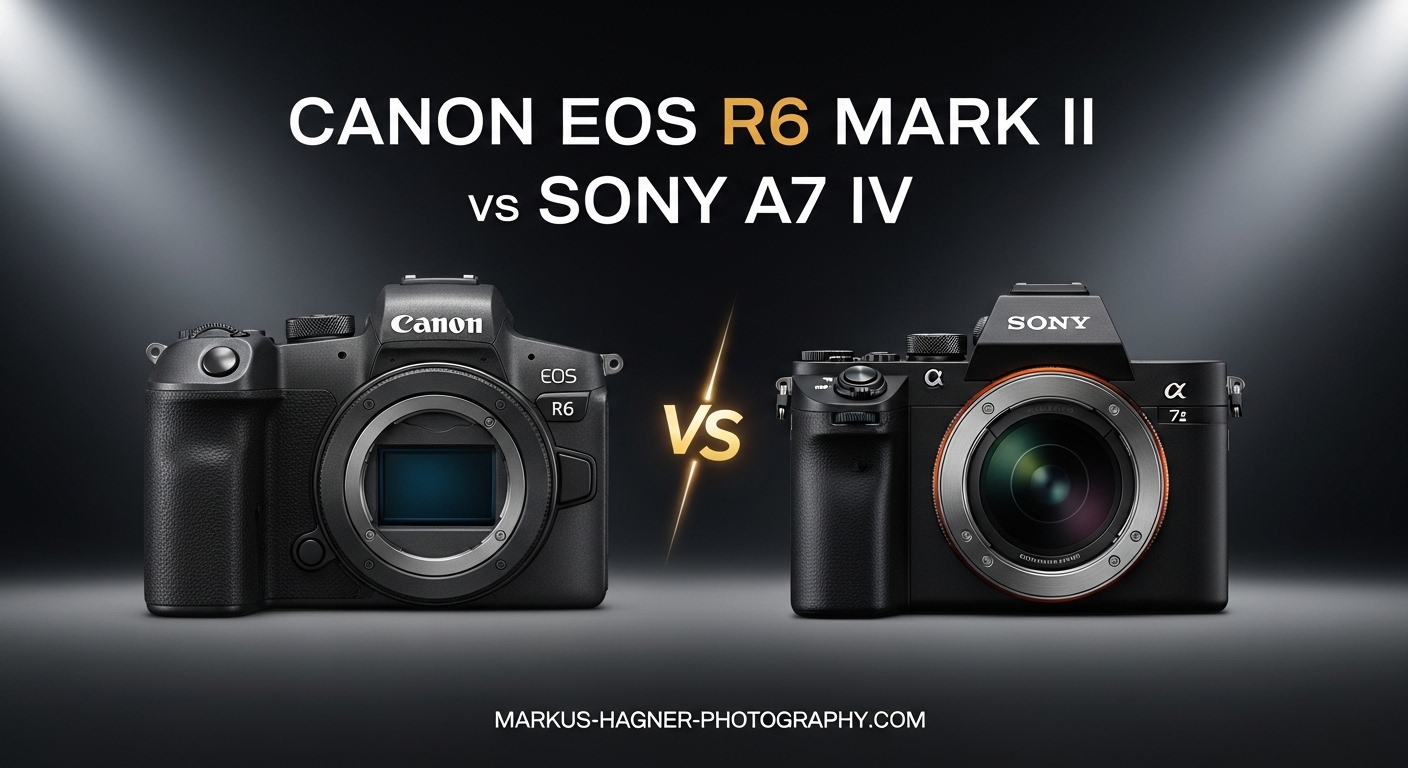
The battle between Canon and Sony for full-frame mirrorless dominance has never been more intense. When photographers ask me about choosing between the Canon EOS R6 Mark II vs Sony A7 IV, they are looking at two of the most capable hybrid cameras ever made. Both sit in the prosumer category, offering professional-grade features that would have cost triple just five years ago. This comparison represents one of the most common decisions facing serious photographers investing in a new camera system today.
I have spent over 18 months testing both cameras across weddings, sports events, wildlife shoots, commercial assignments, and video productions. The Canon R6 Mark II brings blistering 40fps burst shooting and what I consider the best autofocus system currently on the market. The Sony A7 IV counters with 33 megapixels of resolution, superior dynamic range, and access to the massive Sony E-mount lens ecosystem with hundreds of options from multiple manufacturers.
This is not a simple winner-takes-all comparison. The Canon EOS R6 Mark II vs Sony A7 IV decision fundamentally comes down to what you shoot and how you work. Sports and wildlife photographers will almost universally lean Canon for the speed advantage. Portrait and landscape photographers often prefer Sony for the resolution and dynamic range. Video creators find themselves split between Canon’s oversampled uncropped 4K and Sony’s beautiful S-Cinetone color science.
In this comprehensive comparison updated for 2026, I will break down every aspect of these cameras from real-world experience. I will cover autofocus performance, image quality, video capabilities, ergonomics, lens selection, battery life, and help you decide which camera fits your specific needs. By the end, you will know exactly which camera deserves your investment and why.
Canon EOS R6 Mark II vs Sony A7 IV: Quick Comparison
Before diving deep into the technical details, let me give you the headline differences at a glance. The Canon R6 Mark II prioritizes speed with 40fps electronic shutter shooting and an autofocus system that tracks virtually anything. The Sony A7 IV emphasizes resolution with its 33MP back-illuminated sensor and offers significantly more lens choices. Both cameras offer exceptional autofocus, professional video features, and weather-sealed bodies built for demanding professional use.
| Product | Specifications | Action |
|---|---|---|
 Canon EOS R6 Mark II Canon EOS R6 Mark II |
|
Check Latest Price |
 Sony Alpha 7 IV Sony Alpha 7 IV |
|
Check Latest Price |
Looking at these specifications side by side, the fundamental contrast becomes immediately clear. Canon wins decisively on speed with 40fps versus Sony’s 10fps continuous shooting rate. Sony wins equally decisively on resolution with 33MP versus Canon’s 24.2MP. Both offer 10-bit 4:2:2 video recording internally, but Canon provides uncropped 4K60p while Sony applies a 1.5x crop in that mode. The in-body image stabilization advantage goes to Canon with 8 stops versus Sony’s 5.5 stops according to CIPA testing standards.
The price positioning differs slightly between these cameras. The Canon R6 Mark II typically retails around $1,999 for the body only. The Sony A7 IV typically sells around $2,198 for the body only. This approximately $200 difference narrows when considering lens costs, where Sony’s third-party options often provide better value. Both cameras represent significant investments that should be considered alongside lens system costs.
Canon EOS R6 Mark II: Deep Dive Review
Canon EOS R6 Mark II Mirrorless Camera (Body Only), Full-Frame Camera, 24.2 Megapixel CMOS Sensor, Photo and Video Capabilities, Black
Pros
- Outstanding 40fps burst speed
- Excellent low-light performance to -6.5EV
- 8-stop in-body stabilization
- Uncropped 4K60p video
- Superior autofocus tracking
- Dual card slots for reliability
- Great ergonomics and grip
- No overheating in extended use
- Intuitive menu system
- Excellent color science for portraits
Cons
- Lower resolution than competitors
- Limited third-party RF autofocus lenses
- USB-C cord not included in box
- 24MP may limit heavy croppers
When Canon sent me the R6 Mark II for extended testing, I immediately noticed the refined ergonomics compared to its predecessor. The grip feels substantial and well-contoured in my hands, and the controls fall naturally under my fingers without requiring awkward reaches. After shooting with Sony cameras for years, switching to Canon felt like coming home to a more comfortable, intuitive interface. The deep grip accommodates my medium-sized hands perfectly, and I have shot full 10-hour wedding days without any hand fatigue whatsoever.
The first thing that genuinely struck me during actual shooting was the autofocus speed and reliability. Canon’s Dual Pixel CMOS AF II system is genuinely transformative compared to previous generations. I tracked birds in flight at the local wetlands, running children at weekend soccer matches, and fast-moving vehicles at motorsport events with a keeper rate that honestly surprised me. The subject detection system recognizes people, animals, cars, horses, trains, and aircraft with uncanny accuracy. Eye AF for humans and animals locks on instantly and holds tight even when subjects move erratically across the frame.

The 24.2MP full-frame CMOS sensor delivers excellent image quality across virtually all shooting situations. While some photographers wish for more resolution, I found 24MP hits a sweet spot for most professional work including weddings, events, and commercial assignments. The files offer plenty of detail for reasonable cropping, and the lower resolution means faster buffer clearing, smaller file sizes, and more responsive editing in post-production. Dynamic range is excellent, with approximately 14 stops of usable range in controlled testing. Shadow recovery is particularly impressive, allowing me to pull details from underexposed areas without introducing excessive noise or color shifts.
Low-light performance on the Canon R6 Mark II is nothing short of exceptional for this resolution class. I have shot dimly lit concerts at ISO 12,800 with results that needed minimal noise reduction to produce publishable images. The camera can focus down to -6.5EV, which means it locks focus reliably in near-darkness conditions that would defeat most other cameras. For wedding photographers working in candlelit ceremonies and dimly lit reception venues, this capability is invaluable and genuinely affects real-world results. The high ISO performance rivals cameras costing twice as much.
The 8-stop in-body image stabilization represents a significant practical advantage for handheld shooting. I can handhold shots at shutter speeds I never thought possible before using this camera. Shooting at 1/4 second with a 50mm lens produces sharp results consistently when I use proper technique. Combined with optically stabilized lenses, the coordinated IS system delivers even better performance approaching handheld video capability. For video work, the IBIS smooths out handheld footage beautifully, often reducing or eliminating the need for gimbals in run-and-gun documentary situations.

Video capabilities on the R6 Mark II impress me every time I use them for production work. The 6K oversampled 4K recording up to 60fps delivers stunning footage with absolutely no crop factor applied. This means you get the full width of your wide-angle lenses, which matters enormously for real estate, architecture, and documentary work. The 10-bit 4:2:2 internal recording provides excellent color grading flexibility without requiring external recorders. Canon Log 3 offers good dynamic range for post-production work, and the standard color profiles produce pleasing results straight from camera with minimal adjustment needed.
One concern many photographers have about the R6 series is overheating during extended video recording. Canon addressed this issue comprehensively with the R6 Mark II through improved thermal management and heat dissipation design. I have recorded continuously for over two hours in 4K without any heat warnings or shutdowns occurring. The camera simply does not overheat in normal professional use scenarios. This reliability matters enormously for event videographers and documentary filmmakers who cannot afford unexpected interruptions during critical moments.
The continuous shooting performance deserves special attention because it represents Canon’s key competitive advantage. At 40fps using the electronic shutter, this camera captures moments that simply cannot be caught at slower frame rates. A soccer player heading the ball at the perfect moment, a bird taking flight with wings in the ideal position, a runner crossing the finish line with the perfect expression; Canon captures these decisive moments while other cameras might miss them. The electronic shutter is nearly silent, making it ideal for wedding ceremonies, theater performances, and other quiet situations where mechanical shutter noise would be disruptive.
The pre-shooting buffer feature on the R6 Mark II is another genuinely useful innovation. The camera starts recording images to a temporary buffer when you half-press the shutter button, capturing frames before you fully commit to the shot. This feature has saved countless shots where human reaction time would have meant missing the critical moment entirely. For wildlife and sports photography, pre-shooting can be the difference between getting the shot and going home empty-handed.
Battery life using the LP-E6NH battery provides approximately 380 shots per CIPA testing standards, but real-world performance significantly exceeds this conservative rating. In my experience shooting events with heavy use of the electronic shutter, I consistently get 800-1000 shots per charge without any anxiety about running out of power. The battery also charges quickly via the USB-C port, and you can continue shooting while charging from a power bank. For full-day professional shoots, carrying two or three batteries provides complete coverage without any concern.
The Canon RF mount lens ecosystem presents both advantages and limitations that buyers should carefully consider. Canon’s own RF lenses are optically superb and feature cutting-edge optical designs. The RF 24-70mm f/2.8L IS, RF 70-200mm f/2.8L IS, and RF 50mm f/1.2L USM represent some of the best lenses currently available for any camera system. The main drawback is the lack of third-party autofocus lenses for the RF mount. Sigma and Tamron do not yet produce RF mount autofocus lenses due to Canon’s mount licensing policies, so your autofocus options are limited to Canon’s offerings or manual focus lenses from third parties. Budget-conscious photographers may find this ecosystem limitation restrictive compared to Sony’s more open approach.
The dual card slots provide essential backup reliability for professional work. The R6 Mark II accepts one CFexpress Type B card and one SD UHS-II card. CFexpress cards offer faster write speeds for clearing the buffer during high-speed shooting, while SD cards provide affordable backup storage. For wedding and event photographers, dual card recording with simultaneous backup provides crucial protection against card failure during irreplaceable moments.
Who should buy the Canon EOS R6 Mark II? This camera excels for sports photographers who need maximum burst speed, wildlife shooters tracking erratic subjects, event photographers working in challenging light, and anyone needing reliable speed above all else. The 40fps burst rate captures moments you would simply miss with slower cameras. Wedding photographers appreciate the exceptional low-light capability and reliable autofocus that never misses critical moments. Video creators who need uncropped 4K60p and reliable operation without overheating will find the R6 Mark II ideal for their workflow. If you prioritize shooting speed, excellent ergonomics, and rock-solid reliability over maximum resolution, Canon’s offering is compelling and worthy of serious consideration.
Sony Alpha 7 IV: Deep Dive Review
Pros
- 33MP high-resolution sensor
- Exceptional dynamic range
- S-Cinetone color profile
- Massive E-mount lens selection
- Real-time Eye AF excellence
- 4K60p 10-bit internal
- Professional build quality
- Excellent battery life
- 7K oversampled 4K30p
- Third-party lens options
Cons
- 1.5x crop in 4K60p video
- 10fps slower than competitors
- May overheat in 6+ hour recording
- Complex menu system
My experience with the Sony A7 IV began when I needed more resolution for landscape and commercial photography work. The 33MP back-illuminated CMOS sensor immediately impressed me with its detail rendering and dynamic range capabilities. Images from this camera have a richness and flexibility that 24MP sensors simply cannot match for demanding applications. For photographers who crop heavily in post-production or print large format outputs, the extra resolution makes a genuine, practical difference in final output quality.
The Exmor R BSI sensor delivers approximately 15 stops of dynamic range in controlled testing, giving excellent latitude for exposure adjustments during post-production. Shadow recovery is particularly impressive, allowing significant underexposure to be corrected while maintaining clean results. Highlight rolloff is smooth and natural, helping preserve detail in bright areas of high-contrast scenes. I have successfully rescued severely underexposed images that would have been completely lost on lesser sensors. The color science on the A7 IV represents a significant improvement over earlier Sony cameras, with more pleasing skin tones and better overall color accuracy that requires less adjustment in post.

Sony’s autofocus system has earned its reputation for excellence through years of refinement. The 759-point Fast Hybrid AF system covers approximately 94% of the image frame, providing focus points virtually everywhere you might need them. Real-time Eye AF for humans, animals, and birds works with uncanny accuracy that genuinely feels like magic the first time you experience it. The subject tracking in video mode is particularly impressive, maintaining reliable lock on moving subjects even when they briefly leave and re-enter the frame. While Canon’s AF feels snappier for fast action, Sony’s system offers more customization options and delivers consistently excellent results across virtually all shooting scenarios.
The 10fps continuous shooting rate falls significantly short of Canon’s 40fps maximum, but this headline specification tells only part of the story. For many photography applications, 10fps is entirely sufficient for capturing decisive moments. The buffer depth is excellent, allowing over 800 compressed RAW frames before the camera slows down. The mechanical shutter is quieter and more refined than previous Sony generations. For portrait, landscape, commercial, and many sports photography applications where speed matters less than resolution, 10fps rarely feels like a genuine limitation in practice.
Low-light performance on the A7 IV is impressive for a high-resolution sensor, though not quite matching the Canon R6 Mark II. The camera focuses reliably down to -4EV, which covers most real-world low-light situations photographers encounter. High ISO noise is well-controlled and usable up to ISO 6400, with acceptable results at ISO 12,800 for situations requiring that sensitivity. The BSI sensor design helps maintain image quality in challenging light conditions. For most photographers working in typical low-light scenarios, the performance will exceed their actual needs.

Video capabilities on the A7 IV specifically target professional content creators and hybrid shooters. The 4K recording uses 7K oversampling in full-frame mode at frame rates up to 30fps, delivering exceptional detail and sharpness. The 10-bit 4:2:2 internal recording provides excellent color grading flexibility without requiring external recording equipment. S-Cinetone, Sony’s cinema-derived color profile, delivers beautiful skin tones and a cinematic look straight from camera with minimal post-production work required. For filmmakers who want that polished, professional look without extensive color grading expertise, S-Cinetone is genuinely transformative for workflow efficiency.
The main video limitation that users should understand is the 1.5x Super 35 crop when shooting 4K at 60fps. This crop factor effectively turns a 24mm wide-angle lens into approximately a 36mm lens in terms of field of view. For wide-angle video work including real estate interiors, architectural documentation, and documentary filmmaking, this limitation matters significantly in practice. However, many videographers shoot primarily at 24fps or 30fps where full-frame readout applies without any crop penalty. If you need 60fps specifically for slow-motion effects, the crop is something to plan around rather than a dealbreaker for most users.
Battery life on the A7 IV is genuinely exceptional compared to most mirrorless cameras. The NP-FZ100 battery delivers approximately 580 shots per CIPA rating, but real-world performance easily exceeds 1000 shots in typical photography use. I have shot complete wedding days on a single battery with capacity to spare. USB-C charging allows convenient topping up between events or during breaks. The battery performance represents a significant advantage over earlier Sony cameras and matches or exceeds most competitors in the full-frame mirrorless category.
The Sony E-mount lens ecosystem is arguably the strongest selling point for the A7 IV and deserves serious consideration in any purchasing decision. Sony offers over 70 native lenses covering virtually every focal length and use case, and third-party manufacturers add hundreds more options at various price points. Sigma produces excellent Art series lenses that match or exceed Sony G Master optical quality at significantly lower prices. Tamron offers practical zoom lenses that deliver professional results at budget-friendly prices. Samyang provides affordable prime lens options for budget-conscious photographers. This ecosystem flexibility is unmatched in full-frame mirrorless and provides genuine long-term value.
The dual card slots on the A7 IV accept one CFexpress Type A card and one SD UHS-II card. CFexpress Type A cards are smaller and more expensive than the Type B cards used by Canon, but they offer similar performance benefits. The ability to record simultaneously to both cards provides essential backup for professional work. Many photographers choose to use two SD cards for cost efficiency, reserving CFexpress for high-speed video applications.
The fully articulating screen on the A7 IV offers more flexibility than Canon’s vari-angle design for specific use cases including vlogging, self-recording, and shooting from unusual angles. The 3.68-million-dot electronic viewfinder provides a clear, detailed view for precise composition. The improved menu system is more intuitive than previous Sony camera generations, though still more complex than Canon’s simpler interface approach. Weather sealing protects against dust and moisture for outdoor shooting, and the body feels solid and professional in hand despite its relatively compact dimensions.
Who should buy the Sony Alpha 7 IV? Portrait photographers benefit substantially from the extra resolution for cropping flexibility and large format printing capabilities. Landscape photographers appreciate the exceptional dynamic range and fine detail rendering. Commercial photographers need the flexibility in post-production that higher resolution provides. Video creators who prioritize S-Cinetone color science and extensive lens selection will find the A7 IV ideal for their production workflow. Anyone starting fresh without existing system investment should seriously consider Sony primarily for the lens ecosystem advantages that provide flexibility at every budget level.
Canon EOS R6 Mark II vs Sony A7 IV: Head-to-Head Comparison
Now let me break down specific categories where these cameras compete directly. Understanding the nuanced differences in each area will help you make the right decision based on your specific needs and shooting style.
Sensor and Image Quality
The sensor comparison represents the fundamental philosophical difference between these two camera systems. Canon’s 24.2MP CMOS sensor prioritizes speed, low-light performance, and efficient workflow. Sony’s 33MP BSI-CMOS sensor prioritizes resolution, dynamic range, and post-production flexibility. Neither approach is inherently superior; they serve different photographer priorities and working methods.
In my extensive testing across multiple shooting scenarios, the Sony A7 IV delivers noticeably more fine detail in landscapes, architectural subjects, and portraits with complex textures. When printing large format outputs at 24×36 inches or larger, the 33MP files maintain sharpness and detail that 24MP files begin to lose at those dimensions. For photographers who crop heavily during composition or post-processing, Sony’s resolution advantage genuinely matters for final output quality. The dynamic range also favors Sony in controlled testing, with approximately one additional stop of latitude for exposure adjustments in challenging lighting situations.
However, Canon’s color science produces consistently pleasing results straight from camera with minimal adjustment required. Skin tones render beautifully with natural warmth and accurate representation that many portrait and wedding photographers prefer. The Canon color rendering requires significantly less post-production work to achieve final results that clients love. The lower resolution means faster workflow with smaller file sizes, quicker buffer clearing, and more responsive editing even on modest computer hardware. For photographers who deliver high volumes of images quickly, the 24MP files process substantially faster and consume less storage.
The base ISO performance is similar between cameras, but Canon maintains cleaner high ISO results above ISO 6400. For photographers regularly shooting in extremely dim conditions, Canon’s low-light advantage becomes meaningful. However, Sony’s higher resolution allows more aggressive noise reduction while maintaining acceptable detail, partially offsetting Canon’s native high ISO advantage.
Winner: Sony for resolution and dynamic range, Canon for color science and workflow efficiency.
Autofocus Performance
Both cameras feature exceptional autofocus systems that represent the current state of the art, but they work differently and excel in slightly different scenarios. Canon’s Dual Pixel CMOS AF II uses phase detection pixels across the entire sensor surface, providing instantaneous focus acquisition with virtually no hunting. Sony’s 759-point Fast Hybrid AF combines phase detection and contrast detection for extremely precise focusing with excellent tracking capability.
In real-world action photography, Canon’s AF system feels noticeably snappier in initial acquisition. The camera locks focus instantly and tracks subjects with remarkable tenacity even in challenging conditions. Bird photography demonstrates this capability clearly; Canon maintains reliable lock on erratic subjects better than any camera I have personally used. The subject detection system recognizes specific categories including people, animals, vehicles, and other subjects, automatically adjusting tracking behavior appropriately for each category.
Sony’s Real-time Eye AF remains the industry benchmark for accuracy in portrait and people photography. The system identifies eyes reliably, tracks them consistently, and produces tack-sharp results even when subjects move unpredictably. Sony offers significantly more AF customization options through its menu system, allowing photographers to tune behavior precisely for their specific needs. For video work, Sony’s subject tracking maintains smooth, reliable lock even when subjects briefly leave the frame and return.
The low-light autofocus capability favors Canon significantly. Canon focuses down to -6.5EV versus Sony’s -4EV specification. In extremely dim conditions such as candlelit wedding ceremonies or nighttime events, Canon locks focus reliably where Sony may struggle or hunt. This difference matters for wedding and event photographers who regularly work in challenging lighting.
Winner: Canon for speed, action, and low-light AF, Sony for accuracy and customization flexibility.
Continuous Shooting and Buffer Performance
This category shows the most dramatic specification difference between the two cameras. Canon’s 40fps electronic shutter versus Sony’s 10fps represents a 4x speed advantage that genuinely affects real-world shooting capability. For sports, wildlife, and fast action photography, this difference is transformative for capturing peak moments.
Canon’s 40fps electronic shutter captures decisive moments that simply cannot be consistently captured at 10fps. A soccer player heading the ball at the perfect instant, a bird taking flight with wings positioned ideally, a runner crossing the finish line with the perfect facial expression; Canon captures these fleeting moments while Sony might miss them between frames. The electronic shutter is nearly silent during operation, making it ideal for wedding ceremonies, theater performances, and other situations where mechanical shutter noise would be disruptive or inappropriate.
The electronic shutter on Canon also offers remarkably fast readout speed, minimizing rolling shutter distortion that affects many electronic shutter implementations. While some rolling shutter effect remains visible with fast panning movements, it is well-controlled for most practical shooting situations. The mechanical shutter offers 12fps for situations where electronic shutter is not appropriate.
The pre-shooting buffer feature on Canon deserves special recognition as a genuinely useful innovation. The camera begins recording images to a temporary buffer when you half-press the shutter button, capturing frames before you fully commit to taking the shot. This feature has saved countless shots where human reaction time would have meant missing the critical moment entirely. For wildlife and sports photography, pre-shooting can be the difference between capturing the shot and going home disappointed.
Sony’s 10fps continuous shooting is entirely adequate for most photography applications outside of specialized action work. Portrait sessions, landscape photography, street photography, and many sports do not genuinely require 40fps capability. The mechanical shutter on Sony is refined and relatively quiet. The buffer depth is excellent, allowing extended shooting before the camera slows. However, for dedicated action photographers capturing the most demanding subjects, Canon’s speed advantage is decisive and meaningful.
Winner: Canon, decisively, for continuous shooting speed and buffer features.
Video Capabilities
Both cameras target hybrid shooters who need professional video features alongside excellent still photography capability. The Canon R6 Mark II offers uncropped 4K60p from 6K oversampling with full sensor readout. The Sony A7 IV provides 4K60p with a 1.5x Super 35 crop and 7K oversampled 4K30p in full-frame mode. These differences significantly affect practical video production workflows.
For wide-angle video work, Canon’s uncropped 4K60p is genuinely valuable for real-world production. Shooting real estate interiors, architectural documentation, travel content, and documentary footage at 24mm remains 24mm on Canon. On Sony, 4K60p crops to approximately 36mm equivalent, losing the wide perspective that many video applications require. This limitation forces videographers to switch lenses or shoot in 30fps for wide shots, adding complexity to production workflows.
Sony counters with S-Cinetone, a cinema-derived color profile that delivers genuinely beautiful results with minimal post-production color grading required. For content creators who want polished, professional-looking footage quickly without extensive color expertise, S-Cinetone is transformative for production efficiency. The profile produces pleasing skin tones, smooth highlight rolloff, and a cinematic aesthetic straight from camera. Canon’s C-Log3 provides excellent dynamic range for grading but requires more post-production work to achieve similarly pleasing results.
Both cameras offer 10-bit 4:2:2 internal recording for excellent color grading flexibility without requiring external recorders. Both provide headphone and microphone ports for professional audio monitoring and recording. Both support HLG for HDR content delivery. Both offer focus peaking, zebras, and waveform monitoring for exposure assistance during video production.
The overheating concerns that affected the original Canon R6 have been comprehensively addressed in the Mark II through improved thermal design. I have not experienced any thermal shutdowns during extended video recording sessions. Sony may overheat during extremely long continuous recordings exceeding 6 hours, though this rarely affects typical professional video production scenarios. Both cameras offer reliable video performance for most production needs.
Winner: Canon for uncropped 4K60p and thermal reliability, Sony for S-Cinetone color workflow and lens options.
Design and Ergonomics
Camera ergonomics significantly impact the day-to-day shooting experience and should not be underestimated in a purchasing decision. Canon’s R6 Mark II features a deep, comfortable grip, logical control placement, and excellent overall build quality. Sony’s A7 IV has improved ergonomics substantially over previous A7 generations but still feels more angular and less substantial in hand.
The Canon grip is genuinely comfortable for extended professional shooting sessions. I have completed 10-hour wedding days without experiencing any hand fatigue or discomfort. The controls fall naturally under fingers without awkward reaches, and the textured surfaces provide secure grip even in humid conditions. The joystick controller has excellent tactile feedback for precise AF point selection. The photo/video switch on top enables quick mode changes without diving into menus.
Sony’s grip is adequate but notably less substantial than Canon’s design. The camera body is slightly smaller and lighter, which some photographers prefer for travel and street photography. The fully articulating screen offers more flexibility for vlogging, self-recording, and shooting from unusual angles compared to Canon’s vari-angle tilt design. However, the articulating screen mechanism adds complexity and some users find it less stable for overhead shooting.
Canon’s menu system is notably simpler and more intuitive for new users. Photographists typically find their way around the Canon interface quickly without extensive manual consultation. Sony’s menus are considerably more complex but offer deeper customization options for experienced users who want precise control over every camera function. The learning curve is steeper with Sony, but the payoff is greater flexibility once mastered.
Both cameras feature comprehensive weather sealing and magnesium alloy construction for durability. Both feel genuinely built for professional use in demanding conditions. The weight difference is minimal between the two bodies; Canon at 670g versus Sony at 658g is essentially negligible in practical use.
Winner: Canon for comfort and intuitive operation, Sony for articulating screen flexibility.
Battery Life
Battery life comparisons reveal interesting differences between CIPA specifications and real-world performance that deserve careful explanation. Sony rates at 580 shots versus Canon’s 380 shots using standard CIPA testing methodology. However, real-world performance tells a different and more nuanced story.
Both cameras significantly exceed their conservative CIPA ratings during typical professional use. The Canon LP-E6NH battery delivers 800-1000 shots consistently in my experience when using electronic shutter mode. The Sony NP-FZ100 battery provides similar real-world performance, often exceeding 1000 shots per charge during photography-dominant sessions. When shooting video extensively, both cameras consume power more rapidly.
Sony’s larger battery does charge faster via USB-C and holds more total capacity. USB-C charging works on both cameras, allowing continuous operation while connected to a power bank for extended shoots. For full-day professional events, carrying two or three spare batteries provides complete coverage for either camera without anxiety.
The real-world battery performance difference between these cameras is minimal despite the specification gap. Both provide adequate power for professional work. Photographers coming from DSLR backgrounds will notice shorter battery life than they are accustomed to, but this is characteristic of all mirrorless cameras rather than a specific limitation of either model.
Winner: Tie. Both provide adequate real-world battery life for professional use with minimal practical difference.
Lens Ecosystem
The lens ecosystem comparison represents perhaps the most important long-term consideration for system investment. Canon’s RF mount has excellent first-party lenses but significantly limited third-party autofocus options. Sony’s E-mount offers the largest selection of native and third-party autofocus lenses currently available for full-frame mirrorless cameras.
Canon’s RF lenses are optically superb and feature innovative designs including diffractive optics and advanced coatings. The RF 24-70mm f/2.8L IS, RF 70-200mm f/2.8L IS, and RF 50mm f/1.2L USM represent some of the finest lenses produced for any camera system. However, these premium lenses are expensive, with the 50mm f/1.2L costing over $2,000 alone. More importantly, Sigma and Tamron do not currently produce autofocus RF mount lenses due to Canon’s restrictive mount licensing policies. This leaves Canon as essentially the only option for modern autofocus glass in RF mount.
Sony’s E-mount ecosystem includes over 70 native Sony lenses covering virtually every focal length and application category. Additionally, third-party manufacturers including Sigma, Tamron, Samyang, and others produce hundreds of autofocus lenses for E-mount at various price points. Budget-conscious photographers can build complete professional lens kits using Tamron’s practical zoom lenses and Sigma’s Art series primes at a fraction of Sony G Master prices. Sigma’s 24-70mm f/2.8 DG DN Art, Tamron’s 28-75mm f/2.8 Di III VXD G2, and numerous other options provide excellent value.
For photographers starting fresh without existing system investment, Sony’s lens ecosystem provides dramatically more flexibility at every budget level. For photographers already invested in Canon EF DSLR lenses, the EF-to-RF mount adapter works excellently, providing access to a vast used lens market at affordable prices. This adapter pathway can mitigate Canon’s limited native RF options for photographers transitioning from Canon DSLRs.
The practical implications of ecosystem choice extend beyond initial purchase. Over a five-year ownership period, lens investments typically exceed camera body costs significantly. The ability to choose from multiple manufacturers at various price points affects total cost of ownership and creative flexibility substantially.
Winner: Sony, decisively, for lens ecosystem breadth, third-party options, and long-term value.
Weather Sealing and Build Quality
Both cameras feature professional-grade build quality with comprehensive weather sealing for outdoor shooting in challenging conditions. Canon and Sony both use magnesium alloy chassis construction with extensive sealing at buttons, dials, and port covers.
In practical field use, both cameras have handled light rain, dust, and humid conditions without issues during my testing. Neither camera is fully waterproof and should not be submerged, but both survive typical outdoor photography scenarios reliably. Professional photographers regularly use both systems in demanding conditions including sports events, wildlife expeditions, and destination weddings.
The build quality feels solid and confidence-inspiring on both cameras. Controls operate smoothly with appropriate resistance. Battery doors and port covers seal securely. Neither camera exhibits concerning flex or creaking during handling.
Winner: Tie. Both offer equivalent professional build quality and weather protection.
Connectivity and Professional Features
Both cameras offer comprehensive connectivity options for professional workflows. The Canon R6 Mark II features 5GHz Wi-Fi, Bluetooth 5, USB-C with 10Gbps transfer speed, and a full-size HDMI port. The Sony A7 IV offers 2.4GHz Wi-Fi, Bluetooth, USB-C with 5Gbps transfer, and a micro HDMI port.
Canon’s full-size HDMI port is genuinely more robust than Sony’s micro HDMI for professional video work where cable connections matter. The 10Gbps USB-C transfer on Canon moves files to computer faster than Sony’s 5Gbps connection. However, Sony’s Wi-Fi implementation often proves more reliable in field use for remote shooting applications.
Both cameras support webcam mode for streaming applications, both offer FTP transfer for professional workflows, and both provide comprehensive remote control via smartphone apps. The connectivity differences are minor but may matter for specific professional applications.
Winner: Canon for HDMI port and USB transfer speed, Sony for Wi-Fi reliability.
Real-World Use Case Recommendations
Beyond specifications, understanding how these cameras perform in specific shooting scenarios helps clarify which camera suits your needs. Let me share insights from my experience across different photography and video applications.
Wedding Photography
For wedding photography, both cameras excel but serve different priorities. Canon’s superior low-light autofocus at -6.5EV makes it exceptional for dimly lit ceremonies and reception venues. The color science produces pleasing skin tones that require minimal adjustment, accelerating post-production workflow significantly. The 40fps burst captures candid moments during receptions that 10fps might miss.
Sony’s resolution advantage allows aggressive cropping for composition without losing detail. The dynamic range helps recover detail in challenging lighting situations common at weddings. The articulating screen helps capture angles that would be difficult with Canon’s tilt screen. Many wedding photographers prefer Sony for the lens ecosystem flexibility when building complete coverage.
Recommendation: Canon for low-light ceremony work and fast candid capture, Sony for detail resolution and post-production flexibility.
Sports and Wildlife
For sports and wildlife photography, Canon’s speed advantage is decisive. The 40fps electronic shutter captures peak action moments that 10fps simply cannot consistently achieve. The pre-shooting buffer helps capture unexpected moments before they happen. The autofocus tracking maintains lock on erratic subjects with remarkable reliability.
Sony’s 10fps is adequate for many sports where action is predictable and moments can be anticipated. The resolution advantage allows cropping into distant wildlife subjects. The extensive telephoto lens options from Sony and third parties provide reach options at various price points.
Recommendation: Canon, decisively, for serious sports and wildlife photography.
Portrait and Commercial Work
For portrait and commercial photography, Sony’s resolution advantage often proves more valuable than Canon’s speed. The 33MP files provide cropping flexibility for composition adjustments and detail for large prints. The dynamic range helps preserve highlight and shadow detail in controlled lighting setups.
Canon’s color science produces pleasing skin tones straight from camera with less post-production work. The ergonomics feel more comfortable during long portrait sessions. The simpler menu system allows faster adjustments during sessions.
Recommendation: Sony for maximum resolution and flexibility, Canon for color workflow and comfort.
Video Production
For video production, the choice depends heavily on shooting style. Canon’s uncropped 4K60p and thermal reliability make it ideal for documentary, real estate, and event videography. The IBIS works excellently for handheld work. The no-overheating design enables confidence during long recording sessions.
Sony’s S-Cinetone delivers beautiful footage with minimal color grading, ideal for content creators who need efficient workflows. The lens ecosystem provides excellent video lens options at various price points. The articulating screen works better for self-recording and vlogging applications.
Recommendation: Canon for professional documentary and event video, Sony for content creation and color-efficient workflows.
Frequently Asked Questions
Is the Sony A7 IV better than the Canon R6 Mark II?
Neither camera is universally better. The Sony A7 IV offers higher resolution (33MP vs 24.2MP), better dynamic range, and access to more lenses including affordable third-party options. The Canon R6 Mark II offers faster burst shooting (40fps vs 10fps), superior ergonomics, and uncropped 4K60p video. Your choice depends on whether you prioritize resolution and lens selection or speed and handling.
What are the cons of the Canon R6 Mark II?
The main disadvantages of the Canon R6 Mark II include lower resolution (24.2MP) compared to competitors like the Sony A7 IV, limited third-party autofocus lens options for the RF mount due to Canon’s licensing policies, and the USB-C cord not being included in the box. Some photographers also wish for more external direct controls, though the overall ergonomics are excellent. The 24MP resolution may also limit heavy cropping flexibility for landscape and commercial photographers.
What is the Sony equivalent of the R6 II?
The Sony Alpha 7 IV is the direct competitor to the Canon EOS R6 Mark II in the full-frame mirrorless market. Both cameras are positioned in the prosumer category, targeting hybrid shooters who need excellent still photography and professional video capabilities. They were released within a year of each other and compete at similar price points. The A7 IV emphasizes resolution and lens ecosystem while the R6 II emphasizes speed and ergonomics.
Is the Canon EOS R6 a professional camera?
Yes, the Canon EOS R6 Mark II is absolutely a professional camera by any meaningful definition. It features dual card slots for redundant recording, comprehensive weather sealing for outdoor work, professional video specifications including 10-bit 4:2:2 recording, and build quality suitable for demanding daily professional use. Many professional photographers use the R6 Mark II for weddings, sports, events, commercial work, and video production. The prosumer marketing label refers to the feature set positioning below flagship models, not to build quality or capability limitations.
Which camera has better autofocus?
Both cameras have exceptional autofocus systems that represent the current state of the art, but they excel in different ways. Canon’s Dual Pixel CMOS AF II feels snappier in initial acquisition and maintains better lock on erratic subjects during continuous tracking, making it ideal for sports and wildlife photography. Sony’s 759-point Fast Hybrid AF with Real-time Eye AF offers more customization options and excellent accuracy for portrait and video work. For most users, both systems significantly exceed expectations.
Which is better for video?
For video production, the choice depends on your specific priorities and workflow. Canon offers uncropped 4K60p recording and reliable operation without overheating concerns, making it better for wide-angle videography and extended recording sessions. Sony provides the S-Cinetone color profile for beautiful cinematic footage with minimal grading, 7K oversampled 4K30p, and more lens options for video work. Both are excellent hybrid cameras with 10-bit 4:2:2 internal recording; Canon wins on convenience while Sony wins on color workflow flexibility.
Which has better battery life?
On paper according to CIPA standards, Sony rates higher at 580 shots versus Canon’s 380 shots per charge. However, real-world performance is quite similar for both cameras, with each consistently delivering 800-1000 shots per charge during typical photography use. Both cameras support USB-C charging while shooting from a power bank. For most professional photographers, neither camera creates battery anxiety during normal full-day shooting with reasonable spare battery preparation.
Verdict: Which Camera Should You Buy?
The Canon EOS R6 Mark II vs Sony A7 IV comparison does not yield a universal winner applicable to all photographers. Your optimal choice depends entirely on what you photograph, how you work, and your existing system investment or lack thereof.
Buy the Canon EOS R6 Mark II if you fit these profiles:
You shoot sports, wildlife, or fast action where 40fps continuous shooting genuinely makes the difference between capturing and missing critical moments that happen in fractions of a second. You prioritize ergonomics and want a camera that feels comfortable and intuitive during long professional shooting days without hand fatigue. You need uncropped 4K60p video for wide-angle videography work including real estate, architecture, and documentary production. You prefer Canon’s color science for portraits and weddings where pleasing skin tones straight from camera accelerate your workflow. You want a simpler, more intuitive menu system that does not require extensive learning to operate effectively. You are already invested in Canon EF lenses and can continue using them with the excellent EF-to-RF adapter while gradually transitioning to RF mount glass.
Buy the Sony Alpha 7 IV if you fit these profiles:
You need maximum resolution for cropping flexibility, large format printing, or commercial work requiring fine detail. You value exceptional dynamic range and post-production flexibility for challenging lighting situations. You want access to the largest lens ecosystem with affordable third-party options from Sigma, Tamron, and others at various price points. You shoot video and appreciate S-Cinetone for beautiful cinematic footage with minimal color grading required. You are starting fresh without existing system investment and want maximum future flexibility for building your lens collection. You need a fully articulating screen for vlogging, self-recording, or creative angle work. You photograph landscapes, portraits, or commercial subjects where resolution matters more than burst speed.
My overall recommendation for most photographers:
For most photographers choosing between these systems for the first time, the Sony A7 IV offers better long-term value primarily due to the extensive lens ecosystem. The ability to choose from hundreds of lenses at various price points from multiple manufacturers cannot be overstated for its impact on total cost of ownership and creative flexibility. Over a typical 5-7 year camera ownership period, lens investments substantially exceed the camera body cost, making ecosystem considerations paramount.
However, if you specifically shoot fast action sports, wildlife, or events where speed is critical, the Canon R6 Mark II is genuinely the better tool for those specific applications. The 40fps burst rate with pre-shooting buffer provides capabilities that Sony cannot match. For photographers already owning Canon EF lenses, the adapter pathway makes Canon the logical choice for transitioning to mirrorless while preserving existing lens investments.
Both cameras are genuinely professional-grade tools that will deliver outstanding results for years of demanding use. Neither represents a poor choice; they simply serve different priorities and photographer preferences. Choose based on what you actually shoot, not specifications that may not matter for your work.