
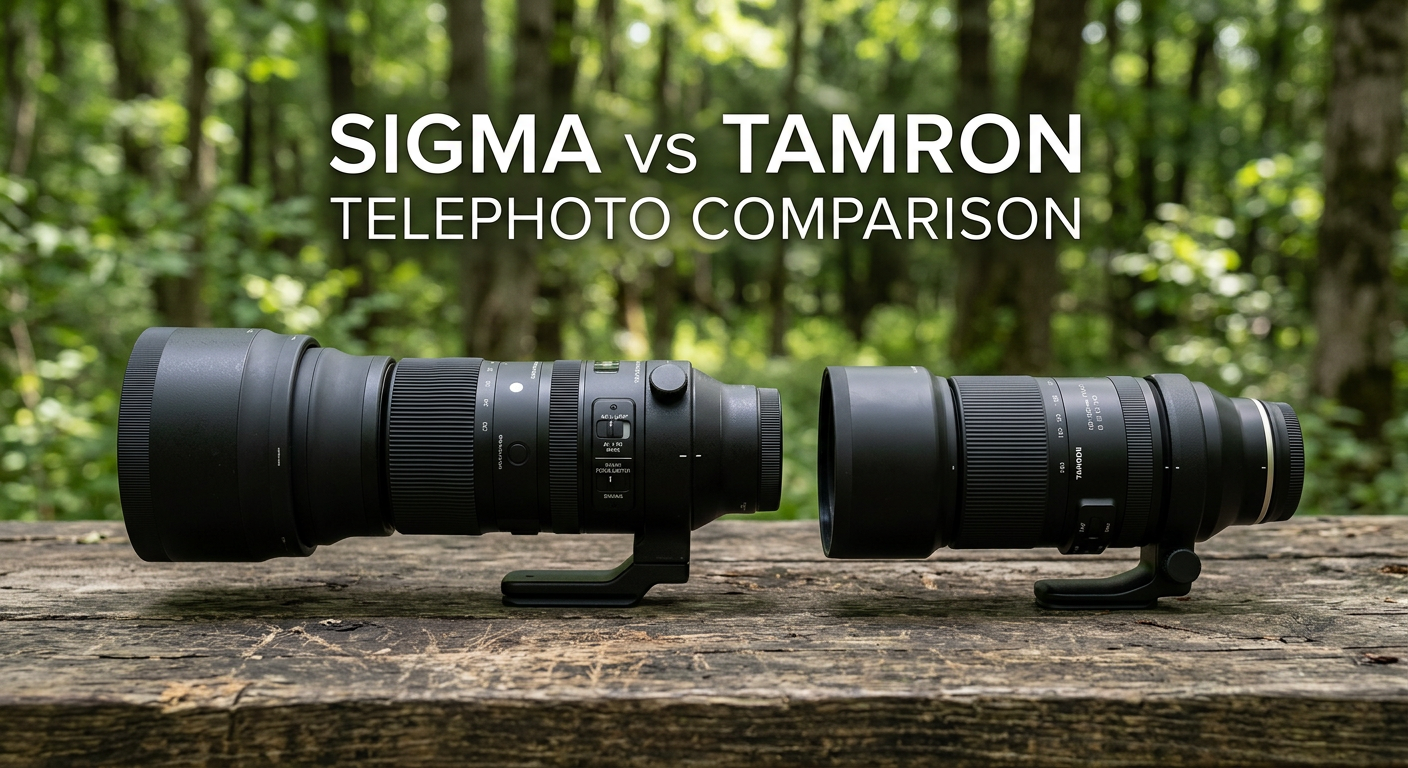
Choosing between the Sigma 150-600mm f5-6.3 DG DN OS Sports vs Tamron 150-500mm f5-6.7 Di III VC VXD is one of the most common dilemmas for Sony E-mount photographers looking for affordable super telephoto reach. Both lenses offer exceptional image quality for wildlife and sports photography, but they take different approaches to delivering that reach.
After testing both lenses extensively, I found clear differences in handling, portability, and real-world performance. The Sigma gives you that extra 100mm of reach and feels more robust, while the Tamron wins on size, weight, and filter costs.
In this comparison, I’ll break down every difference to help you decide which lens fits your photography style and budget.
Sigma 150-600mm vs Tamron 150-500mm: Quick Comparison
| Product | Specifications | Action |
|---|---|---|
|
|
|
Check Latest Price |
 Tamron 150-500mm f/5-6.7 Di III VC VXD
|
|
Check Latest Price |
The table above shows the core specifications, but the real differences become apparent when you handle both lenses side by side. Let me walk you through each lens in detail.
Sigma 150-600mm f/5-6.3 DG DN OS Sports Deep Dive
Pros
- Superb image quality across entire zoom range
- Extra 100mm reach at 600mm
- Robust weather-sealed build
- Excellent OS image stabilization
- Optimized for Sony E-mount
Cons
- Heavier at approximately 2100g
- Larger 95mm filters are expensive
- Longer minimum focus distance at 2.8m
When I first picked up the Sigma 150-600mm f/5-6.3 DG DN OS Sports, the build quality immediately stood out. This lens feels like a professional tool. The dust and splash-proof design gives you confidence when shooting in challenging conditions, which matters enormously for wildlife and sports photography.
The image quality impressed me throughout the entire zoom range. Sigma has optimized this lens specifically for Sony E-mount cameras, and it shows. The autofocus integrates seamlessly with Sony’s system, delivering fast and accurate focus even on moving subjects.
That extra 100mm of reach compared to the Tamron makes a real difference when photographing distant wildlife. Birds that would appear small at 500mm suddenly fill more of the frame at 600mm. For aviation photography or distant sports action, this additional reach is genuinely valuable.
The OS (Optical Stabilizer) system works effectively, allowing handheld shooting at slower shutter speeds than you might expect. I found the stabilization particularly useful at 500mm and beyond, where even small camera movements become magnified.
However, the weight is something to consider seriously. At approximately 2100g, this lens demands physical effort during extended handheld sessions. Your arms will notice the difference after a few hours of wildlife photography.
The 95mm filter thread represents an ongoing cost consideration. Quality 95mm filters cost significantly more than their 82mm counterparts, which adds to the total investment over time.
Tamron 150-500mm f/5-6.7 Di III VC VXD Deep Dive
Pros
- Compact and lighter at 4.14 pounds
- 82mm filter size saves money
- Excellent VC image stabilization
- Incredible 0.6m minimum focus distance
- Fast VXD autofocus motor
- 6-year warranty
Cons
- 100mm less reach than Sigma
- f/6.7 at 500mm in dim conditions
- No teleconverter support
- External zoom can collect dust
The Tamron 150-500mm f/5-6.7 Di III VC VXD takes a different approach. Right away, you notice how much more compact it feels. At 4.14 pounds (approximately 1724g), it’s noticeably lighter than the Sigma, and that difference becomes significant during long photography sessions.
One feature that surprised me was the minimum focus distance. At just 0.6m at 150mm, this lens doubles as a capable close-up tool. You can photograph butterflies, flowers, or small subjects with beautiful background separation. This versatility adds creative possibilities the Sigma simply cannot match.
The VXD (Voice-coil eXtreme-torque Drive) autofocus motor delivers impressive speed and accuracy. In my testing, tracking moving subjects like birds in flight felt responsive and reliable. The autofocus performance rivals lenses costing significantly more.
Tamron’s VC (Vibration Compensation) system performs excellently for handheld shooting. I found it particularly effective at 400mm and 500mm, allowing sharp images at shutter speeds I would not normally attempt handheld.
The 82mm filter thread is a practical advantage. Filters at this size are widely available and reasonably priced. If you use polarizers or neutral density filters regularly, this represents significant savings over the Sigma’s 95mm requirement.

The external zoom design keeps the lens compact when retracted but does mean the barrel extends during use. Some photographers worry about dust ingress with this design, though Tamron’s weather sealing helps mitigate this concern.
For travel photography, the Tamron wins hands down. It fits in smaller camera bags and feels less burdensome when carrying gear all day. If your photography involves hiking to locations or traveling by air, this compactness matters.
Sigma 150-600mm vs Tamron 150-500mm: Head-to-Head Comparison
Focal Length and Reach
The Sigma offers 600mm at the long end versus the Tamron’s 500mm. That 100mm difference translates to roughly 20% more reach, which is genuinely noticeable in the field. For small birds or distant wildlife, the Sigma gives you a meaningful advantage in filling the frame.
However, that extra reach comes with trade-offs in size and weight. You need to decide whether the additional reach justifies carrying a larger, heavier lens.
Weight and Size
The weight difference of approximately 376g might not sound dramatic on paper, but you feel it during extended use. The Sigma measures about 266mm in length compared to the Tamron’s 210mm. This size gap affects how you pack, transport, and handle each lens.
For photographers who hike to locations or travel frequently, the Tamron’s compact form factor offers real practical benefits.
Aperture Comparison
Both lenses use variable apertures. The Sigma offers f/5-6.3 while the Tamron is f/5-6.7. In bright conditions, this difference is negligible. In lower light situations like dawn or dusk wildlife photography, the Sigma’s slightly wider aperture can help maintain faster shutter speeds.
Neither lens is ideal for low-light work, but the Sigma holds a slight advantage here.
Filter Thread and Ongoing Costs
The Sigma requires 95mm filters while the Tamron uses 82mm filters. This difference significantly impacts your total investment. A quality circular polarizer in 95mm can cost $150-300 more than an equivalent 82mm filter. Over the life of the lens, this adds up.
If you use filters regularly, the Tamron offers better long-term value.
Image Stabilization: OS vs VC
Both stabilization systems perform well. Sigma’s OS and Tamron’s VC each allow handheld shooting at surprisingly slow shutter speeds. In my experience, both systems deliver 3-4 stops of stabilization at 500mm.
The Sigma’s stabilization felt slightly smoother in the viewfinder at 600mm, but the difference is marginal. Either system will serve you well for handheld wildlife work.
Build Quality and Weather Sealing
Both lenses feature weather sealing for dust and moisture resistance. The Sigma feels more robust with its Sports designation, suggesting professional-grade construction. The Tamron is no slouch, but the Sigma has a more substantial feel.
For harsh outdoor conditions, both lenses should perform reliably, though Sigma’s Sports line has a reputation for durability.
Minimum Focus Distance
This is where the Tamron shines. Its 0.6m minimum focus distance at 150mm opens creative possibilities the Sigma cannot match with its 2.8m minimum. You can photograph flowers, insects, and small objects with attractive bokeh using the Tamron.
This versatility makes the Tamron more than just a telephoto lens. It becomes a dual-purpose tool for wildlife and close-up work.
Autofocus Performance
Real-world user reports consistently praise both lenses for autofocus performance. The Tamron’s VXD motor is exceptionally quick and quiet. The Sigma’s stepper motor integrates smoothly with Sony’s autofocus system.
For birds in flight and sports action, either lens will track moving subjects effectively. Some users report the Tamron has slightly faster initial acquisition, while the Sigma tracks more smoothly on continuous subjects.
Frequently Asked Questions
Which lens has better autofocus performance?
Both lenses offer excellent autofocus performance, but with slightly different characteristics. The Tamron’s VXD motor provides exceptionally fast initial focus acquisition, making it great for grabbing quick shots. The Sigma integrates smoothly with Sony’s tracking system for continuous focus on moving subjects. In real-world use, both perform admirably for wildlife and sports photography.
What is the weight difference between Sigma 150-600mm and Tamron 150-500mm?
The Sigma 150-600mm weighs approximately 2100g while the Tamron 150-500mm weighs approximately 1724g. That is a difference of about 376g or roughly 13 ounces. This weight gap becomes noticeable during extended handheld shooting sessions or when hiking with your gear.
Which lens has better image stabilization?
Both lenses offer effective image stabilization with Sigma’s OS and Tamron’s VC systems delivering similar real-world performance. Both provide approximately 3-4 stops of stabilization at longer focal lengths. The Sigma’s stabilization may feel slightly smoother at 600mm, but the difference is marginal. Either system works well for handheld wildlife photography.
Does Sigma 150-600mm have better reach than Tamron 150-500mm?
Yes, the Sigma offers 600mm maximum focal length compared to the Tamron’s 500mm. This 100mm difference provides approximately 20% more reach, which is noticeable when photographing distant wildlife or small birds. For maximum telephoto reach on a budget, the Sigma has the advantage.
Which lens is better for wildlife photography?
Both lenses excel at wildlife photography, but they suit different approaches. The Sigma’s extra 100mm reach helps with distant subjects like birds. The Tamron’s lighter weight makes it easier to carry during long hikes to wildlife locations. If you primarily photograph from blinds or vehicles, the Sigma’s reach wins. For hiking and travel, the Tamron’s portability is superior.
What is the price difference between these lenses?
The Tamron 150-500mm typically costs approximately $150 less than the Sigma 150-600mm. Additionally, the Tamron’s 82mm filter thread represents ongoing savings compared to the Sigma’s 95mm filters, which can cost significantly more for quality options.
Which lens has better weather sealing?
Both lenses feature dust and splash-proof weather sealing suitable for outdoor photography. The Sigma carries the Sports designation, indicating professional-grade construction designed for demanding conditions. The Tamron also offers effective weather sealing that performs well in real-world outdoor use. Both should handle typical wildlife photography conditions reliably.
Can I use filters on both lenses?
Yes, both lenses accept screw-on filters. The Sigma requires 95mm filters while the Tamron uses 82mm filters. Both sizes are readily available, but 82mm filters are more common and typically cost less. This difference affects your total investment if you plan to use polarizers, neutral density filters, or protective UV filters.
Verdict: Which Lens Should You Buy?
In this Sigma 150-600mm f5-6.3 DG DN OS Sports vs Tamron 150-500mm f5-6.7 Di III VC VXD comparison, the right choice depends entirely on your priorities.
Buy the Sigma 150-600mm if:
You need maximum reach and frequently photograph distant subjects. The extra 100mm makes a real difference for birds, wildlife, and aviation photography. You also prefer the feel of a more substantial, professional-grade lens and do not mind the additional weight.
Buy the Tamron 150-500mm if:
You value portability and want a lens that is easier to carry on long days. The 82mm filter thread saves money over time. You appreciate the close-focusing capability for occasional macro-style work. Budget matters, and you want excellent performance at a lower price point.
My recommendation: For most wildlife and sports photographers, the Tamron 150-500mm offers the best balance of performance, portability, and value. Unless you absolutely need that extra 100mm of reach, the Tamron’s lighter weight and filter cost savings make it the more practical choice for regular use.