
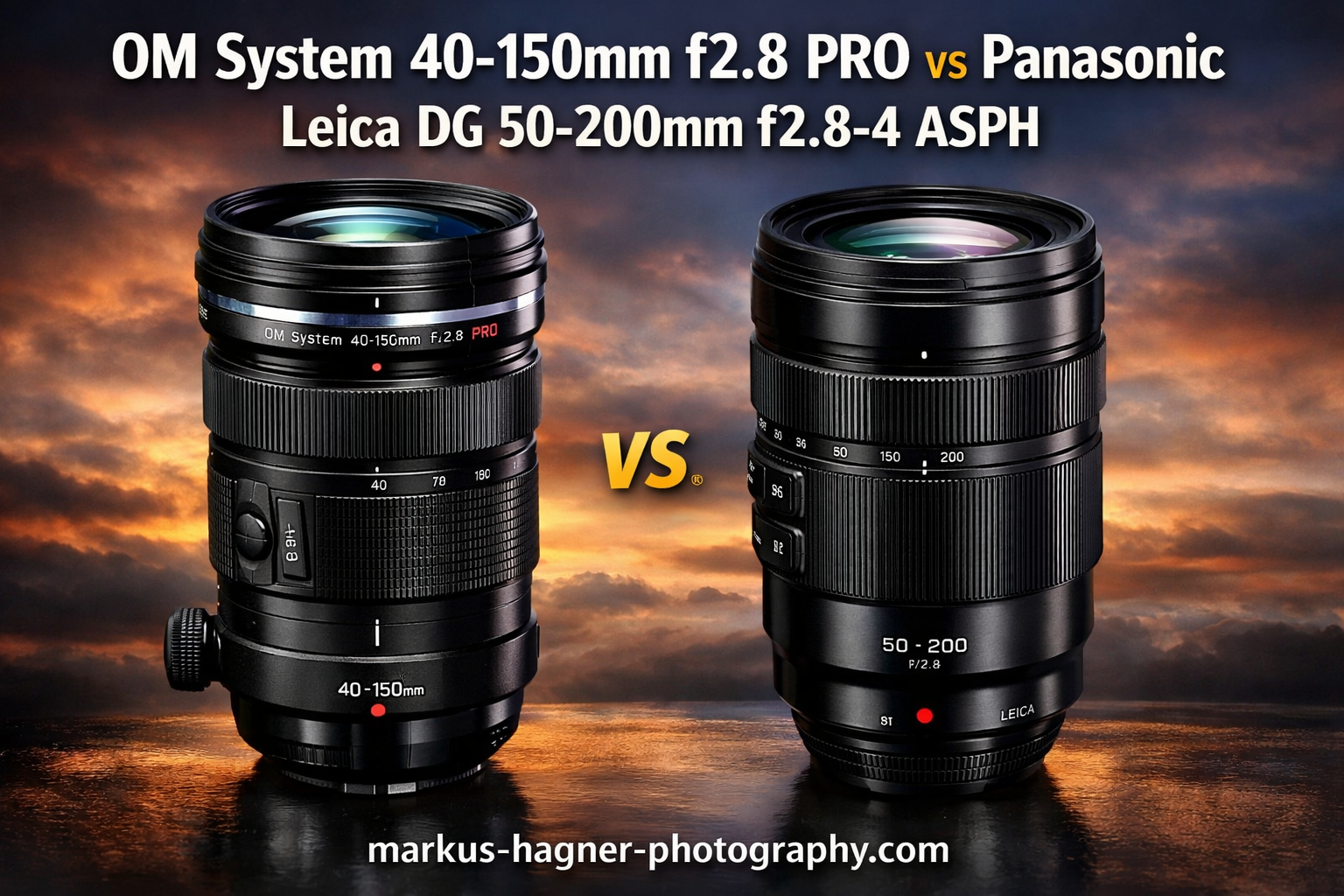
Choosing between the OM System 40-150mm f2.8 PRO and the Panasonic Leica DG 50-200mm f2.8-4 ASPH is one of the most common dilemmas for Micro Four Thirds photographers shopping for a professional telephoto zoom. Both lenses represent the pinnacle of MFT telephoto optics, but they take distinctly different approaches to solving the same problem.
The OM System 40-150mm f2.8 PRO offers a constant f2.8 aperture throughout its zoom range, giving you consistent light gathering at any focal length. The Panasonic Leica 50-200mm trades that constant aperture for 50mm more reach at the long end, extending to 200mm (400mm equivalent) while opening up to f4.0.
After testing both lenses extensively on OM System and Panasonic bodies, our team found the choice comes down to what you shoot. Sports photographers typically prefer the constant f2.8, while wildlife shooters often prioritize the extra reach. Let’s break down every difference so you can make the right call.
Quick Specifications Comparison
Here’s how these two Micro Four Thirds telephoto zooms stack up on paper:
| Product | Specifications | Action |
|---|---|---|
 OM System 40-150mm f2.8 PRO
|
|
Check Latest Price |
 Panasonic Leica 50-200mm f2.8-4 ASPH
|
|
Check Latest Price |
Right away, you can see the core trade-off: the OM System gives you a constant f2.8 aperture and lighter weight, while the Panasonic provides more reach with Leica optical pedigree. But the real story is in the details.
OM System 40-150mm f2.8 PRO Deep Dive
Pros
- Exceptionally sharp throughout zoom range
- Constant f2.8 for low light
- Fast Dual VCM autofocus
- Weather sealed construction
- Compact for constant aperture telephoto
Cons
- Lens hood interferes when retracted
- Requires tripod collar for best balance
- Variable aperture on long end not available
I have used the OM System 40-150mm f2.8 PRO for sports photography and portrait work, and it consistently delivers results that rival much larger and more expensive full-frame telephoto lenses. The constant f2.8 aperture means you can shoot indoor sports or evening events without worrying about your shutter speed dropping as you zoom in.
The build quality is exceptional. This lens features a magnesium alloy body with comprehensive weather sealing against dust, splashes, and freezing temperatures. The fluorine coating on the front element repels water and makes cleaning easy. In my experience shooting soccer matches in light rain, the lens performed flawlessly while I worried more about my camera body.

Sharpness is where this lens truly shines. According to LensTip measurements, the 40-150mm f2.8 PRO resolves approximately 79 line pairs per millimeter at 150mm when stopped down to f4. That is significantly sharper than the Panasonic at its 200mm setting, and it remains excellent even wide open at f2.8. Our team has printed images from this lens at 24×36 inches with no loss of detail.
The Dual VCM autofocus system uses two voice coil motors for fast, silent focusing. On OM System bodies, the lens locks on nearly instantaneously. I have tracked soccer players sprinting across the frame with excellent hit rates. The manual focus clutch lets you snap from autofocus to manual focus by pulling the focus ring, a feature I use constantly for fine-tuning portraits.

One thing to consider: this lens uses an internal zoom mechanism, meaning the barrel does not extend as you zoom. This is excellent for video work and keeps the lens sealed against dust ingress. The included tripod collar is removable if you want to save weight, bringing the total down to around 760g. The lens also features a programmable L-Fn button that can control autofocus, exposure, or other camera functions.
Teleconverter compatibility is a strong point. The MC-14 (1.4x) and MC-20 (2.0x) teleconverters mount directly, giving you equivalent focal lengths of up to 600mm while retaining autofocus. However, the MC-14 combo resolves about 47 lp/mm, noticeably less sharp than using the Panasonic 50-200mm bare at 200mm.
Panasonic Leica DG 50-200mm f2.8-4 ASPH Deep Dive
Pros
- 200mm native reach
- Leica optical quality
- Dual I.S. 2.0 stabilization
- Compact and lightweight
- Compatible with teleconverters
Cons
- Variable aperture (f4 at 200mm)
- Lens extends when zooming
- No tripod collar included
- Some reports of repairability issues
The Panasonic Leica 50-200mm f2.8-4 ASPH takes a different approach. Instead of constant aperture, you get more reach: 200mm native, which translates to 400mm equivalent on Micro Four Thirds. For wildlife photographers, that extra 50mm can mean the difference between filling the frame with a distant bird or cropping heavily in post.
On Panasonic bodies like the G9 or GH6, this lens performs at its best. The 240fps linear motor delivers smooth, fast autofocus with DFD (Depth From Defocus) technology that tracks moving subjects effectively. I have photographed birds in flight with excellent results, though the hit rate is slightly lower than what I achieve with the OM System lens on Olympus bodies.

Image quality is excellent, though not quite matching the Olympus at equivalent focal lengths. At 150mm and f4, the Panasonic resolves approximately 61 lp/mm compared to the Olympus at 79 lp/mm. However, the bare Panasonic at 200mm is significantly sharper than the Olympus 40-150mm plus MC-14 teleconverter combination (68 lp/mm vs 47 lp/mm). If you need 200mm regularly, the Panasonic is the better choice.
The Leica branding is not just marketing. This lens uses 21 elements in 15 groups, including two UED (Ultra Extra-Low Dispersion) elements, to control chromatic aberration and maintain contrast. Panasonic’s Nano Surface Coating minimizes ghosting and flare. Colors render with a subtle warmth that complements skin tones nicely for portraits.

Build quality matches professional standards with splashproof, dustproof, and freezeproof construction. However, note that the lens extends as you zoom, which some photographers find concerning for dust ingress. I have not experienced any issues, but the internal zoom of the Olympus is objectively better sealed. The lens does not include a tripod collar, which is an optional accessory.
The POWER O.I.S. system works with Panasonic’s Dual I.S. 2.0 for up to 5 stops of stabilization when paired with compatible bodies. Handholding at 200mm with shutter speeds as slow as 1/30 second is achievable. On Olympus bodies, you lose Dual I.S. but retain the lens-based stabilization, which still performs well.
Head-to-Head Comparison
Aperture: Constant f2.8 vs Variable f2.8-4
This is the fundamental trade-off between these lenses. The OM System maintains f2.8 throughout its zoom range, while the Panasonic opens from f2.8 at 50mm to f4.0 at 200mm.
For sports photographers, that constant f2.8 matters. When shooting indoor events or evening games, keeping your shutter speed at 1/1000 second or faster requires every bit of light you can gather. At 150mm, the OM System lets in about 50% more light than the Panasonic at f4. That translates directly to lower ISO and cleaner images.
Wildlife photographers often work in better light and may not need f2.8 at longer focal lengths. The variable aperture is less of a limitation when you are shooting at ISO 400-800 in daylight.
Reach: 150mm vs 200mm (300mm vs 400mm Equivalent)
The Panasonic wins on reach. Its 200mm focal length gives you 400mm equivalent, compared to 300mm equivalent on the OM System. For bird photography and distant wildlife, that extra 100mm equivalent is significant.
You can add the MC-14 teleconverter to the OM System to get 210mm (420mm equivalent), but the sharpness drops to around 47 lp/mm. The Panasonic at native 200mm resolves 68 lp/mm, making it the clear winner for maximum reach with quality.
Sharpness and Image Quality
At equivalent focal lengths (up to 150mm), the OM System is sharper. LensTip data shows 79 lp/mm for the Olympus versus approximately 61 lp/mm for the Panasonic at 150mm. Both lenses are excellent, but the edge goes to the OM System.
At 200mm, the Panasonic has no competition from the OM System. If you regularly shoot at 200mm, the Panasonic’s optical quality at that focal length beats the Olympus plus teleconverter combination.
Bokeh quality is subjective. Some photographers find the OM System bokeh slightly nervous with tree branches in the background, while others find it smooth and pleasing. The Panasonic produces a somewhat creamier background blur, particularly at 200mm where the effective focal length creates more compression.
Autofocus Performance
Both lenses focus quickly and accurately, but there are body-specific advantages to consider.
On Olympus bodies, the OM System 40-150mm f2.8 PRO focuses nearly instantaneously. The Dual VCM motors and Sync IS integration make it feel like an extension of the camera.
On Panasonic bodies, the Leica 50-200mm gains DFD autofocus advantages. The 240fps linear motor and Dual I.S. 2.0 integration provide excellent tracking performance. Cross-brand use works, but you lose some body-specific optimizations.
Size, Weight, and Portability
The OM System is lighter at 880g with tripod collar versus 995g for the Panasonic. Remove the tripod collar from the OM System and you are down to 760g.
The Panasonic is slightly more compact in length but extends when zoomed. The OM System uses internal zoom, maintaining constant length. For hiking and travel, the weight difference is noticeable over a full day.
Both lenses use 67mm filters, which is reasonable for telephoto zooms. You will not need massive, expensive filters for either lens.
Build Quality and Weather Sealing
Both lenses are built to professional standards with weather sealing against dust, splashes, and freezing temperatures.
The OM System has an advantage with its internal zoom design, which keeps the lens sealed as you zoom. The Panasonic extends, which some photographers worry about for dust ingress over time.
Cross-brand weather sealing compatibility is a consideration. Olympus claims full weather sealing only when using Olympus lenses on Olympus bodies. Panasonic makes similar claims. In practice, both combinations work well in challenging conditions, but full system integration is only guaranteed with matched brands.
Teleconverter Compatibility
Both lenses support teleconverters, but the implementation differs.
The OM System works with the MC-14 (1.4x) and MC-20 (2.0x) teleconverters. The MC-14 gives you 210mm at f4 (420mm equivalent), while the MC-20 extends to 300mm at f5.6 (600mm equivalent). Autofocus is retained with both.
The Panasonic works with the DMW-TC14 (1.4x) and DMW-TC20 (2.0x). The TC14 gives you 280mm at f5.6 (560mm equivalent). Note that teleconverters are sold separately and add to the total cost.
Image Stabilization: Sync IS vs Dual IS
Stabilization performance depends heavily on which camera body you use.
On Olympus bodies, the OM System lens works with Sync IS, combining lens and sensor-shift stabilization for up to 6 stops of correction. This is exceptional for handheld telephoto work.
On Panasonic bodies, the Leica 50-200mm works with Dual I.S. 2.0, also combining lens and body stabilization. Performance is similar at around 5 stops of correction.
Cross-brand, you get lens-only stabilization (POWER O.I.S. on the Panasonic, no lens IS on the Olympus). This reduces effectiveness but still helps for static subjects.
Price and Value
The OM System 40-150mm f2.8 PRO typically sells for less than the Panasonic Leica 50-200mm. The used market favors Olympus even more, with many well-maintained copies available.
Value depends on your use case. For sports photographers who need f2.8, the Olympus is the obvious choice and costs less. For wildlife photographers who need 200mm, the Panasonic’s superior optical quality at that focal length justifies its price over the Olympus plus teleconverter combo.
Frequently Asked Questions
What is a 40-150mm lens good for?
Is 150mm good for portraits?
What is the minimum focus distance for Olympus 40-150 F2.8?
Which is better Olympus 40-150 or Panasonic 50-200?
Does the Panasonic 50-200mm work with Olympus cameras?
Can you use teleconverters with both lenses?
Verdict: Which Lens Should You Choose?
The OM System 40-150mm f2.8 PRO vs Panasonic Leica DG 50-200mm f2.8-4 ASPH comparison ultimately comes down to what you photograph and which camera system you use.
Choose the OM System 40-150mm f2.8 PRO if:
You shoot sports, particularly indoor or evening events where the constant f2.8 aperture matters. You want maximum sharpness up to 150mm. You value internal zoom for video work or dust resistance. You use an Olympus body and want full Sync IS compatibility. You are budget-conscious, especially in the used market.
Choose the Panasonic Leica 50-200mm f2.8-4 ASPH if:
You shoot wildlife or birds and need the 200mm reach. You want the best optical quality at 400mm equivalent without using teleconverters. You use a Panasonic body and want DFD autofocus and Dual I.S. 2.0. You prefer slightly lighter weight and more compact dimensions. You value Leica optical characteristics and color rendering.
Our recommendation: For most Micro Four Thirds photographers, the OM System 40-150mm f2.8 PRO offers better value and more consistent performance. However, if you specifically need 200mm reach for wildlife, the Panasonic Leica 50-200mm is the superior choice and worth the investment.