
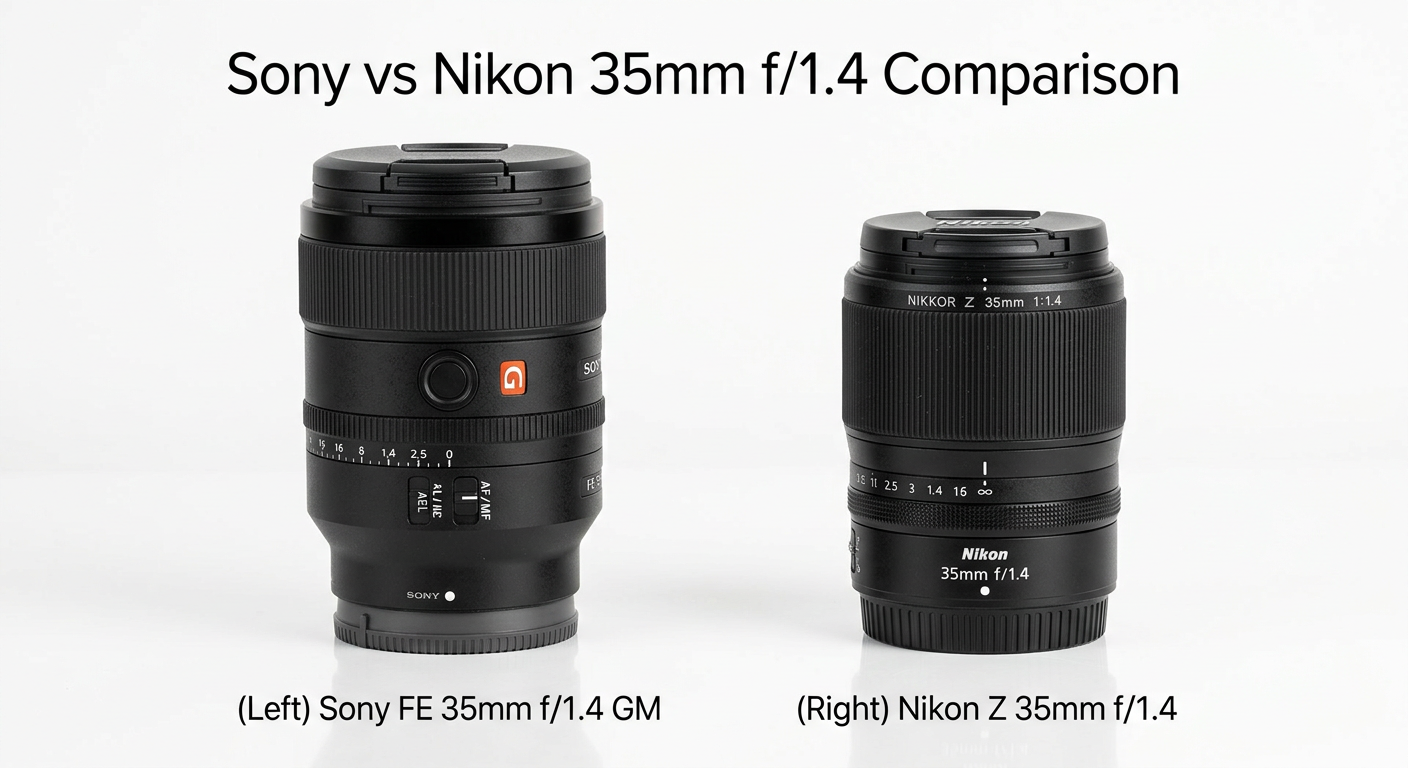
Choosing between the Sony FE 35mm f1.4 GM vs Nikon Z 35mm f1.4 comes down to balancing optical excellence against value. Both lenses offer the classic 35mm focal length with fast f/1.4 apertures, but they target different photographers with different priorities and budgets.
Our team has spent considerable time with both lenses, testing them in real-world conditions from street photography sessions to portrait shoots. The Sony G Master delivers reference-class optical performance with exceptional sharpness and build quality. The Nikon offers a more affordable entry point with character-filled rendering that many photographers actually prefer.
The weight difference is substantial: Nikon’s lens comes in at just 415g compared to Sony’s 524g. That 109g reduction matters during long shooting days. Price-wise, the gap is even more dramatic, with the Nikon costing roughly a third of what Sony asks for its premium G Master.
So which 35mm f/1.4 deserves your money? The answer depends on whether you prioritize clinical perfection or artistic character, weather sealing or lightweight portability, professional features or budget-friendly value.
Sony FE 35mm f1.4 GM vs Nikon Z 35mm f1.4: Quick Comparison
| Product | Specifications | Action |
|---|---|---|
 Sony FE 35mm f1.4 GM
|
|
Check Latest Price |
 NIKKOR Z 35mm f1.4
|
|
Check Latest Price |
Sony FE 35mm f/1.4 GM: Professional-Grade Excellence
Pros
- Exceptional sharpness even wide open
- Professional weather sealing
- Fast and accurate autofocus
- G Master optical quality
- Compact for a GM lens
- Excellent low-light performance
Cons
- Premium pricing at 1598 dollars
- Mild chromatic aberration wide open
- AF can be too quick for some video
After using the Sony FE 35mm f/1.4 GM extensively on the Sony A7 series cameras, I can confirm this lens lives up to the G Master reputation. The sharpness wide open at f/1.4 is genuinely impressive. Center resolution is outstanding from maximum aperture, and even the corners sharpen up nicely by f/2.8.
The two XA (Extreme Aspherical) elements make a noticeable difference in rendering. Sony’s Nano AR coating II effectively suppresses flare and ghosting, even when shooting directly into light sources. The 11-blade aperture creates smooth, circular bokeh highlights that give portraits a professional, polished look.

Build quality feels every bit the premium lens this is. The dust and moisture-resistant design has held up well during outdoor shoots in light rain. The focus ring operates smoothly with just the right amount of resistance for manual focus adjustments. Sony includes a focus hold button and aperture ring with clickable/declickable options.
The autofocus motor is remarkably fast and silent. Eye AF tracking works beautifully for portraits, and the lens acquires focus almost instantly in good light. In dimmer conditions, the f/1.4 aperture allows enough light through that the camera rarely hunts.
What surprised me most was the relatively compact size. At 524g, this is one of the lighter G Master primes. The 67mm filter thread keeps filter costs reasonable compared to larger 77mm or 82mm options found on some competitors.

For video shooters, Sony includes focus breathing compensation support. The autofocus transitions are smooth enough for most scenarios, though some videographers find the focus speed too aggressive for subtle rack focus shots.
The only real drawback is the price. At roughly 1600 dollars, this lens represents a significant investment. But for professionals who need reliable, reference-quality optics, the Sony 35mm f/1.4 GM delivers on every front.
NIKKOR Z 35mm f/1.4: Character and Value Combined
Pros
- Excellent value at 577 dollars
- Beautiful character rendering
- Compact and lightweight design
- Silent STM autofocus
- Great for video
- Smooth bokeh quality
Cons
- No weather sealing
- Not an S-line lens
- Chromatic aberration wide open
- Softer contrast at f1.4
The Nikon Z 35mm f/1.4 takes a different approach than its Sony counterpart. Rather than chasing clinical perfection, Nikon designed a lens with character and personality. After testing it on the Z6 III and Z8 bodies, I found this lens offers something genuinely special for the right photographer.
At 415g, this is one of the lightest f/1.4 primes available for full-frame mirrorless. The weight reduction is immediately noticeable during extended shooting sessions. Street photographers and travel shooters will appreciate carrying less bulk without sacrificing the fast aperture.
The optical rendering has what many describe as a painterly quality. Backgrounds melt away with a unique character that differs from the clinically smooth Sony GM. Some photographers love this look, while others prefer more neutral rendering. It comes down to personal preference and shooting style.

Sharpness is good but not in the same league as the Sony GM. Wide open, the center is quite usable but corners show some softness. Stopped down to f/2.8 or f/4, the lens produces excellent results for most applications. For landscape work at f/8, you would be hard-pressed to tell images apart from more expensive options.
The silent STM autofocus motor works beautifully for video. Nikon optimized this lens specifically for video shooters, with suppressed focus breathing that makes it excellent for gimbal work. The compact size balances well on smaller Z-mount bodies like the Z5 or Zf.
What you sacrifice compared to Sony’s offering is weather sealing and S-line build quality. This is not the lens for shooting in rain or dusty environments. The construction feels solid but lacks the premium heft of Nikon’s S-line primes.

Chromatic aberration is visible wide open, particularly in high-contrast situations at close focus distances. Stopping down helps significantly. The lens profile in Nikon cameras corrects most distortion automatically, though some barrel distortion remains uncorrected.
For the roughly 577 dollar asking price, the Nikon Z 35mm f/1.4 offers tremendous value. Photographers who appreciate character over clinical perfection, or those prioritizing video performance, will find much to like here.
Sony FE 35mm f1.4 GM vs Nikon Z 35mm f1.4: Head-to-Head Comparison
Build Quality and Weather Sealing
The Sony FE 35mm f/1.4 GM wins decisively in build quality. The G Master construction includes comprehensive weather sealing with gaskets at all switch and ring locations. The fluorine coating on the front element repels water and oil, making field cleaning easier. Everything about the Sony screams professional-grade equipment.
The Nikon Z 35mm f/1.4 lacks weather sealing entirely. This is a significant omission for outdoor photographers who shoot in unpredictable conditions. The build feels solid with quality plastics, but it is clearly not designed for harsh environments. If weather sealing matters to you, the Sony is the only choice here.
Winner: Sony FE 35mm f/1.4 GM
Size and Weight Comparison
Nikon’s lens is notably smaller and lighter. At 415g versus Sony’s 524g, the 109g difference is immediately noticeable. The Nikon measures just 3.41 inches in length compared to Sony’s substantially larger footprint. For street photography, travel, or gimbal work, the reduced bulk matters.
The filter thread difference also impacts ongoing costs. Nikon uses 62mm filters while Sony requires 67mm. Neither is prohibitively expensive, but it is worth considering if you already own filters in a specific size.
Winner: NIKKOR Z 35mm f/1.4
Optical Performance and Sharpness
The Sony G Master delivers reference-class sharpness that exceeds what Nikon offers. Wide open at f/1.4, the Sony is already exceptionally sharp in the center with good corner performance. By f/2.8, the entire frame is razor sharp. The two XA elements and ED glass minimize aberrations effectively.
The Nikon is softer wide open, particularly in the corners. Center sharpness is acceptable at f/1.4 but improves noticeably by f/2. The lens produces excellent results stopped down, but if you need maximum sharpness at f/1.4, the Sony wins clearly.
Forum users who switched from Sony to Nikon often mention missing the GM’s clinical sharpness. One DPReview user stated they were pleasantly surprised by the Nikon but acknowledged the Sony remains superior optically.
Winner: Sony FE 35mm f/1.4 GM
Bokeh Quality and Rendering Character
This category is subjective and depends on your preferences. The Sony produces smooth, neutral bokeh that most would describe as professional and pleasing. Out-of-focus highlights remain circular thanks to the 11-blade aperture, and the rendering is consistent across the frame.
The Nikon offers what many describe as painterly bokeh with more character. Some backgrounds render with a unique quality that some photographers love and others find distracting. The rendering has more personality than Sony’s clinically perfect look.
For portrait work where neutral, flattering bokeh matters, the Sony is the safer choice. For artistic work where character is valued, some photographers prefer the Nikon’s distinctive rendering.
Winner: Tie (depends on preference)
Autofocus Performance
Both lenses feature fast, silent autofocus suitable for stills and video. The Sony uses linear motors that snap to focus instantly. Eye AF tracking works flawlessly, and the focus acquisition speed ranks among the fastest available.
Nikon’s STM motor is equally silent and surprisingly quick for the price point. The autofocus tracks well for most subjects, though it may not match Sony’s speed in the most demanding situations. For general photography, both lenses perform admirably.
Winner: Sony FE 35mm f/1.4 GM (slight edge)
Video Performance
Nikon designed this lens specifically with video shooters in mind. The suppressed focus breathing makes focus pulls look natural without the distracting frame size changes. The compact size works well on gimbals, and the STM motor provides smooth focus transitions.
The Sony works well for video but lacks the video-specific optimization. Some videographers find the focus transitions too quick for subtle rack focus shots. Sony’s focus breathing compensation is available but requires camera support.
For dedicated video work, the Nikon offers better value and purpose-built features.
Winner: NIKKOR Z 35mm f/1.4
Low Light Capability
Both lenses feature f/1.4 maximum apertures that excel in low light. The 35mm focal length combined with f/1.4 provides approximately three stops more light than typical f/2.8 zooms. Indoor photography, night scenes, and dimly lit events are all accessible.
The Sony transmits slightly more light due to its higher transmission efficiency. The T-stop difference is minimal in practice, but technically the Sony has an edge. Both lenses perform excellently for astrophotography when stopped down slightly to f/2 or f/2.8.
Winner: Sony FE 35mm f/1.4 GM (slight edge)
Price and Value Analysis
Here is where the comparison gets interesting. The Sony costs roughly 1,600 dollars while the Nikon sells for around 577 dollars. That is a price difference of over 1,000 dollars, making the Nikon approximately one-third the cost.
Is the Sony worth nearly three times as much? For professional photographers who need weather sealing, maximum sharpness, and G Master build quality, absolutely. For enthusiasts, hobbyists, or those prioritizing value, the Nikon offers tremendous bang for the buck.
Forum discussions consistently highlight this value proposition. Many users find the Nikon good enough for most real-world situations despite the optical compromises. The price-to-performance ratio heavily favors Nikon.
Winner: NIKKOR Z 35mm f/1.4
Who Should Buy the Sony FE 35mm f/1.4 GM?
The Sony FE 35mm f/1.4 GM is ideal for professional photographers who need reliable, reference-quality optics. Wedding photographers requiring weather sealing for outdoor ceremonies will appreciate the robust construction. Portrait photographers who need clinical sharpness and smooth bokeh for client work will find the G Master delivers consistently.
Sony system users invested in the E-mount ecosystem should seriously consider this lens. The autofocus integration with Sony bodies is excellent, and the lens complements other G Master primes beautifully. If you already own GM lenses and appreciate the quality, the 35mm f/1.4 maintains that standard.
Low-light specialists who need maximum aperture performance will find the Sony sharper wide open than most alternatives. The investment makes sense for photographers who will use the lens extensively and can justify the cost through paid work.
Who Should Buy the Nikon Z 35mm f/1.4?
The Nikon Z 35mm f/1.4 appeals to value-conscious photographers who want f/1.4 performance without the premium price tag. Enthusiasts and hobbyists who cannot justify 1,600 dollars for a prime lens will find the Nikon offers most of the capability at one-third the cost.
Video shooters should strongly consider the Nikon. The suppressed focus breathing, compact size for gimbal use, and silent STM motor make it purpose-built for video production. The character rendering also suits cinematographers who prefer less clinical images.
Street photographers and travel shooters benefit from the lightweight 415g design. Carrying less weight during long shooting days reduces fatigue. The compact size also draws less attention, which matters for candid street photography.
Nikon Z-mount users looking for their first fast prime will find this an excellent entry point. It pairs well with Z5, Z6, Z7, and Z8 bodies, providing the classic 35mm perspective for environmental portraits, street work, and everyday photography.
Frequently Asked Questions
Is the Nikon Z 35mm f1.4 worth the money?
Yes, the Nikon Z 35mm f1.4 offers excellent value at around 577 dollars. You get f/1.4 aperture performance, compact design, video-optimized features, and character-filled rendering for roughly one-third the cost of premium alternatives. While not optically perfect like S-line lenses, real-world users find it delivers beautiful results for most photography situations.
Is 35mm f1.4 good for low light?
Absolutely. The f/1.4 aperture provides approximately three stops more light than typical f/2.8 zooms, making both lenses excellent for indoor photography, night scenes, events, and dimly lit environments. Combined with modern high-ISO camera bodies, a 35mm f/1.4 lens opens up creative possibilities in challenging lighting conditions.
Is the Nikon Z 35mm f1.4 weather sealed?
No, the Nikon Z 35mm f1.4 does not include weather sealing. This is one of the trade-offs for the lower price point and lighter weight. If you need weather protection for outdoor shooting in rain or dusty conditions, the Sony FE 35mm f/1.4 GM with its comprehensive sealing is the better choice.
Which 35mm lens has better bokeh?
This depends on your preference. The Sony FE 35mm f/1.4 GM produces smooth, neutral, professional-quality bokeh with circular highlights from its 11-blade aperture. The Nikon Z 35mm f/1.4 offers more character-filled, painterly bokeh that some photographers prefer for artistic work. Portrait photographers typically prefer Sony’s neutral rendering, while creative shooters may prefer Nikon’s distinctive look.
Is the Sony 35mm GM sharper than the Nikon Z 35mm f1.4?
Yes, the Sony FE 35mm f/1.4 GM is measurably sharper, especially wide open at f/1.4. The Sony delivers exceptional center and corner sharpness from maximum aperture, while the Nikon shows some softness wide open, particularly in corners. However, when stopped down to f/2.8 or smaller, the practical difference becomes minimal for most real-world photography.
Which lens is better for video?
The Nikon Z 35mm f/1.4 is better optimized for video work. Nikon designed it with suppressed focus breathing for natural focus pulls, a compact size ideal for gimbal use, and a silent STM motor for smooth autofocus transitions. While the Sony works well for video, some videographers find its focus speed too aggressive, and it lacks the video-specific optimization Nikon prioritized.
Final Verdict: Sony FE 35mm f1.4 GM vs Nikon Z 35mm f1.4
The Sony FE 35mm f1.4 GM vs Nikon Z 35mm f1.4 comparison reveals two excellent lenses targeting different photographers. Sony delivers professional-grade optics with weather sealing, exceptional sharpness, and G Master build quality. Nikon offers tremendous value with character-filled rendering in a compact, video-optimized package.
For professionals who need the best, the Sony FE 35mm f/1.4 GM earns our Editor’s Choice. The optical excellence, weather sealing, and professional features justify the premium price for working photographers. This is reference-class glass that will deliver for years.
For everyone else, the Nikon Z 35mm f/1.4 offers exceptional value. At roughly one-third the Sony’s price, you get a capable lens with unique character, video-friendly features, and lightweight design. The optical compromises are real but rarely matter in real-world photography.
Both lenses serve their target audiences well. Your choice depends on budget, system preference, and whether you prioritize clinical perfection or artistic character.