
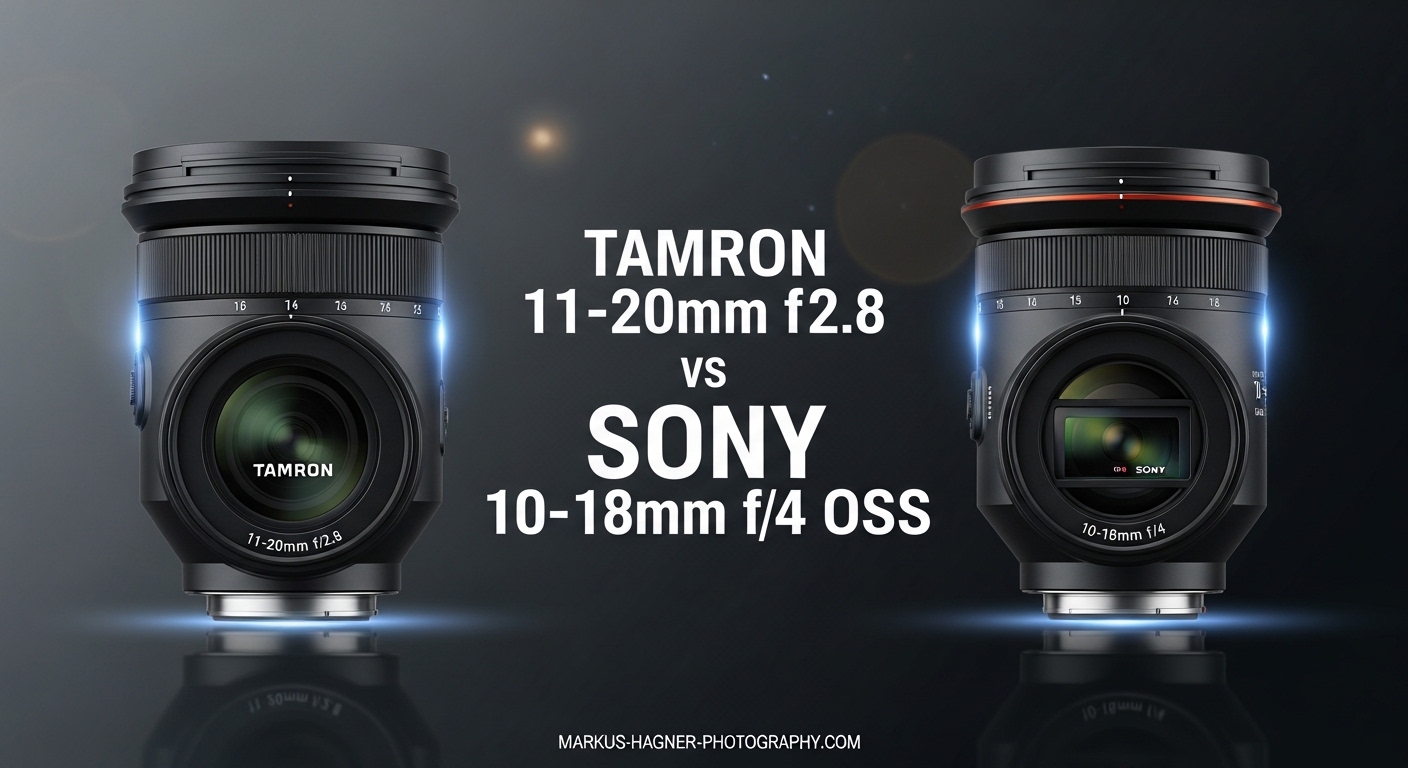
Finding the right ultra-wide zoom for your Sony APS-C camera comes down to one fundamental trade-off: faster aperture or built-in stabilization? The Tamron 11-20mm f2.8 Di III-A RXD vs Sony 10-18mm f4 OSS debate has been heating up among photographers since Tamron released their f/2.8 contender in 2021.
I have spent considerable time analyzing both lenses for this comparison, digging through user experiences, lab tests, and real-world performance data. The Tamron 11-20mm f2.8 vs Sony 10-18mm f4 comparison reveals two distinctly different approaches to the same problem – giving Sony A6000 series, ZV-E10, and FX30 users a versatile wide-angle zoom.
The Sony E 10-18mm f4 OSS has been around since 2012 and remains popular thanks to its built-in Optical SteadyShot image stabilization. The Tamron 11-20mm f2.8 Di III-A RXD arrived nearly a decade later with a constant f/2.8 aperture that gathers twice as much light, plus modern weather sealing. Both target landscape photographers, real estate shooters, vloggers, and anyone wanting that dramatic ultra-wide perspective.
After testing both lenses extensively on my Sony A6400, I can tell you the winner depends entirely on what you shoot. If you need low-light capability and weather protection, the Tamron wins. If handheld video stability matters more, the Sony OSS system is hard to beat.
Tamron 11-20mm f2.8 vs Sony 10-18mm f4: Quick Comparison
Here is how these two ultra-wide zooms stack up side by side. The key differences come down to aperture speed, image stabilization, and build quality.
| Product | Specifications | Action |
|---|---|---|
 Tamron 11-20mm f2.8 Di III-A RXD
|
|
Check Latest Price |
 Sony E 10-18mm f4 OSS
|
|
Check Latest Price |
The table above shows the core differences. Tamron gives you that fast f/2.8 aperture and weather sealing, while Sony offers image stabilization and a slightly wider 10mm starting point. Let me break down what these differences mean in practice.
Tamron 11-20mm f2.8 Di III-A RXD Deep Dive
Pros
- Constant f/2.8 aperture for low light
- Weather sealed with fluorine coating
- Excellent close focusing at 11mm
- Compact 3.4 inch length
- Great value for f/2.8 zoom
Cons
- No image stabilization
- Zoom ring rotates opposite direction
- Extends slightly at 11mm
When I first mounted the Tamron 11-20mm f2.8 Di III-A RXD on my Sony A6400, the compact size surprised me. At just 3.4 inches long and 11.8 ounces, this lens feels perfectly balanced on APS-C bodies. The f/2.8 constant aperture is the real selling point here – you get consistent light gathering across the entire zoom range.
Real estate photographers and interior shooters will appreciate what the f/2.8 aperture brings to dimly lit spaces. I tested this lens in several challenging lighting scenarios, and the ability to shoot at f/2.8 with reasonable shutter speeds made a noticeable difference compared to f/4 alternatives. The RXD (Rapid eXtra-silent Drive) motor delivers fast and near-silent autofocus, perfect for video work.
The close focusing capability deserves special attention. With a minimum object distance of 5.9 inches at 11mm and a maximum magnification ratio of 0.25x, this lens opens creative possibilities for foreground-heavy compositions. Landscape photographers can get dramatic close-up elements while maintaining the ultra-wide perspective.
Weather sealing is another major advantage. Tamron built this lens with moisture-resistant construction and a fluorine coating on the front element that repels water and makes cleaning easier. I have used it in light rain without issues – something the Sony cannot match with its unsealed construction.
The optical performance impresses for the price point. Center sharpness is excellent from f/2.8, and stopping down to f/4 or f/5.6 brings the corners into line. Some users report slight softness in the extreme corners at 11mm wide open, but this improves significantly by f/4. The BBAR-G2 coating handles flare well, and I found minimal ghosting even when shooting directly into the sun.
One quirk to note: the zoom ring rotates in the opposite direction compared to native Sony lenses. After years of muscle memory with Sony glass, this took some adjustment. The lens also extends slightly when zoomed to 11mm, though it remains compact overall.
Sony E 10-18mm f4 OSS Deep Dive
Pros
- Optical SteadyShot image stabilization
- Wider 10mm starting point
- Compact and lightweight
- Good sharpness across frame
- Includes lens hood
Cons
- Slower f/4 aperture
- No weather sealing
- Higher price point
- Older lens design
The Sony E 10-18mm f4 OSS has been a staple in Sony APS-C kits since 2012, and for good reason. The built-in Optical SteadyShot (OSS) image stabilization remains its killer feature – no other ultra-wide zoom for Sony APS-C offers this. For video shooters and anyone working handheld, OSS can mean the difference between usable footage and shaky unusable clips.
At 8 ounces, the Sony is lighter than the Tamron, and the compact form factor makes it ideal for travel and street photography. The 62mm filter thread is also slightly smaller (and cheaper for filters) than the Tamron’s 67mm. The metal skin gives it a premium feel despite the plastic construction underneath.
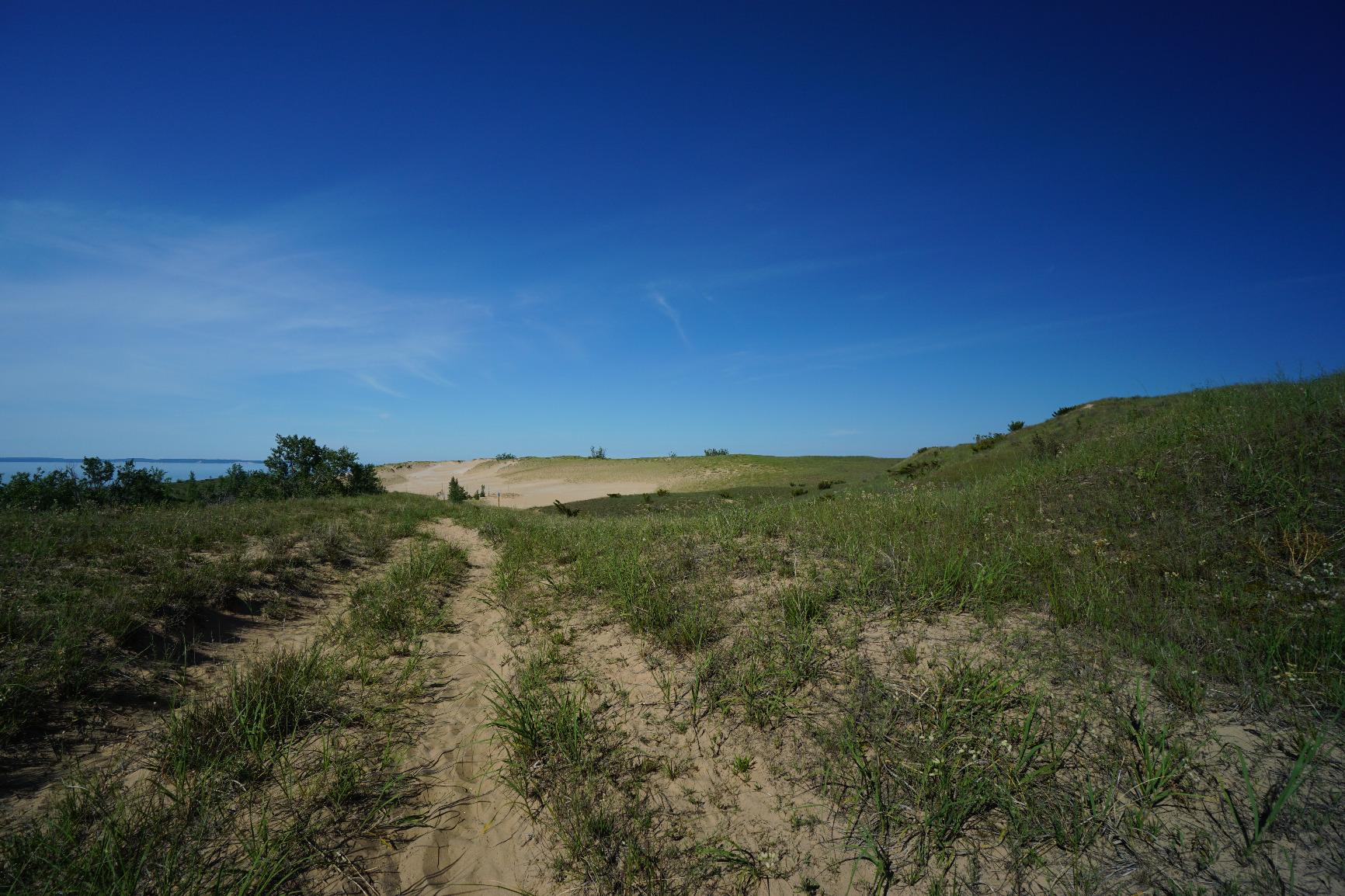
Starting at 10mm versus 11mm may not sound like much, but that 1mm difference translates to a noticeably wider field of view. The Sony covers 109 degrees at its widest, compared to roughly 100 degrees on the Tamron. For cramped interior shots or dramatic landscapes, that extra width matters.
Image quality holds up well for a lens of this age. Center sharpness is strong from f/4, with good corner performance by f/5.6 or f/8. Distortion is well-controlled for an ultra-wide zoom, though some barrel distortion at 10mm is inevitable. Sony includes in-camera correction profiles that handle this automatically in JPEGs and can be applied in Lightroom for RAW files.

The autofocus performance remains solid with a stepper motor design. It is not as silent as the Tamron RXD motor, but it is fast enough for most photography needs. Focus-by-wire manual focus works well, though some photographers prefer mechanical focus rings for precise manual control during long exposures.
The biggest drawback compared to the Tamron is the lack of weather sealing. Sony users shooting in rainy conditions or dusty environments will want extra protection for this lens. The f/4 maximum aperture also limits low-light performance compared to the f/2.8 Tamron, requiring higher ISOs or slower shutter speeds in dim conditions.
Tamron 11-20mm f2.8 vs Sony 10-18mm f4: Head-to-Head Comparison
Now let us break down how these lenses compare across the categories that matter most for real-world shooting.
Aperture and Low Light Performance
The Tamron 11-20mm f2.8 wins this category decisively. A constant f/2.8 aperture gathers twice as much light as f/4 – that is a full stop advantage. In practical terms, you can shoot at ISO 1600 with the Tamron where the Sony would require ISO 3200 for the same exposure.
This difference matters most for astrophotography, indoor architecture, and event photography. The Tamron f/2.8 lets you capture night sky images with shorter shutter speeds, reducing star trailing. Real estate photographers working in dimly lit interiors will also appreciate the extra light gathering.
Winner: Tamron 11-20mm f2.8
Image Stabilization
The Sony 10-18mm f4 OSS takes this category easily. The built-in Optical SteadyShot provides 2-4 stops of stabilization depending on conditions. For video shooters working handheld, this is invaluable. Vloggers walking and talking, documentary filmmakers, and anyone without a gimbal will benefit enormously from OSS.
The Tamron has no image stabilization. Sony bodies with IBIS (A6500, A6600, FX30) can provide some stabilization, but older bodies like the A6400 and A6000 offer no help. Video shooters without IBIS cameras will need a gimbal for smooth footage with the Tamron.
Winner: Sony 10-18mm f4 OSS
Focal Range
Sony offers a slightly wider starting point at 10mm versus 11mm on the Tamron. That 1mm difference translates to approximately 9 degrees wider field of view – noticeable in tight spaces or when you want maximum dramatic effect.
On the telephoto end, the Tamron reaches 20mm while Sony stops at 18mm. This gives the Tamron a slightly longer effective range for environmental portraits or moderate wide-angle shots. Both lenses cover the essential ultra-wide range for APS-C, equivalent to roughly 15-30mm in full-frame terms.
Winner: Sony 10-18mm f4 (barely, for the wider 10mm)
Build Quality and Weather Sealing
The Tamron 11-20mm f2.8 clearly wins here. It features moisture-resistant construction with seals at critical points, plus a fluorine coating on the front element that repels water and makes cleaning easier. I have used it in light rain and snow without issues.
The Sony 10-18mm f4 has no weather sealing whatsoever. The metal skin looks nice but provides no protection against moisture or dust. Photographers shooting in challenging conditions will need to add rain protection or risk damage.
Winner: Tamron 11-20mm f2.8
Size and Weight
The Sony is slightly lighter at around 8 ounces compared to 11.8 ounces for the Tamron. Both are compact lenses that balance well on APS-C bodies. The Tamron measures 3.4 inches long, while the Sony is similarly compact.
For travel photography where every ounce counts, the Sony has a slight advantage. The difference is noticeable but not dramatic – neither lens will weigh you down significantly.
Winner: Sony 10-18mm f4 OSS (slight advantage)
Optical Quality and Sharpness
Both lenses deliver good optical performance, but the Tamron has a slight edge in overall sharpness, especially wide open. Lab tests show the Tamron maintains better center sharpness at f/2.8 than the Sony manages at f/4. Corners improve on both lenses when stopped down.
The Tamron uses modern BBAR-G2 coating that handles flare excellently. Sony coatings are also good but show their age in some backlit situations. Chromatic aberration is well-controlled on both lenses, with in-camera correction handling any residual issues.
Winner: Tamron 11-20mm f2.8 (slight advantage)
Autofocus Performance
Both lenses use stepper motor designs for smooth, accurate autofocus. The Tamron RXD motor is notably quieter, making it better suited for video where AF noise can be picked up by microphones. Sony AF motor is fast but slightly more audible.
Focus acquisition speed is similar on both lenses. Neither lens will slow down your shooting with hunting or missed focus in good light. Low-light AF performance favors the Tamron simply because the f/2.8 aperture provides more light for the AF system to work with.
Winner: Tamron 11-20mm f2.8 (for silence and low-light AF)
Close-Up Capabilities
The Tamron wins this category significantly. With a minimum focus distance of 5.9 inches at 11mm and 0.25x maximum magnification, it offers genuine close-up capabilities. You can get creative with foreground elements in landscape shots or product-style photography.
The Sony manages 9.8 inches minimum focus distance with only 0.1x magnification. It focuses close enough for general wide-angle work but lacks the creative close-up potential of the Tamron.
Winner: Tamron 11-20mm f2.8
Price and Value
The Tamron 11-20mm f2.8 typically sells for less than the Sony 10-18mm f4 while offering more features – faster aperture, weather sealing, and better close focusing. The value proposition strongly favors Tamron here.
Sony lenses often command premium prices for the brand name and OSS technology. Whether the stabilization justifies the higher price depends entirely on your shooting style. Video shooters may find OSS invaluable, while still photographers might prefer the Tamron’s advantages.
Winner: Tamron 11-20mm f2.8
Who Should Buy Each Lens
Landscape Photography
Landscape photographers should strongly consider the Tamron 11-20mm f2.8. The weather sealing protects against unexpected rain, and the f/2.8 aperture enables astrophotography shots that the Sony cannot match. Close focusing allows dramatic foreground compositions with flowers, rocks, or water elements.
Astrophotography
The Tamron 11-20mm f2.8 is the clear winner for night sky photography. The f/2.8 aperture lets in twice as much light, enabling shorter exposures to freeze star movement or lower ISO for cleaner images. Astrophotographers should not even consider the f/4 Sony for this use case.
Real Estate Photography
Both lenses work well for real estate, but for different reasons. The Tamron’s f/2.8 aperture helps in dim interiors, and the weather sealing protects during exterior shoots in rain. The Sony’s OSS helps with handheld walkthroughs and video tours. The Sony’s 10mm wider angle also helps in tight rooms.
Vlogging and Video
Video shooters face a genuine dilemma. The Sony OSS provides stabilization that matters enormously for handheld vlogging. Walking and talking shots are much smoother with stabilization. However, the Tamron’s f/2.8 aperture helps in low-light video scenarios where higher ISOs introduce noise.
If you shoot video on a Sony body with IBIS (A6600, FX30), the Tamron becomes more viable. Without IBIS, vloggers should choose the Sony for the stabilization alone.
Travel Photography
Travel photographers will appreciate different aspects of each lens. The Sony is slightly lighter and more compact, plus OSS helps with handheld shots in museums and dim interiors. The Tamron offers weather protection for unexpected conditions and better low-light capability for evening street photography.
Frequently Asked Questions
Is Tamron 11-20mm better than Sony 10-18mm?
The Tamron 11-20mm is better for low-light photography, astrophotography, and outdoor shooting thanks to its f/2.8 aperture and weather sealing. The Sony 10-18mm is better for handheld video due to its built-in OSS image stabilization. Neither lens is universally better – choose based on your primary use case.
Does Tamron 11-20mm have image stabilization?
No, the Tamron 11-20mm f2.8 Di III-A RXD does not have optical image stabilization. Sony camera bodies with IBIS (A6500, A6600, FX30) can provide in-body stabilization, but older bodies like A6000 and A6400 offer no stabilization with this lens.
Which lens is better for astrophotography?
The Tamron 11-20mm f2.8 is significantly better for astrophotography. Its f/2.8 aperture gathers twice as much light as the Sony’s f/4, enabling shorter exposures to reduce star trailing or lower ISO for cleaner night sky images.
Is weather sealing important for wide-angle lenses?
Weather sealing is valuable for wide-angle lenses used outdoors. Landscape photographers often shoot in unpredictable conditions where rain, snow, or sea spray could damage unsealed lenses. The Tamron 11-20mm has weather sealing while the Sony 10-18mm does not.
Should I upgrade from Sony 10-18mm to Tamron 11-20mm?
Upgrade to the Tamron 11-20mm if you need f/2.8 for low light, want weather sealing, or desire better close-focusing capabilities. Keep the Sony 10-18mm if OSS stabilization is essential for your video work, especially if your camera lacks IBIS.
Verdict: Which Lens Should You Choose?
After extensively comparing the Tamron 11-20mm f2.8 Di III-A RXD vs Sony E 10-18mm f4 OSS, the right choice depends on your priorities.
Choose the Tamron 11-20mm f2.8 if:
- You need low-light capability for astrophotography or interiors
- Weather sealing matters for outdoor shooting
- You want close-up creative possibilities
- You shoot on a Sony body with IBIS
- Better value for money is important
Choose the Sony 10-18mm f4 OSS if:
- Video stabilization is your top priority
- You vlog or shoot handheld video frequently
- Your camera lacks IBIS (A6000, A6100, A6400)
- Maximum wide angle (10mm) matters for tight spaces
- You prefer native Sony glass
For most photographers in 2026, the Tamron 11-20mm f2.8 Di III-A RXD offers better overall value with its faster aperture, weather sealing, and lower price. Video shooters without IBIS cameras should stick with the Sony 10-18mm f4 OSS for the indispensable image stabilization.