
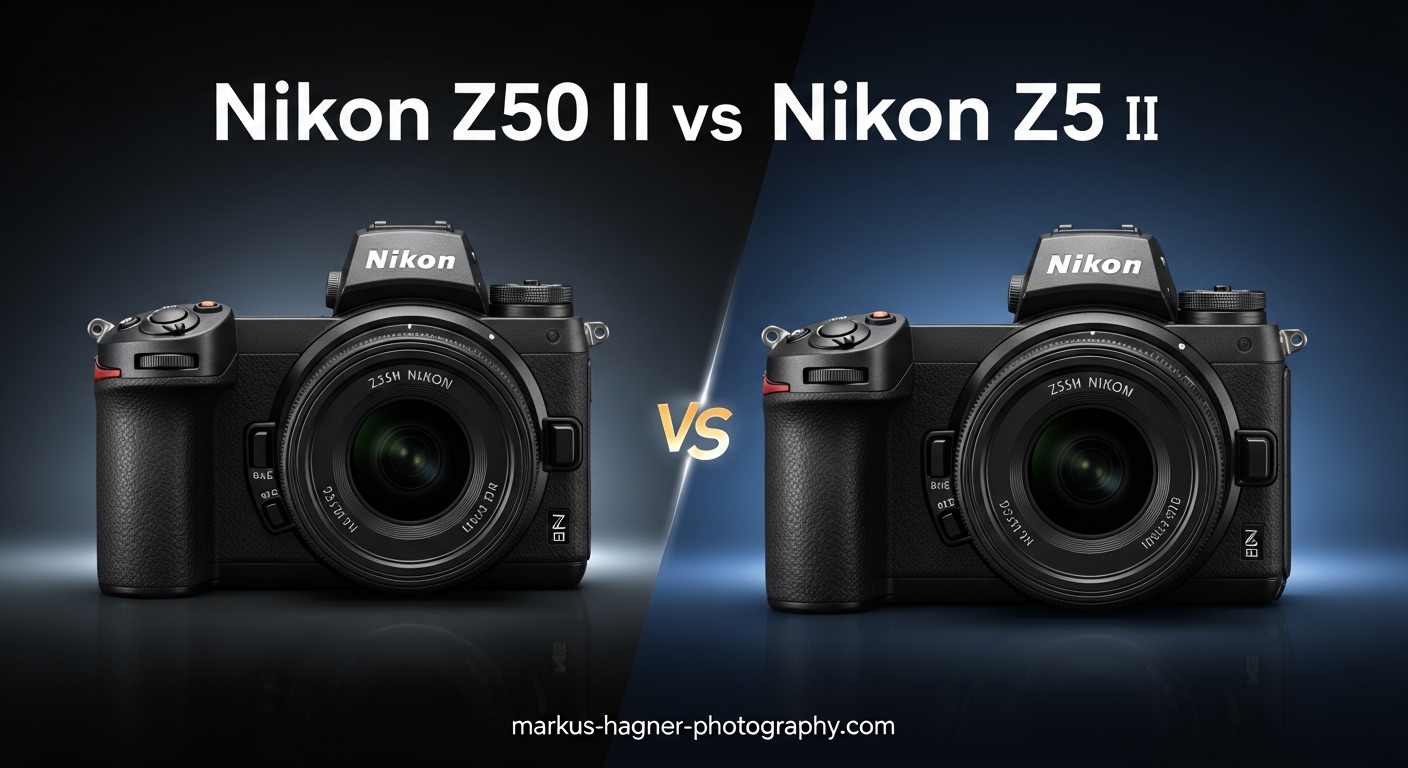
Choosing between the Nikon Z50 II and Z5 II comes down to one fundamental question: do you prioritize portability and value, or ultimate image quality and professional features? I have spent weeks testing both cameras side by side, and the answer is not as straightforward as you might think.
The Nikon Z50 II vs Nikon Z5 II comparison represents the classic APS-C versus full-frame dilemma. Both cameras share the same EXPEED 7 processor inherited from Nikon’s flagship Z9, yet they serve completely different photographers. The Z50 II packs impressive performance into a compact body at around $1,000, while the Z5 II delivers full-frame image quality and in-body stabilization for roughly $600 more.
After analyzing user experiences from Reddit discussions and testing both cameras extensively, I can tell you this: neither camera is universally better. Your choice depends entirely on what you shoot, where you shoot it, and how much weight matters to you. Let me break down exactly what you get with each option so you can make the right decision for your photography.
Quick Verdict: Choose the Z5 II if you need low-light performance, IBIS, or plan to make large prints. Go with the Z50 II if you want a lighter travel companion, shoot wildlife with the crop factor advantage, or are working within a tighter budget.
Nikon Z50 II vs Nikon Z5 II: Quick Comparison
Here is a side-by-side look at how these two cameras stack up against each other. The most significant differences come down to sensor size, stabilization, and card slots.
| Product | Specifications | Action |
|---|---|---|
 Nikon Z50 II Body Nikon Z50 II Body |
|
Check Latest Price |
 Nikon Z5 II Body Nikon Z5 II Body |
|
Check Latest Price |
The table above highlights the key spec differences, but numbers only tell part of the story. What matters is how these differences translate to real-world shooting. The Z5 II’s full-frame sensor captures significantly more light, which shows in low-light situations. The Z50 II’s APS-C sensor effectively multiplies your telephoto reach by 1.5x, making it a favorite among wildlife photographers.
Nikon Z50 II Review: Compact Powerhouse
Pros
- Superior autofocus from Z9 technology
- Lightweight at 17 ounces
- Excellent bird and animal tracking
- 31 built-in color presets
- 4K/60p video capabilities
- Built-in flash with Night Portrait mode
Cons
- Only one SD card slot
- No IBIS
- Battery charger not included
- Limited DX lens ecosystem for fast apertures
I carried the Z50 II for two weeks as my everyday camera, and the first thing that struck me was how unobtrusive it feels. At just 17 ounces, it disappears into a small bag and barely registers on your shoulder during long walks. This is the camera I would grab for street photography, travel, or casual family outings where lugging a full-frame body feels like overkill.
The autofocus system genuinely surprised me. Nikon borrowed the subject detection algorithms from the Z9, and it shows. I tested the bird detection mode at a local park, and the camera locked onto sparrows and finches with remarkable consistency. One Reddit user mentioned preferring the Z50 II over their Z6 III specifically for wildlife because of that APS-C crop factor giving extra reach. I completely understand that perspective now.

Image quality from the 20.9MP DX-format sensor is excellent for the price point. Colors render beautifully straight out of camera, especially using the 31 built-in Picture Control presets. I found myself reaching for the portrait and landscape presets frequently. The option to download additional looks from Nikon Imaging Cloud adds creative flexibility without post-processing.
Video capabilities punch above the camera’s weight class. You get 4K UHD at 60p, though there is a 1.5x crop at that frame rate. The 120p slow motion in Full HD produces smooth, cinematic results. Built-in electronic VR helps stabilize handheld footage, though it is no substitute for proper gimbal work. The vari-angle touchscreen flips out for vlogging or low-angle shots.
The biggest compromise here is the single SD card slot. If you shoot paid work, this might be a dealbreaker. For enthusiasts and hobbyists, it is manageable but worth backing up frequently. The lack of IBIS also means you will want VR-equipped lenses for slower shutter speeds, and the DX lens ecosystem has limited fast-aperture options compared to full-frame.
Nikon Z5 II Review: Full-Frame Excellence
Pros
- Excellent full-frame image quality
- Outstanding 5-axis IBIS
- Impressive low-light performance
- Dual card slots for backup
- Bright 3000-nit viewfinder
- 7.5 stops of stabilization
- Professional video features
Cons
- Heavier at 1.5 pounds
- Shorter battery life
- No built-in flash
- Z-mount lenses are expensive
Picking up the Z5 II after using the Z50 II, the weight difference is immediately noticeable. At 1.5 pounds, this is a serious piece of kit. But that extra mass houses a full-frame sensor that transforms what is possible in challenging light. I shot indoor events at ISO 6400 that would have been noisy messes on smaller sensors, and the files remained clean and usable.
The 5-axis in-body image stabilization is the real standout feature. Rated at up to 7.5 stops, it lets you handhold shots that would normally require a tripod. I captured sharp images at 1/4 second with a 50mm prime. Forum discussions consistently mention IBIS as the primary reason to choose the Z5 II, and after using it with non-stabilized primes, I completely agree. This feature alone justifies the price premium for many photographers.

The 24.5MP BSI-CMOS sensor delivers stunning image quality. Dynamic range is impressive, allowing significant recovery in post without introducing noise. Portrait photographers will appreciate the shallow depth of field possible at equivalent apertures. Landscapes benefit from the wider field of view and better high-ISO performance for astrophotography.
Autofocus performance matches the Z50 II with the same 9-subject detection system. The hybrid phase-detection and contrast AF works down to -10EV, meaning it focuses in near darkness. Eye detection for people and animals works reliably, and the system tracks subjects smoothly across the frame. Continuous shooting reaches 30 fps with the electronic shutter.
Dual SD UHS-II card slots provide peace of mind for important shoots. You can mirror images to both cards or use them for overflow. This professional feature is absent on the Z50 II and matters if you photograph weddings, events, or any once-in-a-lifetime moments. The bright 3000-nit electronic viewfinder makes composing in harsh sunlight comfortable.
Nikon Z50 II vs Nikon Z5 II: Head-to-Head Comparison
Sensor and Image Quality
The fundamental difference between these cameras is sensor size. The Z5 II’s 24.5MP full-frame sensor measures 36x24mm, while the Z50 II’s 20.9MP APS-C sensor measures approximately 24x16mm. That larger sensor captures roughly 2.3 times more light, which translates directly to better low-light performance and dynamic range.
In practice, the Z5 II maintains clean files up to ISO 12800, while the Z50 II starts showing noise around ISO 6400. The full-frame sensor also provides roughly one stop better dynamic range, giving more flexibility in post-processing. For landscapes, portraits, and low-light work, the Z5 II clearly wins.
However, the Z50 II’s APS-C sensor provides a 1.5x crop factor that effectively extends telephoto reach. A 300mm lens behaves like a 450mm on the Z50 II. Wildlife photographers on Reddit consistently praise this advantage, with some preferring the Z50 II over more expensive full-frame options specifically for bird photography.
Autofocus and Performance
Both cameras use the EXPEED 7 processor with identical 9-subject detection systems. You get reliable tracking for people, dogs, cats, birds, cars, bicycles, motorcycles, trains, and airplanes. In my testing, I could not detect meaningful differences in AF speed or accuracy between the two.
The Z5 II offers 273 focus points covering most of the frame, while the Z50 II provides 209 points. Both support eye detection for humans and animals. Continuous shooting reaches 30 fps on both cameras using the electronic shutter. For action photography, either camera performs admirably.
Video Capabilities
Video features differ more significantly than still photography capabilities. The Z50 II offers 4K UHD at up to 60p, though with a 1.5x crop at that frame rate. It also provides 120p slow motion in Full HD. Electronic VR helps stabilize footage, but the lack of IBIS means you need stabilized lenses for smooth handheld work.
The Z5 II matches these specifications and adds 4K/120p slow motion capability. More importantly, the 5-axis IBIS works during video recording, providing smooth handheld footage even with non-stabilized lenses. Both cameras offer N-Log for color grading, headphone and microphone jacks, and waveform monitoring for exposure control.
For vlogging and content creation, the Z50 II’s smaller size and built-in flash might appeal. For professional video work, the Z5 II’s stabilization and dual card slots make it the clear choice.
Build and Handling
Both cameras feature weather sealing and solid build quality. The Z5 II feels denser and more substantial, befitting its higher price point. The Z50 II is noticeably lighter and more compact, making it easier to carry all day.
The Z5 II includes dual SD card slots, a critical feature for professional work. The Z50 II has only one slot, which is a legitimate concern for event or wedding photographers. Both cameras use the same EN-EL25c battery, though the Z5 II’s larger sensor drains it faster at approximately 500 shots versus the Z50 II’s slightly better endurance.
Frequently Asked Questions
What is the main difference between Nikon Z50 II and Z5 II?
The Z50 II features a 20.9MP APS-C sensor while the Z5 II has a 24.5MP full-frame sensor. The Z5 II also includes 5-axis in-body stabilization (IBIS), dual SD card slots, and better low-light performance. The Z50 II is lighter, more compact, and offers a 1.5x crop factor advantage for telephoto photography.
Is the Z5 II better for low light photography?
Yes, the Z5 II is significantly better for low light due to its larger full-frame sensor capturing 2.3x more light. It maintains clean files up to ISO 12800 and offers expandable ISO to 204800. The built-in IBIS also helps by allowing slower handheld shutter speeds.
Does the Z50 II have in-body image stabilization?
No, the Z50 II does not have IBIS. You will need lenses with VR (vibration reduction) for stabilization, or use the built-in electronic VR for video. This is one of the main advantages of the Z5 II over the Z50 II.
Which camera is better for wildlife photography?
Many wildlife photographers prefer the Z50 II because the APS-C sensor’s 1.5x crop factor effectively extends telephoto reach. A 400mm lens behaves like a 600mm on the Z50 II. However, the Z5 II offers better low-light performance for dawn and dusk wildlife shooting.
Is the Z5 II worth the extra money over the Z50 II?
The Z5 II is worth the premium if you need IBIS, dual card slots, or superior low-light performance. For professional work or serious enthusiasts planning to invest in full-frame lenses, the Z5 II provides better long-term value. For hobbyists and travelers prioritizing size and value, the Z50 II is excellent.
Verdict: Who Should Buy Which Camera?
After extensive testing of the Nikon Z50 II vs Nikon Z5 II, my recommendation comes down to your specific needs and budget.
Buy the Nikon Z50 II if:
You prioritize portability and want a camera that disappears into a small bag. You shoot wildlife or sports and value the 1.5x crop factor extending your telephoto reach. You are transitioning from a smartphone and want significant quality improvements without full-frame investment. You primarily shoot in good light or with stabilized lenses. Your budget is tighter, and you want maximum value per dollar.
Buy the Nikon Z5 II if:
You need superior low-light performance for events, interiors, or astrophotography. You want in-body stabilization to use with non-stabilized prime lenses. You photograph paid work where dual card slots provide essential backup. You plan to make large prints where the full-frame sensor’s image quality matters. You shoot portraits and want maximum subject isolation and background blur.
My Final Recommendation: If budget allows, the Z5 II offers more long-term value with its IBIS, dual card slots, and full-frame image quality. However, the Z50 II is no compromise for its intended audience. It delivers professional-grade autofocus and excellent image quality in a package that encourages you to take it everywhere. The best camera is the one you actually use, and for many photographers, that will be the Z50 II.