
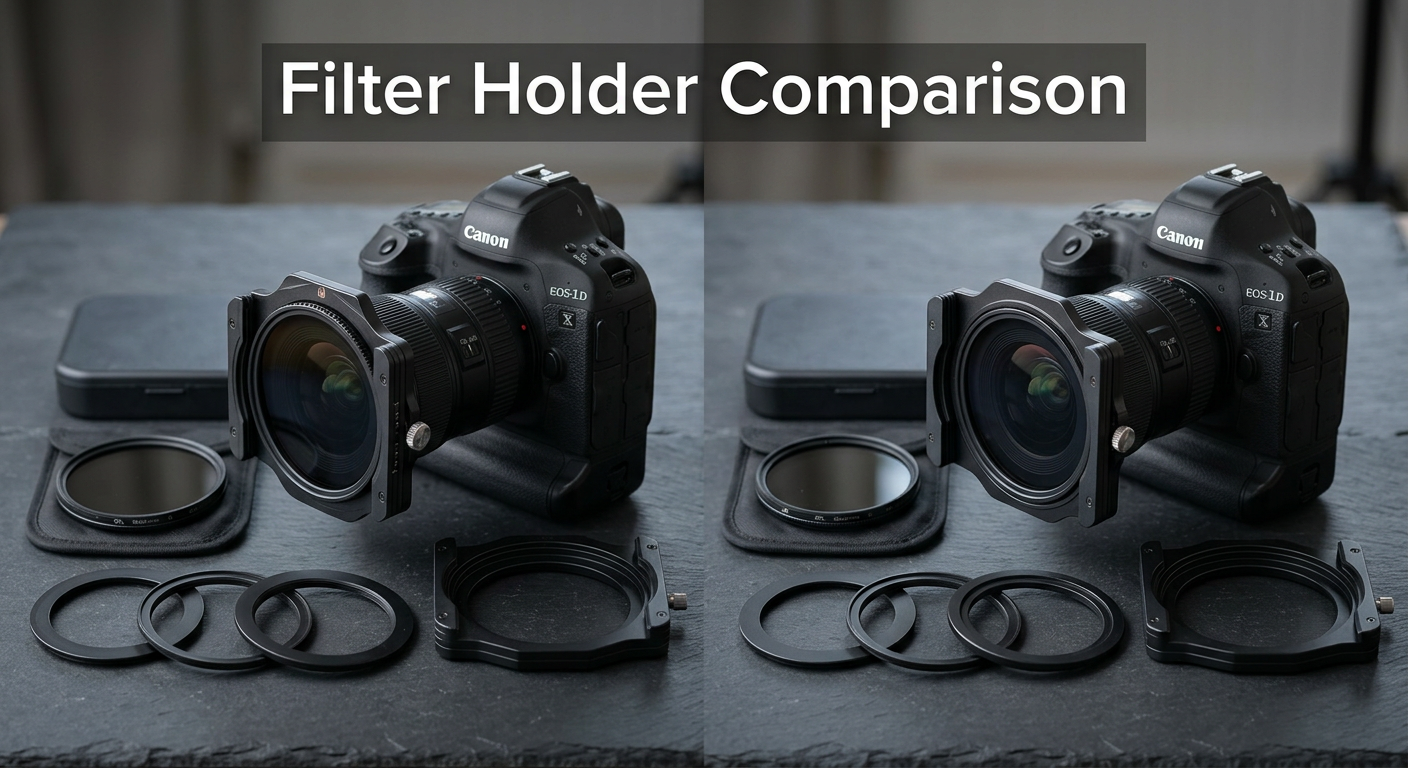
Choosing the right filter holder system can make or break your landscape photography workflow. I have spent countless hours in the field testing both the Haida M10 Filter Holder and the NiSi V7 Filter Holder, and the differences between these two 100mm systems are more significant than you might expect.
The Haida M10 Filter Holder vs NiSi V7 Filter Holder comparison comes down to a fundamental choice between two design philosophies. Haida focuses on a traditional drop-in system with a unique magnetic quick-release mount, while NiSi pushes innovation with a magnetic attachment system and True Color CPL technology.
Both systems target serious landscape photographers who need professional-grade filter holders for neutral density filters, graduated ND filters, and circular polarizers. But their approaches to build quality, workflow speed, and optical performance differ substantially.
After testing both systems extensively on coastal seascapes and mountain landscapes, I can tell you that neither system is universally better. Your choice depends on your shooting style, lens collection, and budget priorities.
Quick Comparison: Haida M10 vs NiSi V7
| Product | Specifications | Action |
|---|---|---|
 Haida M10 Filter Holder Kit Haida M10 Filter Holder Kit |
|
Check Latest Price |
 NiSi V7 Standard Kit NiSi V7 Standard Kit |
|
Check Latest Price |
This side-by-side comparison highlights the key differences. The Haida M10 offers a more affordable entry point with its innovative drop-in CPL system, while the NiSi V7 commands a premium for its vignetting-free wide-angle performance and three included adapter rings.
Haida M10 Filter Holder Kit: Detailed Review
Pros
- Quick snap-on magnetic mounting
- Drop-in CPL with independent rotation
- Includes custom padded case
- Easy filter changes without screws
- Good value for the features
Cons
- May vignette on ultra-wide lenses
- Fiddly to setup in field
- Limited third-party filter compatibility
- Only one adapter ring included
The Haida M10 caught my attention with its clever approach to filter holder design. The magnetic quick-release system lets you attach and remove the holder from your lens in seconds, which sounds like a small convenience until you are shooting in rapidly changing light conditions.
I found the drop-in circular polarizer particularly useful for seascapes where reflections on water need constant adjustment. The CPL sits behind the square filter slots, so you can rotate it independently without disturbing your graduated ND positioning. This design choice makes the Haida M10 excellent for long exposure photography where you need both a polarizer and ND filters stacked.
The build quality uses aviation-grade aluminum with CNC-machined components. It feels substantial in hand without being overly heavy for backpacking trips. The included padded storage case is a nice touch that keeps everything organized in your camera bag.
However, the Haida M10 has some limitations worth considering. On ultra-wide angle lenses, I noticed vignetting at 16mm without using the MSC (Multiple Slot Converter) accessory. If you shoot primarily with wide-angle zooms, this could be a dealbreaker.
The system holds up to two 100mm filters, which covers most landscape photography scenarios. But if you frequently stack three or more filters for extreme long exposures, you will need to upgrade to the M10 Plus holder with three slots.
Third-party filter compatibility proved mixed in my testing. Some standard 100x150mm filters from other brands fit snugly, while others required sanding or simply would not slide in smoothly. This inconsistency could be frustrating if you already own filters from Lee, Formatt Hitech, or other manufacturers.
NiSi V7 Filter Holder Standard Kit: Detailed Review
Pros
- Vignetting-free at 16mm
- True Color CPL eliminates yellow casts
- Three adapter rings included
- Holds 3 filters
- Excellent wide-angle performance
Cons
- Higher price point
- Polarizer can fall off if not secured
- Pouch has limited space
- CPL change difficult with gloves
The NiSi V7 represents a significant evolution from the older V6 system, and it shows in every aspect of the design. My first impression was how refined the magnetic attachment system feels compared to previous generations. Filters snap into place with a satisfying click, and the improved single-pin CPL locking mechanism prevents the rotation issues that plagued earlier models.
What impressed me most during field testing was the vignetting-free performance at 16mm on full-frame cameras. I tested this extensively with a 16-35mm lens, and even at the widest setting, the holder caused zero corner darkening. For landscape photographers who live at 16mm, this alone could justify the premium price.
The True Color CPL delivers on its promise of eliminating the yellow color casts common in budget polarizers. Side-by-side comparisons with other CPLs showed noticeably more natural colors, especially in blue skies and green foliage. This matters when you are trying to minimize post-processing time.
NiSi includes three adapter rings (67mm, 72mm, and 77mm) in the standard kit, which adds tremendous value if you own multiple lenses. The main adapter features an 82mm thread, so photographers with larger filters are covered. This comprehensive kit approach means fewer accessories to purchase separately.
The three filter slots accommodate serious filter stacking for complex exposures. I tested this with a 10-stop ND, a 3-stop graduated ND, and the True Color CPL simultaneously with no issues. The holder handled the weight without sagging or binding.
My main complaint involves the CPL attachment mechanism. While the bayonet mount works smoothly, I had the polarizer detach unexpectedly twice during transport. The cover cap also tends to fall off in a camera bag, potentially exposing your CPL to scratches. These are not dealbreakers, but they require careful handling.
Haida M10 vs NiSi V7: Head-to-Head Comparison
Build Quality and Materials
Both systems use aviation-grade aluminum construction with CNC-machined precision. The Haida M10 feels slightly heavier at 1.19 pounds compared to the NiSi V7 at 14.5 ounces, though the difference is negligible in practice.
The Haida components have a more industrial feel with visible machining marks that speak to their precision manufacturing. NiSi takes a more refined approach with smoother finishes and tighter tolerances between moving parts.
Long-term durability appears comparable between both systems. User reviews consistently mention both holders holding up well after years of field use, with no reports of aluminum fatigue or coating degradation.
Winner: Tie. Both systems offer excellent build quality that should last for years of professional use.
Filter Holder Design and Innovation
Haida takes a traditional approach with its drop-in CPL system. The polarizer slides into a dedicated slot behind the square filter stages, allowing independent rotation. This design works well for photographers who frequently adjust their CPL while maintaining graduated filter positions.
NiSi innovates with its magnetic attachment system for the True Color CPL. The bayonet mount allows quick CPL installation and removal, though the magnetic connection requires careful handling to prevent accidental detachment.
The Haida M10 holds two 100mm filters, while the NiSi V7 accommodates three. For most landscape work, two slots suffice. But photographers doing extreme long exposures with multiple stacked ND filters will appreciate the extra capacity.
Winner: NiSi V7 for its magnetic innovation and three-slot capacity.
CPL Integration Comparison
The Haida M10 drop-in CPL integrates seamlessly with the holder design. You insert it from the rear, and it rotates independently using a dedicated dial. This approach keeps your CPL protected and always ready for use.
NiSi V7 uses its True Color CPL with a front-mounted bayonet system. The polarizer attaches magnetically to the front of the holder, which allows for larger CPL sizes and better wide-angle performance. However, this external mounting makes the CPL more vulnerable to damage.
Color performance favors the NiSi True Color CPL, which eliminates the yellow casts sometimes visible in Haida polarizers. If color accuracy is paramount for your work, the NiSi system has a clear advantage.
Winner: NiSi V7 for color accuracy, though Haida offers better CPL protection.
Vignetting Performance
This is where the NiSi V7 truly shines. The holder is specifically designed to avoid vignetting at 16mm on full-frame cameras, and my testing confirmed this claim. Corner-to-corner illumination remained perfectly even at the widest settings.
The Haida M10 can produce vignetting at 16mm unless you use the optional MSC (Multiple Slot Converter) accessory. Without this upgrade, ultra-wide shooters will see darkened corners that require cropping in post-processing.
For photographers who primarily shoot at 24mm and longer, both systems perform adequately. But if your landscape work involves 16-35mm or 14-24mm zooms, the NiSi V7 offers a significant advantage.
Winner: NiSi V7 by a clear margin for wide-angle work.
Usability and Workflow
The Haida M10 excels at quick filter changes in the field. The magnetic snap-on mount lets you attach or remove the entire holder in seconds without unscrewing anything from your lens. This speed matters when light is changing rapidly during golden hour.
NiSi V7 offers a different workflow advantage with its magnetic filter attachment. Filters snap into the slots magnetically, which is faster than sliding traditional filters. However, the magnetic system requires clean filter edges for reliable attachment.
Both systems include padded cases for transport. The Haida case is larger and holds the holder plus accessories comfortably. The NiSi pouch is more compact but offers less room for additional filters.
Changing the CPL requires bare hands on both systems, which can be challenging in cold weather with gloves. Neither system addresses this common pain point effectively.
Winner: Haida M10 for faster holder attachment, NiSi V7 for faster filter insertion.
Image Quality and Color Cast
Both systems use optical glass that maintains image sharpness and clarity. I detected no softness or degradation when shooting through either holder.
Color neutrality differs between the systems. The NiSi True Color CPL lives up to its name with virtually no color cast. Haida filters sometimes exhibit a slight purple tint in certain lighting conditions, though this is easily corrected in post-processing.
Light leakage is minimal on both systems when properly assembled. The Haida M10 includes a seal that replaces the CPL when you do not need polarization, preventing unwanted light from entering through the drop-in slot.
Winner: NiSi V7 for superior color neutrality.
Price and Value Analysis
The Haida M10 Kit costs approximately $176 and includes the holder, drop-in CPL, 77mm adapter ring, and padded case. This represents solid value for photographers starting their filter system journey.
The NiSi V7 Standard Kit costs around $259 but includes significantly more: the holder, True Color CPL, protective cap, padded pouch, and three adapter rings (67mm, 72mm, 77mm) plus the main 82mm adapter.
When you factor in the cost of additional adapter rings, the price gap narrows considerably. Purchasing two extra adapter rings for the Haida M10 would bring the total investment closer to the NiSi V7 price point.
Winner: Haida M10 for budget-conscious buyers, NiSi V7 for comprehensive kit value.
Frequently Asked Questions
What is the difference between Haida and NiSi filters?
Haida filters tend to have a slight purple coating that can introduce minor color casts, while NiSi filters are known for better color neutrality. In exposure testing, NiSi 6-stop ND filters measure closer to their rated density (5.6 stops actual) compared to Haida filters which may be slightly darker (7.3 stops actual for a 6-stop rating). Both offer excellent optical quality for professional use.
Are Haida filters any good?
Yes, Haida filters are well-regarded in the photography community for their build quality and optical performance. The M10 system features aviation-grade aluminum construction, a convenient drop-in CPL design, and good value compared to premium brands like Lee. While they may exhibit slight color casts in certain conditions, most photographers find the quality excellent for landscape and long exposure work.
Are NiSi filters good quality?
NiSi filters are considered excellent quality and compete directly with premium brands. The True Color CPL technology eliminates yellow color casts, and the optical glass maintains sharpness across the frame. Professional photographers praise NiSi for color-neutral performance, advanced nano coatings, and water-repellent properties. The V7 system represents their latest innovations in filter holder design.
What is the difference between NiSi V6 and V7?
The NiSi V7 improves on the V6 with a single-pin design for CPL locking instead of two separate pins, resulting in better workflow efficiency. The V7 features an enhanced magnetic system for faster filter attachment, improved build quality with tighter tolerances, and better wide-angle vignetting performance. The True Color CPL in the V7 also offers superior color neutrality compared to the V6 polarizer.
Final Verdict: Which Filter Holder System Should You Buy?
The Haida M10 Filter Holder vs NiSi V7 Filter Holder decision ultimately depends on your specific needs as a photographer.
Choose the Haida M10 if:
You want an affordable entry point into professional filter systems. The magnetic quick-release mount suits photographers who need rapid holder attachment and removal. If you primarily shoot at 24mm or longer focal lengths, vignetting will not be an issue. The drop-in CPL design offers excellent protection and convenient rotation control.
Choose the NiSi V7 if:
You shoot ultra-wide landscapes at 16mm and need vignetting-free performance. The True Color CPL is essential for your color-critical work. You own multiple lenses and appreciate having three adapter rings included. The three-slot capacity accommodates your complex filter stacking needs. You prioritize color neutrality over budget considerations.
My recommendation: For serious landscape photographers with ultra-wide lenses, the NiSi V7 offers superior performance that justifies its higher price. The vignetting-free wide-angle capability alone makes it the better choice for 16mm shooters. However, the Haida M10 remains an excellent value for photographers working at normal to moderate wide-angle focal lengths who want a reliable, well-built system without the premium price tag.