
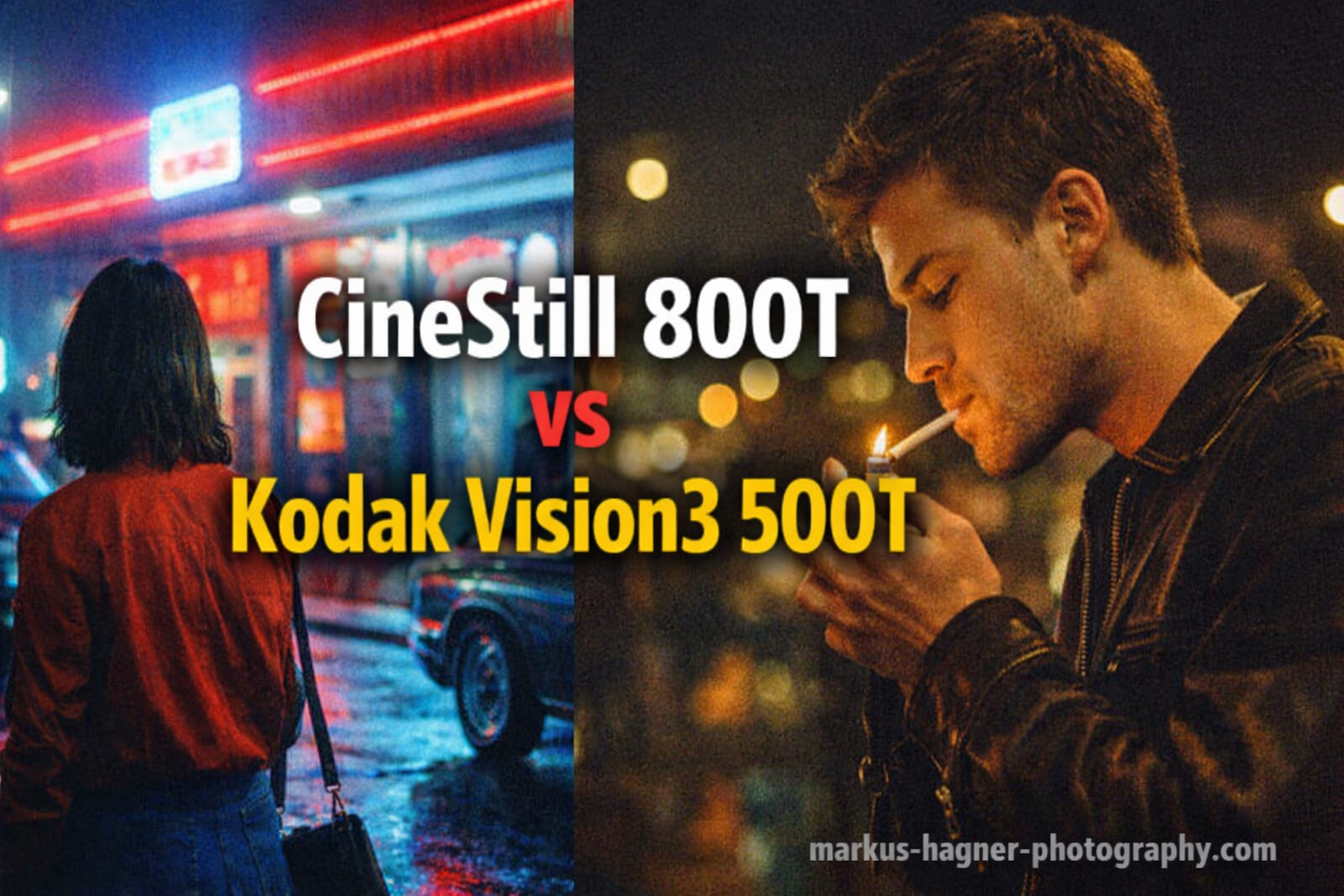
If you are drawn to the cinematic look of tungsten-balanced film for night photography, you have likely encountered the debate between CineStill 800T vs Kodak Vision3 500T. These two films share the same DNA but offer distinctly different shooting experiences. After testing both stocks extensively in various lighting conditions, I will break down exactly what sets them apart and help you decide which deserves a spot in your camera bag.
The relationship between these films fascinates me. CineStill 800T is essentially modified Kodak Vision3 500T with the remjet layer removed, making it processable in standard C-41 labs. But this simple modification creates profound differences in how each film performs, processes, and renders your final images.
Whether you are shooting neon-drenched cityscapes, moody indoor portraits, or exploring astrophotography, understanding the strengths and limitations of each film will dramatically improve your results. This comparison will give you the practical knowledge to make an informed decision based on your specific needs and workflow.
CineStill 800T vs Kodak Vision3 500T: Quick Comparison
Before diving deep into each film, here is a quick overview of the key differences between these two tungsten-balanced stocks:
| Product | Specifications | Action |
|---|---|---|
 CineStill 800T CineStill 800T |
|
Check Latest Price |
Quick Verdict: CineStill 800T wins on convenience and accessibility with its C-41 processing compatibility, while Kodak Vision3 500T offers superior image quality and lower cost per roll if you have access to ECN-2 processing or are willing to remove the remjet layer yourself.
It is worth noting that Vision3 500T is primarily sold as a motion picture film stock, not as a consumer product. This means sourcing requires specialty suppliers rather than standard retail channels. The table above reflects this fundamental difference in availability between the two films.
CineStill 800T Deep Dive
CineStill 800Tungsten High Speed (ISO 800) Color Film, 36exp. 135 DX Coded
Pros
- Process at any C-41 lab
- Signature halation look
- Widely available
- DX coded cartridges
- Great for night photography
Cons
- More expensive per roll
- Larger grain structure
- Blue cast in daylight
- Some QC inconsistency
I have shot countless rolls of CineStill 800T over the past three years, and it remains my go-to film for night photography when convenience matters. The C-41 compatibility is a game-changer. I can drop it off at any local lab or even process it myself at home without dealing with the messy remjet removal process.
The tungsten balance (3200K) creates beautifully rich colors under artificial light. Neon signs, street lamps, and city glow render with that distinctive cinematic quality that is hard to replicate digitally. Skin tones look natural and flattering under indoor tungsten lighting, making it surprisingly versatile for portrait work.

What really sets CineStill apart is the halation effect. Those red glowing highlights around bright light sources have become the film is signature look. Some photographers love it, others hate it, but there is no denying it creates a distinctive aesthetic that viewers immediately recognize as “film.”
That said, I have noticed some inconsistencies between batches. Some rolls show more noticeable halation than others, and grain structure can vary slightly. The price premium is also hard to ignore. At nearly double the cost of raw Vision3, you are paying for convenience and that modified halation effect.
For daylight shooting, you will absolutely need an 85B filter and should rate it at ISO 500. Without the filter, everything takes on a strong blue cast that can be difficult to correct in post. Even with the filter, I find myself slightly overexposing by +0.3 to +0.7 stops to get the best results.
The grain structure at ISO 800 is surprisingly fine for such a fast film, but push-processing beyond EI 1000 introduces noticeable grit. I have experimented with rating it at EI 1600 for dim conditions, and while usable, the grain becomes quite prominent and shadow detail suffers.

One aspect I genuinely appreciate is the factory spooled DX-coded cartridges. They load smoothly and the DX coding means my point-and-shoot cameras automatically recognize the film speed. The 36 exposure count provides good value compared to some premium 24-exposure rolls on the market.
The color reproduction deserves special mention. Under mixed urban lighting, CineStill produces a look that is difficult to describe but instantly recognizable. Sodium vapor street lamps take on a warm orange glow, while fluorescent signs pop with saturated intensity. This is not accurate color reproduction, but it is undeniably beautiful.
I should mention the quality control variations I have experienced. Out of perhaps 50 rolls shot, I have encountered two with spacing issues and one with a loose cassette. This is not a huge problem, but at premium pricing, it is worth noting. Most rolls have been perfectly fine.

Kodak Vision3 500T Deep Dive
Kodak Vision3 500T (technically Kodak 5219/7219) represents the source material before CineStill is modification process. This is the same motion picture film stock used in countless Hollywood productions, offering professional-grade image quality that frankly surpasses CineStill in several technical aspects.
The most significant difference lies in the film is construction. Vision3 retains its remjet backing, that anti-halation layer CineStill removes. This means cleaner highlights without the red glow effect, but it also means you cannot process it in standard C-41 chemistry without first removing the remjet layer.
Image quality is where Vision3 truly shines. The grain structure is finer and more uniform compared to CineStill, creating smoother tonal transitions especially in shadow areas. Dynamic range is excellent, with approximately 10.8 stops of latitude that gives you tremendous flexibility when exposing. I have found it more forgiving of exposure errors than CineStill, particularly when dealing with high-contrast scenes.
Color reproduction feels more accurate to my eye. While CineStill is colors have that stylized cinematic quality, Vision3 renders colors more neutrally. This might sound less exciting, but it gives you more flexibility in post-production to achieve the look you want rather than being locked into a specific aesthetic.
The processing requirements present the biggest challenge. Vision3 is designed for ECN-2 processing, which differs from standard C-41 in several ways. The developer chemistry is different, temperatures run lower, and that remjet layer must be removed during development. Most consumer labs do not offer ECN-2 processing, which means you will need to find a specialty film lab or handle it yourself.
Home developing Vision3 is entirely possible but more involved than standard C-41. The remjet removal process requires a pre-bath with an alkaline solution like sodium carbonate, followed by vigorous agitation to dissolve and wash away the carbon-based remjet layer. It is messy, time-consuming, and requires careful attention to avoid contamination.
Cost is where Vision3 has a clear advantage. Even with the specialty processing factored in, you are typically looking at significantly lower cost per roll compared to CineStill. This is especially true if you buy Vision3 in bulk from motion picture suppliers and process it yourself.
One important development to note: Kodak has introduced new Anti-Halation Undercoat (AHU) technology in some of their motion picture films. This does not replace the remjet layer but rather works alongside it in a different way. The long-term implications for the Vision3 vs CineStill comparison remain to be seen, but it is worth keeping an eye on how this technology evolves.
The motion picture heritage of Vision3 shows in its handling of difficult lighting. The film maintains color consistency across exposure variations better than any still film stock I have used. This is crucial for cinematographers who need to match shots from different angles and lighting conditions, but still photographers benefit from this consistency as well.
I should address the sourcing challenge. Vision3 is typically sold in 400-foot or 1000-foot cans, requiring you to bulk load it into cartridges or find a third-party service that does this for you. This upfront investment and additional step keeps many photographers from trying Vision3, but those who make the effort rarely go back.
CineStill 800T vs Kodak Vision3 500T: Head-to-Head Comparison
The Fundamental Difference: Remjet Layer Explained
The remjet layer is what separates these two films. This carbon-based anti-halation backing sits on the backside of motion picture film and serves three critical functions in cinema applications: it prevents halation (light reflections), it acts as a lubricant for high-speed cameras, and it reduces static electricity buildup during rapid transport.
CineStill removes this layer entirely, which is why their film can be processed in standard C-41 chemistry. However, this removal also eliminates the anti-halation properties, creating those characteristic red glows around bright light sources. Some photographers consider this a feature, others view it as a flaw.
Vision3 retains the remjet layer, resulting in cleaner highlights without halation. The tradeoff is the need for ECN-2 processing or manual remjet removal before C-41 development. It is a fundamental difference that cascades through every other aspect of how these films perform and are processed.
The remjet layer itself is fascinating. It is essentially a colloidal carbon suspension, similar to very fine carbon black, applied to the back of the film base. In motion picture cameras running at 24 frames per second or faster, this layer serves critical functions. It prevents static sparks that could expose the film, lubricates the film path through the camera, and crucially, prevents halation.
Halation occurs when bright light passes completely through the emulsion, reflects off the pressure plate, and exposes the emulsion from the back side. The remjet layer absorbs this light, preventing the reflection. When CineStill removes it, they are trading image purity for processing convenience and a distinctive aesthetic.
It is worth noting that not all halation is created equal. The effect varies depending on the brightness and size of the light source. Small point sources like streetlights and neon signs create the most dramatic halation, while larger diffuse light sources like shop windows may show minimal effect. This variability is part of what makes the film interesting to work with.
Processing Methods: C-41 vs ECN-2
The processing difference is the most practical consideration for most photographers. CineStill is C-41 compatibility means you can use virtually any photo lab, drugstore, or even home develop with standard chemicals. Vision3 requires ECN-2 processing or remjet removal, significantly limiting your lab options.
C-41 chemistry is widely available and well-understood. Temperatures run around 100°F (38°C) with development times of 3-4 minutes. Most mini labs handle this automatically, and home processing kits are inexpensive and readily available.
ECN-2 is a different beast. Developer temperatures run lower at approximately 81°F (27°C), development times are longer (around 6 minutes), and the chemistry formulation is different. More critically, the process includes a remjet removal step that standard C-41 machines cannot handle. This restricts you to specialty motion picture film labs or DIY processing.
The remjet removal process itself is an art. In proper ECN-2 processing, the film goes through an alkaline pre-bath that softens the remjet, then through mechanical buffing stations that physically remove the carbon layer. The remjet is collected and disposed of as hazardous waste, which is why most consumer labs will not touch it.
For home developers wanting to process Vision3 in C-41, the workflow looks like this: pre-bath in sodium carbonate solution to soften the remjet, vigorous agitation to dissolve it, multiple water changes to rinse away the carbon, then standard C-41 processing. It adds 10-15 minutes to your developing time and creates a mess of black water that requires careful disposal.
Some photographers have developed hybrid approaches. They process Vision3 in ECN-2 chemistry but skip the mechanical buffing, using extended agitation during the pre-bath instead. Others use dedicated developing tanks that they reserve exclusively for remjet removal, since the carbon can discolor equipment over time.
The availability of ECN-2 chemistry has improved in recent years. Several companies now sell home ECN-2 kits, and some photographers mix their own using published formulas. This has made Vision3 more accessible to dedicated home developers, though it remains more involved than standard C-41.
ISO Rating Controversy: 500 vs 800 Explained
Here is where things get interesting. Kodak rates Vision3 at EI 500 (Exposure Index), while CineStill markets their film at ISO 800. But are they really different speeds?
The honest answer: probably not as much as the ratings suggest. Extensive testing by the film community has shown that CineStill is ISO 800 rating is optimistic. Many photographers, myself included, find better results rating CineStill at EI 640 or even EI 500 for normal exposure.
The difference likely comes from CineStill is hypersensitization process during remjet removal. This chemical treatment can increase effective film speed, but the degree varies and may not consistently achieve a full one-stop advantage. In practical use, both films often perform similarly at EI 500-640.
Analog.Cafe conducted perhaps the most definitive test on this question. They exposed CineStill 800T and Vision3 500T side by side at EI 400, 800, and 1600, then measured the resulting densities. Their conclusion: there is no meaningful speed difference between the two films. The ISO 800 rating appears to be marketing rather than measurable reality.
This does not mean you should never rate CineStill at ISO 800. For night photography where you want to maximize shutter speed, the higher rating is usable. Just understand that you will be underexposing slightly and may need to push development or accept thinner negatives.
What this means for you: do not be afraid to rate CineStill lower than box speed, especially for critical work. The increased exposure will give you better shadow detail without blowing highlights thanks to the film is excellent latitude.
I have found that EI 640 is often the sweet spot for CineStill. This gives me a slight speed advantage over Vision3 while maintaining good shadow detail. For really low light situations, I will push to EI 1250 or 1600, accepting the increased grain as part of the aesthetic.
Halation Effect: The Signature CineStill Look
The halation effect is CineStill is most distinctive characteristic and the subject of much debate. Those red glows around bright light sources occur because light passes through the emulsion, reflects off the film base, and exposes the adjacent emulsion from behind.
Photographers either love it or hate it. For night photography, neon shots, and moody cityscapes, halation can add atmosphere and visual interest that is difficult to achieve otherwise. The effect becomes particularly pronounced with point light sources in dark environments.
However, halation is not always desirable. In portrait photography, it can create unflattering red glows around specular highlights on skin or in eyes. For architectural or product work where color accuracy matters, the effect can be problematic.
Vision3, with its remjet layer intact, produces clean highlights without halation. This gives you more flexibility to add effects in post rather than being locked into a specific look. Many photographers who want the cinematic aesthetic without the halation choose Vision3 for this reason.
The halation effect varies depending on the subject. Bright point sources like streetlights and neon signs create the most dramatic halation, sometimes spreading across several millimeters of the negative. Larger light sources like illuminated windows may show minimal halation despite being equally bright.
Backlighting situations reveal the effect clearly. Shoot into the sun or a bright light source, and you will see halation flare into the frame. Some photographers use this intentionally for creative effect, while others find it unpredictable and difficult to control.
Interestingly, the halation effect seems to vary between production batches of CineStill. Some rolls show prominent halation even with moderate light sources, while others are more restrained. This inconsistency frustrates some photographers who want predictable results.
The Reddit community has strong opinions on halation. One user called it “a fatal error that causes glow and defeats the purpose,” while another said “the halation effect is exactly why people love this film and it definitely holds up.” This polarization tells you everything you need to know about whether halation is right for your work.
Color Balance and Tungsten Lighting Performance
Both films share the same tungsten color balance (3200K), designed for use with tungsten studio lights or predominantly artificial light environments. Under these conditions, both films produce beautiful, accurate colors with warm skin tones and rich saturation.
Where they differ slightly is in overall color rendition. Vision3 tends toward more neutral, accurate color reproduction. CineStill often exhibits slightly more stylized, saturated colors that many find appealing. The difference is subtle but noticeable when comparing shots side by side.
For daylight shooting without correction, both films will produce a strong blue cast. An 85B filter is essential for daylight work, and with either film, you will want to rate it at EI 500 when using the filter. Some photographers embrace the blue cast for creative effect, particularly for twilight or dawn scenes.
Under mixed lighting conditions, both films perform reasonably well thanks to their wide latitude. Tungsten sources render naturally, while daylight areas take on a cool quality that can work beautifully for the right subject matter.
The tungsten balance creates interesting possibilities with different light sources. Sodium vapor street lamps render with a warm orange glow. Fluorescent lights take on a greenish quality that some find nostalgic. LED lights can produce unpredictable color shifts depending on their color temperature.
For indoor portraiture under household incandescent lighting, both films are superb. Skin tones look natural and flattering without the orange shift that daylight-balanced films exhibit under these conditions. I have shot numerous portraits with both films, and subjects consistently comment on how “realistic” the colors look.
Stage lighting is another area where these films excel. Concerts, theater performances, and events with tungsten stage lighting render beautifully. The films handle high contrast well, and the tungsten balance means you do not need gels or filtration to get accurate colors.
One creative use I have explored is shooting tungsten film in daylight without filtration for a cold, moody look. Winter scenes, overcast days, and even golden hour light can take on a melancholy quality that works for certain subjects. Just understand that this is an aesthetic choice, not color error.
Dynamic Range and Latitude Comparison
Both films offer excellent dynamic range, but Vision3 has a slight edge in technical testing. Kodak is specifications indicate approximately 10.8 stops of latitude for Vision3, while independent testing suggests CineStill falls just short of this figure.
In practical use, both films are quite forgiving. I have accidentally overexposed CineStill by +2 stops and still recovered usable images with good shadow detail. Vision3 seems even more tolerant, particularly in the highlights, which holds detail remarkably well even with significant overexposure.
The key difference shows up in shadow detail. Vision3 maintains cleaner shadows with less color crossover, while CineStill is shadows can take on a slightly greenish cast when pushed too far. This is most noticeable in high-contrast scenes with deep shadows.
For HDR-style photography with extreme contrast ranges, either film will serve you well. But for critical work with delicate shadow transitions, Vision3 is cleaner rendering gives you more to work with in post-processing.
The latitude of these films makes them remarkably forgiving of exposure errors. New film photographers often worry about perfect exposure, but both Vision3 and CineStill are surprisingly tolerant. You can be off by a full stop in either direction and still get usable results.
Highlight retention is particularly impressive. Both films hold detail in extremely bright areas that would blow out on digital cameras. This is partly due to the inherent highlight headroom of negative film and partly due to the wide latitude designed into these emulsions.
Shadow detail is where the films differ more noticeably. Vision3 maintains neutral colors deep into the shadows, while CineStill can show some color shifts. This is rarely a problem in normal use but becomes apparent when pushing the film or recovering underexposed areas.
The practical implication for your photography: do not be afraid to expose these films generously. Slight overexposure (+0.5 to +1 stop) often produces the best results with both stocks. You will get better shadow detail without losing highlight information.
Grain Structure Analysis
Grain structure is one area where Vision3 clearly outperforms CineStill. The remjet layer and original Kodak emulsion combine to produce finer, more uniform grain across the frame. CineStill is modification process, along with its higher ISO rating, results in slightly larger and more prominent grain.
At rated speeds, the difference is noticeable but not dramatic. Both films produce pleasing grain that feels organic and cinematic. The real divergence appears when pushing the film. CineStill at EI 1600 shows significantly more grain and loss of shadow detail compared to Vision3 at the same exposure index.
Scanning also reveals differences. Vision3 is finer grain scans more cleanly, producing sharper digital files with less visible grain pattern. CineStill can sometimes show slightly irregular grain distribution, particularly in mid-tone areas.
For large format printing or applications where fine detail matters, Vision3 has the advantage. For the intentional “gritty” aesthetic that many film photographers seek, CineStill is more prominent grain might actually be preferred.
Kodak is T-GRAIN technology deserves credit here. Vision3 uses tabular grain crystals that are flatter and more uniform than traditional silver halide crystals. This technology, developed in the 1980s, produces finer grain that is less apparent to the eye. Vision3 represents the current state of this technology.
CineStill is grain is still fine for an ISO 800 film, particularly when compared to older high-speed films. But next to Vision3, the difference is apparent in large prints or high-resolution scans. This is one area where the motion picture heritage of Vision3 translates to a tangible benefit for still photographers.
The grain character also differs slightly. Vision3 has grain appears more even and uniform across tonal ranges. CineStill can show slightly more prominent grain in the mid-tones and shadows. This is not necessarily bad, but it is a characteristic worth understanding when choosing between the films.
Price and Availability
Price is a major consideration for most photographers. CineStill 800T typically costs significantly more per roll than bulk Vision3. You are paying for the remjet removal process, factory spooling, and the convenience of C-41 processing.
Vision3, when purchased from motion picture suppliers, costs considerably less per roll even when factoring in respooling costs. The tradeoff is the need to either find an ECN-2 lab or handle remjet removal yourself. If you process at home, the per-roll savings are substantial.
Availability heavily favors CineStill. You can purchase it from numerous online retailers and even some local camera stores. Vision3 requires sourcing from motion picture suppliers, which typically sell in larger quantities and may have minimum order requirements.
Processing availability also differs significantly. CineStill can be processed virtually anywhere that handles C-41. Vision3 limits you to specialty labs offering ECN-2 processing or requires DIY work. For photographers without easy lab access, this consideration alone might dictate the choice.
The total cost of ownership includes more than just film purchase. When you factor in processing costs, the equation changes. CineStill is expensive film plus cheap and available processing. Vision3 is cheap film plus expensive or labor-intensive processing. Which works out to be more affordable depends on your workflow.
Several companies now sell Vision3 pre-spooled into 35mm cartridges, including CinemaFilmPhotography and other specialty retailers. This option sits between bulk loading and CineStill in terms of cost and convenience. You get ready-to-load film at prices lower than CineStill but higher than bulk loading.
For photographers who shoot a lot of film, the savings with Vision3 can add up quickly. If you are shooting 50+ rolls per year, the difference between CineStill and bulk Vision3 could easily exceed $500 annually. That is money that could be spent on other gear or more film.
Best Use Cases for Each Film
Night Photography
For pure night photography, both films excel but with different aesthetic outcomes. CineStill produces that signature glowing highlight look that many night photographers love. Neon signs, street lamps, and city lights take on an otherworldly quality that is instantly recognizable.
Vision3 offers cleaner, more literal renditions of night scenes. Without halation, bright light sources remain sharp and well-defined. This can work better for cityscapes and architectural night shots where you want clear rendering rather than atmospheric glow.
My personal approach: use CineStill for moody, atmospheric night shots where the halation adds to the mood. Switch to Vision3 when I want cleaner, more detailed night images with accurate colors. Having both options gives me maximum creative flexibility.
Street Photography
Street photographers often favor CineStill for its convenience and the cinematic quality it lends to urban scenes. The ability to drop rolls at any lab is huge for photographers on the go. The tungsten balance creates interesting color shifts in mixed urban lighting that can add visual interest to street scenes.
Vision3 works well for street photographers who process their own film or have access to ECN-2 labs. The cleaner image quality and finer grain can be advantages when shooting detailed urban scenes. The lower cost also encourages more shooting without worrying about film expenses.
Indoor Tungsten Lighting
Both films shine under indoor tungsten lighting, which is exactly what they were designed for. Portraits taken under household incandescent lighting look natural and flattering with either stock. Skin tones render warmly without the orange cast that daylight-balanced films produce under these conditions.
CineStill is slightly more saturated colors can be flattering for portraits, while Vision3 is neutral rendition gives you more flexibility in color grading. The choice often comes down to whether you prefer the film is straight-out-of-camera look or want more control in post.
Daylight Shooting Considerations
Daylight shooting with either film requires an 85B filter and rating at EI 500. Some photographers skip the filter for creative effect, embracing the blue cast for moody, cool-toned images. This works particularly well for twilight scenes, overcast conditions, or when you want that melancholy winter feel.
Vision3 tends to produce slightly better results in daylight when properly filtered. The finer grain and cleaner highlights translate to more conventional daylight images. CineStill can work well but requires more careful exposure to avoid color shifts in shadows.
Astrophotography Applications
Both films have enthusiastic followings in the astrophotography community, though they are used differently. CineStill is higher ISO rating makes it slightly better for capturing faint stars and Milky Way details. The halation effect around bright stars can add a dreamlike quality to night sky images.
Vision3 works well for constellation shots and wider astro-landscape images where fine detail matters. The cleaner grain structure produces smoother sky gradients. Some astrophotographers push Vision3 to EI 1000 or higher, accepting increased grain for the sensitivity gain.
Processing, Developing, and Scanning Workflow
C-41 Processing with CineStill
CineStill is biggest advantage is its C-41 compatibility. You can use any consumer lab, drugstore photo department, or mail-order service that processes color negative film. This accessibility makes it ideal for photographers who do not process their own film or do not have access to specialty labs.
Home developing CineStill is straightforward with standard C-41 kits. The process is identical to any other C-41 film: developer, bleach, fix, and final wash. No special steps or chemicals required. This simplicity appeals to photographers new to home developing or those who value convenience.
Scanning CineStill presents no special challenges. Standard negative scanning procedures apply. The film base is clear, making scanning easier than some other specialty films. Most scanning software handles the color inversion well, though the tungsten balance can sometimes confuse automatic color correction.
For the best scanning results, I recommend setting your white balance manually. The tungsten balance means auto white balance will often overcompensate, trying to correct colors that are already correct for the intended light source. A neutral scanning approach usually yields the most accurate colors.
ECN-2 Processing and Remjet Removal for Vision3
Vision3 processing requires more commitment. Professional ECN-2 labs offer the easiest solution, handling both the special chemistry and remjet removal. These labs understand motion picture film and can deliver excellent results, but they are fewer in number and often have longer turnaround times.
Home developing Vision3 is entirely possible but requires additional steps. The process begins with a pre-bath to remove the remjet layer. This typically involves an alkaline solution (sodium carbonate works well) at around 100°F with vigorous agitation to dissolve the carbon layer.
Once the remjet is removed and the film is rinsed clean, you can proceed with either ECN-2 or C-41 chemistry. Many home developers opt for C-41 since chemicals are more readily available, accepting that results may differ slightly from true ECN-2 processing.
Scanning Vision3 after proper processing is identical to scanning any other color negative. The key is ensuring complete remjet removal during development, as any residual carbon can cause scanning issues and affect image quality.
The remjet removal process can be messy. The carbon turns your developing water black, and it requires multiple rinses to get clear water. Some developers dedicate specific equipment to Vision3 processing to avoid staining their regular gear.
Making Your Own “CineStill” from Vision3
A significant subset of film photographers has embraced DIY remjet removal to create homemade CineStill. This approach offers the best of both worlds: lower cost per roll and C-41 processing compatibility.
The process, while accessible, requires attention to detail and some practice to master. You will need bulk rolls of Vision3, empty cartridges for respooling, and supplies for remjet removal including sodium carbonate and a dedicated developing tank you do not mind staining black with carbon residue.
After removing the film from its core in a darkroom or changing bag, you will respool it into 35mm cartridges. The remjet removal happens during development using the pre-bath method mentioned earlier. It is messy but entirely doable, and many photographers report excellent results with this approach.
The main advantage is cost savings. Even with the investment in supplies, you can process multiple rolls for significantly less than purchasing pre-modified CineStill. The downside is the time investment and learning curve, plus the variability that comes with any DIY process.
Analog.Cafe has published excellent guides on this process. Their testing shows that DIY remjet removal produces results nearly identical to factory CineStill, with the added benefit that you can control the process precisely and adjust based on your preferences.
Which Should You Choose?
Choose CineStill 800T If:
You value convenience and want to process film at any C-41 lab. The halation effect appeals to your aesthetic sensibilities. You shoot primarily night photography and want that signature glowing highlight look. You do not process your own film and need accessible lab options. You are willing to pay a premium for convenience and the modified look.
Choose Kodak Vision3 500T If:
You want the best possible image quality and are willing to work for it. You have access to ECN-2 processing or are comfortable with DIY remjet removal. Cleaner highlights without halation appeal to you. You shoot volume and want to minimize per-roll costs. You prefer more neutral color rendering with post-production flexibility.
Frequently Asked Questions
What is CineStill 800T best for?
CineStill 800T is best for night photography, urban street scenes after dark, neon photography, and any situation with artificial tungsten lighting. Its ISO 800 rating and tungsten balance make it ideal for low-light conditions where daylight-balanced films would require tripods or flash. The distinctive halation effect around bright lights creates a cinematic aesthetic that has made it popular for cityscapes, music photography, and artistic work.
Why does CineStill have halation?
CineStill has halation because the remjet anti-halation layer is removed during manufacturing. In standard motion picture film like Kodak Vision3 500T, this carbon-based backing prevents light from reflecting off the camera’s pressure plate back through the emulsion. Without this layer, bright light sources create a distinctive red glow or halo effect around highlights, which has become CineStill’s signature aesthetic.
What is similar to CineStill 800T?
The most similar film to CineStill 800T is Kodak Vision3 500T, which is actually the base stock that CineStill modifies. Other tungsten-balanced options include older stocks like Fuji 64T (discontinued) and various motion picture films. Some photographers create their own fake CineStill by removing the remjet layer from Vision3 500T themselves. For the halation effect without tungsten balance, some photographers experiment with other films lacking anti-halation layers.
What ISO should you shoot CineStill 800T at?
While CineStill rates their film at ISO 800, many experienced photographers find better results shooting it at ISO 500-640. Independent testing suggests the actual sensitivity is closer to Vision3 500T’s ISO 500 rating. If shooting at night with mixed lighting, ISO 640 often produces well-exposed negatives. For daylight use with an 85B filter, rate it at ISO 500. Experiment with your metering technique and development to find your personal preference.
Is CineStill 800T just Vision3 500T with remjet removed?
Essentially yes. CineStill 800T starts as Kodak Vision3 500T motion picture film and undergoes a proprietary process to remove the remjet layer. However, CineStill claims additional hypersensitization to achieve ISO 800, though independent testing shows minimal actual speed difference from the base Vision3 stock. The practical differences are the lack of remjet (enabling C-41 processing), the resulting halation effect, and the convenience of factory-spooled 35mm canisters.
Can you develop Kodak Vision3 in C-41?
Yes, but with an important caveat. Vision3 500T requires remjet removal before or during C-41 processing. You cannot simply drop it off at a standard lab. Options include: finding an ECN-2 lab that handles motion picture film, home developing with ECN-2 chemistry (which includes remjet removal), or removing the remjet yourself with an alkaline pre-wash before C-41 development. The third option is most common for home developers wanting to use standard C-41 chemistry.
Final Verdict: CineStill 800T vs Kodak Vision3 500T
After extensive testing with both CineStill 800T vs Kodak Vision3 500T, the choice ultimately comes down to your priorities and workflow. For most photographers, CineStill offers the right balance of quality, convenience, and distinctive aesthetics. The C-41 compatibility alone is worth the premium for many shooters.
However, Vision3 represents the purer choice with superior technical image quality and significantly lower cost per roll. If you are committed to ECN-2 processing or willing to handle remjet removal yourself, Vision3 delivers cleaner results with finer grain and more accurate colors.
My recommendation: start with CineStill if you are new to tungsten film. The accessibility lets you focus on learning the unique characteristics of tungsten balance without processing complications. As you gain experience and develop specific preferences, you can explore Vision3 for its technical advantages and cost savings.
Many serious film photographers eventually end up shooting both, using each for different applications. CineStill for convenience shoots and when the halation effect fits the subject, Vision3 for critical work and when image quality outweighs processing inconvenience. Having both options in your photographic toolkit gives you maximum creative flexibility.