
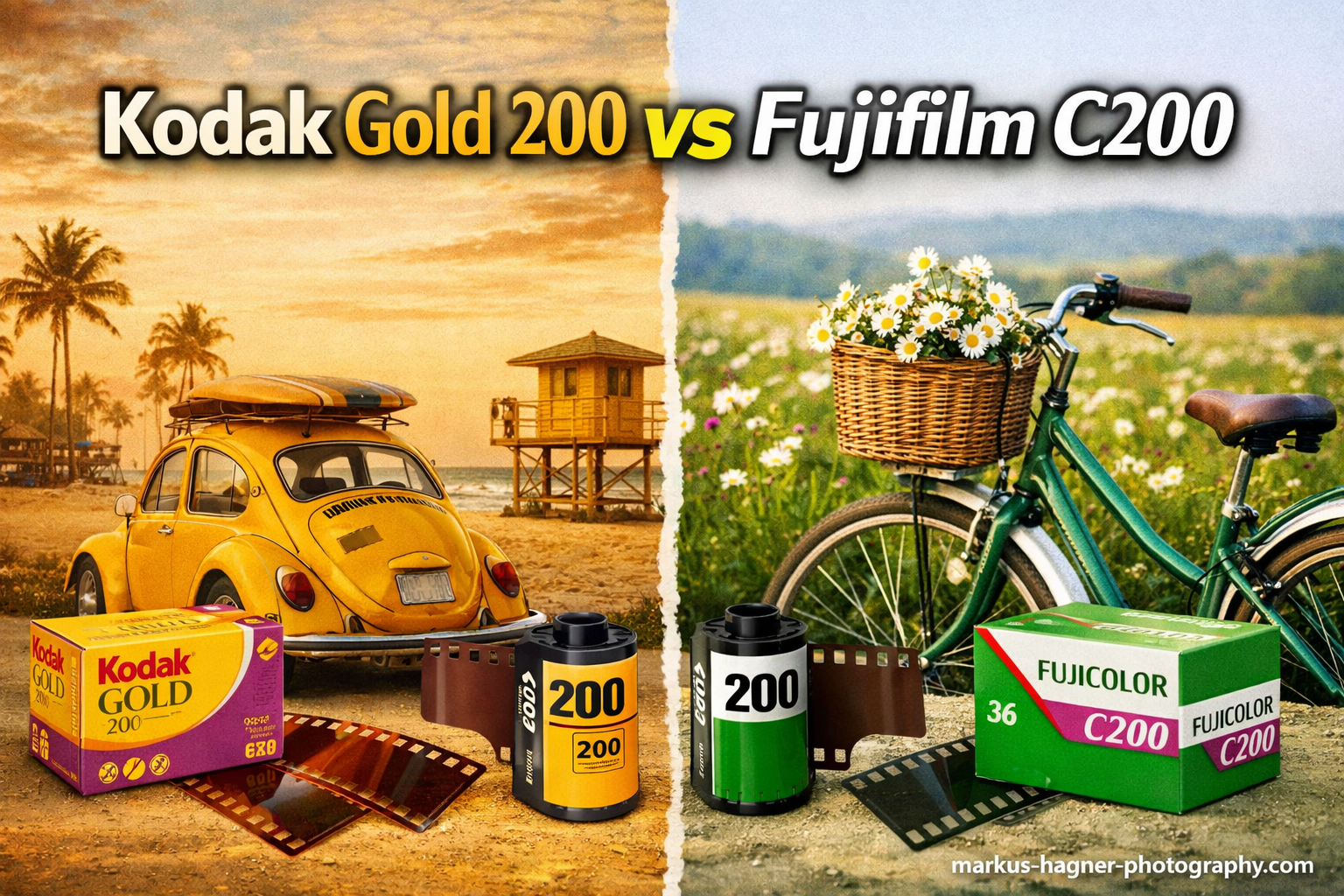
Standing in the film aisle, you have two affordable options staring back at you: Kodak Gold 200 and Fujifilm C200. Both promise great results without breaking the bank, but they deliver distinctly different looks that can make or break your photos.
After shooting hundreds of rolls through everything from vintage SLRs to modern point-and-shoots, I have formed clear opinions about when each film shines. The Kodak Gold 200 vs Fujifilm C200 debate ultimately comes down to one fundamental difference: warm versus cool color rendering.
Kodak Gold produces those classic yellow-orange tones that feel like a summer afternoon. Fujifilm C200 leans toward cooler magenta shifts that many photographers actually prefer for portraits and overcast conditions. Neither is objectively better, but one will match your creative vision more closely.
In this comparison, I will break down exactly how these two budget color negative films differ in color rendition, grain structure, contrast, and real-world performance. By the end, you will know exactly which film belongs in your camera.
Kodak Gold 200 vs Fujifilm C200: Quick Comparison
Let me start with a side-by-side look at how these two films stack up against each other. This gives you the essential specs before we dive into the details.
| Product | Specifications | Action |
|---|---|---|
 Kodak Gold 200 (2-Pack) Kodak Gold 200 (2-Pack) |
|
Check Latest Price |
 Fujifilm Fujicolor C200 (Twin Pack) Fujifilm Fujicolor C200 (Twin Pack) |
|
Check Latest Price |
Both films share the same ISO 200 sensitivity and use standard C-41 processing. The key differences emerge in their color science and exposures per roll. Kodak Gold typically comes with 24 exposures, while Fujifilm offers 36 exposures per roll, giving you more shots with Fuji.
Kodak Gold 200: The Warm Classic
Pros
- Beautiful warm yellow-orange tones
- Forgiving exposure latitude
- Excellent for sunny days
- Classic vintage aesthetic
- Great value for beginners
Cons
- Only 24 exposures per roll
- Not ideal for low light
- Can add unwanted warmth to skin tones
I have shot Kodak Gold 200 more times than I can count, and it remains my go-to recommendation for anyone wanting that classic film look without spending Portra-level money. The warm color rendition immediately gives photos a nostalgic quality that digital filters struggle to replicate authentically.
What strikes me most about Gold 200 is its consistency. Whether I am shooting at the beach, in a park, or walking through city streets on a sunny afternoon, the results are predictable and pleasing. The film delivers those signature yellow-orange undertones that make golden hour scenes even more magical.

The grain structure on Kodak Gold is noticeable but not offensive. At standard print sizes up to 8×10 inches, the grain adds character without becoming distracting. However, if you scan your negatives at high resolution or make large prints, you will see more texture compared to professional-grade films like Portra 400.
Exposure latitude is one area where Gold 200 genuinely impresses me. I have accidentally underexposed shots by a full stop and still recovered usable images during scanning. Overexposure up to one or two stops actually improves shadow detail without blowing out highlights, making this an excellent learning film for beginners still mastering their metering.

For portraits, Kodak Gold creates that warm, sun-kissed look that many people associate with family photos from decades past. The yellow bias can sometimes make skin tones appear slightly jaundiced, especially in cooler lighting conditions. I prefer using this film outdoors in natural daylight where its warmth complements rather than fights the ambient light.
Landscape photographers love Gold 200 for its ability to render warm earth tones and golden light. Forest scenes take on an amber quality, and sunset shots become even more dramatic. If you photograph nature or travel destinations, this film delivers a look that feels both timeless and inviting.
Fujifilm C200: The Cool Alternative
Pros
- 36 exposures per roll
- Cooler magenta-shifted tones
- Works well in various lighting
- Better low-light performance
- Excellent color vibrancy
Cons
- Magenta cast can affect skin tones
- Some users find it less consistent
- Availability varies by region
Fujifilm C200 takes a fundamentally different approach to color rendering. Instead of the warm yellow push that defines Kodak films, C200 leans into cooler tones with a distinctive magenta quality. This creates images that feel more contemporary and less overtly nostalgic.
The first time I shot a roll of C200, I was surprised by how different my results looked compared to Kodak Gold. The same scenes rendered with bluer shadows and pinkish mid-tones. Overcast days that made Gold 200 look flat suddenly produced moody, atmospheric images with C200.

One practical advantage of Fujifilm C200 is the 36 exposures per roll. Those extra 12 frames add up over time, especially if you shoot frequently. For the price-conscious film photographer, getting 50% more shots per roll represents genuine value.
The grain on C200 appears slightly finer than Kodak Gold when scanned at the same resolution. This makes it my preferred choice for half-frame cameras, where the smaller negative size magnifies grain structure. If you shoot with cameras like the Olympus Pen or Agat 18K, C200 maintains image quality better than Gold.

Color vibrancy is another strength of C200. Greens appear more jewel-like, and blues have a richness that works beautifully for water and sky photography. If you photograph gardens, lakes, or coastal scenes, C200 renders these subjects with impressive saturation without looking artificial.
However, the magenta shift requires some consideration. Skin tones can take on a pinkish quality that may or may not flatter your subjects. I have found C200 works better for portraits in cooler lighting conditions, while warmer light can exaggerate the magenta effect in ways that feel unnatural.
Kodak Gold 200 vs Fujifilm C200: Head-to-Head Comparison
Now let me break down exactly how these films compare across the key categories that matter most to photographers.
Color Temperature: Warm vs Cool
The fundamental difference between these films comes down to color temperature. Kodak Gold 200 produces warm images with yellow-orange undertones that intensify golden hour light and add heat to neutral scenes. Fujifilm C200 renders cooler with magenta and blue influences that create a more subdued, contemporary aesthetic.
Neither approach is wrong. Your choice depends entirely on the mood you want to create. If you love that classic, nostalgic film look, Gold 200 delivers it effortlessly. If you prefer cleaner, more modern color rendition, C200 will suit your style better.
Grain Structure
Both films show visible grain at ISO 200, which is expected from consumer-grade color negative stocks. In my experience, C200 has slightly finer grain that scans more smoothly, particularly in shadow areas. Gold 200 has chunkier grain that becomes more apparent in flat, even lighting.
For standard 4×6 prints, neither film shows grain that most viewers would notice. At larger sizes or when cropping significantly, C200 maintains detail slightly better. Half-frame shooters should strongly consider C200 for this reason alone.
Contrast and Saturation
Fujifilm C200 has noticeably higher contrast and saturation compared to Kodak Gold 200. This gives C200 images more punch and vibrancy straight out of the camera. Colors appear more saturated, particularly greens and blues.
Kodak Gold renders with slightly flatter contrast and more muted saturation. This can actually be advantageous if you prefer to adjust these qualities during scanning or post-processing. The lower starting point gives you more flexibility to push colors in either direction.
Exposure Latitude
Both films handle exposure errors remarkably well for budget stocks. I have tested both with intentional bracketing from -2 to +2 EV. Both recover from underexposure acceptably, though shadow detail suffers predictably at -2 stops.
Overexposure tolerance is where they both shine. Adding one or two stops of light actually improves shadow detail without catastrophic highlight loss. This makes either film forgiving for photographers still learning metering or shooting in challenging, contrasty light.
Skin Tone Reproduction
Skin tones reveal the most noticeable difference between these films. Kodak Gold adds warmth that can make skin look sun-kissed or, in some lighting, slightly yellow. This works beautifully for outdoor portraits in golden hour or warm daylight.
Fujifilm C200 renders skin with cooler, pinker tones. Some photographers prefer this for its clean, modern look. Others find the magenta influence unflattering, particularly in warm lighting where it can create an odd color mismatch between the ambient light and skin rendering.
Best Use Cases
Kodak Gold 200 excels in sunny outdoor conditions, golden hour photography, landscapes with warm earth tones, beach and summer scenes, and any situation where you want that nostalgic, warm aesthetic.
Fujifilm C200 performs better in overcast conditions, mixed lighting situations, scenes with vibrant greens and blues, half-frame photography where finer grain matters, and situations where you want cleaner, more neutral color rendering.
The Rebranding Situation
Here is something important to understand about modern Fujifilm 200: in many markets, particularly the United States, current Fujifilm 200 is actually manufactured by Kodak. Multiple distributors have confirmed this, and photographers have noticed that recent Fuji 200 cans have Kodak markings and grey lids.
This means if you buy Fujifilm 200 in the US today, you may essentially be getting Kodak Gold 200 in different packaging. The original Japanese-made Fujicolor C200 with its distinctive cool rendering may no longer be available in some regions.
European photographers report still finding genuine Fuji C200 stock, so regional availability varies significantly. If the specific color characteristics matter to your work, check whether your local Fuji 200 is Made in Japan or Made in USA before assuming it will match older reviews.
Frequently Asked Questions
Is Kodak Gold 200 the same as Fujifilm 200?
In many markets, particularly the United States, modern Fujifilm 200 is manufactured by Kodak and is essentially the same emulsion as Kodak Gold 200. You can identify Kodak-made Fuji by checking for ‘Made in USA’ markings and grey canister lids. Original Japanese-made Fujicolor C200 with its cooler rendering may still be available in some regions.
What is the main difference between Kodak Gold 200 and Fujifilm C200?
The primary difference is color temperature. Kodak Gold 200 produces warm images with yellow-orange tones, while Fujifilm C200 renders cooler with magenta and blue influences. Gold 200 has chunkier grain and lower contrast, while C200 has finer grain, higher contrast, and more saturated colors.
Which film is better for portraits, Kodak Gold 200 or Fujifilm C200?
It depends on your lighting conditions and preferred aesthetic. Kodak Gold 200 creates warm, sun-kissed skin tones ideal for outdoor portraits in golden hour or sunny conditions. Fujifilm C200 renders cooler, pinker skin tones that work well in overcast light or when you want a more contemporary look.
Can you push Kodak Gold 200 or Fujifilm C200?
Both films handle pushing reasonably well up to one stop (rating at ISO 400). Expect increased grain and contrast. Neither film is specifically designed for pushing, but experimental photographers have achieved acceptable results. For reliable push processing, consider films designed for flexibility like Kodak Portra 400 or Fujifilm 400H.
Which budget film is better for beginners?
Both films are excellent for beginners due to their forgiving exposure latitude and affordable price. Kodak Gold 200 may edge out slightly for beginners because its warm tones tend to produce pleasing results in most outdoor situations, and the lower contrast gives more flexibility during scanning. However, Fujifilm C200 offers 36 exposures per roll versus 24, providing more learning opportunities per roll.
Final Verdict: Kodak Gold 200 vs Fujifilm C200
After extensive shooting with both films, my recommendation depends entirely on your shooting style and typical conditions.
Choose Kodak Gold 200 if you love warm, nostalgic aesthetics, shoot primarily in sunny outdoor conditions, photograph landscapes or travel scenes, want that classic family photo look, or prefer slightly flatter contrast for post-processing flexibility. This film delivers consistent, pleasing results that rarely disappoint.
Choose Fujifilm C200 if you prefer cooler, more modern color rendering, frequently shoot in overcast or mixed lighting, photograph scenes with vibrant greens and blues, use half-frame cameras where finer grain matters, or simply want 36 exposures per roll for better value.
For most beginners, I recommend trying both films to discover which color signature matches your vision. Shoot identical scenes with each stock and compare the results side by side. The difference becomes immediately apparent, and your personal preference will guide future purchases.
The Kodak Gold 200 vs Fujifilm C200 debate ultimately has no wrong answer. Both are excellent budget films that have earned their place in the film photography community. Pick the one whose color characteristics align with your creative goals, and start shooting.