
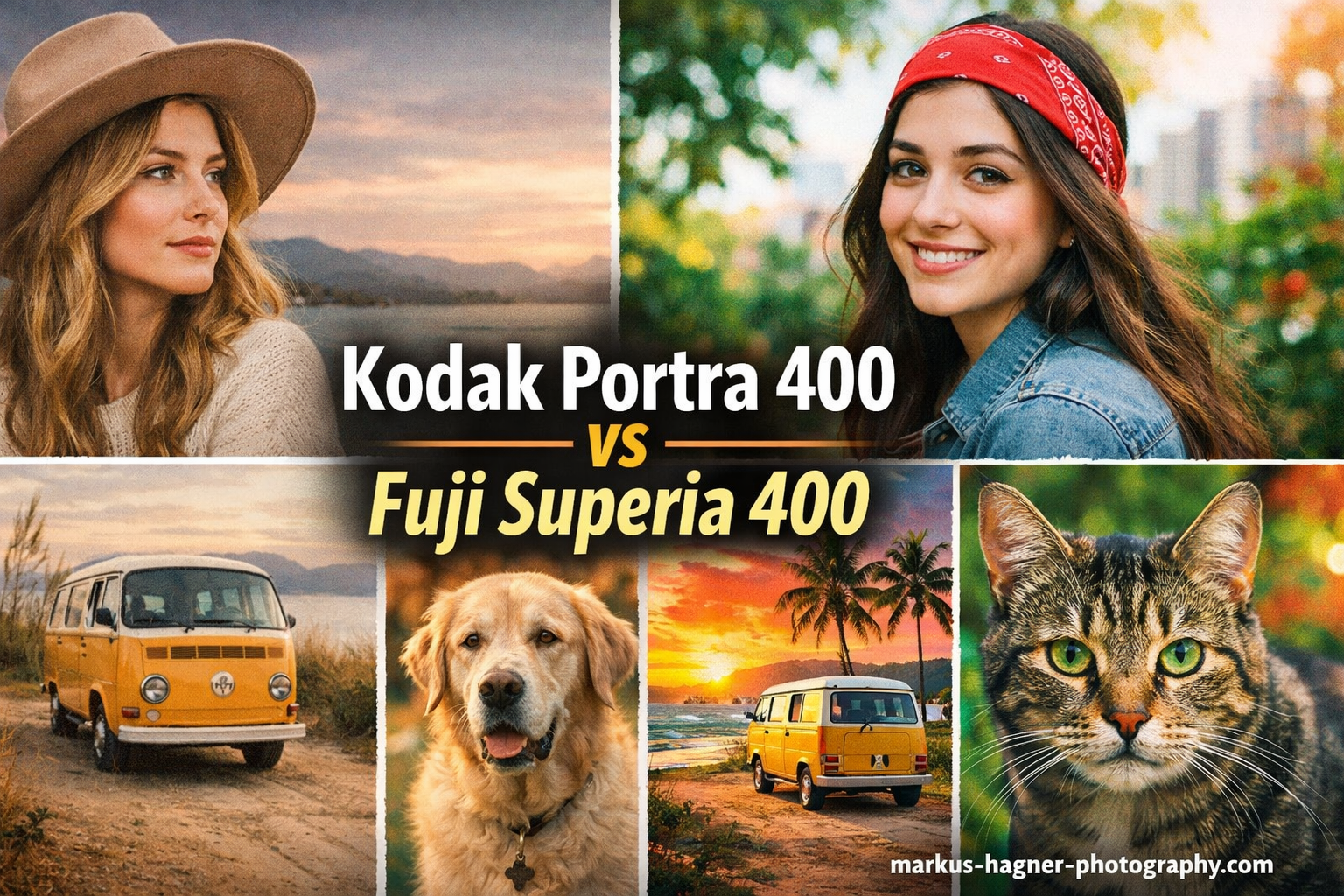
When it comes to color negative film photography in 2026, few debates spark more discussion than Kodak Portra 400 vs Fuji Superia 400. These two ISO 400 films have distinct personalities that can dramatically change how your images look. After shooting both extensively over the past several years, I have developed strong opinions about when each film shines.
Kodak Portra 400 is a professional-grade color negative film known for its exceptionally fine grain, wide exposure latitude, and muted neutral colors. Fuji Superia 400, on the other hand, is a consumer-level film with punchier saturation, more noticeable grain, and a cooler color cast that many photographers love for its nostalgic character.
The key difference comes down to this: Portra 400 offers clean, editable files with natural colors, while Superia 400 delivers bold, saturated results with a distinctive vintage feel. Your choice depends entirely on what aesthetic you are after and what you plan to shoot.
There is also an important availability consideration in 2026: Fuji discontinued Superia 400 in April 2024, so remaining stock is all that exists. Portra 400 remains in active production, making it the sustainable long-term choice.
Kodak Portra 400 vs Fuji Superia 400: Quick Comparison
| Product | Specifications | Action |
|---|---|---|
 Kodak Portra 400 (36 exp) Kodak Portra 400 (36 exp) |
|
Check Latest Price |
 Fujifilm Superia 400 (36 exp) Fujifilm Superia 400 (36 exp) |
|
Check Latest Price |
This table shows the core differences at a glance. Portra 400 sits in the professional category with a 4.5-star rating from nearly 1,000 reviews. Superia 400 holds a 3.8-star average with fewer reviews, reflecting its consumer-grade positioning.
The price gap is substantial. Portra 400 typically costs significantly more per roll, but delivers professional results. Superia 400 offers budget-friendly shooting, though availability is now limited to remaining stock since discontinuation.
Kodak Portra 400 Deep Dive
Pros
- Exceptionally fine grain
- Beautiful natural skin tones
- Excellent dynamic range
- Forgiving exposure latitude
- Great for portraits and landscapes
Cons
- Expensive per roll
- May be too muted for some styles
- Lower contrast out of camera
I have shot Portra 400 for everything from client portrait sessions to travel photography, and it consistently delivers results that exceed expectations. The first thing you notice is how smooth the grain appears, even in challenging lighting conditions. At 400 ISO, this level of grain refinement is remarkable.
The color rendering is where Portra 400 truly distinguishes itself. Colors appear natural and slightly muted, which sounds counterintuitive but actually makes the film incredibly versatile in post-processing. You can push the saturation and contrast during scanning, but starting with a neutral baseline gives you options that punchier films do not provide.

Skin tones are Portra 400’s superpower. Whether shooting outdoors in harsh sunlight or indoors with mixed lighting, faces render with a soft, pleasing quality that flatters subjects. This is why portrait photographers consistently choose Portra over other color negative films.
The exposure latitude on this film is genuinely forgiving. I have accidentally overexposed shots by two or three stops and still recovered usable images with minimal color shift. This makes Portra 400 an excellent choice for situations where lighting changes rapidly or when you are shooting without a meter.
Dynamic range is another strength. Portra 400 holds detail in both highlights and shadows better than most films at this speed. High-contrast scenes that would blow out on other stocks retain information in the bright areas while still lifting shadows acceptably.

Low-light performance is solid for a 400-speed film. I have gotten usable results at dusk and indoors without flash, though grain becomes more apparent in underexposed areas. The key is rating it honestly at box speed or slightly overexposing for cleaner shadows.
The main drawback is cost. Portra 400 commands a premium price, and for good reason. If you are shooting casually or learning film photography, the expense adds up quickly. Most photographers reserve it for important shoots or special occasions.

Format availability sets Portra apart from nearly every other color negative film on the market. You can get it in 35mm for your SLR, 120 medium format for Hasselblads and Rolleiflexes, 4×5 sheet film for view cameras, and even 8×10 for large format work. This versatility means your film choice stays consistent regardless of camera system.
Push processing works remarkably well on Portra 400. I have successfully pushed it to ISO 800 and even ISO 1600 when shooting concerts and indoor events. The grain increases but remains manageable, and shadow detail holds up better than most films when underexposed.
Fuji Superia 400 Deep Dive
Pros
- Budget-friendly option
- Punchy saturated colors
- Nostalgic vintage feel
- Works well for street photography
- Good low-light sensitivity
Cons
- Discontinued in 2024
- More visible grain
- Can show green or magenta cast
- Only available in 35mm format
- Limited remaining stock
Superia 400 has been my go-to for street photography and casual shooting for years. There is something about its saturated, slightly cool rendering that feels genuinely nostalgic. Colors pop with an intensity that Portra deliberately avoids, giving images immediate character without any editing.
The grain structure is noticeably coarser than Portra 400, but this is not necessarily a negative. For street photography and documentary work, visible grain adds texture and mood that complements the aesthetic. If you are chasing that classic 90s film look, Superia delivers it straight from the lab.
Color rendering leans cool with tendencies toward green or magenta casts depending on lighting conditions. Some photographers love this character; others find it frustrating. In mixed lighting, Superia can shift colors in ways that are difficult to correct during scanning.
What Superia 400 does well is deliver punchy, immediately satisfying results. Images look finished straight from the scan, which appeals to photographers who want to minimize post-processing time. The saturated colors and higher contrast create a distinctive look that many associate with classic film photography.
Exposure latitude is more limited than Portra 400. Overexposure handles reasonably well, but underexposure reveals grain quickly and shadow detail suffers. I rate Superia at box speed or slightly overexpose to keep shadows clean.
The discontinuation in April 2024 changes everything. Remaining stock represents the last of this film, and once it is gone, it is gone for good. This makes Superia 400 more of a specialty choice now, something to stock up on if you love its look.
One practical issue with Superia is that it tends to curl when drying, making scanning more difficult. The film does not lay flat in holders, which can cause focus issues if you are not careful. Portra 400 dries flatter, simplifying the scanning workflow.
For home developing, both films use standard C-41 chemistry with identical processing times. However, Superia can show more color variation if your temperature control is not precise, while Portra seems more tolerant of slight processing variations.
Kodak Portra 400 vs Fuji Superia 400: Head-to-Head Comparison
Color Rendering and Saturation
Color is where these films diverge most dramatically. Portra 400 renders colors naturally with subtle saturation, while Superia 400 pushes colors bold and punchy. Neither approach is wrong; they serve different creative visions.
Portra’s muted palette works beautifully for portraits, weddings, and any situation where accurate color matters. Skin tones stay natural without the pinkish or greenish casts that affect other films. Landscape photographers appreciate how Portra handles subtle color gradations in sky and foliage.
Superia’s saturated rendering creates immediate visual impact. Blues appear deeper, greens more vibrant, and reds more intense. This look suits street photography, travel, and casual shooting where you want images that pop without editing.
Under mixed lighting, Portra maintains neutral colors while Superia can shift toward green or magenta. For controlled environments like studios, this matters less. For outdoor shooting with variable light, Portra’s consistency becomes valuable.
Warm lighting scenarios reveal another difference. Portra handles golden hour and tungsten light gracefully, maintaining color balance. Superia tends to exaggerate warm tones, sometimes creating an overly orange cast that requires correction.
Grain Structure and Sharpness
Portra 400 wins the grain comparison decisively. Even at 100 percent magnification, grain appears fine and consistent across tones. This smoothness allows for significant enlargement without grain becoming distracting.
Superia 400 shows more visible grain, particularly in mid-tones and shadows. The grain has a distinct texture that some photographers embrace as part of the film’s character. For small prints or web display, the difference matters less.
Sharpness is comparable between the two films when properly exposed and processed. Both resolve detail well for their speed class. The perception of sharpness often relates more to contrast than actual resolution, and Superia’s higher contrast can make images appear slightly sharper.
For scanning, Portra’s finer grain means less noise reduction needed during post-processing. Superia’s grainier structure requires more aggressive noise reduction if you want smooth results, which can sacrifice fine detail.
Dynamic Range and Exposure Latitude
Portra 400 excels in dynamic range and exposure latitude. Overexposing by two or three stops still produces usable images with minimal color shift. Underexposure handles reasonably well up to about one stop before shadows get muddy.
Superia 400 tolerates overexposure decently but shows its limits faster than Portra. Underexposure reveals grain quickly and loses shadow detail. For consistent results, accurate metering matters more with Superia.
This difference matters practically. Portra forgives mistakes, making it suitable for challenging lighting or situations where you cannot meter carefully. Superia rewards careful exposure and can punish errors with grainy, flat results.
Backlit scenes demonstrate this difference clearly. Portra retains detail in both subject and bright background. Superia often forces a choice: expose for subject and blow highlights, or protect highlights and lose shadow detail to grain.
Skin Tone Rendering
For portraits, Portra 400 is the clear winner. Skin tones render soft and natural across different skin types and lighting conditions. The film was literally designed for portrait work, and it shows.
Superia 400 can produce acceptable skin tones, but they often show pinkish or magenta tendencies. Some photographers embrace this as part of the film’s character, while others find it unflattering. For professional portrait work, Portra remains the safer choice.
Caucasian skin shows the most obvious differences. Portra renders natural peach tones without shifting pink. Superia can push caucasian skin toward pink or even slightly purple, especially in cool lighting.
Darker skin tones handle better on both films, though Portra still wins for accuracy. Superia’s tendency toward color cast shows less obviously in darker skin, making it more acceptable for diverse portrait work.
Price and Value
Portra 400 costs roughly twice what Superia 400 sold for when both were readily available. This price gap reflects Portra’s professional positioning versus Superia’s consumer classification.
Value depends on your needs. For important shoots where image quality matters most, Portra justifies its cost. For casual shooting, learning, or experiments, the price difference becomes significant.
Since Superia’s discontinuation, remaining stock prices have increased. Finding fresh Superia at reasonable prices becomes harder each month, while Portra remains consistently available.
The economics of film photography in 2026 make this comparison more complex than it once was. When Superia was plentiful and cheap, choosing between the films was straightforward. Now, with Superia approaching Portra prices, the value proposition has shifted toward the professional option.
Format Availability
Portra 400 is available in 35mm, 120 medium format, and 4×5 sheet film. This versatility makes it suitable for everything from point-and-shoot cameras to large format view cameras.
Superia 400 was only produced in 35mm format. If you shoot medium format or large format, Superia was never an option. This limited Portra’s direct competition to the 35mm space.
For photographers invested in multiple formats, Portra offers workflow consistency. You can shoot the same film in your Leica, your Mamiya 7, and your Toyo 4×5, matching color characteristics across formats.
Push and Pull Processing Capabilities
Portra 400 handles push processing exceptionally well. Rating it at ISO 800 produces minimal grain increase. Pushing to ISO 1600 remains usable for many applications. The film maintains color accuracy even when significantly underexposed.
Superia 400 pushes less gracefully. ISO 800 shows noticeable grain increase. ISO 1600 produces grainy, contrasty results suitable only for specific artistic purposes. The color cast tendency worsens with underexposure.
Pull processing works on both films but serves different purposes. Portra 400 at ISO 200 or 100 produces exceptionally fine grain with expanded dynamic range. Superia pulled to lower speeds shows less improvement, since its grain structure is less refined to begin with.
For low-light work without flash, Portra’s push capabilities make it the obvious choice. Indoor events, concerts, and night street photography all benefit from Portra’s tolerance for underexposure.
Scanning Considerations
Portra 400 scans easily thanks to its flat-drying base and neutral color characteristics. The film works well with both dedicated film scanners and DSLR or mirrorless scanning setups. Color correction is straightforward since the base is neutral.
Superia 400 presents scanning challenges due to curling and its strong color cast. The film tends to curl during drying, requiring weighted drying or glass carriers for flat scanning. The magenta-green bias requires more color correction work.
For photographers who scan their own film, Portra 400 saves significant time and frustration. The flat negatives feed smoothly through scanners, and the neutral base requires minimal color adjustment.
Lab scans handle both films adequately, though labs may charge more for difficult negatives. Superia’s curling can cause scanning inconsistencies that require rescans, adding cost and delay.
Current Availability Status in 2026
This comparison has changed significantly since Fuji discontinued Superia 400 in April 2024. What was once a choice between two readily available films has become a choice between an actively produced professional film and a discontinued consumer film with limited remaining stock.
Portra 400 remains in full production. Kodak continues to manufacture it in all formats, and availability is consistent through major retailers. For photographers planning long-term projects or building consistent workflows, this matters enormously.
Superia 400 exists only as remaining inventory. Once current stock sells, no more will be produced. Expired Superia can still produce interesting results, but consistency suffers. For photographers who love Superia’s look, stocking up now while supplies exist makes sense.
Several films can approximate Superia’s look if you cannot find it. Kodak Ultramax 400 offers similar saturation and grain at a lower price point than Portra. The colors lean warmer than Superia’s cool rendering, but the overall character appeals to similar tastes.
The new Fujifilm 400 that replaced Superia has different characteristics. Early reports suggest it is less saturated and grainier than the original Superia 400. Photographers specifically seeking Superia’s look should not assume the replacement will satisfy them.
Who Should Choose Kodak Portra 400
Portrait photographers should choose Portra 400 without hesitation. The skin tone rendering and fine grain make it the gold standard for faces. Wedding photographers, family portrait specialists, and anyone shooting people will appreciate how Portra handles skin.
Professional photographers working with clients should choose Portra 400 for its editability. The neutral rendering provides maximum flexibility in post-processing, allowing adjustments to color, contrast, and exposure without degrading image quality.
Photographers shooting in variable or challenging lighting should choose Portra 400 for its exposure latitude. The film forgives mistakes that would ruin shots on less forgiving emulsions.
Medium format and large format photographers have no choice but Portra 400 or other professional films, since Superia never existed in these formats. The investment in larger formats deserves professional film.
Photographers who want consistent, predictable results across shooting conditions should choose Portra 400. Its color accuracy and exposure tolerance remain stable whether shooting in bright sun, overcast conditions, or mixed indoor lighting.
Who Should Choose Fuji Superia 400
Street photographers often prefer Superia’s punchy rendering and visible grain. The immediate character suits the documentary nature of street work, where images need to feel authentic rather than polished.
Budget-conscious photographers shooting casually should consider remaining Superia stock while it lasts. The lower cost per roll allows more shooting for the same investment, which matters when learning or experimenting.
Photographers seeking a nostalgic 90s film aesthetic should choose Superia 400. The saturated colors and noticeable grain evoke that era’s snapshot quality in a way that cleaner films do not capture.
Travel photographers who want finished-looking images without editing might prefer Superia’s bold rendering. The higher contrast and saturation mean less work after scanning.
Documentary photographers working on personal projects where aesthetic consistency matters more than technical perfection may find Superia’s character enhances their storytelling.
Frequently Asked Questions
What is the difference between Fujifilm Superia 400 and Portra 400?
Kodak Portra 400 is a professional color negative film with fine grain, wide exposure latitude, and muted neutral colors designed for portrait work. Fuji Superia 400 is a consumer-grade film with more saturated colors, visible grain, and a cooler color cast that creates a nostalgic aesthetic. Portra offers more editing flexibility while Superia delivers punchy results straight from the scan.
Is Fuji Superia 400 discontinued?
Yes, Fujifilm discontinued Superia 400 in April 2024. Remaining stock represents the last available supply of this film. Once current inventory sells out, no more will be produced. Photographers who love Superia’s look should consider stocking up while supplies last or exploring alternatives like Kodak Ultramax 400.
What is the closest film to Superia 400?
Kodak Ultramax 400 is the closest alternative to Superia 400 in terms of price point and general character. Both are consumer-grade 400 ISO films with punchy colors and visible grain. Ultramax leans warmer in tone while Superia runs cooler, but the overall aesthetic appeals to similar photographic tastes. Other alternatives include Kodak Gold 200 for sunny conditions.
Is Fujifilm Superia 400 good?
Fujifilm Superia 400 is good for specific applications like street photography, travel, and casual shooting where its saturated colors and visible grain create distinctive character. It offers good value for budget-conscious photographers and delivers finished-looking images without much editing. However, it lacks the fine grain, skin tone accuracy, and exposure latitude of professional films like Portra 400.
Can you push Kodak Portra 400?
Yes, Kodak Portra 400 pushes exceptionally well to ISO 800 and even ISO 1600 with acceptable grain increase. The film’s wide exposure latitude means pushed frames retain shadow detail and remain usable. Many photographers regularly push Portra 400 one or two stops for indoor or low-light shooting.
Kodak Portra 400 vs Fuji Superia 400: Final Verdict
After shooting both films extensively, my recommendation comes down to intended use. For professional work, portraits, or any situation where image quality matters most, Kodak Portra 400 is the superior choice. Its fine grain, natural colors, and exposure latitude justify the higher cost.
For casual shooting, street photography, or situations where you want immediate character without editing, Fuji Superia 400 delivers a distinctive look that many photographers love. Just remember that it is discontinued, so availability is limited and shrinking.
The practical reality in 2026 is that Portra 400 represents the sustainable choice. Superia 400 can still be found, but planning a long-term workflow around discontinued film is risky. If you love Superia’s look, consider learning to achieve similar results with Portra through scanning adjustments.
The Kodak Portra 400 vs Fuji Superia 400 comparison ultimately reveals two films designed for fundamentally different purposes. Portra serves professionals who need reliability, consistency, and quality. Superia serves enthusiasts seeking character and nostalgia at a lower price point. Choose based on your priorities, but understand that the film landscape has shifted permanently.